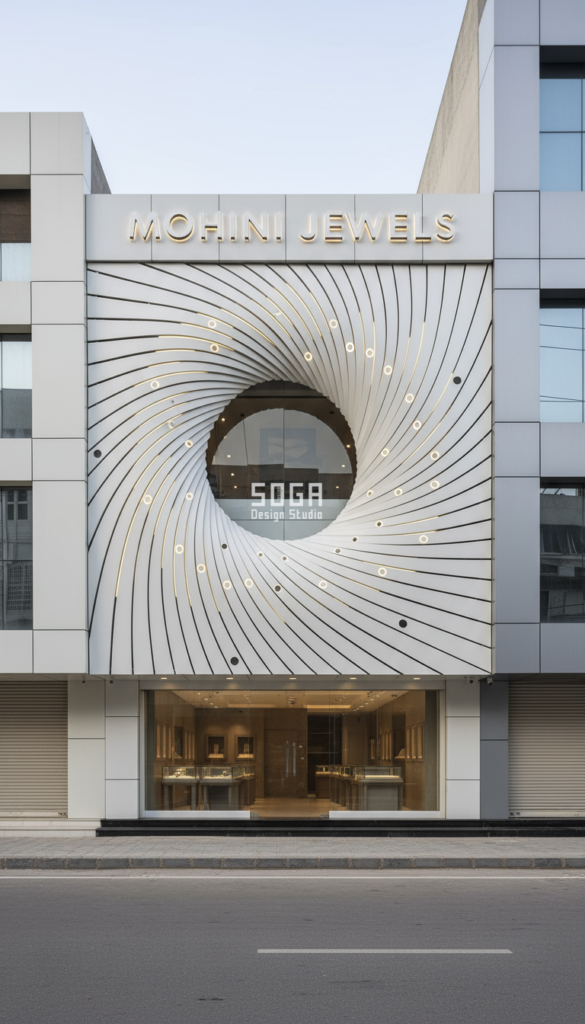
In the bustling streets of Rajkot, Gujarat, a parametric facade has emerged that’s redefining retail architecture in India. Mohini Jewels isn’t just a jewelry showroom—it’s an architectural landmark that showcases the future of computational design. Created by SOGA Design Studio, this project demonstrates how parametric architecture and FRP (Fiber Reinforced Polymer) technology can transform traditional retail spaces into Instagram-worthy destinations.
What is Parametric Design?
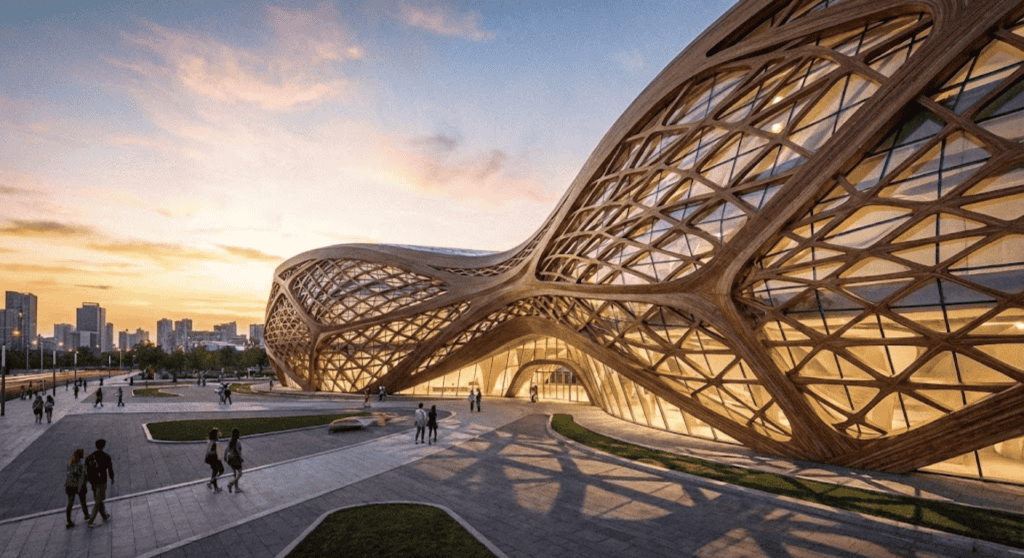
Parametric design represents a fundamental shift in architectural thinking. Unlike traditional architecture that relies on static shapes and manual drafting, parametric design uses algorithms and computational rules to create dynamic, responsive structures. When architects adjust one parameter—like the angle or spacing of facade elements—the entire design automatically adapts, maintaining perfect geometric relationships.
This approach is particularly powerful for creating complex, flowing geometries that would be impossible to design by hand. The Mohini Jewels facade, with its mesmerizing spiral pattern radiating from a central oculus, perfectly exemplifies this computational approach to architecture.
The Mohini Jewels Facade: A Vortex of Attention
Walking past Mohini Jewels in Rajkot, the first thing that strikes you is the facade’s apparent motion. The design features a series of precisely engineered FRP panels that twist and spiral around a circular window, creating an optical illusion of dynamic movement. This “vortex effect” serves multiple purposes:
Visual Magnetism: The radiating lines physically guide viewers’ eyes toward the brand name and store entrance
Landmark Status: In a market saturated with standard glass-and-ACP showrooms, this parametric design creates instant recognizability
Metaphorical Precision: The mathematical rigor mirrors the geometric precision required in jewelry cutting
Why FRP for Parametric Facades?
The choice of Fiber Reinforced Polymer (FRP) as the primary material is critical to achieving this seamless, sculptural effect. Traditional materials like concrete or metal would have several limitations:
Weight: FRP is significantly lighter than concrete, reducing structural load
Moldability: Complex curves and twists can be fabricated with millimeter precision
Seamless Appearance: The facade appears as a single, continuous ribbon without visible joints
Durability: FRP resists weathering, UV damage, and requires minimal maintenance
Fabrication Speed: Custom parametric geometries can be CNC-milled and installed faster than traditional materials
This material innovation is what enables SOGA Design Studio to translate complex computational geometries into physical reality.
SOGA Design Studio: Pioneers of Parametric Facades in India
SOGA Design Studio, operating across India and Dubai, has established itself as a leader in parametric and computational architecture. Their specialization in facade design combines:
Computational Tools: Using Grasshopper, Rhino, and custom algorithms to generate design forms
Material Innovation: Expertise in FRP, ACP (Aluminum Composite Panels), and metal cladding systems
Retail Focus: Understanding how architectural design drives foot traffic and brand recognition
The Mohini Jewels project represents SOGA’s philosophy of bridging global architectural trends with local market needs, bringing world-class parametric design to Gujarat’s commercial real estate landscape.
Parametric Design: The Perfect Metaphor for Jewelry
The choice of parametric architecture for a jewelry showroom is particularly apt. Both disciplines share core principles:
Precision Engineering: Just as diamond cutting requires exact geometric calculations, parametric facades demand mathematical rigor
Unique Identity: Each parametric design, like each piece of jewelry, is distinctive and memorable
Light and Form: The interplay of shadows and depth in the facade mirrors how jewelry catches and reflects light
The Future of Retail Architecture in India
Mohini Jewels represents a broader shift in Indian retail design. As competition intensifies in commercial real estate, developers and brands are seeking “Instagrammable” facades that serve as marketing tools themselves. Parametric architecture offers:
Social Media Value: Distinctive facades generate organic content and brand awareness
Differentiation: In crowded retail markets, architectural uniqueness drives foot traffic
Scalability: Once the parametric system is designed, it can be adapted for different locations and scales
From Niche to Mainstream: The Democratization of Parametric Design
What makes the Mohini Jewels project particularly significant is that it demonstrates parametric design isn’t limited to massive skyscrapers or institutional buildings. SOGA Design Studio has proven that computational architecture can transform modest retail storefronts, making cutting-edge design accessible to smaller commercial projects.
This democratization is accelerating as:
Computational tools become more accessible
FRP and advanced materials become cost-competitive
Clients recognize the ROI of distinctive architecture
Design-build firms like SOGA develop specialized expertise
Conclusion: Where Architecture Meets Algorithm
The Mohini Jewels facade in Rajkot stands as a testament to how parametric design, advanced materials like FRP, and computational thinking are reshaping India’s architectural landscape. SOGA Design Studio has created more than a jewelry showroom—they’ve built a landmark that demonstrates the future of retail architecture.
As computational power grows and material science advances, we’ll see more projects where algorithms sculpt our built environment. The vortex facade of Mohini Jewels is just the beginning.
Visit Mohini Jewels in Rajkot to experience firsthand how parametric architecture is transforming Gujarat’s commercial landscape, one algorithmically-generated curve at a time.
The Rise of Parametric Design
How Algorithms Are Sculpting Our Future
What is Parametric Design?
Parametric design is not just an aesthetic; it’s a completely different way of thinking. Instead of drawing static lines, architects create dynamic systems by defining rules and relationships (parameters). When one parameter changes, the entire design algorithmically adapts. This approach unlocks complex, efficient, and responsive structures that are impossible to create by hand.
Traditional Process
Parametric Process
Case Study: Mohini Jewels, Rajkot
A stunning example of this philosophy is the Mohini Jewels storefront in Rajkot, designed by SOGA Design Studio. Its “vortex” facade is a single, flowing sculpture that creates a visual landmark and embodies the core benefits of this futuristic style.
Precision
The design’s mathematical rigor mirrors the geometric precision of cutting a gemstone.
Uniqueness
It stands out as an “Instagrammable” landmark in a saturated retail market.
Vortex Effect
The fluid lines create a visual funnel, drawing customers’ eyes to the entrance.
The Secret: FRP Material
This fluid design is only possible thanks to Fiber Reinforced Polymer (FRP). This chart compares FRP to traditional concrete on key metrics for complex facades.
Designer: SOGA Studio
Firms like SOGA Design Studio (India & Dubai) lead this space, specializing in computational design. Their portfolio focus highlights the growing demand for unique, algorithm-driven structures.
The Future is Sculpted
Parametric design is more than a trend; it represents a fundamental shift in architecture. As computational power grows, this approach will increasingly define our cityscapes, moving from niche retail facades to large-scale, responsive, and sustainable buildings.