SOGA Design Studio’s Organic Parametric Facade Creates Iconic Landmark in Sangli’s Commercial Heart
In the bustling commercial district of Sangli, Maharashtra, Kanak Jewellery stands as a revolutionary example of how parametric design in India is transforming retail architecture. Designed by SOGA Design Studio, India’s leading parametric facade company specializing in computational design across India and Dubai, this project showcases an innovative wave-pattern fin system that has become an instant urban landmark.
Parametric Wave Fins: Nature-Inspired Innovation
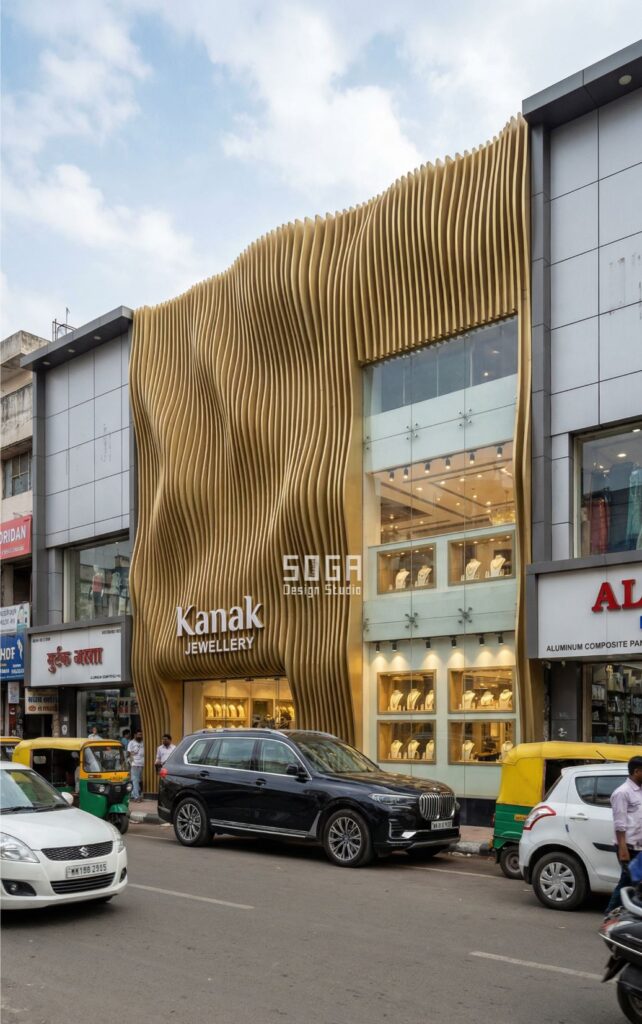
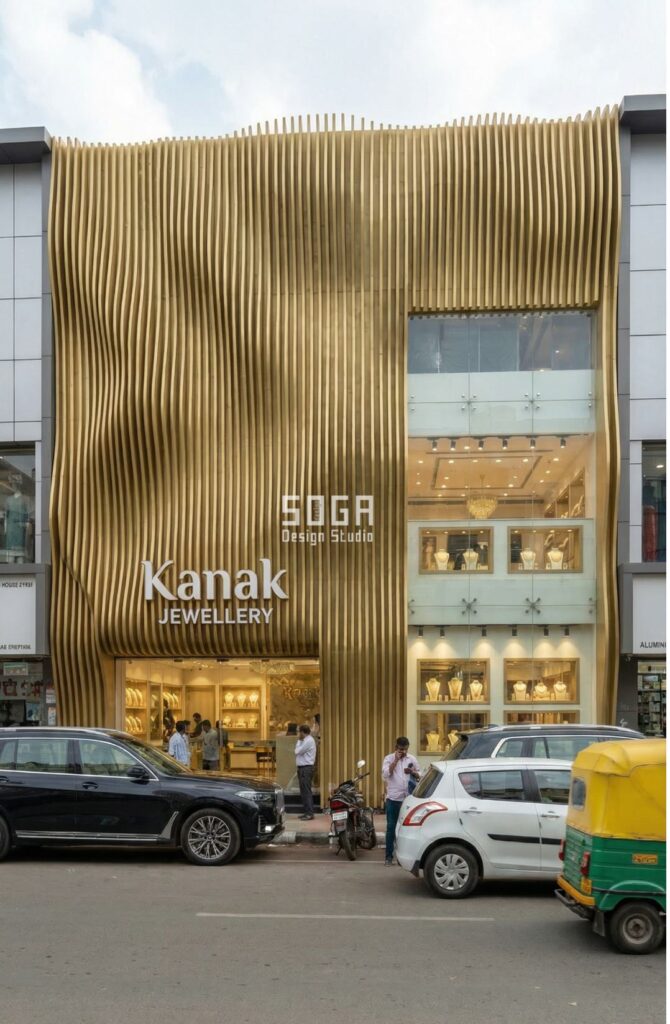
The defining architectural feature of Kanak Jewellery is its stunning parametric wave fin facade—a golden-hued sculptural surface composed of hundreds of vertical fins that undulate in organic, wave-like patterns across the building’s street-facing elevation.
The Art of Parametric Undulation
Unlike conventional vertical louvers that remain straight and static, SOGA Design Studio’s parametric wave fins introduce dynamic curves that mimic natural flowing forms:
Organic Wave Patterns: The fins curve and flow in a rhythmic pattern that evokes water waves, fabric folds, or wind-sculpted sand dunes. This organic quality creates an immediate emotional connection with viewers, making the architecture feel alive and dynamic rather than rigid and static.
Mathematical Precision: Despite their organic appearance, these waves are precisely generated through parametric algorithms. Each fin’s curve is mathematically defined, ensuring perfect consistency and enabling efficient fabrication. This marriage of organic aesthetics with mathematical rigor exemplifies the power of parametric design.
Three-Dimensional Depth: The wave pattern isn’t merely surface decoration—it creates substantial three-dimensional relief. Fins project and recede, creating dramatic shadows that change throughout the day as the sun moves across Maharashtra’s sky. This depth transforms the facade into a dynamic sundial, constantly changing in appearance.
Golden Materiality: The warm golden color of the fins directly references the jewelry displayed within, creating visual coherence between building and brand. The metallic finish captures and reflects sunlight, making the facade shimmer and glow—particularly striking during Sangli’s golden hour light.
Street-Level Drama: The wave pattern extends from the upper facade down to street level, creating visual continuity and ensuring the architectural statement remains impactful even in Sangli’s busy street environment filled with vehicles and pedestrians.
Vertical Rhythm Meets Horizontal Flow
The genius of the parametric wave fin system lies in balancing two seemingly opposite design impulses:
Vertical Emphasis: Each individual fin is vertical, creating upward visual movement that makes the building appear taller and more elegant. This verticality communicates aspiration and quality—important associations for a luxury jewelry retailer.
Horizontal Flow: The wave pattern created by the varying curves introduces strong horizontal movement, guiding the eye across the facade. This horizontal rhythm creates unity across the building’s width and adds dynamism to what might otherwise be a static vertical pattern.
This tension between vertical and horizontal, between individual elements and overall pattern, creates visual richness that rewards extended viewing. The facade reveals new details and relationships the longer one observes it.
SOGA Design Studio: Pioneering Parametric Design in India
Kanak Jewellery exemplifies why SOGA Design Studio has established itself as the premier parametric design company in India:
Computational Design Mastery
The wave fin facade emerged from sophisticated computational design processes that SOGA Design Studio has perfected across dozens of projects:
Algorithm Development: Our team developed custom parametric algorithms specifically for this project. The algorithm takes input parameters—wave amplitude, wavelength, fin spacing, material thickness—and generates the complete three-dimensional geometry of hundreds of unique fins automatically.
Wave Optimization: Not all wave patterns are equally effective. Using parametric tools, we tested dozens of wave configurations—different amplitudes, frequencies, and phase relationships—evaluating each for visual impact, structural feasibility, and cost. The final wave pattern represents the optimal balance across these criteria.
Solar Performance Analysis: The wave pattern isn’t arbitrary—it’s optimized for Sangli’s specific solar conditions. Parametric environmental analysis evaluated how the fins shade the glazing behind them throughout the year, reducing solar heat gain while maintaining natural daylight. The curves were calibrated to maximize shading effectiveness.
Structural Validation: Each curved fin transfers wind loads to the building structure. Parametric structural analysis ensured that every fin maintains adequate strength and stiffness while minimizing material usage. This optimization reduced steel tonnage by approximately 20% compared to a non-optimized approach.
Fabrication Rationalization: The smooth parametric curves needed to be translated into manufacturable elements. Our rationalization algorithms converted the curves into buildable profiles that could be formed using available metal fabrication equipment, making the design practical without compromising aesthetic intent.
Design and Build Integration
As a full-service parametric facade design and build company, SOGA Design Studio maintained complete control over the Kanak Jewellery facade from concept through installation:
Concept Design: Our parametric design team worked directly with the client to understand brand aspirations, budget constraints, and functional requirements, translating these into parametric design parameters.
Engineering Documentation: The parametric model automatically generated detailed fabrication drawings, structural calculations, and installation instructions—ensuring that design intent translated accurately into construction documents.
Fabrication Coordination: We provided CNC-ready digital files to metal fabricators, derived directly from the parametric model. This digital workflow eliminated translation errors and ensured that the complex wave geometries were manufactured to precise specifications.
On-Site Installation: Our installation team used laser surveying equipment referencing the parametric 3D model to position each fin precisely, maintaining the wave pattern’s integrity despite normal construction tolerances.
Quality Assurance: Throughout fabrication and installation, we verified that physical elements matched the parametric model’s specifications, ensuring that the built facade achieved the intended performance and aesthetics.
This integrated approach eliminates coordination problems that typically arise when design, engineering, fabrication, and installation are handled by separate entities with potentially conflicting priorities.
Sangli Context: Bringing Parametric Innovation to Tier-2 India
Sangli, an important commercial center in southern Maharashtra known for its turmeric trade and educational institutions, might seem an unlikely location for cutting-edge parametric architecture. Yet Kanak Jewellery demonstrates that architectural innovation isn’t limited to metros like Mumbai, Delhi, or Bangalore.
Elevating Regional Architecture
The project serves multiple important functions in Sangli’s urban context:
Setting New Standards: By bringing internationally recognized parametric design methodologies to Sangli, the project elevates expectations for what’s possible in regional Indian cities. It demonstrates that tier-2 cities deserve and can achieve world-class architecture.
Economic Signaling: The sophisticated facade signals investment, quality, and forward-thinking business practices—valuable associations for a jewelry retailer where trust and quality perception directly influence purchase decisions.
Urban Landmark: In Sangli’s commercial streetscape of conventional buildings, the parametric wave facade creates an instant landmark. “The building with the golden waves” becomes a mental map reference point for residents and visitors.
Local Pride: The project generates local pride, demonstrating that Sangli can be home to architectural innovation that competes with anything found in larger metros. This pride can catalyze further investment in quality architecture and urban development.
Practical Performance: Beyond symbolic value, the facade performs exceptionally well in Maharashtra’s climate—providing solar shading, glare control, and thermal comfort that reduce operating costs and improve occupant experience.
Parametric Facade Design: Technology Meets Craftsmanship
The wave fin facade represents a synthesis of cutting-edge digital design technology and traditional fabrication craftsmanship:
Digital Design Process
Parametric Modeling: Using Grasshopper for Rhino, SOGA Design Studio created parametric definitions where designers adjust input parameters (wave amplitude, frequency, phase) and the complete facade geometry updates automatically. This parametric flexibility enabled rapid design exploration.
Performance Simulation: Integrated environmental analysis tools evaluated solar shading, daylighting, and thermal performance in real-time as the design evolved. This immediate feedback loop ensured that aesthetic decisions were informed by performance data.
Structural Analysis: Parametric structural models calculated loads, stresses, and deflections for each unique fin geometry. This analysis identified potential issues early, preventing costly redesigns during construction.
Cost Estimation: The parametric model automatically calculated material quantities, fabrication time, and installation complexity, providing real-time cost feedback. This cost transparency enabled design decisions that balanced aesthetics with budget realities.
Visualization: Photorealistic renderings generated from the parametric model helped the client visualize the design before construction, building confidence and enabling informed decision-making.
Physical Fabrication
CNC Metal Forming: Each fin was formed using computer-controlled bending equipment, translating the digital geometry into physical reality with sub-millimeter precision.
Surface Treatment: The golden metallic finish was applied using advanced coating technologies that ensure color consistency, UV resistance, and long-term durability despite Maharashtra’s intense sun and monsoon rains.
Quality Control: Every fabricated fin was measured and verified against the digital model before approval for shipping to site. This verification prevented the accumulation of small errors that could distort the overall wave pattern.
Craft Integration: While the geometries were digitally defined, skilled metalworkers applied their expertise to achieve perfect surface finishes, clean welds, and refined details—demonstrating that parametric design enhances rather than replaces craft.
Performance-Driven Parametric Design
The wave fin facade delivers measurable performance benefits that justify the investment in parametric design:
Solar Shading and Thermal Comfort
Heat Gain Reduction: The fins reduce solar heat gain through the glazed storefront by approximately 40-45% compared to unshaded glass. This dramatic reduction decreases air conditioning loads and energy costs throughout the building’s operating life.
Variable Shading: The wave pattern creates variable shading across the facade—some areas more shaded, others more exposed. This variation provides visual interest while ensuring that no area receives excessive direct sun.
Daylight Preservation: Despite substantial solar shading, the spacing between fins ensures excellent natural daylight penetration. This balance—shading heat while admitting light—is difficult to achieve without parametric optimization.
Glare Control: The fins interrupt direct sun penetration that would otherwise cause glare on jewelry displays and create visual discomfort for customers. This glare control is particularly important for a jewelry retail environment where visual comfort directly affects the shopping experience.
Visual Impact and Brand Identity
Memorability: The distinctive wave pattern ensures that Kanak Jewellery is instantly recognizable and memorable. In competitive retail environments where foot traffic determines success, this visual distinction creates measurable business value.
Photo-Worthy Design: The facade is highly photogenic, encouraging social media sharing that extends the marketing reach far beyond Sangli. Instagram posts, Facebook shares, and WhatsApp forwards provide organic marketing that multiplies the facade’s communication value.
Quality Association: The sophisticated parametric design communicates precision, attention to detail, and quality—exactly the associations jewelry retailers want customers to make. The building’s quality suggests the merchandise within is equally refined.
Day-to-Night Transformation: During daylight, the golden fins shimmer and glow. At night, strategic interior lighting creates a different but equally compelling aesthetic, ensuring the building maintains strong presence around the clock.
Parametric Design Democratization in India
The Kanak Jewellery project represents an important trend: parametric design in India is becoming accessible beyond metro centers and elite projects:
Breaking Geographic Barriers
Technology Diffusion: Parametric design tools like Grasshopper are now widely available, enabling firms throughout India to develop computational design capabilities regardless of location.
Digital Fabrication Expansion: CNC equipment for metal forming, cutting, and finishing is increasingly available in tier-2 and tier-3 Indian cities, making local fabrication of parametric designs practical and economical.
Knowledge Sharing: Online education, YouTube tutorials, and professional forums enable architects throughout India to learn parametric methods, breaking the monopoly of elite institutions and established firms.
Client Sophistication: Clients in regional Indian cities increasingly appreciate innovative design and are willing to invest in architectural quality that differentiates their businesses.
Economic Accessibility
Cost Competitiveness: Parametric design, when properly executed, can actually reduce costs through material optimization, fabrication efficiency, and coordination improvement. The wave fin facade at Kanak Jewellery cost less per square meter than many conventional facade systems while delivering superior performance and aesthetics.
Value Creation: The business value created by distinctive architecture—increased foot traffic, enhanced brand perception, social media exposure—often far exceeds the incremental cost of parametric design over generic alternatives.
ROI Demonstration: As completed parametric projects like Kanak Jewellery demonstrate measurable business benefits, client willingness to invest in innovative design increases throughout India.
SOGA Design Studio’s Parametric Portfolio
Kanak Jewellery joins SOGA Design Studio’s growing portfolio of parametric projects across India, demonstrating versatility across contexts and scales:
Maharashtra:
- Kanak Jewellery Sangli (wave fins)
- Aabhusan Palace Mumbai (Para Triblock panels)
- Vikram Ahuja Residence Mumbai (organic curves)
- Raja Ram Pune (hexagonal system)
Tamil Nadu:
- Ramo Jewel Chennai (circular patterns)
- Mohini Jewels (spiral geometry)
Gujarat:
- One 9 Group GIFT City (Para Curve Fins)
This geographic diversity—from metros to tier-2 cities—demonstrates that parametric facade design adds value across Indian urban contexts. The consistent thread is SOGA Design Studio’s commitment to computational design excellence, performance optimization, and integrated design-build delivery.
Technical Innovation: Wave Pattern Engineering
Creating the wave fin facade required solving numerous technical challenges:
Geometry Rationalization
Curved to Straight Translation: The smooth parametric waves were approximated using linear segments short enough to visually read as curves. This rationalization made fabrication practical while maintaining aesthetic intent.
Panel Standardization: While each fin follows a unique curve, careful parametric design maximized the number of fins that could be formed using common bending dies and tooling, controlling fabrication costs.
Connection Points: Each fin connects to the structural backing at specific calculated points that transfer wind loads efficiently while accommodating thermal expansion. These connection points were parametrically positioned to align with structural logic.
Material Selection
Aluminum for Formability: Aluminum was selected for its excellent formability, enabling the tight curves required by the wave pattern without cracking or distorting.
Coating Technology: The golden metallic finish uses multi-layer coating technology that provides color consistency, UV resistance, and long-term durability despite exposure to sun, rain, and pollutants.
Thickness Optimization: Parametric structural analysis enabled precise optimization of material thickness—thick enough for structural adequacy and wind resistance, thin enough to minimize material cost and forming difficulty.
Installation Methodology
Laser-Guided Positioning: During installation, laser surveying equipment referenced the 3D parametric model, guiding installers to position each fin precisely. This technology was essential for maintaining the wave pattern’s integrity across hundreds of individual elements.
Staged Installation: The facade was installed in carefully sequenced stages that maintained structural stability and protected completed work from damage during subsequent installation.
Tolerance Management: The parametric model incorporated realistic construction tolerances, ensuring that small variations in fabrication or installation wouldn’t accumulate and distort the overall pattern.
Sustainability Through Parametric Optimization
The wave fin facade contributes to Kanak Jewellery’s environmental sustainability:
Energy Efficiency: The 40-45% reduction in solar heat gain directly reduces air conditioning energy consumption, lowering both operating costs and carbon emissions over the building’s lifespan.
Material Optimization: Parametric structural analysis minimized aluminum usage while maintaining safety margins, reducing embodied carbon by approximately 20% compared to non-optimized approaches.
Durability: The high-quality materials and precision fabrication ensure 50+ years of service life with minimal maintenance, avoiding the environmental impact of premature replacement.
Local Sourcing: Using Indian fabrication capabilities reduced transportation carbon footprint compared to importing facade systems internationally.
Natural Ventilation: The fin spacing allows for natural ventilation through operable windows during Maharashtra’s temperate seasons, reducing mechanical cooling requirements.
These sustainability benefits emerge naturally from the parametric design approach, which enables holistic optimization rather than requiring compromises between performance and aesthetics.
SEO Keywords: Parametric Design Leadership in India
SOGA Design Studio’s expertise in Kanak Jewellery and across our portfolio establishes us as India’s leader in:
Parametric Design in India: Pioneering computational design methodologies throughout Indian contexts from metros to tier-2 cities.
Parametric Facade: Specializing in algorithmically generated facade systems that optimize performance and aesthetics simultaneously.
Parametric Facade Company: Offering integrated design-build services that ensure seamless execution of complex parametric systems.
SOGA Design Studio: India’s premier computational design firm with proven capabilities across residential, commercial, and institutional projects.
Parametric Architecture India: Demonstrating that Indian firms can achieve parametric design excellence that competes globally.
Facade Design India: Establishing Indian facade design and engineering capabilities at international quality standards.
Computational Design Company: Applying algorithmic thinking and digital tools to architectural design challenges throughout India and Dubai.
Wave Fin Facade: Pioneering organic wave patterns in vertical fin systems that combine aesthetics with performance.
Jewelry Retail Architecture: Creating facades specifically optimized for jewelry retail environments where brand perception is critical.
Maharashtra Architecture: Bringing parametric innovation to Maharashtra’s diverse urban contexts from Mumbai to Pune to Sangli.
This comprehensive expertise positions SOGA Design Studio as the go-to firm when Indian projects demand parametric sophistication, technical excellence, and proven design-build capabilities.
The Business Case for Parametric Design
Kanak Jewellery demonstrates the compelling business case for investing in parametric design:
Brand Differentiation: In competitive retail markets, architectural distinction creates real business value. The wave fin facade ensures Kanak Jewellery stands out from competitors.
Foot Traffic Generation: The visually striking facade attracts attention from passing pedestrians and vehicles, drawing potential customers who might otherwise not notice the store.
Social Media Marketing: The photogenic facade generates organic social media exposure as visitors photograph and share images, extending marketing reach at zero advertising cost.
Quality Signaling: The sophisticated architecture communicates quality, precision, and attention to detail—associations that directly influence jewelry purchase decisions where quality perception is paramount.
Energy Cost Reduction: The 40-45% reduction in cooling energy directly improves operating margins, providing measurable ROI throughout the building’s operating life.
Property Value: Distinctive architecture enhances property value, providing financial benefits if the owner chooses to sell or lease the property in the future.
Long-Term Durability: The precision fabrication and high-quality materials reduce maintenance costs and extend service life, improving lifecycle economics.
Future of Parametric Design in Regional India
Kanak Jewellery points toward the future of architecture in India’s regional cities:
Design Quality Parity: Parametric tools enable tier-2 and tier-3 cities to achieve design quality that matches metros, democratizing access to architectural innovation.
Local Fabrication Growth: Demand for parametric facades drives investment in CNC equipment and digital fabrication capabilities throughout India, building local industry capacity.
Architect Skill Development: As parametric projects become more common, more Indian architects develop computational design skills, raising overall professional capabilities.
Client Expectations Evolution: As clients see parametric projects like Kanak Jewellery deliver measurable business value, expectations rise and demand for innovative design increases.
Sustainable Performance: As climate concerns intensify, parametric optimization of thermal performance, daylighting, and material efficiency becomes increasingly valuable and necessary.
Cultural Expression: Parametric design enables new forms of architectural expression that can integrate Indian design sensibilities with contemporary methodologies, creating architecture that is both innovative and culturally rooted.
Conclusion: Waves of Innovation from Sangli to All India
The Kanak Jewellery wave fin facade in Sangli, Maharashtra stands as a landmark project in the evolution of parametric design in India. Through SOGA Design Studio’s computational design expertise, a jewelry retail project in a tier-2 city achieves architectural quality that competes with anything in India’s major metros or international markets.
The flowing golden waves—precisely generated through parametric algorithms, optimized for performance, and flawlessly executed through integrated design-build delivery—demonstrate that parametric design serves real business objectives while creating architecture that enriches the urban experience.
As India’s leading parametric facade company and premier computational design firm operating across India and Dubai, SOGA Design Studio continues to prove that Indian architectural and engineering expertise can achieve parametric excellence across diverse contexts, scales, and building types.
The Kanak Jewellery project invites the entire Indian architecture and construction industry to embrace parametric methodologies—not as abstract technical exercises but as practical tools that enable better buildings: more sustainable, more distinctive, more responsive to specific contexts and requirements.
From Sangli to Mumbai, from Chennai to GIFT City, SOGA Design Studio’s parametric projects demonstrate that the future of Indian architecture is computational—where algorithms serve human aspirations, where performance and beauty unite, and where innovation is accessible throughout India’s diverse urban landscape.
About SOGA Design Studio
SOGA Design Studio is India’s premier parametric design company and computational design firm, specializing in innovative parametric facade solutions across India and Dubai. As a leading parametric facade company offering integrated design-build services, we create distinctive architectural experiences through advanced algorithmic design, performance optimization, and precision fabrication. Our portfolio of parametric projects includes the wave fin system at Kanak Jewellery Sangli, Para Curve Fins at One 9 Group GIFT City, Para Triblock panels at Aabhusan Palace Mumbai, hexagonal systems at Raja Ram Pune, circular patterns at Ramo Jewel Chennai, spiral geometry at Mohini Jewels, and organic curves at the Vikram Ahuja Residence in South Bombay.
For inquiries about parametric facade design, computational design services, wave fin systems, or to discuss how parametric innovation can elevate your project anywhere in India or Dubai, contact SOGA Design Studio.
Project Details:
- Project Name: Kanak Jewellery
- Location: Sangli, Maharashtra, India
- Design and Build: SOGA Design Studio
- Facade System: Parametric wave fins – organic undulating vertical fins
- Key Features: Golden metallic wave pattern, three-dimensional depth, solar shading optimization
- Building Type: Jewelry retail showroom
- Performance: 40-45% solar heat gain reduction, glare control, daylight optimization
- Materials: Aluminum fins with golden metallic coating, engineered substructure
- Design Approach: Parametric computational design with performance optimization
- Significance: Bringing world-class parametric facade design to tier-2 India