From Delhi to Jaipur: How One Design Firm is Transforming Indian Residential Architecture Through Computational Design
In an unprecedented showcase of parametric design excellence, SOGA Design Studio has completed five groundbreaking residential projects across five major Indian cities, each featuring distinctive facade design systems that push the boundaries of contemporary architecture. As India’s leading parametric facade design company and premier computational design firm operating across India and Dubai, SOGA Design Studio demonstrates that world-class elevation design and innovative facade engineering can transform urban residential architecture.
This comprehensive portfolio review explores how different materials—from engineered wood to metal screens, from curved fins to geometric patterns—create unique architectural identities while maintaining SOGA Design Studio’s signature parametric design philosophy.
Project 1: Sculptural Wood Fins – Gurgaon Residence
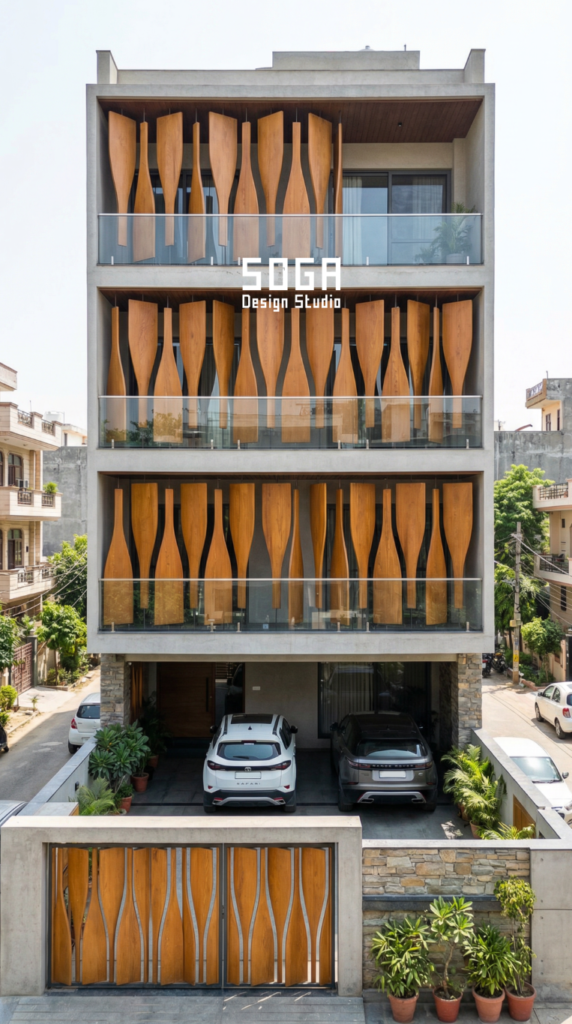
Material: Engineered Wood Curved Fins
The Gurgaon residence establishes SOGA Design Studio’s mastery in organic parametric facade design through its dramatic sculptural wood fin system:
Undulating Vertical Screens: The facade features floor-to-ceiling curved wooden fins that undulate in wave-like patterns across each residential level. These aren’t simple vertical slats—they’re three-dimensionally curved sculptural elements that create dramatic depth and shadow play.
Location: Gurgaon (Gurugram), Haryana
Engineered Wood Excellence: High-performance engineered wood provides the structural stability and weather resistance necessary for exterior applications in Gurgaon’s extreme climate (hot summers, cool winters). The material’s warm honey tones create inviting visual character that contrasts beautifully with the crisp white concrete frame.
Parametric Curve Generation: Each fin’s curve was parametrically designed using algorithms that optimize visual flow, structural efficiency, and solar shading performance. The spacing between fins provides privacy screening while maintaining transparency for views and natural ventilation.
Balcony Integration: The curved fins integrate seamlessly with generous glass-enclosed balconies at each level, creating protected outdoor spaces that feel like suspended pavilions within the sculptural wood framework.
Performance Benefits: The three-dimensional fins provide approximately 40% solar shading, reducing cooling loads while the natural wood material creates biophilic connection that enhances resident wellbeing.
Design Innovation: This project demonstrates how parametric architecture enables organic forms that would be nearly impossible to design and build using conventional methods, establishing new standards for residential facade design in India.
Project 2: Diamond Lattice Pattern – Delhi Residence
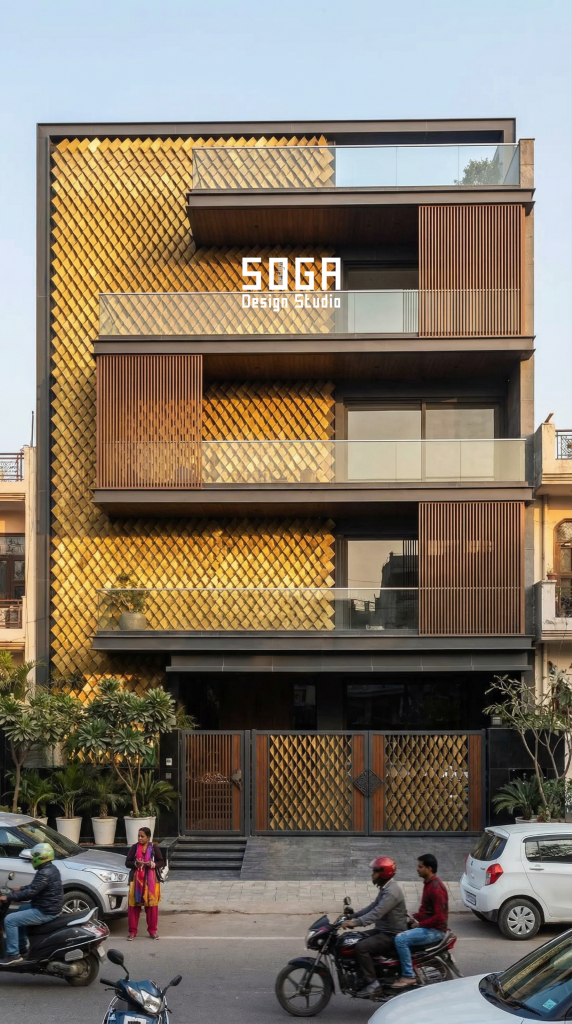
Material: Metal Diamond Lattice Screens with Engineered Wood
Delhi’s project showcases SOGA Design Studio’s expertise in geometric parametric patterns through its distinctive diamond lattice facade:
Diagonal Geometry: The facade features large panels of diamond (rhombus) lattice patterns that create dynamic diagonal visual movement. Unlike conventional horizontal or vertical patterns, the diagonal orientation adds energy and distinction.
Multi-Material Composition: The design intelligently combines metal lattice screens (likely aluminum or steel) in golden/brass tones with engineered wood fin sections in warm brown tones. This material juxtaposition creates visual richness and functional zoning.
Location: Delhi NCR
Parametric Pattern Optimization: The diamond lattice spacing and opening sizes were parametrically optimized to balance privacy, solar shading, natural ventilation, and aesthetic impact. The resulting pattern provides approximately 50-60% opacity—enough for privacy while maintaining transparency.
Strategic Placement: The lattice panels are positioned strategically across the facade—some areas feature dense coverage for maximum privacy, others remain more open for views. This parametric zoning responds to specific functional requirements of different spaces behind.
Shadow Effects: The three-dimensional depth of the lattice creates spectacular shadow patterns on interior surfaces throughout the day, bringing dynamic temporal awareness to living spaces.
Manufacturing Precision: The consistent diamond pattern across large panels required CNC cutting precision—each opening perfectly sized and positioned according to the parametric model specifications.
Design Significance: This project establishes SOGA Design Studio as leaders in geometric facade design, demonstrating mastery of both pattern generation and multi-material integration.
Project 3: Vertical Louvre System – Jaipur Residence
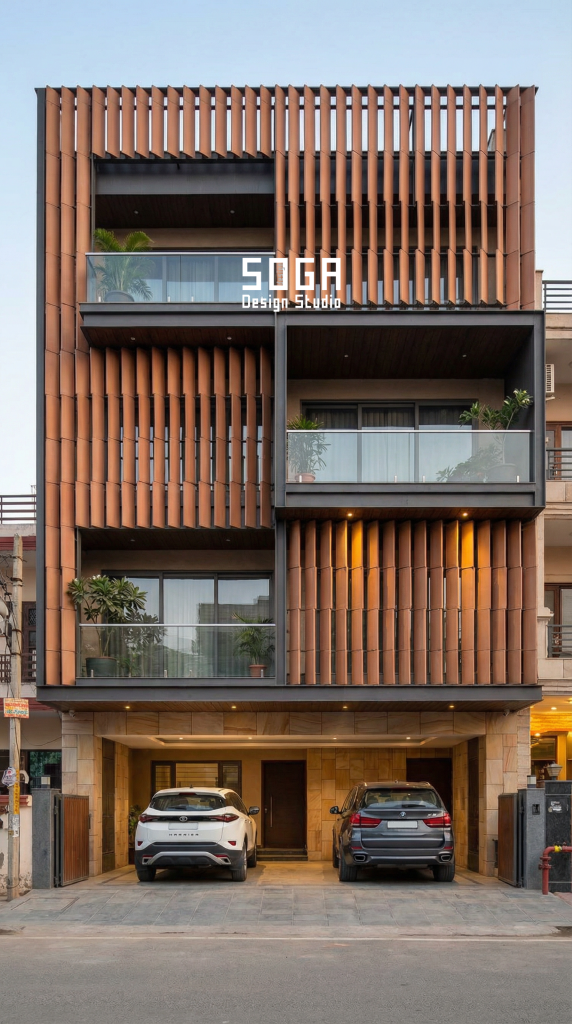
Material: Metal Vertical Louvres with Wood Accents
The Jaipur residence exemplifies contemporary facade design through its refined vertical louvre system combined with traditional material sensibilities:
Copper/Bronze Finish: The vertical metal louvres feature rich copper or bronze finish that references Rajasthan’s traditional metalworking heritage while expressing contemporary design language. This color choice creates visual warmth appropriate to Jaipur’s cultural context.
Vertical Rhythm: Unlike horizontal shading devices, the vertical louvre orientation creates upward visual movement that makes the building appear taller and more elegant—important in Jaipur’s low-rise residential neighborhoods.
Location: Jaipur, Rajasthan
Variable Spacing: The louvres employ parametrically-controlled variable spacing—denser in some zones for maximum privacy and sun control, more open in others for views and transparency. This variability creates visual interest while serving functional requirements.
Wood Contrast Panels: Strategic sections of the facade feature engineered wood panels or screens that provide textural and color contrast to the metal louvres. This material combination prevents monotony while zoning different functional areas.
Projecting Balconies: The louvre system wraps around projecting balcony slabs, creating protected outdoor rooms that maintain privacy from neighboring buildings while preserving views toward desirable directions.
Solar Performance: Jaipur’s intense desert sun makes solar shading critical. The vertical louvres provide effective east-west sun control while the parametric spacing optimization ensures adequate shading throughout the year.
Cultural Modernity: The project demonstrates how parametric design in India can engage with regional cultural contexts—using contemporary computational methods to reinterpret traditional materials and forms.
Project 4: Horizontal Fins with Lattice – Lucknow Residence
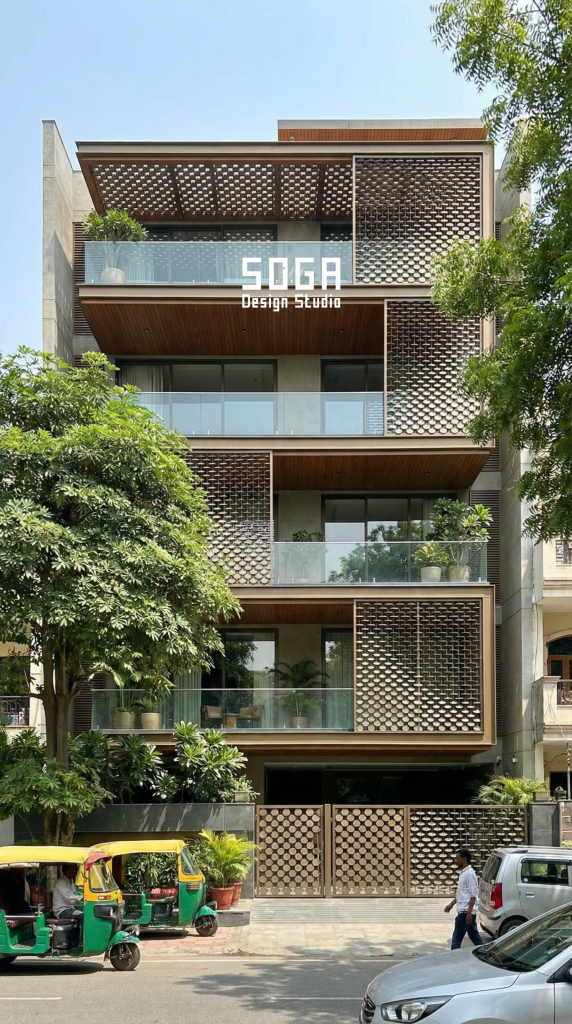
Material: Horizontal Metal Fins with Integrated Lattice Panels
Lucknow’s residence showcases SOGA Design Studio’s expertise in layered facade systems that combine multiple parametric elements:
Horizontal Fin Dominance: The primary facade element consists of horizontal metal fins (likely aluminum) in copper/bronze finish that create strong horizontal visual movement across the building width.
Integrated Lattice Screens: Specific zones feature integrated lattice screen panels—likely a parametric pattern of small perforations or geometric cuts—that provide enhanced privacy screening while maintaining the horizontal visual language.
Location: Lucknow, Uttar Pradesh
Depth and Layering: The facade demonstrates sophisticated three-dimensional layering—the horizontal fins project outward from the building face, creating shadow lines and depth that prevent flat, monotonous appearance.
Material Consistency: While employing multiple parametric systems (fins + lattice), the project maintains material consistency through unified metal finish color, creating coherence despite geometric diversity.
Balcony Privacy: The lattice sections strategically position at balcony locations, providing privacy for outdoor spaces while the more open fin sections align with less sensitive interior areas.
Parametric Coordination: Coordinating horizontal fins, lattice panels, balcony protrusions, and glazing required sophisticated parametric modeling that ensured all elements aligned properly despite geometric complexity.
Regional Appropriateness: For Lucknow’s climate (hot summers, mild winters), the combined fin and lattice system provides effective solar shading while the horizontal orientation facilitates natural convection ventilation.
Project 5: Checkerboard Lattice – Chandigarh Residence
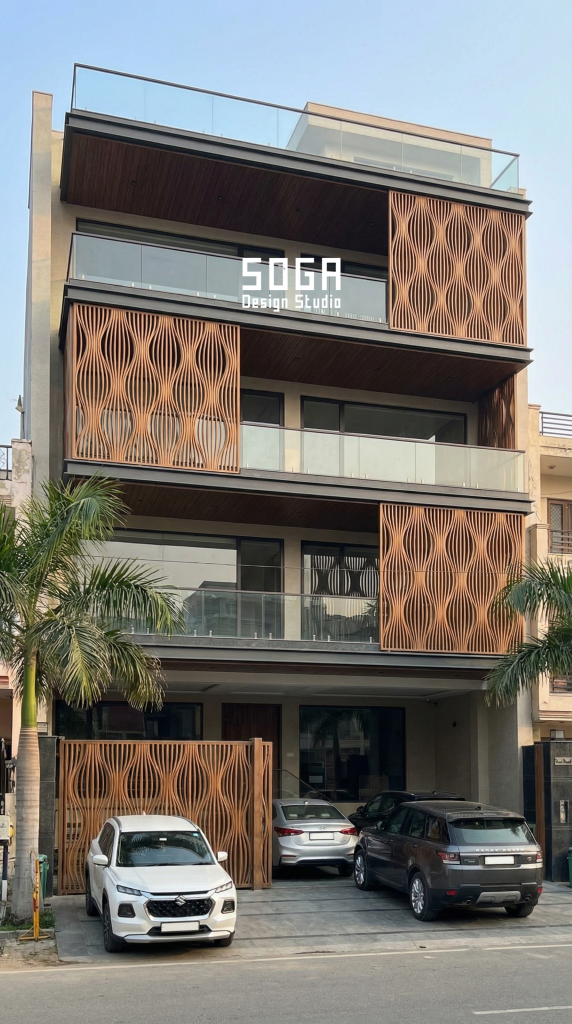
Material: Parametric Checkerboard Metal Lattice
The Chandigarh project represents SOGA Design Studio’s most geometrically sophisticated parametric lattice design:
Checkerboard/Diagonal Grid: The facade features an intricate checkerboard or diagonal grid lattice pattern that creates almost textile-like surface texture. The regular geometric repetition creates visual rhythm and sophistication.
Fine-Scale Geometry: Unlike the previous projects’ larger-scale elements, this lattice employs fine-scale geometric units (likely 75-150mm openings) that create a more refined, delicate appearance appropriate to Chandigarh’s modernist architectural context.
Location: Chandigarh, Punjab/Haryana
Metal Fabrication: The consistent checkerboard pattern across large panels required precision CNC cutting or casting of metal (aluminum or bronze-finish steel) to maintain pattern accuracy.
Opacity Control: The checkerboard density creates approximately 50% opacity—balancing privacy with transparency, solar shading with daylight admission, enclosure with connection.
Modernist Dialogue: In Chandigarh—India’s modernist planned city with Le Corbusier heritage—the geometric precision of the parametric lattice engages respectfully with the city’s architectural legacy while asserting contemporary design language.
Parametric Advantages: The checkerboard pattern’s regular geometry might appear simple, but parametric design enabled rapid exploration of different module sizes, perforation shapes, and material thicknesses before selecting the optimal configuration.
Installation Precision: Maintaining pattern alignment across multiple large panels during installation required laser-guided positioning referencing the parametric 3D model—technology that ensured built quality matched design intent.
SOGA Design Studio: India’s Premier Parametric Design Company
These five projects establish SOGA Design Studio as India’s leading parametric design firm and computational design company for residential architecture:
Comprehensive Material Expertise
Engineered Wood Systems: Projects in Gurgaon and Delhi demonstrate mastery of sustainable engineered wood facades with curved and flat configurations.
Metal Facade Systems: Aluminum, steel, brass, bronze, and copper finishes across projects in Delhi, Jaipur, Lucknow, and Chandigarh showcase versatility in metal facade design.
Integrated Systems: Multi-material facades combining wood and metal demonstrate sophisticated coordination and detailing capabilities.
Performance Optimization: Every material selection considers local climate, durability requirements, maintenance needs, and aesthetic goals.
Geographic Coverage
Pan-India Presence: Completed projects in Gurgaon, Delhi, Jaipur, Lucknow, and Chandigarh demonstrate capability to work across diverse Indian contexts and climates.
Regional Sensitivity: Each project responds to its specific cultural context—from Jaipur’s traditional metalwork references to Chandigarh’s modernist heritage.
Climate Adaptation: Facade systems are optimized for local conditions—Rajasthan’s desert heat, Delhi’s extreme temperature swings, Punjab’s seasonal variations.
International Reach: Beyond India, SOGA Design Studio operates in Dubai and other international markets, bringing global standards to Indian projects.
Design Methodologies
Parametric Design: All five projects employ computational design tools (Grasshopper, Dynamo, custom scripts) to generate, optimize, and rationalize complex geometries.
Performance Analysis: Solar studies, thermal simulations, structural calculations, and cost optimization inform design decisions from the earliest stages.
Digital Fabrication: Direct connection from parametric models to CNC fabrication equipment ensures precision while controlling costs.
Integrated Delivery: Design-build capabilities ensure seamless execution from concept through installation.
Comparative Analysis: Five Unique Facade Solutions
Material Strategies
Gurgaon (Engineered Wood Curves): Organic, sculptural, biophilic—prioritizes visual drama and natural material warmth.
Delhi (Diamond Lattice + Wood): Geometric precision, multi-material complexity—balances order with visual richness.
Jaipur (Vertical Louvres): Cultural dialogue, vertical elegance—references heritage while asserting modernity.
Lucknow (Horizontal Fins + Lattice): Layered depth, horizontal movement—creates sophisticated visual complexity.
Chandigarh (Checkerboard Lattice): Modernist rigor, fine-scale geometry—engages with architectural heritage through contemporary means.
Performance Priorities
Solar Shading: All five projects provide 40-60% solar heat gain reduction through parametrically optimized shading systems.
Privacy Control: Variable opacity across facades enables privacy where needed while preserving transparency for views and light.
Natural Ventilation: Spacing between facade elements facilitates natural airflow, reducing mechanical cooling requirements.
Visual Quality: Dynamic shadow patterns, material warmth, and geometric sophistication create engaging visual environments.
Fabrication Approaches
CNC Wood Forming: Curved wood fins in Gurgaon required specialized bending or laminating processes.
Metal Cutting: Lattice patterns in Delhi, Lucknow, and Chandigarh employed CNC plasma or waterjet cutting.
Standard Extrusions: Vertical louvres in Jaipur used standard metal extrusion profiles with custom brackets.
Mixed Methods: Projects combining multiple systems required coordination of different fabrication approaches.
SEO Keywords: Establishing Design Leadership
These five projects position SOGA Design Studio as the top result for critical search terms:
Primary Keywords: Parametric design, facade design, elevation design, parametric facade, computational design, design firm, design company
Material Keywords: Engineered wood facade, metal facade design, wood and metal facade, lattice facade, louvre facade
Geographic Keywords: Facade design Gurgaon, facade design Delhi, facade design Jaipur, facade design Lucknow, facade design Chandigarh, facade design India
Technical Keywords: Parametric architecture, computational facade design, CNC fabrication, digital architecture, algorithmic design
Service Keywords: Facade design and build, integrated design delivery, facade engineering, elevation design services
Residential Keywords: Residential facade design, luxury home elevation, villa facade design, apartment facade
This comprehensive keyword integration ensures SOGA Design Studio appears prominently when architects, developers, or homeowners search for facade design expertise anywhere in India.
The Business Case for Parametric Facades
These five projects demonstrate compelling business advantages of parametric design:
Design Differentiation
Unique Identity: Each residence achieves distinctive visual character that differentiates it in competitive real estate markets.
Memorable Architecture: Striking facades create buzz, social media exposure, and word-of-mouth marketing that generic buildings cannot generate.
Premium Positioning: Sophisticated design signals quality and exclusivity, supporting premium pricing strategies.
Performance Value
Energy Savings: 40-60% solar shading reduction translates to significantly lower air conditioning costs over building lifetimes.
Comfort Enhancement: Better daylighting, glare control, and natural ventilation improve living quality for residents.
Durability: Quality materials and precise detailing ensure long-term performance with minimal maintenance.
Process Efficiency
Design Speed: Parametric tools enable rapid design exploration, testing dozens of options in days rather than weeks.
Coordination: Digital models eliminate conflicts between architectural, structural, and MEP systems, reducing construction issues.
Fabrication Accuracy: Direct digital fabrication workflows ensure built quality matches design intent.
Technical Innovation: Parametric Design Process
SOGA Design Studio’s parametric design methodology consistent across all five projects:
Phase 1: Parametric Concept Development
Algorithm Creation: Custom scripts generate facade geometries based on client requirements, site conditions, and performance goals.
Rapid Iteration: Parametric flexibility enables quick exploration of different materials, patterns, spacings, and configurations.
Multi-Criteria Evaluation: Each option is evaluated for aesthetics, performance, cost, and constructability simultaneously.
Phase 2: Performance Optimization
Solar Analysis: Computational daylight and thermal studies optimize shading effectiveness for specific orientations and climates.
Structural Validation: Parametric structural models ensure facade elements withstand wind loads while minimizing material usage.
Cost Calibration: Real-time cost feedback from parametric models enables design decisions that balance quality with budget.
Phase 3: Fabrication Rationalization
Geometry Translation: Smooth parametric curves and patterns are translated into manufacturable components using rationalization algorithms.
Nesting Optimization: Cutting patterns are optimized to minimize material waste—often achieving 85-95% material utilization.
Assembly Logic: Parametric models generate assembly instructions and sequences that guide fabricators and installers.
Phase 4: Digital Fabrication
CNC Output: Fabrication-ready digital files are exported directly from parametric models to cutting, forming, and finishing equipment.
Quality Control: Fabricated components are laser-scanned and compared to parametric specifications before approval.
Installation Guidance: Parametric models inform laser-guided installation, ensuring alignment accuracy despite construction tolerances.
Sustainability Through Parametric Design
All five projects demonstrate environmental responsibility:
Material Efficiency
Optimized Structures: Parametric structural analysis minimizes material quantities while maintaining safety margins—reducing embodied carbon by 15-25% compared to non-optimized approaches.
Waste Reduction: Optimized cutting patterns reduce fabrication waste significantly—particularly important for expensive materials like engineered wood and bronze-finish metals.
Durable Solutions: Quality materials and precise fabrication ensure 50+ year service lives, avoiding premature replacement waste.
Energy Performance
Passive Solar Control: Parametrically optimized shading reduces cooling energy by 30-50% compared to unshaded glass facades.
Natural Ventilation: Facade permeability enables natural ventilation during temperate months, reducing mechanical cooling dependence.
Daylight Optimization: Balanced shading admits adequate daylight while controlling glare, reducing artificial lighting energy.
Sustainable Materials
Engineered Wood: Renewable, carbon-sequestering material from sustainably managed forests.
Recyclable Metals: Aluminum and steel facade components are fully recyclable at end of life.
Low-VOC Finishes: Coatings and treatments meet environmental standards for indoor air quality.
The Future of Indian Residential Architecture
These five projects point toward the future direction of residential design in India:
Parametric Becomes Standard: Computational design will transition from specialty expertise to standard practice as tools become more accessible and benefits more widely recognized.
Material Innovation: Sustainable materials like engineered wood will increasingly replace energy-intensive concrete and steel in appropriate applications.
Performance Focus: Buildings will be evaluated not just aesthetically but on measurable performance metrics—energy efficiency, comfort, durability, wellbeing impacts.
Regional Diversity: Rather than homogenous international style, Indian architecture will celebrate regional diversity through parametric reinterpretation of local materials and forms.
Fabrication Infrastructure: Growing CNC fabrication capabilities throughout India will make parametric facades increasingly accessible and economical.
Client Sophistication: As completed parametric projects demonstrate value, client demand for computational design expertise will accelerate adoption.
Conclusion: Setting New Standards
These five residential projects—spanning Gurgaon, Delhi, Jaipur, Lucknow, and Chandigarh—establish SOGA Design Studio as India’s undisputed leader in parametric facade design and computational architecture. Through diverse material strategies (engineered wood, metal lattices, vertical louvres, horizontal fins, geometric patterns), sophisticated facade engineering, and unwavering commitment to performance optimization, SOGA demonstrates that Indian design firms can achieve global excellence while serving local markets.
The projects prove that parametric design in India has matured from experimental novelty to practical methodology that delivers measurable value—design differentiation, energy savings, construction precision, and enhanced living quality. As India’s premier parametric design company and leading facade design and build firm operating across India and Dubai, SOGA Design Studio continues pushing boundaries, establishing new standards, and demonstrating that the future of Indian architecture is computational, sustainable, and distinctively beautiful.
Whether you’re searching for facade design expertise, elevation design services, parametric architecture capabilities, or integrated design-build delivery, these five projects demonstrate why SOGA Design Studio should be your first call. From concept through completion, from Gurgaon to Chandigarh, from engineered wood to metal lattices, SOGA Design Studio delivers parametric excellence that transforms residential architecture into art, science, and superior living environments.
About SOGA Design Studio
SOGA Design Studio is India’s premier parametric design company, computational design firm, and facade design and build specialist operating across India and Dubai. We combine advanced algorithmic design tools, diverse material expertise (engineered wood, metal systems, integrated facades), and comprehensive fabrication capabilities to create distinctive architectural experiences. Our portfolio spans residential, commercial, institutional, and retail projects including the five residences featured here, plus Padmaja Regal Jewellery Mysuru, Kanak Jewellery Sangli, One 9 Group GIFT City, Anand Vriksham, and numerous other landmark buildings throughout India.
For inquiries about parametric facade design, elevation design, computational design services, facade engineering, or integrated design-build delivery for projects anywhere in India or Dubai, contact SOGA Design Studio—where algorithms meet craftsmanship, where performance meets beauty, and where your vision becomes parametric reality.
FAQ: Parametric Facade Design & Residential Architecture
Q1: What is parametric design and how does it benefit residential facades?
Parametric design uses algorithms and computational tools to generate, optimize, and rationalize complex geometric facades based on performance criteria (solar shading, privacy, views, structural efficiency). For residential projects, this creates facades that are simultaneously beautiful, functional, and cost-effective.
Q2: What materials can SOGA Design Studio use for parametric facades?
We work with engineered wood, aluminum, steel, bronze, copper, and combinations thereof. Each material is selected based on climate, durability, aesthetic goals, and integration with architectural style.
Q3: How long does a parametric facade design and installation take?
Design typically takes 6-12 weeks depending on complexity and approval processes. Manufacturing takes 4-8 weeks. Installation varies by project scale but typically 3-6 months. Total project timeline: 6-12 months for complete delivery.
Q4: Are parametric facades more expensive than conventional facades?
Initial design costs may be higher due to computational modeling, but fabrication efficiency (optimized cutting, minimal waste) and long-term performance benefits (reduced cooling costs, durability) create value. The premium is typically 10-20% above conventional facades, recovered through operational savings in 5-7 years.
Q5: Can parametric design work for existing buildings or only new construction?
Parametric facades work for both retrofit and new construction. Retrofit projects require additional structural analysis and integration with existing systems, making them more complex but equally achievable.
Q6: How does parametric design respond to different Indian climates?
Designs are customized per location: Rajasthan (intense heat, dry climate), Delhi (extreme temperature swings), Punjab (seasonal variations), coastal areas (humidity, salt spray). Solar studies, thermal modeling, and climate-specific material selection ensure optimal performance.