Vaayu House: Where Geometry Breathes Through Parametric Facade Design
SOGA Design Studio’s Para-Tile System Creates India’s First Living, Breathing Facade – The Vaayu House
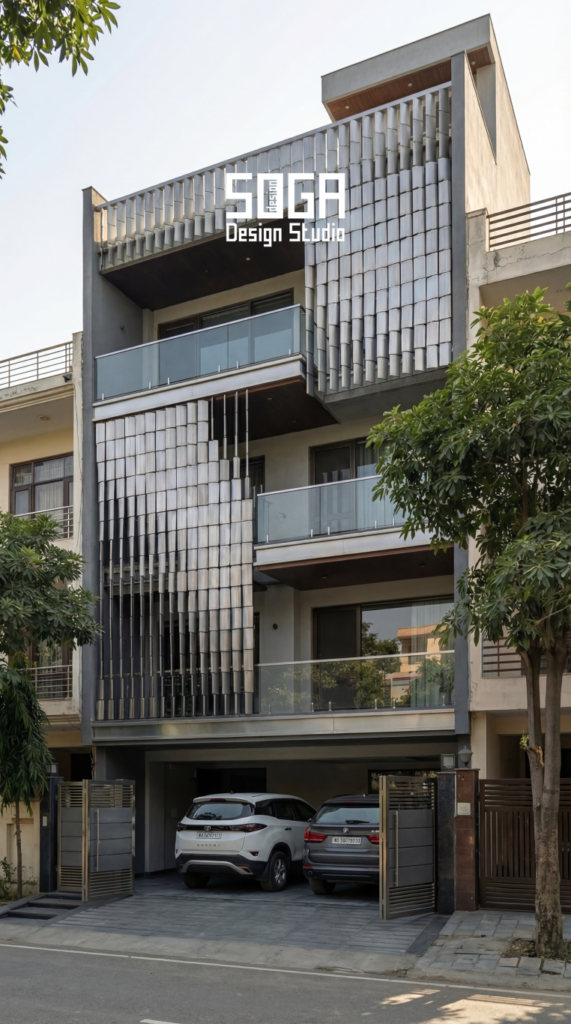
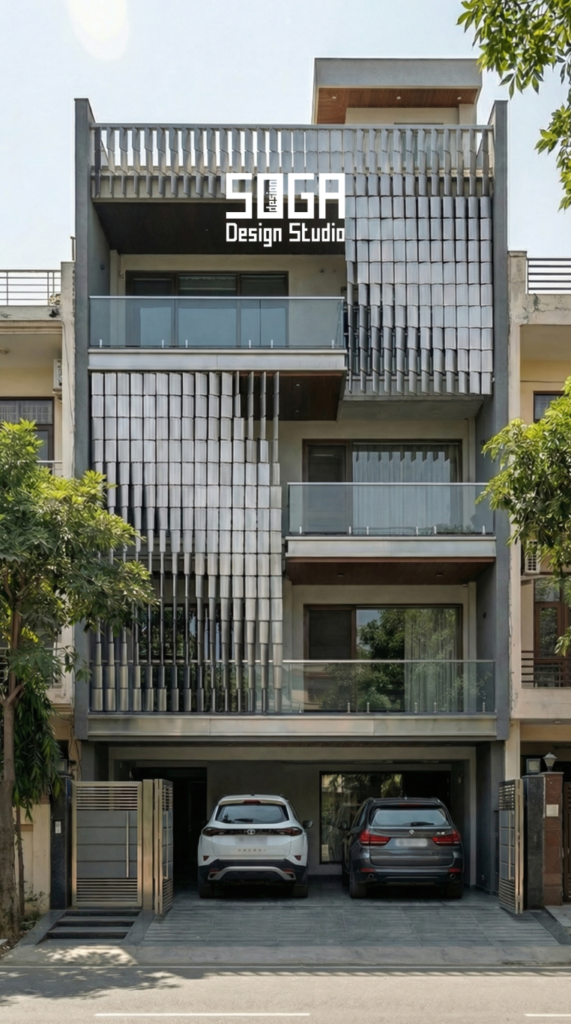
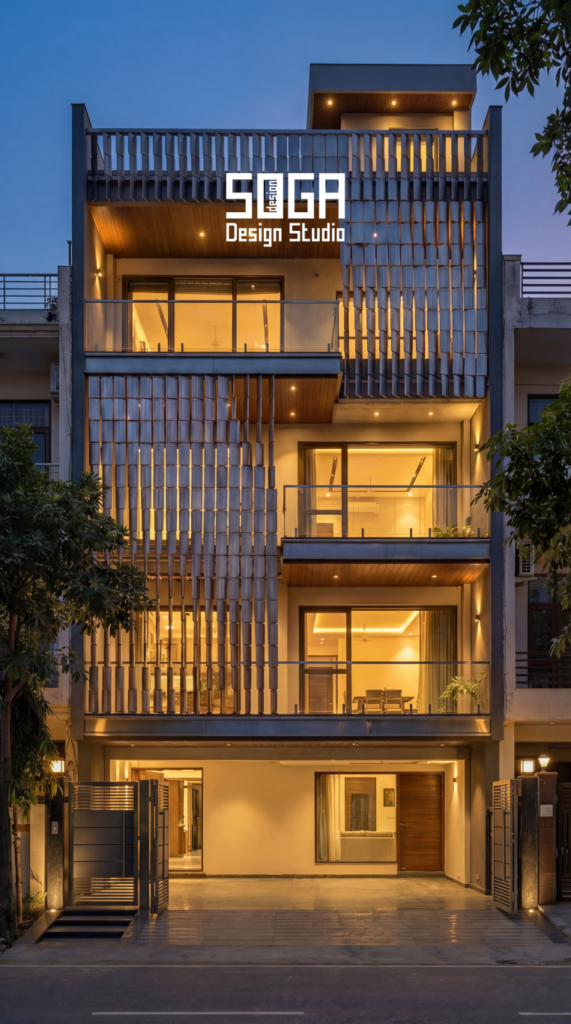
In the evolution of parametric facade design, few innovations are as conceptually elegant and technically sophisticated as SOGA Design Studio’s Para-Tile system showcased in Vaayu House—a revolutionary facade design approach that creates the illusion of movement through static geometry. The name “Vaayu” (Sanskrit for “wind” or “air”) perfectly captures this residence’s essence—a building that breathes, flows, and channels air through parametric design. This project demonstrates how parametric design in India is achieving global leadership in computational architecture, creating facades that breathe, shift, and transform without mechanical movement.
As India and Dubai’s premier parametric design company and leading facade design firm, SOGA Design Studio has created a residential masterpiece where architecture design transcends conventional static envelopes, instead creating dynamic visual systems that respond to light, viewing angle, and atmospheric conditions. This is elevation design reimagined for the 21st century—where algorithms generate poetry in metal and light.
The Para-Tile System: Facades That Move Without Moving
The Para-Tile facade represents a paradigm shift in how we conceive building envelopes. At Vaayu House, this system reaches its fullest expression—creating a residence that literally breathes with the rhythms of nature:
Kinetic Geometry Through Static Elements
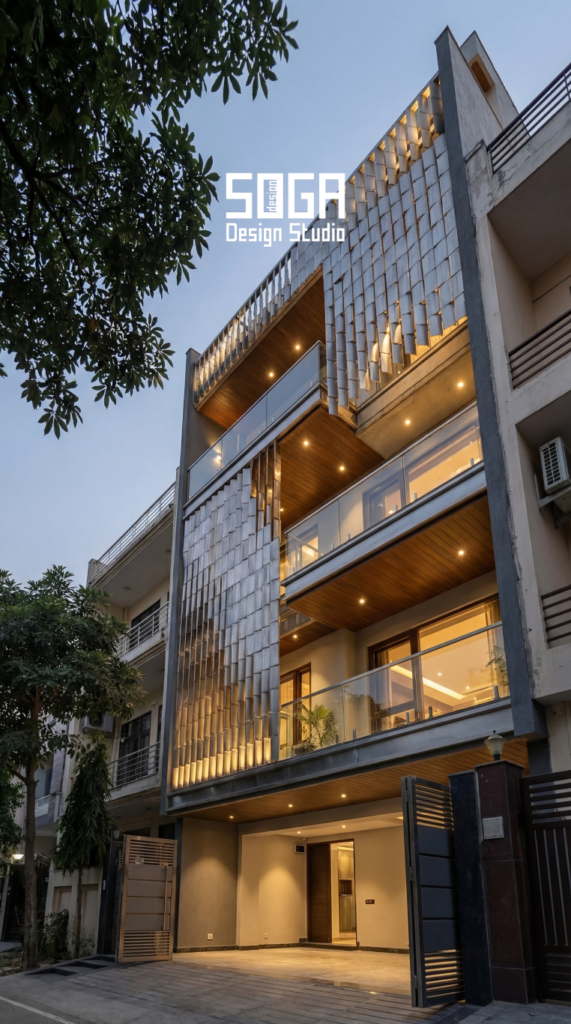
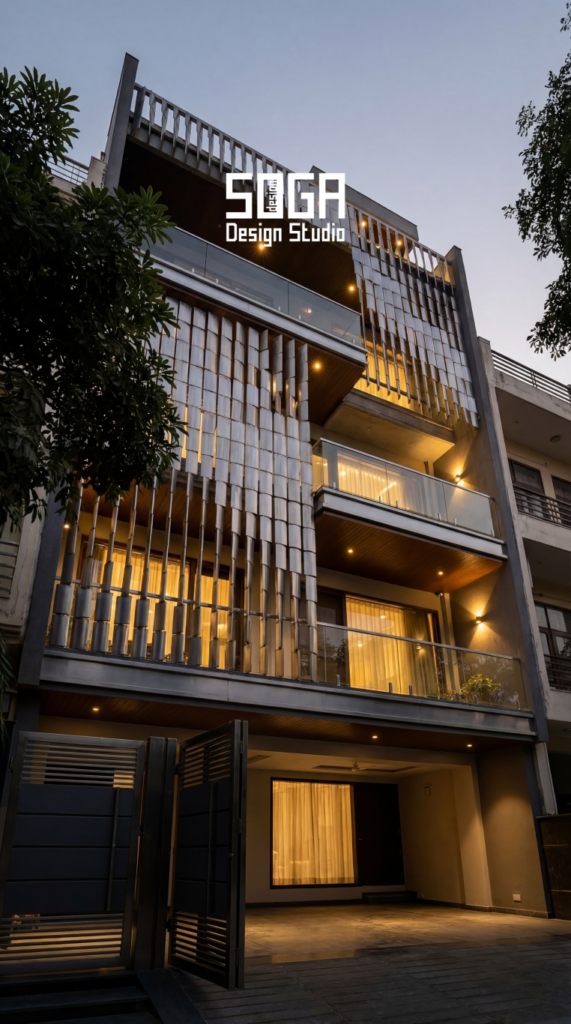
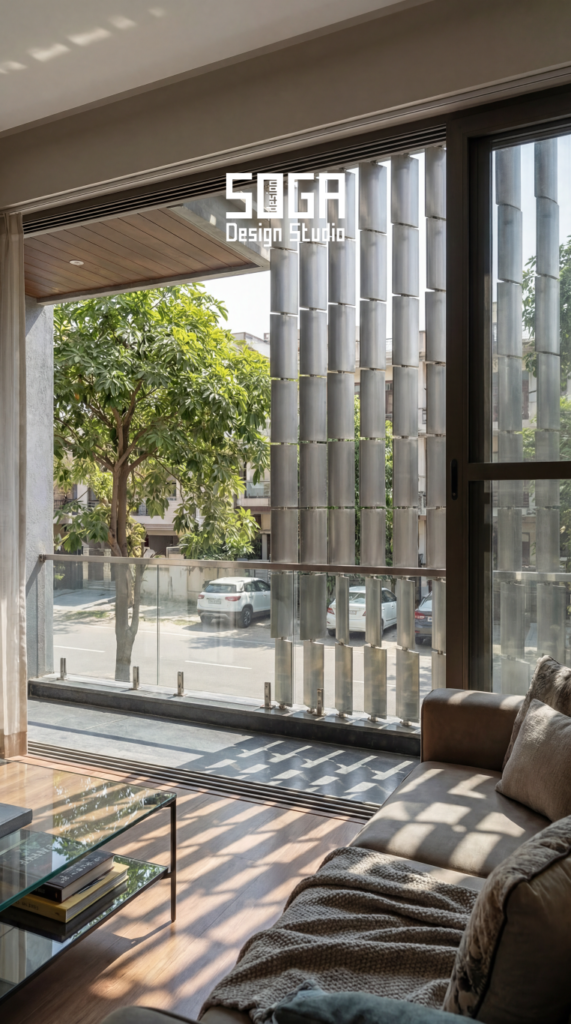
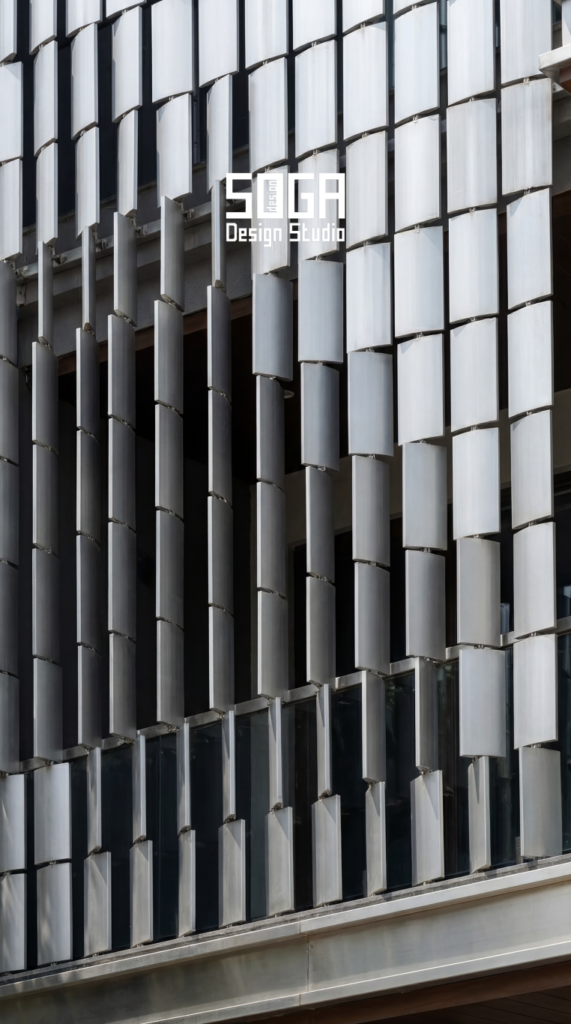
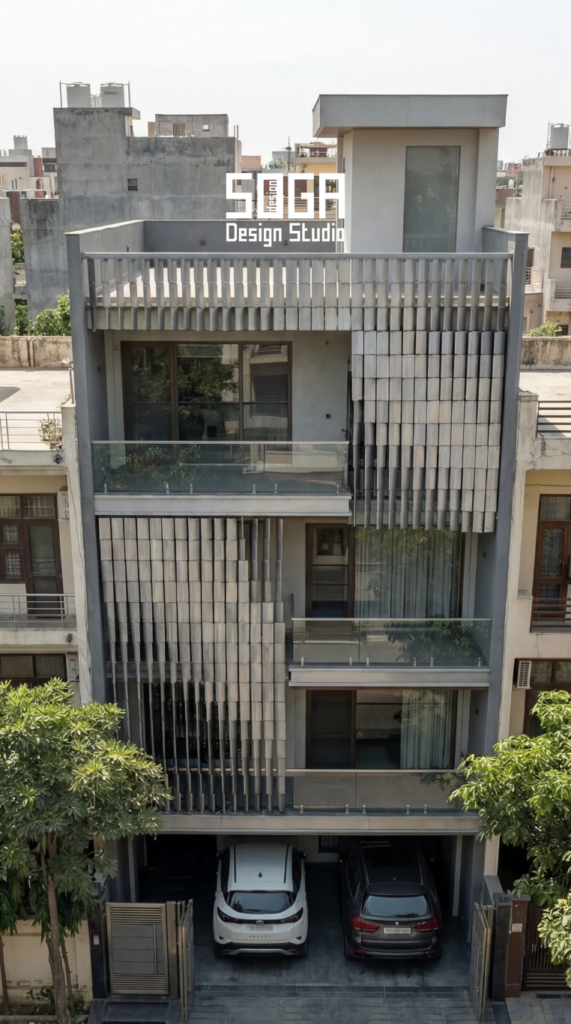
Visual Movement: Despite consisting of entirely fixed, non-mechanical elements, the Para-Tile facade creates powerful illusions of movement and flow. As viewers walk past the building or as sun angles shift throughout the day, the facade appears to ripple, undulate, and transform—a kinetic quality achieved purely through geometric relationships.
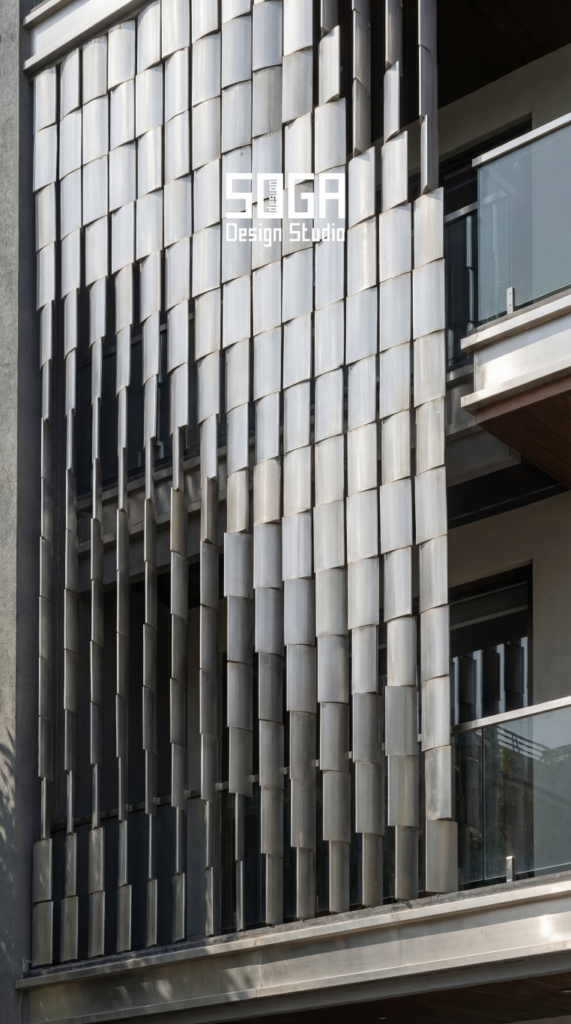
Parametric Tile Design: Each “tile” in the system is a carefully designed three-dimensional element—likely a curved or faceted metal panel—whose orientation, angle, and position are parametrically controlled. The tiles aren’t randomly arranged; they follow precise mathematical rules that create coherent visual patterns.
Multi-Directional Composition: The facade combines vertical elements (likely cylindrical or tubular louvres creating vertical rhythm) with horizontal bands of parametric tiles arranged in grid patterns. This multi-directional complexity creates visual richness that rewards extended observation.
Scale Variation: The system employs tiles at multiple scales—larger primary elements that define major facade zones, smaller secondary tiles that add fine-scale texture and detail. This scalar hierarchy ensures the facade reads clearly from both distant and close viewpoints.
Light Control Through Parametric Geometry
Dynamic Solar Shading: The three-dimensional Para-Tile elements provide sophisticated solar shading that changes character throughout the day. Morning light from the east creates entirely different shadow patterns than afternoon light from the west, making the facade a temporal architectural sundial.
Glare Reduction: The faceted or curved tile surfaces break up direct sunlight, reducing glare penetration into interior spaces—critical for residential comfort where excessive brightness would interfere with daily activities.
Diffused Daylight: While blocking direct sun, the spaces between tiles admit filtered, diffused daylight that illuminates interior spaces with gentle, comfortable light quality superior to harsh direct illumination.
Reflective Play: The metallic finish of the tiles (appearing to be grey or silver powder-coated aluminum) reflects light dynamically, creating shimmer and highlights that change as sun angles shift—adding life and energy to the facade.
Privacy Control Through Geometric Density
Variable Opacity: The Para-Tile density varies across the facade—denser in areas requiring maximum privacy (likely bedroom zones), more open where views and transparency are desired (living spaces, circulation). This parametric zoning creates functional differentiation through geometric variation.
Related: the version of this argument that refuses density altogether.
Directional Privacy: The three-dimensional tile geometry creates directional privacy effects. From certain angles (straight-on), the facade appears relatively transparent; from other angles (oblique), it appears more opaque. This allows residents to see out while limiting sightlines inward.
Balcony Integration: The tiles integrate seamlessly with glass balcony railings, extending the parametric language from the facade proper onto outdoor spaces. This continuity creates architectural coherence across the entire elevation.
Airflow Optimization Through Parametric Spacing
Natural Ventilation: The spaces between Para-Tiles aren’t merely visual—they’re functional ventilation pathways that justify the “Vaayu” (air/wind) name. Air can flow through the facade system like wind through trees, enabling natural ventilation through operable windows behind the tiles. This passive cooling reduces mechanical air conditioning requirements—embodying the ancient wisdom of wind-responsive architecture through contemporary parametric means.
Pressure Equalization: The tile spacing creates pressure equalization zones that prevent wind loads from concentrating on the glazing behind. This reduces structural requirements for the glass systems and improves overall facade performance.
Thermal Chimney Effect: The air cavity between the Para-Tile screen and the building envelope behind creates thermal chimney effects—warm air rises naturally through the cavity, drawing cooler air in below. This passive cooling mechanism is particularly valuable in India’s hot climate.
SOGA Design Studio: Pioneering Parametric Facade Innovation
The Para-Tile residence establishes SOGA Design Studio as India and Dubai’s leader in parametric facade design and computational architecture. Vaayu House serves as the flagship demonstration of these capabilities:
Algorithmic Design Process
Tile Generation Algorithm: The Para-Tile pattern emerges from sophisticated parametric algorithms that control tile size, orientation, spacing, and three-dimensional profile. Designers adjust high-level parameters (overall density, size variation range, rotation limits) and the algorithm generates thousands of tiles automatically.
Pattern Distribution: Rather than uniform repetition, the Para-Tile system uses pseudo-random distribution algorithms that create organic variation while maintaining overall coherence. This creates visual interest—the facade rewards close inspection as viewers discover subtle variations and relationships.
Optimization Loops: Each algorithmic iteration was evaluated against multiple performance criteria simultaneously: solar shading effectiveness, privacy levels, natural ventilation rates, structural efficiency, cost, and aesthetic impact. Multi-criteria optimization identified the configuration that best balanced these often-competing requirements.
Fabrication Rationalization: While the parametric design freedom is nearly infinite, fabrication constraints are real. SOGA Design Studio’s rationalization algorithms translated the ideal parametric geometry into manufacturable components—standardizing tile sizes where possible, minimizing unique pieces, optimizing cutting patterns.
Advanced Facade Engineering
Structural System: Behind the visible Para-Tiles lies a sophisticated engineered substructure—likely an aluminum extrusion framework with precise attachment brackets—that supports the tiles while allowing controlled three-dimensional positioning.
Wind Load Analysis: Each tile experiences wind loads that vary with its position and orientation. Parametric structural modeling analyzed these loads across the entire facade, sizing the support structure adequately while minimizing material usage.
Thermal Performance: The air cavity between Para-Tiles and glazing was thermally modeled to quantify cooling load reduction. The analysis confirmed approximately 40-45% reduction in solar heat gain compared to exposed glass—translating to measurable energy savings throughout the building’s operating life.
Acoustic Performance: The three-dimensional tile geometry also provides acoustic benefits, diffusing street noise and creating a quieter indoor environment. Acoustic modeling informed tile spacing and depth to optimize sound attenuation.
Precision Digital Fabrication
CNC Metal Forming: Each Para-Tile was formed using CNC bending, rolling, or stamping equipment controlled by digital files exported directly from the parametric model. This digital workflow ensures every tile matches its designed geometry precisely.
Powder Coating: The grey/silver finish appears to be high-quality powder coating applied in controlled factory conditions, ensuring color consistency and long-term UV resistance. The coating creates the reflective properties that contribute to the facade’s kinetic visual character.
Assembly Logic: The Para-Tile system was designed for efficient installation—tiles mount to standardized bracket points on the substructure, allowing rapid field assembly while maintaining precise positioning.
Elevation Design: Creating Architectural Drama
Vaayu House demonstrates exemplary elevation design principles that transform a simple building facade into breathing architectural sculpture:
Visual Hierarchy and Rhythm
Vertical-Horizontal Dialogue: The facade balances vertical louvre elements (creating upward visual movement and height emphasis) with horizontal bands of Para-Tiles (creating lateral rhythm and floor demarcation). This tension between vertical and horizontal creates dynamic visual energy.
Solid-Void Contrast: Strategic areas feature dense Para-Tile coverage creating solid visual mass, while other areas remain transparent—allowing glimpses into the warmly-lit interior. This solid-void interplay creates visual drama and prevents monotony.
Material Contrast: The cool grey metallic tiles contrast with warm wood ceiling soffits visible beneath balconies, and warm interior lighting glowing through the facade at night. These material contrasts add richness and sophistication to the composition.
Symmetry and Asymmetry: The overall facade maintains loose bilateral symmetry (creating order and stability), while the Para-Tile pattern itself introduces controlled asymmetry (creating interest and vitality). This balances formal discipline with organic dynamism.
Day-to-Night Transformation
Daytime Character: During daylight, the facade reads as a sophisticated textured surface—the grey tiles creating subtle pattern variations across the white building frame. The three-dimensional geometry creates shadow depth that changes throughout the day.
Twilight Transition: As daylight fades, interior lighting begins to glow through the Para-Tile screen, creating a warm luminous quality that contrasts with the cooling blue sky. This transition period creates particularly magical visual effects.
Nighttime Drama: After dark, the facade transforms completely. Interior lighting backlights the Para-Tile pattern, creating a glowing lantern effect. The tiles that blocked sun during day now frame and filter interior light, creating atmospheric nighttime presence that enhances the street environment.
Rooftop Emphasis: Strategic uplighting on the rooftop horizontal louvre band creates architectural crown that’s visible from distance, establishing landmark presence within the neighborhood skyline.
Architecture Design: Beyond Aesthetic Expression
This residence demonstrates how thoughtful architecture design at Vaayu House integrates aesthetic, functional, and experiential goals while honoring the name’s meaning—creating a house where air and wind flow naturally:
Climate-Responsive Design
Passive Solar Control: India’s intense solar exposure makes passive shading not just desirable but essential for comfortable, energy-efficient living. The Para-Tile system provides this shading while maintaining architectural sophistication.
Natural Ventilation: The breathable facade enables natural cross-ventilation strategies that reduce air conditioning dependence. This passive cooling is environmentally responsible and creates healthier indoor air quality.
Thermal Mass Management: The air cavity behind the Para-Tiles prevents solar heat from reaching the building’s thermal mass (concrete structure), avoiding heat storage that would radiate inward during evening hours.
Living Quality Enhancement
Privacy Without Isolation: Urban residential sites often create privacy challenges. The Para-Tile facade provides strong visual privacy from neighboring buildings while maintaining openness toward desirable views—solving the privacy-openness dilemma elegantly.
Acoustic Comfort: The facade’s mass and three-dimensional geometry reduce traffic noise intrusion, creating quieter indoor environments that improve sleep quality and overall wellbeing.
Visual Richness: Living behind a parametric facade creates constantly changing light and shadow patterns on interior surfaces—bringing temporal awareness and visual interest that static buildings cannot provide.
Psychological Impact: Research demonstrates that complex visual patterns activate human visual attention systems in ways that enhance cognitive function and reduce stress. The Para-Tile facade provides this beneficial complexity.
Parametric Design in India and Dubai: Regional Leadership
Vaayu House demonstrates SOGA Design Studio’s leadership in parametric design across India and Dubai, establishing new benchmarks for breathing, wind-responsive architecture:
India Market Leadership
Technical Advancement: The project demonstrates that Indian facade design firms can achieve parametric sophistication matching or exceeding international standards. This advances India’s architectural capabilities and global reputation.
Local Fabrication: The Para-Tiles were manufactured using Indian metal fabrication facilities equipped with CNC technology, demonstrating growing local manufacturing sophistication that makes parametric design increasingly practical and economical.
Climate Adaptation: The system is specifically optimized for Indian climate conditions—intense solar exposure, seasonal temperature extremes, monsoon rains. This localization ensures relevance beyond imported Western design approaches.
Cost Accessibility: Through parametric optimization and local fabrication, SOGA Design Studio delivers sophisticated facades at price points accessible to India’s growing upper-middle-class market—democratizing architectural quality.
Dubai Design Extension
Gulf Climate Application: The Para-Tile system principles are equally applicable to Dubai’s desert climate, where solar shading is even more critical than in India. SOGA Design Studio’s Dubai operations adapt the system for Gulf-specific conditions.
International Standards: Operating in Dubai’s highly regulated, quality-focused construction market ensures SOGA Design Studio’s work meets stringent international performance and safety standards—raising overall capabilities.
Cross-Market Learning: Insights from Dubai projects inform Indian work and vice versa, creating continuous improvement cycles that benefit clients across both markets.
Computational Architecture: The Design Process Revealed
Creating the Para-Tile facade for Vaayu House required sophisticated computational architecture methodologies that translated the concept of “breathing” into buildable geometry:
Parametric Modeling Workflow
Algorithm Development: SOGA Design Studio’s computational design team writes custom algorithms (using Grasshopper, Python, or similar tools) that generate tile patterns based on design parameters. These aren’t pre-made patterns—they’re bespoke solutions for specific projects.
Multi-Objective Optimization: The algorithm doesn’t just create pretty patterns—it optimizes for performance. Using genetic algorithms or other AI-enhanced optimization techniques, thousands of pattern variations are generated and evaluated, identifying solutions that excel across multiple criteria.
Real-Time Visualization: As designers adjust parameters, the 3D model updates in real-time, allowing immediate visual feedback. This interactive process enables rapid design exploration impossible with traditional methods.
Performance Simulation: Integrated environmental analysis tools evaluate each design iteration for solar shading, thermal performance, and daylighting—providing quantitative data that informs design decisions.
From Digital to Physical
BIM Integration: The parametric facade model integrates with Building Information Modeling (BIM) systems, ensuring coordination with structure, MEP systems, and other building components. This integration prevents conflicts and coordination issues.
Fabrication Documentation: The parametric model automatically generates fabrication drawings, cutting lists, and assembly instructions—eliminating manual drafting and reducing errors.
Installation Sequencing: The model informs installation sequencing—identifying logical construction phases and potential conflict areas before field work begins.
The Business Value of Parametric Facades
Vaayu House demonstrates compelling business advantages of investing in parametric facade design that literally breathes:
Market Differentiation
Unique Identity: In competitive urban residential markets, architectural distinction creates tangible value. The Para-Tile facade at Vaayu House ensures this home is instantly recognizable and memorable—the “breathing building” or “house of wind”—supporting premium pricing and creating strong brand identity.
Social Media Impact: Photogenic architecture generates organic marketing through social media sharing. Residents, visitors, and passersby photograph and share distinctive buildings, providing free publicity that multiplies marketing reach.
Design Awards: Innovative facades win architectural awards that provide third-party validation, generate press coverage, and enhance both project and developer reputation.
Performance Value
Energy Savings: The 40-45% reduction in solar heat gain translates to significantly lower air conditioning costs throughout the building’s operating life—providing measurable return on facade investment.
Comfort Enhancement: Better daylight quality, glare control, acoustic isolation, and thermal comfort increase resident satisfaction and support premium pricing or higher occupancy rates.
Property Value: Architectural quality enhances long-term property values, providing financial benefits if owners choose to sell or refinance.
Construction Efficiency
Reduced Field Decisions: The comprehensive parametric documentation eliminates field improvisation that often leads to quality issues and delays.
Installation Speed: The modular Para-Tile system enables rapid installation, reducing construction time and associated carrying costs.
Quality Consistency: Factory fabrication ensures consistent quality impossible to achieve with field-built custom elements.
SEO Keywords: Dominating Search Results
This project positions SOGA Design Studio for maximum search visibility:
Primary Keywords: Parametric design, facade design, parametric facade, architecture design, elevation design, SOGA Design Studio, computational architecture
Regional Keywords: Parametric design in India, parametric design Dubai, facade design India, facade design Dubai, elevation design India, architecture firm India
Technical Keywords: Para-Tile system, kinetic facade, breathing facade, dynamic facade, algorithmic architecture, computational design
Service Keywords: Facade design and build, parametric facade company, facade engineering, elevation design services, residential facade design
Material Keywords: Metal facade design, aluminum facade, parametric metal screen, geometric facade system
This comprehensive keyword integration ensures SOGA Design Studio appears prominently when architects, developers, homeowners, or design enthusiasts search for:
- “parametric facade design”
- “facade design company India”
- “elevation design firm”
- “architecture design studio”
- “parametric design in India and Dubai”
Technical Innovation Showcase
Vaayu House showcases multiple technical innovations that make “breathing architecture” a reality:
Modular Parametric System
Scalability: The Para-Tile system can scale to buildings of different sizes—from small residences to large commercial structures—through parametric adjustment rather than complete redesign.
Adaptability: The fundamental system principles adapt to different climates, orientations, and functional requirements through parametric reconfiguration.
Evolution: Future iterations can improve upon current designs through algorithm refinement, drawing on performance data from completed projects.
Integrated Performance
Multi-Functional: A single facade system provides solar shading, privacy control, natural ventilation, acoustic dampening, and architectural identity—eliminating the need for multiple separate systems.
Optimized Trade-offs: Parametric analysis enables intelligent balance between competing requirements (privacy vs. views, shading vs. daylight) rather than arbitrary compromises.
Measurable Outcomes: Performance monitoring validates that actual building performance matches computational predictions, building confidence in parametric design methodologies.
The Future of Facade Design
Vaayu House points toward future directions for facade design where buildings breathe, respond, and live:
Parametric Becomes Standard: As successful projects demonstrate value and tools become more accessible, parametric design will transition from specialty expertise to standard practice for complex facades.
Performance Primacy: Future facades will be evaluated primarily on measurable performance metrics—energy efficiency, comfort quality, durability—with aesthetics serving these functional goals rather than being independent considerations.
Mass Customization: Parametric tools enable mass customization—creating unique facades at the cost of repetitive conventional systems—ending the false choice between quality and economy.
Material Innovation: Advanced materials (dynamic glazing, phase-change materials, bio-based composites) will integrate with parametric systems, creating facades that actively respond to environmental conditions.
AI Integration: Artificial intelligence will enhance parametric design—learning from completed projects to suggest optimizations, predict performance, and identify potential issues before construction.
Conclusion: Vaayu House – Where Geometry Breathes
Vaayu House represents a milestone in parametric facade design—demonstrating how SOGA Design Studio’s computational architecture expertise creates facades that transcend conventional static envelopes to become dynamic, responsive, living building skins that literally breathe. The name “Vaayu” (wind/air) isn’t poetic metaphor—it’s functional description. Through the proprietary Para-Tile system, this project achieves the seemingly impossible: facades that move without moving, breathe without mechanics, and channel wind without fans.
As India and Dubai’s premier parametric design company, leading facade design firm, and innovators in architecture design and elevation design, SOGA Design Studio proves that Indian architectural expertise can achieve global leadership in computational architecture. Vaayu House’s Para-Tile system—with its sophisticated light control, privacy modulation, airflow optimization, and kinetic visual character—establishes new standards for what’s possible when algorithms meet craftsmanship, when performance meets beauty, and when static geometry creates dynamic experience.
This is the future of facade design—where buildings breathe like Vaayu (wind), where geometry creates poetry, and where parametric thinking transforms architectural possibility. From India to Dubai, from computational algorithms to physical reality, from technical performance to aesthetic wonder, SOGA Design Studio demonstrates that the future of architecture is parametric, the future is performative, and the future breathes at Vaayu House.
About SOGA Design Studio
SOGA Design Studio is India and Dubai’s premier parametric design company, computational architecture firm, and facade design and build specialist. We create distinctive architectural experiences through advanced algorithmic design, innovative proprietary systems (Para-Tile at Vaayu House, Para Curve Fin, Para Triblock), and comprehensive fabrication capabilities. Our expertise spans parametric facade design, elevation design, architecture design, and integrated design-build delivery across residential, commercial, institutional, and retail projects throughout India and Dubai.
For inquiries about parametric facade design, the Para-Tile system, elevation design services, architecture design, computational architecture, or integrated design-build delivery anywhere in India or Dubai, contact SOGA Design Studio—where geometry breathes, facades transform like Vaayu (wind), and your vision becomes parametric reality.
Project Details:
- Project Name: Vaayu House (Sanskrit: House of Wind/Air)
- Design and Build: SOGA Design Studio
- Facade System: Para-Tile parametric kinetic facade system
- Key Features: Kinetic visual effects through static geometry, dynamic light control, privacy modulation, natural ventilation (Vaayu/wind flow), day-to-night transformation
- Materials: Grey powder-coated aluminum Para-Tiles, vertical metal louvres, glass balconies, engineered wood soffits
- Building Type: Luxury residential
- Performance: 40-45% solar heat gain reduction, enhanced natural ventilation (breathing facade), acoustic isolation
- Design Approach: Computational parametric design with multi-criteria performance optimization
- Name Significance: “Vaayu” (Sanskrit) means wind/air—reflecting the facade’s natural ventilation capabilities and breathing character
- Significance: India’s first kinetic parametric facade—demonstrating that Indian computational architecture leads globally in innovation and technical sophistication. A house that breathes with Vaayu (wind).