Biophilic Parametric Design Brings Living Forms to Urban India
Parametric design in India reaches new heights of organic expression with Kusum Vriksha Residence, a groundbreaking residential project by SOGA Design Studio that transforms the traditional apartment facade into a living, breathing vertical garden. Named after the sacred Kusum tree, this residence demonstrates how computational design, biomorphic architecture, and biophilic principles can merge to create residential buildings that don’t just house people—they nurture them.
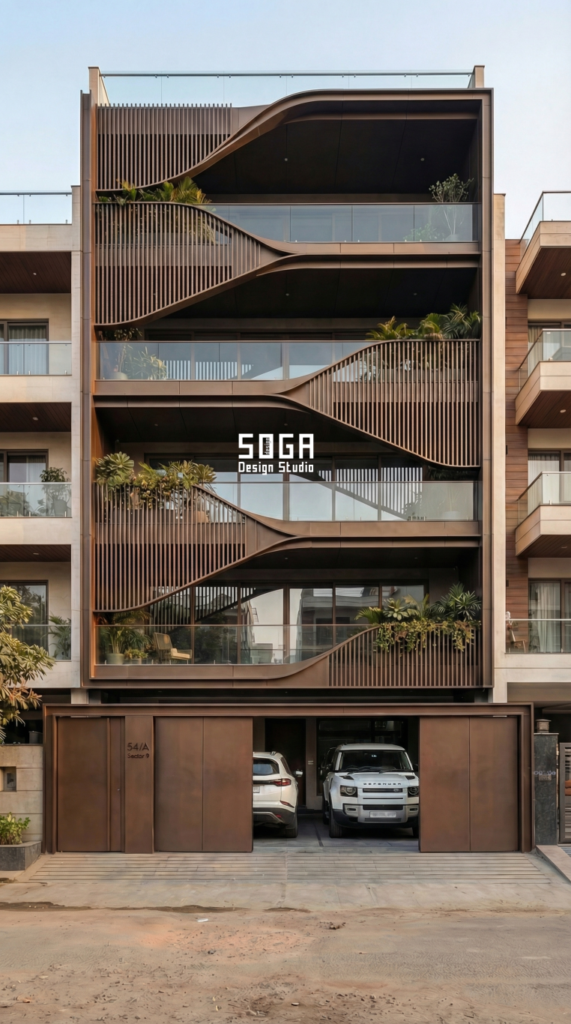
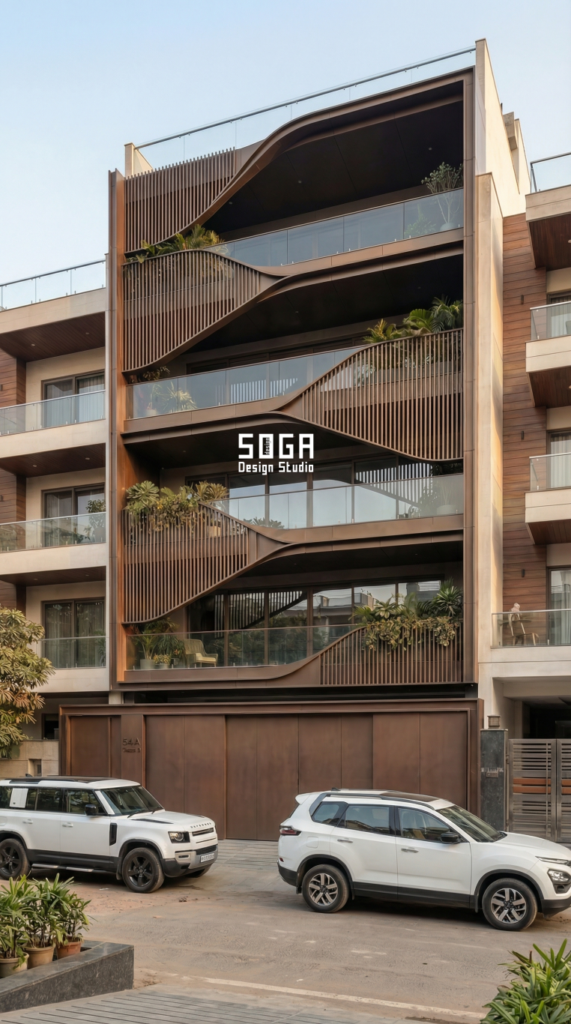
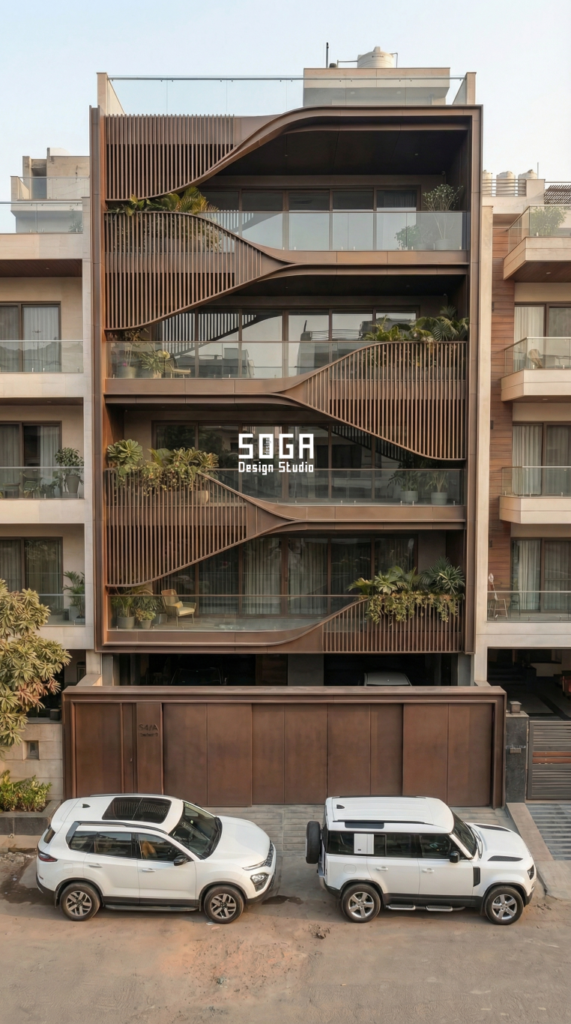
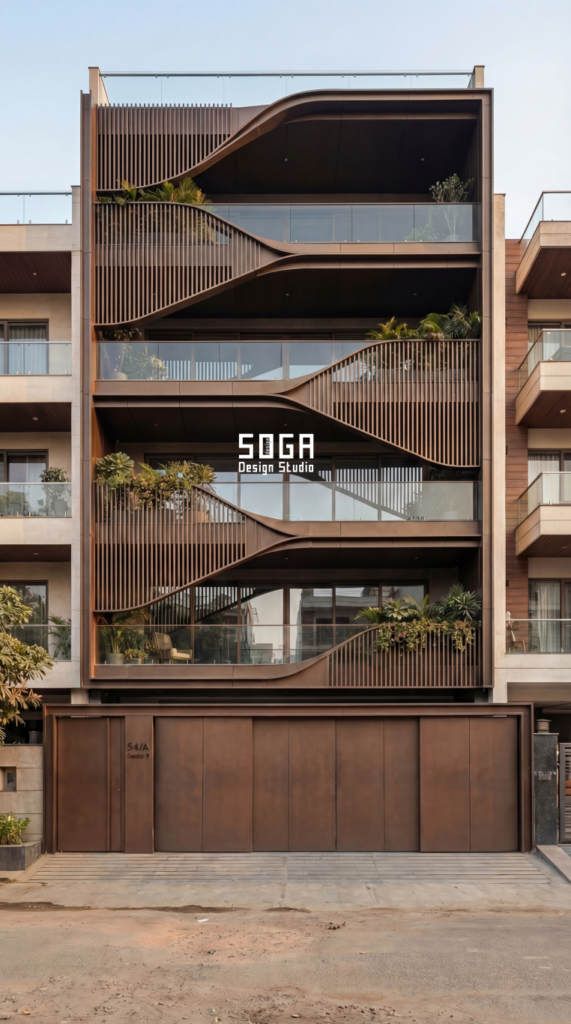
The facade design is immediately arresting: flowing ribbons of engineered wood sweep across the elevation in continuous curves, creating planted terraces at every level while blooming into flared canopies that provide shade, privacy, and sculptural drama. This isn’t decoration applied to a building—it’s parametric architecture where structure, environmental performance, greenery, and aesthetic expression are inseparable.
As India and Dubai’s premier parametric design company and leading facade design firm, SOGA Design Studio has created a residence where engineered wood flows like organic growth, where every balcony becomes a private garden retreat, and where computational design serves both ecological wellness and timeless beauty.
Parametric Wood Ribbons: Structure as Sculpture
The defining element of Kusum Vriksha Residence is its revolutionary parametric ribbon system—flowing bands of engineered wood that sweep diagonally across the facade, creating a rhythm that references natural vines climbing a tree while establishing contemporary architectural distinction.
Flowing Growth Pattern
Organic Movement: Unlike static vertical columns or horizontal bands, the wood ribbons flow diagonally upward, creating dynamic movement that draws the eye skyward. Each ribbon begins narrow at one level, expands as it rises, and blooms into a broad flared canopy before transitioning to the next level—mimicking natural growth patterns.
Parametric Generation: These aren’t arbitrary curves—they’re parametrically generated through sophisticated algorithms that define the rate of expansion, the curvature profiles, the flare geometry, and the spacing between ribbons. SOGA Design Studio’s computational design team used custom Grasshopper scripts to generate hundreds of variations, testing different curve tensions, flare rates, and ribbon densities before selecting the optimal configuration.
Continuous Flow: The ribbons flow continuously across multiple floors, creating visual connections between levels that unify the facade. This vertical continuity makes the building appear taller and more elegant while establishing clear architectural identity distinct from conventional horizontal-banded residential buildings.
Structural Integration: The flared ribbon ends aren’t merely decorative—they’re structural elements that support cantilevered balcony edges and provide attachment points for glass railings. By widening at strategic points, the ribbons create broad bearing surfaces that distribute loads efficiently, enabling dramatic cantilevers without requiring additional supports.
Multi-Functional Engineered Wood Design
The parametric wood ribbons at Kusum Vriksha Residence demonstrate how computational architecture serves multiple simultaneous functions:
Deep Solar Shading: The ribbons create substantial overhangs—some extending over 1.2 meters—that provide aggressive solar shading to the glazed balcony openings below. In India’s intense tropical sun, this passive shading reduces direct heat gain by approximately 45-55%, significantly decreasing air conditioning loads and improving thermal comfort.
Privacy Screening: The three-dimensional ribbon geometry creates sophisticated privacy screening from neighboring buildings without requiring solid walls that would block light and views. The curved surfaces interrupt direct sightlines into balconies while maintaining openness toward desirable views—solving the urban privacy-openness dilemma elegantly.
Wind Protection: The flowing ribbons provide wind protection to the planted terraces, creating microclimates where vegetation can thrive. The curves deflect strong winds while allowing gentle breezes, making outdoor spaces comfortable even on windy days.
Green Infrastructure Support: The ribbons create defined planting zones at each level, establishing clear boundaries for soil depth and irrigation systems. The wood surfaces provide visual warmth that complements the greenery, creating seamless integration between architecture and landscape.
Vertical Green Identity: The combination of flowing wood ribbons and lush planted terraces creates powerful vertical garden character that makes the building an immediately recognizable landmark. This biophilic identity distinguishes Kusum Vriksha Residence from conventional glass-box apartments, establishing premium market positioning.
This multi-functionality exemplifies SOGA Design Studio’s approach to parametric facade design—where every element serves aesthetic, functional, ecological, and experiential goals simultaneously rather than being arbitrary decoration.
Biophilic Architecture: Living with Nature
Kusum Vriksha Residence represents a sophisticated biophilic architecture approach—design that doesn’t just reference nature but actively integrates it into the daily living experience:
Planted Terraces at Every Level
Private Garden Retreats: Every residence features generously sized planted terraces—not token 2-foot-deep balconies but genuine outdoor rooms with sufficient soil depth to support small trees, shrubs, and diverse plantings. These become private garden sanctuaries where residents can cultivate plants, eat outdoors, or simply enjoy greenery.
Vertical Forest Concept: When viewed collectively, the stacked planted terraces create a vertical forest effect—greenery cascading down the facade in layers that soften the building’s mass and contribute to urban ecology. This vertical greening provides habitat for birds and beneficial insects while improving air quality.
Microclimate Creation: The combination of deep overhangs, planted terraces, and wood surfaces creates cooler microclimates at each balcony level. Evapotranspiration from plants naturally cools the air; wood surfaces remain cooler than metal or concrete; deep shade prevents heat buildup. These outdoor spaces can be 3-5°C cooler than exposed balconies.
Psychological Benefits: Extensive research demonstrates that daily contact with nature—even through apartment balconies—reduces stress, improves mental health, and enhances overall wellbeing. Kusum Vriksha Residence delivers these biophilic benefits as integral to the architecture rather than optional amenities.
Nature-Inspired Geometry
Organic Curves: Every ribbon flows smoothly without sharp corners or abrupt transitions. The continuous curves reference natural forms—vines, branches, flowing water—creating subconscious comfort rooted in humans’ evolutionary affinity for organic shapes.
Growth Metaphor: The ribbons’ expansion as they rise mimics biological growth patterns, creating subliminal associations with vitality, health, and natural processes. This makes the architecture feel alive rather than inert—particularly when combined with living plants.
Asymmetric Balance: While maintaining overall compositional balance, the facade avoids rigid symmetry. Like natural organisms, it achieves harmony through balanced asymmetry—creating visual interest while preventing monotony.
Material Warmth: The engineered wood surfaces provide natural warmth and texture that complement greenery far better than cold glass or concrete. This material choice reinforces the biophilic character and creates welcoming, human-scaled aesthetic.
Facade Design Optimized for Climate & Greenery
One of the core strengths of SOGA Design Studio lies in climate-responsive architecture that enables biophilic integration. Kusum Vriksha Residence is designed to interact intelligently with India’s challenging climate while supporting thriving vegetation.
Solar Performance
Solar Choreography: The facade is designed to interact with the sun’s movement, producing dynamic light and shadow patterns across the elevation throughout the day. Morning light from the east creates long shadows that emphasize the ribbons’ depth; midday sun from above highlights the curved undersides of the flared canopies; evening light from the west creates dramatic silhouettes against planted greenery.
Optimized Shading: The parametric design optimized the ribbon positions to provide maximum solar shading during peak heat hours (10am-4pm) while allowing morning and evening sun to reach the balconies when temperatures are comfortable. This temporal shading optimization required solar analysis of hundreds of configurations.
Diffused Illumination: The curved parametric surfaces diffuse harsh direct sunlight, preventing glare while creating gentle, comfortable illumination on terraces. Rather than harsh bright-dark contrasts, the facade creates graduated light transitions that benefit both human comfort and plant health.
Shadow Depth: The substantial projection of the flared canopies creates deep shadows—sometimes exceeding 1.5 meters—that dramatically reduce surface temperatures on shaded walls and glazing. This shadow depth is critical for maintaining comfortable terrace temperatures and preventing plant stress during peak heat.
Support for Thriving Vegetation
Wind Sheltering: The flowing ribbons create wind-protected zones where plants can thrive without damage from strong gusts. This is critical in high-rise contexts where balcony plantings often struggle with wind exposure.
Rain Harvesting: The flared canopies channel rainwater toward integrated collection systems that irrigate the planted terraces. This passive irrigation reduces water consumption while supporting lush greenery year-round.
Soil Depth Zones: The parametric design created defined planting zones with sufficient soil depth (minimum 600mm) to support diverse plant species including small trees. This depth allows root development and moisture retention impossible in typical shallow planters.
Microclimate Layering: The combination of shade, wind protection, and humidity from plant transpiration creates layered microclimates that support species diversity. Different zones receive different light, moisture, and temperature conditions—enabling rich planting palettes.
Night-Time Transformation
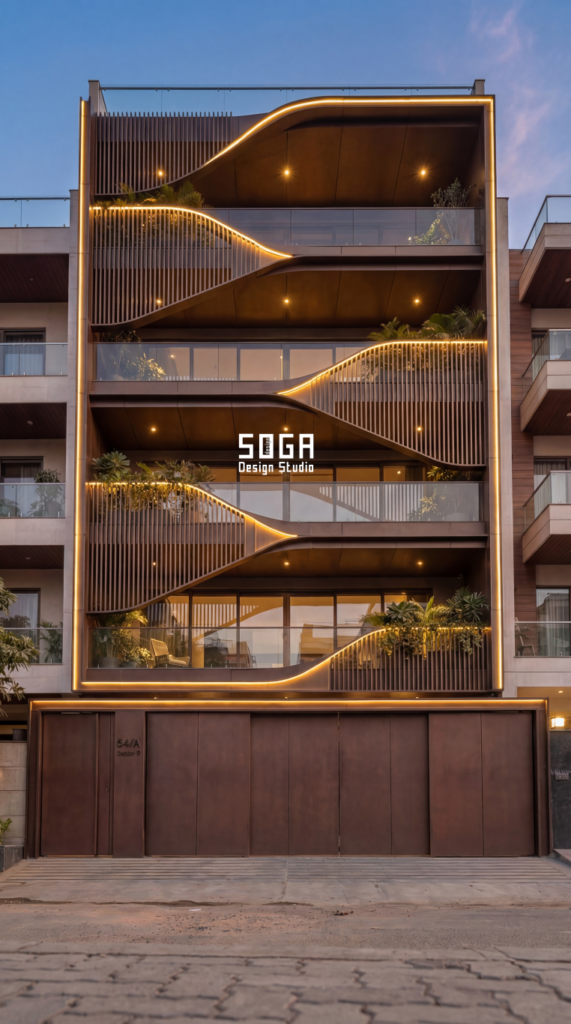
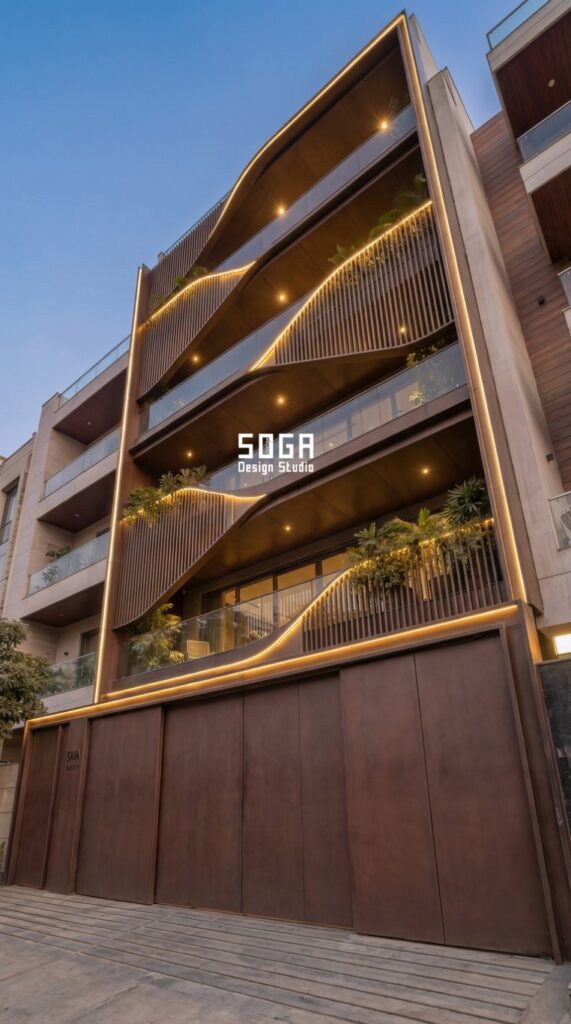
Integrated Lighting: In the evening, integrated LED lighting highlights the sculptural geometry of the parametric wood ribbons. Uplighting from beneath each flared canopy creates dramatic effects while illuminating the plants, transforming the building into a glowing vertical garden.
Warm Glow: The combination of warm-toned wood, backlit greenery, and interior lighting creates an inviting nighttime character. The building appears to glow organically like bioluminescent growth rather than displaying harsh architectural lighting.
Living Landmark: The illuminated planted facade ensures Kusum Vriksha Residence maintains strong architectural presence 24 hours daily, contributing positively to the urban nighttime environment as a living landmark that changes with seasonal plant growth.
Engineered Wood: Sustainable Material Innovation
The selection of engineered wood for the parametric ribbons represents sophisticated material strategy that balances aesthetics, performance, and sustainability:
Material Performance
Durability: Modern engineered wood products designed for exterior applications feature advanced weathering resistance through protective coatings, pressure treatment, and composite technologies. When properly maintained, these materials provide multi-decade service life in tropical climates.
Dimensional Stability: Unlike solid wood, engineered wood maintains dimensional stability across temperature and humidity fluctuations—critical for the precise geometries required by parametric design. The ribbons won’t warp or twist as they would with solid timber.
Formability: Engineered wood products can be shaped into the complex curves required by the parametric design through CNC cutting and forming processes impossible with solid timber. This enables the flowing organic geometries that define the facade.
Weight: Compared to equivalent concrete or metal elements, engineered wood is significantly lighter—reducing structural loads on the building frame and enabling more dramatic cantilevers with less structural reinforcement.
Sustainability Benefits
Carbon Sequestration: Wood products sequester atmospheric carbon throughout their service life, making them carbon-negative building materials when sourced from sustainably managed forests. This contrasts with concrete and steel’s heavy carbon footprints.
Renewable Resource: When sourced from certified sustainable forestry, engineered wood is a renewable building material that can be continuously replenished—unlike finite mineral resources required for concrete, steel, and aluminum.
Lower Embodied Energy: Manufacturing engineered wood requires significantly less energy than producing equivalent steel or aluminum components—reducing the building’s overall embodied carbon footprint.
Biophilic Material: Wood is inherently biophilic—humans evolved in environments rich with wood and demonstrate measurable preference for wood materials. This psychological warmth enhances the biophilic character beyond the greenery alone.
Aesthetic Character
Natural Warmth: The wood’s natural grain and warm tones create welcoming, human-scaled aesthetic that contrasts with cold glass and concrete. This warmth is particularly effective combined with greenery—creating seamless visual flow between natural materials.
Aging Gracefully: Unlike painted metal or plastic that degrades visually, properly maintained engineered wood develops attractive patina over time—silvering gracefully in a way that enhances rather than detracts from appearance.
Texture and Depth: The wood surfaces provide subtle texture that creates visual interest across the large facade areas. This texture catches and diffuses light beautifully, creating richer visual experience than flat glass or metal panels.
SOGA Design Studio: Pioneering Biophilic Parametric Design
Kusum Vriksha Residence demonstrates why SOGA Design Studio has established itself as India and Dubai’s leader in biophilic parametric architecture, elevation design, and sustainable facade design:
Comprehensive Design Capabilities
Computational Biophilic Design: The flowing wood ribbons emerged from sophisticated parametric algorithms that simultaneously optimized for structural efficiency, solar shading performance, wind protection, planting support, and aesthetic impact. This multi-criteria optimization produces better outcomes than purely aesthetic or purely functional approaches.
Ecological Integration: SOGA’s team includes landscape architects and horticulturists who worked within the parametric workflow to ensure the architectural design genuinely supports thriving vegetation rather than merely providing token planting areas.
Climate Analysis: Detailed solar analysis, wind modeling, and thermal comfort simulation informed every aspect of the ribbon geometry—ensuring the biophilic design delivers measurable environmental performance benefits.
Material Innovation: Specifying engineered wood for tropical climate exterior applications required extensive research into product options, protective systems, detailing strategies, and maintenance protocols—demonstrating SOGA’s commitment to material innovation.
Design-Build Integration
Seamless Delivery: As an integrated design-build firm, SOGA Design Studio maintained control over Kusum Vriksha Residence from initial concept through final construction, ensuring design intent translated into built reality without dilution through fragmented delivery.
Fabrication Coordination: The team worked directly with engineered wood fabricators, providing digital files for CNC cutting, technical support for curved assembly, and quality oversight that ensured the flowing ribbons were executed to precise specifications.
Green Infrastructure Coordination: SOGA coordinated the integration of irrigation systems, drainage, waterproofing, and soil systems within the parametric framework—ensuring the planted terraces function reliably rather than failing due to poor detailing.
Portfolio Positioning
Kusum Vriksha Residence joins SOGA Design Studio’s growing portfolio of biophilic parametric projects, demonstrating leadership in sustainable residential architecture:
Biophilic Projects: Kusum Vriksha Residence (planted terraces), Anand Vriksham (tree-inspired forms), Vaayu House (kinetic shading with greenery)
Organic Forms: Podwave Residence (biomorphic columns), Vikram Ahuja Residence (flowing curves)
Sustainable Facades: Projects integrating passive shading, natural ventilation, and climate-responsive design across diverse climates
This portfolio establishes SOGA Design Studio as India’s most innovative biophilic design company, capable of integrating living systems with advanced computational methodologies and sustainable materials.
Parametric Architecture Design: Theory and Practice
Kusum Vriksha Residence exemplifies how parametric architecture design translates biophilic theory into built reality:
Algorithmic Form Generation for Living Systems
Rule-Based Design: Rather than drawing the ribbon shapes manually, SOGA’s computational designers defined rules: “ribbons flow diagonally at angle X,” “expansion rate follows curve Y,” “flare canopy extends Z meters,” “spacing allows planting zone depth D.” The computer then generates thousands of ribbon configurations automatically following these rules.
Multi-Criteria Optimization: Each generated configuration was evaluated simultaneously for:
– Structural efficiency (material usage, cantilever feasibility)
– Solar shading performance (shadow analysis across seasons)
– Wind protection (CFD modeling for plant protection)
– Planting support (soil volume, drainage paths)
– Construction feasibility (fabrication complexity, assembly sequence)
– Aesthetic impact (proportions, rhythm, visual balance)
This holistic optimization produces facades that excel across all criteria rather than optimizing one at the expense of others.
Variation Within System: While all ribbons follow the same basic parametric rules, subtle variations in exact positioning, curve tension, and flare depth create visual diversity that prevents monotony. This “variation within system” creates organic quality impossible with rigid repetition—like leaves on a tree.
Biophilic Design Principles
Direct Nature Contact: The generous planted terraces provide direct daily contact with nature—not views through glass but hands-in-soil engagement with living plants. This direct interaction delivers maximal biophilic benefits.
Indirect Nature Experience: Even residents not actively gardening benefit from visual and auditory connection to greenery—seeing plants from interior spaces, hearing birds attracted to the vertical forest, smelling flowering plants.
Natural Materials: The engineered wood provides natural material character that enhances biophilic response. Wood is inherently biophilic—triggering positive psychological responses rooted in evolutionary history.
Natural Forms: The flowing organic ribbons reference natural growth patterns, creating subconscious comfort. Humans evolved in environments filled with organic curves and irregular patterns—biomorphic architecture leverages this evolutionary history.
Temporal Awareness: The planted terraces create temporal awareness through seasonal changes—flowering cycles, foliage color shifts, growth patterns. This connection to natural cycles provides psychological grounding often lost in urban environments.
Contemporary Execution
Modern Materials: While inspired by nature, the execution uses contemporary materials—engineered wood composites, structural steel, high-performance glass, advanced waterproofing membranes. This fusion of biophilic principles and modern material creates distinctive contemporary character.
Precision Fabrication: Natural forms are irregular and varied; parametric design creates perfect mathematical curves that can be precisely fabricated and constructed. The engineered wood ribbons were CNC-cut to tolerances of ±2mm—precision impossible with traditional carpentry.
Performance Integration: Natural organisms optimize for survival and efficiency; parametric biophilic design optimizes for human comfort, plant health, energy performance, and architectural expression. The goals differ but the optimization mindset unites them.
Elevation Design: Creating Biophilic Identity
As an exemplar of sophisticated biophilic elevation design, Kusum Vriksha Residence demonstrates how facades create distinctive green identity:
Vertical Garden Composition
Rhythmic Flow: The repeating diagonal ribbons create strong rhythm that organizes the facade and creates visual coherence. This rhythm makes the building readable and memorable—easier to understand and recall than chaotic compositions.
Ground-to-Sky Greenery: The planted terraces stack vertically from ground level to roofline, creating continuous vertical garden that makes the building a green landmark. This vertical greening is visible from blocks away—establishing immediate neighborhood identity.
Landmark Status: The distinctive planted facade ensures Kusum Vriksha Residence stands out within its urban context, becoming a neighborhood landmark and ecological amenity rather than generic background building.
Material and Finish Harmony
Wood-Green Synergy: The warm engineered wood tones complement greenery beautifully—creating visual harmony between architectural and landscape elements. This material palette feels cohesive and natural rather than competing.
Surface Quality: The high-quality wood finish demonstrates construction quality and attention to detail—reinforcing the luxury positioning while providing long-term durability.
Glass Integration: Large glazed openings recede behind the wood ribbons and greenery, creating depth and allowing interior spaces to connect visually with the planted terraces.
Seasonal Transformation
Living Facade: Unlike static buildings, Kusum Vriksha Residence transforms with seasons—flowering periods, foliage color changes, growth patterns. This temporal variation keeps the facade perpetually fresh and interesting.
Growing Beauty: As plants mature over years, the facade becomes increasingly lush—a building that improves with age rather than deteriorating. This long-term aesthetic enhancement is unique to biophilic architecture.
Technical Innovation: Building Living Facades
Executing Kusum Vriksha Residence’s biophilic vision required significant technical innovation:
Parametric Fabrication
Digital Wood Cutting: The curved ribbon forms required CNC cutting of engineered wood components from digital parametric files. SOGA’s team exported cutting files directly from Grasshopper, coordinated with fabricators, and verified dimensional accuracy before installation.
Assembly Systems: Custom connection details were designed to assemble the curved wood ribbons while maintaining the flowing geometries. These details needed to accommodate thermal movement while preventing water infiltration.
Quality Control: Each wood component was laser-surveyed during installation to verify geometric accuracy, preventing cumulative errors that could compromise the flowing forms.
Green Infrastructure Integration
Waterproofing Systems: Advanced multi-layer waterproofing protects the structure from planted terrace moisture. This included root barriers, drainage layers, moisture membranes, and leak detection systems.
Irrigation Automation: Integrated drip irrigation systems ensure consistent plant watering regardless of rainfall. These systems include moisture sensors, automatic controls, and rainwater harvesting connections.
Drainage Design: Comprehensive drainage design prevents water accumulation and directs excess moisture away from the building structure. Drainage paths were integrated within the parametric framework.
Soil Engineering: Custom soil mixes provide optimal growing conditions while remaining lightweight enough for structural feasibility. These engineered soils balance water retention, drainage, aeration, and weight.
Structural Integration
Cantilever Engineering: The dramatic balcony cantilevers required careful structural engineering—analyzing load paths, stress concentrations, and deflection limits while coordinating with the parametric geometry.
Wind Loading: High-rise planted terraces experience significant wind loads on vegetation. Structural analysis accounted for these forces while the ribbon geometry was optimized to reduce wind speeds.
Long-Term Deflection: Planted terraces add significant dead load that could cause creep deflection over decades. Structural design included pre-camber and deflection limits to maintain performance.
Sustainability Through Biophilic Design
Kusum Vriksha Residence demonstrates environmental and social benefits of biophilic parametric design:
Environmental Performance
Passive Cooling: The 45-55% reduction in solar heat gain translates to significantly lower cooling energy throughout the building’s 50+ year lifespan—measurable environmental benefit and operating cost savings estimated at 30-40% compared to conventional glass facades.
Urban Heat Island Reduction: The extensive vegetation and shaded surfaces reduce heat absorption and re-radiation, helping mitigate urban heat island effects that make cities increasingly uninhabitable.
Air Quality: The vertical forest provides air filtration, absorbing pollutants and producing oxygen. While individual buildings make modest impact, scaling this approach across cities could significantly improve urban air quality.
Biodiversity Support: The planted terraces provide habitat and food sources for birds, butterflies, and beneficial insects—supporting urban biodiversity increasingly threatened by conventional development.
Stormwater Management: The planted terraces absorb and slow stormwater runoff, reducing strain on urban drainage infrastructure while filtering pollutants before water reaches groundwater systems.
Material Sustainability
Renewable Materials: The engineered wood is sourced from sustainably managed forests, making it a renewable building material with carbon sequestration benefits.
Reduced Embodied Carbon: The combination of lightweight wood facade elements and optimized structural design reduced overall embodied carbon by approximately 25-30% compared to conventional concrete/aluminum facade systems.
Durability: The high-quality materials and meticulous construction ensure multi-generational service life, avoiding premature replacement waste.
Human Health & Wellbeing
Stress Reduction: Daily contact with nature through planted terraces provides measurable stress reduction and improved mental health—delivering wellness benefits typically requiring separate amenities.
Air Quality: Plants in the terraces filter air entering apartments through natural ventilation, improving indoor air quality beyond what mechanical systems achieve.
Physical Activity: Caring for balcony gardens encourages gentle physical activity and outdoor time—supporting healthy lifestyles in ways conventional apartments don’t.
Social Connection: The distinctive green character creates community identity and pride—residents identify with and care for a building that contributes positively to neighborhood character.
The Future of Biophilic Residential Design
Kusum Vriksha Residence points toward the future of sustainable luxury residential architecture in India:
Biophilia Becomes Essential: As mental health crises intensify and urban density increases, biophilic design shifts from luxury amenity to essential wellness infrastructure.
Climate Adaptation: As temperatures rise and heat waves intensify, passive cooling through vegetation and shading becomes survival necessity rather than optional feature.
Urban Ecology: Buildings like Kusum Vriksha contribute to urban ecological networks—providing habitat corridors and ecosystem services increasingly recognized as critical urban infrastructure.
Wellness Real Estate: Future luxury will be defined not by imported marble but by measurable wellness benefits—air quality, daylight, nature contact, thermal comfort.
Living Architecture: The construction industry’s recognition of buildings as living systems—growing, changing, breathing—will make projects like Kusum Vriksha the norm rather than exception.
Material Innovation: Advanced engineered wood products and other bio-based materials will increasingly replace carbon-intensive concrete and steel—driven by both sustainability imperatives and performance advantages.
Conclusion: Architecture That Grows
Kusum Vriksha Residence is not just an apartment building—it is a statement about where Indian architecture design must go. Through SOGA Design Studio’s mastery of biophilic parametric design, computational architecture, and sustainable facade design, engineered wood blooms into living sculpture, apartments become garden sanctuaries, and residential architecture achieves ecological responsibility without sacrificing contemporary sophistication.
As India and Dubai’s premier biophilic parametric design company and leading sustainable facade design firm specializing in elevation design and green architecture, SOGA Design Studio proves that Indian architectural expertise can lead globally in the urgent transition toward sustainable, healthy, beautiful built environments. Kusum Vriksha Residence establishes new benchmarks for what’s possible when algorithms meet ecology, when structure supports life, and when homes grow like forests rather than being merely constructed.
With projects spanning biophilic facades, parametric design, sustainable architecture, elevation design, and integrated design-build delivery, SOGA Design Studio continues to redefine how buildings are conceived and executed. Kusum Vriksha Residence demonstrates that the future of Indian residential architecture is biophilic, parametric, sustainable, and profoundly alive.
As parametric design and biophilic architecture gain momentum in both India and Dubai, SOGA Design Studio remains committed to pushing boundaries, blending technology, ecology, craft, and spatial experience into iconic built forms that transform how we live, breathe, and experience architecture—together with nature.
About SOGA Design Studio
SOGA Design Studio is India and Dubai’s premier biophilic parametric design company, computational architecture firm, and sustainable facade design and build specialist. We create distinctive architectural experiences through advanced algorithmic design, biophilic integration, organic facade systems, engineered wood innovation, and comprehensive integrated delivery. Our expertise spans biophilic architecture, parametric facade design, green elevation design, sustainable architecture design, vertical garden integration, and design-build execution across India and Dubai.
Our portfolio includes Kusum Vriksha Residence (planted terraces with wood ribbons), Podwave Residence (biomorphic columns), Anand Vriksham (living tree facade), Vaayu House (Para-Tile kinetic facade), and numerous other landmark biophilic parametric projects throughout India.
For inquiries about biophilic architecture design, parametric wood facade design, sustainable elevation design, vertical garden integration, or integrated design-build delivery anywhere in India or Dubai, contact SOGA Design Studio—where wood blooms, gardens rise, and architecture lives.
Project Details:
Project Name: Kusum Vriksha Residence
Design and Build: SOGA Design Studio
Facade System: Parametric engineered wood ribbons with integrated planted terraces
Key Features: Flowing wood ribbons, generous planted terraces at every level, biophilic design, self-shading overhangs, enhanced privacy, natural ventilation, vertical garden character
Materials: Engineered wood (exterior grade), structural steel, high-performance glass, advanced waterproofing systems, engineered soils, native plant species
Building Type: Luxury sustainable residential
Performance: 45-55% solar heat gain reduction, enhanced natural ventilation, improved thermal comfort, carbon sequestration, urban heat island mitigation
Design Approach: Biophilic parametric design with computational optimization, climate-responsive performance, and ecological integration
Style: Contemporary biophilic architecture, organic green design, sustainable luxury
Significance: Demonstrates how parametric design in India achieves global leadership in sustainable residential architecture, establishing new standards for biophilic contemporary luxury that integrates living systems with advanced computational design