There is a moment in the jeweller’s workshop — fleeting, almost impossible to hold — when raw metal loses its rigidity. When copper, heated to its transition point, ceases to be a solid object and becomes something between form and formlessness. The jewellery artist reaches in at this precise moment, shaping what was chaos into something that will last centuries.
The Aabha Jewels facade, designed by SOGA Design Studio, is that moment — made permanent. Made architectural. Made into a building skin that a city can see every day and never fully understand why it stops them in their tracks.
The Brief: A Store That Earns Its Name
Aabha — the Sanskrit word for radiance, glow, splendour. The brief to SOGA Design Studio was not simply to design a facade for a retail building. It was to design a facade that answered the name — that possessed aabha not as a decorative gesture but as a structural condition of the building itself.
The challenge: How do you build radiance? How do you make glow a material fact rather than a lighting effect? How do you make a building skin that changes meaning depending on the time of day, the angle of approach, the quality of light? SOGA’s answer began not with a sketch of the building — but with a close study of the material the store sells.
Design Concept: Molten Metal, Captured in Architecture
Copper — the original jewellery metal. Before gold dominated the imagination, copper was what human beings first shaped into adornment. It carries the warmth of gold without its coldness of perfection. It patinas, it ages, it tells time on its surface. And when heated, it flows.
The SOGA team asked: what does copper do at the moment it is worked by a master craftsperson? It flows in waves. It folds and billows. The craftsperson pulls the metal into organic curves, never forcing it but guiding it — the form emerging from the material’s own logic. The master jewellery artist doesn’t impose a shape. They listen to what the molten metal wants to become, and then help it get there.
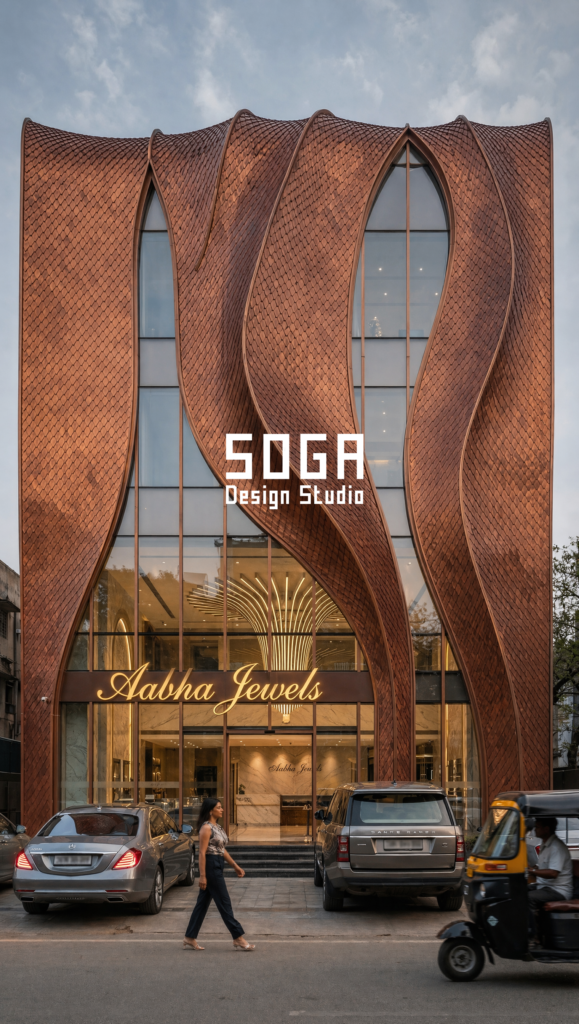
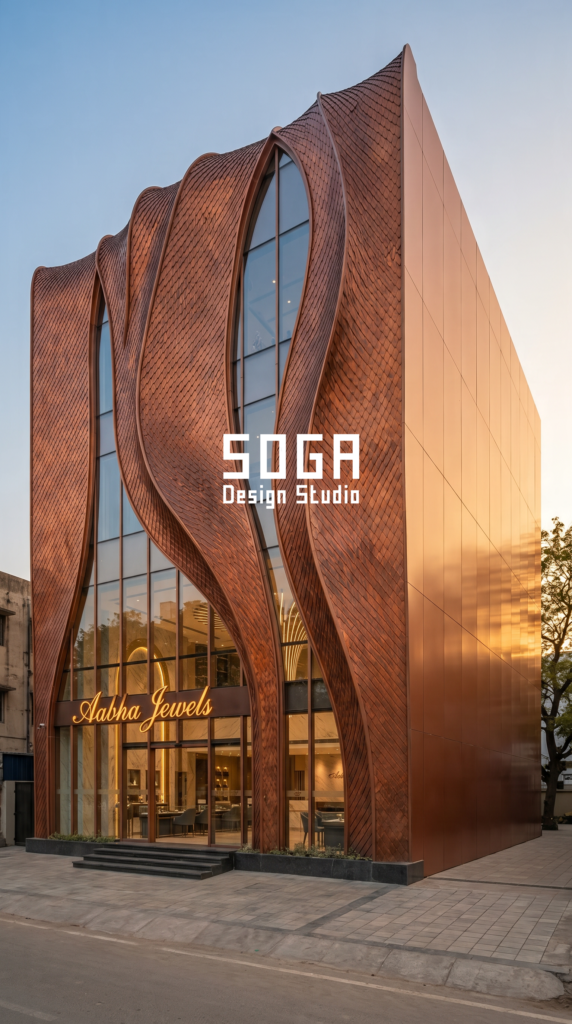
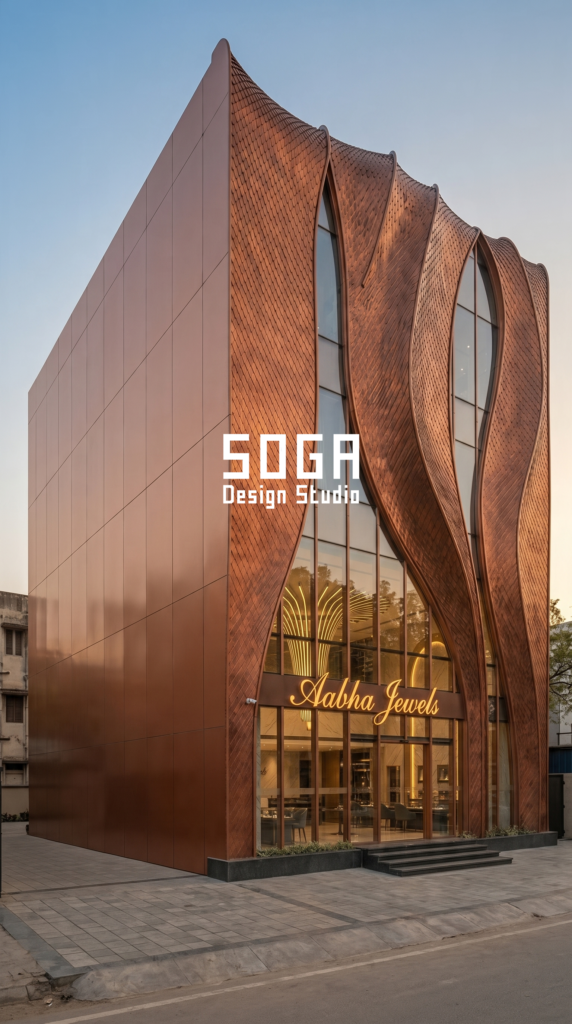
This is the conceptual DNA of the Aabha Jewels facade: raw copper at the moment of artistic transformation. The five structural fins that rise from street level and billow outward — weaving through the glass curtain wall, pulling back, folding in — are not architectural columns. They are the fingers of the jewellery artist, preserved in metal, mid-motion.
The wave form is parametrically computed. Each fin follows a spline curve derived from fluid dynamics studies of viscous metal flow. The geometry is the physics. The beauty is the engineering.
Material: Copper Shingles — Craft at Micro Scale
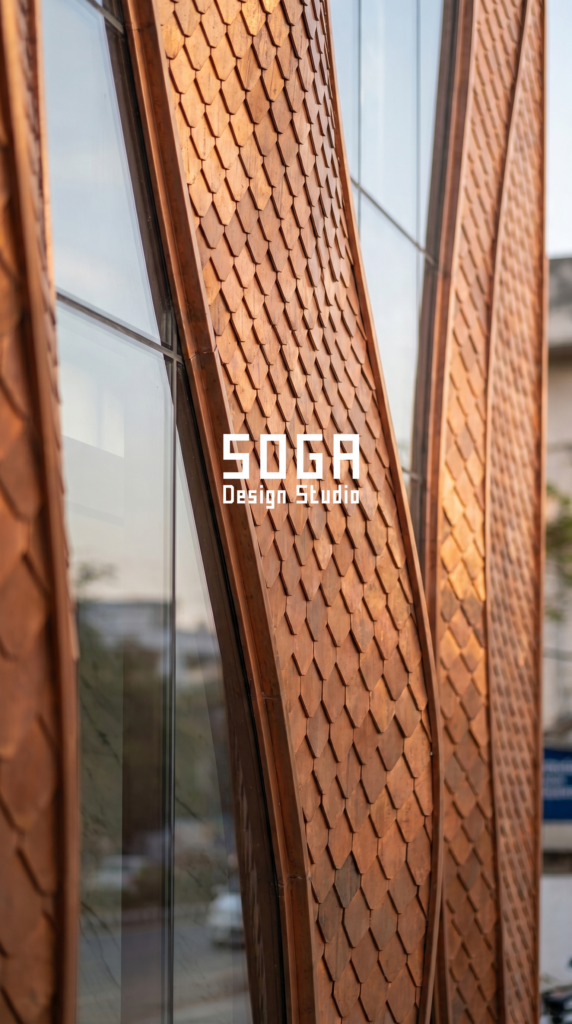
If the wave form is the macro-gesture — the sweep of the artist’s hand — the copper shingles are the micro-texture: the individual hammer marks, the scale-by-scale evidence of labour, the tactile proof that a human made this.
Each shingle is a small curved copper tile, shaped to overlap the next like scales on a living surface. Under direct sunlight, the shingle field reads as a single warm bronze mass. As light rakes across the surface at morning and evening, each individual tile casts its own micro-shadow — and the facade appears to breathe, to animate. At night, with the retail interior glowing warm gold behind the glass, the copper fins become lanterns: each shingle catching and returning interior light differently depending on its position in the wave geometry.
Copper shingles are also a technically superior choice for India:
- Self-protecting — copper’s natural patina (cuprous oxide) forms a stable layer requiring no painting or regular maintenance
- Long-lived — properly detailed copper facades have 60–80 year lifespans in Indian climate conditions, far exceeding ACP or stone cladding
- Thermally responsive — the shingle system creates a ventilated cavity behind panels, reducing heat transmission into the retail space
- Fabrication-precise — every shingle was CNC-profile-cut in SOGA’s in-house digital fabrication facility to millimetre tolerance on the curved surface geometry
The Wave Geometry: Parametric Structure, Not Decoration
The five structural fins are each unique — generated by the same parametric algorithm but with different input parameters: height, lean, outward billow, window void size. The algorithm defines the relationship between these variables; the design team adjusts inputs until the composition achieves the desired tension between each fin and its neighbours.
The result is a facade where every element is individually computed but the whole reads as inevitable — as if this is the only form the building could ever have taken. This is the signature of genuinely parametric design: complexity that reads as necessity.
The glass curtain wall reads as the negative space between the copper solids — the voids through which the jewellery interior glows at dusk. The interaction between copper masses and glass voids creates a second-order visual effect: the store interior, lit in warm gold, appears to be cradled by copper hands.
Street Presence and the Experience of Arrival
From the street, Aabha Jewels does something rare for commercial architecture in India: it earns attention without demanding it. It does not shout colour or chase visual novelty. It simply possesses a quality — weight, warmth, motion — that is different in kind from the buildings around it, not merely different in degree.
The copper patinas at its own rate across the facade, the fins aged by sun and rain into their own individual characters. Five years from completion, no two fins will read exactly the same colour. The building will continue to evolve — an architecture that improves with time, like the jewellery it houses.
The entrance — framed by two converging wave fins pulling inward toward the doorway — creates a moment of compression and release: the street contracts to a threshold, then opens into the warmth of the interior. Every major decision in the facade design was also a decision about the experience of arrival.
Technical Execution: One Team, End to End
The Aabha Jewels facade was designed, engineered, fabricated, and installed entirely by SOGA Design Studio — the only parametric facade specialist in India holding all four capabilities in-house.
- Parametric design — computed in Rhinoceros 3D with Grasshopper scripts developed specifically for the copper shingle-on-curved-surface system
- Facade engineering — structural calculations for each fin’s fixing loads, wind pressure resistance, and thermal movement allowances
- CNC fabrication — all copper shingles and structural steel armature fabricated at SOGA’s Gurugram facility
- Site installation — SOGA’s team managed alignment, fixing, and sealant detailing so the as-built facade matched the parametric model exactly
The single-team delivery eliminated the coordination gaps that typically cause quality loss in complex facade projects in India — where design intent is diluted at each transfer between architect, contractor, and subcontractor.
Project Details
| Project | Aabha Jewels |
| Type | Commercial — Jewellery Retail Flagship |
| Design Studio | SOGA Design Studio, Gurugram |
| Facade System | Copper shingle cladding on parametric wave structural fins |
| Primary Material | CNC-fabricated copper shingles |
| Concept | Molten copper at the moment of jewellery forming — wave form from fluid metal dynamics |
| Delivery | Design + Engineering + CNC Fabrication + Installation (in-house) |
Frequently Asked Questions
What material is used on the Aabha Jewels facade?
The Aabha Jewels facade uses CNC-fabricated copper shingles installed in an overlapping scale pattern across five parametric wave fins. Copper was chosen for its jewellery associations, natural self-patination, thermal performance, and 60–80 year lifespan in Indian climate conditions.
Who designed the Aabha Jewels facade?
The Aabha Jewels facade was designed, engineered, fabricated, and installed by SOGA Design Studio — a parametric facade specialist based in Gurugram, India. SOGA managed the complete project scope in-house, from computational design through site completion.
What is the design concept of the Aabha Jewels facade?
The concept is raw copper at the moment it is shaped by a master jewellery artist — when molten metal flows and the craftsperson guides it into form. The five structural wave fins represent that fluid organic movement. The copper shingle texture captures the micro-scale evidence of craft. The facade embodies the meaning of “Aabha” — radiance — as a material and spatial condition, not a decorative effect.
Can copper shingle facades be used for commercial buildings in India?
Yes. Copper shingles are highly suitable for Indian commercial buildings. Copper’s natural oxide patina forms a stable self-protecting layer with minimal maintenance. The ventilated cavity reduces heat gain. SOGA Design Studio has developed a CNC-fabricated copper shingle system applicable to curved and parametric forms — as demonstrated at Aabha Jewels.
What is a parametric wave facade?
A parametric wave facade uses computational algorithms to define structural fins or surfaces whose form follows mathematically described curves. At Aabha Jewels, curves were derived from fluid dynamics of molten metal. Each fin is unique — generated by the same algorithm with different input parameters — producing a composition that is systematically generated yet visually individual. SOGA uses Rhinoceros 3D and Grasshopper for all parametric facade geometry.
How does SOGA Design Studio approach jewellery store facade design in India?
SOGA begins every commercial facade project with a material and concept investigation specific to the brand’s identity. For Aabha Jewels, this meant studying copper — the original jewellery metal — and the forms it takes when worked by a craftsperson. The result is not a generic commercial skin but a building-scale expression of the store’s identity. SOGA’s in-house fabrication ensures this concept-to-completion integrity throughout delivery.
About SOGA Design Studio: India’s specialist parametric facade design and delivery studio, based in Gurugram. End-to-end facade services — parametric design, facade engineering, CNC digital fabrication, and site installation — for residential, commercial, and NRI clients. 900+ completed projects across India, Dubai, and Singapore. Request a facade consultation.