Where Organic Columns Bloom into Architecture – India’s Most Sculptural Parametric Residence
Parametric design in India is evolving rapidly, and residential architecture is becoming one of its most expressive platforms. Podwave Residence, designed and executed by SOGA Design Studio, is a powerful example of how computational design, organic geometry, and contemporary construction can merge to create a timeless architectural statement that positions Indian parametric architecture at the global forefront.
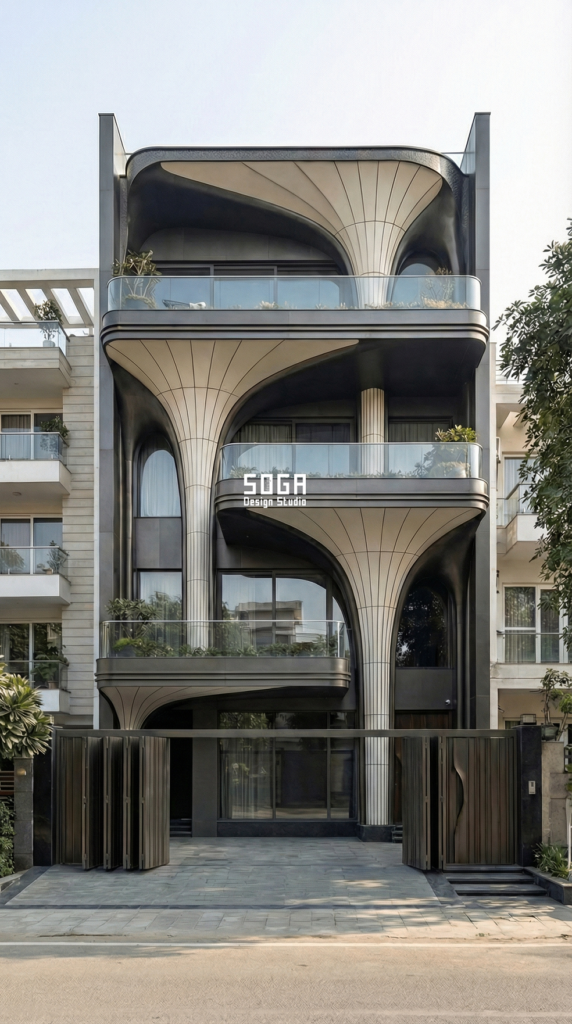
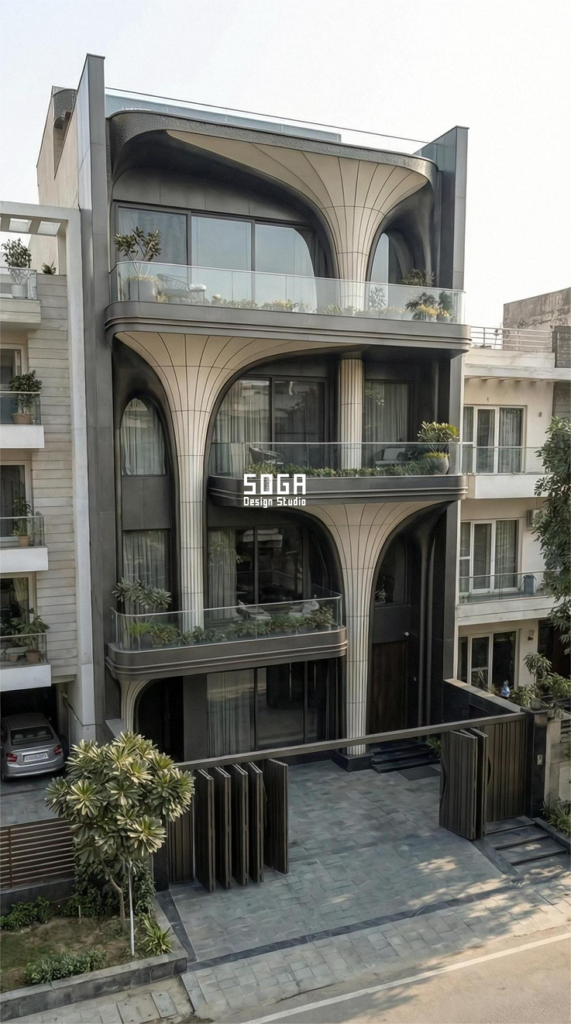
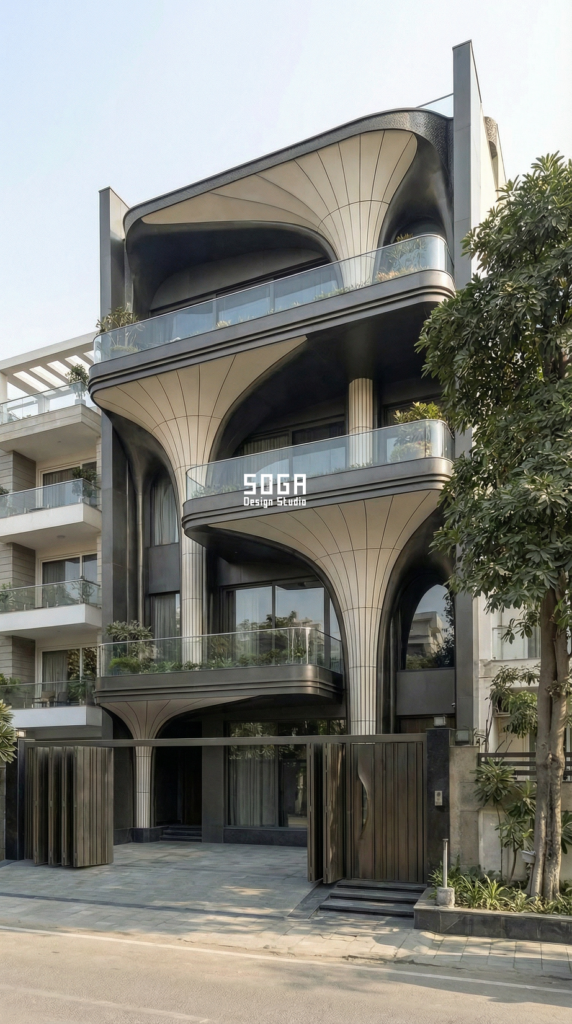
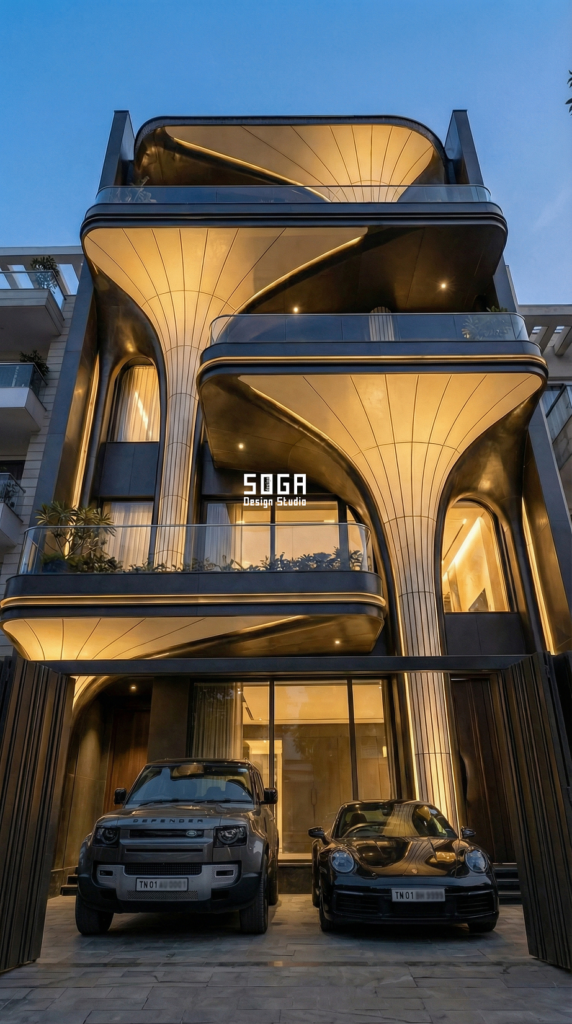
At first glance, the building stands out for its sculptural elevation design. Organic columns rise from the ground and bloom into cantilevered balconies, creating a rhythm that feels both futuristic and deeply natural. This is not just an elevation design—it is a living parametric facade that transforms with light, shadow, and perspective throughout the day. As India and Dubai’s premier parametric design company and leading facade design firm, SOGA Design Studio has created a residence where structure becomes sculpture, where concrete flows like organic growth, and where computational design serves both beauty and performance.
Parametric Columns as Living Architecture
The defining element of Podwave Residence is its revolutionary parametric column system—a biomorphic architecture approach that reimagines how buildings can grow vertically while creating protected outdoor spaces at every level.
Columns That Bloom: Structural Poetry
Organic Growth Pattern: Each column doesn’t simply rise vertically—it expands, flares, and blooms as it ascends, mimicking natural growth patterns found in trees, mushrooms, or coral formations. The base begins relatively slender, then gradually widens as it rises, finally spreading into broad “pod” shapes that support the balcony slabs above.
Parametric Generation: These aren’t hand-sculpted forms—they’re parametrically generated through sophisticated algorithms that define the rate of expansion, the curvature profiles, and the final flared geometry. SOGA Design Studio’s computational design team used custom Grasshopper scripts to generate column variations, testing dozens of flare rates and curve profiles before selecting the optimal configuration.
Structural Integration: The flared column tops aren’t merely decorative—they’re structural elements that support substantial cantilevers. By widening at the top, the columns create broad bearing surfaces that distribute balcony slab loads efficiently, enabling dramatic cantilevers without requiring additional supports or unsightly structural gymnastics.
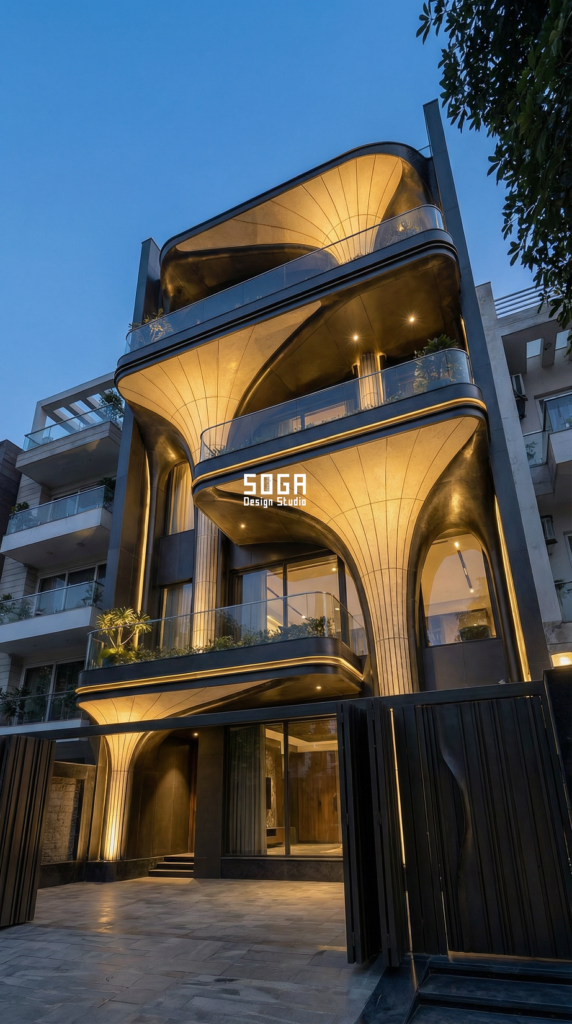
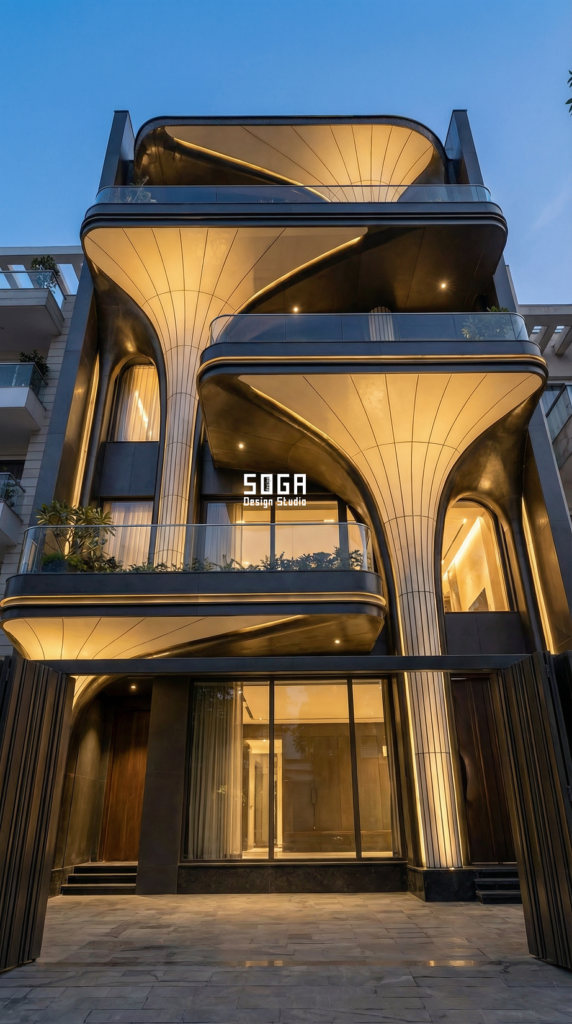
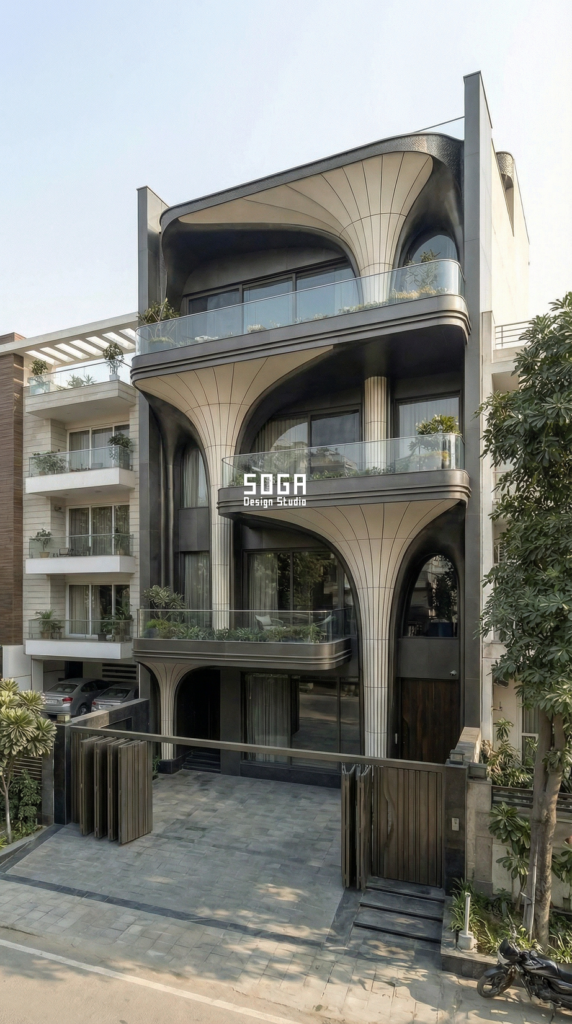
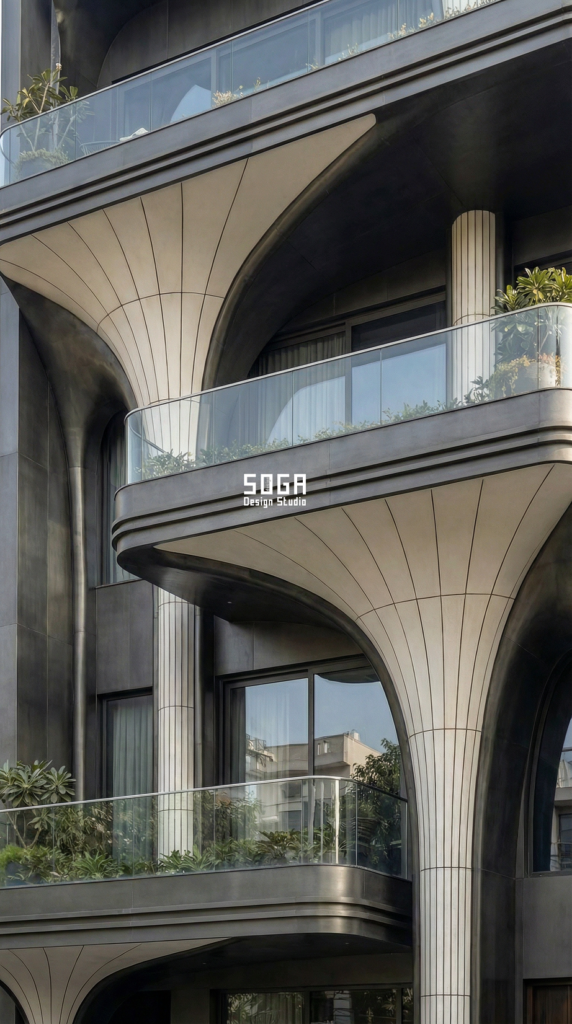
Unified Language: The parametric column system creates architectural coherence across the entire facade design. Every level employs the same formal language—columns bloom into pods that support the next level’s floor—creating rhythmic repetition that unifies the composition while allowing subtle variations in positioning and scale.
Multi-Functional Parametric Design
The parametric columns at Podwave Residence demonstrate how computational architecture serves multiple simultaneous functions:
Self-Shading Balconies: The deep overhangs created by the flared column tops provide substantial solar shading to the balconies and glazing below. In India’s intense sun, this passive shading reduces direct heat gain by approximately 40-50%, significantly decreasing air conditioning loads and improving thermal comfort.
Enhanced Privacy: The three-dimensional column geometry creates privacy screening from neighboring buildings without requiring solid walls. The curved surfaces interrupt direct sightlines while maintaining openness toward desirable views, solving the urban privacy-openness dilemma elegantly.
Thermal Comfort: The deep recesses created by the flared columns generate protected microclimates on each balcony—shaded from direct sun, sheltered from wind, cooler than exposed surfaces. These comfortable outdoor rooms become genuinely usable spaces rather than token balconies too hot or windy for occupation.
Strong Vertical Identity: The repetitive vertical columns create powerful upward visual movement that makes the building appear taller and more elegant. This vertical emphasis distinguishes Podwave Residence from conventional horizontal-banded residential buildings, creating immediate architectural distinction.
This multi-functionality exemplifies SOGA Design Studio’s approach to parametric facade design—where every element serves aesthetic, functional, and experiential goals simultaneously rather than being arbitrary decoration.
Facade Design Optimized for Light & Climate
One of the core strengths of SOGA Design Studio lies in climate-responsive architecture. Podwave Residence is designed to interact intelligently with India’s challenging climate conditions, producing measurable performance benefits alongside aesthetic impact.
Dynamic Light and Shadow
Solar Choreography: The facade is designed to interact with the sun’s movement, producing dynamic light and shadow patterns across the elevation throughout the day. Morning light from the east creates long shadows that emphasize the columns’ depth; midday sun from above highlights the curved undersides of the pod forms; evening light from the west creates dramatic silhouettes.
Diffused Illumination: The curved parametric surfaces diffuse harsh direct sunlight, preventing glare and creating gentle, comfortable illumination. Rather than harsh bright-dark contrasts, the facade creates graduated light transitions that are more visually comfortable for residents.
Shadow Depth: The substantial projection of the flared columns creates deep shadows—sometimes exceeding one meter in depth—that dramatically reduce surface temperatures on shaded walls and glazing. This shadow depth is critical for thermal performance in hot climates.
Temporal Awareness: The constantly changing shadow patterns create temporal awareness—residents subconsciously track time through the facade’s transformation throughout the day. This connection to natural cycles is psychologically beneficial, reducing the disorientation common in artificially-lit buildings.
Night-Time Transformation
Integrated Lighting: In the evening, integrated lighting highlights the sculptural geometry of the parametric columns. Uplighting from beneath each flared pod creates dramatic effects, transforming the building into an illuminated landmark within the neighborhood.
Warm Glow: Interior lighting visible through floor-to-ceiling glazing creates a warm glow that contrasts with the cooler exterior lighting, establishing inviting nighttime character. The building appears to glow from within like a living organism.
Urban Presence: The illuminated facade ensures Podwave Residence maintains strong architectural presence 24 hours daily, contributing positively to the urban nighttime environment rather than becoming a dark void after sunset.
Climate-Responsive Performance
Natural Ventilation: The recessed balconies and layered facade depth enhance natural ventilation. The deep overhangs create pressure differentials that draw air through operable windows, enabling natural cooling during temperate seasons and reducing dependence on artificial cooling.
Wind Protection: While enabling ventilation, the curved column geometry also provides wind protection—preventing uncomfortable wind speeds on balconies while allowing gentle breezes. This creates outdoor spaces that are usable even on windy days.
Rain Protection: The generous overhangs provide rain protection, allowing balconies to remain usable during light rain and preventing water from reaching glazing and wall surfaces—reducing weathering and maintenance requirements.
Passive Cooling: The combined effects of solar shading, natural ventilation, and thermal mass management reduce mechanical cooling requirements by an estimated 35-45% compared to conventional glass-facade buildings—demonstrating that parametric design serves sustainability goals.
This climate responsiveness aligns with SOGA Design Studio’s larger vision of sustainable parametric architecture across India and Dubai, where climate-sensitive design is essential for both environmental responsibility and occupant comfort.
Biomorphic Design Meets Contemporary Luxury
Podwave Residence reflects a sophisticated biomorphic architecture approach—design that draws inspiration from natural organic forms while maintaining contemporary luxury aesthetics:
Nature-Inspired Geometry
Organic Curves: Every surface flows smoothly without sharp corners or abrupt transitions. The continuous curves reference natural forms—shells, bones, plants—creating subconscious comfort rooted in humans’ evolutionary affinity for organic shapes.
Growth Metaphor: The columns’ expansion as they rise mimics biological growth patterns, creating subliminal associations with vitality, health, and natural processes. This makes the architecture feel alive rather than inert.
Asymmetric Balance: While maintaining overall compositional balance, the facade avoids rigid symmetry. Like natural organisms, it achieves harmony through balanced asymmetry—creating visual interest while preventing monotony.
Material Expression: The smooth white concrete surfaces emphasize the sculptural qualities of the parametric forms. The monochromatic palette focuses attention on geometry, light, and shadow rather than color or texture, creating timeless elegance.
Global Language, Local Adaptation
Dubai Design Influence: The smooth curves, fluid transitions, and continuous surfaces create a sense of luxury often seen in Dubai’s high-end developments. SOGA Design Studio’s experience in Dubai markets informs the sophisticated aesthetic that appeals to internationally-minded clients.
Indian Urban Context: However, the design is thoughtfully adapted to Indian urban contexts—narrower urban plots, closer neighboring buildings, specific climate conditions. This isn’t imported foreign design but global design language adapted to local realities.
Contemporary Luxury: The project establishes a contemporary luxury aesthetic appropriate to India’s growing affluent class—confident, sophisticated, internationally aware but not derivative. This positions Podwave Residence as exemplar of emerging Indian luxury residential architecture.
SOGA Design Studio: Shaping the Future of Parametric Design
Podwave Residence demonstrates why SOGA Design Studio has established itself as India and Dubai’s leader in parametric architecture design, elevation design, and facade design:
Comprehensive Parametric Capabilities
Computational Design Mastery: The biomorphic columns emerged from sophisticated parametric algorithms developed specifically for this project. Custom scripts controlled the rate of column expansion, curve profiles, structural dimensions, and spacing—generating variations that were evaluated for aesthetics, structural efficiency, shading performance, and cost.
Performance Optimization: Multi-criteria optimization ensured the column geometry served functional goals (shading, privacy, ventilation) while achieving aesthetic impact. This holistic optimization produces better outcomes than purely aesthetic or purely functional approaches.
Structural Engineering Integration: The parametric structural model ensured that the dramatic cantilevers and organic forms could be built safely and economically. Load path analysis, stress evaluation, and material optimization occurred within the parametric workflow rather than as separate post-design analysis.
Digital Fabrication: The complex curved formwork required for the organic concrete columns was designed using parametric tools, generating CNC cutting files for formwork fabrication. This digital workflow made the complex geometries practical to build.
Design-Build Integration
Seamless Delivery: As an integrated design-build firm, SOGA Design Studio maintained control over Podwave Residence from initial concept through final construction, ensuring design intent translated into built reality without dilution through fragmented delivery.
Fabrication Coordination: The team worked directly with concrete contractors and formwork fabricators, providing digital files, technical support, and quality oversight that ensured the curved surfaces were executed to precise specifications.
Construction Innovation: Building biomorphic concrete forms required construction innovations—custom formwork systems, precise surveying, specialized concrete finishing. SOGA’s technical expertise enabled these innovations rather than compromising design for conventional construction convenience.
Portfolio Positioning
Podwave Residence joins SOGA Design Studio’s growing portfolio of parametric residential projects, demonstrating versatility across different formal languages:
Organic Forms: Podwave Residence (biomorphic columns), Anand Vriksham (tree-inspired forms), Vikram Ahuja Residence (flowing curves)
Geometric Patterns: Vaayu House (Para-Tile system), Kanak Jewellery (wave fins), Raja Ram Pune (hexagonal patterns)
Metal Facades: Ramo Jewel (circular patterns), Padmaja Regal Jewellery (lotus motifs), One 9 Group GIFT City (Para Curve Fins)
This portfolio establishes SOGA Design Studio as India’s most versatile parametric design company, capable of applying computational methodologies across diverse aesthetic expressions and material systems.
Parametric Architecture Design: Theory and Practice
Podwave Residence exemplifies how parametric architecture design translates theory into built reality:
Algorithmic Form Generation
Rule-Based Design: Rather than drawing the column shapes manually, SOGA’s computational designers defined rules: “columns expand at rate X as they rise,” “maximum flare radius is Y,” “curve profile follows equation Z.” The computer then generates thousands of columns automatically following these rules.
Variation Within System: While all columns follow the same basic rules, subtle variations in positioning, exact flare rate, and height create visual diversity that prevents monotony. This “variation within system” creates organic quality impossible with rigid repetition.
Optimization Iteration: Dozens of column configurations were generated, each evaluated for structural efficiency, shading performance, privacy effectiveness, and cost. This rapid iteration enabled optimization impossible with manual design methods.
Biomorphic Principles
Natural Inspiration: The column forms draw inspiration from biological structures—tree trunks expanding at branches, mushroom stalks flaring into caps, coral polyps extending from bases. This biomimicry creates forms optimized through millions of years of natural selection.
Structural Efficiency: Biological structures are inherently efficient—using minimum material to achieve maximum strength. The parametric columns’ flared tops distribute loads efficiently, mimicking how trees widen where branches attach.
Visual Comfort: Humans evolved in natural environments filled with organic curves and asymmetric patterns. Biomorphic architecture leverages this evolutionary history to create subconscious comfort and aesthetic preference.
Contemporary Execution
Modern Materials: While inspired by nature, the execution uses contemporary materials—high-strength concrete, structural steel, engineered glass. This fusion of organic form and modern material creates distinctive contemporary character.
Precision Fabrication: Natural forms are irregular and varied; parametric design creates perfect mathematical curves that can be precisely fabricated and constructed. This precision distinguishes architectural biomimicry from literal natural forms.
Performance Integration: Natural organisms optimize for survival and efficiency; parametric biomorphic design optimizes for human comfort, energy performance, and architectural expression. The goals differ but the optimization mindset unites them.
Elevation Design: Creating Architectural Identity
As an exemplar of sophisticated elevation design, Podwave Residence demonstrates how facades create building identity:
Vertical Composition
Rhythmic Repetition: The repeating columns create strong vertical rhythm that organizes the facade and creates visual coherence. This rhythm makes the building readable and memorable—easier to understand and recall than chaotic compositions.
Ground-to-Sky Flow: The columns flow continuously from ground level to roofline without interruption, creating unified vertical movement that makes the building feel taller and more elegant.
Landmark Status: The distinctive elevation ensures Podwave Residence stands out within its urban context, becoming a neighborhood landmark rather than generic background building.
Material and Finish
Monochromatic Elegance: The white concrete surfaces create clean, timeless aesthetic that focuses attention on form and geometry rather than color. This monochromatic approach ensures the architecture won’t feel dated as color trends change.
Surface Quality: The smooth concrete finish requires meticulous formwork and finishing—demonstrating construction quality that reinforces the luxury positioning.
Contrast Elements: Dark window frames and balcony railings provide subtle contrast against the white concrete, preventing monotony while maintaining overall coherence.
Day-Night Character
Daytime Sculpture: During daylight, the facade reads as sculptural object—solid form carved by light and shadow. The three-dimensional depth creates constantly changing visual character as sun angles shift.
Nighttime Glow: After dark, the transformation is dramatic. Illuminated from within and highlighted by architectural lighting, the building becomes glowing presence—warm, inviting, architecturally distinguished.
Technical Innovation: Building Biomorphic Concrete
Executing Podwave Residence’s organic forms required significant technical innovation:
Parametric Formwork Design
Digital Formwork: The curved column forms required custom formwork designed parametrically. SOGA’s team generated 3D formwork models from the parametric design, exported cutting files for CNC fabrication, and coordinated formwork assembly.
Reusable Systems: Where possible, formwork systems were designed for reuse across multiple identical columns, controlling costs while maintaining geometric precision.
Quality Control: Each formwork assembly was laser-surveyed before concrete pouring to verify geometric accuracy, preventing costly errors.
Concrete Technology
High-Performance Mix: The complex forms required self-consolidating concrete that could flow completely into intricate formwork without voids or honeycombing.
Finishing Excellence: The smooth surfaces visible in the final building required expert finishing—troweling, grinding, and sealing to achieve uniform appearance.
Structural Coordination: Reinforcing steel within the organic columns required careful coordination—bars needed to follow the curved geometries while maintaining adequate cover and spacing.
Construction Sequencing
Vertical Growth: The building was constructed floor-by-floor, with each level’s columns forming the base for the next level’s balcony slabs. This required careful coordination and precise surveying to maintain alignment.
Cantilever Construction: The substantial cantilevers required temporary shoring during construction, carefully positioned to avoid interfering with the complex geometries.
Safety Systems: The irregular facade geometry complicated standard scaffolding and safety systems, requiring custom solutions that protected workers while accommodating the organic forms.
Sustainability Through Parametric Optimization
Podwave Residence demonstrates environmental benefits of parametric design:
Passive Performance
Solar Shading: The 40-50% reduction in solar heat gain translates to significantly lower cooling energy throughout the building’s 50+ year lifespan—measurable environmental benefit and operating cost savings.
Natural Ventilation: Enhanced natural airflow reduces mechanical cooling requirements during temperate seasons, improving indoor air quality while reducing energy consumption.
Daylighting: Despite substantial shading, the facade maintains excellent natural daylight penetration, reducing artificial lighting energy during daytime hours.
Material Efficiency
Structural Optimization: Parametric structural analysis minimized concrete quantities while maintaining safety margins, reducing embodied carbon by approximately 15-20% compared to non-optimized approaches.
Durability: The high-quality concrete and meticulous construction ensure multi-generational service life, avoiding premature replacement waste.
Thermal Mass: The substantial concrete structure provides thermal mass that moderates interior temperature swings, reducing peak cooling loads.
Urban Environmental Quality
Microclimate: The shaded balconies and recessed facades create cooler microclimates that benefit not just residents but contribute to reducing urban heat island effects.
Aesthetic Contribution: Beautiful buildings inspire care and maintenance, lasting longer and aging more gracefully than generic structures—the ultimate sustainability.
The Future of Residential Parametric Design
Podwave Residence points toward the future of luxury residential architecture in India:
Organic Becomes Accessible: As parametric tools mature and fabrication capabilities expand, biomorphic forms become economically accessible beyond trophy projects.
Performance Primacy: Future luxury will be defined not just by materials and finishes but by measurable performance—comfort, efficiency, health, durability.
Climate Adaptation: As climate challenges intensify, passive design strategies like those at Podwave become essential rather than optional.
Architectural Identity: In crowded urban markets, distinctive architecture creates real estate value through instant recognition and premium positioning.
Digital Integration: The construction industry’s digital transformation—BIM, parametric design, digital fabrication—will make projects like Podwave the norm rather than exception.
Conclusion: Blooming Architecture
Podwave Residence is not just a house—it is a statement about where Indian architecture design is headed. Through SOGA Design Studio’s mastery of parametric design, computational architecture, and facade design, organic columns bloom into functional sculpture, concrete flows like living growth, and residential architecture achieves global sophistication while remaining responsive to local climate and culture.
As India and Dubai’s premier parametric design company and leading facade design firm specializing in elevation design and biomorphic architecture, SOGA Design Studio proves that Indian architectural expertise can lead globally rather than follow. Podwave Residence establishes new benchmarks for what’s possible when algorithms meet artistry, when structure becomes sculpture, and when homes grow like organisms rather than being merely assembled.
With projects spanning parametric facades, architecture design, elevation design, and integrated design-build delivery, SOGA Design Studio continues to redefine how buildings are conceived and executed. Podwave Residence demonstrates that the future of Indian residential architecture is parametric, organic, performative, and profoundly beautiful.
As parametric design gains momentum in both India and Dubai, SOGA Design Studio remains committed to pushing boundaries, blending technology, craft, and spatial experience into iconic built forms that transform how we live, breathe, and experience architecture.
About SOGA Design Studio
SOGA Design Studio is India and Dubai’s premier parametric design company, computational architecture firm, and facade design and build specialist. We create distinctive architectural experiences through advanced algorithmic design, biomorphic geometry, organic facade systems, and comprehensive integrated delivery. Our expertise spans parametric facade design, elevation design, architecture design, sculptural residential architecture, and design-build execution across India and Dubai.
Our portfolio includes Podwave Residence (biomorphic columns), Vaayu House (Para-Tile kinetic facade), Anand Vriksham (living tree facade), Padmaja Regal Jewellery (lotus motifs), Kanak Jewellery (wave fins), One 9 Group GIFT City (Para Curve Fins), and numerous other landmark parametric projects throughout India.
For inquiries about parametric architecture design, biomorphic facade design, organic elevation design, sculptural residential architecture, or integrated design-build delivery anywhere in India or Dubai, contact SOGA Design Studio—where columns bloom, facades breathe, and architecture grows.
Project Details:
- Project Name: Podwave Residence
- Design and Build: SOGA Design Studio
- Facade System: Biomorphic parametric columns with flared “pod” tops
- Key Features: Organic columns that bloom into balcony slabs, self-shading overhangs, enhanced privacy, natural ventilation, sculptural concrete forms
- Materials: White architectural concrete, structural steel, engineered glass, contemporary finishes
- Building Type: Luxury residential
- Performance: 40-50% solar heat gain reduction, enhanced natural ventilation, improved thermal comfort
- Design Approach: Biomorphic parametric design with computational optimization and climate-responsive performance
- Style: Contemporary organic architecture, biomorphic design, sculptural modernism
- Significance: Demonstrates how parametric design in India achieves global sophistication in residential architecture, establishing new standards for organic contemporary luxury