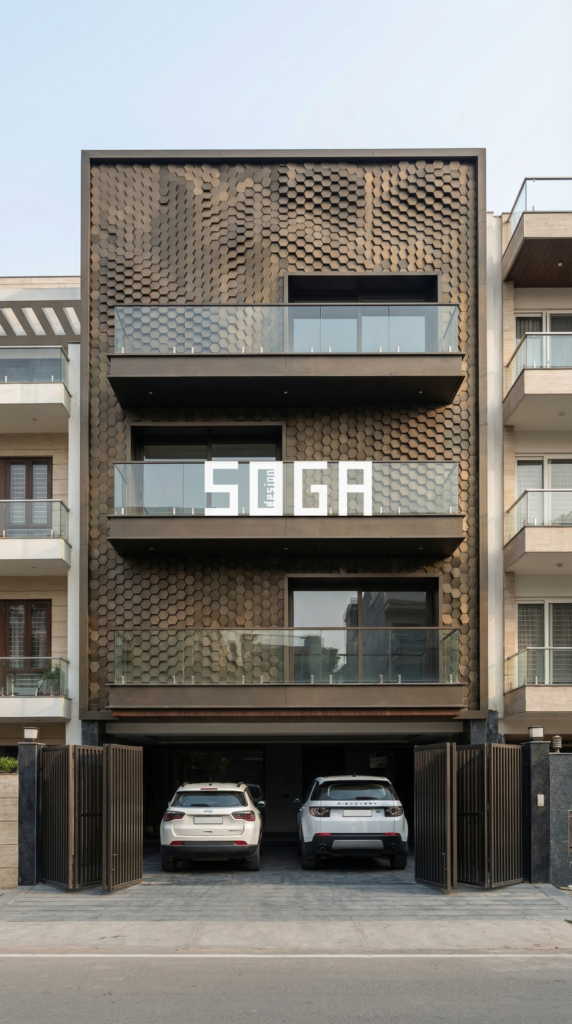
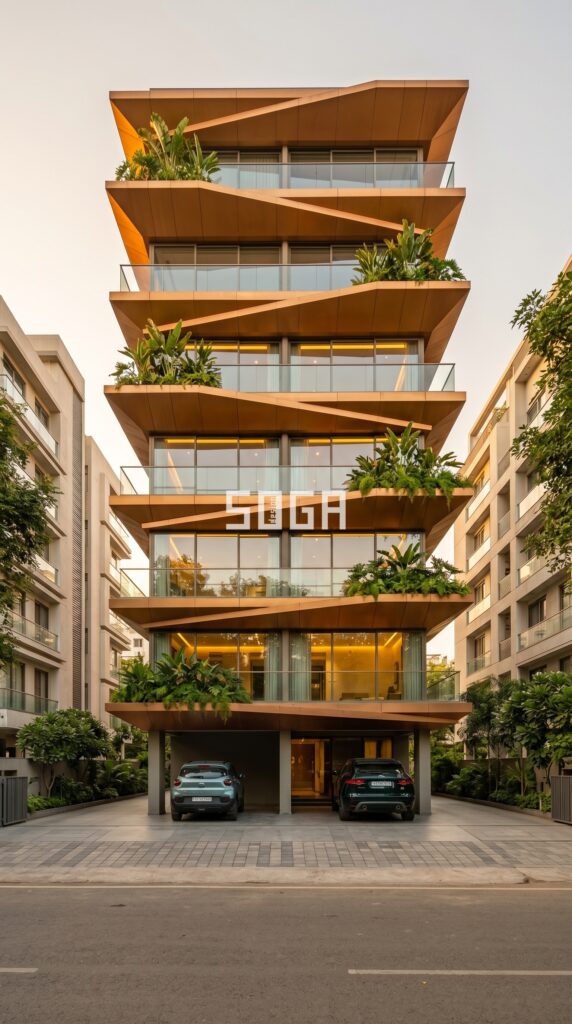
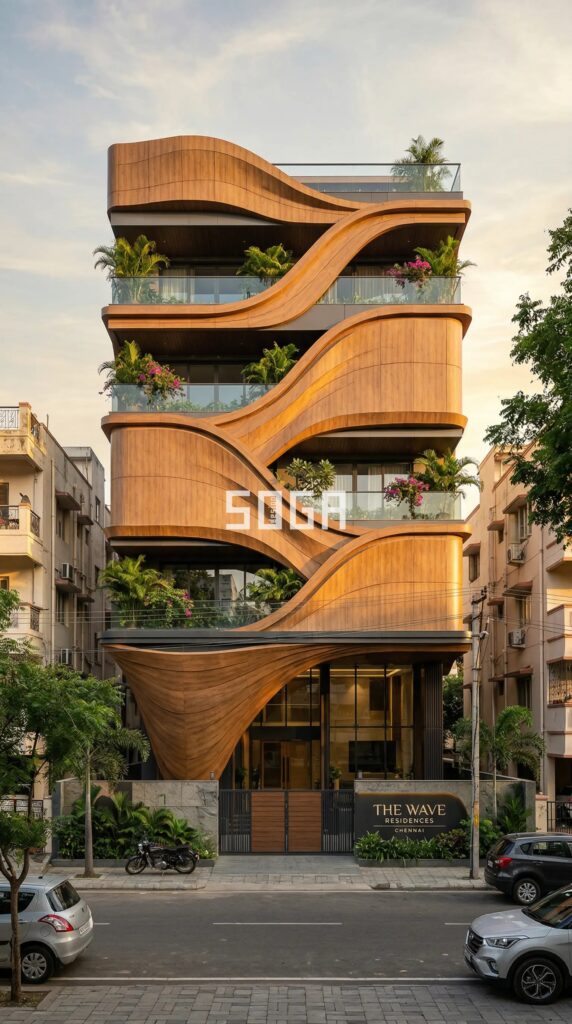
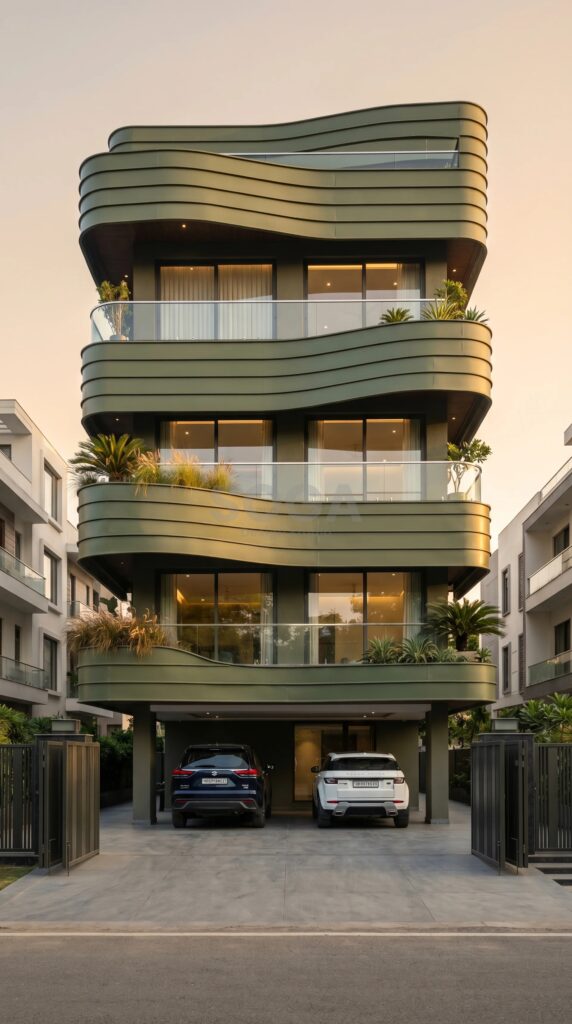
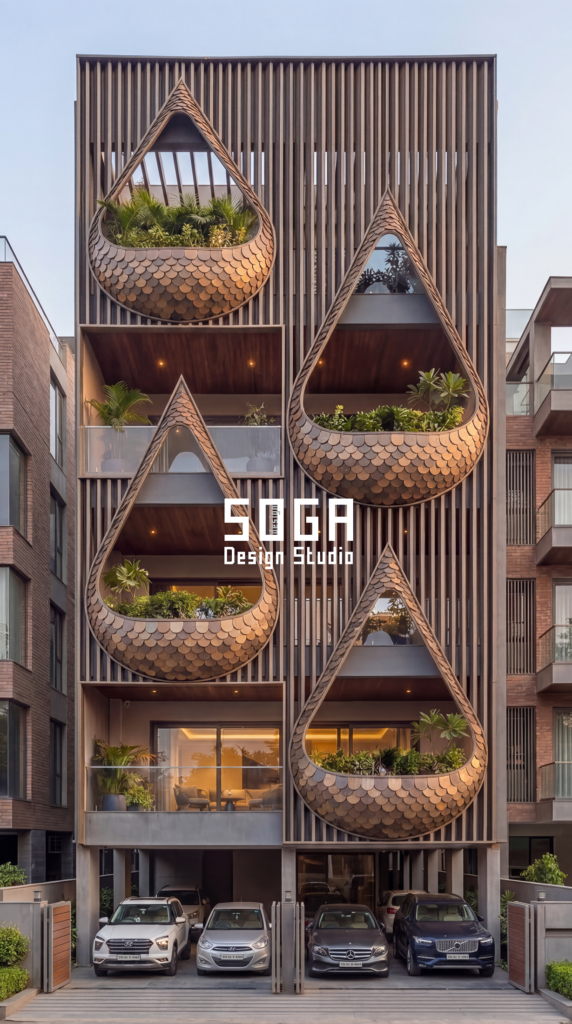
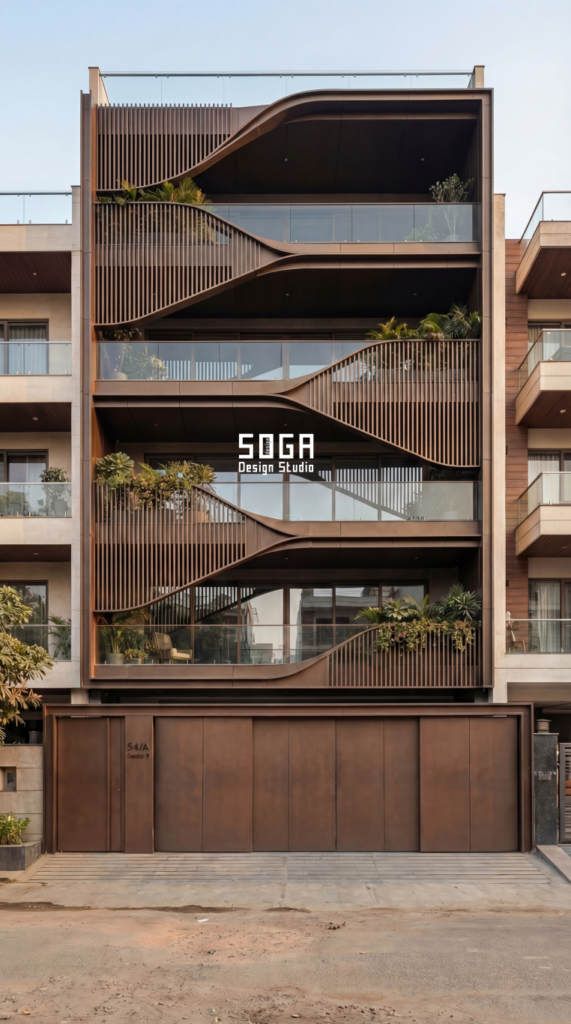
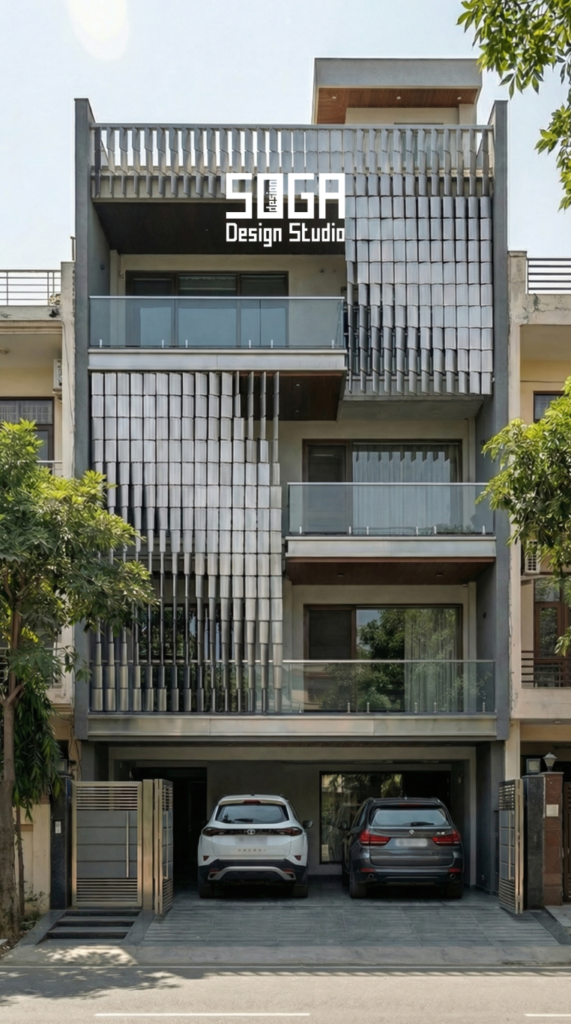
By SOGA Design Studio | Gurugram, India | Updated May 2026
Parametric design is no longer a niche skill — it’s becoming the defining competency that separates India’s next generation of architects from the rest. But with so many questions about tools, salaries, courses, and career paths, it can be hard to know where to start.
At SOGA Design Studio, we’ve been practicing parametric and computational design in India since our founding, working on complex facades, institutional buildings, and mixed-use developments across Gurugram, Delhi NCR, and beyond. Our founders — Sonali Jaiswal and Gajender Sharma — answer the 40 most common questions we receive from aspiring parametric designers every week.
Whether you’re a fresh architecture graduate, a working professional looking to upskill, or a firm principal curious about integrating computational design — this guide is for you.
Section 1: Getting Started with Parametric Design (Q1–Q6)
Q1. What exactly is parametric design, and how is it different from regular architecture?
Parametric design is a method where you define the rules and relationships between design elements rather than drawing fixed shapes. Instead of drawing a wall at a specific height, you define: “wall height = floor-to-ceiling height × 0.85, where floor-to-ceiling height is a variable.” Change one parameter and everything updates instantly.
Traditional architecture involves direct manipulation — you draw, copy, adjust. Parametric design involves indirect manipulation — you set up logic, then explore thousands of design variations by changing inputs. It’s the difference between sculpting by hand and programming a robot sculptor.
The practical result: parametric buildings can respond to site-specific factors (sun angles, wind, views), can be fabricated with high precision, and can be optimized for performance (energy, structure, cost) in ways that hand-drafting simply cannot achieve.
Q2. Do I need a programming background to learn parametric design?
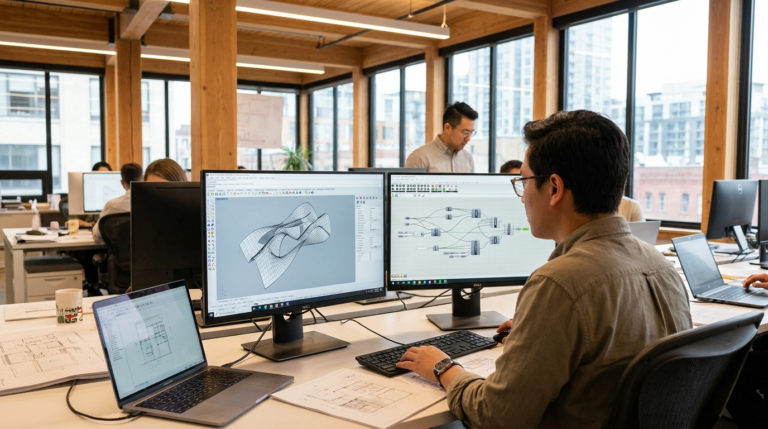
No — and this surprises most people. Tools like Grasshopper (for Rhino) use a visual programming interface where you connect blocks (called “nodes” or “components”) with wires instead of writing lines of code. If you can think logically and break a problem into steps, you can learn Grasshopper without any prior coding experience.
That said, if you eventually want to go deeper — writing custom scripts, automating repetitive tasks, or building your own plugins — learning some Python (via GhPython) or C# will make you significantly more powerful. But it’s optional for 80% of parametric design work.
At SOGA, roughly half our team came from traditional architecture backgrounds with no programming experience. Within 6 months of focused Grasshopper practice, they were contributing meaningfully to complex facade projects.
Q3. What’s the minimum qualification to enter parametric design in India?
There is no regulatory minimum — parametric design is a skill, not a licensed profession category in India. However, practically speaking:
- B.Arch or equivalent: Strongly preferred by firms, as it gives you the design vocabulary and construction understanding that makes parametric work meaningful rather than just aesthetic.
- Engineering (civil/mechanical/product design): Valid entry point, especially if the role is computational/fabrication-focused.
- Self-taught designers: Portfolio matters more than degree. If you can demonstrate real projects using Grasshopper, Rhino, and ideally Karamba3D or Ladybug, many boutique firms will hire you.
In India’s growing parametric scene, a strong portfolio on Behance or your own website often outweighs a certificate from a prestigious institution.
Q4. How long does it realistically take to become job-ready in parametric design?
Here’s an honest timeline based on what we’ve seen:
- 3 months: You can use Grasshopper for basic parametric modeling — grids, panels, attractors. You understand the logic of data trees (a critical concept).
- 6 months: You can tackle real project tasks — facade panelization, structural optimization inputs, basic environmental analysis with Ladybug.
- 12 months: You can lead parametric design on a small-to-mid project, write basic Python/GhPython scripts, and present your logic to clients.
- 2–3 years: You’re a senior parametric designer who can design complex systems, manage fabrication data, and mentor juniors.
These timelines assume consistent practice (1–2 hours daily) plus real project exposure. Online courses alone without project application will take 2× longer to reach the same level.
Q5. Can I learn parametric design while working at a traditional architecture firm?
Yes — and we’d argue it’s one of the best paths. Here’s why: you already have access to real projects, real clients, and real constraints. Learning Grasshopper in the context of an actual building problem is far more effective than tutorial exercises.
Practical strategies:
- Volunteer to handle the 3D modeling on projects — this gets you into Rhino daily.
- Spend 30–45 minutes every morning before office work on Grasshopper tutorials.
- Identify one problem at your current firm (e.g., repetitive facade panel layouts) and solve it with Grasshopper. Show your manager the result.
- Propose a parametric study for an upcoming project — even a simple sun-shading analysis with Ladybug demonstrates value immediately.
Most firms in India will encourage this — parametric capability is a competitive advantage they want in-house.
Q6. Is parametric design only for facade projects, or does it apply across architecture?
Parametric design applies across the entire building lifecycle and architectural typology — facades are just the most visually striking application. Other significant uses include:
- Structural optimization: Using Karamba3D or Millipede to optimize beam sizes, shell geometries, and material use.
- Urban planning: Generating massing options based on FAR, setback, and sunlight rules.
- Interior design: Parametric ceiling patterns, acoustic panel arrays, custom furniture.
- MEP coordination: Grasshopper can interface with Revit via Rhino.Inside.Revit for complex MEP routing.
- Fabrication & manufacturing: Automating CNC cut files, nested panel layouts, and assembly instructions directly from the 3D model.
- Environmental performance: Solar analysis, wind simulation, daylight optimization using Ladybug & Honeybee.
In India, the market currently leads with facades and institutional interiors, but structural and urban applications are growing fast, especially in Tier 1 cities.
Section 2: Tools & Software (Q7–Q14)
Q7. Rhino + Grasshopper vs. Dynamo (Revit) — which should I learn first?
For parametric design as a creative and fabrication-focused practice: Rhino + Grasshopper. For BIM integration in corporate AEC environments: Dynamo. Here’s the breakdown:
| Factor | Rhino + Grasshopper | Dynamo (Revit) |
|---|---|---|
| Design freedom | ⭐⭐⭐⭐⭐ | ⭐⭐⭐ |
| BIM integration | ⭐⭐ (via Rhino.Inside) | ⭐⭐⭐⭐⭐ |
| Fabrication output | ⭐⭐⭐⭐⭐ | ⭐⭐ |
| Plugin ecosystem | ⭐⭐⭐⭐⭐ | ⭐⭐⭐ |
| India market demand | ⭐⭐⭐⭐⭐ | ⭐⭐⭐ |
| Learning curve | Medium | Medium |
| Cost | ~₹45,000/yr (Rhino) | Included in Revit |
Our recommendation: Start with Rhino + Grasshopper. Once you’re fluent, Dynamo takes 2–3 weeks to pick up because the visual programming logic is similar. The reverse is harder — Dynamo fluency doesn’t easily transfer to Grasshopper’s richer ecosystem.
Q8. What Grasshopper plugins are essential for a parametric designer in India?
Core plugins every parametric designer should know:
- Ladybug + Honeybee: Environmental analysis — solar radiation, wind, daylight. Essential for climate-responsive design (critical in India’s varied climate zones).
- Karamba3D: Structural analysis within Grasshopper. Useful for any load-bearing parametric geometry.
- Kangaroo2: Physics simulation and form-finding. Great for tensile structures, hanging chains, mesh relaxation.
- Lunchbox: Panel and surface division tools. Speeds up facade work dramatically.
- Weavebird: Mesh subdivision and smoothing. Used for organic forms.
- Human: UI creation within Grasshopper — makes your scripts presentable to clients.
- Pufferfish: Advanced morphing and blending operations.
- Elk: Import OpenStreetMap data for urban-scale parametric work.
All of these are free except Karamba3D (which has a free limited version). Start with Ladybug — it immediately adds real-world value to any Indian project by quantifying solar performance.
Q9. How much does Rhino cost in India, and are there student discounts?
As of 2026:
- Rhino 8 (full commercial): ~₹45,000–₹50,000 one-time purchase (perpetual license). No annual subscription required.
- Rhino student/educational license: ~₹5,500–₹6,000 (available through authorized resellers with valid student ID). This is a massive discount and valid for personal, non-commercial use during studies.
- Rhino 90-day trial: Fully functional, free — enough time to complete a substantial self-learning program.
- Authorized reseller in India: DesignTech Systems is a primary distributor. McNeel (Rhino’s maker) also sells directly online in USD.
Grasshopper is bundled free with Rhino — no separate purchase needed.
Q10. Do I need a high-end computer to run parametric design software?
For getting started: No. For production work with complex models: Yes. Here’s a practical guide:
- Minimum (learning/tutorials): 16GB RAM, i5/Ryzen 5, any decent dedicated GPU (even GTX 1650). ₹50,000–₹70,000 range laptop.
- Recommended (professional use): 32GB RAM, i7/Ryzen 7, NVIDIA RTX 3060 or better. ₹1,00,000–₹1,50,000 range.
- Workstation (complex simulation): 64GB RAM, i9/Ryzen 9 or Xeon, RTX 3080/4090 or equivalent. ₹2,00,000–₹3,50,000.
Key note: Grasshopper is primarily CPU-bound, not GPU-bound. For most parametric work, invest in CPU cores and RAM first. GPU matters more for rendering (V-Ray, Enscape) than Grasshopper computation. If budget is tight, a ₹70,000 laptop + good tutorials will get you far.
Q11. What’s the role of AI tools like Midjourney or Stable Diffusion in parametric design?
AI image generation tools have become a powerful complement to parametric design — primarily in the concept and client presentation phase. Here’s how leading parametric studios in India use them:
- Concept ideation: Generate mood images for early client presentations before detailed modeling begins. Saves 2–3 days of rendering time in early design stages.
- Material visualization: Quickly visualize how a parametric facade system would look in different materials (brushed steel vs. terracotta vs. perforated aluminum).
- Client communication: AI renders help non-technical clients understand complex geometric forms that are hard to appreciate from technical drawings alone.
- Not a replacement for modeling: AI can’t generate fabrication-ready geometry. The parametric model is still required for construction documentation, structural analysis, and fabrication.
At SOGA, we use Higgsfield AI for generating high-quality architectural visualizations. It produces photorealistic output that captures the depth and materiality of parametric facades better than standard rendering tools for initial client presentations.
Q12. Should I learn BIM (Revit) alongside parametric design?
Yes — especially if you want to work at larger firms or on government/institutional projects in India. Here’s the practical reality:
Most major Indian infrastructure and commercial projects are now mandated to use BIM (the government’s BIM mandate is being rolled out for projects above ₹100 crore). Firms are therefore expected to deliver Revit models as part of project deliverables.
The good news: Rhino.Inside.Revit (a free plugin) allows you to run Grasshopper inside Revit, bridging parametric design with BIM documentation. This is increasingly the workflow at sophisticated Indian firms — design in Rhino/Grasshopper, document in Revit, link via Rhino.Inside.
Our advice: Get Grasshopper-proficient first (6–12 months), then invest 2–3 months in Revit basics. You don’t need to be a Revit expert — you need to understand BIM logic enough to coordinate with the documentation team.
Q13. Is Blender a viable alternative to Rhino for parametric architecture?
Blender has become remarkably capable, and its Geometry Nodes system (introduced in Blender 3.x) is a genuine visual programming environment similar to Grasshopper. For certain use cases, it’s a compelling alternative:
- Blender advantages: Free, excellent renderer (Cycles, EEVEE), strong animation capabilities, active development community, Python scripting built-in.
- Blender limitations for architecture: NURBS surfaces (critical for precise facade geometry) are inferior to Rhino’s. CAD data import/export (DWG, STEP) is not as reliable. Fabrication-ready outputs require additional plugins.
Our verdict: Blender Geometry Nodes is excellent for conceptual/visualization work and for designers on a tight budget. For production-level parametric facade work that needs to go to fabricators, Rhino + Grasshopper is still the industry standard. Many studios use both — Rhino for geometry generation, Blender for final rendering and animation.
Q14. How important is learning Python/GhPython for parametric design?
It depends on your career trajectory:
- Design-focused role: Python is optional but valuable. Visual Grasshopper components cover 80% of design tasks. You can have a successful parametric career without scripting.
- Computational designer/researcher role: Python is essential. Custom algorithms, machine learning integration, and complex data processing all require scripting.
- Tool developer / plugin creator: C# (via Visual Studio) is the language for Grasshopper plugin development. Python won’t take you this far.
If you do invest in Python, GhPython (Grasshopper’s Python component) is the starting point. From there, Rhinoscript Python gives you full control over the Rhino document. We recommend learning Python basics (variables, loops, functions, lists) before jumping into GhPython — 20 hours of Python fundamentals pays dividends for years.
Section 3: Courses & Learning Path (Q15–Q21)
Q15. What are the best online courses for learning Grasshopper in India?
Based on feedback from our team and network:
- Mode Lab (modelab.us): The gold standard for structured Grasshopper learning. The Grasshopper Primer is free and comprehensive. Paid courses go deep into specific applications.
- Parametric House (parametrichouse.com): Excellent project-based tutorials. Strong on facade and surface geometry — highly relevant for Indian practice.
- Udemy: Several affordable courses (₹500–₹2,000 during sales). Quality varies — check “Parametric Architecture with Grasshopper” courses with 4.5+ star ratings.
- ShapeDiver tutorials: Good for understanding parametric logic for web-based configurators.
- YouTube (free): Jose Luis Garcia del Castillo’s channel, Ngon.io, and Grasshopper3D forums. Excellent for specific techniques and troubleshooting.
- Indian platforms: Novatr (novatr.com) offers structured BIM + computational design courses tailored to Indian market requirements and job preparation.
Our recommended sequence: Free Grasshopper Primer → one structured Udemy course → Parametric House project tutorials → real project application.
Q16. Are there offline parametric design courses or workshops in India?
Yes — the scene has grown significantly post-2022:
- SPA (School of Planning & Architecture), Delhi: Elective computational design modules in their M.Arch program.
- CEPT University, Ahmedabad: Strong computational design culture, workshops throughout the year.
- IIT Kharagpur & IIT Roorkee: Occasional parametric design workshops, particularly for engineering students.
- Private workshops: SOGA Design Studio, along with firms like Footprint, Arudra, and others in Delhi NCR, run periodic 2–3 day Grasshopper workshops. These are hands-on and focused on real Indian project contexts.
- Archasm & Novatr: Online + mentored cohort programs with Indian instructors — a good middle ground between self-study and structured classroom learning.
Follow Archmarathon India and Dezeen Jobs India for announcements of upcoming workshops.
Q17. Does a Master’s degree in computational design help in India?
It’s a strong differentiator — but not a prerequisite. Here’s an honest assessment:
Programs worth considering (international): AA School (London), ETH Zurich DAS, UCL Bartlett, RMIT Melbourne. These are the gold standard and open doors to international practice and academic careers. Cost: ₹25–₹50 lakhs for the full program.
Indian programs: CEPT M.Arch (Computational Design specialization) and SPA M.Arch are emerging options. More affordable (₹2–₹5 lakhs) but have less international recognition currently.
The honest truth for India: A master’s degree in computational design is more valuable if you want to teach, research, or work internationally. For Indian practice, a strong portfolio of real projects often carries more weight with hiring firms than a master’s degree. We’ve hired designers without master’s degrees who outperform those with them, purely based on their Grasshopper portfolio and problem-solving ability.
Q18. What should a parametric design portfolio include to get hired in India?
A strong portfolio for Indian firms should include:
- 3–5 complete projects: Not just pretty renders — show the Grasshopper definition, the logic diagram, the parameter exploration, and the final output. Firms want to see you understand the process.
- At least one facade project: This is the highest-demand skill. Show panelization, solar analysis, or structural integration.
- One environmental analysis project: A Ladybug solar study or Honeybee energy analysis shows you can add performance value, not just aesthetic value.
- One fabrication-ready output: Unrolled panels, CNC files, or an assembly diagram shows you understand how parametric geometry becomes real construction.
- Clear explanations: Write 3–4 sentences per project explaining the design problem, your parametric approach, and the outcome. Partners at firms often review portfolios quickly — don’t make them guess.
- Format: PDF (max 15MB), Behance link, or personal website. Behance is widely used by Indian firms for initial screening.
Avoid portfolios that show only final renders. The process — the Grasshopper screenshots, parameter tables, and iteration studies — is what sets parametric designers apart.
Q19. How can architecture students in India build parametric skills without industry access?
Students have more resources than they realize:
- Food4Rhino: Free community platform for all Grasshopper plugins. Download, experiment, and contribute.
- Archasm competitions: Monthly online architecture competitions, many with parametric-friendly briefs. Entry is free and builds your portfolio.
- GitHub: Many open-source parametric scripts and definitions for study. Search “grasshopper definition architecture” to find shareable GH files.
- Real community projects: Reach out to NGOs, community organizations, or local government bodies for pro bono computational design work. Even a parametric shade structure for a local park is a real project.
- Research publications: Replicate published parametric projects from journals like Nexus Network Journal or proceedings from ACADIA (Association for Computer Aided Design in Architecture).
- Internships at parametric firms: SOGA, Morphogenesis, Arudra, Footprint, and Rahul Mehrotra’s firm (RMA Architects) all have computational design exposure. An unpaid or stipend internship is worth it to get real project experience.
Q20. What are the most common mistakes beginners make when learning Grasshopper?
Based on our experience mentoring young designers:
- Skipping data trees: Data trees are Grasshopper’s most confusing concept and the source of 80% of beginner errors. Spend an entire week on just data tree logic before proceeding. It will save you months of frustration.
- Not baking geometry: Baking (converting Grasshopper geometry to Rhino objects) is essential for checking real-world dimensions and for handing geometry off to other team members.
- Over-complexity too early: Beginners often try to build an entire building parametrically before they can generate a parametric wall. Start absurdly simple.
- No documentation: Not labeling components and groups in the Grasshopper canvas. Your future self (or a colleague) will thank you for naming every component and group logically.
- Ignoring units: Rhino’s unit system (millimeters vs. meters vs. feet) causes constant errors. Always set your document units at the start and be consistent.
- Tutorial-only learning: Watching tutorials passively without rebuilding them from scratch. You must type/build the definition yourself — muscle memory is real in Grasshopper.
Q21. Is a RIBA, AIA, or IIA certification relevant for parametric design?
These professional body memberships are relevant for practice licensure in India (Council of Architecture registration is legally required to sign drawings), but they are not specific to parametric design. Parametric design is a skill set, not a regulated sub-discipline in India.
What IS relevant for parametric practice credentials:
- Rhino Certified Professional: McNeel’s official certification. Respected globally, shows verified competency in Rhino 3D.
- Autodesk Certified Professional (Revit): Relevant if you’re pursuing the BIM + parametric overlap.
- Novatr’s computational design certificate: Growing recognition among Indian firms as a hiring signal.
- LEED + Parametric combination: LEED accreditation combined with Ladybug/Honeybee skills is a powerful combination for sustainable design roles.
Section 4: Career & Job Opportunities (Q22–Q28)
Q22. What types of firms hire parametric designers in India?
The hiring landscape is broader than most people think:
- Parametric/computational design specialists: SOGA Design Studio, Arudra Engineers, Footprint Consultants, Studio Symbiosis — firms where parametric is the core methodology.
- Large architecture firms with computational design cells: Morphogenesis, Hafeez Contractor, S+PS Architects, Kapoor Associates — established firms building in-house computational capability.
- Engineering consultancies: L&T Construction, AECOM India, Mott MacDonald — need parametric skills for complex structural geometry, modular systems, and BIM automation.
- Interior design firms: Particularly luxury residential and hospitality designers using parametric ceilings, custom joinery, and feature walls.
- Fabricators & manufacturers: Metal facade manufacturers, GRC product companies, and modular construction firms need in-house parametric/Grasshopper capability to automate panel layouts and CNC files.
- Real estate developers: Prestige, DLF, Godrej Properties increasingly want computational design capabilities in-house or from their consultants for differentiated product development.
- Academic institutions: As parametric education grows, universities need qualified faculty and research assistants.
Q23. What are the job titles for parametric designers in India?
You’ll see a range of titles in Indian job postings:
- Parametric Designer
- Computational Designer
- Digital Design Architect
- BIM + Computational Designer
- Design Technologist
- Facade Designer (Computational)
- Rhino/Grasshopper Specialist
- Computational Design Researcher (academic)
- Digital Fabrication Specialist
When searching on LinkedIn, Naukri, or Dezeen Jobs India, use multiple search terms — the field lacks standardized job titles in India yet. Also search for “Grasshopper architect” or “Rhino 3D architect” to find roles that don’t explicitly say “parametric.”
Q24. Is there demand for parametric designers in Tier 2 and Tier 3 cities in India?
Currently, demand is concentrated in Tier 1 cities — Delhi NCR, Mumbai, Bengaluru, Hyderabad, Pune, Chennai — where the large commercial and institutional projects that typically use parametric design are located.
However, an important shift is happening: remote work and digital collaboration have opened up the geography significantly. Several SOGA clients are based outside Delhi NCR but collaborate with us remotely on parametric facade design. If you’re in Jaipur, Ahmedabad, Kochi, or Chandigarh, you can work with Delhi NCR or Mumbai firms remotely as a parametric design specialist.
The exception is fabrication-linked roles — if you’re managing CNC operations or coordinating with fabricators on-site, physical presence is still required. But pure computational design work is increasingly location-agnostic in India.
Q25. How do I find parametric design job opportunities in India?
The best channels, ranked by effectiveness:
- LinkedIn (highest yield): Follow specific firms and set up job alerts for “parametric designer India”, “computational design India”. Connect directly with principals and design directors.
- Dezeen Jobs India: The most architecture-specific job board with international credibility.
- Archinect: Global but has Indian listings; useful for firms with international connections.
- Instagram & Behance portfolio: Counterintuitively, many Indian parametric designers get hired through Instagram DMs after firm principals see their work. Post consistently and tag relevant firms.
- Direct outreach: Email the design director at 10 firms you admire with your portfolio link. A 10% response rate is normal — that’s still 1 conversation per 10 emails, which is excellent for specialized roles.
- Competitions and workshops: Many hires in the Indian parametric scene come from personal connections formed at workshops, competitions, and conferences like FOAID.
Q26. What does a typical parametric designer’s workday look like at an Indian firm?
At SOGA Design Studio, a typical day for a parametric designer involves:
- Morning (9–11am): Grasshopper work — developing or refining facade definitions, running simulations, exploring parameter variations. This is the deep work time and is usually uninterrupted.
- Mid-morning (11am–1pm): Coordination — brief sync with the project architect, reviewing structural engineer feedback on geometry, discussing material options with the facade vendor.
- Afternoon (2–5pm): Mixed tasks — fabrication data export (unrolling panels, generating DXF files), presentation preparation (renders, diagrams, parameter tables for client meetings), responding to contractor queries on geometry tolerances.
- Late afternoon (5–7pm): Research and learning — testing new plugins, exploring techniques from recent publications, preparing for upcoming project challenges.
The ratio shifts significantly by project phase. During schematic design, it’s 70% Grasshopper exploration. During construction documentation, it’s 60% coordination and fabrication data management.
Q27. Can I transition from a traditional architecture career to parametric design at age 35+?
Absolutely — and you may have significant advantages over recent graduates. Your experience in construction, client management, and project delivery is genuinely valuable in parametric practice. Parametric design without practical building knowledge often produces unbuildable geometry; your traditional architecture background is a feature, not a liability.
The transition typically takes:
- 6 months of dedicated Grasshopper learning (mornings, weekends)
- 1–2 self-initiated parametric projects to build portfolio
- Networking in the computational design community (LinkedIn, workshops)
Many of the most respected parametric practitioners in India made this transition in their 30s and 40s. Experience in traditional practice gives you better judgment about what geometric complexity is actually buildable — a quality that junior parametric designers often lack.
Q28. How can I get work experience in parametric design if no firm will hire me without experience?
The classic catch-22. Here’s how to break it:
- Open-source contributions: Contribute to Grasshopper plugin development on GitHub. This demonstrates scripting ability and community engagement.
- Pro bono projects: Approach small contractors, NGOs, or community organizations with a parametric design proposal. A free parametric shade canopy for a school is real experience.
- Competition entries: Archasm, YAC (Young Architects Competitions), and Buildner regularly have briefs where parametric approaches are competitive.
- Studio assistant / intern (unpaid): Offer to assist a small parametric studio for 2–3 months unpaid in exchange for mentorship and portfolio projects. Most boutique firms will say yes — they get free help, you get real experience.
- Teach what you know: Start a local Grasshopper study group or run a free workshop at a college. Teaching reinforces learning and builds your professional network simultaneously.
Section 5: Salary & Freelance Income (Q29–Q32)
Q29. What is the salary range for parametric designers in India in 2026?
Based on our network’s current market data:
- Entry level (0–2 years experience): ₹4–₹8 LPA. Most boutique parametric firms in India start at ₹5–₹6 LPA for fresh graduates with strong Grasshopper skills.
- Mid-level (2–5 years): ₹8–₹18 LPA. Significant spread depending on city (Mumbai/Bengaluru pay 20–30% more than Delhi NCR for equivalent roles), firm size, and specialization.
- Senior / lead level (5–10 years): ₹18–₹35 LPA. At this level, you’re managing parametric teams, client relationships, and fabrication coordination.
- Director / principal level (10+ years): ₹35–₹80 LPA or equity/profit share in firms where you’re a key technical differentiator.
Important caveat: These are for full-time employment at Indian firms. Engineering consultancies (AECOM, Arup India, L&T) and technology companies hiring computational designers for product/manufacturing roles can pay 30–50% more than pure architecture firms.
Q30. Can I earn a good income as a freelance parametric designer in India?
Yes — and the freelance market for parametric design is growing rapidly in India as more firms want the capability without the full-time hire cost. Realistic freelance rates:
- Grasshopper definition development: ₹500–₹2,000 per hour, or ₹15,000–₹80,000 per project depending on complexity.
- Facade panelization for a mid-size project: ₹50,000–₹2,00,000 as a fixed-price engagement.
- Environmental analysis (Ladybug/Honeybee): ₹30,000–₹1,00,000 per study.
- Parametric 3D visualization/animation: ₹20,000–₹80,000 per project.
The key to sustainable freelance parametric work in India: specialize, build a visible portfolio on LinkedIn and Behance, and target firms that clearly need computational capability but don’t have it in-house. Medium-sized firms (20–50 person studios) are the sweet spot — large enough to pay, small enough that they outsource parametric work.
Q31. Is it worth targeting international clients as an Indian parametric designer?
Increasingly yes — and the pay differential is significant. An Indian parametric freelancer serving UK or UAE clients typically earns 3–5× the equivalent Indian market rate, while costs of living remain Indian.
How to get there:
- Build English-language portfolio documentation (not just images — written project descriptions matter to international clients).
- Join platforms like Upwork, Toptal (architecture), or Archiboo for international freelance connections.
- Target UAE firms specifically — there is a large Gulf architectural market with high demand for parametric facade work, and Indian professionals have strong cultural/language compatibility.
- Contribute to international parametric communities and forums — this is how many Indian parametric designers first connected with international firms.
Q32. What is the income potential of starting your own parametric design studio in India?
Based on our experience building SOGA Design Studio:
Year 1–2 is survival mode for most new studios. Focus on building a reputation through 3–5 excellent projects and maintaining relationships with fabricators who can bring you project opportunities. Revenue in Year 1 is typically ₹15–₹40 lakhs for a 2-person studio, primarily from consulting fees.
Year 3–5: If you’ve built strong relationships and a distinctive design language, revenue can reach ₹50–₹1.5 crore depending on project scale. Facade consulting on a single major commercial project can generate ₹20–₹50 lakhs in design fees.
The most successful parametric studios in India complement design fees with: workshops and training programs, product development (parametric furniture or building product lines), and software/plugin development for niche markets.
Section 6: Parametric Design in the Indian Market (Q33–Q37)
Q33. Which sectors in India are adopting parametric design fastest?
As of 2026, adoption by sector:
- Commercial real estate (Grade A office, retail): Fastest adopter. Clients like DLF, Prestige, and Brookfield demand distinctive facades that command premium leasing rates. Parametric facades are seen as a competitive differentiator.
- Hospitality (5-star hotels, luxury resorts): Strong demand. Hotel chains competing for international guests see parametric design as a design identity tool. Oberoi, Marriott, ITC projects in India increasingly specify computational design.
- Educational institutions (IITs, private universities): Growing rapidly. Campuses compete for student enrollment partly on design quality. IIT Bhilai, O.P. Jindal University, Ashoka University have all commissioned parametric buildings.
- Healthcare (private hospitals): Emerging. Complex medical facility requirements (infection control, wayfinding, daylighting) are well-suited to parametric optimization.
- Infrastructure (metro stations, airports): High potential, slower adoption due to procurement processes. Delhi Metro Phase 4 and new airport terminals are showing computational design influence.
- Government/public projects: Slowest adoption. Procurement rules, contractor capability limitations, and budget sensitivity constrain complex parametric work. Improving as India’s Smart Cities Mission matures.
Q34. What are the biggest challenges for parametric design practice in India?
Honest answers from our experience at SOGA:
- Contractor capability gap: The parametric model is complete, but finding contractors who can fabricate complex geometry to tolerance is difficult outside Mumbai, Delhi, and Bengaluru. We’ve had to reject geometric ambitions due to local contractor limitations.
- Client education: Many clients understand they want “something unique” but don’t understand why parametric design costs more or takes longer to detail. Client education is an ongoing investment.
- Software piracy culture: Legitimate Rhino licenses cost money that small studios resist spending. This creates a two-speed market where some firms can’t access the professional software ecosystem reliably.
- Talent scarcity: The talent pool of trained parametric designers in India is genuinely small. We have positions we struggle to fill because candidates with the right Grasshopper skills are rare.
- Fee compression: Indian architecture fees are historically low. Parametric design requires more design investment than conventional approaches; recovering this cost in compressed fee structures is a constant challenge.
Q35. How does climate influence parametric design work in India specifically?
India’s climate diversity makes parametric environmental design particularly valuable and complex:
- Hot-dry zones (Rajasthan, Gujarat): Facades must minimize solar heat gain while allowing natural ventilation. Parametric perforation patterns that respond to sun angle are highly effective here. Terracotta and stone — traditional Indian materials — can be fabricated into parametric systems.
- Hot-humid zones (coastal cities, Chennai, Kochi, Mumbai): Shading + ventilation optimization. Parametric louvre systems that track seasonal sun angles are a common application.
- Composite zones (Delhi NCR): Extreme heat in summer, cold winters, and significant air quality issues. Parametric facades here must balance summer shading, winter heat gain, and air filtration — a complex multi-variable optimization problem ideal for Grasshopper + Ladybug.
- Cold zones (Himachal, Uttarakhand, Kashmir): Thermal mass, solar gain maximization, wind protection. Parametric forms that respond to mountain topography are an emerging application.
This climate diversity means Indian parametric designers must be fluent in Ladybug/Honeybee environmental analysis tools — the design can’t be aesthetically parametric without being climatically responsive to be truly successful in the Indian context.
Q36. What role do local materials play in Indian parametric design?
This is an area where Indian parametric practice can genuinely lead the world. While Western parametric practice often defaults to aluminum, glass, and steel, India’s rich material heritage — Jaipur sandstone, Raj green marble, terracotta, jaali screens, GRC (Glass Fiber Reinforced Concrete) — offers unique parametric opportunities.
At SOGA, we’ve been developing computational workflows for Indian materials:
- Parametric jaali (lattice screens): Traditional jaali patterns can be mathematically parameterized for sun shading performance, then CNC-carved in stone or cast in GRC.
- GRC panel systems: Fiberglass-reinforced concrete can be cast in parametric molds at Indian fabrication facilities at significantly lower cost than aluminum extrusions.
- Terracotta tiles: Standard terracotta tile geometry can be varied parametrically to create complex surface patterns — something we’ve explored for residential and hospitality projects.
The intersection of computational design methods with Indian craft traditions and local materials is, in our view, the most exciting frontier of parametric design practice in India.
Q37. Are there any Indian firms/designers known internationally for parametric work?
Several Indian designers and studios have established international reputations in computational/parametric design:
- Morphogenesis (New Delhi): Known for climate-responsive computational design. Awarded extensively internationally.
- Studio Symbiosis: Strong parametric approach to urban and architectural scale projects.
- Arudra Engineers (Chennai): Structural and computational design engineering with a strong international project track record.
- Anupama Kundoo: While not strictly “parametric,” her computational approach to material research has international recognition.
The parametric design scene in India is growing its international profile, particularly through competition wins and publications in journals like Architectural Record and Domus. Younger studios (including SOGA) are actively building this international presence through Behance portfolios and international competition entries.
Section 7: Advanced Practice & Future Trends (Q38–Q40)
Q38. How is generative AI changing parametric design practice?
Generative AI (tools like Midjourney, Stable Diffusion, and architecture-specific tools) is integrating with parametric practice in specific ways:
- Early concept generation: AI image generation produces parametric-inspired concepts in minutes that previously required hours of Grasshopper work. This is changing how schematic design is presented to clients.
- AI-to-parametric pipelines: Researchers are developing workflows where AI-generated images are reverse-engineered into Grasshopper definitions — essentially training AI to generate buildable parametric geometry, not just images.
- Optimization using machine learning: ML algorithms running inside Grasshopper (via Wallacei or Octopus plugins) can explore thousands of design variations and identify Pareto-optimal solutions — doing in hours what manual iteration would take weeks.
- Automated BIM generation: Tools like Swapp.ai and Spacemaker (Autodesk) can generate building layouts parametrically from program requirements. This automates the earliest stage of parametric design.
The parametric designer of 2030 will be a hybrid — part computational geometer, part AI prompt engineer, part fabrication coordinator. The underlying logical thinking skill set of parametric design (defining rules, managing parameters, understanding data flow) is directly applicable to working with AI systems.
Q39. What is the future of parametric design in India over the next 5 years?
Our assessment for 2026–2031:
- Democratization of tools: Rhino/Grasshopper alternatives (Blender Geometry Nodes, Spline.design, web-based parametric tools) will lower the barrier to entry. More designers will have basic parametric capability, raising the floor but also raising the bar for what’s considered genuinely sophisticated.
- BIM mandate impact: India’s government BIM mandate will accelerate demand for Revit + Dynamo skills alongside Rhino + Grasshopper. Hybrid BIM-computational designers will be highly sought after.
- Fabrication industry growth: As India’s metal fabrication industry modernizes (CNC, water jet, laser cutting), the ability to realize complex parametric geometry will expand beyond the current Delhi/Mumbai/Bengaluru concentration.
- Sustainability pressure: As green building mandates tighten (GRIHA, LEED, BEE), parametric environmental analysis (Ladybug/Honeybee) will shift from differentiator to baseline requirement.
- Parametric education mainstream: Grasshopper and computational design will enter B.Arch curricula at more Indian institutions, creating a larger talent pipeline — and more competitive hiring market.
Q40. What one piece of advice would SOGA give to someone starting their parametric design journey today?
Build one complete project from concept to fabrication-ready output, and document every step.
Not a tutorial exercise. Not a competition render. An actual project — however small — where you solve a real design problem using parametric logic, account for real fabrication constraints, and produce drawings or data files that could be handed to a contractor.
This single project will teach you more than 100 hours of tutorials. It will force you to confront the gap between beautiful Grasshopper geometry and buildable architecture. It will require you to learn Grasshopper features you’d never touch in a tutorial. And it will give you something concrete and genuine to show in your portfolio.
Parametric design is ultimately about solving real design problems more intelligently. The sooner you connect your digital skills to real material and spatial outcomes, the faster you’ll grow into a designer who can genuinely transform India’s built environment.
Work with SOGA Design Studio
SOGA Design Studio is Gurugram’s specialist parametric architecture practice. We work on facades, institutional buildings, and mixed-use developments across India — bringing computational design intelligence to every project.
Whether you’re an architect looking to collaborate, a developer seeking distinctive design, or a student looking for mentorship, we’d love to connect.
📍 Gurugram, Haryana, India
🌐 sogadesignstudio.com
📧 Contact us for projects, workshops, and collaborations