Parametric Architecture in India 2026: Why It’s Shaping the Future of Facade Design
By Gajender Sharma, Co-founder, SOGA Design Studio
Parametric architecture is no longer a futuristic concept reserved for experimental design studios in silicon valleys and European capitals. In 2026, India stands at the forefront of a parametric revolution—a transformation that’s reshaping how architects, engineers, and designers approach building facades, interiors, and urban structures. From the gleaming towers of Mumbai’s financial districts to the sustainable corporate campuses of Bangalore, parametric design is becoming the backbone of India’s architectural identity.
At SOGA Design Studio, based in Gurugram, we’ve witnessed this shift firsthand. Over the past five years, we’ve designed over 50 parametric facade projects across India, transforming passive building surfaces into intelligent, adaptive systems that respond to climate, aesthetics, and functionality. This article explores why parametric architecture is reshaping India’s built environment in 2026 and where this revolutionary approach is heading.
What is Parametric Architecture? Definition and How It Works
Parametric architecture is a design methodology that uses algorithms and mathematical parameters to generate complex forms and systems. Rather than drawing a single fixed design, architects define relationships between design elements—dimensions, angles, materials, structural logic—as parameters that can change based on inputs. When you modify one parameter, the entire design adapts accordingly.
Think of traditional architecture like a photograph: once taken, it’s fixed. Parametric architecture is more like a living algorithm—flexible, responsive, and intelligent. This approach is powered by tools like Grasshopper (a visual programming language in Rhinoceros 3D) and Rhino, which allow designers to encode design intent into mathematical rules.
Here’s how it works in practice:
- Define Parameters: Architects establish variables like facade angle, panel size, material properties, solar exposure, and wind loads.
- Create Algorithms: Using visual programming, designers build rules that govern how these parameters interact.
- Generate Solutions: The algorithm automatically generates thousands of design variations in seconds.
- Optimize: Engineers analyze structural efficiency, energy performance, and aesthetic impact, selecting the optimal design.
- Fabricate: Digital files are sent directly to CNC machines, 3D printers, and robotic fabricators.
The beauty of parametric design lies in its marriage of art and science. A facade isn’t just beautiful—it’s structurally optimized, environmentally responsive, and fabrication-ready from day one.
Why India is Embracing Parametric Architecture in 2026
India’s construction sector is booming. The country’s real estate market is projected to reach $1 trillion by 2030, with major metros undertaking transformative infrastructure projects. But this growth comes with challenges: rapid urbanization, sustainability demands, cost pressures, and the need for differentiation in a competitive market.
Parametric architecture addresses all of these challenges simultaneously:
1. Sustainability Imperative
India is one of the world’s fastest-growing CO2 emitters from the building sector. Parametric design enables architects to optimize building envelopes for thermal comfort, reducing HVAC loads by 30-40%. At SOGA, our parametric facades in Bangalore and Hyderabad have achieved 25-35% energy savings compared to conventional designs.
2. Cost Optimization Through Smart Design
Parametric algorithms can minimize material waste. A facade that might use 8,000 sqft of material in traditional design might use 6,500 sqft when optimized parametrically. For a 50,000 sqft building envelope, that’s significant cost savings—especially at current aluminum and steel prices.
3. Fabrication Revolution
India’s manufacturing ecosystem has matured. We now have world-class CNC machines, robotic arms, and 3D printing capabilities in Pune, Chennai, and Bangalore. Parametric designs, which generate precise digital fabrication files, are perfectly suited to this infrastructure.
4. Competitive Advantage in Global Markets
Indian developers and architects competing internationally need to demonstrate innovation. Parametric facades provide instant visual differentiation and substantive performance advantages.
5. Regulatory Pressure on Performance
India’s green building codes (LEED, IGBC) are tightening. Parametric design makes it easier to hit these targets early in the design process, rather than retrofitting later.
According to industry reports, the parametric design market in India is growing at 23% CAGR, nearly double the general architecture market growth rate. This isn’t coincidental—it’s driven by genuine performance benefits and market demand.
Key Applications: Facades, Interiors, Urban Structures
While parametric architecture encompasses many applications, three domains are seeing explosive growth in India:
1. Building Facades
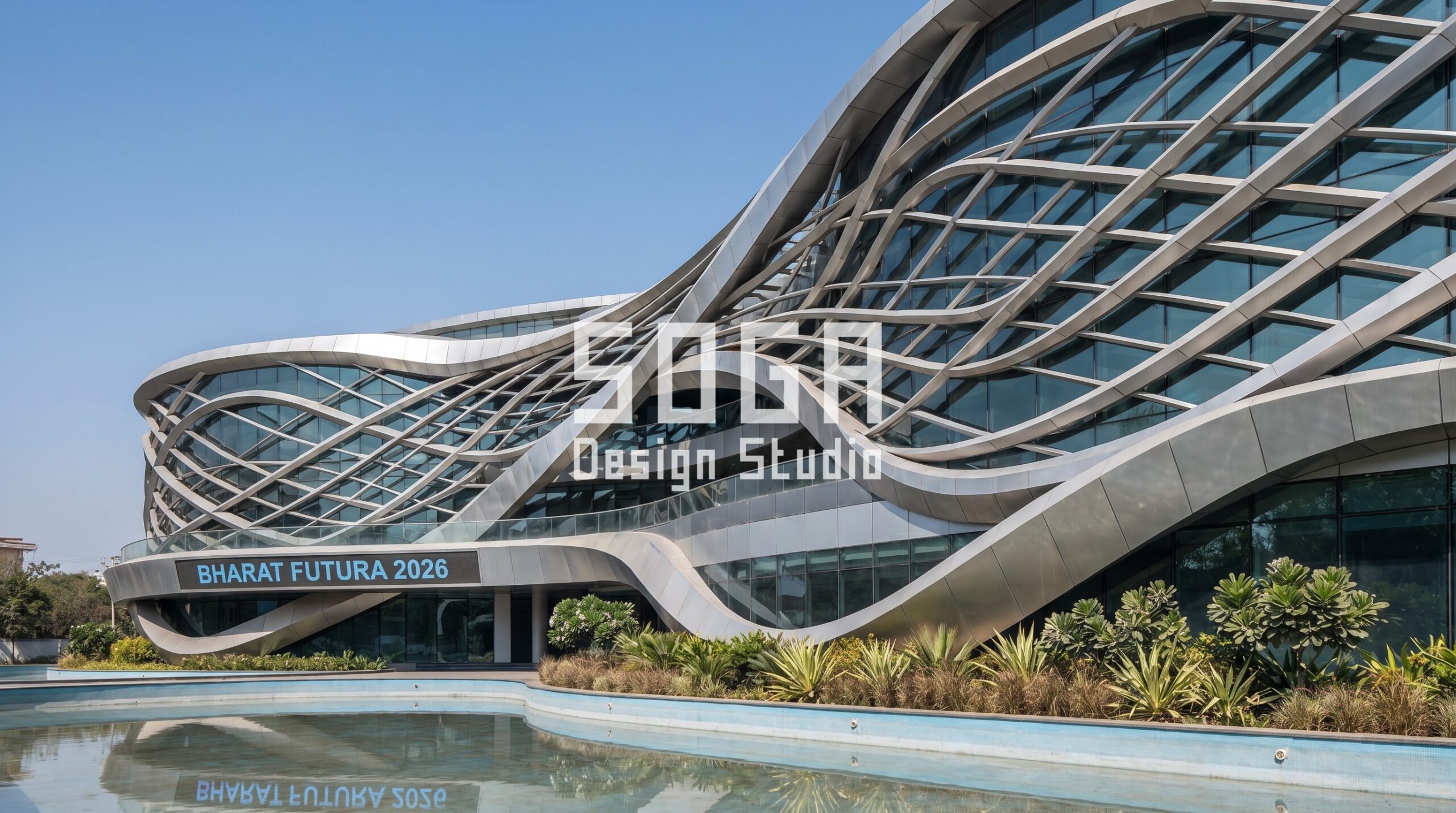
This is the flagship application. Parametric facades serve dual purposes: they’re the visual identity of a building and a high-performance skin. At SOGA, we’ve designed parametric facades that adapt to solar orientation, shifting from dense panels on the east and west faces to open screens on the north. These facades reduce solar gain by up to 40% while maintaining aesthetic consistency.
2. Interior Design and Spatial Experiences
Beyond building exteriors, parametric design is revolutionizing interiors. Parametric ceiling systems, acoustic panels, and spatial partitions can optimize acoustics, light distribution, and spatial flow. Corporate offices and hospitality projects in Delhi and Mumbai are using parametric interiors to create unique, brand-aligned environments.
3. Urban Infrastructure and Public Spaces
Cities like Mumbai and Bangalore are using parametric design for public pavilions, metro station canopies, and urban furniture. These structures are designed to respond to climate, foot traffic patterns, and cultural contexts—not merely aesthetic whims.
How Parametric Facades Are Designed: The Process
Understanding the design process demystifies parametric architecture and reveals why it’s superior to traditional facade design.
Phase 1: Site and Performance Analysis
The process begins with data, not drawings. We analyze:
- Solar radiation patterns (hourly, seasonal)
- Wind speeds and directions
- Indoor climate requirements (temperature, humidity, daylight)
- Structural loads and constraints
- Local regulations and aesthetic guidelines
Phase 2: Parameter Definition
We define which design elements will be variable (parametric). For a residential tower facade, parameters might include:
- Panel horizontal offset (based on solar exposure)
- Panel size (based on floor area and structural grid)
- Opening percentage (based on unit type and orientation)
- Material transition points (structural logic)
Phase 3: Algorithm Development in Grasshopper
Using visual programming, we build the parametric engine. This is where art meets mathematics. The algorithm translates performance goals (minimize energy, maximize daylight, ensure structural safety) into geometric rules.
Phase 4: Generative Design and Optimization
The algorithm generates hundreds of design variations. We then run simulations—thermal analysis, structural FEA, daylight studies—and select the optimal design, or create a family of designs for different zones.
Phase 5: Fabrication-Ready Documentation
Unlike traditional design, parametric designs emerge fully documented for fabrication. Every panel has a unique serial number, precise dimensions, and CNC-ready files.
Phase 6: Manufacturing and Installation
The parametric files drive CNC cutting, bending, and assembly. This reduces on-site fabrication errors and accelerates installation timelines.
This entire process—from site analysis to fabrication-ready files—typically takes 8-12 weeks, compared to 16-20 weeks for traditional facade design, despite the increased complexity.
SOGA Design Studio’s Approach to Parametric Architecture in India
At SOGA, we’ve built our practice around a singular principle: parametric architecture should be a tool for solving real problems, not a style exercise.
We began our journey in 2019 with a simple question: “Can we use digital design to make India’s buildings more sustainable and more beautiful?” Five years later, we’ve answered with an unequivocal yes.
Our approach combines three elements:
1. Deep Technical Expertise
Our team includes architects trained in computational design, structural engineers with FEA expertise, and digital fabrication specialists. We don’t outsource parametric design—we own the entire pipeline from concept to installation.
2. Climate-Responsive Design Philosophy
India’s climate is diverse: from the humid tropics of Kerala to the arid zones of Rajasthan. Our parametric designs respond to local climate, not global trends. A facade designed for Mumbai’s monsoons is structurally and functionally different from one designed for Delhi’s dust storms.
3. Manufacturing Partnerships
We’ve established partnerships with leading fabrication firms in Pune and Chennai, ensuring that our designs are not only conceptually brilliant but also practically buildable within Indian cost and timeline constraints.
Our portfolio includes:
- Luxury Residences (Mumbai, Bangalore): Parametric facades that reduce cooling loads by 35% while providing stunning visual impact.
- Corporate Headquarters (Gurugram, Bangalore, Pune): Biophilic parametric interiors that improve employee well-being and reduce energy consumption.
- Hospitality Projects (Delhi, Mumbai): Parametric facade systems that create brand-specific visual identities.
- Educational Institutions (Mumbai, Bangalore): Parametric learning spaces designed for adaptive pedagogy.
We’re not just designing buildings; we’re designing systems that perform, adapt, and improve over time.
Cost of Parametric Facade Design in India: What to Expect
One of the biggest misconceptions about parametric design is that it’s prohibitively expensive. In reality, when you account for material optimization, energy savings, and accelerated timelines, parametric facades are highly cost-competitive.
In India, parametric facade costs typically range from ₹800 to ₹3,500 per square foot, depending on complexity, material, and fabrication method:
Budget Range (₹800–₹1,200/sqft):
Simple parametric patterns, standard materials, aluminum panels, basic optimization. Suitable for mid-range residential and commercial projects. Energy savings: 15-20%.
Mid-Range (₹1,200–₹2,000/sqft):
Moderate geometric complexity, material experimentation (composite, local stone, wood), advanced environmental optimization. Suitable for premium residential and corporate headquarters. Energy savings: 25-35%.
Premium (₹2,000–₹3,500/sqft):
High-complexity geometries, mixed materials, bespoke fabrication, full performance optimization (structural, thermal, acoustic, daylighting). Suitable for iconic landmark projects. Energy savings: 35-45%.
For perspective: a conventional aluminum and glass facade costs ₹600–₹1,200/sqft with minimal performance optimization. A parametric facade in the ₹1,200–₹1,600/sqft range offers 25-30% energy savings, faster fabrication, and superior aesthetics—a net savings when lifecycle costs are considered.
At SOGA, we’ve helped clients reduce total project costs by strategic parametric application: designing parametric facades for south and west exposures (where thermal loads are highest) and conventional systems for north faces. This hybrid approach delivers 60-70% of the performance benefits at 50% of the cost.
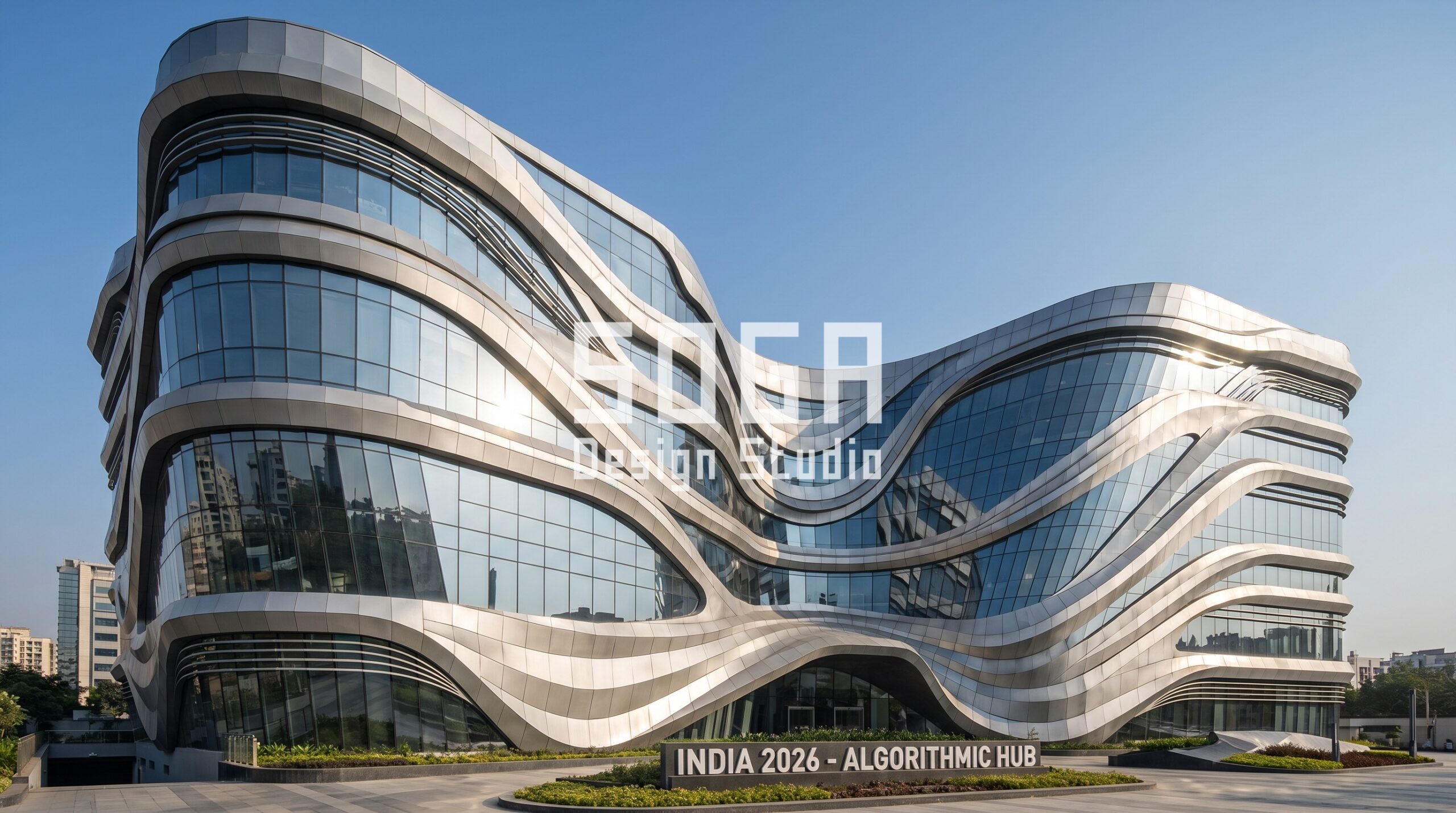
Cities Leading the Parametric Revolution: India’s Hotbeds of Innovation
Parametric architecture isn’t evenly distributed across India. Certain metros have emerged as centers of innovation:
Mumbai
India’s financial capital is home to the highest concentration of parametric projects. The city’s real estate competition is fierce—developers and architects use parametric design as a differentiator. From the Bandra-Worli waterfront to the emerging Central Mumbai developments, parametric facades are becoming signature elements.
Delhi-NCR (Including Gurugram)
Gurugram, where SOGA is headquartered, has become a parametric hotbed. The city’s corporate headquarters, premium residential towers, and tech campuses demand innovation. Gurugram-based firms have pioneered parametric applications in mixed-use developments and commercial parks.
Bangalore
India’s tech capital brings a data-driven, engineering-first mentality to architecture. Parametric design aligns naturally with Bangalore’s tech culture. IT parks, startup hubs, and biotech facilities increasingly use parametric design for sustainability and performance.
Jaipur
Often overlooked, Jaipur is emerging as a parametric design hub for tourism and hospitality projects. The city’s architectural heritage combined with modern parametric techniques is creating unique synthesis—parametric designs that respect local vernacular while achieving contemporary performance.
Hyderabad
Like Bangalore, Hyderabad’s IT sector is driving parametric adoption. The city’s real estate boom and tech-forward mindset make it a natural fit for computational architecture.
Dubai (Regional Inspiration)
While technically not in India, Dubai has been a proving ground for parametric architecture. Projects like the Museum of the Future and Zayed University have demonstrated parametric design at a monumental scale. Indian architects study these projects closely, and many parametric frameworks developed in Dubai are being adapted for Indian contexts.
What these cities share: strong economic growth, competitive real estate markets, and openness to design innovation. As India’s tier-2 cities (Pune, Ahmedabad, Kolkata) mature economically, we expect parametric architecture to spread rapidly.
The Future: Where Parametric Architecture in India is Headed
If 2026 is the year parametric architecture goes mainstream in India, what does 2030 look like?
AI-Driven Design Optimization
Artificial intelligence will move beyond simulation to actual design generation. Architects will specify performance targets (reduce energy by 40%, maximize daylight, minimize material), and AI will generate and refine designs autonomously. We’re already experimenting with this at SOGA.
Mass Customization at Scale
As manufacturing becomes more automated, the cost premium for customization (which parametric design inherently enables) will approach zero. Every facade panel could be unique, optimized for its specific location, without cost penalty.
Integration with Operational Data
Buildings will feed real-time operational data back into parametric systems. A facade that was parametrically optimized in design might receive new inputs from occupancy sensors, thermal cameras, and energy meters—and algorithmically adapt. This closes the loop between design and operation.
Parametric Entire Buildings, Not Just Facades
Today, parametric design is largely applied to facade and envelope. Future buildings will be parametrically designed from structure to interior layout to landscaping. The entire building becomes a responsive, integrated organism.
Vernacular Parametrics
India’s traditional architecture—from Mughal jali screens to Kerala’s nalukettu ventilation systems—will be digitized and parametrized. We’ll see contemporary buildings that are rooted in local tradition but globally contemporary in performance.
Regulatory Framework Evolution
As parametric buildings prove their performance benefits, building codes will evolve to incentivize and facilitate computational design. We expect India’s green building codes to explicitly encourage parametric optimization by 2028.
Talent Pipeline Maturation
Today, parametric architects are rare. By 2030, computational design will be a standard part of architectural curriculum in India’s top schools. This democratization will accelerate adoption.
The trajectory is clear: parametric architecture will evolve from niche innovation to standard practice. The question isn’t whether parametric design will shape India’s built environment—it’s how quickly and comprehensively.
For architects, developers, and building owners, the time to embrace parametric design is now. Early adopters gain competitive advantage, establish market leadership, and create buildings that will define India’s architectural character for decades.
Frequently Asked Questions
What’s the difference between parametric architecture and generative design?
Parametric architecture is the methodology—defining relationships between design variables. Generative design is the process of using algorithms (often AI) to explore thousands of design variations and automatically generate optimized solutions. Generative design is a subset of parametric thinking. All generative designs are parametric, but not all parametric designs are generative.
How long does it take to design a parametric facade?
At SOGA, a parametric facade design typically takes 8-12 weeks from site analysis to fabrication-ready documentation. This includes site data collection, parameter definition, algorithm development, optimization iterations, and detailed drawing production. This is actually faster than traditional facade design, which often takes 14-20 weeks.
Can parametric design be applied to renovation projects, or only new buildings?
Both. We’ve successfully retrofitted existing buildings with parametric facade systems. For renovations, parametric design is particularly valuable because it can optimize new systems to complement existing architecture and integrate structural upgrades with visual improvements.
What’s the learning curve for architects wanting to adopt parametric design?
Grasshopper has a learning curve of 3-6 months for architects with basic Rhino experience to achieve proficiency on simple projects. Mastery (designing complex building-scale systems) takes 1-2 years. At SOGA, we invest heavily in ongoing training because the tools evolve rapidly.
How do you ensure parametric designs are actually buildable in India?
We maintain direct partnerships with fabrication facilities and bring manufacturing partners into the design process early. We design within known capabilities and constraints—this isn’t compromise, it’s good design practice. A design that can’t be built is just computer art.
What ROI can developers expect from parametric design projects?
ROI is multifaceted. Direct energy savings typically payback additional design costs in 5-7 years. Indirect benefits—premium pricing for differentiated aesthetic, faster market absorption, reduced lifecycle costs, brand value—often exceed direct energy savings. We’ve seen projects achieve 15-25% premium pricing due to superior performance and design.
Ready to Transform Your Building with Parametric Design?
Parametric architecture isn’t the future—it’s the present. India’s leading developments are already embracing computational design to create smarter, more beautiful, more sustainable buildings. If you’re ready to move beyond conventional design and explore what’s possible with parametric systems, let’s talk.
At SOGA Design Studio, we combine deep technical expertise with practical buildability to deliver parametric designs that perform. Whether you’re developing a landmark residential tower, a corporate headquarters, or a mixed-use complex, we can help you harness parametric architecture to create competitive advantage.
Contact us today for a consultation to discover how parametric design can elevate your project.
Learn More About Parametric Design:
- Understanding Parametric Design in Architecture: Your Questions Answered
- 5 Revolutionary Parametric Residences: SOGA Design Studio’s Facade Design Mastery Across India
Go Deeper: The Parametric Architecture Guides
This page is the overview. Each of the guides below takes one part of it much further.
- Parametric facade design in India — systems, materials & cost per sq ft — the five systems actually being built here, material cost bands, what really drives price, and realistic timelines.
- Parametric facade trends in India 2026 — the seven shifts defining this year, from fire-led material change to tier-2 city growth.
- SOGA parametric facade projects — 16 built and concept projects by city, typology and system.
- 8 questions to ask before hiring a parametric studio — how to tell a concept-only practice from one that can deliver to site.
- Commercial facade cost: India, Dubai, Singapore & UAE — per sq ft rates and the hidden cost drivers.
Five companion guides go deeper on the practical side of a parametric facade: what it costs to maintain over twenty years, the substructure and wind load engineering behind it, which finish actually lasts in Indian conditions, how to choose the fabricator who builds it, and how to retrofit one onto an existing house.
Two further guides test the claims behind facade design with numbers and tradition: how much a shading facade really cuts the AC bill, and how a parametric elevation works with Vastu.
Some facades stay in the memory and most do not. The qualities that separate them are set out in what makes a facade iconic in India.