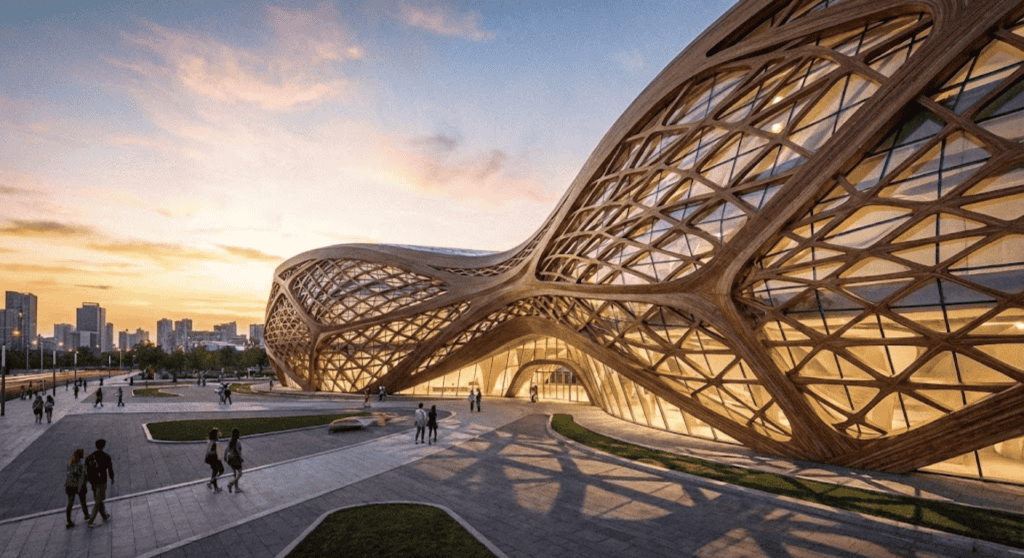
This is part of SOGA Design Studio’s daily 2026 facade study series — a running visual record of how Indian residential architecture is evolving, plot by plot. Today’s focus is Chandigarh, with comparative concepts from three other metros. The unifying material is matte warm brushed bronze acp panels and the unifying gesture is bold chevron herringbone pattern embossed met. If you are searching ral 7021 facade panel options for a current or upcoming residential project, the four concepts below are calibrated for typical Indian G+3 to G+7 plot dimensions and can be adapted on request.
Facade Design in India: Why Chandigarh Is Choosing Parametric Metal in 2026
Facade design in India has moved from an afterthought to the single most important decision on a residential project. In 2026, demand for parametric facade design in India is rising fastest in cities such as Chandigarh, Mumbai, Bangalore, Delhi, and Pune, where homeowners and developers want elevations that are both performance-driven and instantly recognisable. SOGA Design Studio specialises in facade design in India — from G+3 individual homes to G+7 residential blocks — pairing algorithmic geometry with matte warm brushed bronze acp panels and fabrication-ready detailing. Whether you are comparing metal facade design in India for a new build or a retrofit, the concepts below show how a considered facade redefines a building’s identity and its long-term value.
1. Chandigarh: A bold chevron herringbone pattern embosse Study
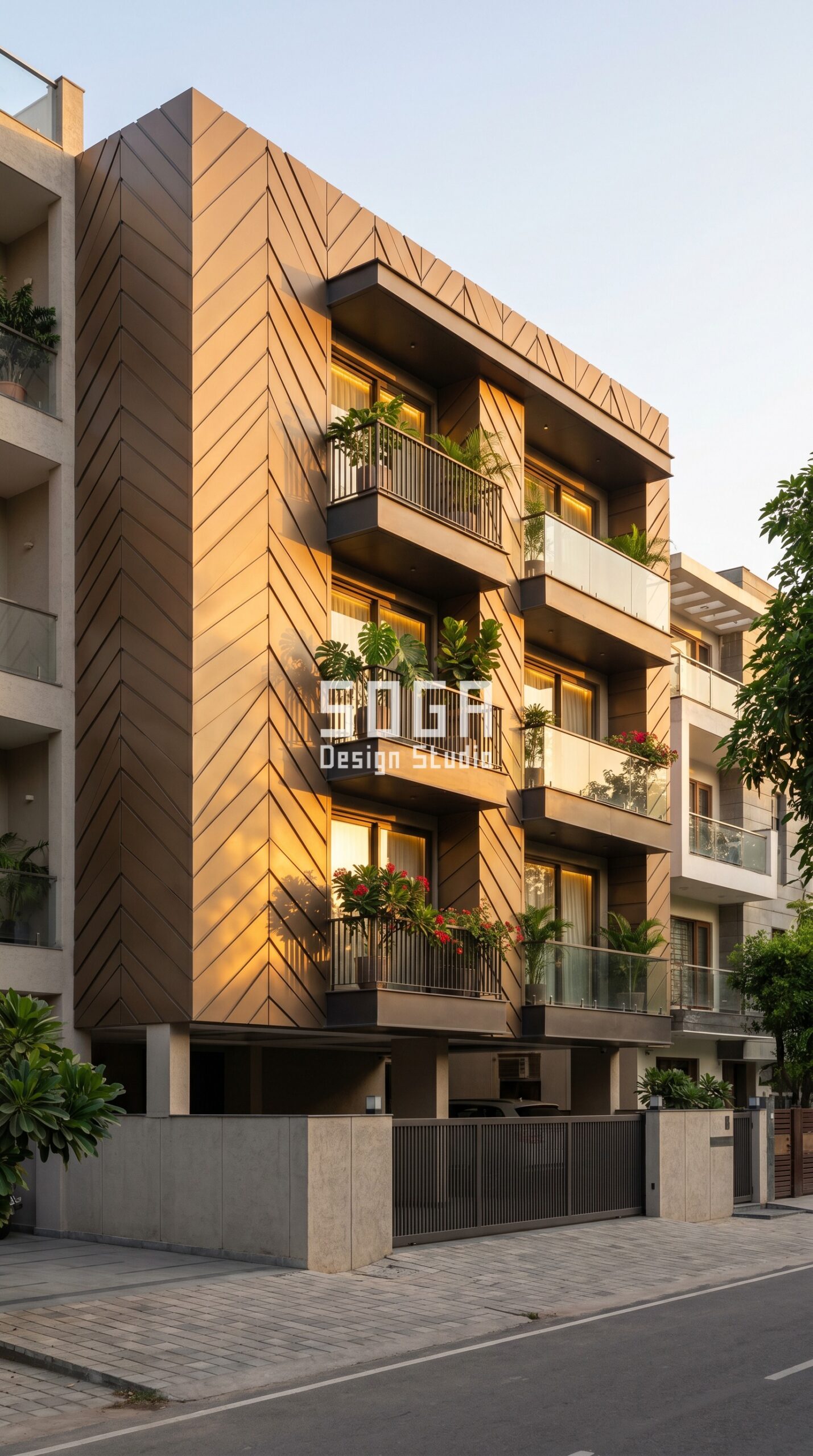
Translating a bold chevron herringbone pattern embossed metal pa concept into a buildable Chandigarh project demands more than a good rendering. This G+3 study was developed with the actual parameters Chandigarh clients bring to our studio: 2,400 to 6,000 sq ft plot footprints, 1.5 m setbacks, and a clear preference for matte warm brushed bronze acp over plaster or stone. The facade resolves wind load, panel sizing, and structural sub-frame depth in the same parametric model that drove the geometry. SOGA Design Studio carries this discipline through approval, fabrication, and on-site supervision — so what you see in the visualisation is what gets built.
2. Ludhiana: A twisted rotating vertical metal louvers Study
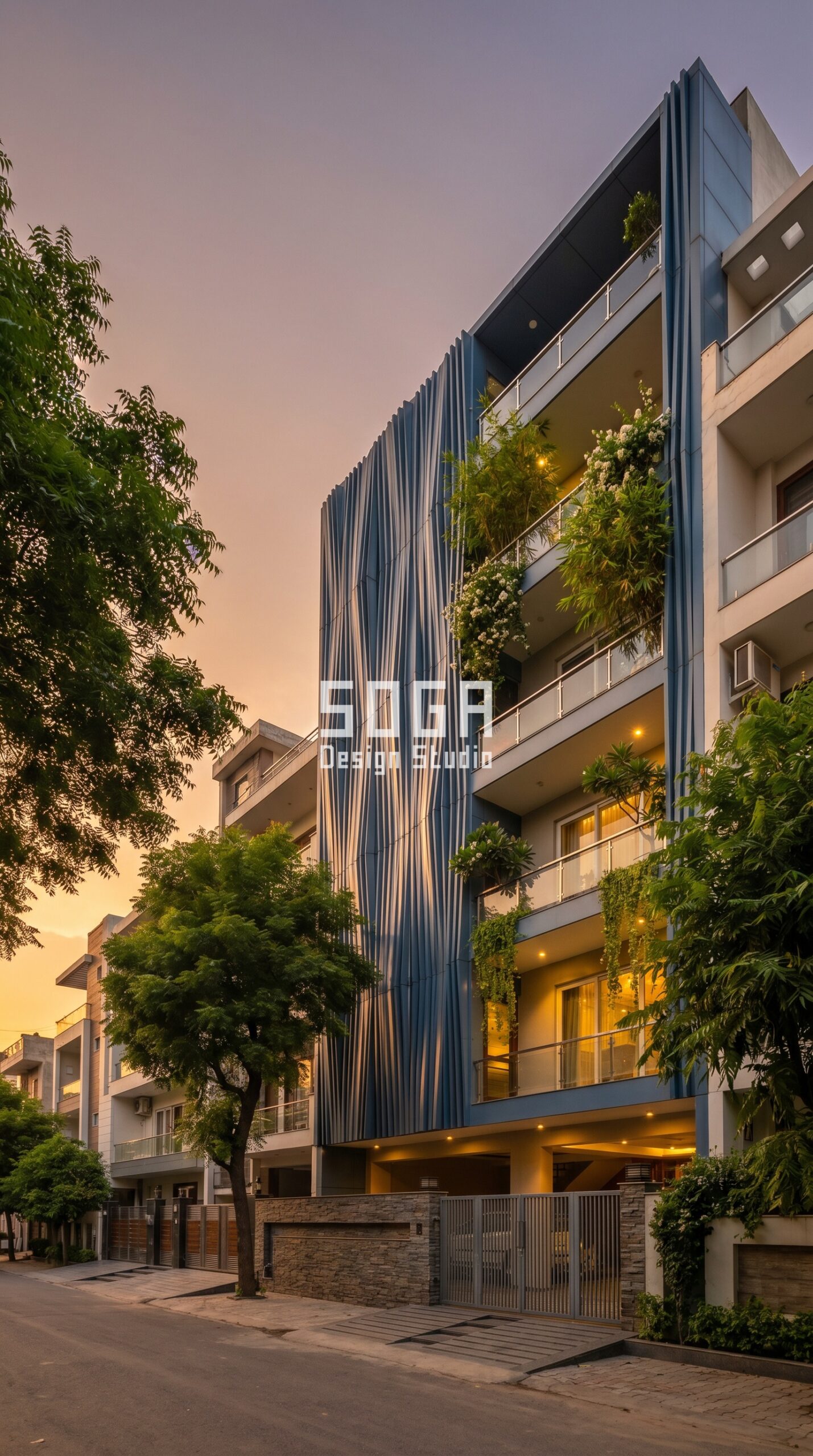
This G+4 concept for a Ludhiana residential plot reframes the entire street-facing elevation as a single articulated surface. The twisted rotating vertical metal louvers creating d gesture, executed in matte powder-coated ral 5011 steel blue , was generated parametrically — every panel angle, perforation density, and shadow gap is the output of a script tuned to the city’s solar geometry. The result is a facade that performs across the day: at noon it reads as solid sculpture, by 4 PM the raking light reveals the depth of the offsets, and after dusk the warm interior glow animates the openings. SOGA Design Studio takes concepts like this from the AI-visualised stage through to fabrication-ready shop drawings, working with vetted Indian fabricators to keep cost and lead-time predictable.
3. Ahmedabad: A circular pod-like metal balcony bays pro Study
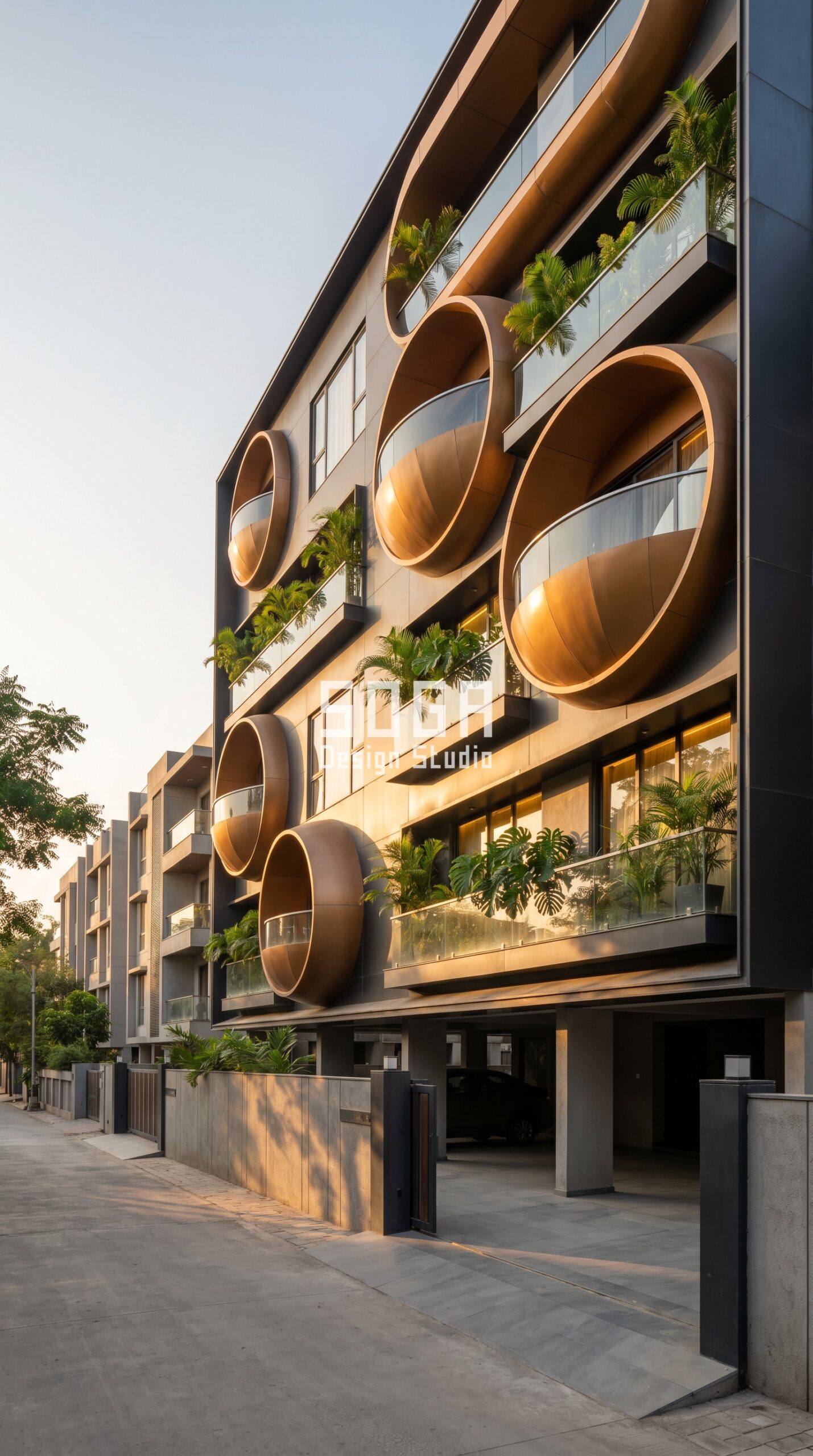
A Ahmedabad luxury plot rarely needs more square-footage; what it needs is a stronger street presence. This concept solves exactly that — a circular pod-like metal balcony bays protruding fr treatment in matte burnished warm honey copper sheeti that turns a standard G+5 envelope into a sculptural landmark. The composition was driven by three constraints common to Ahmedabad residential plots: setback limits, neighbour overlooking, and afternoon solar load on the western flank. The parametric pattern resolves all three simultaneously while creating a facade that photographs powerfully from any approach angle. SOGA Design Studio adapts this typology to your specific plot dimensions, regulations, and budget.
4. Bangalore: A twisted rotating vertical metal louvers Study
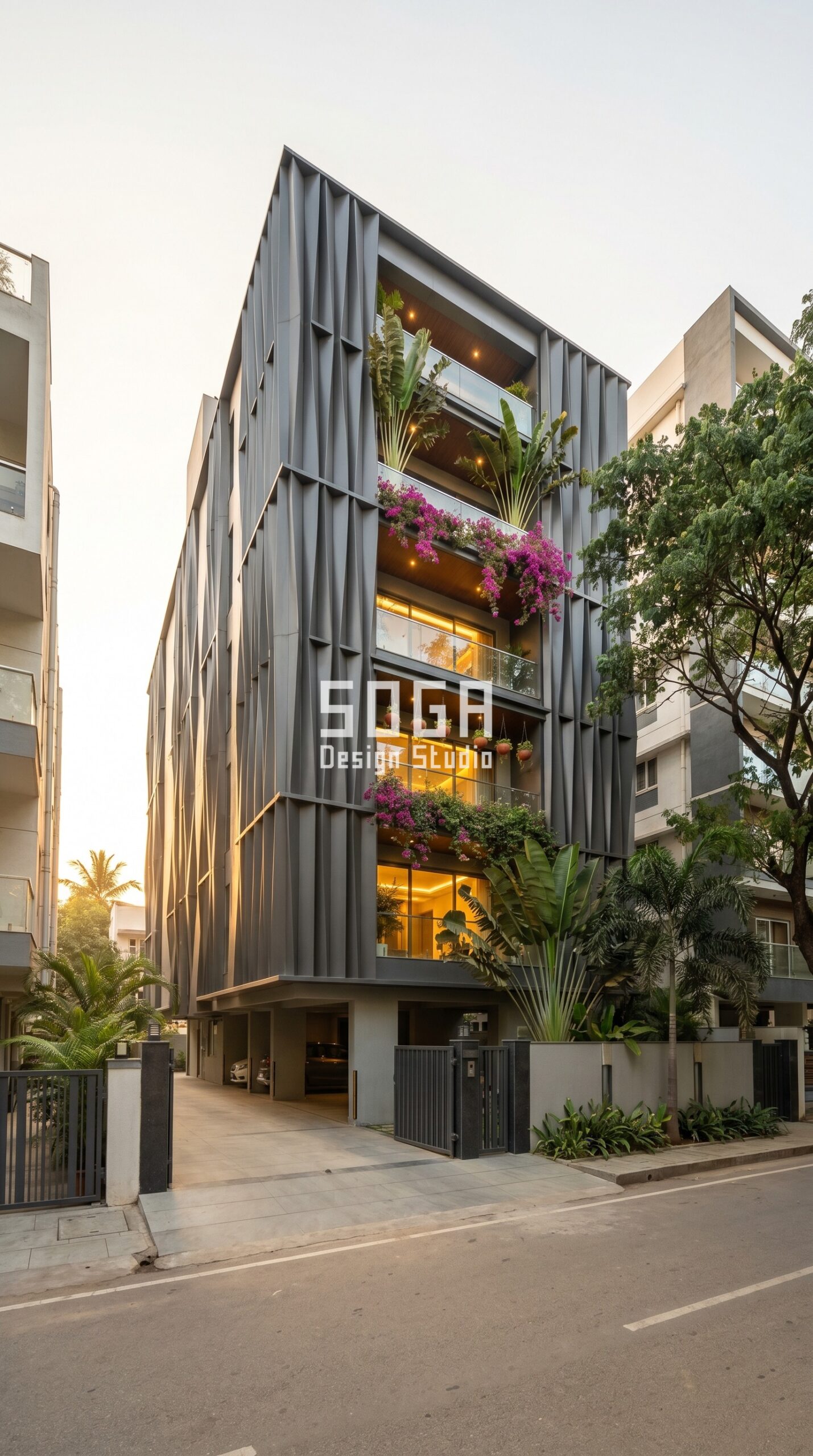
Material discipline is what holds this concept together. Everything visible on the Bangalore facade — the twisted rotating vertical metal louvers creating d, the railings, the gate piers — is detailed in matte powder-coated ral 7021 dark black or its complementary finish, producing a coherence that street-level photographs immediately register as ‘designed’. For a G+3 typology in Bangalore, this approach also has a practical edge: a single primary cladding system simplifies fabrication, reduces interface details, and lowers maintenance. SOGA Design Studio’s role is to balance the visual ambition with the buildability needed to deliver it on schedule and within tolerance.
Indian Parametric Architecture Reference: Miraj Stadium
When discussing parametric facade design in the Indian context, it is worth anchoring the conversation in built precedent. Miraj Stadium in — (—) is a useful reference: MetaCoin parametric facade. The bold chevron herringbone pattern em concepts shown above sit in the same conceptual lineage — algorithmic geometry, Indian climate, residential typology — translated for individual G+3 to G+7 homeowners rather than monumental civic scale.
2026 Cost Benchmarks for Indian Parametric Metal Facades
One of the most-asked questions on a Chandigarh project brief is budget. The 2026 all-in installed rates for parametric metal facades in India sit in the following ranges:
- Steel facade (full design + install): ₹1,200–₹2,800 per sq ft
- Aluminium, anodised or powder-coated: ₹800–₹2,500 per sq ft
- Zinc cladding: ₹1,500–₹3,000 per sq ft
- ACM panels (3 mm basic): ₹200–₹250 per sq ft (basic)
- ACM panels (4 mm): ₹250–₹350 per sq ft
- Solid aluminium panels: ₹800–₹1,800 per sq ft
- Installation labour: ₹50–₹150 per sq ft (varies by height + access)
- Conventional cladding (for comparison): ₹400–₹1,200 per sq ft installed (stone veneer / ceramic / standard ACM)
These figures are baseline; actual project cost depends on facade area, panel complexity, fabricator location, and finish specification. SOGA Design Studio prepares an itemised cost estimate as part of every consultation so the budget conversation starts with hard numbers rather than guesses.
Parametric Facade Design Across India, Dubai & Singapore
Climate is the unspoken brief on every Indian project. Chandigarh, with its specific solar geometry and humidity profile, demands facades that perform — not just facades that look striking. At SOGA Design Studio, every parametric concept is run through climate analysis early: solar radiation per orientation, wind exposure, and monsoon water-shedding paths all feed back into panel angle and perforation density. The concepts you see above already incorporate this layer of analysis for Chandigarh’s sun path; adapting them for Mumbai’s rain, Delhi’s dust, or Bangalore’s milder conditions is part of the standard scope.
Frequently Asked Questions
Is parametric design suitable for G+3 and G+4 residential plots?
Absolutely — it is in fact the highest-growth segment in India. G+3 and G+4 plots benefit most because the entire facade is visible from the street, so a sculptural parametric treatment yields maximum identity per rupee invested. SOGA Design Studio specialises in this typology, with concepts adapted to standard 30×40, 40×60, and 50×80 ft plots across Indian metros and tier-2 cities.
Why is parametric architecture suited to the Indian climate?
India’s combination of intense sun, monsoon humidity, and dense urban context demands a ‘smart skin’ rather than a static wall. Parametric facades let designers tune perforation density, panel depth, and orientation per building per orientation — cutting solar heat gain by 25–40% while boosting cross-ventilation. The approach also reinterprets centuries-old jali screening for modern G+3 and G+4 buildings.
How much heat does a perforated parametric facade actually reduce?
Independent studies on Indian residential applications show double-skin perforated metal facades reduce direct solar heat gain by 25–40% on west and south orientations, dropping interior surface temperatures by 4–7°C compared to bare RCC. The shaded gap also enables passive cross-ventilation. SOGA Design Studio specifies perforation percentage based on each orientation’s solar load.
What is the typical timeline from design to installed parametric facade?
For a G+3 to G+4 residence: 3 weeks for concept and approval, 4 weeks for fabrication-ready drawings, 6–8 weeks for fabrication, and 3–5 weeks for site installation — total 16–20 weeks from go-ahead to occupancy. Retrofit projects on existing buildings compress this to 10–14 weeks because no structural coordination is needed.
Which RAL colours work best for Indian residential facades?
Three palettes dominate 2026 Indian residential work: warm earthy bronze and corten tones (RAL 8004, 8019) for traditional contexts; deep desaturated blues and greens (RAL 5004, 5011, 6009) for contemporary luxury; and matte charcoal/black (RAL 9005, 7016) paired with brass or copper accents for a graphic urban look. Light cladding with dark frames is the most-searched aesthetic of 2026.
Parametric metal facade vs traditional stone or paint — which is better long-term?
Stone is heavy, expensive (₹600–₹1,500 per sq ft just for material), and difficult to repair when chipped. Paint requires repainting every 4–6 years in Indian conditions. A powder-coated parametric metal facade has higher upfront cost but a 25–30 year service life, zero repainting, and far stronger street identity — making total cost of ownership lower over a 20-year horizon. It is also significantly lighter, reducing structural cost on G+3 and above.
How much does a parametric metal facade cost per square foot in Indore?
In 2026, all-in parametric metal facade rates in India range from ₹800–₹2,500 per sq ft for aluminium and ₹1,200–₹2,800 per sq ft for steel, installed. SOGA Design Studio prepares itemised estimates as part of the consultation.
What is a sculptural petal-shaped metal fin facade?
SOGA Design Studio addresses this question in detail during the design consultation. For Chandigarh projects, we provide a fully customised answer based on plot, orientation, and budget — typically within 48 hours of receiving the brief.
Start Your Facade Project With SOGA Design Studio
If any of the bold chevron herringbone pattern em concepts above resonate with your project, send us your brief. SOGA Design Studio delivers customised parametric facade concepts for India, Dubai, Singapore, and the UK.