Valkala Residence: A Sculptural Facade Design in India by SOGA Design Studio
Valkala Residence is a striking example of sculptural facade design in India, where SOGA Design Studio used parametric modelling and a copper-shade fish scale cladding system to turn a standard residential plot into an organic, twisting work of architecture.
That needs to be said first. Because every person who sees Valkala Residence for the first time assumes the same thing: it must be a digital image. A concept. A competition entry that was never built. Something from a design school thesis that lives only on a screen.
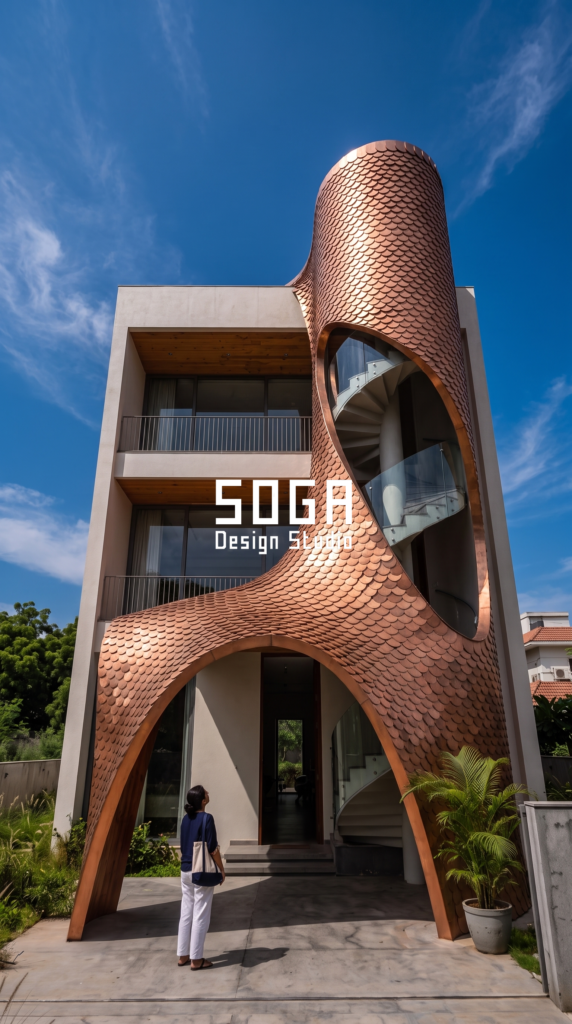
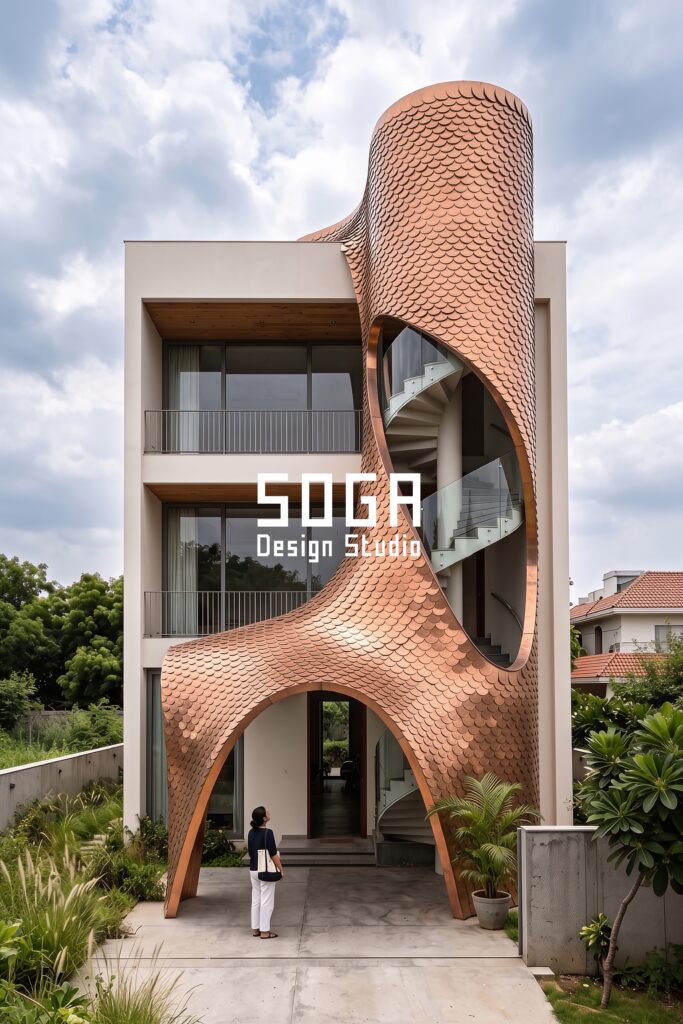
It isn’t. It’s a residential home. On a standard plot. In an Indian neighborhood. Built with local fabrication. People live in it. Cars park under it. A woman walks up to the entrance and the copper-shade form towers above her, catching the last light of the day.
Valkala Residence is the most ambitious facade SOGA Design Studio has delivered. And it started — like every project we take on — with a question from the client.
The brief that changed everything
The client didn’t come with a Pinterest mood board. They didn’t ask for “modern elevation” or “something different from the neighbors.” They came with a single provocation:
“Can a house have a soul that’s visible from outside?”
That question sat with us for weeks before we drew a single line. Because it wasn’t asking for a facade. It was asking for something deeper — a building whose exterior wasn’t a wrapper around rooms but an expression of the life happening within.
The answer came from an unexpected place: the staircase.
In most Indian residential buildings, the staircase is a service element. Tucked into a corner. Enclosed in walls. Invisible from outside. Functional, forgettable, and completely disconnected from the building’s public face.
What if the staircase wasn’t hidden? What if it became the building’s most visible element — the spine around which the entire facade wrapped?
That idea became Valkala Residence.
The name
“Valkala” is a Sanskrit word meaning bark — the outer skin of a tree. The protective layer that wraps around the living core, growing with it, adapting to its shape, inseparable from the life it contains.
The name captures exactly what this facade does. It wraps the building’s staircase core the way bark wraps a tree trunk — not as a separate layer applied to a structure, but as a continuous skin that IS the structure’s identity. Remove it and the building doesn’t just look different. It ceases to be the same building.
What you’re looking at
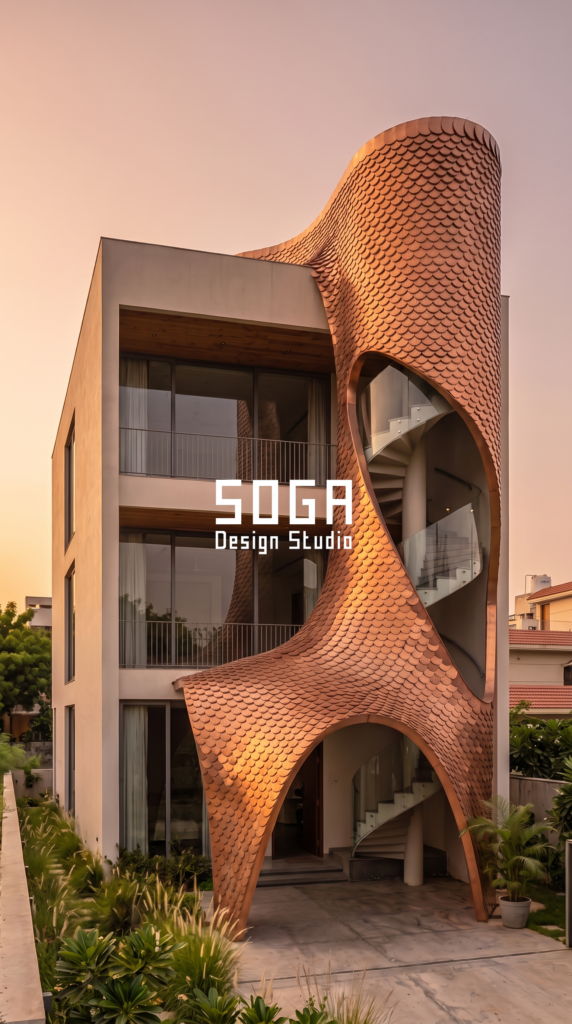
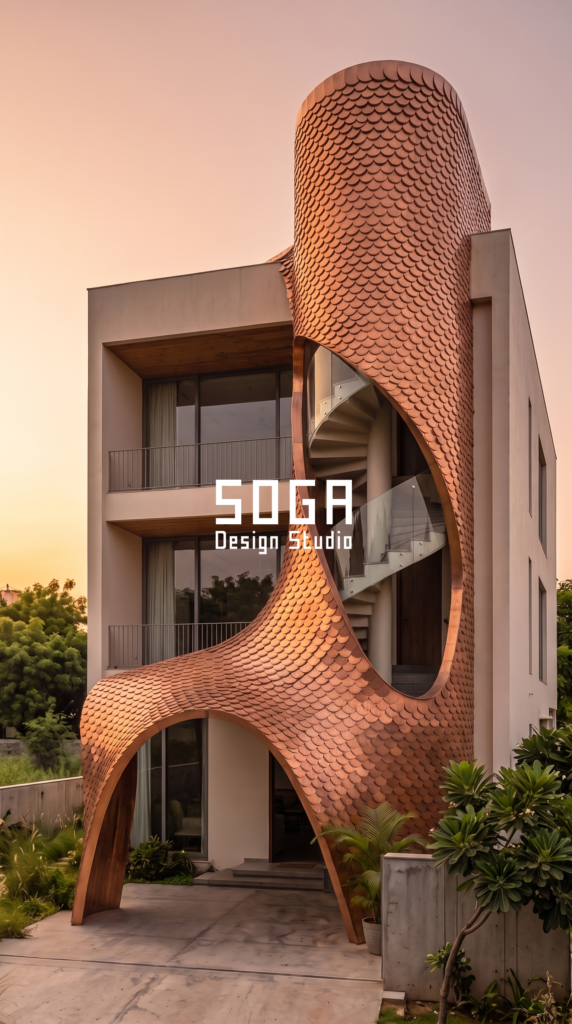
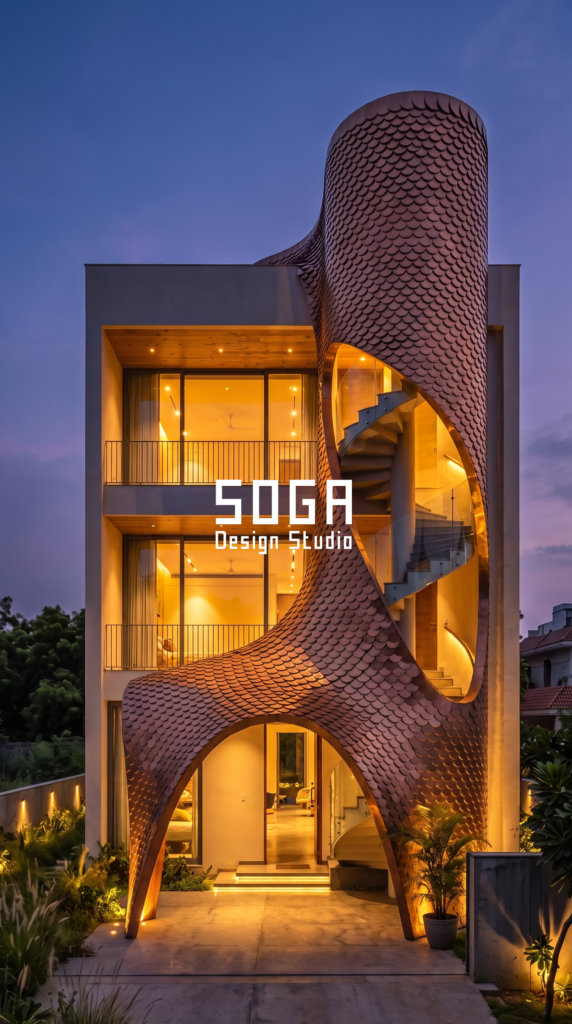
A twisting, doubly-curved sculptural form rises from the ground at the building’s corner. At the base, it flares outward to create an arched entrance — you walk under and through the sculpture to enter the home. As it rises, it narrows, twists, and wraps around the spiral staircase that connects all floors.
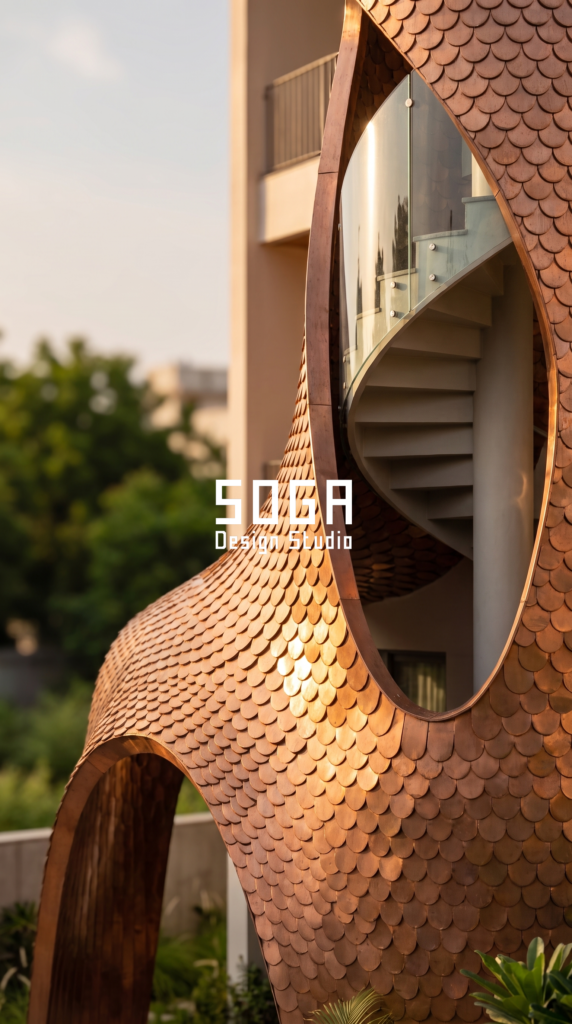
At two points, the form splits open. Teardrop-shaped glass openings reveal the staircase inside — spiral steps visible through curved glass, the interior life of the building made visible to the street. These openings aren’t windows in the conventional sense. They’re eyes. The building looks back at you.
At the top, the form culminates in a cylindrical tower that rises above the roofline — a crown that gives the building a presence on the skyline visible from streets away.
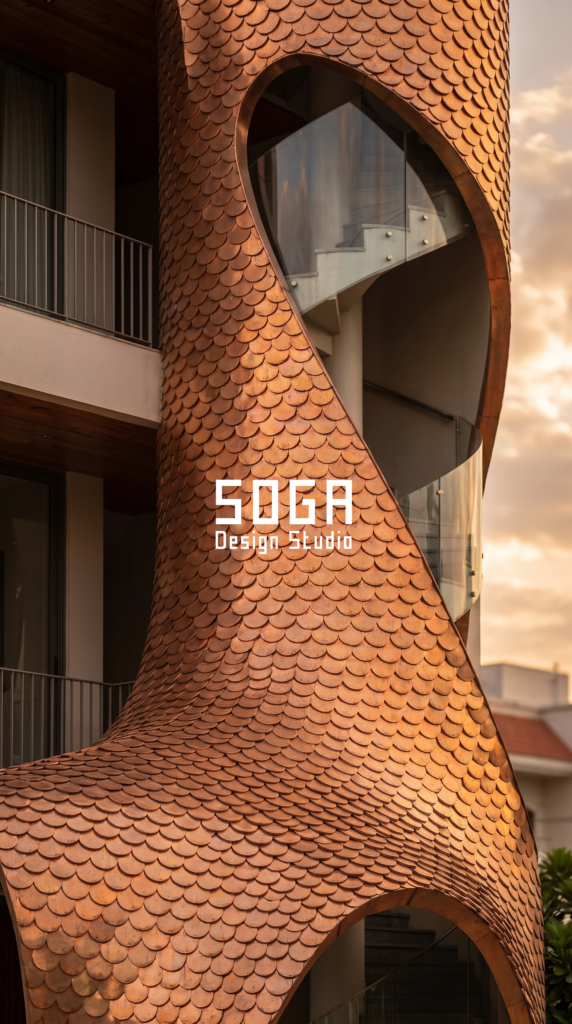
The entire surface is clad in hundreds of copper-shade shingles — overlapping scale-like elements that follow every curve, every twist, every compound surface of the form. The shingles catch light at different angles across the surface, creating a texture that shimmers and shifts as the sun moves. At golden hour, the entire sculpture glows warm copper against the sky.
The rest of the building — the part not wrapped by the sculptural form — is deliberately restrained. Clean white walls. Simple balconies. Minimal railings. The restraint is intentional. It creates the canvas against which the copper-shade sculpture reads as the single, undeniable focal point.
How the form was designed
The form began with the spiral staircase.
We mapped the staircase geometry in three dimensions — the helical path of the steps, the radius of the spiral, the floor-to-floor heights. That geometry became the armature around which the facade form was generated.
The computational model started with a simple question: what shape would naturally wrap around a helix while maintaining structural continuity from ground to rooftop? The answer — arrived at through hundreds of iterations — was a form that twists and narrows as it rises, pinching at the floor levels where structure concentrates, and expanding between floors where the staircase landings create wider moments.
The teardrop openings were positioned where the staircase landings face the street — the points where someone standing on the stairs would naturally look outward. The openings frame those sightlines, giving the staircase a relationship with the neighborhood that no enclosed stair core ever achieves.
The entrance arch at ground level was generated by the same logic — the form flares at its base because the structural loads collect there, and the flare creates a natural canopy over the front door. The arch isn’t decorative. It’s the form doing what it needs to do structurally, and the result happens to be a dramatic entry experience.
Every decision in the form follows from the staircase geometry. Nothing was added for visual effect alone. The drama is a byproduct of the logic.
The shingle system: hundreds of scales on a compound curve
The copper-shade shingles are the element that gives Valkala Residence its extraordinary texture. And they’re the element that presented the greatest fabrication challenge.
On a flat surface, shingles are simple. Identical pieces. Regular overlap. Repeating grid. Standard installation.
On a doubly-curved, twisting surface, nothing is standard.
Every shingle sits at a slightly different angle to the surface beneath it. The overlap between shingles must remain consistent despite the changing curvature — too little overlap and water penetrates; too much and the texture becomes visually uneven. The curvature changes in two directions simultaneously (doubly-curved), meaning the shingles must twist as well as tilt.
The parametric model generated the position, angle, and overlap for every individual shingle on the surface. The output was a numbered map — each shingle with a designated location, like tiles on a mosaic. Fabrication produced the shingles in batches. Site installation followed the numbered sequence, piece by piece, curve by curve.
The copper-shade finish was applied before installation. The warm tone was chosen for its relationship to Indian material traditions — it reads as hammered copper from the street, connecting the building to centuries of Indian metalcraft while being entirely contemporary in its form. The finish is permanent. No patina, no fading, no recoating. The copper warmth you see on day one is the copper warmth it keeps.
Why the teardrop openings matter
The teardrop-shaped glass openings in the shingle surface do more visual work than any other element on the facade. They serve three purposes simultaneously:
They reveal the interior. The spiral staircase is visible through each opening — a glimpse of the building’s circulatory system. This reverses the normal relationship between facade and interior. Instead of the facade hiding what’s behind it, it frames and presents it. The building shows you how it works.
They frame light. Each teardrop is positioned where afternoon and evening light enters at the most dramatic angle. The glass catches reflections of the sky while the copper-shade shingles around it glow warm. The contrast between reflective glass and textured copper creates a visual tension that draws the eye.
They give the form eyes. This is the less technical, more intuitive observation. The teardrop shapes, set into the scaled surface, read as eyes. The building appears to look back at you. That anthropomorphic quality — the sense that the building is alive, aware, watching — is what gives Valkala Residence its uncanny emotional presence. It’s not just a beautiful object. It feels like a being.
The entrance experience
Most residential buildings in India have entrances that are functional afterthoughts — a gate, a few steps, a door. The transition from street to home is abrupt and undramatic.
Valkala Residence inverts this. The sculptural form flares outward at its base, creating a copper-shade arch that you walk under to enter the home. The arch is tall enough to feel ceremonial but intimate enough to feel protective. The shingle texture is directly above you — close enough to touch, close enough to see every individual scale and the light catching its edges.
You pass through the sculpture to enter the building. The facade isn’t something you look at from outside. It’s something you move through. The boundary between exterior and interior dissolves in that moment under the arch — you’re simultaneously outside (under the sky, in the copper warmth) and inside (sheltered, enclosed, arriving home).
This is what the client meant by “a soul visible from outside.” The entrance is the moment where you feel it most directly.
Scale and context
One of the most important things about Valkala Residence is what it ISN’T.
It isn’t a villa on a five-acre estate. It isn’t a museum designed by an international practice. It isn’t a tech company headquarters with a limitless budget.
It’s a residential home on a standard Indian plot. In a normal neighborhood. With normal neighbors on either side — simple, flat-fronted buildings with standard railings and standard finishes.
That context is what makes the project extraordinary. Not the form itself — impressive as it is — but the fact that this form exists on a plot where every neighboring building settled for ordinary. Same building codes. Same setbacks. Same construction ecosystem. Same available labor and fabrication resources.
The difference between Valkala Residence and its neighbors is not money. It’s not materials. It’s not connections to international fabricators. The difference is design ambition — the decision to ask “what if a house could have a soul visible from outside?” instead of asking “what’s the standard elevation for this plot size?”
That decision is available to anyone. The tools exist. The fabrication capability exists. The only variable is whether someone chooses to use them with intention.
What Valkala Residence proves
This project proves several things that matter beyond its own boundaries:
A residential plot in India can hold world-class sculptural architecture. The assumption that ambitious facade design requires large plots, commercial budgets, or international contexts is false. Valkala Residence disproves it definitively. Standard plot. Local fabrication. Extraordinary result.
Texture transforms perception. The copper-shade shingles create a surface richness that no smooth cladding can achieve. The texture makes the form feel handcrafted and precious even at building scale. Every shingle edge catches light differently. The surface is alive in a way that flat panels — regardless of color or material — simply cannot be.
A facade can be the building, not just a layer on it. Most facades are applied to a building’s structure as a finishing step. Valkala Residence’s sculptural form is inseparable from the building’s organization — it wraps the staircase, creates the entrance, frames the views, and defines the skyline presence. Remove it and the building doesn’t just look different. It functions differently.
The staircase is an underused design opportunity. In 99% of Indian residential buildings, the staircase is hidden. Valkala Residence makes it the most celebrated element — visible through teardrop openings, wrapped in sculptural form, and positioned as the building’s architectural spine. Every building has a staircase. Almost none treat it as a design opportunity.
Emotional architecture is achievable at residential scale. Valkala Residence makes people stop. It makes them feel something — wonder, curiosity, awe, the uncanny sense that the building is looking back at them. That emotional response doesn’t require a museum budget. It requires a design that touches something deeper than aesthetic preference.
About SOGA Design Studio
SOGA Design Studio is a parametric and computational architecture firm based in Gurugram, India, co-founded by Gajender kumar sharma and Sonali Jaiswal. The studio specializes in facade design that goes beyond surface treatment — creating building skins that are structural, spatial, and sculptural.
With 900+ facade projects across India, Dubai, and Singapore, SOGA works across residential, commercial, and institutional scales. Valkala Residence represents the studio’s most ambitious exploration of what a residential facade can become.
Website: sogadesignstudio.com Instagram: @sogadesignstudio
Bring Sculptural Facade Design to Your Next Project
If you are exploring parametric residential facades, copper shade facades, or organic facade design for a plot in India, Dubai, or Singapore, SOGA Design Studio’s team can help translate your site and brief into a similarly ambitious, buildable facade.
Frequently Asked Questions About This Sculptural Facade Design in India
Q: Is Valkala Residence a real built project? A: Yes. Valkala Residence is a completed residential home on a standard Indian plot, designed by SOGA Design Studio. The sculptural copper-shade facade was fabricated locally and assembled on-site.
Q: What are the copper-shade shingles made from? A: The shingles are finished in a permanent copper-shade tone. The finish does not patina, fade, or require recoating — the warm copper appearance seen at completion is maintained permanently.
Q: Can a sculptural facade like this be built on a standard residential plot in India? A: Yes. Valkala Residence was built on a standard plot under normal building code restrictions, using local fabrication and standard construction labor. The computational design process resolves the sculptural complexity digitally, keeping site work methodical and sequential.
Q: How were the shingles placed on the curved surface? A: Each shingle position was computed parametrically to maintain consistent overlap across the doubly-curved surface. The output was a numbered map assigning each shingle a specific location. Site installation followed this sequence piece by piece.
Q: What is the copper-shade sculptural form wrapping? A: The form wraps the building’s spiral staircase — making the staircase the most visible and celebrated element of the home rather than hiding it inside the building.
Q: Can SOGA Design Studio create similar sculptural facades for other projects? A: Yes. SOGA’s computational design process can generate sculptural facade forms from any project’s unique constraints. Valkala Residence demonstrates one expression of this capability. The studio’s portfolio of 900+ projects shows that the same process produces completely different results for different clients and sites.
Q: Who designed Valkala Residence? A: Valkala Residence was designed by SOGA Design Studio, a parametric and computational architecture firm based in Gurugram, India, co-founded by Gajender kumar sharma and Sonali Jaiswal.