Mixed-use commercial facade design in India has to do three jobs at once in 2026: give a retail podium street presence, shade offices and homes stacked above it, and tie the whole tower together with a single confident skin. At SOGA Design Studio we engineer parametric metal facades for mixed-use developments – retail, offices, serviced apartments and residences under one roof – across India’s fastest-growing metros. The same computational method scales from a Bangalore tech-corridor tower to a Gurugram Golf Course Road block, a Lower Parel high-rise in Mumbai and a Gachibowli tower in Hyderabad. This guide walks through four buildable concepts – one per city – and the exact numbers behind them.
Why Mixed-Use Facade Design Went Parametric in India in 2026
By 2026, the mixed-use brief across India is consistent: a sculptural, low-maintenance metal skin that measurably lowers operating cost while unifying retail, office and residential floors behind one facade language. Independent studies on commercial applications in India show a well-tuned parametric metal shading system cuts direct solar heat gain by 25-40% and lowers peak cooling load enough to shrink HVAC sizing – savings that compound across a tall mixed-use tower with many tenants. The engine is computational: fin depth, box-frame projection and louvre rhythm are all scripted, then fabricated to tolerance as discrete, repeating modules. Our parametric facade design in India practice is the backbone we adapt for every mixed-use typology.
1. Bangalore Parametric Sky-Terrace Fin: A G+12 Mixed-Use Tower (Retail Podium, Offices And Sky Terraces)
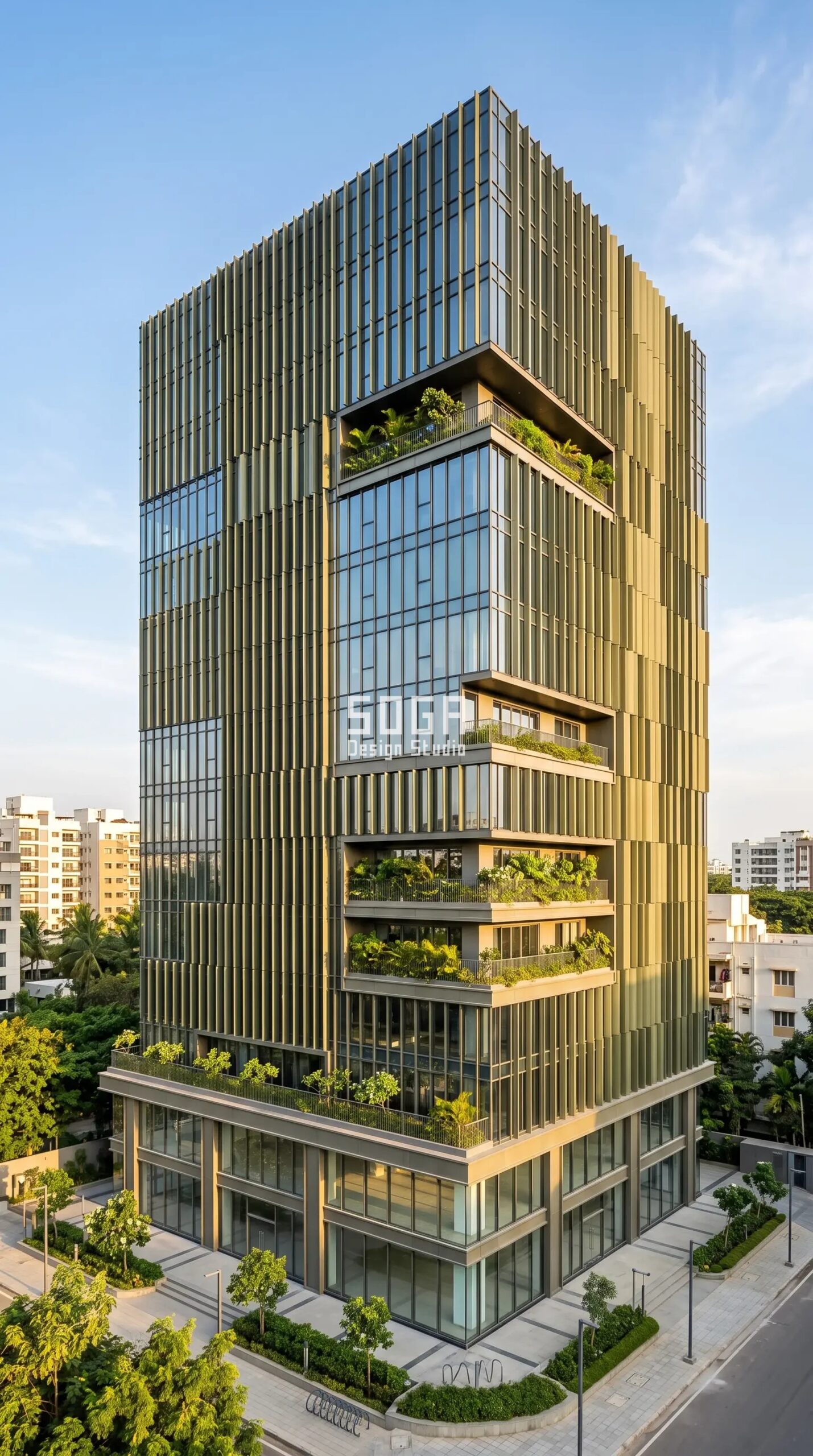
Design seed: Stacked mixed-use massing x vertical fin screen x ordered depth-band gradient x bronze-green powder-coated aluminium x biophilic sky terraces. This G+12 mixed-use tower (retail podium, offices and sky terraces) in Whitefield, Bangalore wears a Parametric Sky-Terrace Fin skin in bronze-green powder-coated aluminium vertical fins with stacked planted sky terraces. Bangalore’s mild climate and low west sun are met by deep vertical fins and stacked planted sky terraces that shade the offices and cool the retail podium naturally. The parametric variation is written into the fabrication drawings, not sprayed on afterwards.
How the Parametric Sky-Terrace Fin is built
| Design parameter | Specification |
|---|---|
| Module | 80 x 260mm bronze-green powder-coated aluminium vertical fin, floor-height, in an ordered rhythm |
| Spacing driver | fin centre-to-centre held steady at 240mm, projection stepping 160mm to 320mm in ordered vertical bands |
| Variation | an ordered depth gradient up the tower, every fin parallel and discrete, no weave or twist |
| Density | screen coverage graded 45% at the sky terraces to 70% at the west offices |
| Panels + substructure | 9 repeating fin types on a 60 x 60mm aluminium grid, with planted terraces every three floors |
| Cavity | 1.8m planted terrace zone plus a 150mm fin cavity |
Material & colour: hero skin in bronze-green fins with white soffits and greenery, kept to a restrained palette so the geometry does the talking. Indicative facade cost: Rs 1,600-2,900 per sq ft, fully designed and installed, with an itemised estimate produced per project.
2. Gurugram Parametric Shadow-Box Grid: A G+14 Mixed-Use Tower (Retail Podium, Offices And Serviced Apartments)
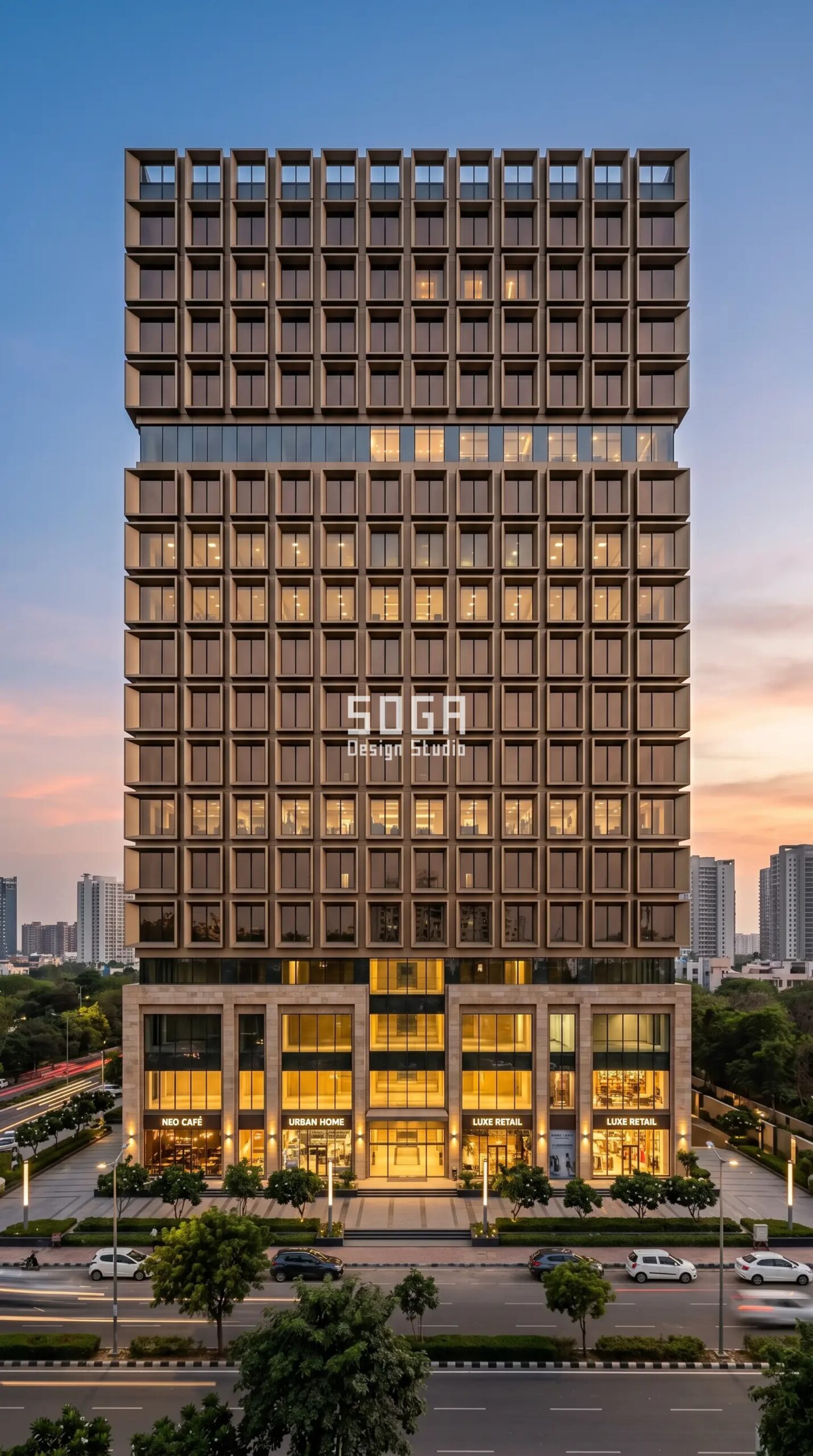
Design seed: Podium-and-tower massing x projecting box-frame skin x ordered depth-step grid x champagne-bronze anodised aluminium x desert-edge self-shading. This G+14 mixed-use tower (retail podium, offices and serviced apartments) in Golf Course Road, Gurugram wears a Parametric Shadow-Box Grid skin in champagne-bronze anodised aluminium projecting box frames over bronze glazing. Gurugram’s hot, dusty summers and high west glare are cut by the deepening box-frame self-shading and a ventilated cavity that releases heat before it reaches the glass. The parametric variation is written into the fabrication drawings, not sprayed on afterwards.
How the Parametric Shadow-Box Grid is built
| Design parameter | Specification |
|---|---|
| Module | 1.5 x 3.6m champagne-bronze anodised aluminium projecting box-window frame |
| Depth driver | frame projection stepping 120mm to 340mm across the grid in ordered bands, deepest at the office floors |
| Variation | each frame a discrete flat-sided box, projection increasing bay by bay, never twisted or melted |
| Density | solid-to-glass ratio graded 40% at the retail podium to 60% at the apartments |
| Panels + substructure | 12 repeating frame sizes on an 80 x 40mm aluminium unitised grid with concealed fixings |
| Cavity | 150mm rear-ventilated cavity over insulated glazing |
Material & colour: hero skin in champagne-bronze frames with bronze glass, kept to a restrained palette so the geometry does the talking. Indicative facade cost: Rs 1,700-3,000 per sq ft, fully designed and installed, with an itemised estimate produced per project.
3. Mumbai Parametric Blade Stack: A G+15 Mixed-Use Tower (Retail Podium And Residences)
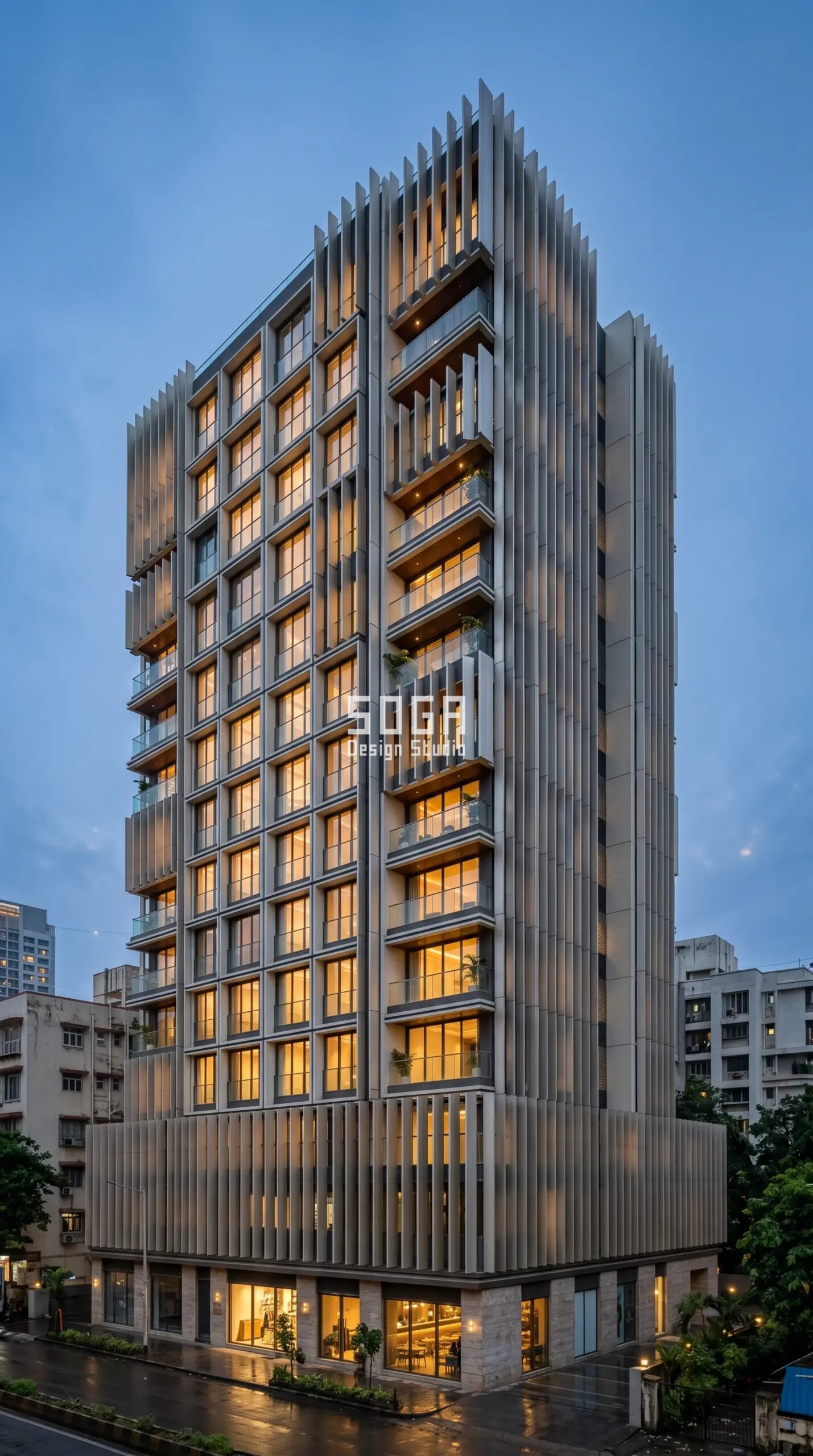
Design seed: Podium-and-tower massing x vertical blade screen x ordered depth-band gradient x silver-champagne anodised aluminium x coastal shading with recessed balconies. This G+15 mixed-use tower (retail podium and residences) in Lower Parel, Mumbai wears a Parametric Blade Stack skin in silver-champagne anodised aluminium vertical blades over an off-white frame. Mumbai’s humid coastal glare and monsoon are handled by deep vertical blades, recessed balconies and a drained ventilated cavity that keeps the wall dry. The parametric variation is written into the fabrication drawings, not sprayed on afterwards.
How the Parametric Blade Stack is built
| Design parameter | Specification |
|---|---|
| Module | 70 x 300mm silver-champagne anodised aluminium vertical blade, floor-height |
| Spacing driver | blade centre-to-centre held at 260mm, projection stepping 150mm to 300mm in ordered vertical bands |
| Variation | an ordered depth gradient up the tower, blades parallel and discrete, no warping |
| Density | screen coverage graded 45% at the residences to 65% at the west face |
| Panels + substructure | 10 repeating blade types on a 60 x 60mm aluminium grid, bracket-fixed to the slab edges |
| Cavity | 150mm ventilated cavity with recessed planted balconies |
Material & colour: hero skin in silver-champagne blades with off-white frame, kept to a restrained palette so the geometry does the talking. Indicative facade cost: Rs 1,800-3,200 per sq ft, fully designed and installed, with an itemised estimate produced per project.
4. Hyderabad Parametric Louvre Ledge: A G+12 Mixed-Use Tower (It Offices And Retail Podium)
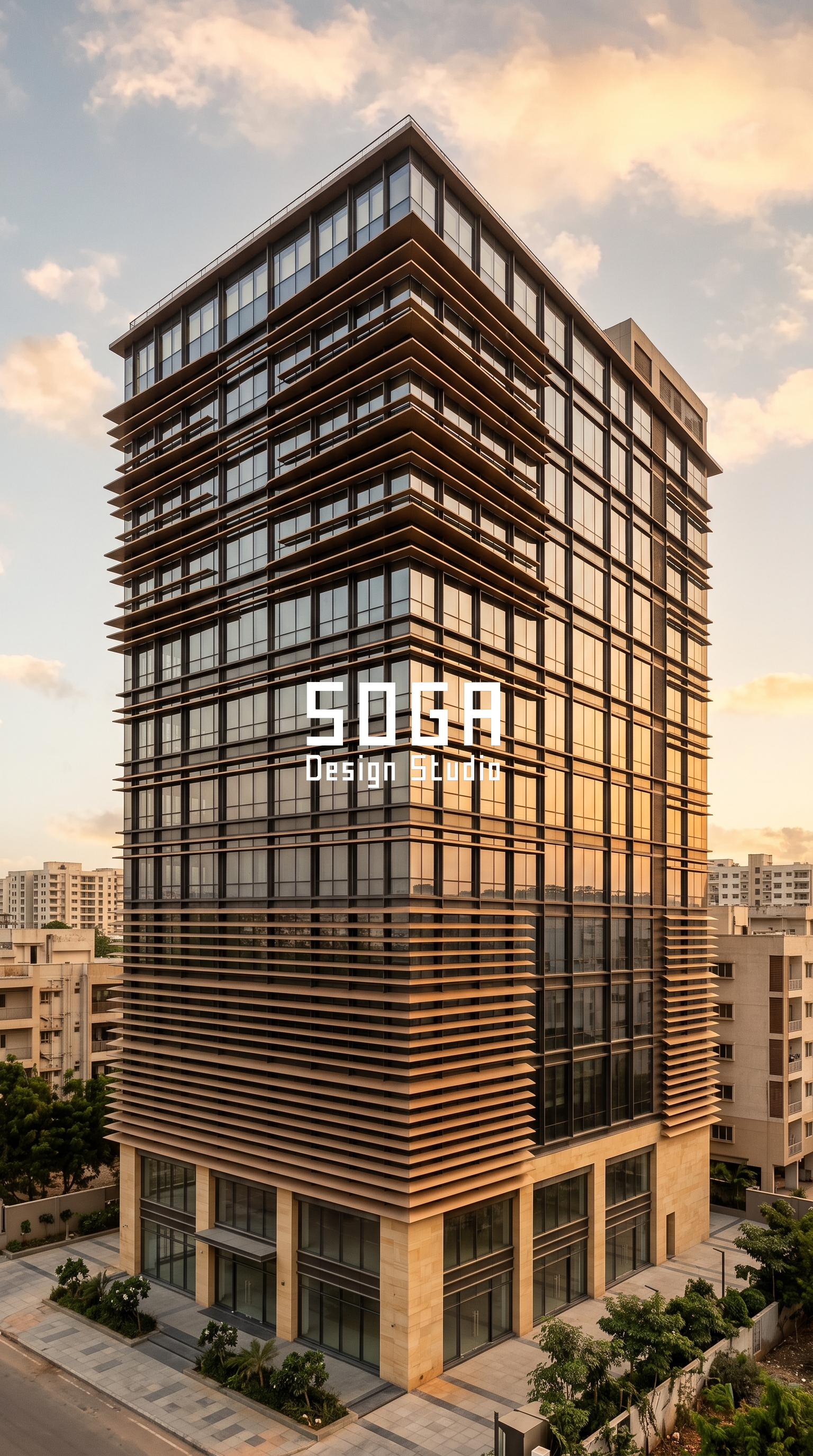
Design seed: Podium-and-tower massing x horizontal louvre-ledge skin x ordered row-by-row depth gradient x warm bronze aluminium over sandstone x west-sun shading. This G+12 mixed-use tower (IT offices and retail podium) in Gachibowli, Hyderabad wears a Parametric Louvre Ledge skin in warm bronze aluminium horizontal louvre ledges over a sandstone-toned base. Hyderabad’s hot dry summers and strong west sun are tamed by the deep horizontal louvre ledges that shade each office floor, with a ventilated cavity and a warm sandstone base. The parametric variation is written into the fabrication drawings, not sprayed on afterwards.
How the Parametric Louvre Ledge is built
| Design parameter | Specification |
|---|---|
| Module | 300mm-deep warm bronze aluminium horizontal louvre ledge, 1.8m run, stacked in rows |
| Depth driver | louvre projection increasing 200mm at the base to 400mm at the upper office floors in ordered rows |
| Variation | an ordered stacked cadence of horizontal louvre ledges, each a straight discrete blade, no warping |
| Density | shading coverage graded 50% at the podium to 72% at the west offices |
| Panels + substructure | 8 repeating louvre types on a 60 x 60mm aluminium grid, bracket-fixed to the spandrels |
| Cavity | 300mm cavity behind the louvres over an insulated sandstone-toned wall |
Material & colour: hero skin in warm bronze louvres with sandstone base, kept to a restrained palette so the geometry does the talking. Indicative facade cost: Rs 1,500-2,800 per sq ft, fully designed and installed, with an itemised estimate produced per project.
Mixed-Use Facade Cost in India (2026)
Mixed-use facade cost tracks geometric complexity, glazing spec and height – a flat cladding panel sits at the bottom of each band, while a deep vertical-fin system or a projecting box-frame grid on a tall tower approaches the top. The rates below are our published India benchmarks, applicable across retail, office and residential floors of a mixed-use development.
| System / material | Indicative rate (per sq ft) |
|---|---|
| Aluminium fin / louvre systems | Rs 1,000-2,600 per sq ft |
| Steel facade (full design + install) | Rs 1,200-2,800 per sq ft |
| Zinc facade | Rs 1,500-3,000 per sq ft |
| Unitised glazing + metal shading | Rs 1,800-3,500 per sq ft |
| ACM / solid aluminium cladding | Rs 250-1,800 per sq ft |
| Conventional cladding (stone / ceramic / standard ACM) | Rs 400-1,200 per sq ft |
Buildable, Not Just Rendered: How SOGA Engineers a Mixed-Use Skin
Every concept in this guide is drawn to fabrication tolerance before it is rendered. SOGA scripts each facade as discrete, repeating modules – fins, box-frames, blades and louvre ledges on a clear structural grid – and caps unique panel types at roughly 20% of the total to control mould and cutting cost. The substructure (aluminium or MS grid, bracket and slab-edge fixings, ventilated cavity, maintenance access) is detailed in the same drawing set, and the system is planned so retail, office and residential floors read as one facade while each gets the shading it needs. Panel weights stay within a two-person lift or are flagged for crane, finishes suit the local climate, and every project ships with an itemised cost estimate and a fabrication-ready panel schedule. That engineering-first method is why SOGA mixed-use facades move cleanly from concept to installed skin across India.
Related Reading
- Retail Podium Facade Design: letting footfall set the gradient direction
- Parametric facade design in India
- SOGA’s parametric metal facade approach
- Serviced Apartment Facade Design India: The 2.5° Twist
- Stacked Volume Facade Design India: Shift, Then Skin
Frequently Asked Questions
How much does a mixed-use building facade cost in India in 2026?
In India, a designed-and-installed parametric metal mixed-use facade runs Rs 1,000-2,600 per sq ft for aluminium fin and louvre systems, Rs 1,200-2,800 for steel and Rs 1,500-3,000 for zinc; unitised glazing with metal shading sits at Rs 1,800-3,500. Basic ACM cladding starts near Rs 250 per sq ft. Because a mixed-use tower stacks retail, office and residential floors, SOGA Design Studio issues a floor-by-floor itemised estimate for every project.
What facade system works best for a mixed-use tower?
For mixed-use towers, metal shading that unifies the elevation works best – vertical fins or blades, projecting box-frames or horizontal louvre ledges in anodised or powder-coated aluminium. They give one facade language across retail, office and residential floors while self-shading the glass and reflecting glare. A rear-ventilated cavity releases heat before it reaches the glazing. SOGA tunes shading depth floor by floor to the local sun path.
How do you shade offices and homes on the same facade?
The trick is a single parametric system whose density and depth change floor by floor: deeper shading on west office floors for glare control, lighter and more open at residences and sky terraces for views and daylight. Because the module stays the same and only its depth or spacing grades, the tower reads as one design while each use gets the right performance. SOGA scripts this gradient into the fabrication drawings.
How much can a mixed-use facade cut cooling and energy cost?
Independent studies on commercial applications in India show a well-designed parametric metal shading system cuts direct solar heat gain by 25-40% on exposed orientations and lowers peak cooling load enough to reduce HVAC sizing and running cost. Across a tall mixed-use tower with many tenants, that saving compounds year on year. The louvre depth and density are re-tuned to each city’s sun path.
Can SOGA design a mixed-use facade for any Indian city?
Yes. SOGA Design Studio designs mixed-use and commercial facades across India – Bangalore, Gurugram, Mumbai, Hyderabad, Pune, Delhi and tier-2 cities – and runs the process end to end, from site and sun-path analysis to fabrication drawings, panel schedules and an itemised estimate. Multi-city and remote engagements for developers are standard.
Design Your Mixed-Use Facade with SOGA
Whether your development is in Bangalore, Gurugram, Mumbai or Hyderabad, SOGA Design Studio can take your mixed-use tower from a parametric concept to an installed metal facade – with the engineering, cost estimate and floor-by-floor shading done up front. Explore our parametric facade design work, then write to us at [email protected] to start your mixed-use project anywhere in India.