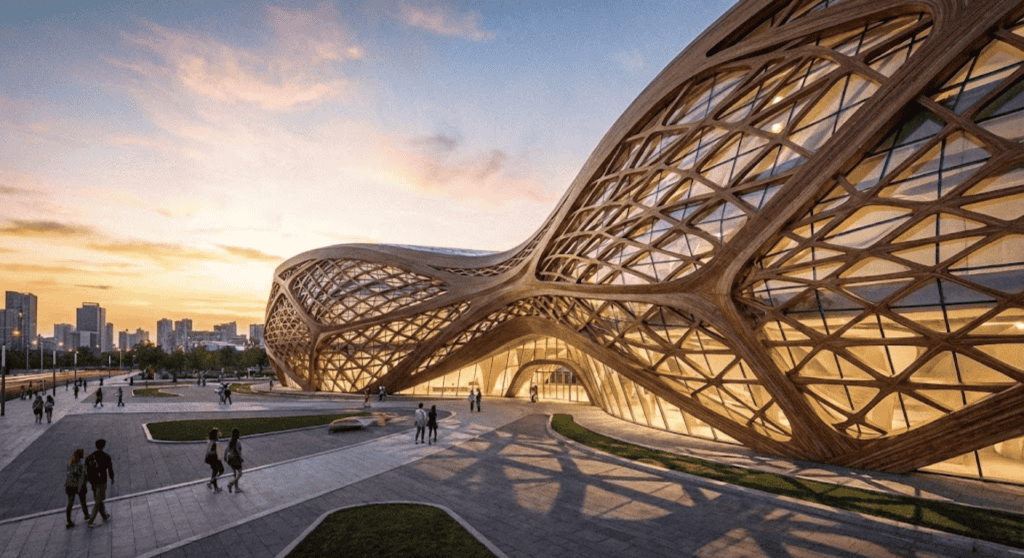
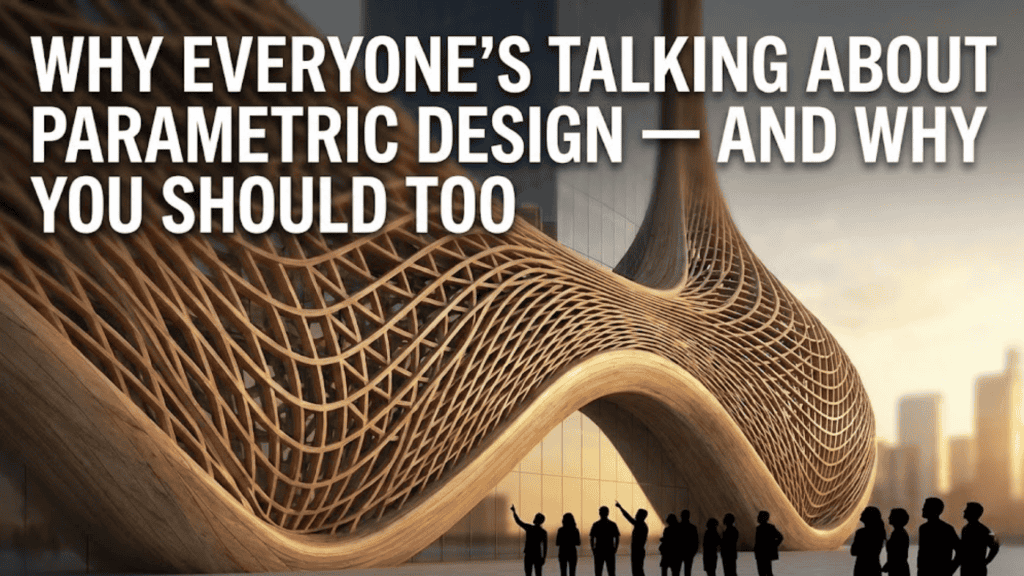
In Chennai, a facade has to do more than look good — it has to fight salt-laden coastal air, the pre-monsoon glare and the everyday heat, all while keeping a home private from a busy street. That is exactly the problem parametric metal facades were built to solve. Instead of a flat painted wall that fades in three summers, a computer-shaped metal skin can shade, ventilate and last for decades. Below are four buildable concepts our studio designed this month — one leading Chennai project and three more across Chennai, Bangalore and Gurugram — each showing a different way to turn an ordinary elevation into a climate-smart signature.
Facade Design in India: Why Chennai Is Choosing Parametric Metal
Facade design in India has moved from an afterthought to the single most important decision on a residential project. Today, demand for parametric facade design in India is rising fastest in cities such as Chennai, Mumbai, Bangalore, Delhi, and Pune, where homeowners and developers want elevations that are both performance-driven and instantly recognisable. SOGA Design Studio specialises in facade design in India — from G+3 individual homes to G+7 residential blocks — pairing algorithmic geometry with matte powder-coated ral 5004 black blu and fabrication-ready detailing. Whether you are comparing metal facade design in India for a new build or a retrofit, the concepts below show how a considered facade redefines a building’s identity and its long-term value.
1. Chennai Parametric Interlace Weave: A Deep-Blue Screen for a G+8
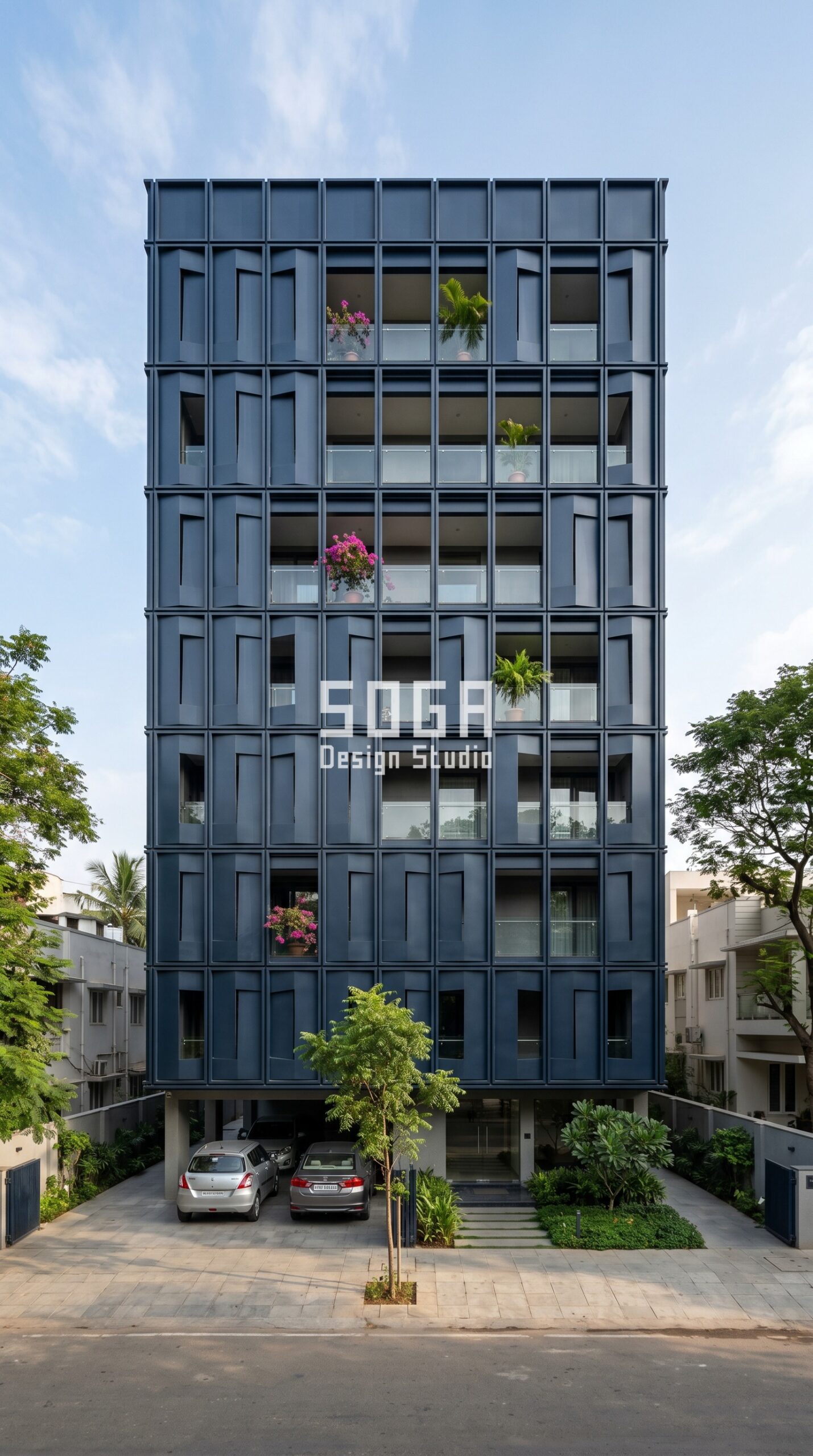
Our lead Chennai concept is a G+8 residence in Nungambakkam wrapped in a Parametric Interlace Weave — a woven interlocking angular metal screen where solid and open modules alternate in a strict, repeating grid. Finished in matte powder-coated RAL 5004 black-blue steel, the deep tone reads calm from the street yet gives every balcony a layer of shade and privacy without closing the home in. Because each panel is a crisp, discrete flat module on a rectangular grid, the pattern stays legible and fully buildable — no chaotic curves, just ordered rhythm. The alternating solid-and-open logic is tuned to the Chennai sun: denser where the west light is harshest, more open where residents want a view. On a coastal site, the powder-coated finish is the practical hero, shrugging off salt air that would blister ordinary paint in a couple of seasons.
2. Chennai Parametric Motif Screen: A Quiet Olive Elevation for a G+3
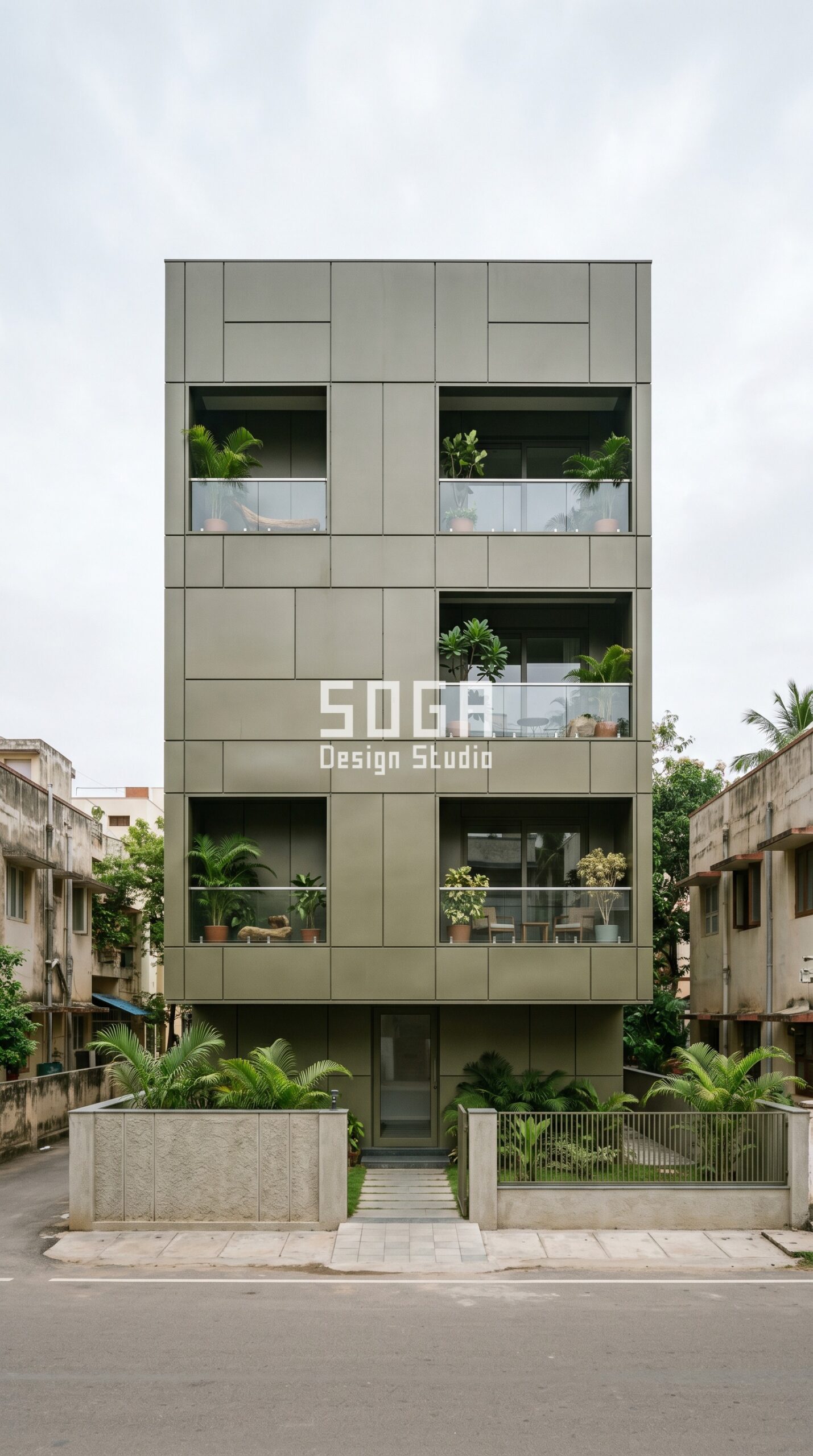
The second concept, also in Chennai (Thiruvanmiyur), takes the opposite mood: a low-rise G+3 in a calm residential lane, dressed in a Parametric Motif Screen of clean, laser-cut geometric metal panels. The finish is a muted military-olive-drab powder coat that settles the building into its leafy street rather than shouting over it. Here the parametric logic is restrained — an ordered, repeating motif of discrete panels with consistent seams, proving that ‘parametric’ does not have to mean dramatic. Deep balcony reveals and generous glazing keep the interiors bright under Chennai’s often overcast, diffused light. For a family home on a quiet plot, this is the version of metal-facade design that ages gracefully and needs almost no upkeep.
3. Bangalore Parametric Spiral Shell: A Bronze Ribbon That Rises
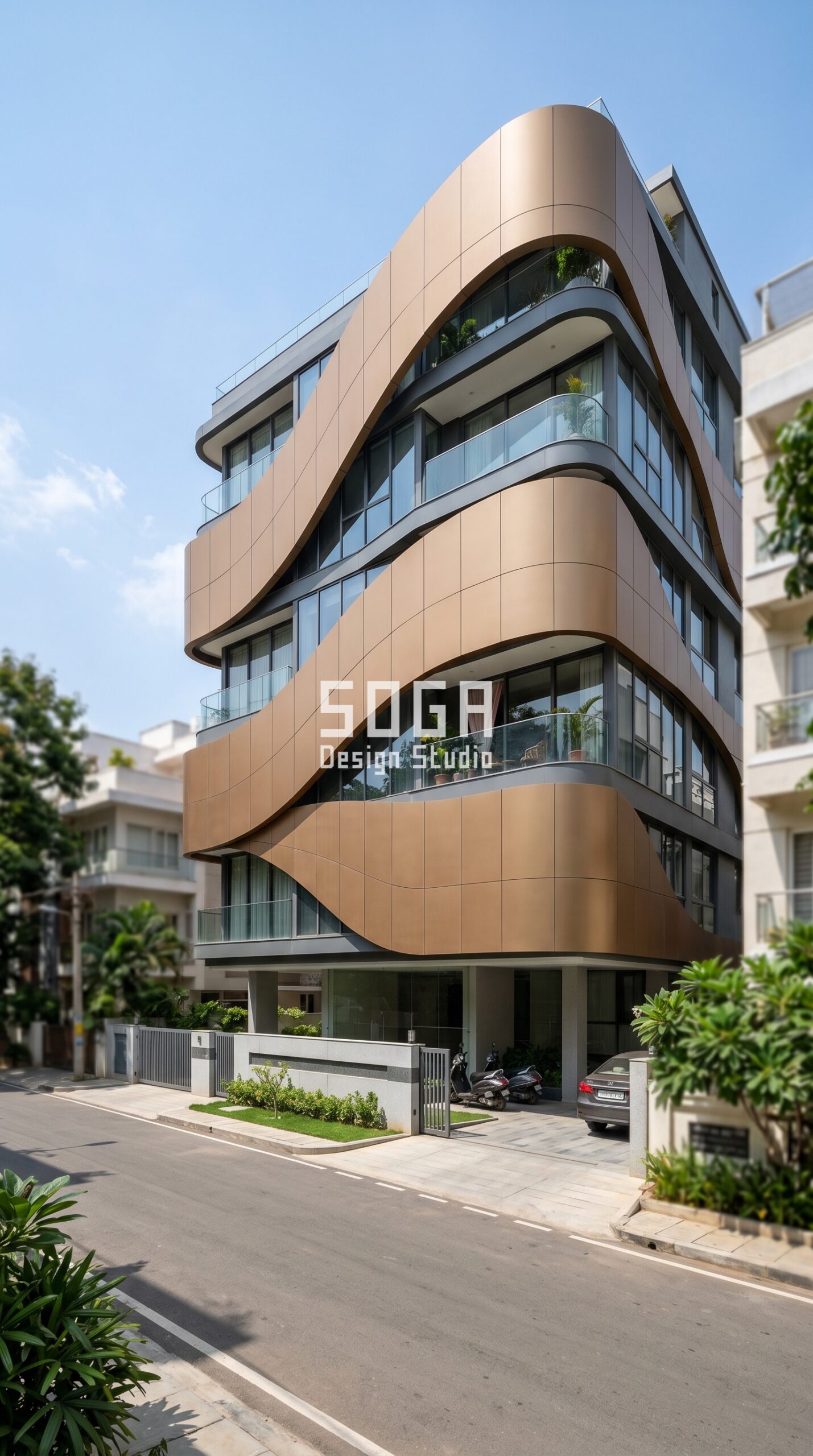
In Sanjay Nagar, Bangalore, we let the facade move. The Parametric Spiral Shell is a continuous S-curve ribbon in matte warm brushed-bronze ACP that rises gently across a G+5, sweeping past balconies and glazing to give the building a single, sculptural gesture. Crucially, the ribbon is still built from crisp, discrete flat panels on a clear module grid with a gentle per-bay gradient — so it curves without ever looking melted or flimsy. Bangalore’s mild climate lets us be more expressive with form and less defensive about heat, and the bronze catches the city’s bright midday light beautifully. It is the concept for a client who wants their home to be the one people remember on the street — without sacrificing buildability.
4. Gurugram Parametric Stagger Pulse: Blackened-Steel Trays for Delhi-NCR Heat
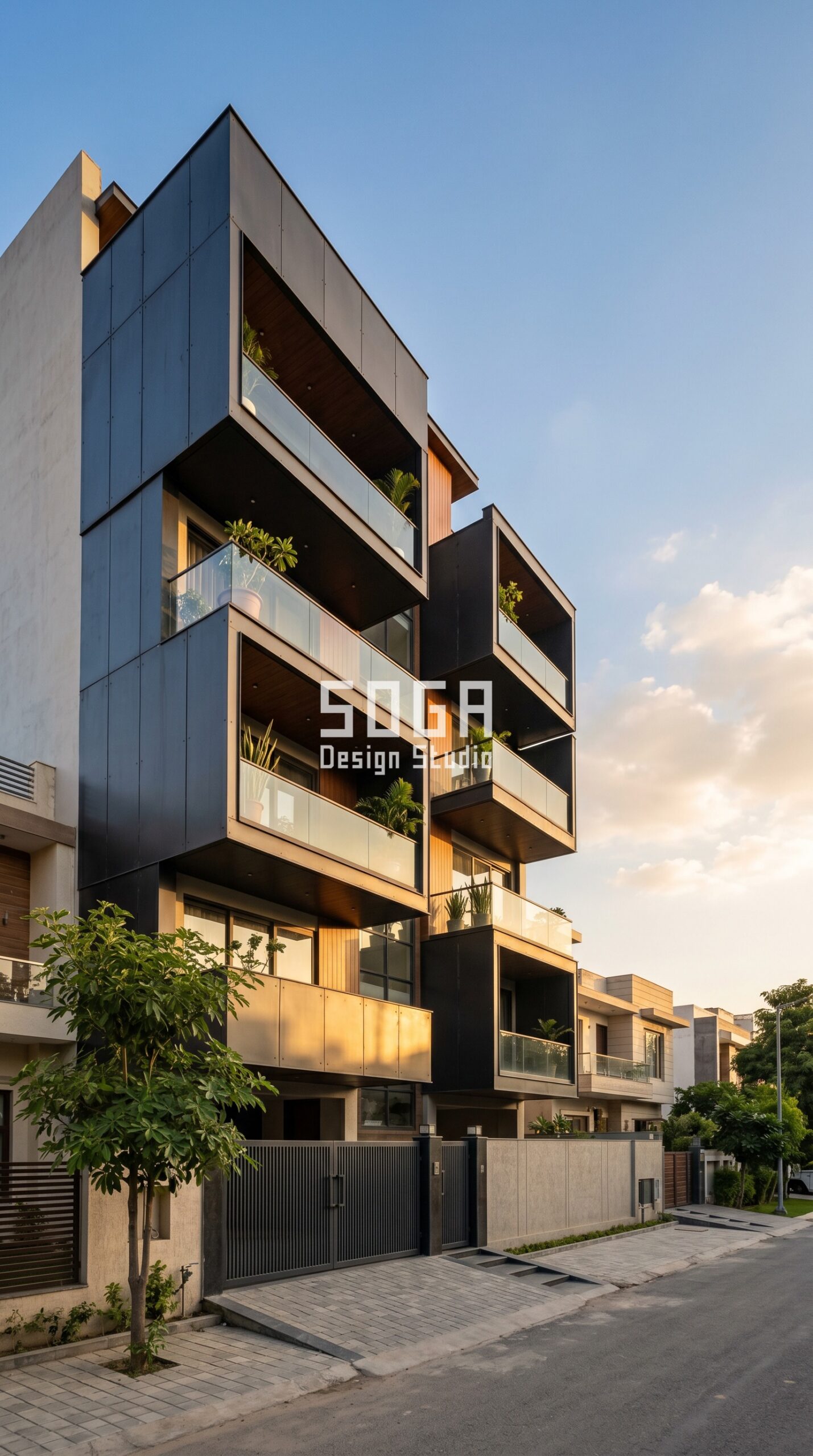
The fourth concept moves north to DLF Phase 2, Gurugram, where the enemy is harsh sun and dust rather than salt. The Parametric Stagger Pulse gives a G+4 a rhythm of staggered, cantilevered metal trays at alternate floors in matte blackened steel, each tray a crisp discrete module that throws real self-shade across the windows below. Shot in late-afternoon golden light, the deep trays read as strong horizontal shadows — architecture that performs and photographs. The staggering is not decoration: it is a passive-shading move that cuts solar gain on Gurugram’s exposed plots while carving out private outdoor pockets. Blackened steel keeps the palette confident and hides the fine dust of the NCR far better than a pale render.
Cost Benchmarks for Indian Parametric Metal Facades
One of the most-asked questions on a Chennai project brief is budget. The current all-in installed rates for parametric metal facades in India sit in the following ranges:
- Steel facade (full design + install): ₹1,200–₹2,800 per sq ft
- Aluminium, anodised or powder-coated: ₹800–₹2,500 per sq ft
- Zinc cladding: ₹1,500–₹3,000 per sq ft
- ACM panels (3 mm basic): ₹200–₹250 per sq ft (basic)
- ACM panels (4 mm): ₹250–₹350 per sq ft
- Solid aluminium panels: ₹800–₹1,800 per sq ft
- Installation labour: ₹50–₹150 per sq ft (varies by height + access)
- Conventional cladding (for comparison): ₹400–₹1,200 per sq ft installed (stone veneer / ceramic / standard ACM)
These figures are baseline; actual project cost depends on facade area, panel complexity, fabricator location, and finish specification. SOGA Design Studio prepares an itemised cost estimate as part of every consultation so the budget conversation starts with hard numbers rather than guesses.
Parametric Facade Design Across India, Dubai & Singapore
Indian residential architecture is shifting from decoration to performance. SOGA Design Studio’s residential work is built for the scale most clients actually build at: G+3 to G+7 homes on plots of 2,400 to 6,000 sq ft, where a parametric metal facade has to earn its place by controlling sun, dust, and privacy as well as it controls first impressions. The studio’s role is to compress what used to take a six-month traditional design cycle into a sharper, AI-accelerated process — without sacrificing the engineering rigour that separates a buildable facade from a rendering. Every concept is developed for the plot, the orientation, and the budget in front of us, not borrowed from a catalogue.
Why Trust SOGA Design Studio for Facade Design in Chennai
- Experience: SOGA Design Studio has delivered parametric metal facades on G+3 to G+8 residences across Chennai, Bangalore, Gurugram and other Indian cities, so every concept here is drawn from buildable, on-site experience — not just renders.
- Expertise: Our team designs each screen as a real manufactured assembly — discrete powder-coated, ACP and steel modules on a clear structural grid — engineered for panel seams, fixings and fabrication tolerances from day one.
- Authority: As a India-focused facade design studio, SOGA specialises in climate-responsive metal skins tuned to coastal salt, monsoon glare and NCR dust, with a documented library of parametric systems for Indian conditions.
- Trust: We give clients honest cost bands, realistic maintenance expectations and buildable detailing up front, so the facade you approve is the facade that gets built.
Frequently Asked Questions
Which metal facade is best for a coastal city like Chennai?
For Chennai’s salt-laden air, powder-coated aluminium, PVDF-coated aluminium and marine-grade or properly coated steel perform best. The coating matters as much as the metal: a good powder-coat or PVDF finish resists salt corrosion and colour fade far better than paint on plaster.
Do parametric metal facades actually reduce heat inside the home?
Yes. A shading screen or a staggered-tray system like the Gurugram concept blocks direct sun before it hits the glass, which meaningfully lowers solar heat gain and cooling load. The denser the screen over west and south light, the greater the effect.
How long does a metal facade last and what maintenance does it need?
A well-detailed powder-coated or PVDF metal facade typically lasts 25 to 40 years. Maintenance is minimal — periodic washing and occasional fixing checks — which is why metal skins are popular for low-upkeep homes.
Can SOGA design facades for Bangalore, Gurugram and other Indian cities too?
Yes. SOGA Design Studio works across India, tuning each parametric metal facade to the local climate — coastal Chennai, mild Bangalore, hot and dusty Gurugram and beyond — as the four concepts in this article show.
How is AI changing facade design in India in 2026?
AI is now a routine input at the concept stage: generative tools propose dozens of parametric variations from a single brief, and computational performance simulators predict heat gain, daylight, and material cost before any drawing is finalised. SOGA Design Studio uses AI-assisted visualisation to accelerate the concept phase from 4 weeks to 4 days, while the engineering and fabrication detailing remain human-led.
Why is parametric architecture suited to the Indian climate?
India’s combination of intense sun, monsoon humidity, and dense urban context demands a ‘smart skin’ rather than a static wall. Parametric facades let designers tune perforation density, panel depth, and orientation per building per orientation — cutting solar heat gain by 25–40% while boosting cross-ventilation. The approach also reinterprets centuries-old metal shadow screening for modern G+3 and G+4 buildings.
Is parametric design suitable for G+3 and G+4 residential plots?
Absolutely — it is in fact the highest-growth segment in India. G+3 and G+4 plots benefit most because the entire facade is visible from the street, so a sculptural parametric treatment yields maximum identity per rupee invested. SOGA Design Studio specialises in this typology, with concepts adapted to standard 30×40, 40×60, and 50×80 ft plots across Indian metros and tier-2 cities.
How much does a parametric metal facade cost in India 2026?
Aluminium parametric facades range ₹800–₹2,500 per sq ft (full design + install), steel ₹1,200–₹2,800 per sq ft, and zinc ₹1,500–₹3,000 per sq ft. Basic ACM cladding (3–4 mm) starts at ₹200–₹350 per sq ft; solid aluminium panels run ₹400–₹600 per sq ft. Installation labor adds ₹50–₹150 per sq ft depending on building height. SOGA Design Studio provides itemised cost estimates as part of every consultation.
Can NRIs design and build a parametric facade in India remotely?
Yes. SOGA Design Studio runs end-to-end remote consultations for NRI clients in Dubai, Singapore, the UK, and the US. The workflow — site analysis, design development, client review, fabrication-ready drawings, and on-site supervision — is delivered virtually. NRI projects in tier-2 cities like Coimbatore, Indore, and Chandigarh make up a fast-growing share of our portfolio.
Can a parametric metal facade be retrofitted onto an existing Indian building?
Yes, and it is one of the fastest-growing segments. A lightweight aluminium parametric screen can be mounted on stand-off brackets over existing brick, RCC, or even tired plaster facades — completely transforming the elevation in 4–8 weeks without disturbing tenants or interiors. Retrofit is particularly cost-effective for 1990s-2010s Indian apartments where the original facade has aged.
What is a sculptural petal-shaped metal fin facade?
SOGA Design Studio addresses this question in detail during the design consultation. For Chennai projects, we provide a fully customised answer based on plot, orientation, and budget — typically within 48 hours of receiving the brief.
Related Reading
- Parametric Facade Design in India: the complete guide
- Facade Design in Bangalore: parametric metal concepts
Start Your Facade Project With SOGA Design Studio
Whether it is a deep-blue screen in Chennai, a bronze ribbon in Bangalore or blackened-steel trays in Gurugram, the same principle holds: a parametric metal facade is a climate tool first and a style statement second.
Whether you are building new or retrofitting an existing block, SOGA Design Studio can adapt the concepts above to your exact plot and budget. Start the conversation here — consultations are free and no-commitment.