Most facades are designed for a photograph taken at noon. But a building is looked at all day — and all evening. The most convincing metal facades going up across Pune and India in 2026 share one quiet idea: they are shaped so the same skin that carves crisp shadow at midday turns luminous when grazed by light after dark. Here are four concepts, in four Indian cities, that each solve the day-and-night read a different way.
Facade Design in India: Why Pune Is Choosing Parametric Metal
Facade design in India has moved from an afterthought to the single most important decision on a residential project. Today, demand for parametric facade design in India is rising fastest in cities such as Pune, Mumbai, Bangalore, Delhi, and Pune, where homeowners and developers want elevations that are both performance-driven and instantly recognisable. SOGA Design Studio specialises in facade design in India — from G+3 individual homes to G+7 residential blocks — pairing algorithmic geometry with matte powder-coated ral 5011 steel blu and fabrication-ready detailing. Whether you are comparing metal facade design in India for a new build or a retrofit, the concepts below show how a considered facade redefines a building’s identity and its long-term value.
1. Pune Parametric Blade Screen: A Steel-Blue Facade That Works Day and Night
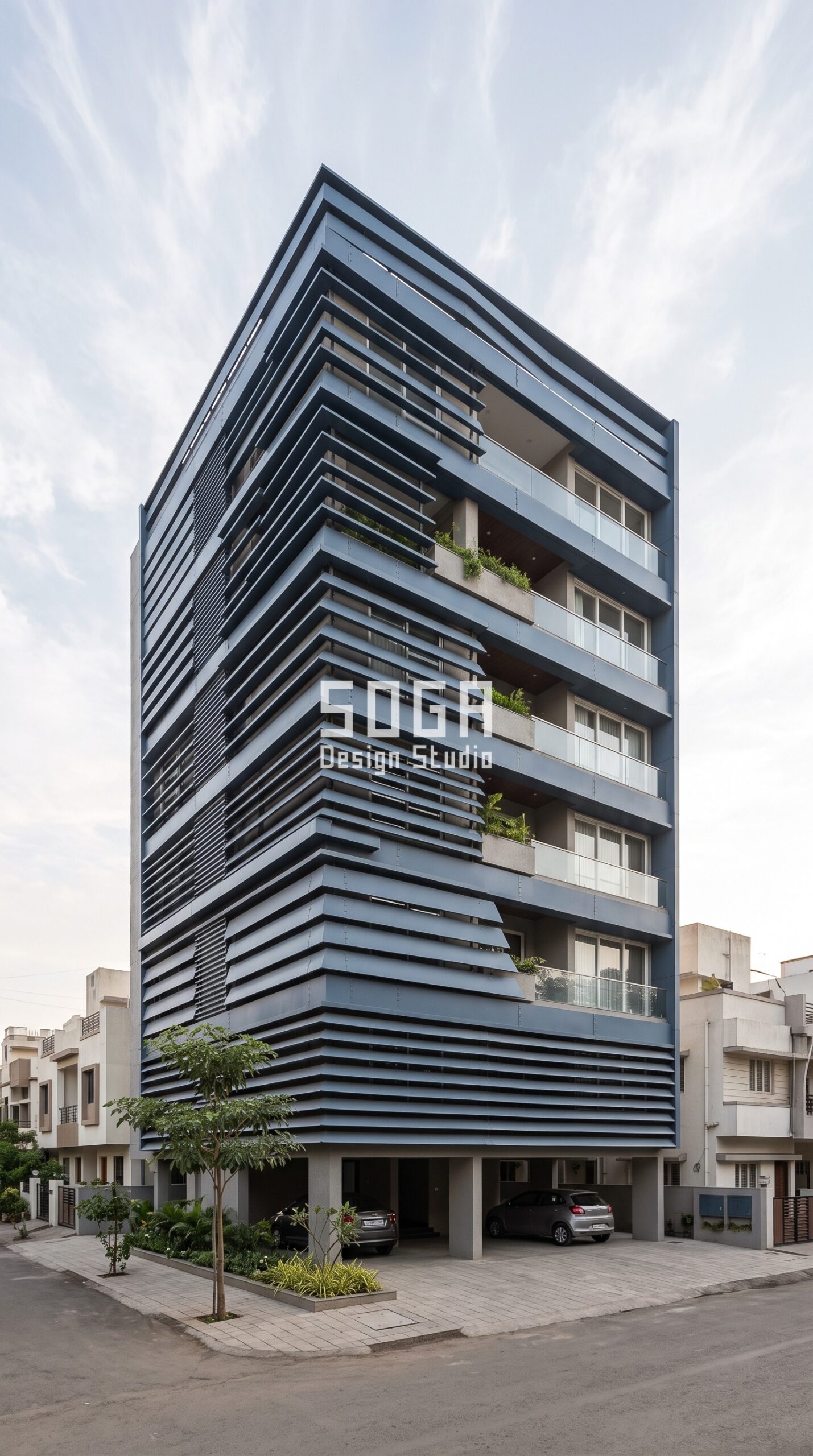
In Shivajinagar, Pune, this G+7 residence wears a parametric array of layered horizontal metal blades in matte steel-blue (RAL 5011). The blades sit tight near the base and open up as they rise, so the same skin that carves deep, crisp shadow lines under Pune’s bright morning sun becomes a ladder of glowing horizontal streaks when it is grazed by warm light after dark. That dual read — sculptural by day, luminous by night — is the entire reason for building depth into a facade instead of printing a pattern onto a flat wall. The powder-coated steel is detailed with honest seams and concealed fixings, so it reads as real manufactured metal rather than a rendered box. Recessed balconies with clear glass railings and a few planters break the rhythm just enough to keep it residential. It is a facade that earns its keep in a photograph at 9 a.m. and again at 9 p.m.
2. Ludhiana Parametric Facet Grid: A Jet-Black Sculptural Metal Elevation
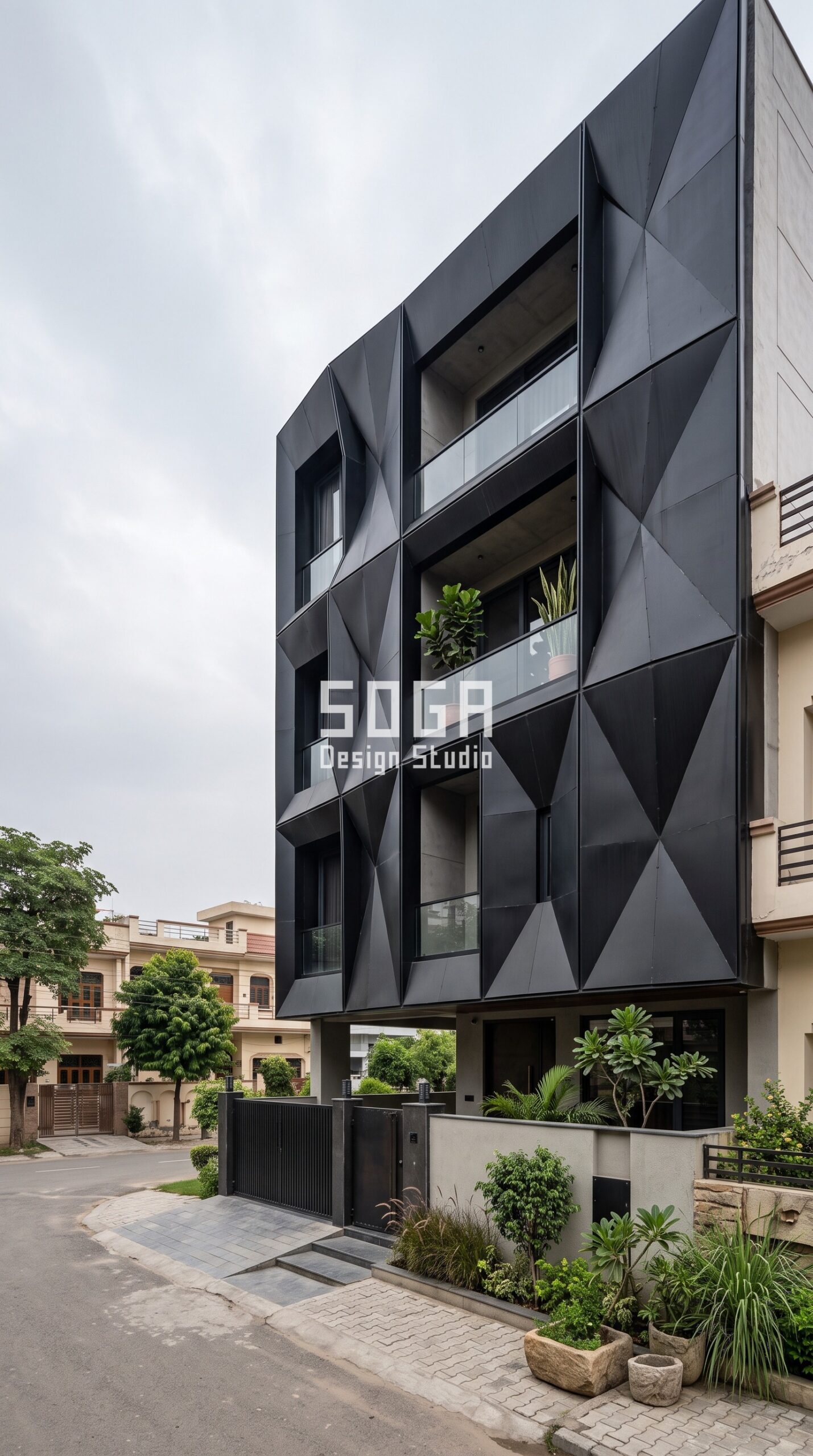
Ludhiana’s Model Town concept is a G+3 block sheathed in a parametric grid of angular, diamond-faceted folded metal panels in matte jet-black (RAL 9005). Each facet is tilted slightly differently, so even under Ludhiana’s flat, overcast sky the elevation never goes dull — one plane catches the light while its neighbour falls into shadow, giving the whole wall a quiet three-dimensional shimmer. Seen from the low, looking-up angle typical of a tight urban plot, the folds read as a single sculptural mass rather than a repeating tile. At night, a few grazing wall-washers turn those same facets into a field of soft highlights and dark valleys. The discrete, ordered modules keep it buildable and easy to fabricate in Ludhiana’s steel workshops. This is how a modest G+3 plot earns a landmark elevation without a landmark budget.
3. Bangalore Parametric Cantilever Pulse: Rhythm on a Floating Metal Volume
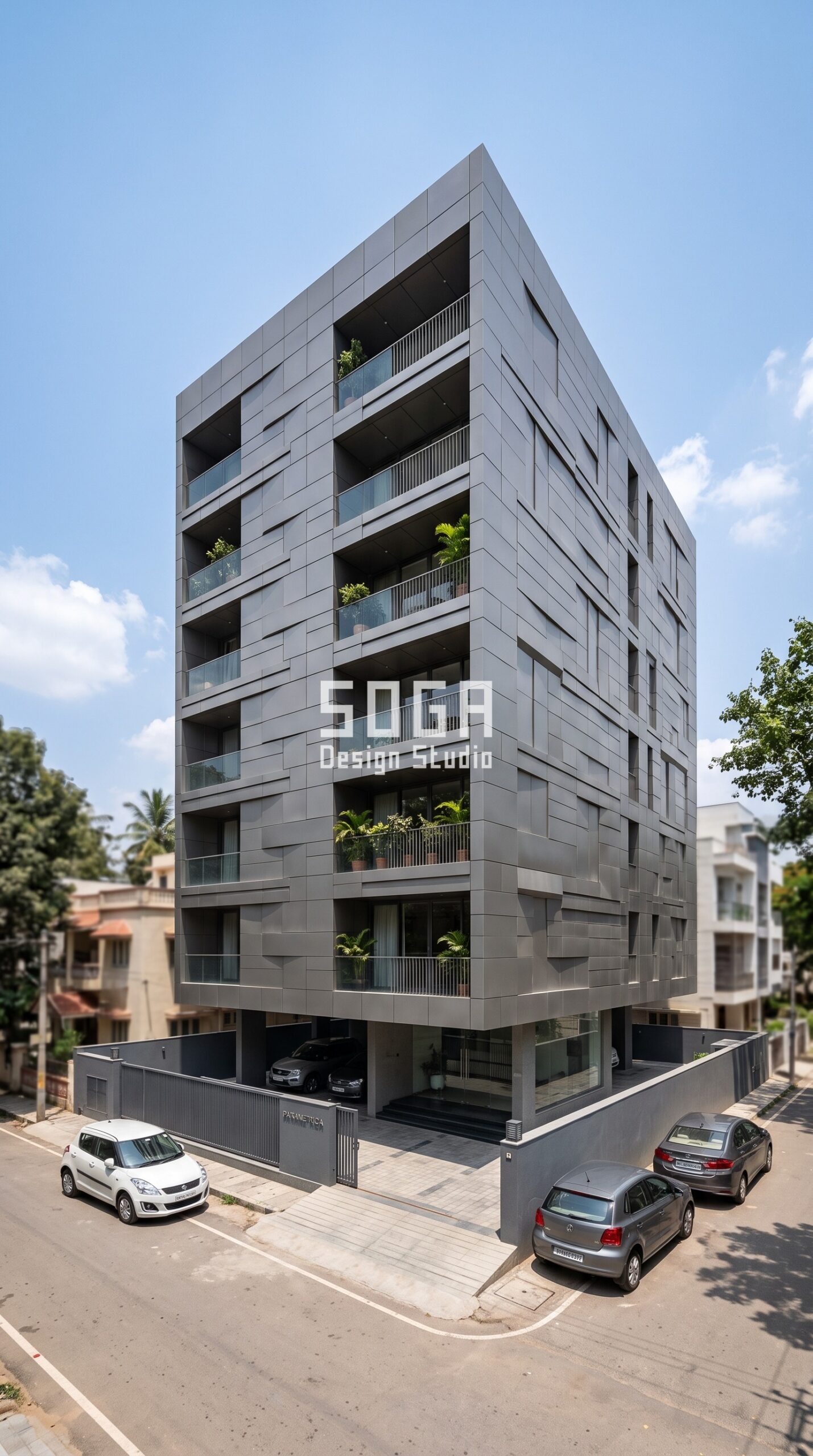
In Jayanagar, Bangalore, the design is a G+6 residence built as a cantilevered box floating above open parking, clad edge to edge in matte titanium-grey anodized metal. The panel rhythm is deliberately not uniform — module sizes and joint lines shift subtly across the elevation, so Bangalore’s strong midday sun rakes across the surface and reveals a pulse of light and shadow instead of a flat grey slab. Because the whole volume reads from the street, that shifting rhythm does the heavy lifting ornament once did. A ground-floor lobby behind clear glass and a quiet driveway keep the base calm and open. After dark, concealed uplights trace the cantilever edge and the grid quietly re-emerges. It is a restrained, clean elevation that still has movement built into it.
4. Ahmedabad Parametric Canopy Shell: Undulating Metal Sunshades in Golden Light
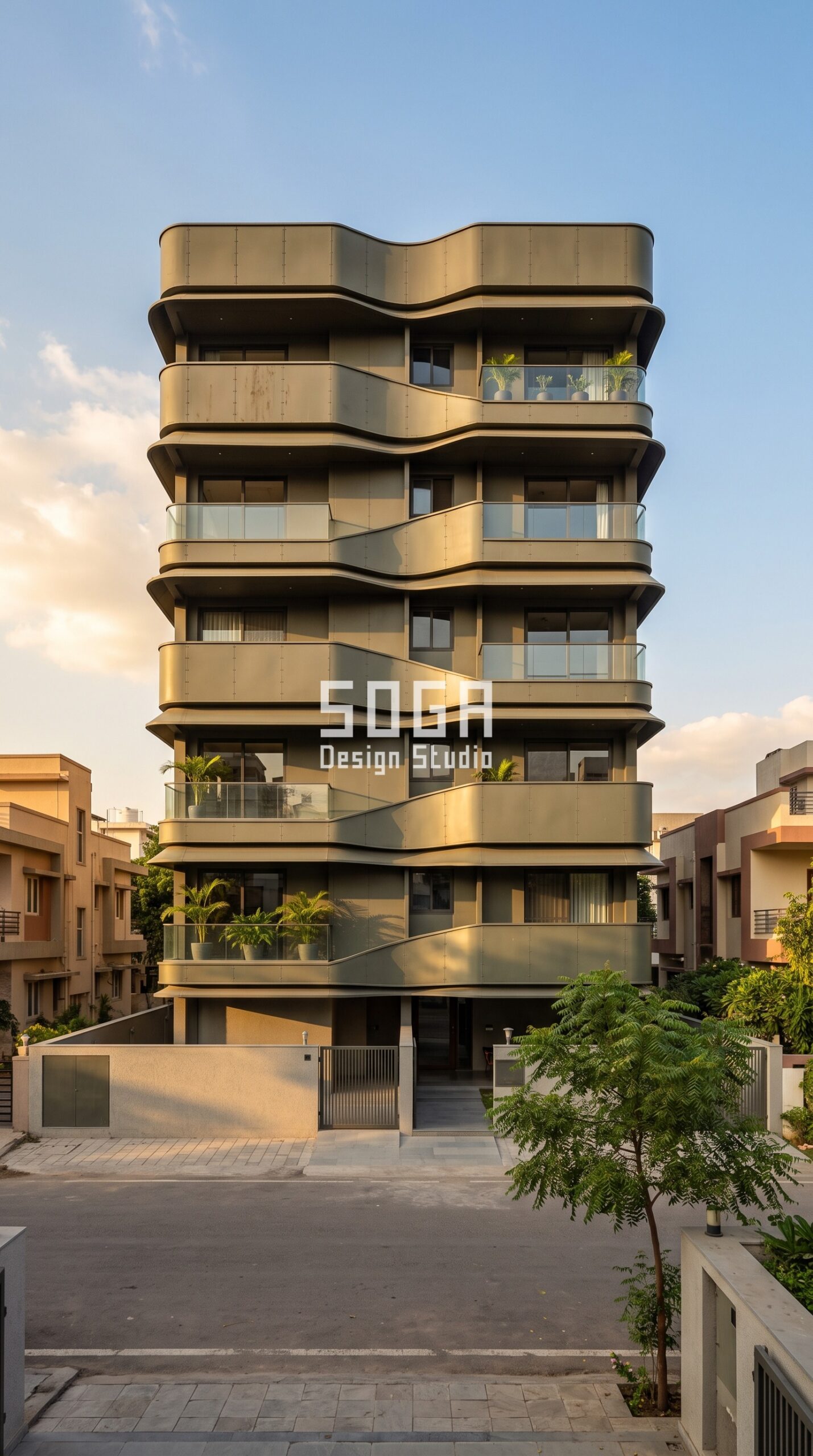
Ahmedabad’s Bodakdev concept, a G+5 residence in matte military olive-drab steel, replaces flat balcony slabs with wide, undulating metal canopy bands that double as horizontal sunshades on every floor. The curve depth eases gently up the building, so in Ahmedabad’s low, late-afternoon golden light the whole facade appears to ripple — shade below each band, a warm glow along its lip. Those same bands are doing real climate work, cutting direct sun off the glazing behind them in a city that badly needs it. Detailed with honest seams and concealed fixings, the olive-drab metal reads warm rather than industrial against the surrounding low-rise houses. At night the undersides of the bands catch soft light and the ripple returns as a set of glowing horizontal waves. Function and form arrive in the same gesture.
Cost Benchmarks for Indian Parametric Metal Facades
One of the most-asked questions on a Pune project brief is budget. The current all-in installed rates for parametric metal facades in India sit in the following ranges:
- Steel facade (full design + install): ₹1,200–₹2,800 per sq ft
- Aluminium, anodised or powder-coated: ₹800–₹2,500 per sq ft
- Zinc cladding: ₹1,500–₹3,000 per sq ft
- ACM panels (3 mm basic): ₹200–₹250 per sq ft (basic)
- ACM panels (4 mm): ₹250–₹350 per sq ft
- Solid aluminium panels: ₹800–₹1,800 per sq ft
- Installation labour: ₹50–₹150 per sq ft (varies by height + access)
- Conventional cladding (for comparison): ₹400–₹1,200 per sq ft installed (stone veneer / ceramic / standard ACM)
These figures are baseline; actual project cost depends on facade area, panel complexity, fabricator location, and finish specification. SOGA Design Studio prepares an itemised cost estimate as part of every consultation so the budget conversation starts with hard numbers rather than guesses.
Parametric Facade Design Across India, Dubai & Singapore
Indian residential architecture is shifting from decoration to performance. SOGA Design Studio’s residential work is built for the scale most clients actually build at: G+3 to G+7 homes on plots of 2,400 to 6,000 sq ft, where a parametric metal facade has to earn its place by controlling sun, dust, and privacy as well as it controls first impressions. The studio’s role is to compress what used to take a six-month traditional design cycle into a sharper, AI-accelerated process — without sacrificing the engineering rigour that separates a buildable facade from a rendering. Every concept is developed for the plot, the orientation, and the budget in front of us, not borrowed from a catalogue.
Why Trust SOGA Design Studio for Facade Design in Pune
- Experience: SOGA Design Studio has delivered parametric metal facades across Pune, Bangalore, Ahmedabad and more than a dozen Indian cities, from G+3 residential plots to larger mixed-use elevations.
- Expertise: Every concept is engineered in parametric software, then resolved into fabrication-ready shop drawings with defined module sizes, joint lines, fixing details and RAL colour specifications.
- Authority: SOGA works only in buildable, climate-responsive metal systems — steel, aluminium and zinc — detailed for Indian sun, monsoon and dust, never one-off sculptural experiments.
- Trust: Clients receive transparent per-square-foot cost bands, realistic fabrication and installation timelines, and end-to-end remote consultation for NRI owners in Dubai, Singapore, the UK and the US.
Frequently Asked Questions
How do you light a metal facade for night-time appeal?
The trick is grazing light, not floodlight. Concealed linear fixtures mounted close to the facade skim across the blades, facets or canopy bands so the depth designed for daylight re-appears as highlights and shadows after dark. Warm 2700–3000K LEDs suit residential metal facades, and edge-lighting a cantilever or the underside of sunshade bands is far more effective — and more efficient — than washing the whole wall flat.
Is a parametric metal facade worth it on a G+3 or G+4 plot?
Yes — G+3 and G+4 residences are the highest-growth segment for parametric facades in India, because the entire elevation is visible from the street. A sculpted metal skin gives a modest plot genuine landmark presence that a flat painted wall never can, and the smaller scale keeps fabrication and cost manageable.
Can NRIs design and build a metal facade in India remotely?
Yes. SOGA runs end-to-end remote consultations for NRI clients in Dubai, Singapore, the UK and the US — site analysis, parametric concept design, fabrication-ready drawings and coordination with local fabricators — so owners can commission an Indian facade without being on site.
Is parametric facade design expensive in India?
SOGA Design Studio addresses this question in detail during the design consultation. For Pune projects, we provide a fully customised answer based on plot, orientation, and budget — typically within 48 hours of receiving the brief.
Which metal is best for a facade in the Indian climate?
For luxury Indian residential facades today, the most-specified materials are powder-coated aluminium, precision-cut bronze and copper, and pre-patinated zinc. The choice depends on climate, budget, and the visual language of the building.
Do metal facades actually reduce heat?
Parametric precision-cut facades reduce solar heat gain by 25-40% on west and south orientations in Indian conditions, lowering interior surface temperatures by 4-7 degrees Celsius compared to bare RCC. Panel perforation density is tuned per orientation.
Is parametric design suitable for G+3 and G+4 residential plots?
Absolutely — it is in fact the highest-growth segment in India. G+3 and G+4 plots benefit most because the entire facade is visible from the street, so a sculptural parametric treatment yields maximum identity per rupee invested. SOGA Design Studio specialises in this typology, with concepts adapted to standard 30×40, 40×60, and 50×80 ft plots across Indian metros and tier-2 cities.
How much does a parametric metal facade cost in India 2026?
Aluminium parametric facades range ₹800–₹2,500 per sq ft (full design + install), steel ₹1,200–₹2,800 per sq ft, and zinc ₹1,500–₹3,000 per sq ft. Basic ACM cladding (3–4 mm) starts at ₹200–₹350 per sq ft; solid aluminium panels run ₹400–₹600 per sq ft. Installation labor adds ₹50–₹150 per sq ft depending on building height. SOGA Design Studio provides itemised cost estimates as part of every consultation.
What is parametric facade design?
Parametric facade design uses algorithmic rules — light, climate, orientation, and structural parameters — to generate a building skin where every panel is mathematically calibrated. The result is a facade that performs (heat control, ventilation, daylighting) while expressing a unique sculptural identity. It is the direct computational descendant of traditional Indian metal screens.
Which RAL colours work best for Indian residential facades?
Three palettes dominate 2026 Indian residential work: warm earthy bronze and corten tones (RAL 8004, 8019) for traditional contexts; deep desaturated blues and greens (RAL 5004, 5011, 6009) for contemporary luxury; and matte charcoal/black (RAL 9005, 7016) paired with brass or copper accents for a graphic urban look. Light cladding with dark frames is the most-searched aesthetic of 2026.
How much heat does a parametric metal facade actually reduce?
Independent studies on Indian residential applications show double-skin parametric metal screen facades reduce direct solar heat gain by 25-40% on west and south orientations, dropping interior surface temperatures by 4-7 deg C compared to bare RCC. The shaded gap also enables passive cross-ventilation. SOGA Design Studio tunes the screen opening density based on each orientation solar load.
What is a kinetic facade and is it practical for Indian residences?
A kinetic facade has moving panels — louvres, rotating fins, or actuated screens — that respond to sun angle, occupancy, or wind. For mid-rise Indian residences, the practical version is ‘pseudo-kinetic’: a static parametric pattern that creates the visual illusion of motion as the sun tracks across it. True actuated kinetic systems are typically reserved for premium G+10 and above commercial buildings.
What is a sculptural petal-shaped metal fin facade?
SOGA Design Studio addresses this question in detail during the design consultation. For Pune projects, we provide a fully customised answer based on plot, orientation, and budget — typically within 48 hours of receiving the brief.
Related Reading
Start Your Facade Project With SOGA Design Studio
A metal facade is not a daytime decoration — designed with real depth, rhythm and curve, it performs and photographs from sunrise to well after dark, which is exactly why parametric metal is winning across Pune, Bangalore, Ahmedabad and India’s other fast-building cities.
Whether you are building new or retrofitting an existing block, SOGA Design Studio can adapt the concepts above to your exact plot and budget. Start the conversation here — consultations are free and no-commitment.