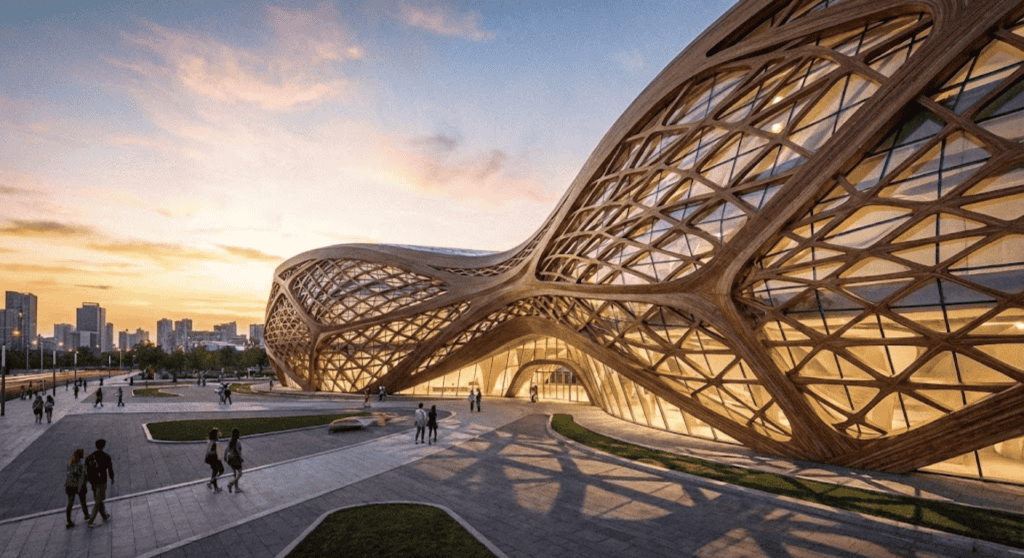
Walk down a Sadashivanagar lane in 2026 and you will pass two G+3 plots at almost the same stage. One has scaffolding up and a metal skin going on. The other still has a site office full of marked-up elevations, because the client moved a balcony, and the change cost six weeks of redrawing. That gap is the honest argument for parametric facade design in India, and it has almost nothing to do with software drawing faster. It has to do with what a change costs you. When a facade is described as a rule rather than as fifty fixed drawings, the rule absorbs the change and the fabricator never stops. Below are four concepts from Bangalore and other Indian cities, each showing a different place where those weeks come back.
Facade Design in India: Why Bangalore Is Choosing Parametric Metal
Facade design in India has moved from an afterthought to the single most important decision on a residential project. Today, demand for parametric facade design in India is rising fastest in cities such as Bangalore, Mumbai, Bangalore, Delhi, and Pune, where homeowners and developers want elevations that are both performance-driven and instantly recognisable. SOGA Design Studio specialises in facade design in India — from G+3 individual homes to G+7 residential blocks — pairing algorithmic geometry with matte titanium grey anodized metal pan and fabrication-ready detailing. Whether you are comparing metal facade design in India for a new build or a retrofit, the concepts below show how a considered facade redefines a building’s identity and its long-term value.
1. Bangalore Parametric Lancet Screen: One Rule Instead of Fifty Drawings
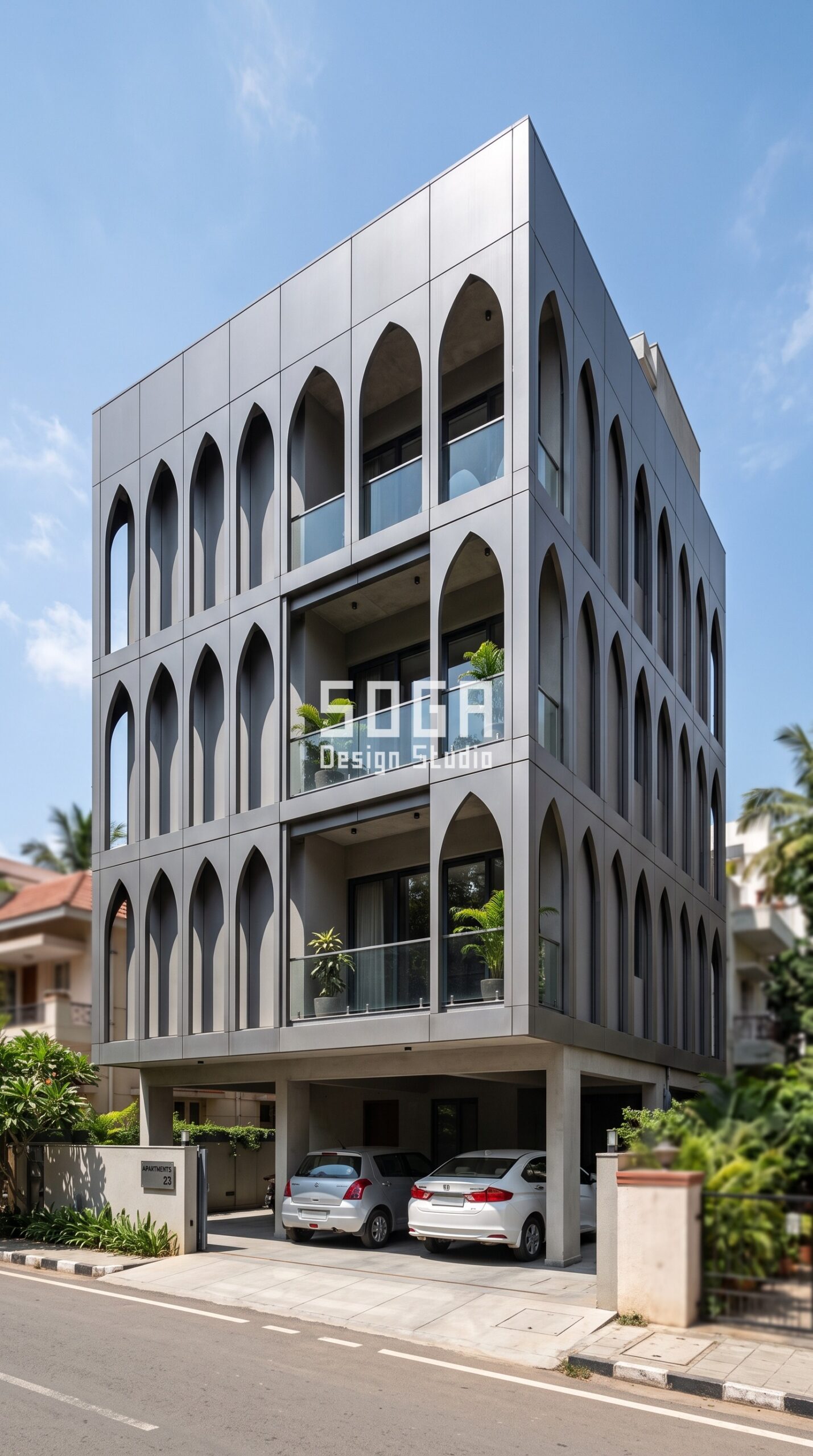
This G+3 in Sadashivanagar sits on the kind of tight Bangalore plot where the west elevation takes the full afternoon load and the setback leaves no room for a projecting sunshade. The screen answers it with tall arched openings cut into discrete matte titanium grey anodized panels, where the height and width of every arch is a function of its floor level and the sun angle it has to handle, not a shape someone drew by hand. That single relationship is why the design moved quickly: when a balcony line shifts during review, one input changes and the whole screen regenerates overnight, correctly, with no elevation left stale. Anodized aluminium suits Bangalore’s mild wet-dry cycle, because the finish needs nothing more than an annual rinse. Through the day the arches read as a flat silver grid at noon and as deep shadowed niches by four o’clock. The building gets its identity from geometry that also happens to be the shading strategy.
2. Goa Parametric Facet Fold: One Panel Family, Not Fifty Bespoke Pieces
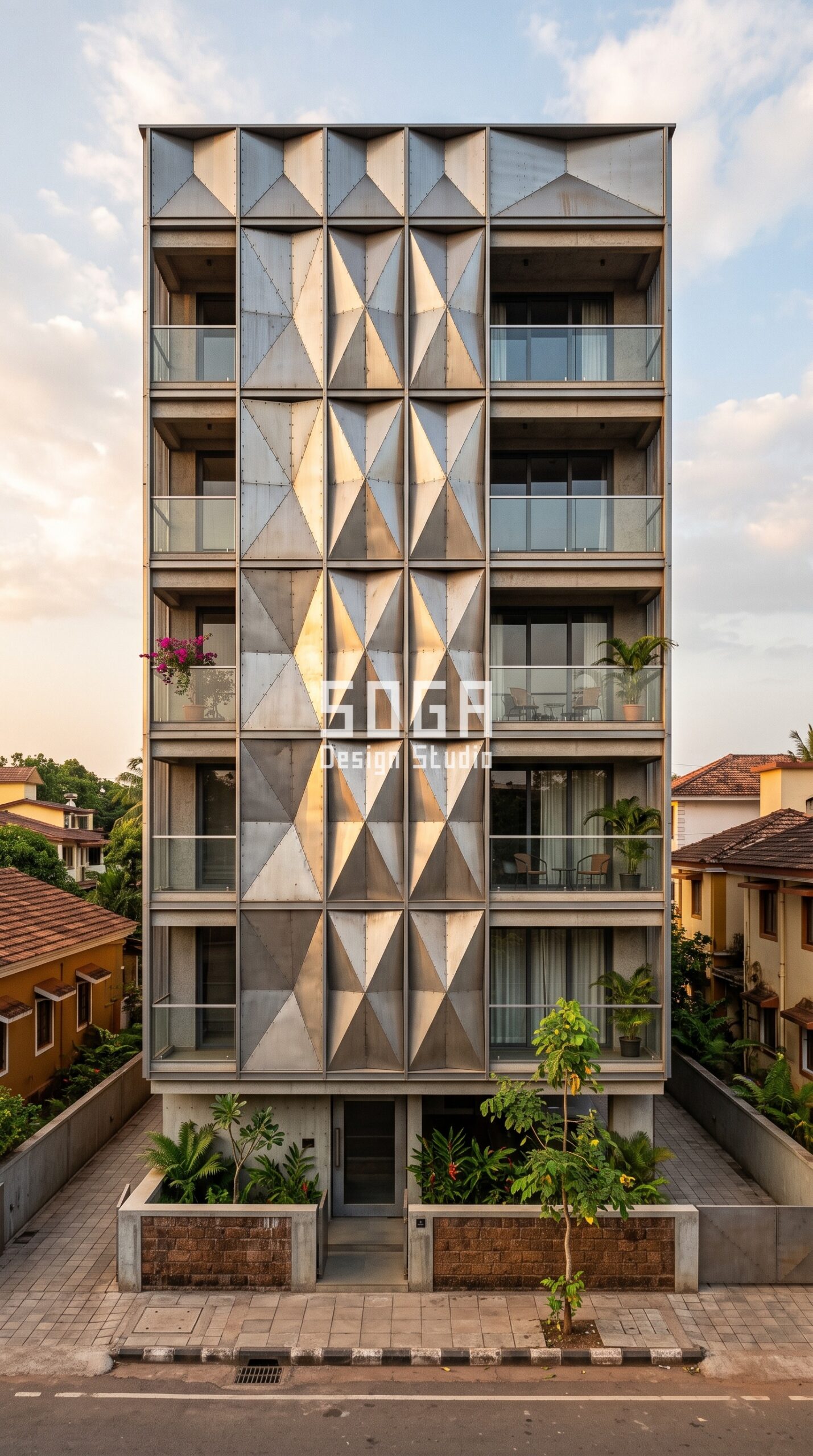
Dona Paula presents a narrow G+6 frontage facing a coastal street, which means salt-laden air, strong low western light, and an owner who does not want a facade needing repaint in four years. The skin is an array of angular diamond-faceted folded cassettes in matte industrial raw steel with a clear wax coating, and the important detail is that every cassette comes off the same press-brake setup, varying only in fold depth. That is where the second block of time comes back: a fabricator quoting one tool and one panel family prices and schedules the job in days, while a facade of fifty unique pieces goes to committee. The raw waxed steel is specified deliberately for Goa, so the surface deepens with exposure rather than failing. In late-afternoon raking light the varying folds turn a flat elevation into a field of bright and dark triangles that shifts as you walk past. It is a rich facade built from a deliberately short parts list.
3. Bangalore Parametric Prism Stack: Fabrication Files Straight From the Model
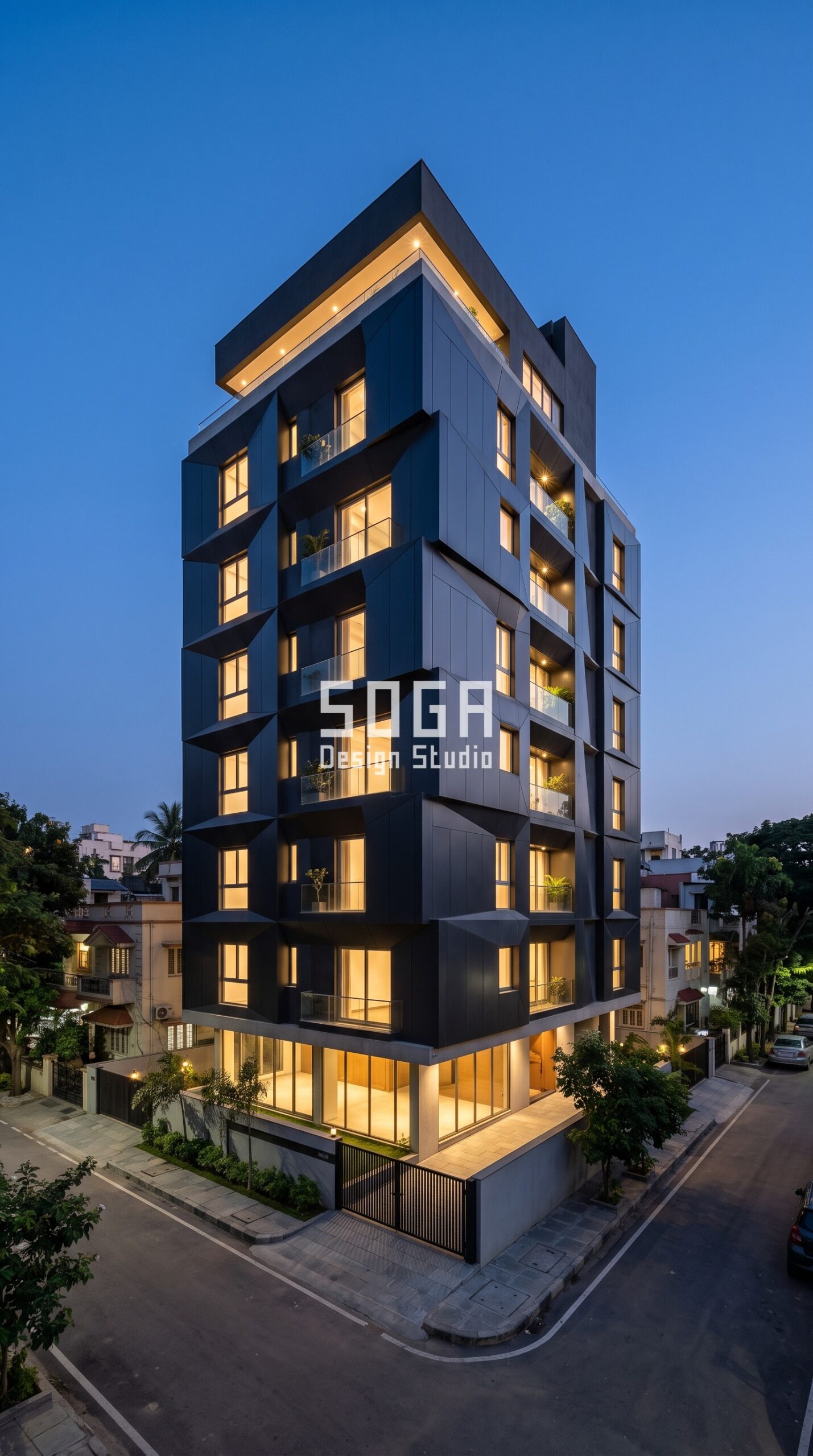
The Indiranagar concept is a G+7 on a dense corner where neighbours look almost directly into the living rooms, so the brief is privacy without darkening the flats. The response is a stack of faceted prismatic folded volumes in matte deep charcoal black powder-coated steel, where the fold depth steps floor by floor so lower, more exposed levels get deeper screening and upper floors open out. Because each panel is a parametric instance rather than a one-off drawing, the flat patterns, bend lines and fixing positions export straight out of the model as cutting files, which removes the shop-drawing round trip that usually adds three to five weeks between design approval and first delivery. Charcoal powder coat keeps the mass quiet against a low-rise street by day. At blue hour the folds catch the warm interior light and the whole elevation reads as a stack of lit prisms. Privacy stops being a compromise and becomes the pattern.
4. Chennai Parametric Ledge Band: A Skin That Removes the Late Add-On
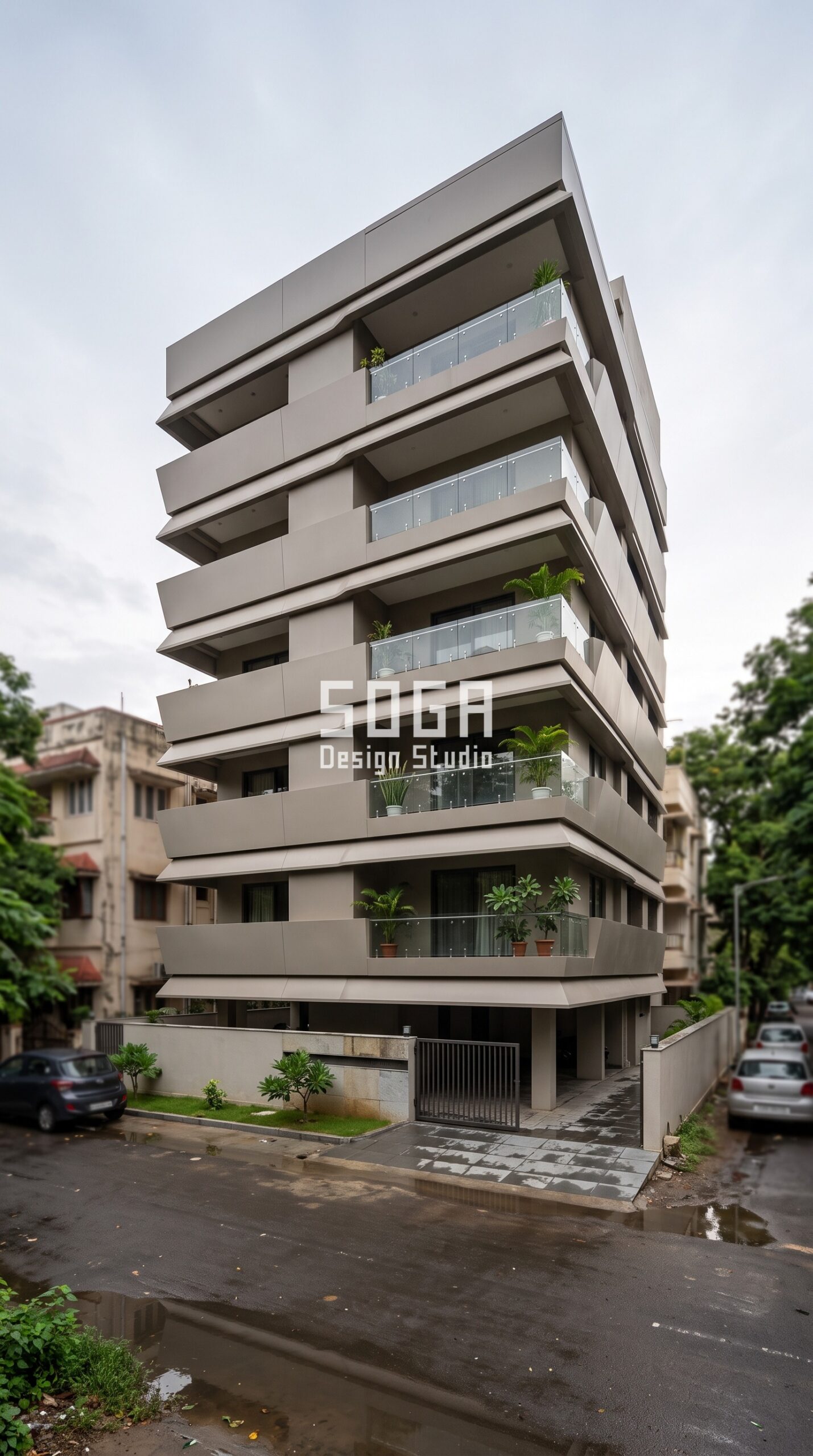
On Boat Club Road the twin problems are Chennai’s heat and its monsoon, and the classic Indian pattern is to design a clean elevation and then bolt on chajjas and rain hoods later, which is exactly the late change that wrecks a schedule. This G+6 solves both in one element: wide horizontal press-braked shading ledges in matte powder-coated RAL 1019 warm grey beige steel, one per floor, each a rigid band whose projection steps in and out across the elevation according to the orientation it faces. Deeper bands sit where the sun is worst, shallower ones where daylight matters more, and every band already doubles as rain shelter over the balcony glazing. Because the shading is part of the geometry from day one, nobody has to redesign the facade after the first monsoon review. In wet overcast light the warm beige stays soft rather than glaring, and the stepped shadows give a tall building a horizontal calm. The fastest revision is the one the brief never triggers.
Cost Benchmarks for Indian Parametric Metal Facades
One of the most-asked questions on a Bangalore project brief is budget. The current all-in installed rates for parametric metal facades in India sit in the following ranges:
- Steel facade (full design + install): ₹1,200–₹2,800 per sq ft
- Aluminium, anodised or powder-coated: ₹800–₹2,500 per sq ft
- Zinc cladding: ₹1,500–₹3,000 per sq ft
- ACM panels (3 mm basic): ₹200–₹250 per sq ft (basic)
- ACM panels (4 mm): ₹250–₹350 per sq ft
- Solid aluminium panels: ₹800–₹1,800 per sq ft
- Installation labour: ₹50–₹150 per sq ft (varies by height + access)
- Conventional cladding (for comparison): ₹400–₹1,200 per sq ft installed (stone veneer / ceramic / standard ACM)
These figures are baseline; actual project cost depends on facade area, panel complexity, fabricator location, and finish specification. SOGA Design Studio prepares an itemised cost estimate as part of every consultation so the budget conversation starts with hard numbers rather than guesses.
Parametric Facade Design Across India, Dubai & Singapore
Retrofit is the fastest-growing segment of today’s Indian facade market and SOGA Design Studio is investing heavily in it. A lightweight aluminium parametric screen mounted on stand-off brackets can transform a tired 1990s or 2000s Bangalore apartment block in 4 to 8 weeks without disturbing tenants or interiors. The economics often surprise owners: a retrofit facade can reset rental yield, reposition a building in the listings, and add visible value at a fraction of the cost of a full reclad. Several of the concepts shown above have direct retrofit variants available on request.
Why Trust SOGA Design Studio for Facade Design in Bangalore
- Experience: SOGA Design Studio has been developing and visualising parametric metal facade concepts for real Indian G+3 to G+7 plots since 2023, including a daily published study series covering Bangalore, Chennai, Goa, Mumbai, Delhi, Pune, Hyderabad and Kolkata conditions.
- Expertise: Every concept is built as a parametric model, not a picture: aperture size, panel depth, fold geometry and screen density are driven per orientation from solar exposure, then resolved into panel families, bend lines and fixing positions that export as fabrication-ready files.
- Authority: SOGA positions as India’s facade design experts across residential and commercial typologies, and works from its own engineering studies and buildability testing rather than borrowed precedent.
- Trust: All concepts are costed against real 2026 Indian rates (aluminium Rs 800-2,500 per sq ft, steel Rs 1,200-2,800 per sq ft, zinc Rs 1,500-3,000 per sq ft, plus Rs 50-150 per sq ft installation), delivered with itemised estimates, and the first consultation is free with no commitment. NRI clients are handled remotely end to end.
Frequently Asked Questions
How long does a parametric facade take to design in India?
For a typical Indian G+3 to G+7 residential building, a parametric facade concept takes about 2 to 3 weeks to reach an agreed design, and a further 3 to 4 weeks to reach fabrication-ready panel documentation. The saving over a conventionally drawn facade is not in the first pass, it is in revisions: because the facade is defined as a rule, a change to a balcony, floor height or setback regenerates the whole skin instead of triggering weeks of manual redrawing.
Is parametric facade design more expensive than conventional cladding?
The panel cost sits above basic cladding but not dramatically so, and the gap narrows when the design is disciplined. Conventional stone veneer, ceramic or standard ACM cladding runs roughly Rs 400-1,200 per sq ft installed, while a parametric aluminium facade runs Rs 800-2,500 per sq ft. Keeping the design to one panel family with varying parameters, rather than many bespoke pieces, is what keeps a parametric facade in the lower half of that band.
How much does a parametric metal facade cost per sq ft in India in 2026?
In 2026 Indian rates, aluminium parametric facades run Rs 800-2,500 per sq ft for full design and install, steel Rs 1,200-2,800 per sq ft and zinc Rs 1,500-3,000 per sq ft. Basic ACM panels start much lower at Rs 200-350 per sq ft for 3 to 4 mm sheets, and installation labour adds Rs 50-150 per sq ft depending on building height and site access. SOGA Design Studio issues an itemised estimate with every consultation so the number is specific to your elevation area, not a range.
Can Indian fabricators build a parametric metal facade?
Yes, and this is the point of designing it parametrically. The geometry is resolved into standard operations that Indian metal fabricators already run every day: laser or CNC cutting, press-brake folding, powder coating or anodising, and bracket fixing to an aluminium or MS sub-frame. Because flat patterns and bend data export directly from the model, the fabricator receives cutting files rather than drawings they have to reinterpret, which is what keeps the shop from becoming the bottleneck.
Is parametric facade design only worth it for large buildings?
No. The approach works well from G+2 upward, and small buildings often benefit most, because a modest Bangalore or Chennai plot has little room for projecting sunshades and needs the skin itself to do the shading. On a smaller elevation the total panel area is lower, so the cost premium over plain cladding is a smaller absolute number while the visual and thermal difference is just as large.
Where are parametric metal facades fabricated in India?
The main fabrication clusters are Mumbai-Pune (precision aluminium and steel), Chennai-Coimbatore (laser cutting and powder coating), Delhi-NCR (large-format ACM and screens), and Ahmedabad (brass and copper specialty). SOGA Design Studio works with vetted fabricators in each cluster to keep transport cost and lead-time low for any project location.
Which RAL colours work best for Indian residential facades?
Three palettes dominate 2026 Indian residential work: warm earthy bronze and corten tones (RAL 8004, 8019) for traditional contexts; deep desaturated blues and greens (RAL 5004, 5011, 6009) for contemporary luxury; and matte charcoal/black (RAL 9005, 7016) paired with brass or copper accents for a graphic urban look. Light cladding with dark frames is the most-searched aesthetic of 2026.
How much heat does a parametric metal facade actually reduce?
Independent studies on Indian residential applications show double-skin parametric metal screen facades reduce direct solar heat gain by 25-40% on west and south orientations, dropping interior surface temperatures by 4-7 deg C compared to bare RCC. The shaded gap also enables passive cross-ventilation. SOGA Design Studio tunes the screen opening density based on each orientation solar load.
Can a parametric metal facade be retrofitted onto an existing Indian building?
Yes, and it is one of the fastest-growing segments. A lightweight aluminium parametric screen can be mounted on stand-off brackets over existing brick, RCC, or even tired plaster facades — completely transforming the elevation in 4–8 weeks without disturbing tenants or interiors. Retrofit is particularly cost-effective for 1990s-2010s Indian apartments where the original facade has aged.
Can NRIs design and build a parametric facade in India remotely?
Yes. SOGA Design Studio runs end-to-end remote consultations for NRI clients in Dubai, Singapore, the UK, and the US. The workflow — site analysis, design development, client review, fabrication-ready drawings, and on-site supervision — is delivered virtually. NRI projects in tier-2 cities like Coimbatore, Indore, and Chandigarh make up a fast-growing share of our portfolio.
Parametric metal facade vs traditional stone or paint — which is better long-term?
Stone is heavy, expensive (₹600–₹1,500 per sq ft just for material), and difficult to repair when chipped. Paint requires repainting every 4–6 years in Indian conditions. A powder-coated parametric metal facade has higher upfront cost but a 25–30 year service life, zero repainting, and far stronger street identity — making total cost of ownership lower over a 20-year horizon. It is also significantly lighter, reducing structural cost on G+3 and above.
How much does a parametric metal facade cost per square foot in Indore?
Currently, all-in parametric metal facade rates in India range from ₹800–₹2,500 per sq ft for aluminium and ₹1,200–₹2,800 per sq ft for steel, installed. SOGA Design Studio prepares itemised estimates as part of the consultation.
What is a sculptural petal-shaped metal fin facade?
SOGA Design Studio addresses this question in detail during the design consultation. For Bangalore projects, we provide a fully customised answer based on plot, orientation, and budget — typically within 48 hours of receiving the brief.
Related Reading
- facade design concepts for Bangalore
- double skin facade benefits and cost in India
- parametric metal facade design in Chennai
- Villa Facade Design in India 2026: 6 Luxury Parametric Metal
- Facade Design in India 2026: Lucknow Parametric Metal Facade Guide
- Facade Design in India 2026: Parametric Metal Facade Guide
Start Your Facade Project With SOGA Design Studio
Parametric facade design does not save time by drawing faster; it saves time by making change cheap. That is the whole advantage, and it is why a rule beats a drawing set on an Indian site.
If any of the gothic-inspired pointed arched cuto concepts above resonate with your project, send us your brief. SOGA Design Studio delivers customised parametric facade concepts for India, Dubai, Singapore, and the UK.