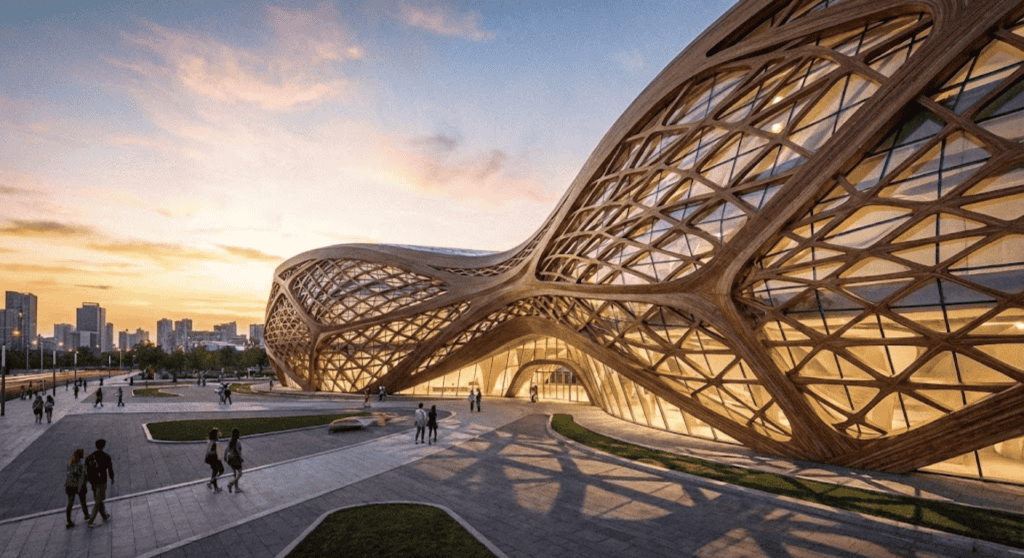
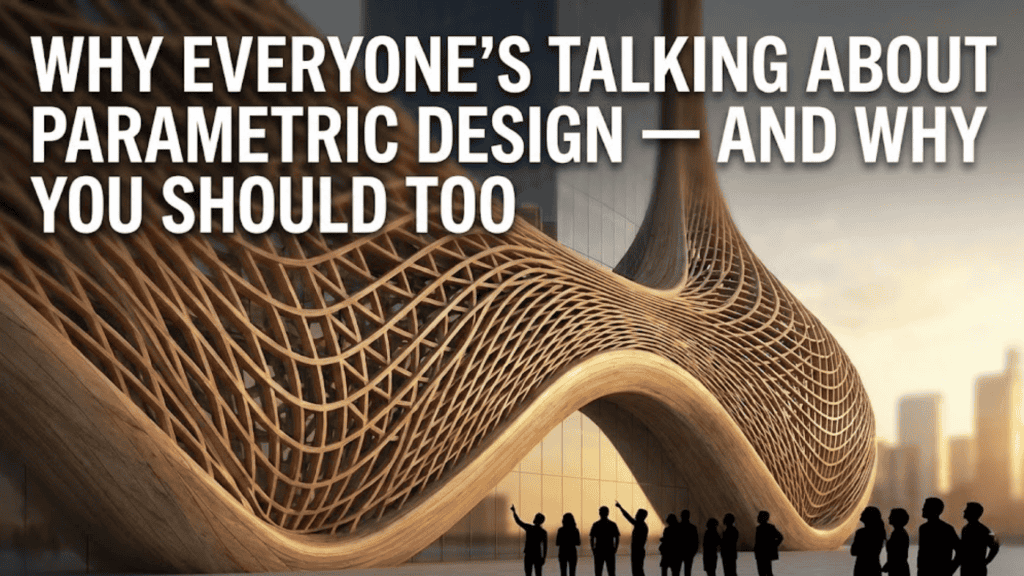
Most people meet parametric architecture as a photograph – a building that ripples, folds or fans, and looks like it was grown rather than built. What almost nobody explains is that the ripple is not the design. It is the output. Behind every facade like this sits a small set of controllable rules: one module, repeated, with one property changed a measured amount each time it repeats. Change the rule and the building changes with it. This guide takes four principles that sit at the foundation of parametric design and shows each one working on a real residential concept – in Chennai, Lucknow, Gurugram and Ahmedabad – so you can see exactly which lever produces which effect, what the module is made of, and roughly what it costs per square foot in India in 2026.
Facade Design in India: Why Chennai Is Choosing Parametric Metal
Facade design in India has moved from an afterthought to the single most important decision on a residential project. Today, demand for parametric facade design in India is rising fastest in cities such as Chennai, Mumbai, Bangalore, Delhi, and Pune, where homeowners and developers want elevations that are both performance-driven and instantly recognisable. SOGA Design Studio specialises in facade design in India — from G+3 individual homes to G+7 residential blocks — pairing algorithmic geometry with matte powder-coated ral 5008 slate gre and fabrication-ready detailing. Whether you are comparing metal facade design in India for a new build or a retrofit, the concepts below show how a considered facade redefines a building’s identity and its long-term value.
1. Principle One: Rhythm – Chennai’s Bow Rib Facade
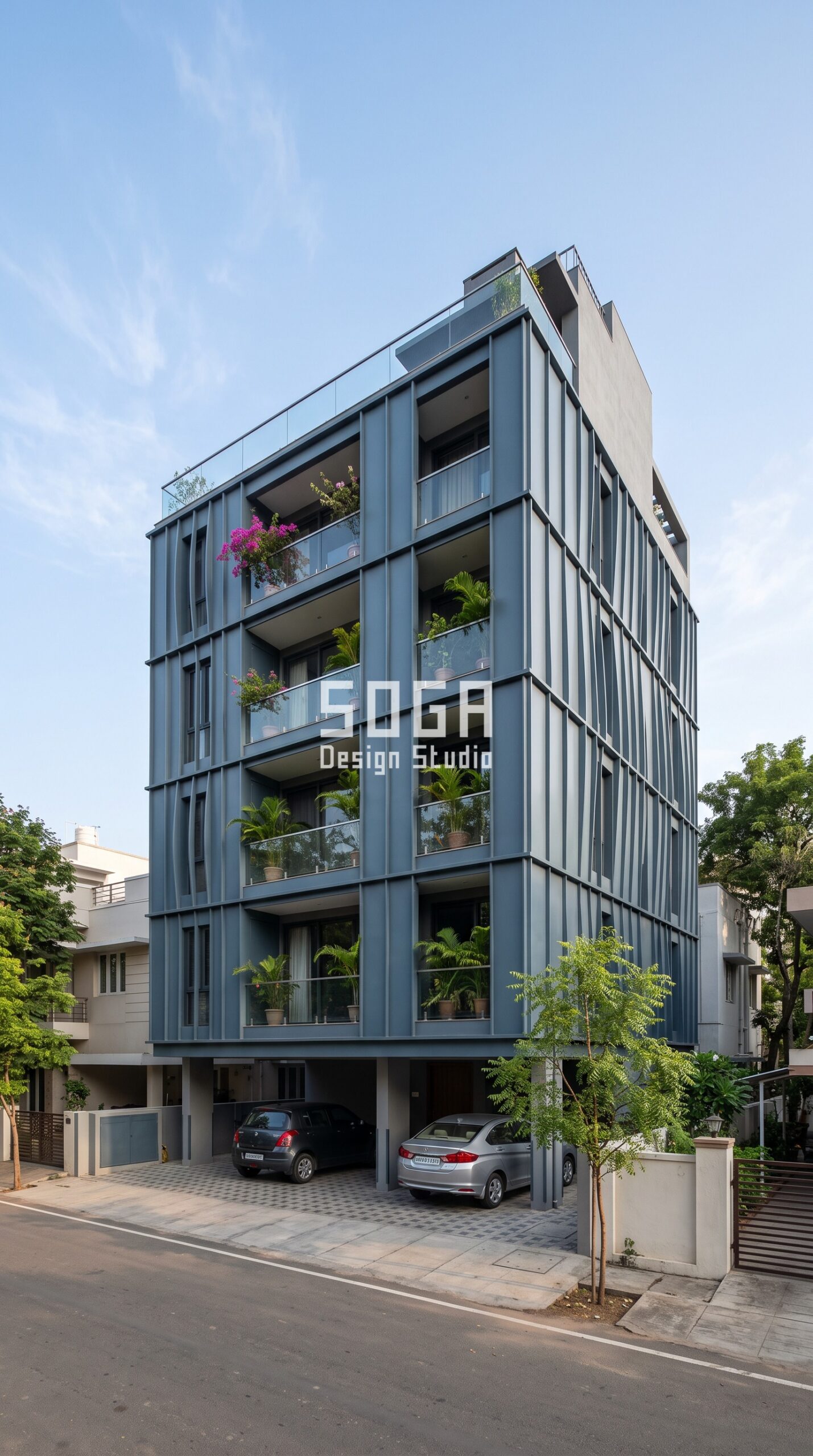
The first and simplest parametric principle is rhythm: take one element, repeat it across the elevation, and vary a single property along the run. On this G+5 in Anna Nagar, Chennai, the element is a slender vertical rib in matte powder-coated RAL 5008 slate grey-blue steel, and the varied property is how far each rib bows out from the wall. Ribs near the balcony openings sit almost flat; ribs across the solid piers bow furthest, so the elevation reads as a slow breathing curve without a single curved panel being fabricated. Every rib is a straight, repeatable, shop-formed section – the curve is in the arrangement, not the part, which is exactly what keeps a facade like this affordable to build. That is the discipline behind the whole SOGA Parametric Bow Rib system: complexity in the pattern, simplicity in the piece. In Chennai’s coastal air the powder-coated steel also earns its keep, shrugging off salt-laden humidity that would chalk a painted plaster elevation within a few monsoons.
2. Principle Two: Rotation – Lucknow’s Pinwheel Facet Panels
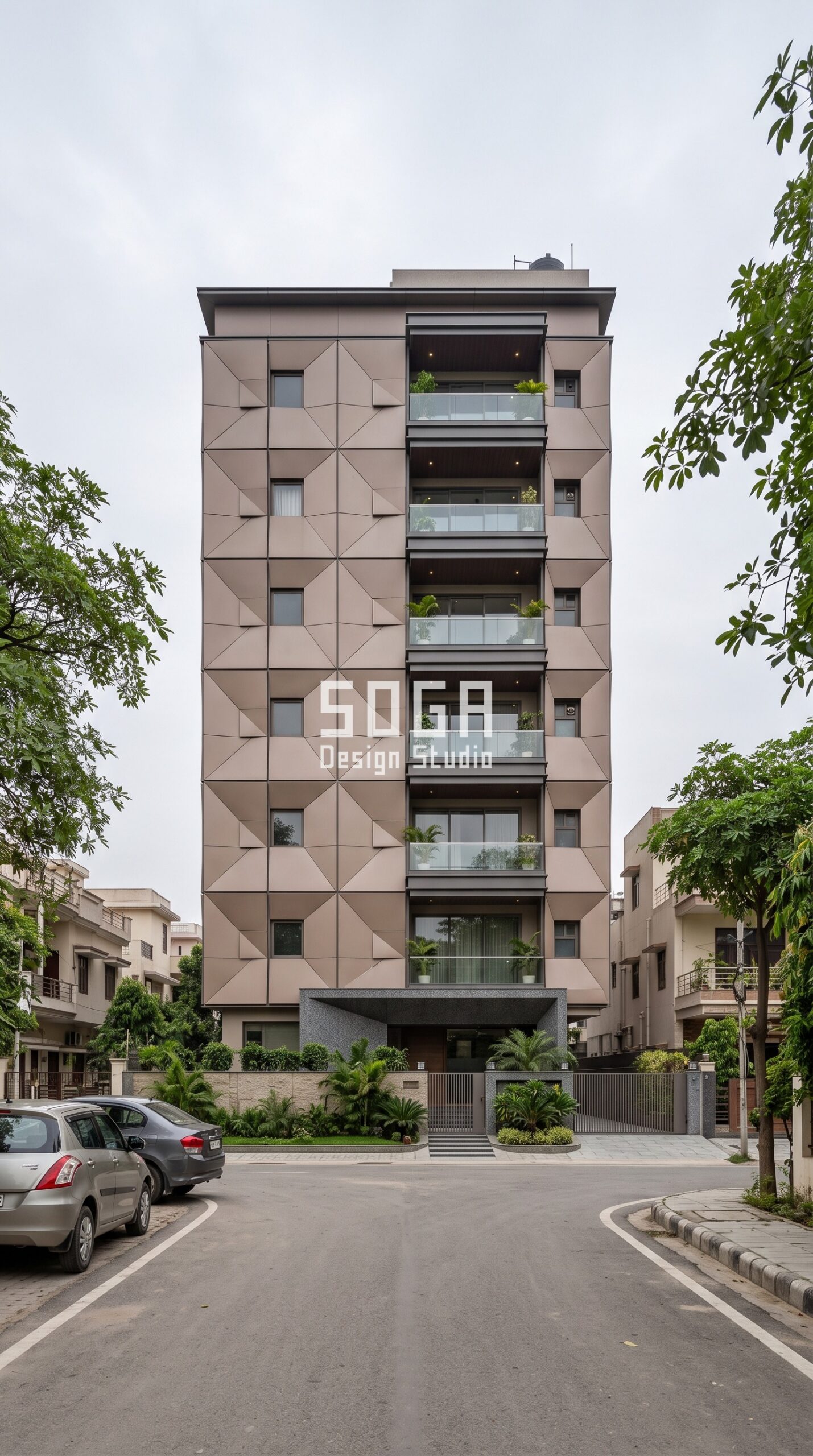
The second principle swaps movement for orientation: keep the module in one place and rotate it instead. This G+7 in Gomti Nagar, Lucknow, is clad in square panels of matte powder-coated RAL 8025 pale brown steel, each one folded into a shallow pinwheel and turned a few degrees further than its neighbour. Because the panels are identical and only their angle changes, one press tool produces the entire elevation, yet no two bays catch the light the same way – the facade shifts from soft and flat under Lucknow’s overcast mornings to sharply faceted by late afternoon. Rotation is the cheapest depth you can buy in a facade: it costs an angle on a drawing, not extra material. It is also the principle most often wasted, because rotating panels randomly produces visual noise; the Parametric Pinwheel Facet system steps the angle in a fixed increment so the eye reads order rather than accident. For a north Indian climate the shallow fold does quiet thermal work too, self-shading part of each panel through the hottest hours.
3. Principle Three: Gradient – Gurugram’s Swell Band Elevation
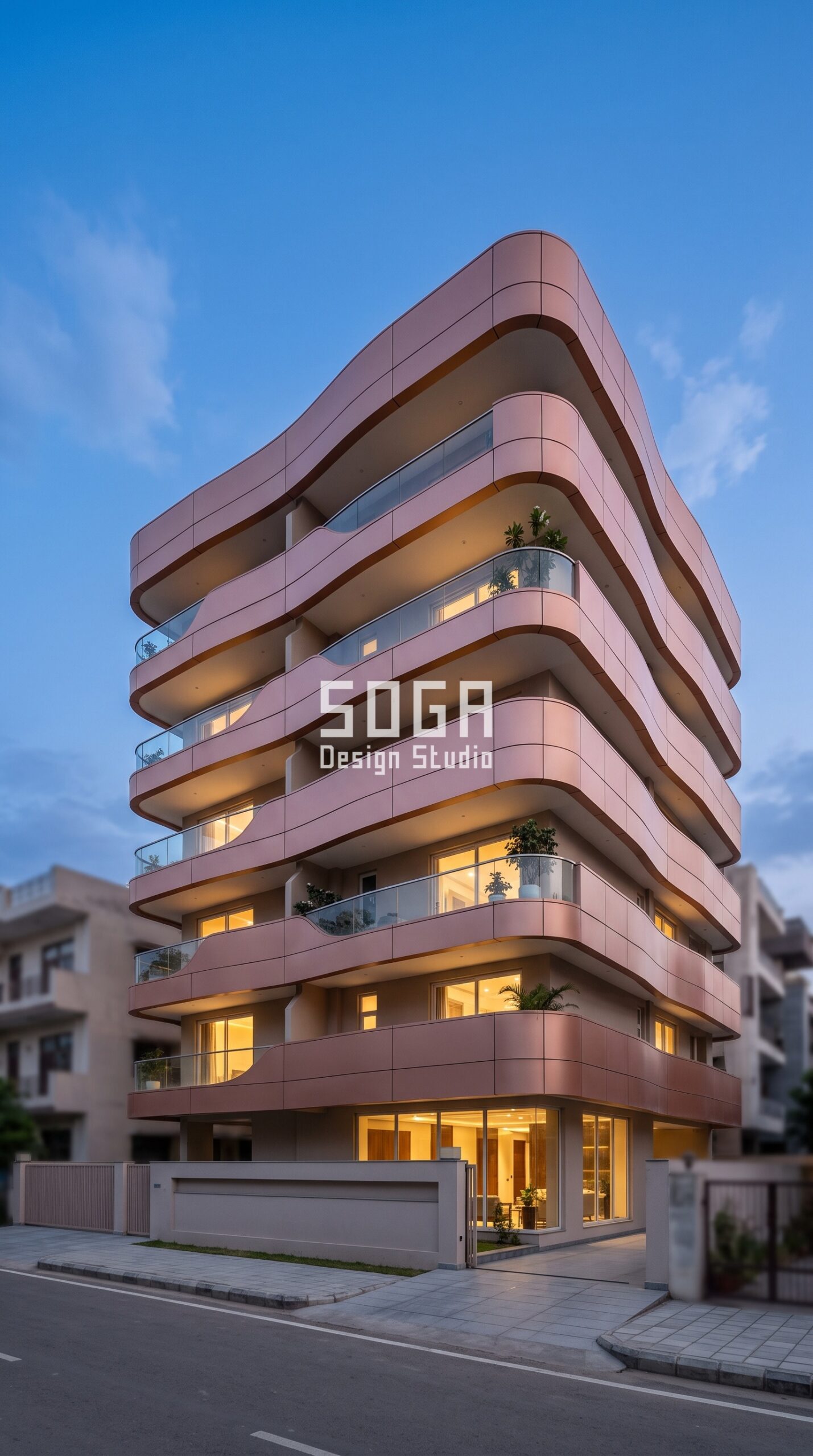
The third principle is the gradient: instead of varying a property in steps, vary it continuously so the change reads as flow. On this G+5 in Sector 21, Gurugram, the module is a horizontal floor-slab band in matte rose gold anodized aluminium, and the varied property is projection – each band swells outward and draws back in across the elevation, deepest where it shades a west-facing balcony and shallowest where daylight is wanted. The result is a facade that looks poured rather than assembled, though every band is a separate fabricated tray with a consistent, cleanly returned edge. Anodized aluminium is the right material for this move because the finish is integral to the metal rather than sprayed on it, so the colour holds its tone through a Delhi-NCR summer without the patchy fade that kills cheaper coatings. At blue hour the principle pays a second dividend: the swelling soffits catch warm interior light and the whole Parametric Swell Band elevation glows band by band, giving the building a completely different identity after dark.
4. Principle Four: Varied Repetition – Ahmedabad’s Arcade Colonnade
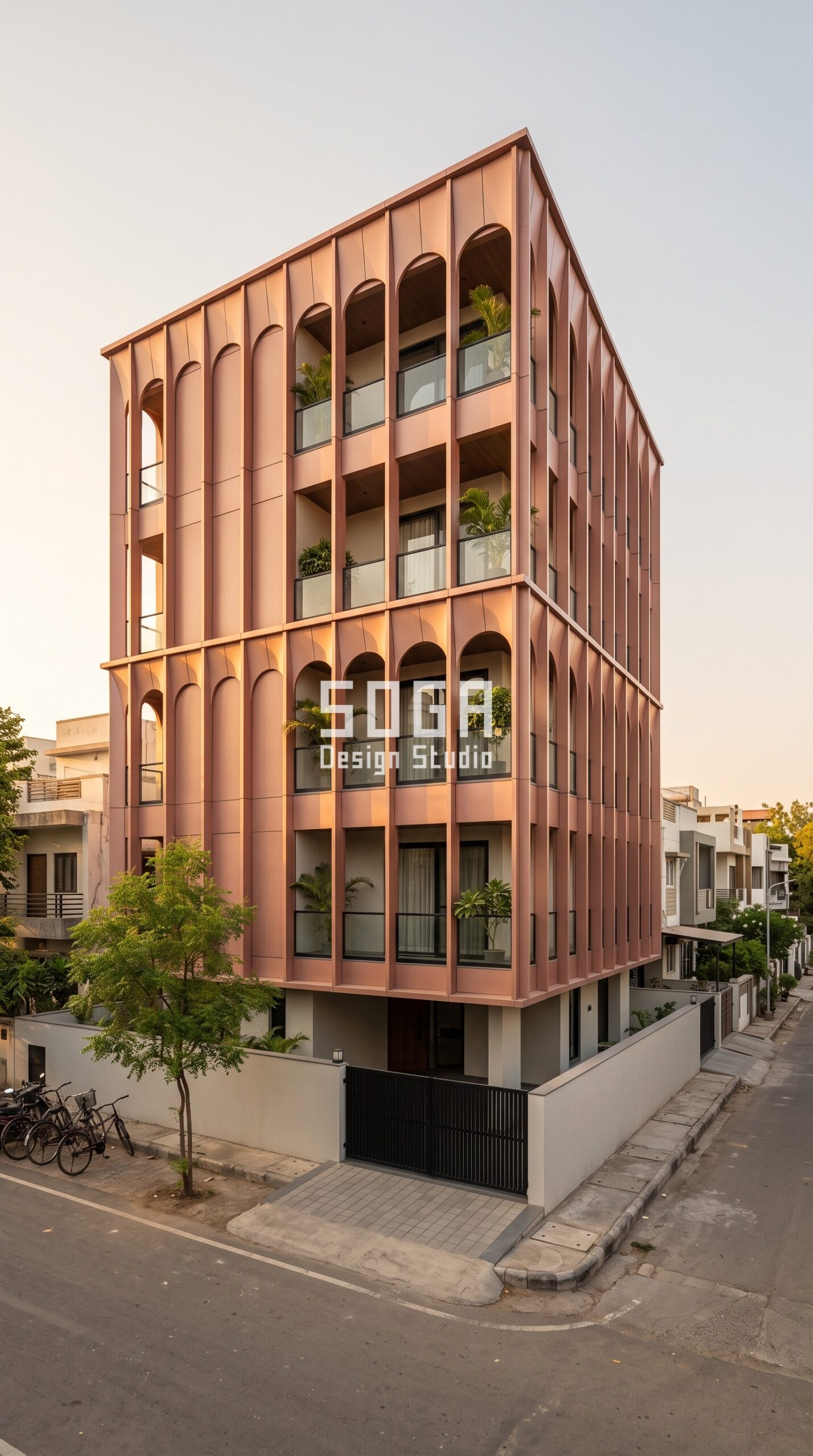
The fourth principle is the one that separates parametric design from ordinary pattern-making: repetition that responds to where it sits on the building. This G+5 in Navrangpura, Ahmedabad, wraps its perimeter in full-height slender metal arches of matte rose gold anodized aluminium – a single arch profile, repeated, but with its width eased progressively wider as it approaches each corner. That widening is not decoration; it thickens the facade exactly where the low western sun strikes hardest, and it visually anchors the corners of a building that would otherwise read as a plain box. Ahmedabad’s brutal pre-monsoon sun makes this kind of tuned self-shading genuinely useful rather than merely handsome, and the deep reveal keeps direct sun off the glazing for most of the afternoon. Built as a repeating fabricated module, the Parametric Arcade Colonnade stays within a normal cladding budget while behaving like bespoke architecture – which is the entire promise of the parametric method, and the reason it has moved from landmark projects into ordinary Indian residential streets.
Cost Benchmarks for Indian Parametric Metal Facades
One of the most-asked questions on a Chennai project brief is budget. The current all-in installed rates for parametric metal facades in India sit in the following ranges:
- Steel facade (full design + install): ₹1,200–₹2,800 per sq ft
- Aluminium, anodised or powder-coated: ₹800–₹2,500 per sq ft
- Zinc cladding: ₹1,500–₹3,000 per sq ft
- ACM panels (3 mm basic): ₹200–₹250 per sq ft (basic)
- ACM panels (4 mm): ₹250–₹350 per sq ft
- Solid aluminium panels: ₹800–₹1,800 per sq ft
- Installation labour: ₹50–₹150 per sq ft (varies by height + access)
- Conventional cladding (for comparison): ₹400–₹1,200 per sq ft installed (stone veneer / ceramic / standard ACM)
- Facade Design in Chennai & India 2026: Metal Facade Guide
These figures are baseline; actual project cost depends on facade area, panel complexity, fabricator location, and finish specification. SOGA Design Studio prepares an itemised cost estimate as part of every consultation so the budget conversation starts with hard numbers rather than guesses.
Parametric Facade Design Across India, Dubai & Singapore
Climate is the unspoken brief on every Indian project. Chennai, with its specific solar geometry and humidity profile, demands facades that perform — not just facades that look striking. At SOGA Design Studio, every parametric concept is run through climate analysis early: solar radiation per orientation, wind exposure, and monsoon water-shedding paths all feed back into panel angle and perforation density. The concepts you see above already incorporate this layer of analysis for Chennai’s sun path; adapting them for Mumbai’s rain, Delhi’s dust, or Bangalore’s milder conditions is part of the standard scope.
Why Trust SOGA Design Studio for Facade Design in Chennai
- Experience: SOGA Design Studio has delivered parametric metal facades across Indian cities including Chennai, Ahmedabad, Pune, Coimbatore, Mumbai and Gurugram, on G+3 to G+14 residential and commercial buildings.
- Expertise: Every concept is modelled parametrically and resolved to a fabrication-ready module – panel sizes, rotation increments, projection depths, substructure and concealed fixing detail – before a single quotation is issued.
- Authority: The studio works across India as well as NRI markets in Dubai, Singapore and the UK, and publishes its cost benchmarks and system logic openly rather than quoting on request only.
- Trust: Clients receive itemised per-square-foot cost bands, realistic 2026 material lifespans and honest advice on where a simpler cladding system would serve them better than a parametric one.
Frequently Asked Questions
What are the key principles of parametric facade design?
Four principles cover most built work: rhythm (repeat one module and vary a property along the run), rotation (turn identical modules by a fixed increment), gradient (vary a property continuously so it reads as flow), and varied repetition (let the variation respond to orientation, sun path or building geometry). Everything else is a combination of these. Critically, all four keep the manufactured piece simple and put the complexity into the arrangement, which is what makes parametric facades buildable at normal Indian cladding budgets.
Is a parametric metal facade more expensive than ACP cladding in India?
Yes on first cost, but the gap is smaller than most people expect and it narrows over time. Basic 3 to 4 mm ACM panels start around Rs 200 to Rs 350 per sq ft, while a parametric aluminium system starts around Rs 800 per sq ft. What you buy for the difference is depth, self-shading, an integral anodised or powder-coated finish rated for 25 to 30 years, and a facade that does not date. ACP typically needs replacement or refinishing far sooner, so over a 20-year horizon the annualised cost difference is modest.
Can a parametric facade be added to an existing building?
Often yes. Because these systems are lightweight metal modules on a secondary substructure, they can be hung off an existing RCC frame as a retrofit skin, provided a structural engineer confirms the frame and fixing points. Retrofits are one of the fastest-growing parts of the Indian facade market, particularly for tired G+3 and G+4 buildings in Mumbai, Delhi, Bangalore and Chennai where redevelopment is not viable. The design has to be surveyed against as-built dimensions rather than original drawings.
How long does a powder-coated or anodised metal facade last in Indian conditions?
Correctly detailed and ventilated, powder-coated aluminium or galvanised steel lasts 25 to 30 years before recoating is needed, even in coastal Chennai and Mumbai. Anodised aluminium, as used in the Gurugram and Ahmedabad concepts above, can exceed 40 years because the colour is integral to the metal rather than a surface film. Maintenance is an annual rinse-down; there is no repainting cycle as with plaster and paint elevations.
Does a parametric facade actually reduce heat gain in Indian cities?
It can, when the geometry is tuned to orientation rather than applied uniformly. Depth, projection and rotation are what create self-shading, and a facade designed around solar angle typically cuts solar heat gain on the treated elevations by 25 to 40 per cent compared with a flat clad wall. The gain is real but orientation-specific, which is why SOGA varies module depth per elevation instead of wrapping one identical pattern around all four sides.
What is the typical timeline from design to installed parametric facade?
For a G+3 to G+4 residence: 3 weeks for concept and approval, 4 weeks for fabrication-ready drawings, 6–8 weeks for fabrication, and 3–5 weeks for site installation — total 16–20 weeks from go-ahead to occupancy. Retrofit projects on existing buildings compress this to 10–14 weeks because no structural coordination is needed.
How much does a parametric metal facade cost in India 2026?
Aluminium parametric facades range ₹800–₹2,500 per sq ft (full design + install), steel ₹1,200–₹2,800 per sq ft, and zinc ₹1,500–₹3,000 per sq ft. Basic ACM cladding (3–4 mm) starts at ₹200–₹350 per sq ft; solid aluminium panels run ₹400–₹600 per sq ft. Installation labor adds ₹50–₹150 per sq ft depending on building height. SOGA Design Studio provides itemised cost estimates as part of every consultation.
Where are parametric metal facades fabricated in India?
The main fabrication clusters are Mumbai-Pune (precision aluminium and steel), Chennai-Coimbatore (laser cutting and powder coating), Delhi-NCR (large-format ACM and screens), and Ahmedabad (brass and copper specialty). SOGA Design Studio works with vetted fabricators in each cluster to keep transport cost and lead-time low for any project location.
How much heat does a parametric metal facade actually reduce?
Independent studies on Indian residential applications show double-skin parametric metal screen facades reduce direct solar heat gain by 25-40% on west and south orientations, dropping interior surface temperatures by 4-7 deg C compared to bare RCC. The shaded gap also enables passive cross-ventilation. SOGA Design Studio tunes the screen opening density based on each orientation solar load.
What is parametric facade design?
Parametric facade design uses algorithmic rules — light, climate, orientation, and structural parameters — to generate a building skin where every panel is mathematically calibrated. The result is a facade that performs (heat control, ventilation, daylighting) while expressing a unique sculptural identity. It is the direct computational descendant of traditional Indian metal screens.
Parametric metal facade vs traditional stone or paint — which is better long-term?
Stone is heavy, expensive (₹600–₹1,500 per sq ft just for material), and difficult to repair when chipped. Paint requires repainting every 4–6 years in Indian conditions. A powder-coated parametric metal facade has higher upfront cost but a 25–30 year service life, zero repainting, and far stronger street identity — making total cost of ownership lower over a 20-year horizon. It is also significantly lighter, reducing structural cost on G+3 and above.
What is a sculptural petal-shaped metal fin facade?
SOGA Design Studio addresses this question in detail during the design consultation. For Chennai projects, we provide a fully customised answer based on plot, orientation, and budget — typically within 48 hours of receiving the brief.
Related Reading
- Facade Design in Coimbatore & India 2026: Metal Facade Guide
- Facade Design in Pune & India 2026: Metal Facade Guide
- Facade Design in Ahmedabad & India 2026: Metal Parametric Guide
Start Your Facade Project With SOGA Design Studio
Once you can name the lever – rhythm, rotation, gradient or varied repetition – you stop shopping for a look and start briefing a system, which is where both the performance and the cost control actually come from.
Whether you are building new or retrofitting an existing block, SOGA Design Studio can adapt the concepts above to your exact plot and budget. Start the conversation here — consultations are free and no-commitment.