Walk a Lutyens lane in New Delhi at dusk and you will pass twenty painted G+4 blocks without looking up once. Then one stops you. Not because it shouts, but because the west light is doing something ordered on its face – slim amber fins standing off the glass, deeper where the afternoon sun is worst, easing back where the balconies want a view. Nothing about it is decorative. That is the shift in facade design in India in 2026: the elevation has quietly become an environmental instrument rather than a paint choice. This post walks four such concepts – one in New Delhi and three in other Indian cities – with the constraint each one answers, and what it actually costs.
Facade Design in India: Why New Delhi Is Choosing Parametric Metal
Facade design in India has moved from an afterthought to the single most important decision on a residential project. Today, demand for parametric facade design in India is rising fastest in cities such as New Delhi, Mumbai, Bangalore, Delhi, and Pune, where homeowners and developers want elevations that are both performance-driven and instantly recognisable. SOGA Design Studio specialises in facade design in India — from G+3 individual homes to G+7 residential blocks — pairing algorithmic geometry with matte warm amber gold anodized aluminu and fabrication-ready detailing. Whether you are comparing metal facade design in India for a new build or a retrofit, the concepts below show how a considered facade redefines a building’s identity and its long-term value.
1. New Delhi Parametric Reed Screen: Vertical Fins Tuned to the Lutyens West Sun
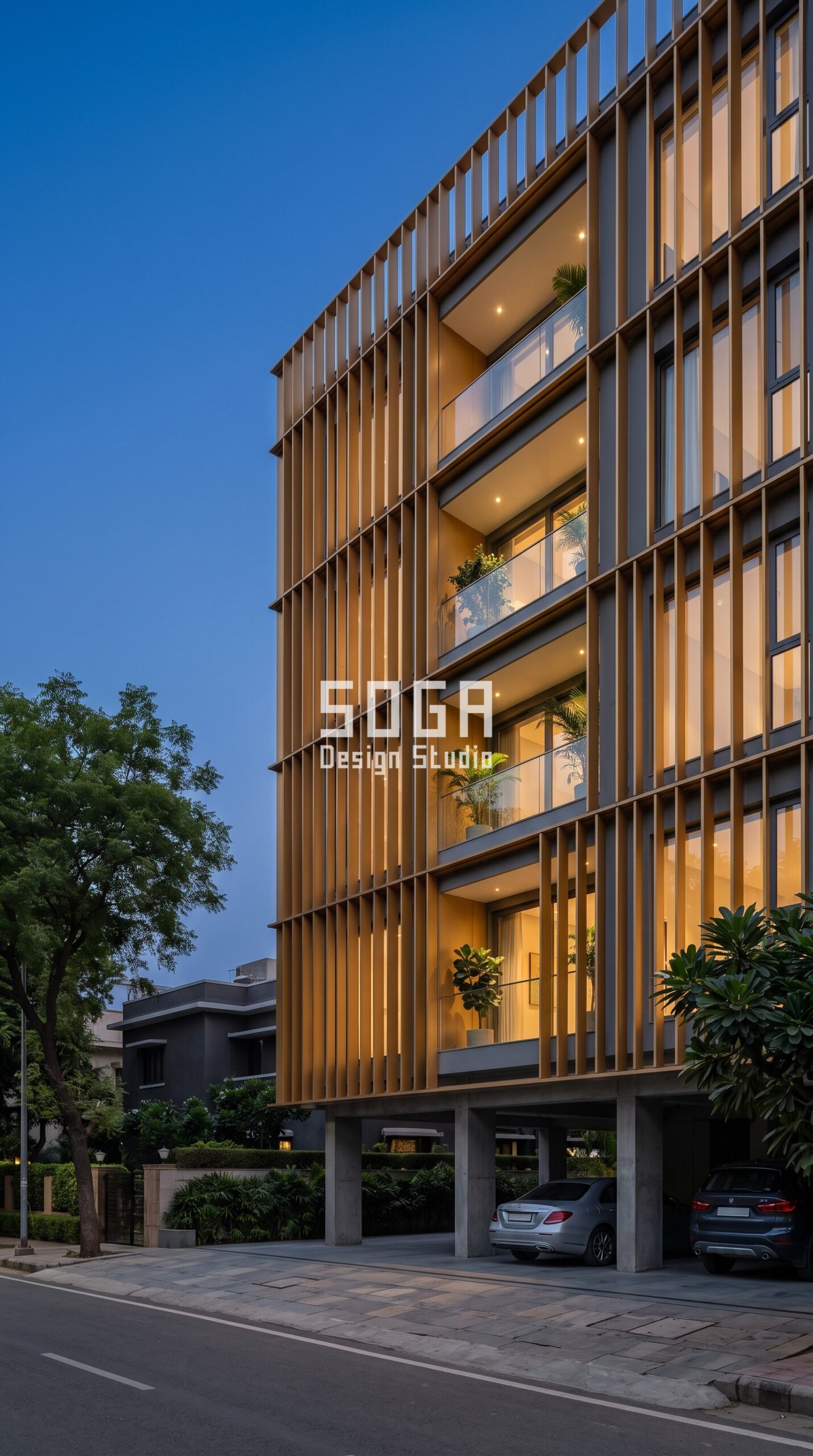
Lutyens-zone and central Delhi plots come with the tightest rulebook in the country – height caps, deep setbacks, and a street the building is not allowed to dominate. That leaves the elevation itself as the only place to make an argument. This concept runs slim vertical fins in matte warm amber-gold anodised aluminium across a G+4, each fin a discrete flat blade on a regular module grid, with projection depth gradating bay by bay: deepest on the west-facing bays that take the 3pm to 6pm load, shallowest where a balcony needs its sightline back. Anodising rather than powder coat is a deliberate Delhi call – the finish is integral to the metal, so NCR dust washes off instead of chalking the colour out over five summers. By blue hour the fins stop being shading and become a filter, breaking the interior glow into an ordered rhythm from the street. It is the cheapest kind of drama: geometry doing the work that expensive materials usually get asked to do.
2. Navi Mumbai Parametric Ledge Pulse: Cantilevered Trays Built for the Monsoon
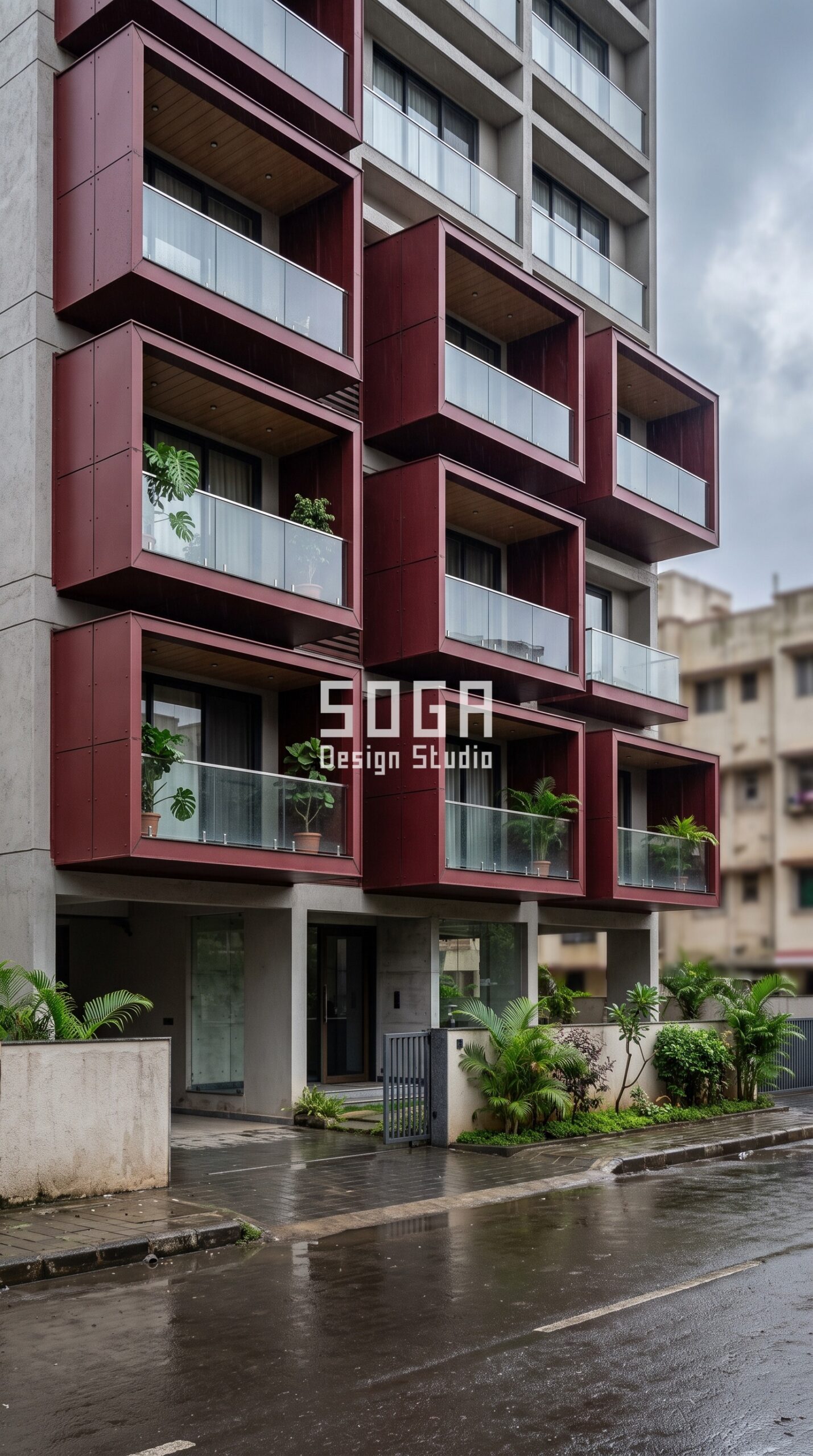
Kharghar’s problem is not sun, it is water arriving sideways for four months. Standard balconies on a G+5 there take driving rain straight into the opening, and within two seasons the elevation is streaked. This concept answers it structurally rather than cosmetically: cantilevered metal trays project at alternate floors in matte powder-coated RAL 3007 deep black-red steel, each tray a discrete flat rectangular module on a clear structural grid, throwing rain clear of the floor below and shading it in the dry months. The stagger shifts gradually bay by bay rather than randomly – enough to break the flat slab-stack silhouette that makes so many Navi Mumbai towers interchangeable, not so much that the fabrication drawing becomes bespoke on every floor. The deep black-red was chosen for grey light specifically: on an overcast monsoon morning it reads rich and saturated where a pale facade would go flat and show every water track. Wet, the whole elevation gains a second life in the reflections off the street.
3. Ahmedabad Parametric Pixel Grid: Depth Instead of Budget on a Narrow G+6
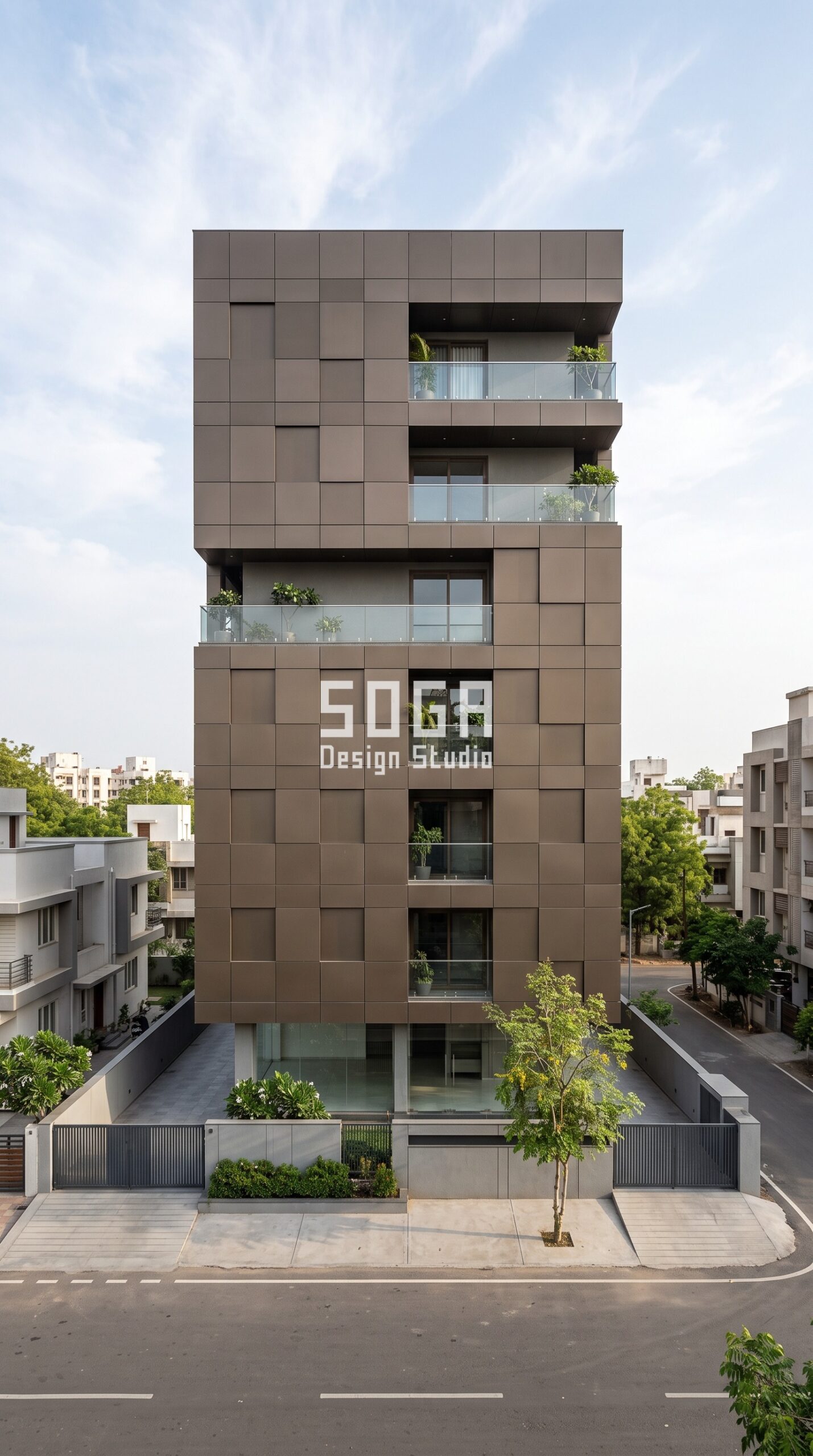
Thaltej throws up the hardest brief in this set – a narrow frontage stretched to G+6, brutal summer radiation, and a client budget that will not carry solid aluminium across that much elevation. The move here is to buy relief instead of material: a mosaic of square metal tiles in matte dark bronze ACP, every tile a discrete flat panel on a rectangular module grid, stepping at three or four moderate projection depths in a calm chequer rhythm. ACP keeps the rate honest on a tall face, while the stepped depths give the plane a self-shading texture that a flat clad box can never produce. The depths were sized against Ahmedabad’s sun path rather than picked for looks – shallow enough to fabricate and clean, deep enough that the pattern still reads at noon when overhead light tries to flatten everything. Bronze sits with the warm masonry of the surrounding houses instead of fighting it. The result is a G+6 that gains presence from shadow, not from spend.
4. Gurugram Parametric Delta Grid: Faceted Green Steel Against a Sector of Beige
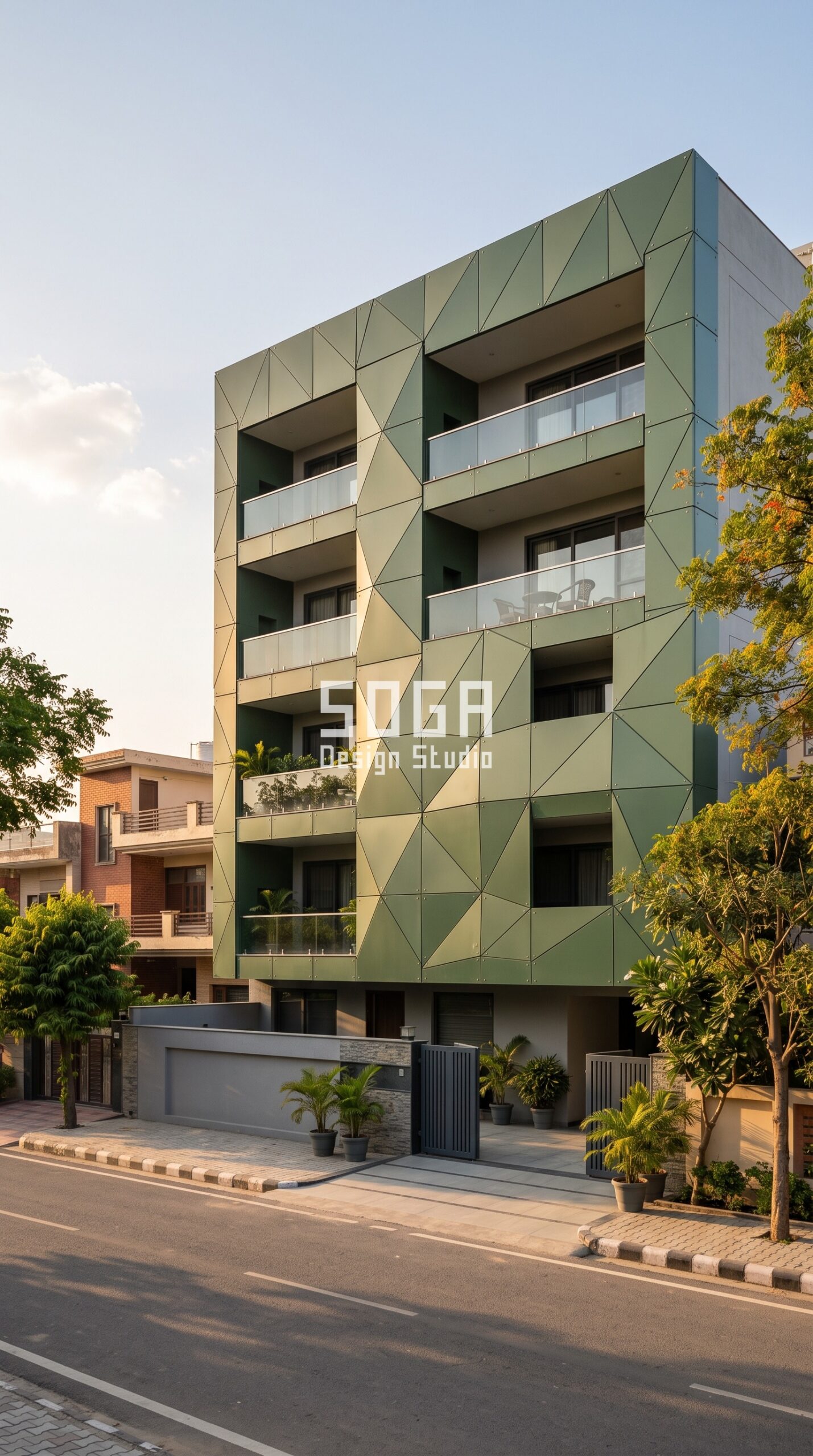
Sector 56 is a run of competent, near-identical builder blocks in beige and grey, and any new G+4 there faces one commercial question: how do you become memorable without becoming loud. This concept uses an interlocking field of flat triangular metal panels in matte powder-coated RAL 6005 moss-green steel, alternating matte and satin faces in a regular repeating rhythm on a clear ordered module grid. Because the two finishes are the same colour, the elevation gets its variation from light rather than pigment – late-afternoon raking sun catches the satin facets and skips the matte ones, so the same panel field reads differently at 8am, 2pm and 6pm without a single accent colour. The satin faces also matter practically in NCR: they shed the fine dust that settles on textured cladding and greys it out within a season. Moss green does the rest, reading as considered rather than novel next to the beige. One material, one colour, one geometry – and the block is no longer interchangeable.
Cost Benchmarks for Indian Parametric Metal Facades
One of the most-asked questions on a New Delhi project brief is budget. The current all-in installed rates for parametric metal facades in India sit in the following ranges:
- Steel facade (full design + install): ₹1,200–₹2,800 per sq ft
- Aluminium, anodised or powder-coated: ₹800–₹2,500 per sq ft
- Zinc cladding: ₹1,500–₹3,000 per sq ft
- ACM panels (3 mm basic): ₹200–₹250 per sq ft (basic)
- ACM panels (4 mm): ₹250–₹350 per sq ft
- Solid aluminium panels: ₹800–₹1,800 per sq ft
- Installation labour: ₹50–₹150 per sq ft (varies by height + access)
- Conventional cladding (for comparison): ₹400–₹1,200 per sq ft installed (stone veneer / ceramic / standard ACM)
These figures are baseline; actual project cost depends on facade area, panel complexity, fabricator location, and finish specification. SOGA Design Studio prepares an itemised cost estimate as part of every consultation so the budget conversation starts with hard numbers rather than guesses.
Parametric Facade Design Across India, Dubai & Singapore
Retrofit is the fastest-growing segment of today’s Indian facade market and SOGA Design Studio is investing heavily in it. A lightweight aluminium parametric screen mounted on stand-off brackets can transform a tired 1990s or 2000s New Delhi apartment block in 4 to 8 weeks without disturbing tenants or interiors. The economics often surprise owners: a retrofit facade can reset rental yield, reposition a building in the listings, and add visible value at a fraction of the cost of a full reclad. Several of the concepts shown above have direct retrofit variants available on request.
Why Trust SOGA Design Studio for Facade Design in New Delhi
- Experience: SOGA Design Studio has been running a daily parametric facade study series since 2023, developing concepts for real Indian G+3 to G+7 plots across Delhi NCR, Mumbai, Ahmedabad, Bangalore, Hyderabad, Chennai and Pune – including remote briefs for NRI clients in Dubai, Singapore and the UK.
- Expertise: Every concept is generated against orientation-specific climate analysis – solar path, prevailing wind, monsoon exposure – and then resolved to a module grid, panel depth range, fixing type and seam line that a fabricator can price. We work across anodised and powder-coated aluminium, PVDF, galvanised and Corten steel, zinc, ACP and solid aluminium, and we choose between them on climate and rate, not on preference.
- Authority: SOGA Design Studio positions as India’s facade design specialists, publishing costed, buildable parametric facade studies for Indian cities rather than image-only concept boards.
- Trust: We publish real 2026 India cost bands – aluminium parametric facades at Rs 800 to Rs 2,500 per sq ft, steel at Rs 1,200 to Rs 2,800 per sq ft, zinc at Rs 1,500 to Rs 3,000 per sq ft, 3-4 mm ACP from Rs 200 to Rs 350 per sq ft, plus Rs 50 to Rs 150 per sq ft installation depending on height and access – and issue an itemised estimate with every consultation. The first 30-minute discovery call is free and carries no commitment, and our remote workflow is built for NRI clients who cannot visit the site.
Frequently Asked Questions
Which metal facade material works best in New Delhi’s climate?
For Delhi NCR the two decisive factors are UV load and airborne dust, not corrosion. Anodised aluminium performs best because the colour is integral to the oxide layer rather than sitting on top of it, so it does not chalk or fade under Delhi summers and rinses clean of dust. High-grade PVDF powder-coated aluminium is the next option and is more forgiving on cost. Galvanised and powder-coated steel works well where panel spans or projections need the extra stiffness, as in deep fin or tray systems. Untreated Corten is generally a poor choice for dense Delhi streets because run-off staining marks the plinth and paving below.
Do you need a special degree to design a parametric facade in India?
There is no separate statutory licence for parametric facade design in India. Building design and sanction drawings must be signed by a Council of Architecture registered architect, and structural elements must be certified by a licensed structural engineer, but the facade geometry itself is not a separately regulated discipline. In practice the qualification that matters is not the degree – it is fabrication literacy: whether the designer can set a module grid, size a fixing bracket, hold panel tolerances and detail a seam line that survives six floors of thermal movement. That is where most striking parametric renders fall apart on site, and it is why SOGA Design Studio resolves every concept to shop-drawing level with vetted Indian fabricators before a rate is quoted.
Can a parametric metal facade be retrofitted onto an existing building?
Yes, and retrofit is one of the fastest-growing parts of the Indian facade market in 2026. A lightweight parametric metal screen can be fixed back to an existing RCC frame or an existing masonry wall using a secondary support grid, provided a structural assessment confirms the frame can take the additional dead and wind load, which for an aluminium screen is usually modest. Retrofits are commonly used to cut solar gain on a west face, to unify a building that has been extended piecemeal, or to modernise a dated elevation without touching the interiors. The main constraints are access for installation and municipal approval where projections extend beyond the sanctioned building line.
How long does a powder-coated metal facade last in Indian conditions?
Quality powder-coated aluminium or galvanised steel facades, when correctly detailed and ventilated, last 25–30 years before recoating is needed — even in coastal Mumbai, Chennai, and Kochi. Anodised aluminium and pre-patinated zinc/copper can exceed 40 years. Maintenance is annual rinse-down only; no repainting like traditional plaster facades.
How much heat does a parametric metal facade actually reduce?
Independent studies on Indian residential applications show double-skin parametric metal screen facades reduce direct solar heat gain by 25-40% on west and south orientations, dropping interior surface temperatures by 4-7 deg C compared to bare RCC. The shaded gap also enables passive cross-ventilation. SOGA Design Studio tunes the screen opening density based on each orientation solar load.
Which RAL colours work best for Indian residential facades?
Three palettes dominate 2026 Indian residential work: warm earthy bronze and corten tones (RAL 8004, 8019) for traditional contexts; deep desaturated blues and greens (RAL 5004, 5011, 6009) for contemporary luxury; and matte charcoal/black (RAL 9005, 7016) paired with brass or copper accents for a graphic urban look. Light cladding with dark frames is the most-searched aesthetic of 2026.
Parametric metal facade vs traditional stone or paint — which is better long-term?
Stone is heavy, expensive (₹600–₹1,500 per sq ft just for material), and difficult to repair when chipped. Paint requires repainting every 4–6 years in Indian conditions. A powder-coated parametric metal facade has higher upfront cost but a 25–30 year service life, zero repainting, and far stronger street identity — making total cost of ownership lower over a 20-year horizon. It is also significantly lighter, reducing structural cost on G+3 and above.
How much does a parametric metal facade cost in India 2026?
Aluminium parametric facades range ₹800–₹2,500 per sq ft (full design + install), steel ₹1,200–₹2,800 per sq ft, and zinc ₹1,500–₹3,000 per sq ft. Basic ACM cladding (3–4 mm) starts at ₹200–₹350 per sq ft; solid aluminium panels run ₹400–₹600 per sq ft. Installation labor adds ₹50–₹150 per sq ft depending on building height. SOGA Design Studio provides itemised cost estimates as part of every consultation.
What is parametric facade design?
Parametric facade design uses algorithmic rules — light, climate, orientation, and structural parameters — to generate a building skin where every panel is mathematically calibrated. The result is a facade that performs (heat control, ventilation, daylighting) while expressing a unique sculptural identity. It is the direct computational descendant of traditional Indian metal screens.
What is a sculptural petal-shaped metal fin facade?
SOGA Design Studio addresses this question in detail during the design consultation. For New Delhi projects, we provide a fully customised answer based on plot, orientation, and budget — typically within 48 hours of receiving the brief.
Related Reading
- how facade materials compare – GFRC vs GRC vs ACP vs HPL in India
- our complete facade and elevation design FAQ guide for India
- the Ahmedabad and India metal facade guide
Start Your Facade Project With SOGA Design Studio
In 2026 the difference between a facade that photographs well and one that still looks right in year seven is not the concept – it is whether the panel depth, the fixing and the finish were chosen for that specific city’s light, dust and rain.
Whether you are building new or retrofitting an existing block, SOGA Design Studio can adapt the concepts above to your exact plot and budget. Start the conversation here — consultations are free and no-commitment.