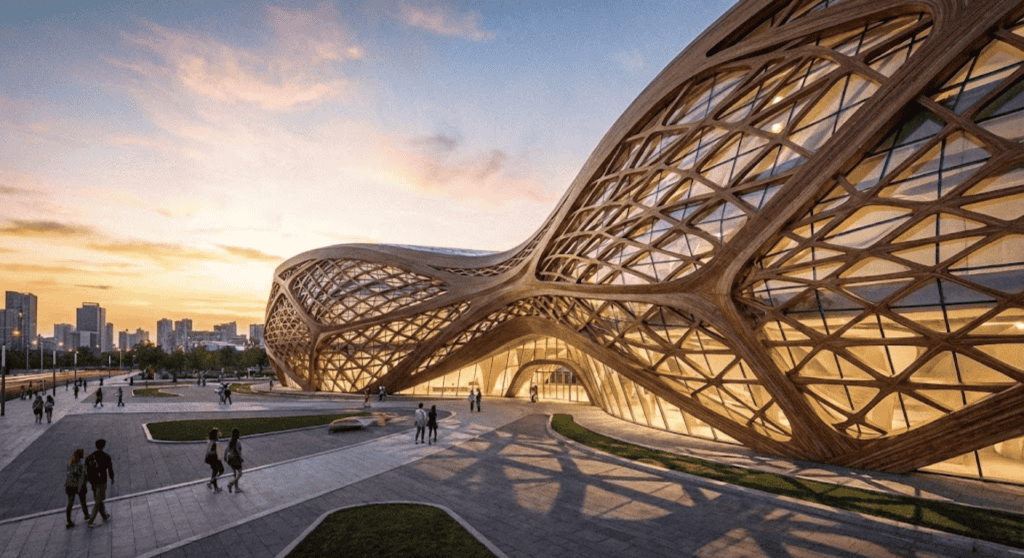
Walk down a Nungambakkam lane in 2026 and you can tell within seconds which G+3 was designed and which one was merely decorated. The decorated ones wear their pattern like a poster: flat, printed, already dated. The designed ones have depth you can read as the sun moves across them. That difference almost never comes from a bolder idea. It comes from whether the geometry survived contact with a fabricator’s shop drawing. This is the quiet fault line running through facade design in India right now. So instead of another gallery of pretty skins, here are four 2026 studies – in Chennai, Dehradun, Mumbai and Nagpur – where the parametric model was built to be cut, folded and bolted, not just rendered.
Facade Design in India: Why Chennai Is Choosing Parametric Metal
Facade design in India has moved from an afterthought to the single most important decision on a residential project. Today, demand for parametric facade design in India is rising fastest in cities such as Chennai, Mumbai, Bangalore, Delhi, and Pune, where homeowners and developers want elevations that are both performance-driven and instantly recognisable. SOGA Design Studio specialises in facade design in India — from G+3 individual homes to G+7 residential blocks — pairing algorithmic geometry with matte titanium grey anodized metal pan and fabrication-ready detailing. Whether you are comparing metal facade design in India for a new build or a retrofit, the concepts below show how a considered facade redefines a building’s identity and its long-term value.
1. Chennai Parametric Meander Shell: Real Depth on a Tight Nungambakkam Plot
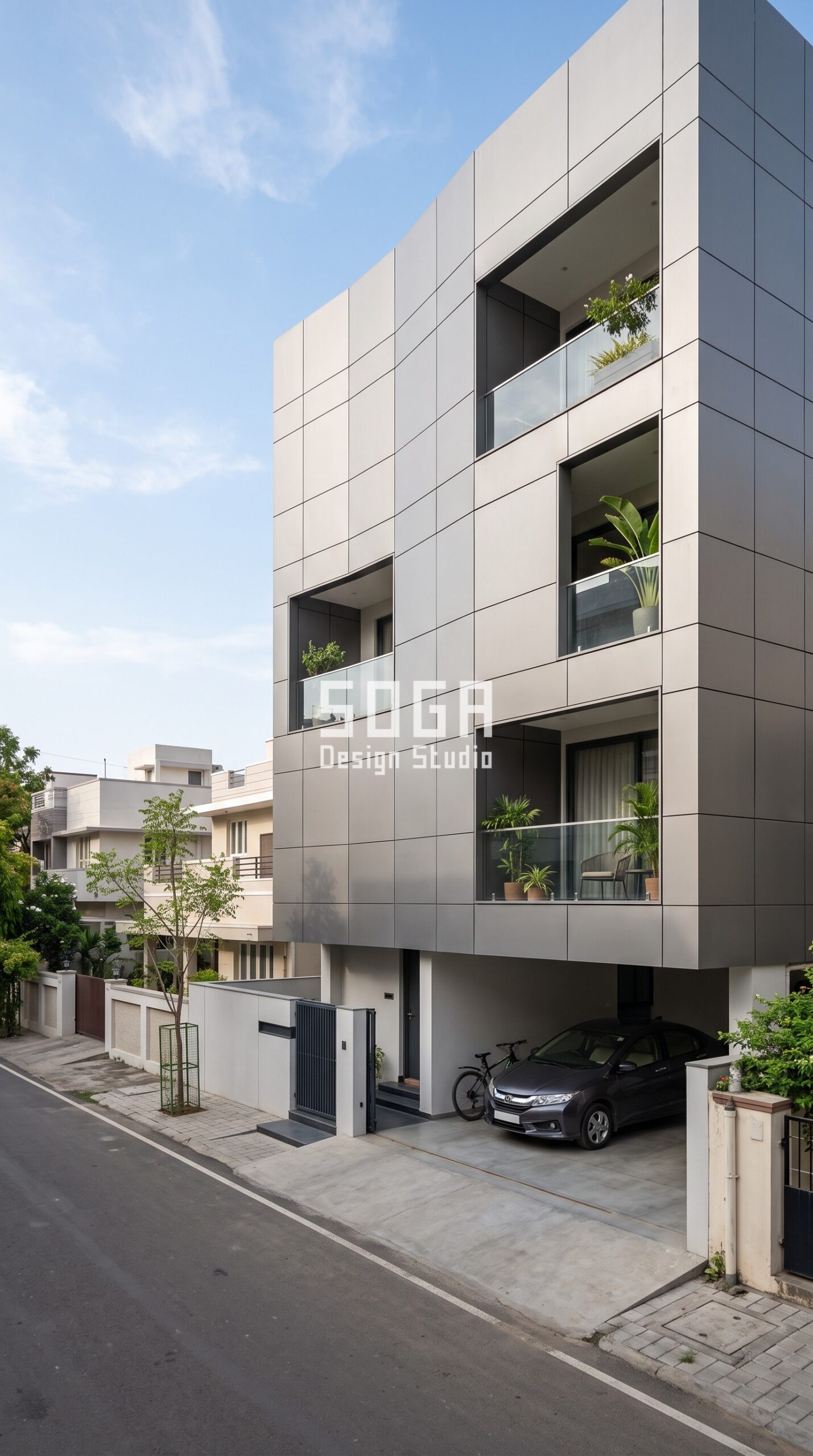
Nungambakkam plots are narrow, the neighbour is a few metres away, and the setback leaves you almost nothing to project into – which is where most ambitious Chennai facades die. The Parametric Meander Shell answers that by keeping every cassette dead flat and staying within roughly 150mm of the wall line: the S-curve rhythm is produced by stepping panels bay to bay, not by bulging outward. Because each panel is an identical press-braked tray on one common module grid, the curve adds nothing to the fabrication bill – only the bracket length changes down the run. Matte titanium grey anodised aluminium was specified for the salt-laden coastal air, where a painted mild-steel skin would chalk within a few monsoons. In the morning the stepping reads as a soft gradient across the elevation; by mid-afternoon the same steps throw hard shadow lines and the building looks like a different address. And because the depth stays shallow, it never steals the neighbour’s light – an objection that sinks more Chennai facade proposals than cost ever does.
2. Dehradun Parametric Swell Pulse: A Facade Built for Flat Valley Light
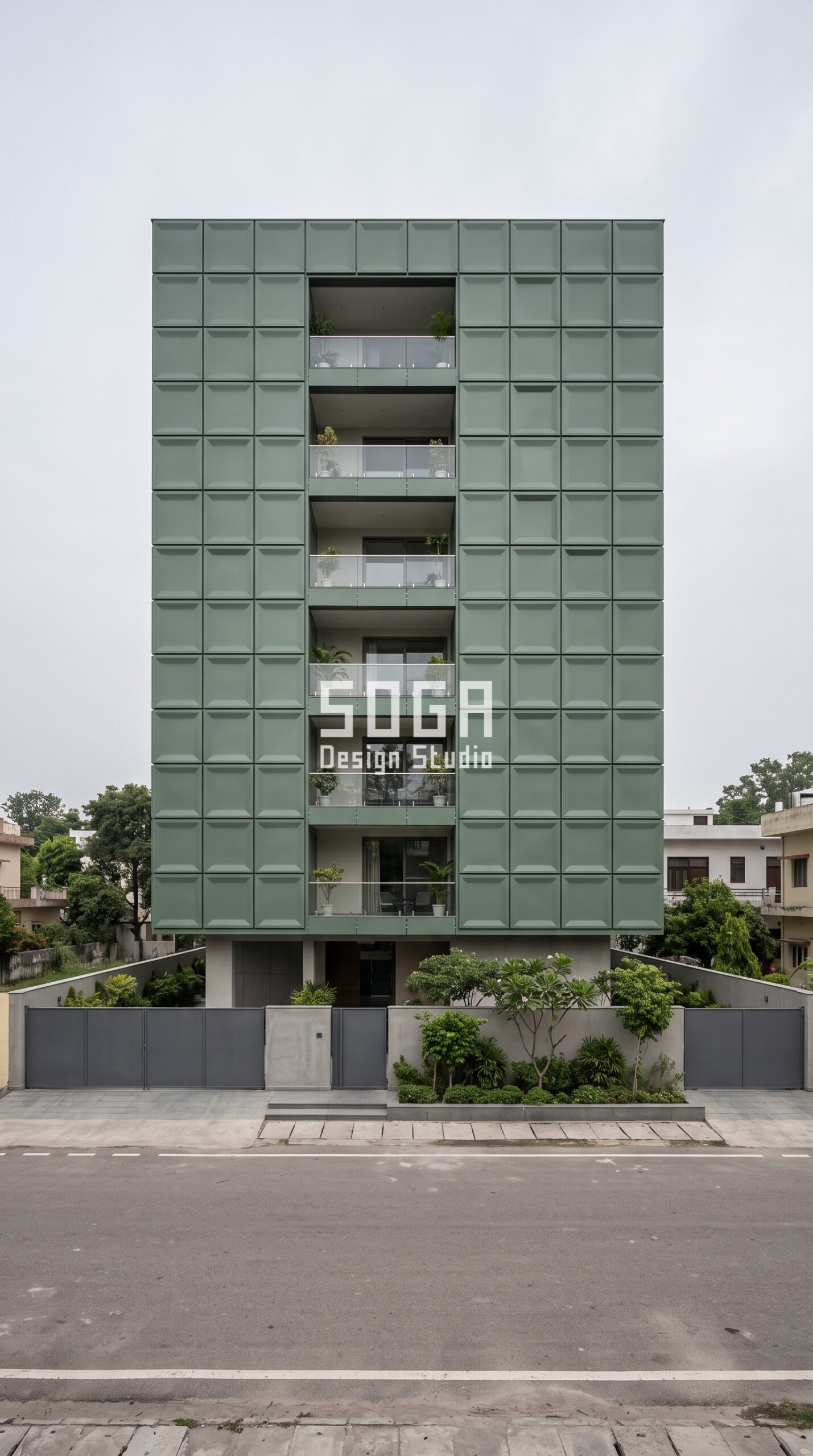
Dehradun spends a large part of the year under soft, flat valley light, with no hard sun to carve a plain elevation into something worth looking at. So this G+7 study on GMS Road makes its own shading instead of borrowing it: every square steel cassette is shallowly dished, some pressed inward and some outward, so even fully diffused daylight produces a gentle light-to-dark gradient across each panel face. The relief depth gradates slowly across the elevation rather than swinging dramatically, which keeps the module grid legible and every panel a discrete, orderable unit – the difference between a facade that reads as crafted and one that reads as crumpled. Matte powder-coated deep sage green was chosen to settle into the foothill greenery rather than fight it. The dishes are pressed, not welded, so tolerance is held in the press shop where it is cheap, not on site where it is not. And with Doon’s monsoon load, the drained, ventilated cavity behind the cassettes matters far more to the building’s life than the pattern on the front.
3. Mumbai Parametric Ridgeline Screen: Privacy and Rain Cover on the Slab Edge
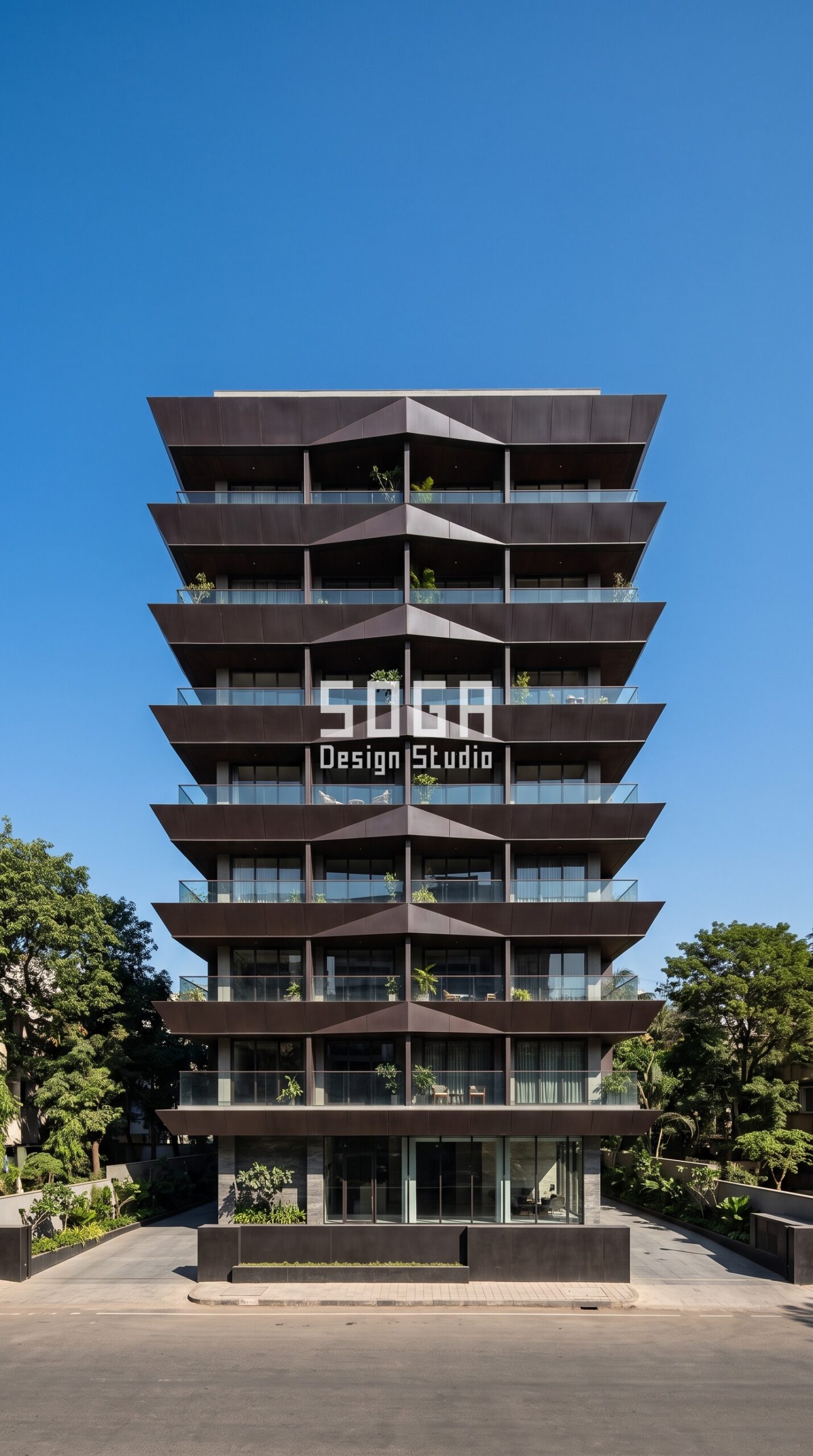
In Worli the two real problems are rarely aesthetic: you are overlooked by taller neighbours, and wind-driven monsoon rain walks straight into an open balcony. The Parametric Ridgeline Screen puts the entire move on the slab edge rather than the wall plane – each floor’s fascia is folded into straight angular segments that step in and out, with the phase shifted floor by floor so the stack reads as a travelling diagonal ridge. Where the fascia projects it shields the balcony below from rain and cuts the sightline from the tower opposite; where it pulls back, the sea view is left wide open. This is also the cheapest species of parametric facade to build, because it is cladding fixed to an RCC slab edge: no separate structural frame, no new load path, and each slab acts as a natural cavity barrier. Matte dark espresso brown oxidised steel keeps the geometry reading as shadow depth rather than as colour. Nothing on the wall plane changes at all – which is precisely why this version gets approved while a full-height cladding proposal stalls.
4. Nagpur Parametric Cassette Grid: Three Depths Tuned to a 45 Degree Summer
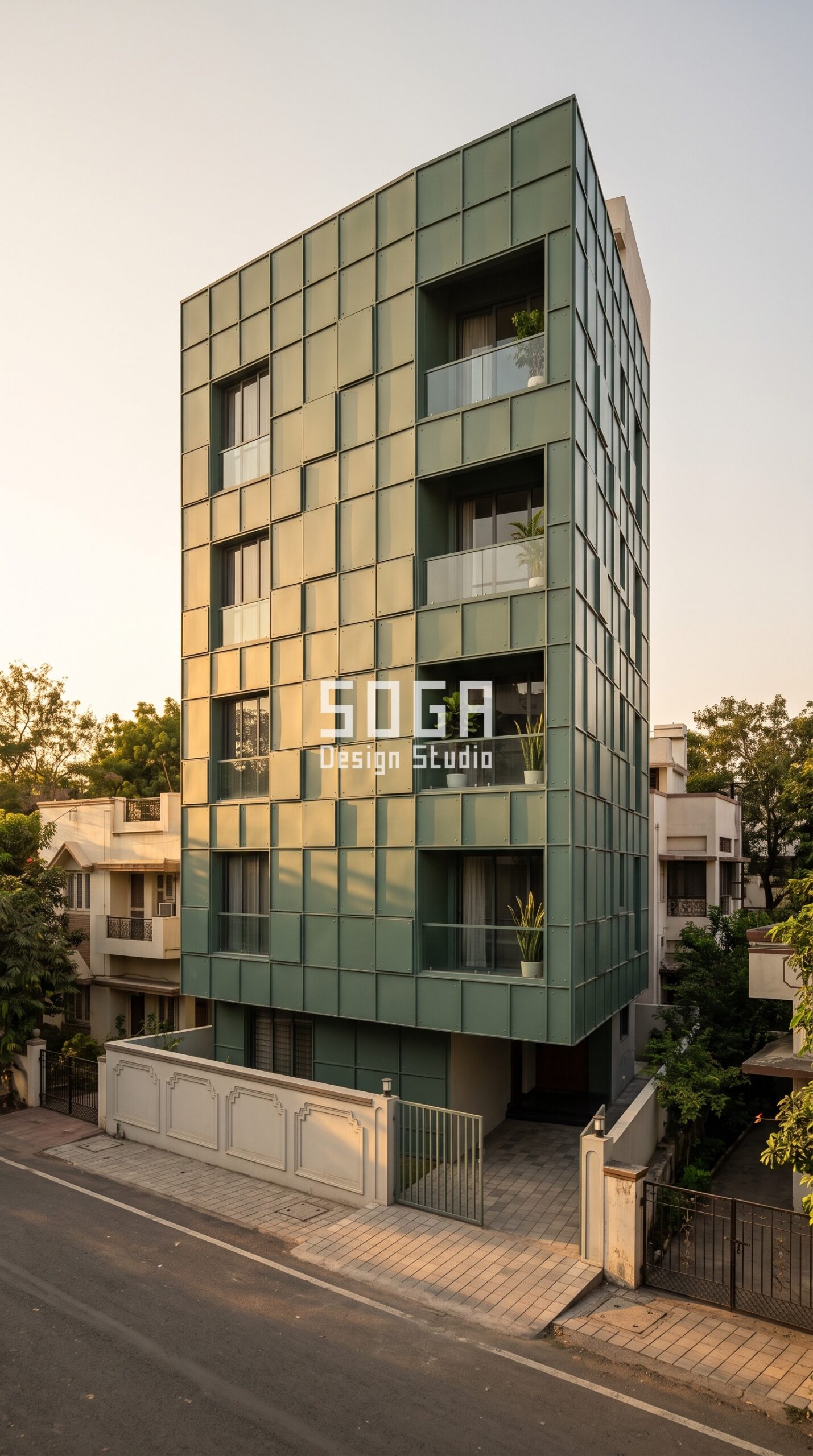
Nagpur summers push past 45 degrees and the west face takes the worst of it, so this G+8 in Dharampeth treats depth as a thermal instrument rather than a graphic. Every tile is the same square powder-coated steel cassette, but each one sits at one of only three projection depths, distributed by orientation – deepest where the late sun lands hardest, flush where it never reaches. One panel type and three bracket lengths keeps the bill of quantities reassuringly boring, which is exactly what makes an eight-floor elevation affordable instead of aspirational. The self-shading benefit is real but modest and we would rather state it honestly: a meaningful drop in wall surface temperature on the shaded bays, not the dramatic whole-building savings this category likes to advertise. The reward is visual too – late in the day the raking sun catches the proud tiles and throws clean rectangular shadows across the recessed ones, so the elevation is most alive at exactly the hour the heat is worst.
Cost Benchmarks for Indian Parametric Metal Facades
One of the most-asked questions on a Chennai project brief is budget. The current all-in installed rates for parametric metal facades in India sit in the following ranges:
- Steel facade (full design + install): ₹1,200–₹2,800 per sq ft
- Aluminium, anodised or powder-coated: ₹800–₹2,500 per sq ft
- Zinc cladding: ₹1,500–₹3,000 per sq ft
- ACM panels (3 mm basic): ₹200–₹250 per sq ft (basic)
- ACM panels (4 mm): ₹250–₹350 per sq ft
- Solid aluminium panels: ₹800–₹1,800 per sq ft
- Installation labour: ₹50–₹150 per sq ft (varies by height + access)
- Conventional cladding (for comparison): ₹400–₹1,200 per sq ft installed (stone veneer / ceramic / standard ACM)
These figures are baseline; actual project cost depends on facade area, panel complexity, fabricator location, and finish specification. SOGA Design Studio prepares an itemised cost estimate as part of every consultation so the budget conversation starts with hard numbers rather than guesses.
Parametric Facade Design Across India, Dubai & Singapore
Retrofit is the fastest-growing segment of today’s Indian facade market and SOGA Design Studio is investing heavily in it. A lightweight aluminium parametric screen mounted on stand-off brackets can transform a tired 1990s or 2000s Chennai apartment block in 4 to 8 weeks without disturbing tenants or interiors. The economics often surprise owners: a retrofit facade can reset rental yield, reposition a building in the listings, and add visible value at a fraction of the cost of a full reclad. Several of the concepts shown above have direct retrofit variants available on request.
Why Trust SOGA Design Studio for Facade Design in Chennai
- Experience: SOGA Design Studio has run a daily parametric facade study series since 2023, working through Indian G+3 to G+8 residential plots with their real setbacks, orientations and fabrication limits.
- Expertise: Each concept is developed as a parametric model driven by orientation and solar exposure, then resolved into press-braked panel types, bracket schedules and fixing details that our vetted Indian fabricators can quote directly from.
- Authority: We work as dedicated facade design specialists across Indian cities and for NRI owners in Dubai, Singapore and the UK, on new build skins and retrofits alike.
- Trust: We publish real 2026 cost bands per sq ft, issue itemised estimates before any commitment, and the first consultation is free with no obligation.
Frequently Asked Questions
How much does a parametric metal facade cost in India in 2026?
As an installed rate in 2026, expect roughly Rs 1,200-2,800 per sq ft for a steel facade, Rs 800-2,500 per sq ft for anodised or powder-coated aluminium, and Rs 1,500-3,000 per sq ft for zinc. 4mm ACM panels sit far lower at about Rs 250-350 per sq ft, and conventional cladding such as stone veneer or standard ACM runs about Rs 400-1,200 per sq ft installed. Installation labour is typically Rs 50-150 per sq ft depending on height and access. The single biggest cost driver is not the pattern but the number of distinct panel types – keeping one panel and varying the bracket, as in the Nagpur study above, is what holds the rate down.
Can a parametric metal facade be retrofitted onto an existing Indian building?
Yes, and it is one of the most common briefs we get. A sub-frame is anchored back to the slab edges and columns, so the existing wall is not asked to carry the new skin. Slab-edge systems like the Mumbai concept above are the easiest retrofits of all, because the fixing zone is exposed structural concrete. The one non-negotiable is a structural check on anchor pull-out and the age of the concrete before anything is ordered.
Is parametric facade design worth it for a G+3 or G+4 plot?
Yes – the Chennai concept above is a G+3. Smaller elevations actually simplify the problem, because fewer panel types are needed and the whole skin can often be fabricated in a single production run. The key on a small plot is keeping the relief shallow so it works within the setback line and does not overshadow the neighbour, which is a design constraint rather than a reason to avoid parametric design altogether.
Can NRIs design and build a parametric facade in India remotely?
Yes. A large share of our work is for NRI owners in Dubai, Singapore, the UK and the US. Design development, 3D reviews and material selection happen online, we coordinate directly with the fabricator and site team in India, and our team makes the physical site visits so the owner does not have to fly down for each stage.
Parametric metal facade vs traditional stone or paint — which is better long-term?
Stone is heavy, expensive (₹600–₹1,500 per sq ft just for material), and difficult to repair when chipped. Paint requires repainting every 4–6 years in Indian conditions. A powder-coated parametric metal facade has higher upfront cost but a 25–30 year service life, zero repainting, and far stronger street identity — making total cost of ownership lower over a 20-year horizon. It is also significantly lighter, reducing structural cost on G+3 and above.
Which RAL colours work best for Indian residential facades?
Three palettes dominate 2026 Indian residential work: warm earthy bronze and corten tones (RAL 8004, 8019) for traditional contexts; deep desaturated blues and greens (RAL 5004, 5011, 6009) for contemporary luxury; and matte charcoal/black (RAL 9005, 7016) paired with brass or copper accents for a graphic urban look. Light cladding with dark frames is the most-searched aesthetic of 2026.
Where are parametric metal facades fabricated in India?
The main fabrication clusters are Mumbai-Pune (precision aluminium and steel), Chennai-Coimbatore (laser cutting and powder coating), Delhi-NCR (large-format ACM and screens), and Ahmedabad (brass and copper specialty). SOGA Design Studio works with vetted fabricators in each cluster to keep transport cost and lead-time low for any project location.
What is a kinetic facade and is it practical for Indian residences?
A kinetic facade has moving panels — louvres, rotating fins, or actuated screens — that respond to sun angle, occupancy, or wind. For mid-rise Indian residences, the practical version is ‘pseudo-kinetic’: a static parametric pattern that creates the visual illusion of motion as the sun tracks across it. True actuated kinetic systems are typically reserved for premium G+10 and above commercial buildings.
How long does a powder-coated metal facade last in Indian conditions?
Quality powder-coated aluminium or galvanised steel facades, when correctly detailed and ventilated, last 25–30 years before recoating is needed — even in coastal Mumbai, Chennai, and Kochi. Anodised aluminium and pre-patinated zinc/copper can exceed 40 years. Maintenance is annual rinse-down only; no repainting like traditional plaster facades.
Why is parametric architecture suited to the Indian climate?
India’s combination of intense sun, monsoon humidity, and dense urban context demands a ‘smart skin’ rather than a static wall. Parametric facades let designers tune perforation density, panel depth, and orientation per building per orientation — cutting solar heat gain by 25–40% while boosting cross-ventilation. The approach also reinterprets centuries-old metal shadow screening for modern G+3 and G+4 buildings.
How much does a parametric metal facade cost per square foot in Indore?
Currently, all-in parametric metal facade rates in India range from ₹800–₹2,500 per sq ft for aluminium and ₹1,200–₹2,800 per sq ft for steel, installed. SOGA Design Studio prepares itemised estimates as part of the consultation.
What is a sculptural petal-shaped metal fin facade?
SOGA Design Studio addresses this question in detail during the design consultation. For Chennai projects, we provide a fully customised answer based on plot, orientation, and budget — typically within 48 hours of receiving the brief.
Related Reading
- parametric metal facade design in Chennai
- Dehradun metal facade design guide
- facade design cost across India, Dubai and Singapore
- Facade Design in Pune 2026: Parametric Metal Facade Guide
- Facade Design in Coimbatore 2026: Parametric Metal Facade Guide
- Hotel Facade Design in India 2026: Parametric Metal Facade Ideas for Hotels & Resorts
Start Your Facade Project With SOGA Design Studio
The pattern is the easy part. What separates a facade that gets built from one that stays a render is whether it reduces to a repeatable panel, a known bracket and a drawing a fabricator can quote from.
Book a free 30-minute discovery call with SOGA Design Studio to discuss how a continuous s-curve ribbon metal fac or similar parametric concept can work on your Chennai plot. NRI clients welcome — full remote workflow available.