Ask ten families in Coimbatore what makes a building look expensive, and almost none of them will say “the facade” – yet it is the first thing anyone actually sees. In 2026, the fastest-moving residential projects across India are the ones that treat the outer skin as engineering, not decoration: a metal screen tuned to the sun, the street and the budget. This guide walks through four real parametric metal facade concepts – one designed for Coimbatore and three more from Bhopal, New Delhi and Navi Mumbai – so you can see exactly how the same disciplined approach adapts to four very different cities and climates before you commit a single rupee.
Facade Design in India: Why Coimbatore Is Choosing Parametric Metal
Facade design in India has moved from an afterthought to the single most important decision on a residential project. Today, demand for parametric facade design in India is rising fastest in cities such as Coimbatore, Mumbai, Bangalore, Delhi, and Pune, where homeowners and developers want elevations that are both performance-driven and instantly recognisable. SOGA Design Studio specialises in facade design in India — from G+3 individual homes to G+7 residential blocks — pairing algorithmic geometry with matte powder-coated ral 1019 warm grey and fabrication-ready detailing. Whether you are comparing metal facade design in India for a new build or a retrofit, the concepts below show how a considered facade redefines a building’s identity and its long-term value.
1. Coimbatore: A Woven Interlock Screen That Tames the South-Indian Sun
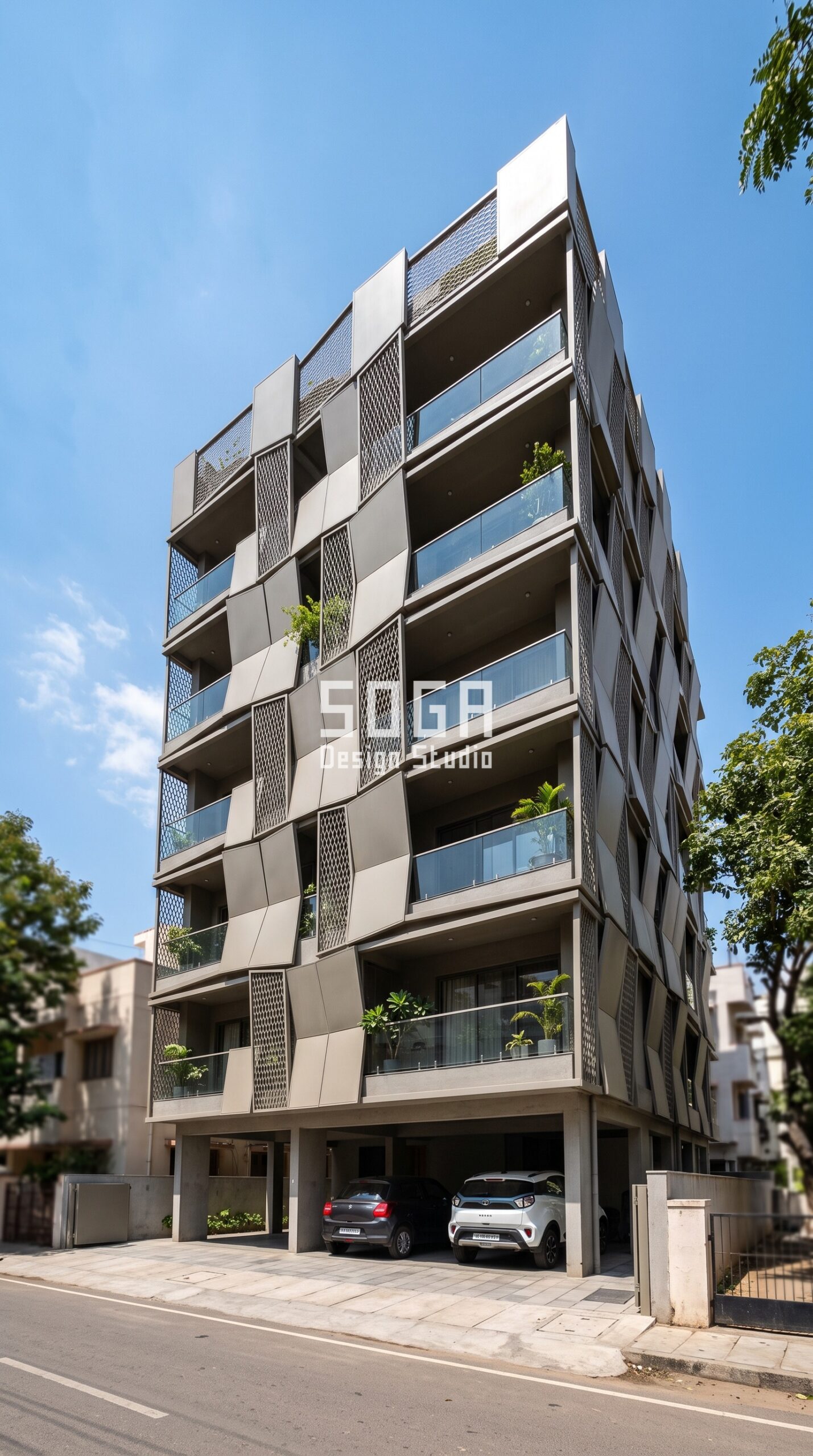
The Coimbatore concept opens the set with a G+6 residence in RS Puram wrapped in a Parametric Interlock Screen – discrete, ordered angular modules of matte RAL 1019 warm grey-beige steel that alternate between solid panels and open sections. Photographed from street level looking up in hard midday light, the screen does the one job Coimbatore homes need most: it filters direct western glare off the balconies without turning the interiors dark, so rooms stay cool and daylit at the same time. The warm grey-beige tone keeps the building calm against the neighbouring bungalows rather than shouting for attention, while the open stilt parking below keeps the ground plane generous. This is parametric design working quietly – the geometry is doing thermal work, not just looking modern.
2. Bhopal: A Sage-Green Double-Skin Veil for the City of Lakes
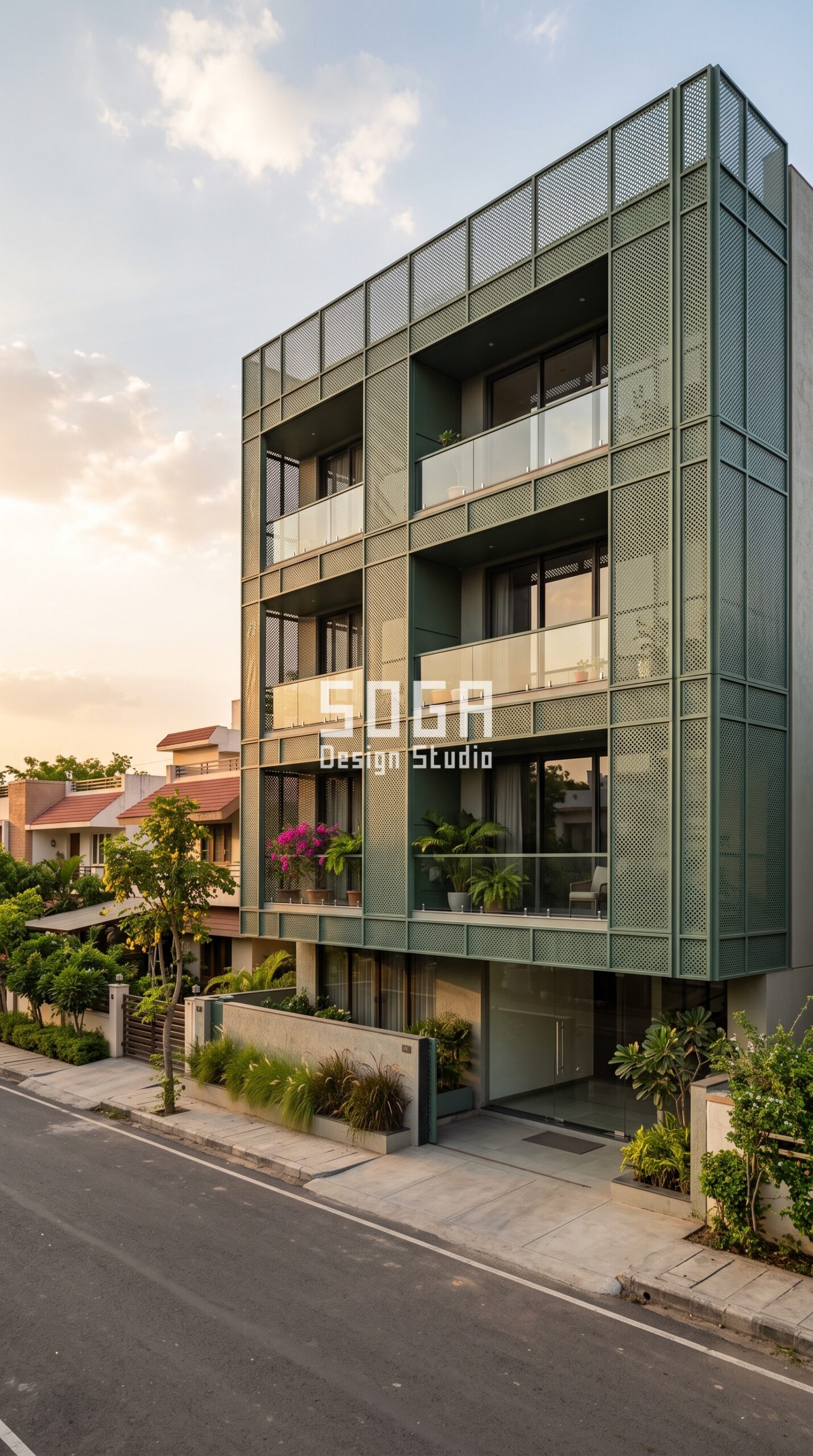
Move north to Shamla Hills in Bhopal and the language shifts to a Parametric Veil Screen – a double-skin of deep sage green precision-cut steel standing a short distance in front of an inner glass curtain wall on a compact G+3 block. Shot in raking late-afternoon golden light, the two layers read clearly: the outer metal veil breaks the low sun and gives the balconies privacy, while the air gap behind it lets Bhopal’s lakeside breeze wash the glass and carry heat away before it reaches the rooms. The sage tone deliberately answers the green hills around it, so the building feels planted rather than parachuted in. For families who want a contemporary elevation that still belongs to a leafy, low-rise neighbourhood, the double-skin veil is the most climate-intelligent option in the set.
3. New Delhi: Folded Bronze Fins That Glow at Dusk in Lutyens
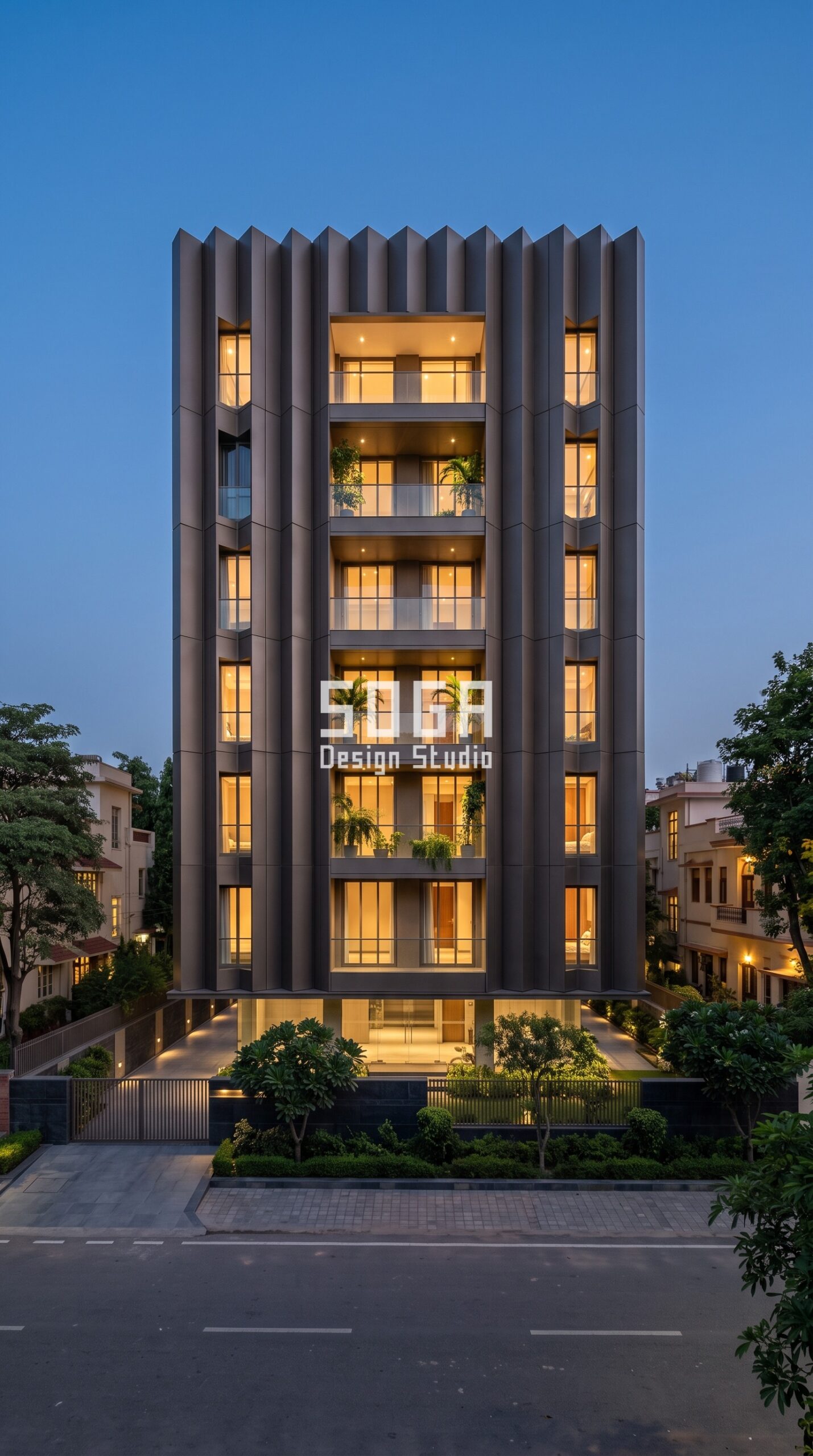
In Lutyens’ New Delhi, the third concept is a G+7 residence dressed in a Parametric Origami Fin wall – vertical folded fins of matte dark bronze-grey steel that alternate forward and back to form a crisp, ordered pleat across the elevation. Captured at blue-hour twilight with warm interior light spilling out, the folds do double duty: by day the angled planes throw self-shading shadows that cut Delhi’s brutal summer load, and by night the same geometry turns the building into a controlled lantern. The bronze-grey reads as understated and permanent – exactly the register a heritage-adjacent Delhi address demands – while the deep folds give real depth and privacy without a single flat, blank wall. It is the most formal, most ‘address’ concept of the four.
4. Navi Mumbai: Rotating Louvers Built for the Monsoon
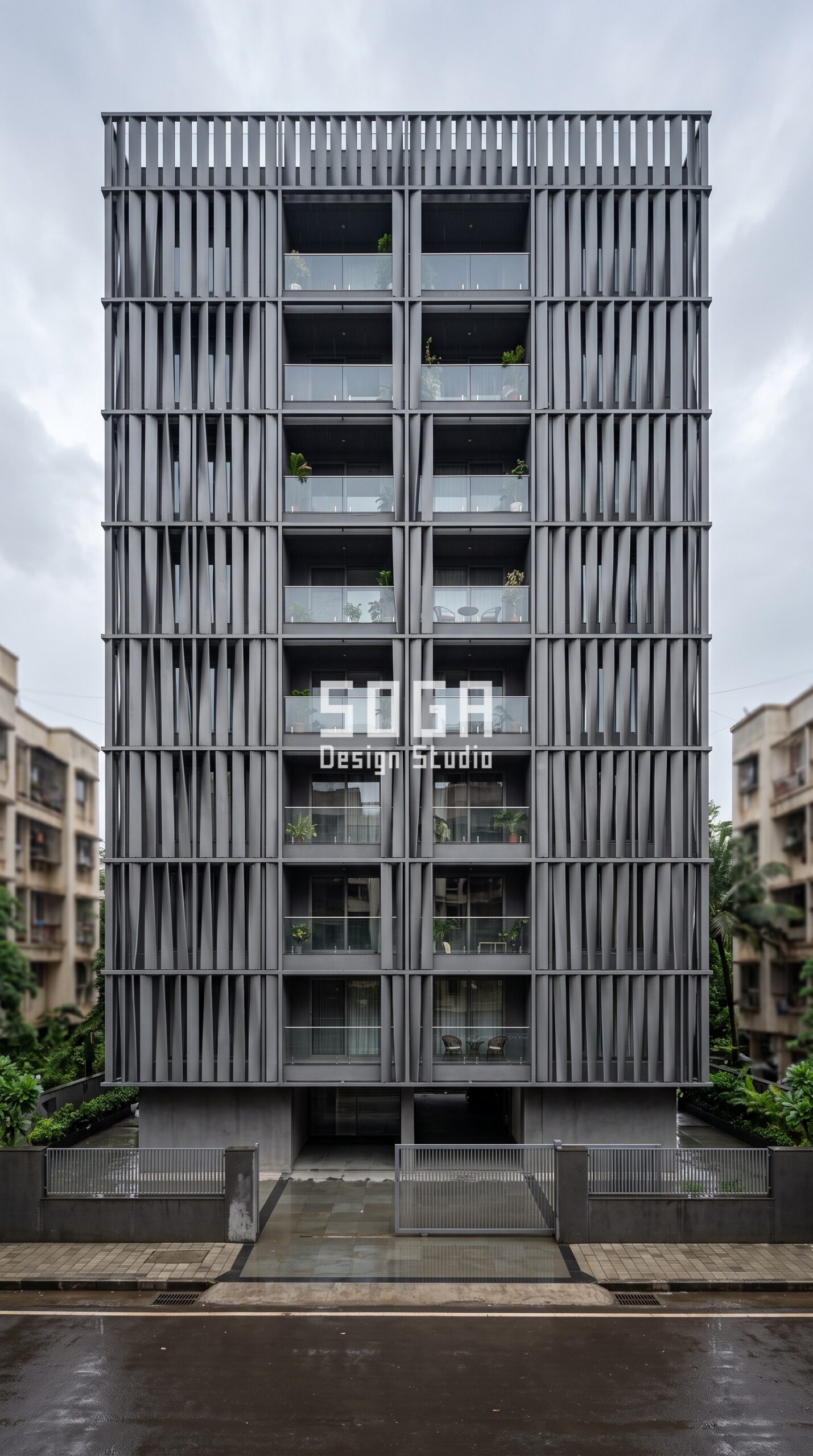
The set closes in Kharghar, Navi Mumbai, with a G+8 block behind a Parametric Spin Louvre – an array of twisted vertical metal louvers in matte gunmetal grey, each blade turned a little more than the last so the whole elevation animates as you move past it. Photographed straight-on just after monsoon rain, with the street still wet and the sky overcast, the facade shows why rotation matters on the coast: angled blades shed driving rain and break the flat glare of a grey Mumbai sky while still pulling sea breeze through the balconies. The gunmetal finish is deliberately robust for a salt-laden coastal environment, and the twist keeps an eight-storey tower from ever feeling like a repetitive stack. It is the most dynamic, most durable concept in the guide.
Cost Benchmarks for Indian Parametric Metal Facades
One of the most-asked questions on a Coimbatore project brief is budget. The current all-in installed rates for parametric metal facades in India sit in the following ranges:
- Steel facade (full design + install): ₹1,200–₹2,800 per sq ft
- Aluminium, anodised or powder-coated: ₹800–₹2,500 per sq ft
- Zinc cladding: ₹1,500–₹3,000 per sq ft
- ACM panels (3 mm basic): ₹200–₹250 per sq ft (basic)
- ACM panels (4 mm): ₹250–₹350 per sq ft
- Solid aluminium panels: ₹800–₹1,800 per sq ft
- Installation labour: ₹50–₹150 per sq ft (varies by height + access)
- Conventional cladding (for comparison): ₹400–₹1,200 per sq ft installed (stone veneer / ceramic / standard ACM)
These figures are baseline; actual project cost depends on facade area, panel complexity, fabricator location, and finish specification. SOGA Design Studio prepares an itemised cost estimate as part of every consultation so the budget conversation starts with hard numbers rather than guesses.
Parametric Facade Design Across India, Dubai & Singapore
Indian residential architecture is shifting from decoration to performance. SOGA Design Studio’s residential work is built for the scale most clients actually build at: G+3 to G+7 homes on plots of 2,400 to 6,000 sq ft, where a parametric metal facade has to earn its place by controlling sun, dust, and privacy as well as it controls first impressions. The studio’s role is to compress what used to take a six-month traditional design cycle into a sharper, AI-accelerated process — without sacrificing the engineering rigour that separates a buildable facade from a rendering. Every concept is developed for the plot, the orientation, and the budget in front of us, not borrowed from a catalogue.
Why Trust SOGA Design Studio for Facade Design in Coimbatore
- Experience: SOGA Design Studio has delivered parametric metal facades on G+3 to G+8 residential projects across Coimbatore, Bhopal, Delhi-NCR, Mumbai and Navi Mumbai, from concept geometry to fabrication-ready shop drawings.
- Expertise: Every concept is developed in parametric modelling tools (Rhino and Grasshopper) and detailed for real manufactured steel and aluminium systems, so the geometry that looks good on screen is buildable on site.
- Authority: The studio focuses exclusively on facades and building elevations, publishing India-specific cost benchmarks and climate-response logic rather than generic renders.
- Trust: Consultations are free and no-commitment, concepts are returned within 48 hours, and NRI clients are supported end-to-end through a fully remote workflow.
Related Reading
Frequently Asked Questions
How much does a parametric metal facade cost per square foot in India in 2026?
As a planning guide, a designed metal facade in India typically runs about Rs 850 to Rs 2,200 per sq ft of facade area, depending on the metal (powder-coated steel is the value end, aluminium and stainless the premium end), the depth of the geometry, and the fabrication method. A simple flat screen sits near the lower end; a deep, double-skin or rotating-blade system sits higher. SOGA Design Studio prices each concept against your actual elevation area and budget.
Which metal facade is best for a hot Indian climate like Coimbatore?
For hot, high-glare cities, a screen or double-skin that shades the openings while leaving an air gap behind it performs best – like the woven interlock screen shown for Coimbatore or the sage-green double-skin veil for Bhopal. The metal blocks direct sun before it hits the glass, and the ventilated gap carries heat away, which lowers cooling loads without darkening the rooms.
Are these facades only for large buildings, or can I use one on a G+3 home?
They scale down comfortably. The Bhopal concept in this guide is a G+3 residence, and the same parametric logic works on individual homes as well as G+7 and G+8 blocks – only the module size, density and material are tuned to the project’s height and budget.
Can SOGA design a facade remotely for an NRI or out-of-city client?
Yes. The studio runs a fully remote workflow – you share plot dimensions, reference images and a timeline, and receive a tailored parametric facade concept within 48 hours, followed by fabrication-ready detailing. Clients across India, Dubai, Singapore and the UK are supported this way.
How much heat does a parametric metal facade actually reduce?
Independent studies on Indian residential applications show double-skin parametric metal screen facades reduce direct solar heat gain by 25-40% on west and south orientations, dropping interior surface temperatures by 4-7 deg C compared to bare RCC. The shaded gap also enables passive cross-ventilation. SOGA Design Studio tunes the screen opening density based on each orientation solar load.
What is a kinetic facade and is it practical for Indian residences?
A kinetic facade has moving panels — louvres, rotating fins, or actuated screens — that respond to sun angle, occupancy, or wind. For mid-rise Indian residences, the practical version is ‘pseudo-kinetic’: a static parametric pattern that creates the visual illusion of motion as the sun tracks across it. True actuated kinetic systems are typically reserved for premium G+10 and above commercial buildings.
What is the typical timeline from design to installed parametric facade?
For a G+3 to G+4 residence: 3 weeks for concept and approval, 4 weeks for fabrication-ready drawings, 6–8 weeks for fabrication, and 3–5 weeks for site installation — total 16–20 weeks from go-ahead to occupancy. Retrofit projects on existing buildings compress this to 10–14 weeks because no structural coordination is needed.
Why is parametric architecture suited to the Indian climate?
India’s combination of intense sun, monsoon humidity, and dense urban context demands a ‘smart skin’ rather than a static wall. Parametric facades let designers tune perforation density, panel depth, and orientation per building per orientation — cutting solar heat gain by 25–40% while boosting cross-ventilation. The approach also reinterprets centuries-old metal shadow screening for modern G+3 and G+4 buildings.
Can a parametric metal facade be retrofitted onto an existing Indian building?
Yes, and it is one of the fastest-growing segments. A lightweight aluminium parametric screen can be mounted on stand-off brackets over existing brick, RCC, or even tired plaster facades — completely transforming the elevation in 4–8 weeks without disturbing tenants or interiors. Retrofit is particularly cost-effective for 1990s-2010s Indian apartments where the original facade has aged.
Parametric metal facade vs traditional stone or paint — which is better long-term?
Stone is heavy, expensive (₹600–₹1,500 per sq ft just for material), and difficult to repair when chipped. Paint requires repainting every 4–6 years in Indian conditions. A powder-coated parametric metal facade has higher upfront cost but a 25–30 year service life, zero repainting, and far stronger street identity — making total cost of ownership lower over a 20-year horizon. It is also significantly lighter, reducing structural cost on G+3 and above.
How much does a parametric metal facade cost per square foot in Indore?
Currently, all-in parametric metal facade rates in India range from ₹800–₹2,500 per sq ft for aluminium and ₹1,200–₹2,800 per sq ft for steel, installed. SOGA Design Studio prepares itemised estimates as part of the consultation.
What is a sculptural petal-shaped metal fin facade?
SOGA Design Studio addresses this question in detail during the design consultation. For Coimbatore projects, we provide a fully customised answer based on plot, orientation, and budget — typically within 48 hours of receiving the brief.
Related Reading
Start Your Facade Project With SOGA Design Studio
One approach, four cities: the right parametric metal facade is the one tuned to your climate, your street and your budget – not a template copied from a brochure.
If any of the parametric metal facade concepts above resonate with your project, send us your brief. SOGA Design Studio delivers customised parametric facade concepts for India, Dubai, Singapore, and the UK.