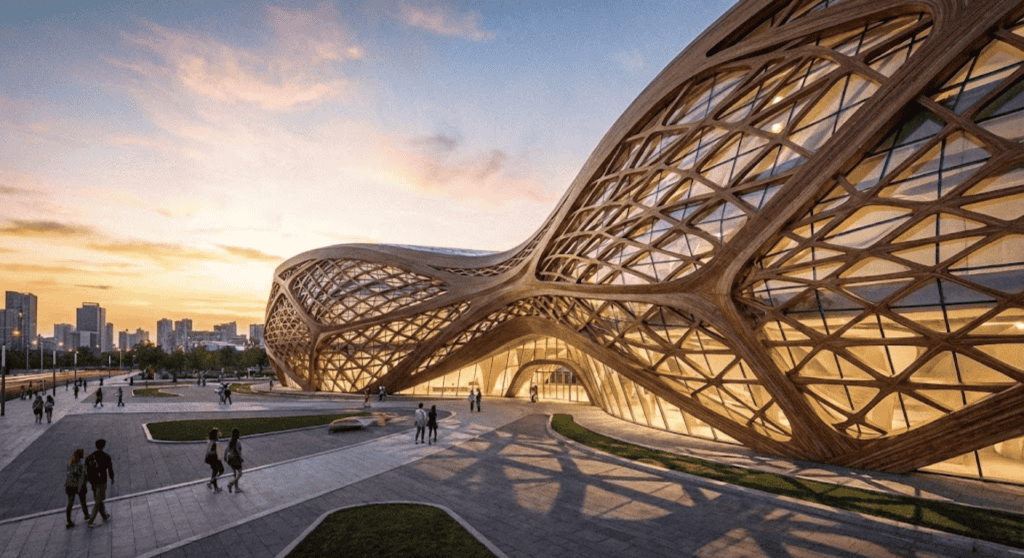
Computational design in architecture has moved from a research curiosity to the mainstream design method for new Indian residential, hospitality and boutique commercial work in 2026. Today, virtually every new G+4 to G+10 facade you see going up in Mumbai, Delhi, Bangalore, Hyderabad, Pune and Jaipur with a sculptural identity is the output of a parametric model — not a hand-drawn elevation. This guide explains what that means in practice: the 7-step workflow, the software stack, the cost impact, and the nine questions every Indian homeowner, developer and NRI client should ask before commissioning a computationally-designed facade in 2026.
For clients who want to skip the long technical evaluation entirely, the SOGA Parametric Systems™ library — five pre-engineered, pre-costed computational facade systems (SogaGrid™, SogaWeave™, SogaShell™, SogaScreen™, SogaPulse™) — collapses the entire workflow below into a single proposal delivered within 48 hours.
Q1. What is computational design in architecture, exactly?
Computational design is a method of generating building geometry where the architect writes a parametric rule (a script) and the computer outputs every panel, mullion and bracket as the logical consequence of that rule. Inputs — plot dimensions, solar orientation, view priority, structural module, budget ceiling — drive the output. Change any input and the entire geometry updates instantly.
The practical effect is that a 4,000 sq ft facade with 600 unique panels can be designed, structurally validated and exported to CNC fabrication in a few days — work that would take 8 to 12 weeks of manual drafting in a traditional workflow. Every panel ships as a numbered piece, on-site cutting drops to near zero, and the built facade matches the visualisation to within a few millimetres.
Q2. Why are Indian projects adopting computational design in 2026?
Five drivers explain the shift from conventional to computational design across Indian metros in 2026:
- Climate response: India’s east, west and south orientations carry heavy solar load 8 to 10 months a year. Parametric panel angles and perforation density, tuned per orientation, reduce interior surface temperatures by 4 to 7 degrees Celsius vs bare RCC.
- Fabrication accuracy: Indian fabrication shops in 2026 are CNC-equipped and can hold 0.5 mm tolerance — but only if the input geometry is digitally numbered. Computational design produces exactly this.
- Cost predictability: a parametric model gives a fixed bill of materials early in the project. Change orders during construction drop by 60 to 80 percent.
- Visual identity: Indian buyers in Tier-1 and Tier-2 metros increasingly read a parametric facade as the signal of a designed home. The resale and rental uplift on parametric homes is measurable.
- AI-assisted concept exploration: generative AI has compressed the concept stage of facade design by roughly 40 percent — clients can review 15 to 20 facade directions in a single 60-minute meeting instead of waiting two weeks for three manual options.
Q3. What does the computational design workflow look like, step by step?
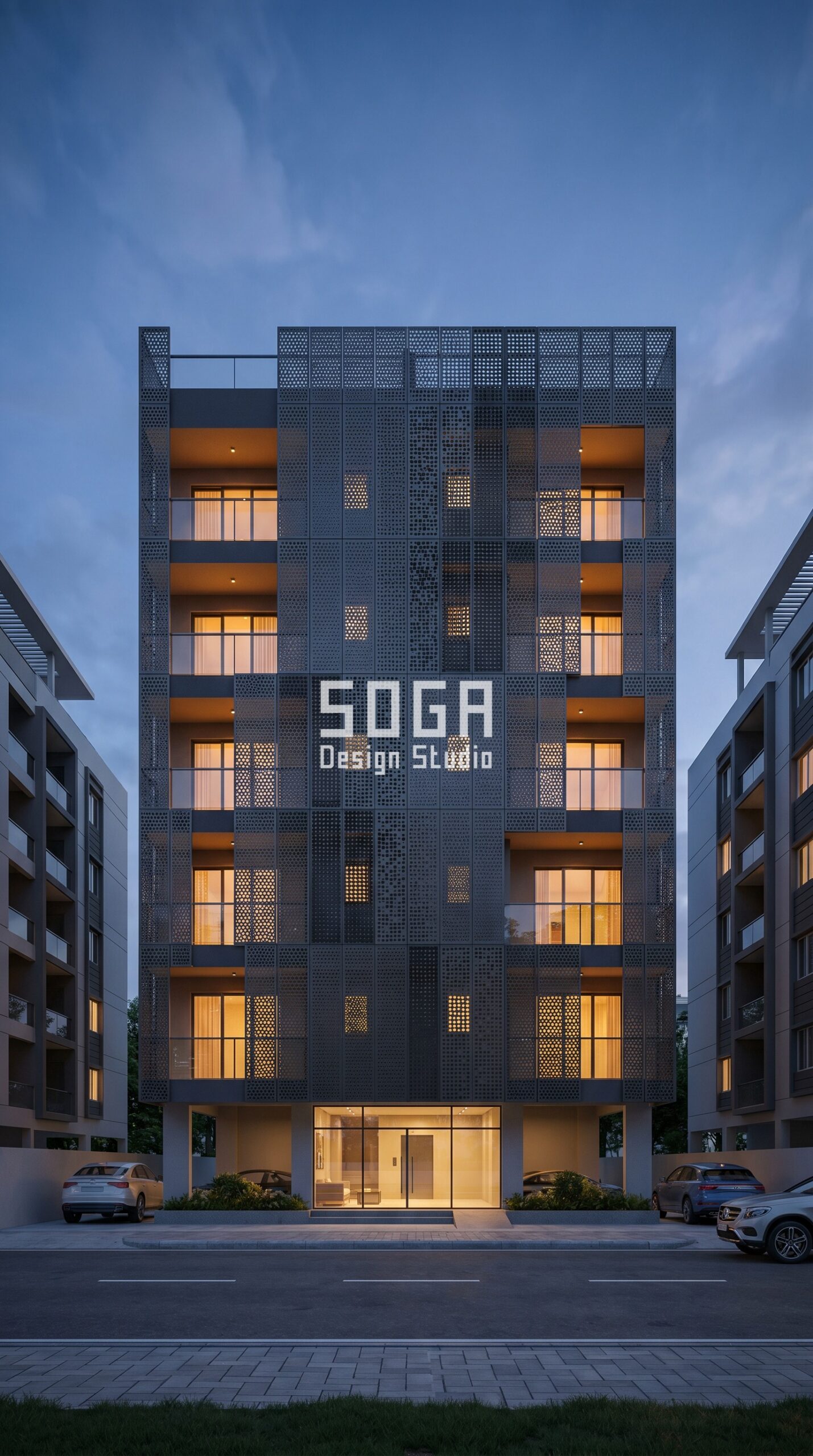
Below is the 7-step computational design workflow SOGA Design Studio runs on every project in India, Dubai and Singapore in 2026. Each step has a defined deliverable, a named software tool, and a typical timeline. The Bangalore G+5 SogaPulse™ visualisation above is the output of this exact workflow.
- Site analysis (Week 1): Plot dimensions, solar path study via Ladybug, wind load (IS 875), neighbour overlooking analysis, view-priority mapping. Output: a single annotated site analysis sheet.
- System recommendation (Week 1): Based on inputs above, SOGA recommends one of the five SOGA Parametric Systems™ or a hybrid. The client sees indicative cost on day one.
- Parametric modelling (Weeks 2–4): Rhinoceros 8 + Grasshopper script drives panel angle, density, opening pattern, and module size as outputs of the site analysis. Three to five design variations are exported per system.
- Climate + structural validation (Week 4): Solar radiation analysis per panel, structural sub-frame stress check via Karamba3D, water-shedding paths simulated for monsoon. Variations that fail are eliminated; the surviving variation is locked.
- Structural coordination (Weeks 5–6): Sub-frame layout, bracket spacing, wind load checks coordinated with the project’s structural engineer. BIM model exported to Revit if required.
- Fabrication-ready output (Weeks 6–8): Every panel exported with a unique fabrication number, CNC tool path (where applicable), bracket layout, finish specification, and bill of materials.
- Factory + install (Weeks 9–16): Panels go to SOGA’s vetted fabrication partner. Each panel is laser-marked with its fabrication number. SOGA’s site engineer supervises install with dated photo updates.
Q4. Which software tools power computational design in 2026?
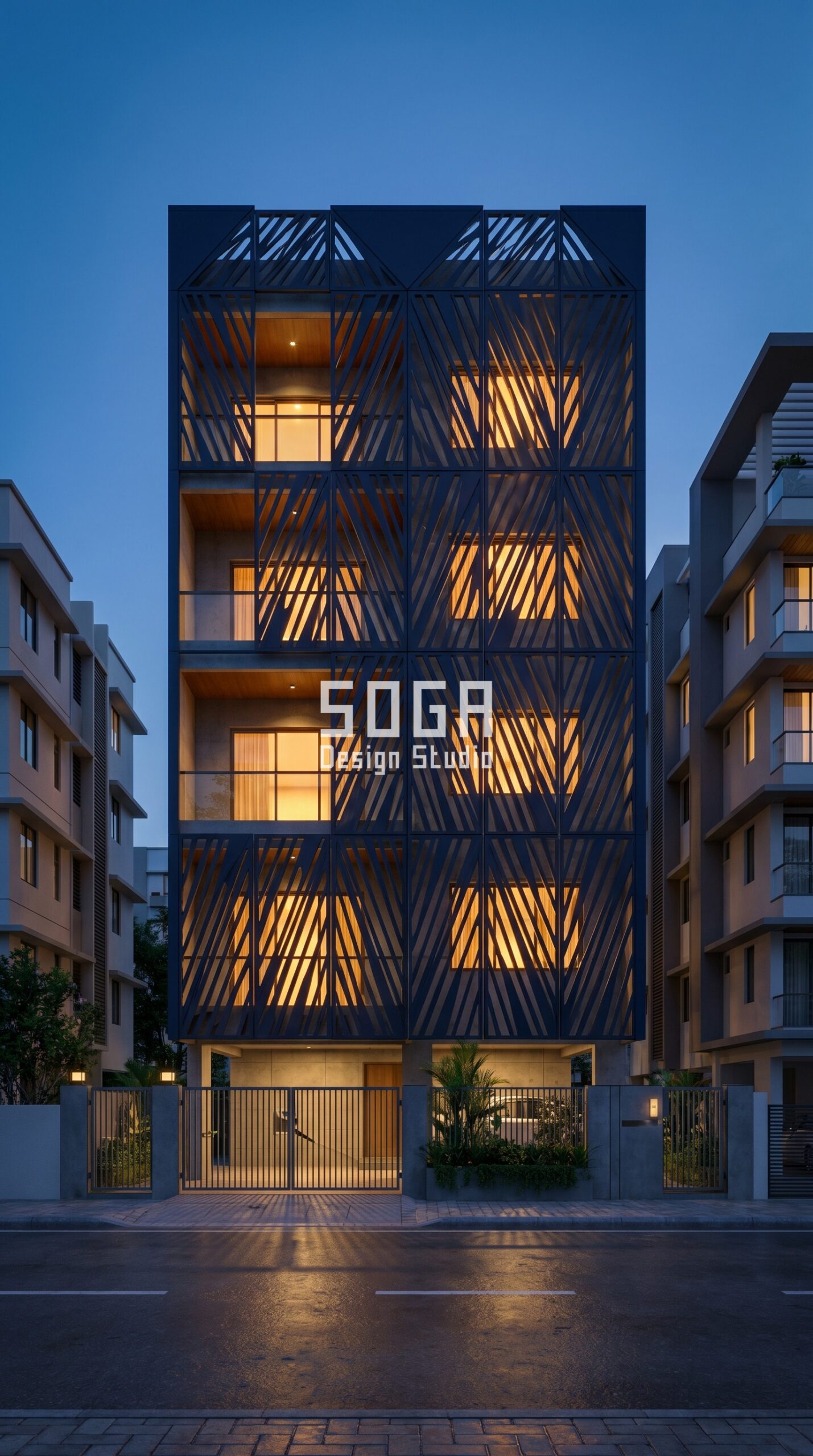
Indian computational architecture in 2026 is dominated by a tight stack of tools that work together. The Mumbai G+4 SogaScreen™ visualisation above — with its algorithmically-cut geometric openings — is the output of three tools running on the same Grasshopper definition:
- Rhinoceros 8: the geometric NURBS engine that hosts every parametric facade in the SOGA library.
- Grasshopper: the visual scripting environment where the parametric rule itself is authored.
- Ladybug + Honeybee: climate analysis plug-ins for solar radiation, daylight, and energy modelling — essential for Indian solar geometry.
- Kangaroo: physics-driven form-finding for organic surfaces (used in SogaShell™ wave panel development).
- Karamba3D: real-time structural analysis directly on the parametric geometry — wind load, deflection, panel sub-frame stress.
- Lunchbox + Pufferfish + Weaverbird: additional Grasshopper plug-ins for surface paneling and mesh refinement.
- Revit + Dynamo: BIM documentation for projects that require IFC export or coordinated MEP integration.
- RhinoCAM / CAMplete: direct CNC tool-path generation for fabrication-ready output.
- Generative AI image tools: used at concept stage for divergent exploration; the parametric model remains the source of truth for built geometry.
- House Elevation Design in India: The Questions Everyone Asks, Answered
Q5. How does computational design differ from traditional Indian architecture practice?
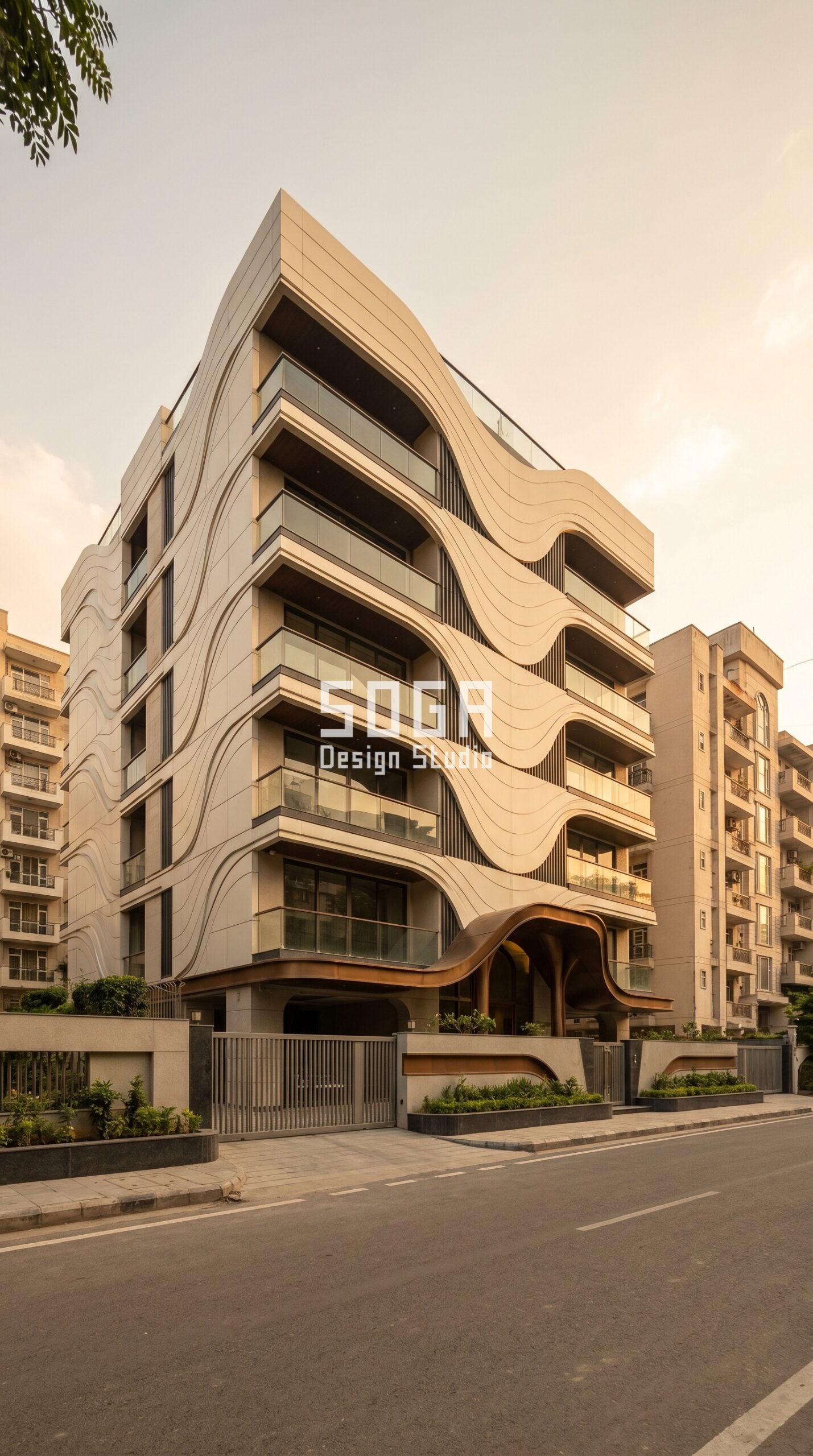
The Delhi G+5 SogaShell™ visualisation above is a useful case study. A conventional architect would have drawn this facade as a series of curved elevations by hand, then asked a fabricator to interpret the drawings into panels — a process that typically introduces a 5 to 10 percent geometric deviation between intent and built reality, plus 2 to 4 weeks of back-and-forth between architect and fabricator.
Under a computational workflow, the same facade is generated as a single continuous wave surface, automatically split into CNC-formed panels with standardised edge details, and exported as a numbered panel schedule. The architect-fabricator iteration loop disappears. Geometric deviation drops to under 1 percent. The four practical differences are:
- Source of truth: traditional = paper drawing; computational = parametric model.
- Change handling: traditional = redraw and reissue; computational = update one input, all panels regenerate.
- Fabrication interface: traditional = fabricator interprets drawings; computational = fabricator runs CNC from numbered schedule.
- Validation: traditional = manual checks; computational = automated structural + climate analysis on every variation.
Q6. How much does computational design add to a project’s cost in India?
Computational design adds 8 to 15 percent to the design fee versus a traditional architecture practice, but saves money downstream:
- Fabrication waste drops by 5 to 12 percent because every panel ships as a numbered piece, eliminating on-site cutting.
- Installation time drops by 4 to 8 percent because there is no panel re-cutting or re-fitting on site.
- Change orders during construction drop by 60 to 80 percent because the bill of materials is locked early.
- Maintenance cost over 10 years drops because every panel has a documented finish spec and a known replacement geometry.
Net effect: total project cost is approximately neutral or slightly lower than a traditional workflow, with significantly better visual and performance outcomes. For SOGA Parametric Systems™ projects specifically, the all-in installed rate is Rs 1,200 to Rs 3,800 per sq ft of facade depending on system and finish choice.
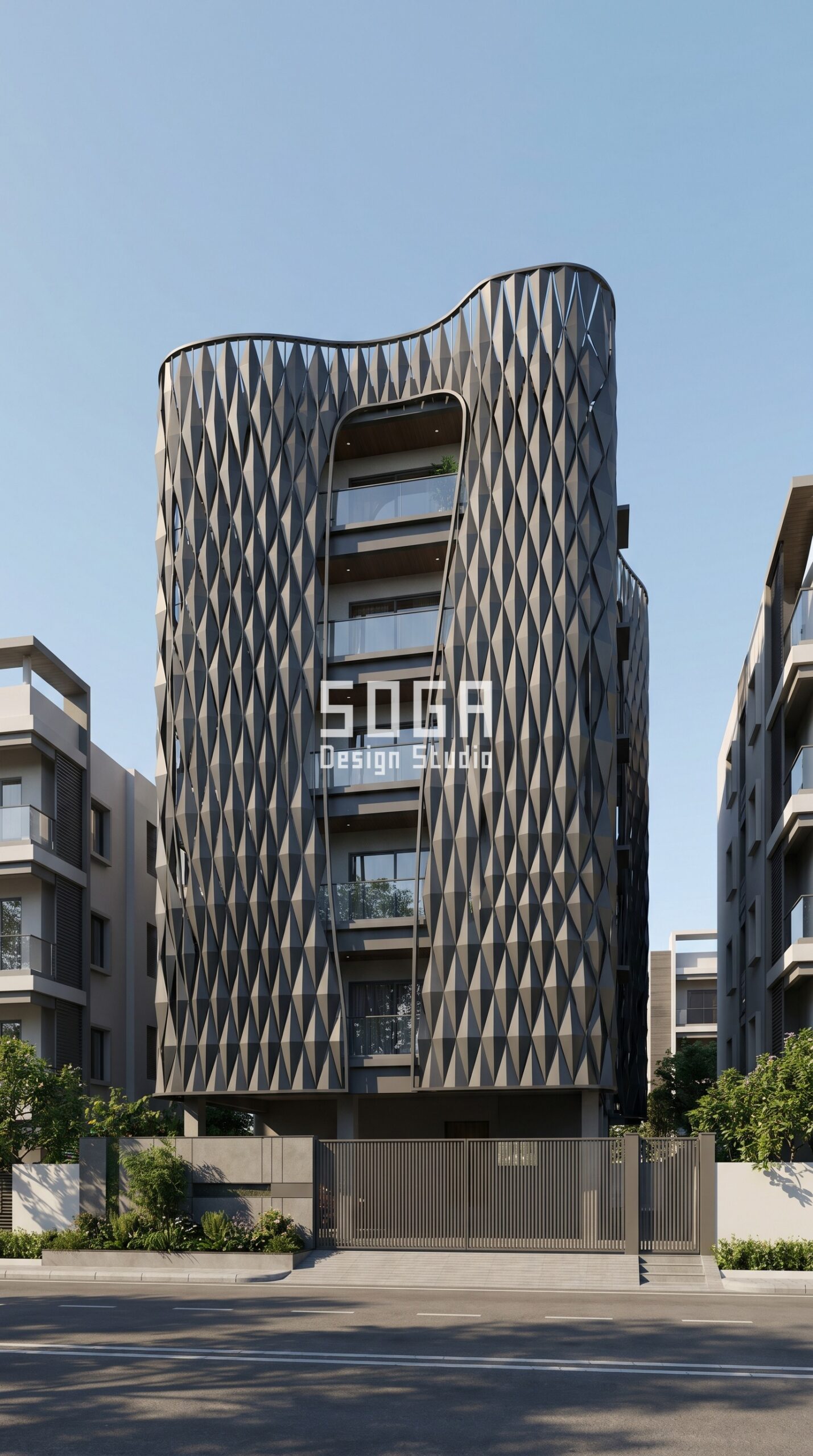
Q7. How long does the computational design workflow take from brief to handover?
The Hyderabad G+4 SogaGrid™ visualisation above — a fully computational diamond grid with density-modulated panel spacing — is the kind of project that runs to 14 to 18 weeks total under the SOGA workflow. Specifically:
- Discovery + brief: 1 week.
- Site analysis + system recommendation + concept variations: 3 to 4 weeks.
- Climate + structural validation + final concept lock: 1 to 2 weeks.
- Fabrication-ready drawings + bill of materials: 2 to 3 weeks.
- Factory fabrication: 4 to 6 weeks.
- On-site installation: 3 to 4 weeks.
- Snagging + handover: 1 week.
Traditional architecture workflows on equivalent facades typically run 22 to 30 weeks because of the manual drafting loop and the architect-fabricator iteration cycle. The SOGA workflow compresses this to 14 to 18 weeks without sacrificing engineering rigour.
Q8. Can a residential homeowner commission a computationally-designed facade?
Yes, and 2026 is the year residential clients in India have become the majority segment for computational facade work. The SOGA Parametric Systems™ library is calibrated specifically for individual G+3 to G+7 residential plots between 2,400 and 8,000 sq ft.
- SogaGrid™ (Rs 1,400 to 2,400 per sq ft installed): entry-tier computational facade for budget-conscious G+3 homes.
- SogaWeave™ (Rs 1,200 to 2,200 per sq ft): twisted vertical fin facade for hot east/west orientations.
- SogaScreen™ (Rs 1,500 to 2,800 per sq ft): CNC-cut shadow screen for plots needing solar control + visual identity.
- SogaShell™ (Rs 1,800 to 3,200 per sq ft): organic wave cladding for luxury homes above 4,000 sq ft.
- SogaPulse™ (Rs 2,000 to 3,800 per sq ft): fully computational responsive facade for landmark residential and signature builds.
Q9. How does AI fit into the 2026 computational design workflow?
AI tools have been integrated into Indian computational architecture practice through 2025 and 2026 in three specific ways — none of which replace the parametric model itself:
- Concept divergence (saves 4 to 6 weeks): generative AI image models produce 15 to 20 facade direction options in a single afternoon. The client narrows down to 2 or 3 directions before any parametric work begins. This compresses the concept stage by roughly 40 percent.
- Visual presentation (saves on render time): AI upscaling and post-processing convert Grasshopper output renders into client-presentable visuals in minutes rather than hours.
- Site analysis automation: AI-trained models extract solar geometry, neighbour shading and view priority from satellite imagery and 3D city models, feeding inputs directly into Ladybug/Honeybee without manual digitisation.
What AI does not do: AI does not generate fabrication-ready geometry. The Grasshopper-driven parametric model remains the single source of truth for every panel, bracket and sub-frame piece that goes to the factory.
How SOGA Design Studio Wraps Computational Design Into a Single Contract
Running through the 9-question framework above with a traditional architecture firm typically returns a two-stage engagement (design fee + separate execution contract) and a 22+ week timeline. With SOGA Design Studio, computational design is the default workflow, and the SOGA Parametric Systems™ library means most of the upfront geometric R&D is already done:
- Q1 (what it is): SOGA’s entire design model is Rhino + Grasshopper from concept to fabrication, with the Grasshopper definition shared with the client at sign-off.
- Q2 (why adopt): climate-tuned parametric panels reduce solar heat gain by 25 to 40 percent on Indian west and south orientations.
- Q3 (workflow): the 7-step SOGA workflow above is the standard delivery scope.
- Q4 (tools): Rhinoceros 8, Grasshopper, Ladybug, Honeybee, Kangaroo, Karamba3D, Revit + Dynamo, AI concept-stage tooling.
- Q5 (vs traditional): sub-1% geometric deviation between visualisation and built facade.
- Q6 (cost): Rs 1,200 to 3,800 per sq ft installed, with fabrication waste and change orders reduced.
- Q7 (timeline): 14 to 18 weeks total for a G+4 parametric facade.
- Q8 (residential): five pre-costed systems calibrated for G+3 to G+7 Indian residential plots.
- Q9 (AI role): AI used at concept stage to compress timeline; parametric model remains source of truth.
Explore the full library: SOGA Parametric Systems™ — SogaGrid™, SogaWeave™, SogaShell™, SogaScreen™, SogaPulse™ — each delivered across India, Dubai, Singapore, Qatar and Saudi Arabia under a single accountability chain.
Frequently Asked Questions About Computational Design in Indian Architecture
What is computational design in architecture in simple terms?
Computational design is when the architect writes a parametric rule (a script in software like Grasshopper) and the computer generates every panel, mullion and bracket as the output of that rule. Change any input — plot, solar orientation, budget — and the entire facade geometry updates automatically.
Is computational design more expensive than traditional Indian architecture practice?
It adds 8 to 15 percent to the design fee but saves 5 to 12 percent on fabrication waste, 4 to 8 percent on installation time, and 60 to 80 percent on construction-stage change orders. Net total project cost is approximately neutral or slightly lower with significantly better outcomes.
What software does a computational architecture studio in India use in 2026?
The standard stack is Rhinoceros 8, Grasshopper, Ladybug, Honeybee, Kangaroo, Karamba3D, plus Revit + Dynamo for BIM documentation. Generative AI tools are used at concept stage. SOGA Design Studio runs this exact stack on every project.
How long does a computationally-designed facade take from brief to handover?
14 to 18 weeks for a G+4 parametric facade under the SOGA workflow. Traditional architecture firms on equivalent projects typically run 22 to 30 weeks because of manual drafting loops.
Can a homeowner commission a computationally-designed facade for a G+3 or G+4 home in India?
Yes. The five SOGA Parametric Systems are calibrated specifically for G+3 to G+7 residential plots between 2,400 and 8,000 sq ft. Entry-tier rate is Rs 1,400 per sq ft installed for SogaGrid.
Does computational design reduce a building’s energy consumption in Indian climate?
Yes. Parametric perforated facades reduce solar heat gain by 25 to 40 percent on west and south orientations in Indian conditions, lowering interior surface temperatures by 4 to 7 degrees Celsius compared to bare RCC.
How is AI used in computational architecture workflows in 2026?
AI is used at concept stage for divergent option exploration (15 to 20 facade directions in one afternoon vs 2 weeks for three manual options), for visual upscaling of Grasshopper renders, and for automated site analysis. AI does not generate fabrication-ready geometry — the parametric model remains the source of truth.
What is the difference between parametric design and computational design?
They are closely related but distinct. Parametric design is the broader concept — any design driven by parameters. Computational design is the specific practice of using algorithms, scripts and engineering analysis software to generate, validate and fabricate that geometry. All computational design is parametric, but not all parametric design is fully computational.
Does SOGA Design Studio handle the full computational design workflow in-house?
Yes. SOGA runs site analysis, parametric modelling, climate and structural validation, fabrication-ready drawings, factory production, and on-site installation supervision under a single accountability chain. All five SOGA Parametric Systems are delivered through this workflow across India, Dubai, Singapore, Qatar and Saudi Arabia.
Commission a Computationally-Designed Facade With SOGA Design Studio
If you are planning a new G+3 to G+10 facade in India, Dubai or Singapore and want the computational workflow benefits described above, book a free 30-minute discovery call. SOGA will recommend whether SogaPulse™ (fully computational), SogaScreen™ (computational opening pattern) or a hybrid of the five SOGA Parametric Systems™ fits your project, and return a fixed-fee design proposal within 48 hours.