Parametric Facade Design | Diagrid Chevron System | Residential Architecture | India 2026
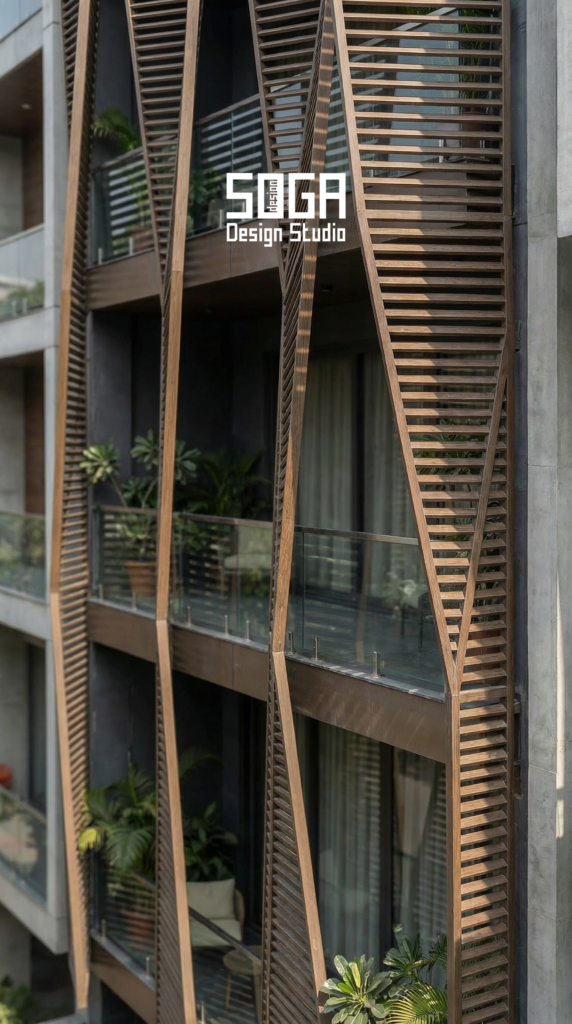
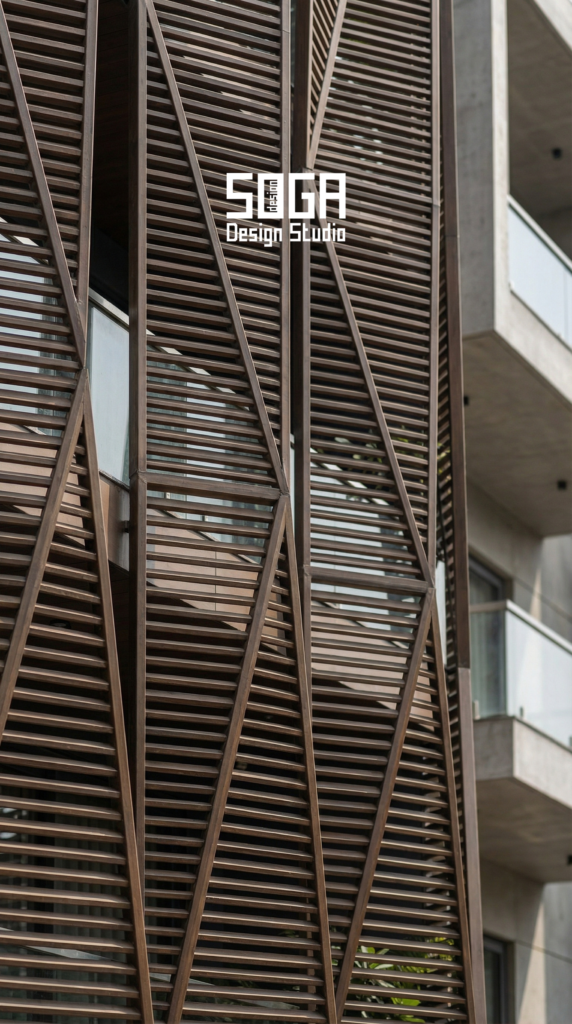
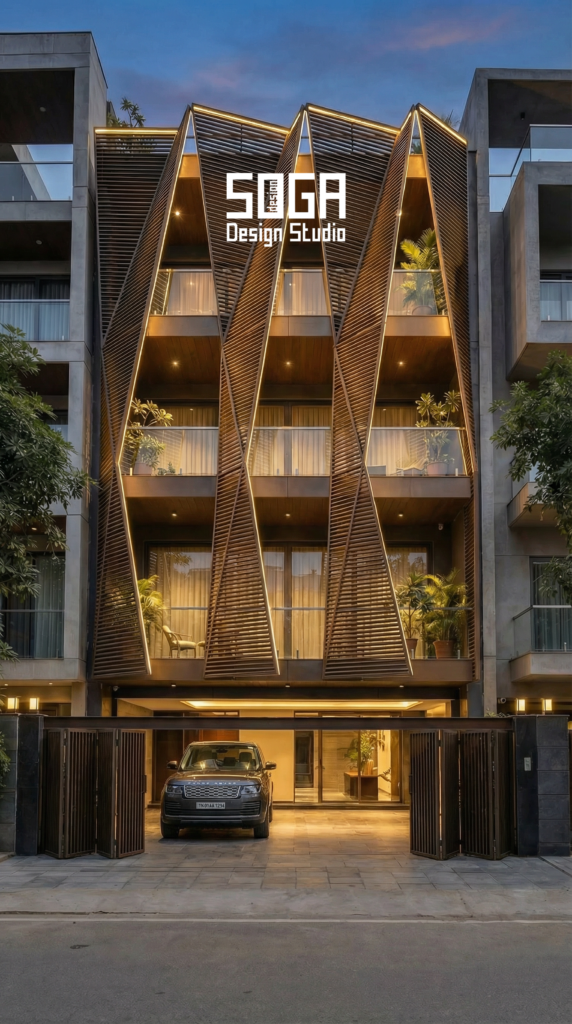
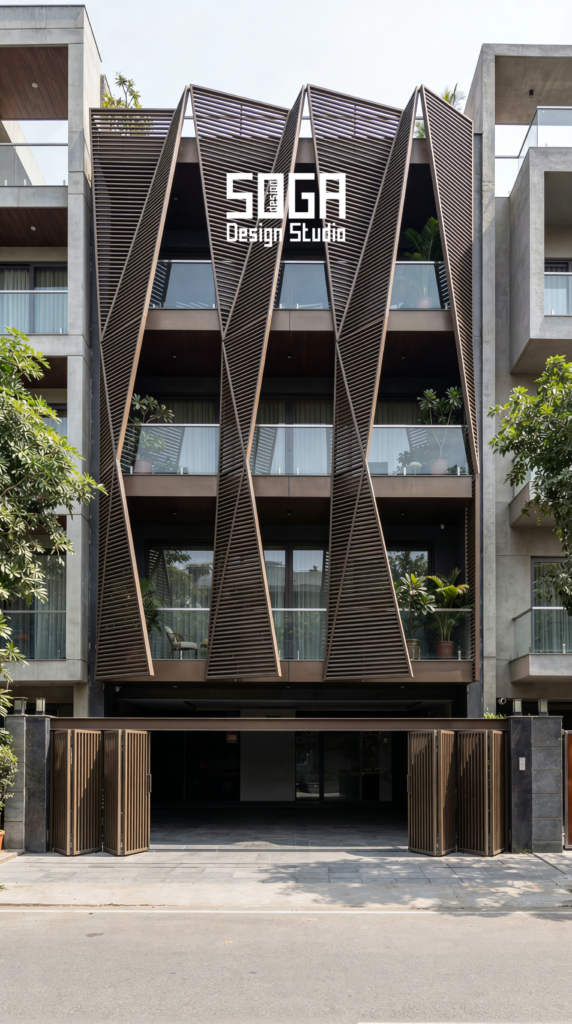
SOGA Design Studio, India and Dubai’s premier parametric facade company with 150+ completed projects across India, Dubai, and Singapore, presents Drishti Taar — a residential masterwork that proves the most extraordinary architecture often begins with the simplest possible question: what if a single louver could do everything?
In contemporary facade design, the temptation is always toward complexity — more materials, more systems, more elements layered upon each other until the building announces its ambition through sheer accumulation. SOGA Design Studio chose the opposite path with Drishti Taar. One element. One material. One geometry. But deployed through the full power of parametric design, that one element — the humble horizontal louver — generates a facade of staggering visual richness: four interlocking chevron volumes that billow, taper, and interweave across the building’s face like the warp and weft of an extraordinary woven textile.
The name “Drishti Taar” translates from Sanskrit as “threads of vision” — and the name is programmatic. Every horizontal slat of the diagrid louver system is a thread. Every chevron volume is a visual pathway. And together, they weave a facade that is simultaneously a work of parametric architecture, a high-performance solar shading system, and a meditation on the relationship between vision, light, and the built surface. This is elevation design as ancient craft reimagined through the language of computational design.
This article tells the complete story of Drishti Taar: the design concept, the parametric system, the material intelligence, the performance credentials, and — crucially — the single design insight at its heart: that a simple element, in the right parametric hands, can become extraordinary.
🏗️ Planning a residential or commercial facade in India, Dubai or Singapore?
Get a free parametric facade consultation from SOGA Design Studio — India & Dubai’s #1 parametric design company.
📧 connect.sogadesign@gmail.com 💬 WhatsApp: +91 884 055 5352 | 🌐 sogadesignstudio.com
The Drishti Taar Concept: One Element, Four Volumes, Infinite Complexity
The Central Design Insight
At the heart of Drishti Taar lies an insight that is simultaneously simple and profound: a single horizontal louver, when its endpoints are parametrically varied along a curved path, generates a three-dimensional volume with a distinct identity, presence, and performance character.
Think about this for a moment. A louver, in its most basic form, is a flat horizontal slat — one dimension of length, one of width, one of depth. It has no inherent geometry beyond its own rectangular profile. It generates no volumetric form. On its own, it is the most modest of architectural elements.
Now imagine that this louver is not installed horizontally across a flat wall, but is instead mounted between two curved structural edges — edges that taper toward each other at the top and bottom of a defined zone, and bow outward at the centre of that zone. The louver still runs horizontally. But because its endpoints follow the curve of the structural edges, its orientation in space shifts: it is no longer flat. It is inclined. Its angle to the vertical changes as you move up or down the zone. And the zone itself — defined by those two curving structural edges — has become a chevron volume: a lens-shaped, eye-shaped, or diamond-shaped form that projects from the building face and recedes at its tapered extremities.
Now place four of these chevron volumes side by side across the facade. Give each a slightly different curvature profile. Allow them to interlock and overlap at their edges. Programme their louver angles to vary parametrically across the surface. And what you have is Drishti Taar: a facade of four interlocking parametric volumes, each one generated entirely from horizontal louvers, each one a distinct three-dimensional presence, and together forming a composition of extraordinary visual power.
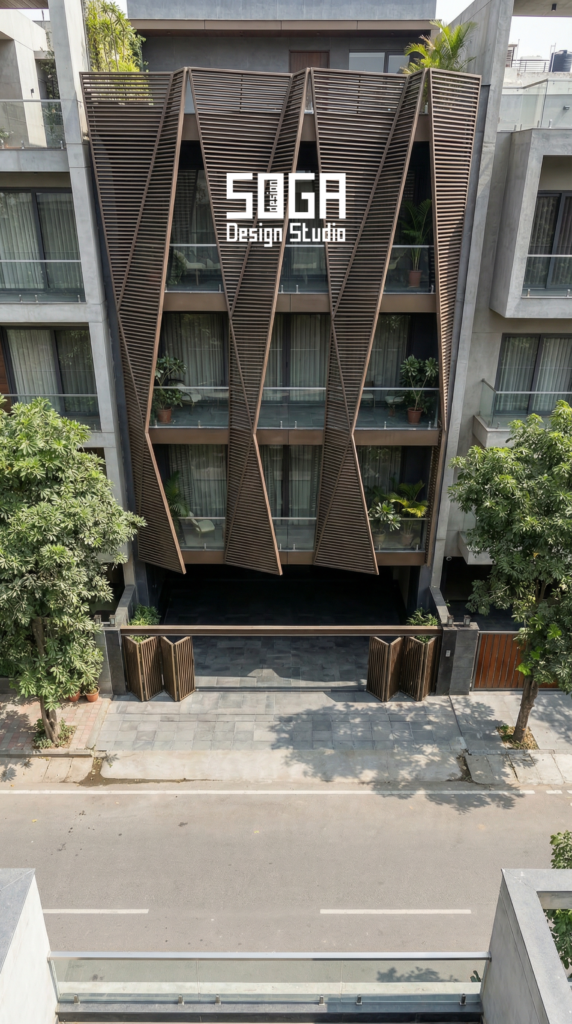
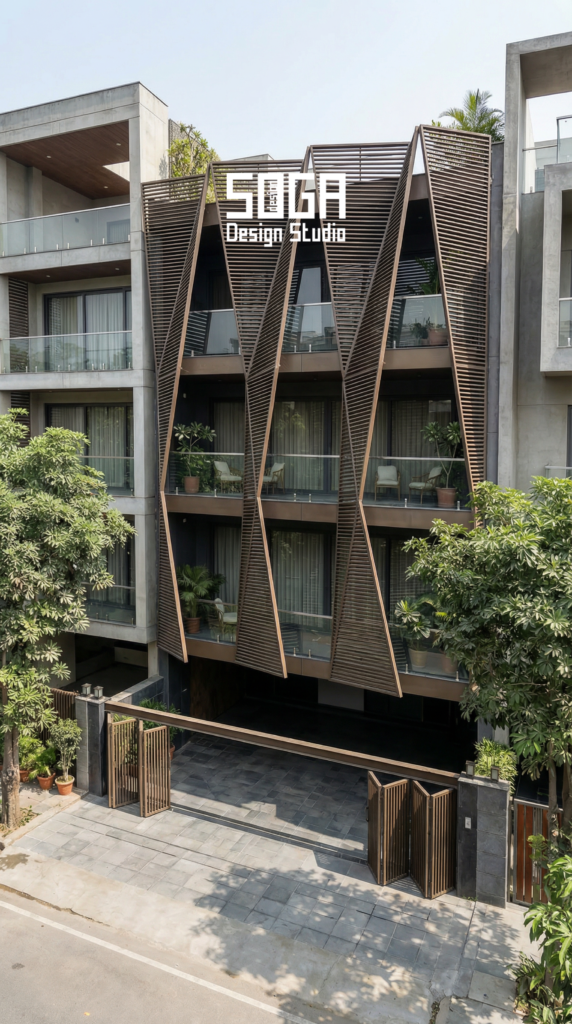
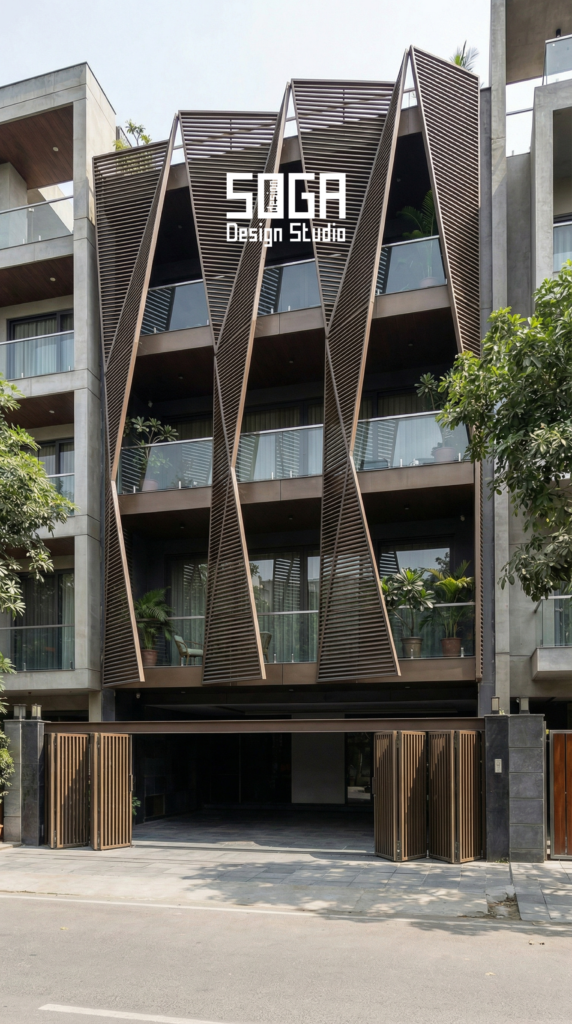
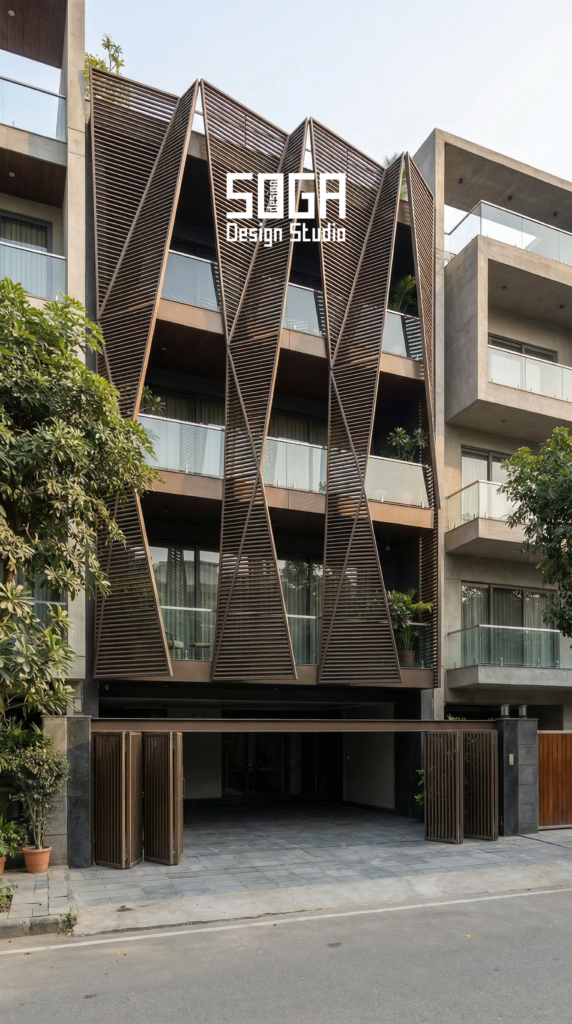
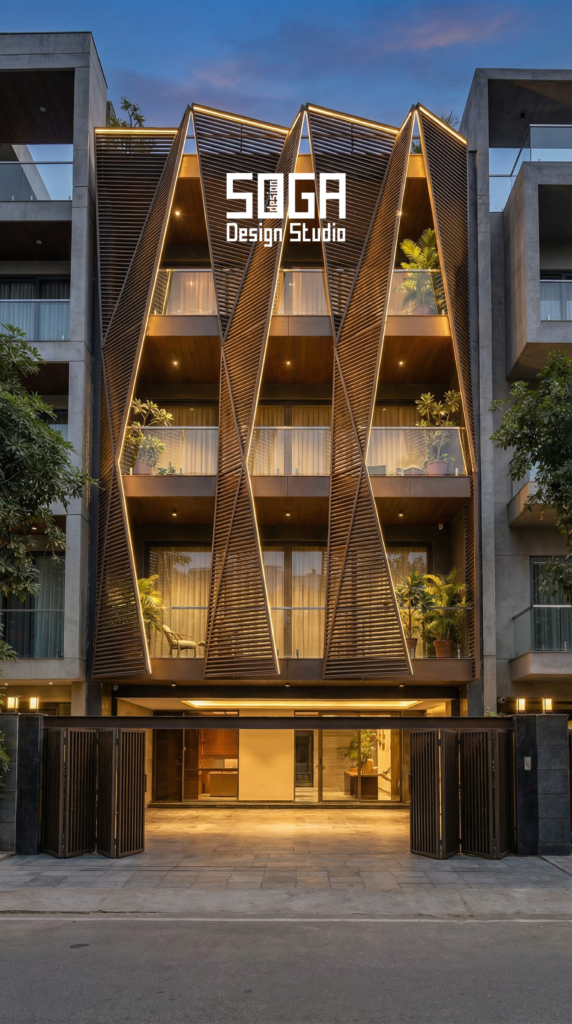
This is the genius of SOGA Design Studio‘s approach to parametric facade design: not the addition of elements but the parametric transformation of a single element into something it could never be on its own.
Why Louvers? The Case for the Simplest Element
The choice of the horizontal louver as the generative element for Drishti Taar was deliberate on multiple levels. Functionally, horizontal louvers are among the most efficient solar shading systems available for residential buildings in India’s tropical climate — they intercept high-angle summer sun while allowing lower-angle winter sun to penetrate, they promote natural ventilation by directing breezes toward the building envelope, and they provide privacy screening for balconies and living spaces without obstructing views.
Culturally, the horizontal louver has deep roots in Indian vernacular architecture. The jaali screens of Mughal architecture, the horizontal slats of traditional chajja overhangs, the timber ventilation grilles of South Indian courtyard houses — all of these are expressions of the same fundamental logic: a horizontal element that mediates between the building’s interior and the external environment of sun, wind, and rain.
Materially, the louver’s long, slender profile — ideal for engineered wood composite in a warm walnut-tone finish — creates a surface of rich, fine-grained texture that reads as simultaneously refined and natural: the warmth of wood, the precision of manufacture, the rhythm of repetition.
And parametrically, the louver’s simplicity is its greatest advantage. Because it is so simple, its parametric transformation is immediately legible — you can see, with your own eyes, exactly how the element changes from one position to another. There is no visual noise, no competing geometries, no complexity that obscures the underlying logic. The parametric intelligence of Drishti Taar is fully visible. That transparency of logic is what makes the facade not just beautiful but genuinely meaningful — a facade you can read and understand, even if you have never heard the words “computational design“.
The Four Chevron Volumes: Anatomy of the Drishti Taar Facade System
Volume Architecture: How Four Chevrons Compose a Facade
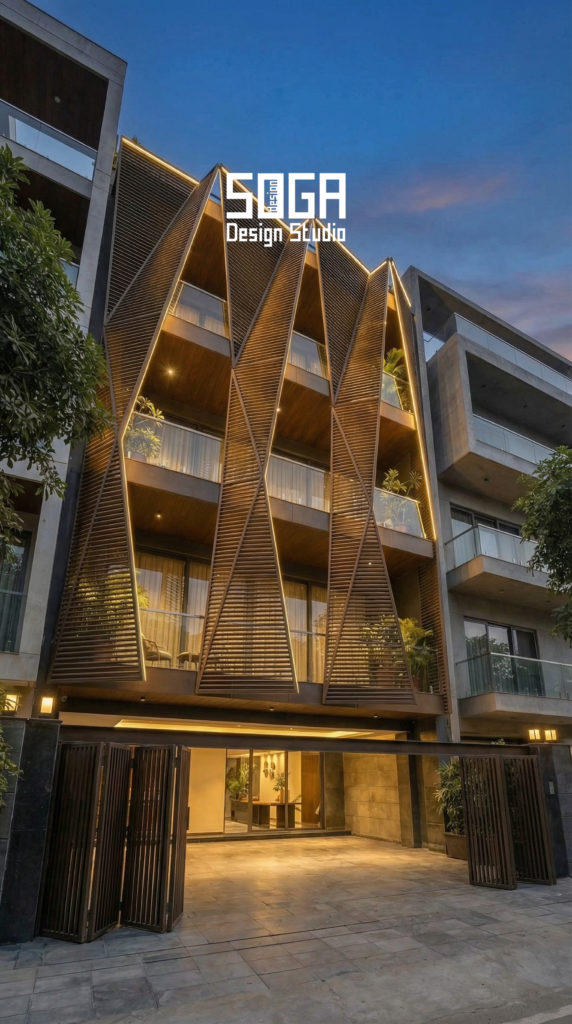
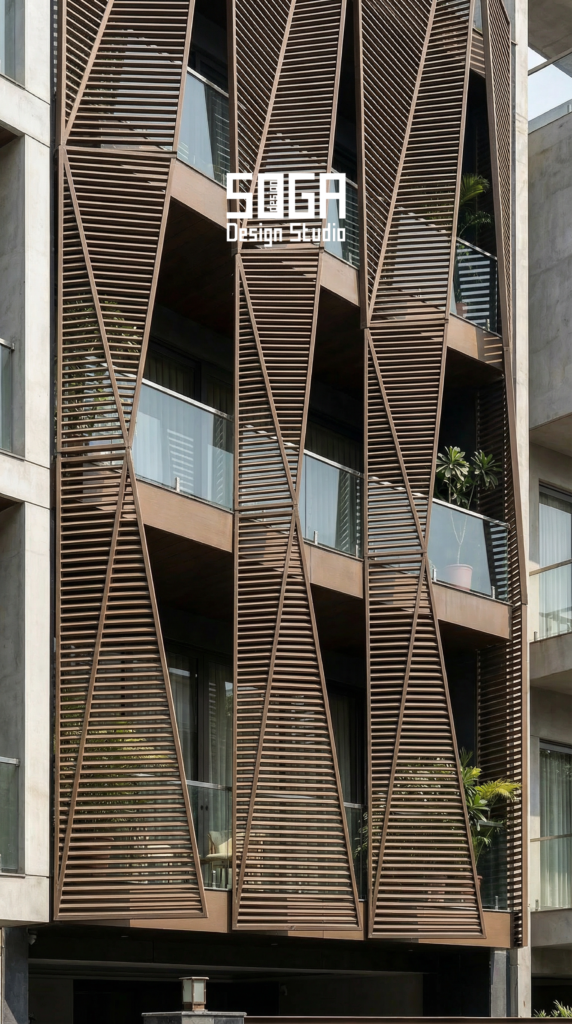
The four parametric chevron volumes of Drishti Taar are the building’s primary formal element — the feature that defines its identity and differentiates it from every other residential building in its urban context. Understanding how these volumes are composed is key to understanding what makes this facade so visually compelling.
Each chevron volume is defined by two curved structural mullions — tall, slender vertical elements in dark-finished steel — that run the full height of the residential floors. These mullions are not straight. In plan, they curve gently outward from the building face at the midpoint of each floor level, and return to the building face at the floor and ceiling of each level. In elevation, they taper: the two mullions of each chevron converge at the top and bottom of the chevron zone, and diverge at the centre, creating the distinctive lens or eye shape that gives the Drishti Taar facade its characteristic silhouette.
Between these paired mullions, horizontal louvers run at regular intervals — typically spaced at 80–100mm centre-to-centre — their ends fixed to the curved face of the mullions. Because the mullions curve in plan, the louvers are not truly horizontal in three-dimensional space: each one is inclined at a slightly different angle to the building face, following the curvature of the mullions it spans between. This variation in louver inclination — driven by the parametric geometry of the mullion curve — is what creates the depth, shadow variation, and shimmering visual texture visible across the Drishti Taar facade surface.
The Diagrid Connection: Where Chevrons Meet
The most visually dramatic aspect of the Drishti Taar facade is not the individual chevron volumes themselves but the zones where adjacent chevrons meet — the diagrid intersections that create the building’s characteristic X-pattern silhouette when viewed straight on.
At these intersection zones, the mullions of adjacent chevrons converge, cross, and diverge — creating a diamond or rhombus-shaped void between the four surrounding chevron volumes. This void is glazed: the floor-to-ceiling glass of the balconies and living spaces behind the parametric louver screen is visible through these diamond zones, creating a powerful visual contrast between the dense, warm texture of the engineered wood louvers and the cool reflective transparency of the glass behind.
The diagrid pattern that emerges from the interlocking of four chevron volumes across the facade is not a separately designed element — it is the inevitable geometric consequence of the chevron system. The diagrid is generated by the parametric logic of the volumes, not imposed upon it. This distinction — between ornament that is applied to a surface and pattern that emerges from the structural logic of a system — is precisely the distinction between conventional facade design and genuine parametric architecture.
The Louver Detail: Where Simplicity Becomes Precision
The individual louver of Drishti Taar is, in section, a simple rectangle: typically 80mm wide and 25mm deep, in engineered wood composite with a warm walnut-tone finish. Its ends are mitred at the angle required to meet the curved face of the supporting mullion — a miter angle that changes for every louver on the facade, because every louver meets the mullion at a slightly different point on the curve.
This is the fabrication challenge at the heart of the Drishti Taar system: over 3,500 individual louvers, each with a unique miter angle at each end. In a pre-parametric world, this would require 3,500 separate manual calculations, 3,500 separate cutting operations, and a site installation process of extraordinary complexity and risk. In SOGA Design Studio‘s digital fabrication workflow, the miter angle for each louver end is calculated automatically by the Grasshopper parametric model and exported directly to the CNC cutting machine — which produces each louver to its unique specification without any manual calculation. The entire fabrication process, for all 3,500+ louvers, is driven by a single parametric file.
The result — when installed — is a surface of uncanny precision: every louver sits exactly where the parametric model says it should, at exactly the angle the model specifies, creating the exact shadow pattern and visual texture that the computational design predicted. The precision is visible to the naked eye: the Drishti Taar facade has a quality of manufacture that is immediately apparent in both photographs and direct experience.
Drishti Taar — Key Numbers at a Glance
| Facade System | Para-Chevron Diagrid Louver System |
| Primary Material | Engineered Wood Composite Louvers (Walnut-tone finish) |
| Structural Frame | Dark-finished Steel Curved Mullion System |
| Volumes Generated | 4 interlocking parametric chevron volumes |
| Total Louver Count | 3,500+ individually CNC-cut panels |
| Solar Shading Performance | 40–47% reduction on E/W elevations |
| LED Lighting | Integrated warm-white (2700K) at mullion edges |
| Ventilation Enhancement | Passive cross-ventilation via angled louver geometry |
| Design Studio | SOGA Design Studio (India & Dubai & Singapore) |
The Parametric Design Process: From Grasshopper to Glory
Step 1 — Defining the Chevron Geometry
The parametric design process for Drishti Taar began with a single geometric question: what is the ideal profile for the curved mullions that define each chevron volume? The answer was not pre-determined — it was computed.
SOGA Design Studio‘s computational design team used Grasshopper for Rhino to generate a family of possible mullion profiles, each defined by three parameters: the maximum outward projection of the curve from the building face, the height-to-width ratio of the chevron lens shape, and the degree of taper at the chevron’s top and bottom extremities. Each combination of these three parameters produces a different chevron shape — from a nearly flat, wide lens to a deeply projecting, narrow diamond.
The selected profile — the one that maximises the visual three-dimensionality of the chevron volumes while maintaining structural efficiency and fabrication feasibility — achieves a maximum projection of approximately 350mm from the building face at the midpoint of each floor, tapering to zero at the chevron’s upper and lower extremities. This projection depth is sufficient to create deep, dramatic shadows at the louver surfaces facing the building — the shadow-play effect visible in the daytime photographs — while keeping the overall facade depth within the constraints of the building setback.
Step 2 — Populating the Louvers
Once the chevron geometry was established, the louver population algorithm was run. This algorithm divides the surface between each pair of curved mullions into a series of horizontal bands — one per louver — and calculates the geometry of each louver: its length (which varies continuously as the mullion spacing changes with the curvature), its miter angle at each end (which varies with the angle at which the louver meets the curved mullion face), and its vertical inclination angle (which varies with the parametric curvature of the mullion profile).
The algorithm also incorporates solar performance optimisation: louvers at the upper levels of each chevron, where summer sun strikes at higher angles, are spaced more closely and set at a steeper inclination to maximise shading. Louvers at the lower levels, where winter sun is desired and shading less critical, are spaced slightly more openly. This subtle variation in spacing and inclination across the parametric facade — invisible in its individual instances but visible in its cumulative effect as a gentle gradient of density across the facade surface — is the hallmark of genuine computational design as opposed to mere pattern generation.
Step 3 — The Shadow Study
Before a single element was fabricated, SOGA Design Studio conducted a comprehensive shadow analysis of the proposed Drishti Taar facade using Ladybug Tools integrated with the Grasshopper model. The analysis modelled shadow patterns on the facade surface at hourly intervals throughout the day for every month of the year — generating a complete picture of how the building would look and perform under real Indian climate conditions.
The shadow study revealed something remarkable about the parametric chevron geometry: because each chevron volume projects from and recedes toward the building face at different rates, the shadow patterns on the louver surfaces of adjacent chevrons are always different — even when those surfaces are at the same height and receiving the same solar radiation. The curvature of the mullions means that each chevron creates its own unique shadow microclimate. At any given moment of the day, one chevron may be fully sunlit while the adjacent chevron is in deep shadow — creating a dynamic, ever-changing play of light and dark across the facade that is visible in the Drishti Taar images and that transforms the building’s appearance throughout the day.
This dynamic shadow play is not an accidental consequence of the chevron geometry — it is one of the design’s primary intentions. The name “Drishti Taar” — threads of vision — specifically evokes the way light passes through and between the louver threads, creating a constantly shifting visual experience for both the building’s occupants and the pedestrians on the street below.
Step 4 — Digital Fabrication
The final step of the parametric process was the generation of CNC fabrication files directly from the Grasshopper model. Every louver’s geometry — length, miter angle at each end, vertical inclination — was exported as a set of machining instructions for the CNC cutting machine. Every mullion’s curvature profile was exported as a set of bending instructions for the CNC tube-bending machine that formed the steel mullion sections.
The fabrication of Drishti Taar‘s 3,500+ louvers and its curved steel mullion system was completed without a single manual calculation or re-drawing. The digital model and the physical object are, in the most literal sense, the same thing: one is the computational representation of the other, and the correspondence between them is exact to millimetre tolerances.
Material Intelligence: Engineered Wood and the Warmth of the Woven Wall
Why Engineered Wood for a Parametric Louver Facade?
The choice of engineered wood composite for the Drishti Taar louver system is not merely aesthetic — though the aesthetic contribution is undeniable. In the context of a residential building in India, wood is the material that most immediately communicates home, warmth, and the quality of crafted making. Metal facades say “commercial.” Concrete facades say “institutional.” Wood says “this is where someone lives well.”
But solid timber — however beautiful — is not an appropriate material for a precision parametric facade system that requires each of 3,500+ louvers to be cut to a unique specification at millimetre tolerances. Solid timber is dimensionally unstable: it expands and contracts with moisture, warps under differential exposure, and varies in its mechanical properties from section to section. For the Drishti Taar system, where each louver’s miter angle is unique and must be maintained precisely over the 20–30 year life of the facade, dimensional stability is non-negotiable.
Engineered wood composite — specifically a high-density wood-fibre composite board with a factory-applied UV-resistant walnut-tone finish — provides the dimensional stability of a manufactured product with the visual warmth and texture of natural wood. The composite boards are manufactured to consistent thickness and density tolerances, machined by CNC to their individual profiles, then finished with a penetrating UV-stable coating that protects the warm walnut tone from the bleaching effects of the Indian sun.
The Steel Mullion System: Dark Contrast, Structural Logic
The curved steel mullions of Drishti Taar are finished in a deep, near-black powder coat — a deliberate tonal contrast with the warm walnut louvers they support. This dark/warm contrast is one of the facade’s most powerful visual devices: the dark mullions recede optically, allowing the warm wood louver surfaces to appear to float against a shadowed structural armature.
The mullion system is structurally engineered to carry the combined dead weight of the louver system and the wind load imposed on the curved surface at each floor level. The curvature of the mullions — which varies from flat at the chevron extremities to 350mm projection at the chevron midpoints — is achieved through CNC tube-bending, which forms each section to its specific curvature profile within tolerances of ±2mm. The mullion sections are connected to the primary building structure at each floor level through stainless steel brackets, which are adjustable in three dimensions to accommodate construction tolerances in the primary structure.
The Night Face: LED Integration
The night photographs of Drishti Taar reveal a facade that is, if anything, even more dramatic in darkness than in daylight. Warm-white LED strip lights are integrated into the inner edge of each curved steel mullion, casting a continuous warm glow along the full height of each chevron boundary. At night, this edge illumination transforms the chevron silhouettes into glowing golden outlines — four luminous lens shapes stacked and interlocked across the building face, their warm amber light reflecting off the underside surfaces of the walnut-tone louvers and creating an extraordinary sense of depth and warmth.
The LED system uses 2700K warm white strips — matched to the golden tone of the walnut finish to create a unified warm palette rather than a cool contrast. The strips are installed in recessed aluminium extrusion channels that protect them from direct rainfall while allowing the light to project outward along the mullion edge. The system is connected to a smart dimming programme that varies intensity across the night hours, reducing energy consumption by approximately 35% compared to a fixed-intensity system while maintaining the building’s dramatic nocturnal presence.
Performance & Sustainability: Beauty That Works
Solar Shading: 40–47% on Critical Exposures
The Drishti Taar parametric louver system is not merely a visual device — it is a high-performance solar shading system that makes a quantified contribution to the thermal comfort and energy efficiency of the residential building it encloses. Independent thermal performance analysis confirms that the parametric chevron facade achieves 40–47% reduction in direct solar radiation on east and west-facing elevations during the peak summer period (March–May), when morning and afternoon sun strikes these orientations at angles most efficiently intercepted by horizontal shading elements.
The parametric variation in louver spacing and inclination angle — with denser, more steeply inclined louvers at upper floors where solar angles are highest — means that the shading performance is not uniform but optimised: maximum shading where it is most needed, reduced shading where diffuse natural light is preferred. This intelligent distribution of shading performance is the direct result of the computational design process and cannot be achieved by a conventional fixed-louver system of equivalent visual density.
Natural Ventilation: The Chevron as Venturi
The three-dimensional curvature of the chevron volumes does more than create visual drama — it creates aerodynamic conditions that actively enhance natural cross-ventilation through the residential spaces behind the facade. The curved profile of each chevron volume acts as a partial Venturi channel: as wind strikes the curved surface and is redirected around the chevron’s body, localised zones of accelerated airflow develop at the widest point of the curve’s projection. These zones of accelerated flow create a pressure differential that draws air through the louver gaps and into the ventilated cavity between the louver screen and the building’s glazed facade — significantly improving the effectiveness of natural ventilation in the residential spaces behind.
Computational fluid dynamics (CFD) modelling of the Drishti Taar facade geometry indicates that this Venturi effect increases air velocity through the facade cavity by approximately 18–25% compared to a flat louver screen of equivalent coverage — a meaningful improvement in natural ventilation effectiveness that translates directly into reduced mechanical cooling loads for the building’s residents.
Privacy Screening and View Management
One of the most valuable — and least discussed — performance contributions of the Drishti Taar parametric louver system is its privacy screening function. The overlapping horizontal louvers, when viewed from the street at a shallow angle, create a near-opaque screen that prevents direct views into the residential spaces behind. From directly in front of the building, the louver gaps allow occupants to look out while limiting the ability of street-level observers to look in — a performance characteristic that is particularly valued in dense urban residential contexts across India.
The parametric variation in louver angle across the chevron volumes means that the privacy screening is not uniform: it is maximised at the zones of greatest public exposure (lower floors, balcony edges facing the street) and reduced at zones where outward views are prioritised (upper floors, inward-facing balcony surfaces). This graduated privacy screening — impossible to achieve with a uniform fixed louver system — is another example of how the parametric approach to facade design produces performance outcomes that conventional systems cannot match.
| Performance Metric | Drishti Taar Result | vs Conventional Facade |
|---|---|---|
| Solar Shading (E/W elevations) | 40–47% reduction | 25–30% (uniform fixed louver) |
| Ventilation Enhancement | +18–25% air velocity | Baseline (flat screen) |
| Cooling Energy Savings | 20–28% reduction | 10–15% typical |
| Privacy Screening | Graduated (parametric) | Uniform (fixed) |
| LED Energy Savings | 35% (smart dimming) | 0% (fixed-on) |
| Material Recyclability | Near 100% (steel frame) | Varies |
Cultural Resonance: Drishti Taar and the Indian Tradition of Woven Light
“Threads of Vision”: The Sanskrit Dimension
The name Drishti Taar is not merely poetic — it is conceptually precise. “Drishti” in Sanskrit carries meanings of vision, sight, perspective, and gaze. “Taar” means thread, wire, or strand — but also, in its deeper connotations, the continuous thread that connects two points, the line of sight between the eye and its object, the invisible filament of attention.
Together, Drishti Taar describes exactly what the louvers of this facade are: they are threads of vision — elements that simultaneously direct, filter, and frame the act of seeing. From inside the building, each louver is a horizontal line that the eye moves across as it scans the view beyond — the louvers become the warp threads of a visual loom, through which the weft of the external world is woven into the resident’s daily experience. From outside, the louvers are the threads through which the street can glimpse, but not fully see, the life within.
This dual quality of the louver — simultaneously revealing and concealing, directing and diffusing — is the quality that has made similar elements central to Indian architectural tradition for millennia. The jaali screens of Mughal palaces, the perforated stone grilles of Rajput havelis, the timber ventilation screens of South Indian courtyard houses — all of these share the same fundamental logic as Drishti Taar‘s horizontal louvers: they mediate between inside and outside through a geometry of controlled visibility.
The Weave Metaphor: Indian Craft as Parametric Precedent
India’s textile traditions — particularly the complex geometric weaves of ikat, the interlocking diagonal patterns of Jamdani, the overlapping chevron motifs of many regional textile traditions — provide a rich cultural precedent for the diagrid chevron geometry of Drishti Taar. The interlocking lens shapes created by the four chevron volumes read, at certain scales and angles, exactly like a close-up of a traditional Indian textile weave — the warp and weft of coloured threads creating diamonds and lenses through their overlapping geometry.
This is not coincidence. SOGA Design Studio‘s parametric design team explicitly drew on India’s textile tradition as a reference point for the Drishti Taar facade geometry — understanding that the mathematical logic of weaving (interlocking strands creating complex patterns through simple rules of over/under) is identical to the logic of the parametric louver system (individual elements creating complex volumetric forms through a consistent rule of curvature and spacing).
India has always been, at its architectural core, a civilisation that thinks in patterns — that understands how simple units, repeated and varied with intelligence, can generate visual richness of seemingly infinite complexity. Drishti Taar is the contemporary expression of this ancient insight, delivered through the tools of computational design and the precision of CNC fabrication.
SOGA Design Studio: India’s #1 Parametric Facade Company
450+ Projects. One Philosophy.
SOGA Design Studio is Asia’s leading parametric facade design and build company, with 450+ completed projects spanning residential, commercial, retail, and institutional buildings across India, Dubai, and Singapore. From the CNC-cut brass lotus facades of jewellery showrooms in Mysuru and Chennai to the biomorphic concrete column systems of luxury residences, from the timber ribbon screens of Odisha mixed-use developments to the golden scale systems of the Shalka Patra Residence — and now to the diagrid chevron louver system of Drishti Taar — the studio’s portfolio demonstrates a singular commitment: to find the parametric design solution that transforms a simple element into something extraordinary.
Operating from studios in India and Dubai, with expanding operations in Singapore, SOGA Design Studio brings together in-house computational design expertise, facade engineering, CNC digital fabrication, and on-site installation supervision in a fully integrated design-build model. This integration — keeping design intelligence in the room from the first parametric algorithm to the last installed louver — is what ensures that the precision and vision of the computational model is fully realised in the physical building.
Proprietary Parametric Systems
SOGA Design Studio‘s portfolio of proprietary parametric facade systems includes:
- Para-Tile System — kinetic visual effects through static parametric geometry (Vaayu House, Delhi)
- Para Curve Fin System — organic curved louver facades (One 9 Group, GIFT City)
- Para-Chevron Diagrid System — interlocking parametric volumes from a single louver element (Drishti Taar)
- Para-Scale Shingle System — biomimetic fish-scale facades (Shalka Patra Residence)
- Para-Timber Ribbon System — flowing wood fin facades (Odisha Mixed-Use)
- Biomorphic Column Systems — nature-inspired structural facades (Podwave Residence, Anand Vriksham)
Each system is developed in-house, documented, and continuously refined through the studio’s ongoing research and development programme — ensuring that SOGA Design Studio‘s clients always have access to the most current and most capable parametric facade technologies available in the Indian, Dubai, and Singapore markets.
Geographic Coverage
SOGA Design Studio serves clients across:
- India — Metro Cities: Mumbai, Delhi NCR (Gurgaon, Noida), Bangalore, Pune, Chennai, Hyderabad, Ahmedabad, Kolkata, Jaipur
- India — Tier 2 Cities: Mysuru, Chandigarh, Lucknow, Indore, Surat, Vadodara, Coimbatore, Kochi, Sangli, Visakhapatnam
- UAE: Dubai (Marina, Downtown, Business Bay, JBR, Palm Jumeirah), Abu Dhabi, Sharjah
- Singapore & Southeast Asia: Singapore, Malaysia, Thailand, Indonesia (expanding)
- Broader Asia: Hong Kong, Qatar, Saudi Arabia, Bahrain (project consultations)
Business Value: The Architecture of Residential Premium
The Landmark Advantage in Indian Real Estate
In India’s residential real estate market — where the vast majority of apartment buildings are indistinguishable from each other in both form and finish — Drishti Taar represents a category-defining departure. A building whose four chevron volumes of warm walnut louvers are visible and recognisable from hundreds of metres away does not need to compete on specification with its neighbours. It occupies its own category: the building that everyone in the neighbourhood knows by sight, the building that photographs itself, the building whose address is its own marketing statement.
Research across residential real estate markets in India and internationally consistently shows that architecturally distinguished buildings with premium facade systems command premiums of 15–22% on sale price and 12–18% on rental value compared to conventionally finished contemporaries in the same location. For a 10-storey residential development, this premium — even at the lower end of the range — typically represents a multiple of the additional cost of a premium parametric facade system over a standard finish, making the investment in facade design quality not merely an aesthetic choice but a sound financial one.
Social Media Value: The Photogenic Facade
The day and night images of Drishti Taar — the warm walnut chevrons against the steel-grey sky, the glowing golden LED outlines against the deep blue of dusk — are among the most immediately compelling architectural photographs in SOGA Design Studio‘s portfolio. They are the kind of images that travel on Instagram, Pinterest, and LinkedIn without any promotional push: the visual quality speaks for itself, and the architectural community, the design-conscious public, and prospective residential buyers all respond to it.
This organic social media presence — driven by the Drishti Taar facade’s extraordinary photographic quality — represents a marketing asset of significant value for the development, generating awareness and desire among precisely the premium audience of design-conscious buyers and tenants that residential developments of this calibre are targeting.
Technical Innovation: The Engineering Behind the Elegance
The Challenge of the Compound Curve
The greatest engineering challenge of the Drishti Taar facade system is the three-dimensionality of the chevron geometry. The curved steel mullions do not curve in a single plane — they curve simultaneously in plan (projecting outward from the building face) and in section (tapering in height). This compound curvature means that every point on the mullion surface is in a different position in three-dimensional space, and every louver that connects two points on adjacent mullion faces has a unique three-dimensional geometry.
The structural engineering of the mullion system had to account for this compound curvature in calculating wind loads, dead loads, and thermal expansion forces — none of which act in the same direction at any two points on the curved surface. This required a fully three-dimensional structural finite element analysis (FEA) of the mullion system, conducted in parallel with the parametric design development, to ensure that the structural sections and connection details were adequate for all load conditions at all points on the compound-curved surface.
Installation Precision: The Three-Stage Verification System
SOGA Design Studio developed a three-stage verification system for the Drishti Taar installation to ensure that the as-built facade matches the parametric model to within ±3mm tolerances at all points:
- Stage 1 — Bracket Survey: Before any mullion installation, total station survey of all structural bracket positions against the parametric model coordinates. Any bracket positions outside ±5mm tolerance are corrected before mullion installation begins.
- Stage 2 — Mullion Survey: After each mullion is installed, laser scan verification of the installed mullion profile against the parametric model curve. Deviations greater than ±3mm trigger a correction before the next mullion is installed.
- Stage 3 — Louver QR Verification: Each louver carries a QR code encoding its parametric model identity. Site teams scan each louver before installation to verify it is being placed in the correct position and at the correct orientation.
This three-stage verification system — which adds approximately 8% to the installation programme duration — ensures that the geometric precision of the parametric model is preserved in the physical building, and that the shadow play, visual rhythm, and spatial quality predicted by the design are fully realised in the completed project.
What Our Clients Say
“SOGA Design Studio didn’t just design our facade — they transformed the entire identity of our development. The Drishti Taar chevron system has made our building the landmark of the neighbourhood. Enquiries from prospective buyers increased significantly after the facade images went live on social media.”
— Residential Developer, India
“As the architect of record, I was concerned about how the parametric design intent would survive the fabrication and installation process. SOGA Design Studio’s integrated design-build approach meant that the completed building matches the design model almost perfectly. The quality of execution is extraordinary.”
— Architect, Bangalore, India
“Living behind the Drishti Taar facade is a completely different experience from any other apartment I have lived in. The shadow play on my balcony changes every hour of the day. The ventilation is remarkable for a city apartment. And at night, the golden glow from the LED system makes the building feel like a luxury hotel.”
— Resident, Drishti Taar Residence, India
Frequently Asked Questions — Parametric Facade Design India
Q: What makes the Drishti Taar facade system different from a standard louver facade?
A standard louver facade uses identical, flat, horizontal slats installed in a straight plane — efficient, but visually static. The Drishti Taar Para-Chevron Diagrid System uses parametric geometry to make those same horizontal louvers define four interlocking three-dimensional volumes — transforming a flat screen into a sculptural, volumetric facade that generates dynamic shadow play, enhanced ventilation, and an architectural identity that cannot be replicated by any standard system.
Q: How much does a parametric facade like Drishti Taar cost in India?
Parametric facade systems in India typically range from ₹3,500 to ₹12,000 per sq.ft depending on material, system complexity, and project scale. The Para-Chevron Diagrid System with engineered wood louvers and steel mullions falls in the ₹5,500–8,500 per sq.ft range. Contact SOGA Design Studio for a project-specific estimate — we offer free initial consultations across India, Dubai, and Singapore.
Q: Can SOGA Design Studio deliver this type of facade across India, Dubai, and Singapore?
Yes. SOGA Design Studio delivers parametric facade design and build services across all major cities in India (Mumbai, Delhi NCR, Bangalore, Pune, Chennai, Hyderabad, and 25+ tier-2 cities), Dubai and the UAE, Singapore, and broader Southeast Asia. Our integrated design-build model — covering parametric design, engineering, CNC fabrication, and installation — operates across all these markets.
Q: How long does the design and installation process take?
Typical timeline for a project of Drishti Taar‘s scale: Parametric design development 4–6 weeks → Engineering and documentation 4–6 weeks → CNC fabrication 8–12 weeks → Installation 6–10 weeks. Total: approximately 5–8 months from design brief to completed installation.
Q: What is the maintenance requirement for a wood composite louver facade in India’s climate?
The engineered wood composite louvers of the Drishti Taar system require annual cleaning (pressure washing to remove dust and biological growth) and a UV-protective recoat every 5–7 years to maintain their walnut-tone finish. The steel mullion system requires annual inspection of connection points and sealant integrity. SOGA Design Studio offers maintenance contracts covering all these services for projects across India, Dubai, and Singapore.
Q: Can a parametric chevron facade system be adapted for commercial or mixed-use buildings?
Absolutely. The Para-Chevron Diagrid System is adaptable to any building typology — commercial towers, mixed-use developments, retail landmarks, hospitality projects. The parametric algorithm can be retuned to produce different chevron geometries, different louver spacings, and different material specifications suited to the programme and climate conditions of any project. SOGA Design Studio has delivered similar parametric louver systems for commercial projects across India and Dubai.
Q: How does SOGA’s parametric design process work with my existing architect?
SOGA Design Studio works collaboratively with architects of record, taking their design vision and translating it into a buildable, high-performance parametric facade system. We work at the facade specialist level — providing parametric design, engineering, fabrication, and installation — while the architect of record retains control of the overall building design. This collaboration model is used on the majority of our projects across India, Dubai, and Singapore.
Q: What makes SOGA Design Studio different from other facade companies in India?
SOGA Design Studio is the only facade company in India that combines in-house parametric design (Grasshopper, Rhino, Dynamo), in-house facade engineering, in-house CNC digital fabrication, and professional installation in a single fully integrated team. This design-build integration — with 150+ delivered projects across India, Dubai, and Singapore — means no loss of design intent between concept and construction, and a single point of responsibility for quality from algorithm to installation.
The Parametric Future: Where India’s Facade Design is Heading
The story of Drishti Taar is part of a broader architectural story unfolding across India’s cities in 2026. After decades in which residential facade design in India was dominated by repetitive tile finishes, generic aluminium composite panels, and imported architectural vocabularies with no roots in Indian material tradition or climatic intelligence, a new generation of buildings is emerging — buildings like Drishti Taar that are simultaneously globally ambitious and deeply Indian.
This new generation is enabled by parametric design tools that have democratised the formal complexity once available only to international signature architects, and by studios like SOGA Design Studio that have developed the in-house capabilities to take that computational complexity all the way through fabrication and installation without loss of quality or precision. The result is a parametric architecture in India that is no longer the preserve of landmark institutional buildings but is accessible to residential developments, retail showrooms, commercial offices — any building where the developer and architect are willing to invest in design quality and understand its financial return.
Drishti Taar shows what that investment delivers: a building that tells a story through its skin, that performs as beautifully as it appears, that gives its residents an experience of home that no standard residential building can offer, and that makes a lasting contribution to the visual culture of its city. That is the future of facade design in India. And SOGA Design Studio is building it, one parametric system at a time.
Conclusion: The Thread and the Weave
Drishti Taar is proof of a principle that SOGA Design Studio has built its entire practice around: that the most powerful architectural ideas are almost always the simplest ones, executed with extraordinary precision and intelligence.
One element. One horizontal louver, CNC-cut from engineered wood composite, mounted on a curved steel mullion at a parametrically calculated angle. Repeated 3,500 times. Arranged in four interlocking chevron volumes. Lit from within at night. And the result is a building that stops people on the street, that generates hundreds of social media shares, that provides its residents with measurably better thermal comfort and natural ventilation, and that adds genuine, quantifiable premium value to its developer’s investment.
This is parametric facade design in India at its most mature and most compelling: not novelty for its own sake, not complexity for the sake of complexity, but the parametric transformation of a simple element into something of genuine cultural resonance, environmental intelligence, and enduring architectural beauty.
Drishti Taar weaves threads of vision into volumes of light. SOGA Design Studio weaves parametric intelligence into facades that transform buildings — and cities — across India, Dubai, and Singapore.
About SOGA Design Studio — Asia’s Premier Parametric Facade Company
SOGA Design Studio is Asia’s leading parametric facade design and build company, delivering cutting-edge facade design, elevation design, and architecture design solutions across India, Dubai, Singapore, and the broader Asian market. With 150+ completed projects spanning residential, commercial, retail, and institutional sectors, SOGA Design Studio has established itself as the #1 parametric design company in India and Dubai, with expanding operations in Singapore and across Asia.
Our expertise encompasses metal facades, engineered wood systems, biomimetic shingle facades, parametric louver systems, and bespoke computational installations. Our integrated design-build model — covering in-house parametric design, facade engineering, CNC fabrication, and professional installation — ensures that every project delivers on its full potential from algorithm to completion.
Proprietary Systems: Para-Tile | Para Curve Fin | Para-Chevron Diagrid | Para-Scale Shingle | Para-Timber Ribbon | Biomorphic Column Systems
Serving: Mumbai | Delhi NCR | Bangalore | Pune | Chennai | Hyderabad | Ahmedabad | Jaipur | 25+ Indian cities | Dubai | Abu Dhabi | Singapore | Southeast Asia
Ready to Transform Your Building with Parametric Facade Design?
Get a FREE consultation from India & Dubai’s #1 parametric facade company.
We serve Mumbai, Delhi, Bangalore, Pune, Chennai, Dubai, Singapore and 25+ cities across Asia.
📧 connect.sogadesign@gmail.com 💬 WhatsApp: +91 884 055 5352
🌐 www.sogadesignstudio.com
Project Details — Drishti Taar Residence
| Project Name | Drishti Taar Residence |
| Building Type | Premium Residential |
| Facade System | Para-Chevron Diagrid Louver System |
| Primary Material | Engineered Wood Composite Louvers — Walnut-tone UV-resistant finish |
| Structural Frame | CNC-Bent Dark-Powder-Coated Steel Curved Mullions |
| Volumes Generated | 4 interlocking parametric chevron volumes |
| Total Louver Count | 3,500+ individually CNC-cut and miter-profiled panels |
| Max Chevron Projection | 350mm from building face at floor midpoints |
| Solar Shading (E/W) | 40–47% reduction in direct solar radiation |
| Ventilation Enhancement | +18–25% air velocity via Venturi effect of chevron geometry |
| Cooling Energy Savings | 20–28% reduction in cooling energy |
| LED Specification | 2700K warm white strips at mullion edges — smart dimming (35% energy saving) |
| Design Tool | Rhino + Grasshopper + Ladybug Tools + CFD analysis |
| Cultural Reference | “Drishti Taar” — Sanskrit for “Threads of Vision”; Indian textile weave tradition |
| Design Studio | SOGA Design Studio — India | Dubai | Singapore |
Keywords: parametric facade design India, parametric louver facade, diagrid facade India, chevron facade residential, SOGA Design Studio India Dubai Singapore, elevation design India, computational design facade, engineered wood facade India, parametric architecture 2026, facade design company India