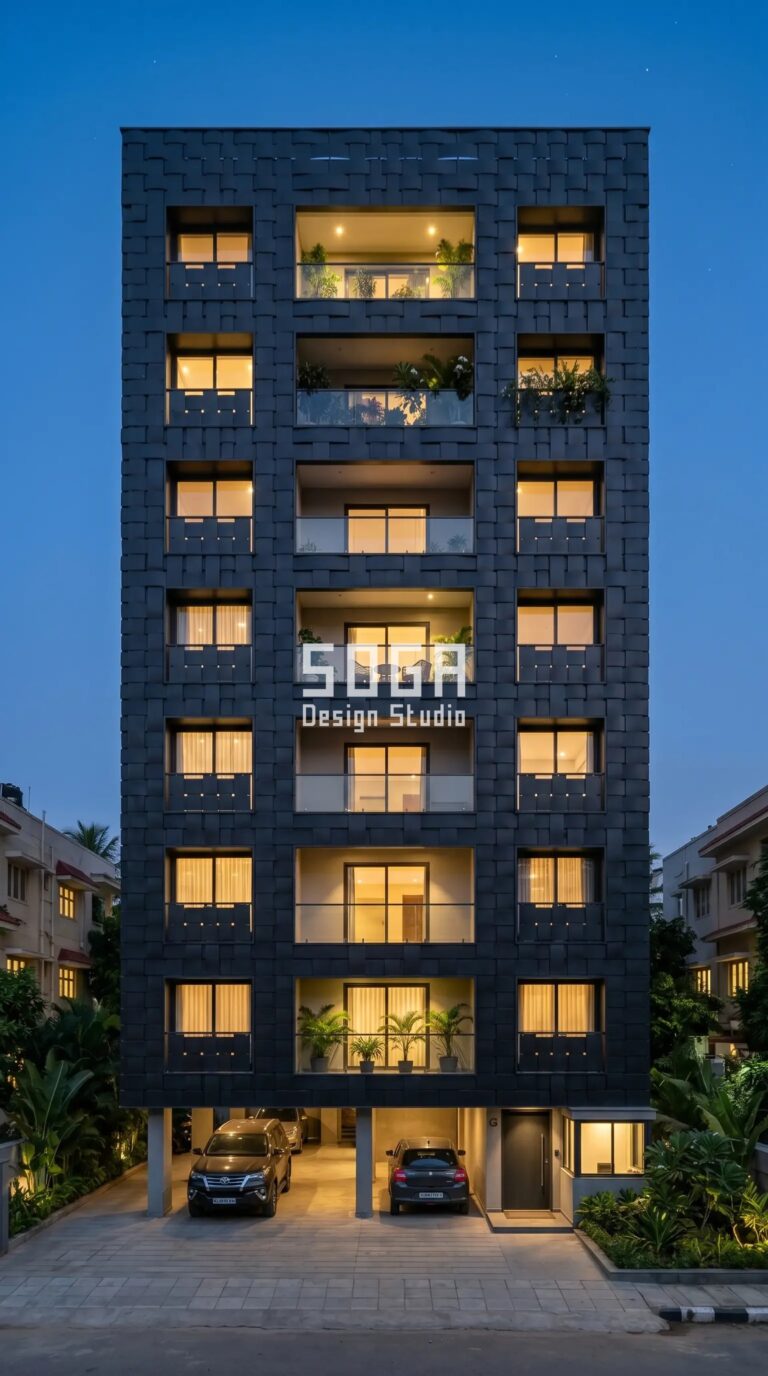
Walk down a Jubilee Hills lane in 2026 and one G+6 will stop you mid-stride – not because it is taller, but because its skin moves. Where its neighbours wear flat sheets of ACP, this one carries a woven metal screen that catches the blue-hour light in a slow, deliberate rhythm. That is the shift quietly reshaping facade design in India: away from cladding chosen by the square foot, toward parametric metal screens engineered panel by panel for one specific plot, one orientation, one climate. This post walks through four such concepts – one for Hyderabad and three from other Indian cities – and, just as importantly, what each one actually costs to build.
Facade Design in India: Why Hyderabad Is Choosing Parametric Metal
Facade design in India has moved from an afterthought to the single most important decision on a residential project. Today, demand for parametric facade design in India is rising fastest in cities such as Hyderabad, Mumbai, Bangalore, Delhi, and Pune, where homeowners and developers want elevations that are both performance-driven and instantly recognisable. SOGA Design Studio specialises in facade design in India — from G+3 individual homes to G+7 residential blocks — pairing algorithmic geometry with matte blackened steel and fabrication-ready detailing. Whether you are comparing metal facade design in India for a new build or a retrofit, the concepts below show how a considered facade redefines a building’s identity and its long-term value.
1. Hyderabad Rattan Weave: Blackened Steel Screen
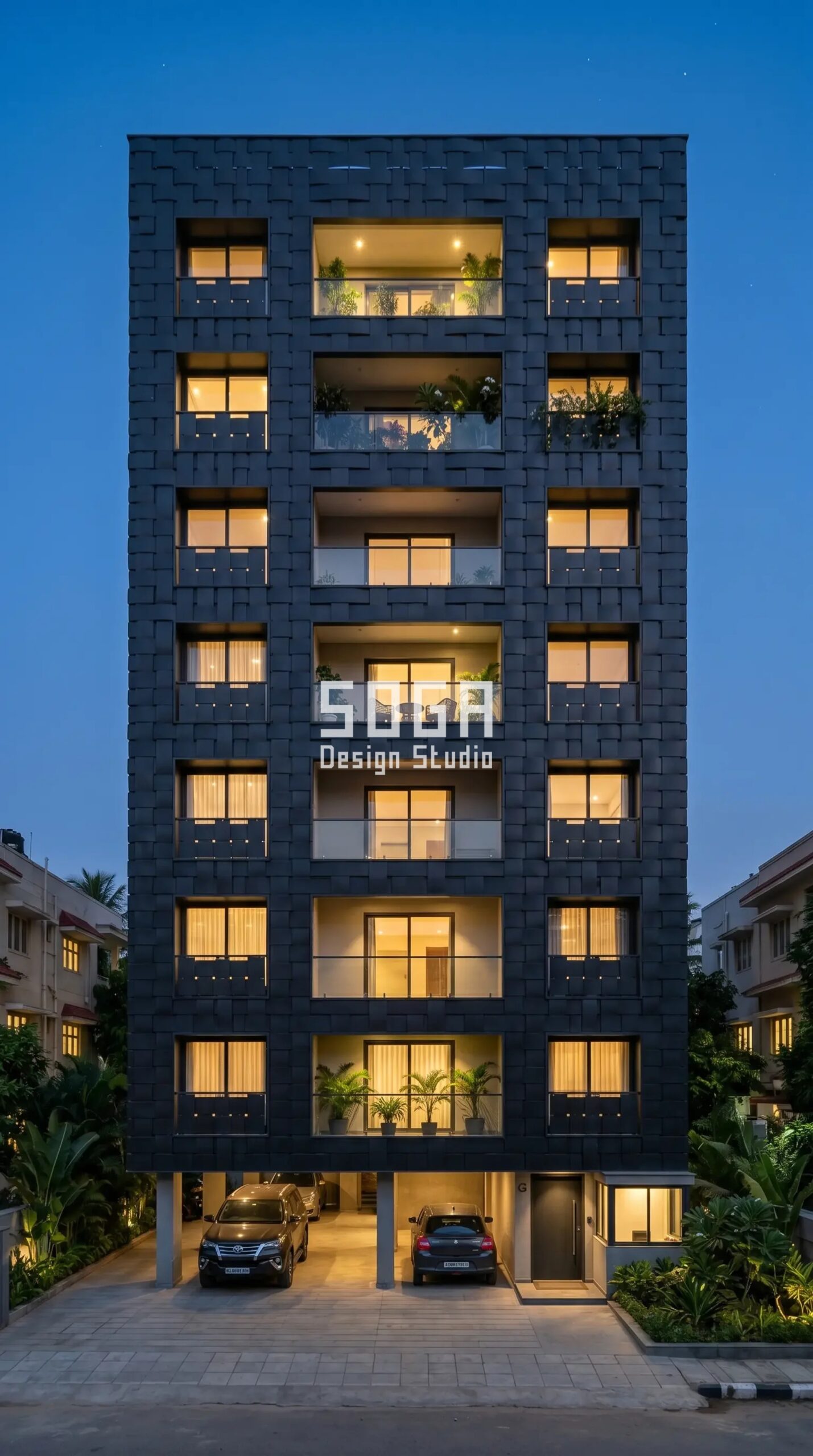
Hyderabad’s premium G+6 plots in Jubilee Hills face a hard western sun and neighbours close enough to see in, so this concept wraps the building in a macro-scale woven basket-weave screen of matte blackened steel. The interlaced bands read as a single sculptural surface from the street, but each opening is sized so the screen filters low evening glare while letting the interiors breathe. At blue hour the warm light leaking between the woven bands turns the whole elevation into a lantern – privacy and drama from the same move. Blackened steel was chosen because the Deccan heat and dust forgive a dark, matte finish far better than a glossy panel. The result is a facade that works hardest exactly when Hyderabad’s sun is most punishing.
2. Vizag Colonnade Screen: Terracotta Metal Facade
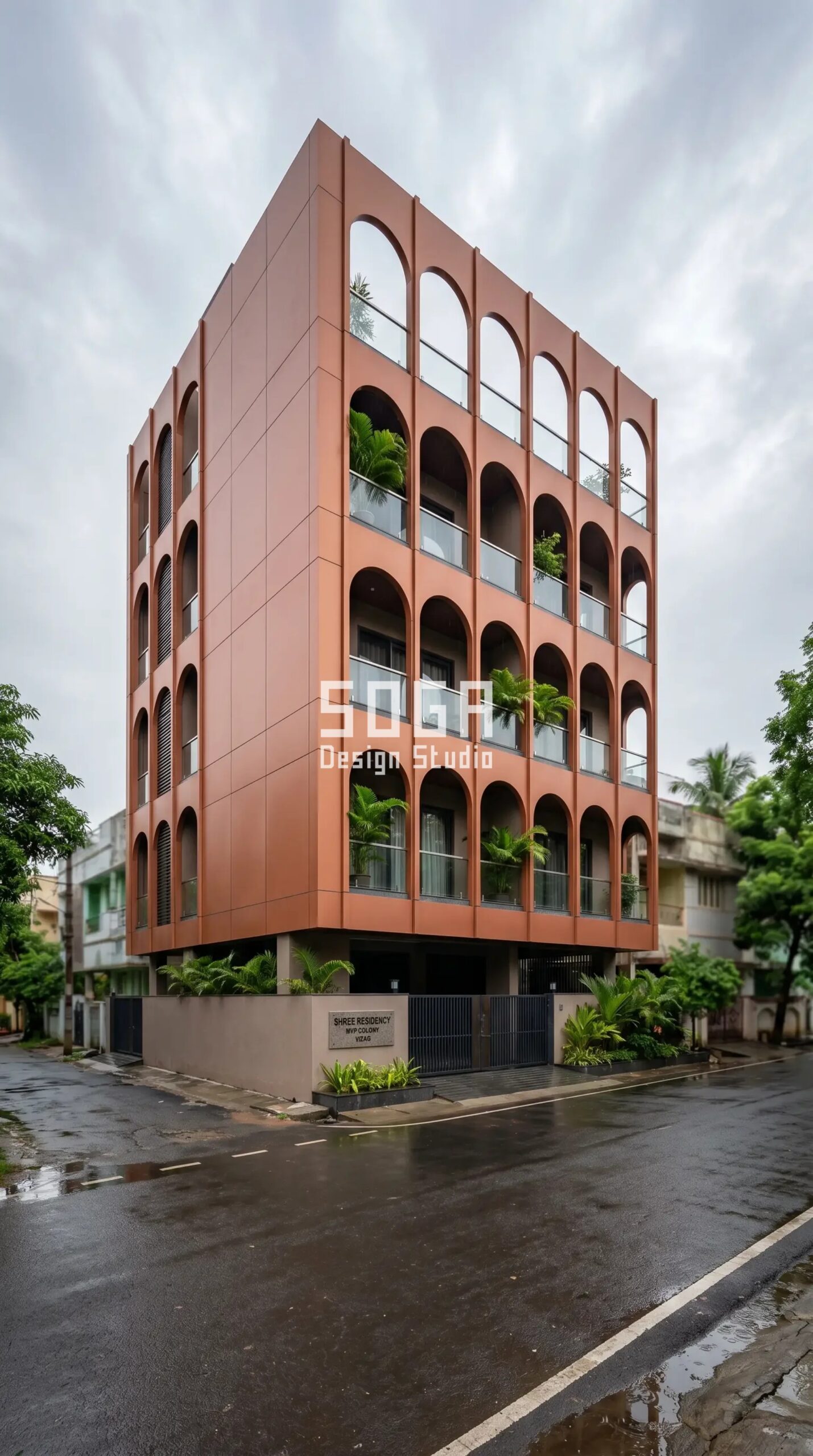
On a coastal G+4 in MVP Colony, the enemies are salt air, monsoon driving rain and humidity – so this concept answers with a full-height arched metal colonnade in warm terracotta-toned composite panels. The arches are not nostalgia; each one is a deep shaded loggia that pushes rain and direct sun off the glass behind it, so balconies stay usable through Vizag’s wet months. The terracotta composite is specified for coastal corrosion resistance, holding its colour where a cheaper coated sheet would chalk and streak within two seasons. Seen across a wet street after rain, the rhythm of arches and their reflections give the building a calm, grounded presence. It is a skin that treats the coast as a design input, not a maintenance problem to discover later.
3. Lucknow Monolith Grid: Cantilever Metal Facade
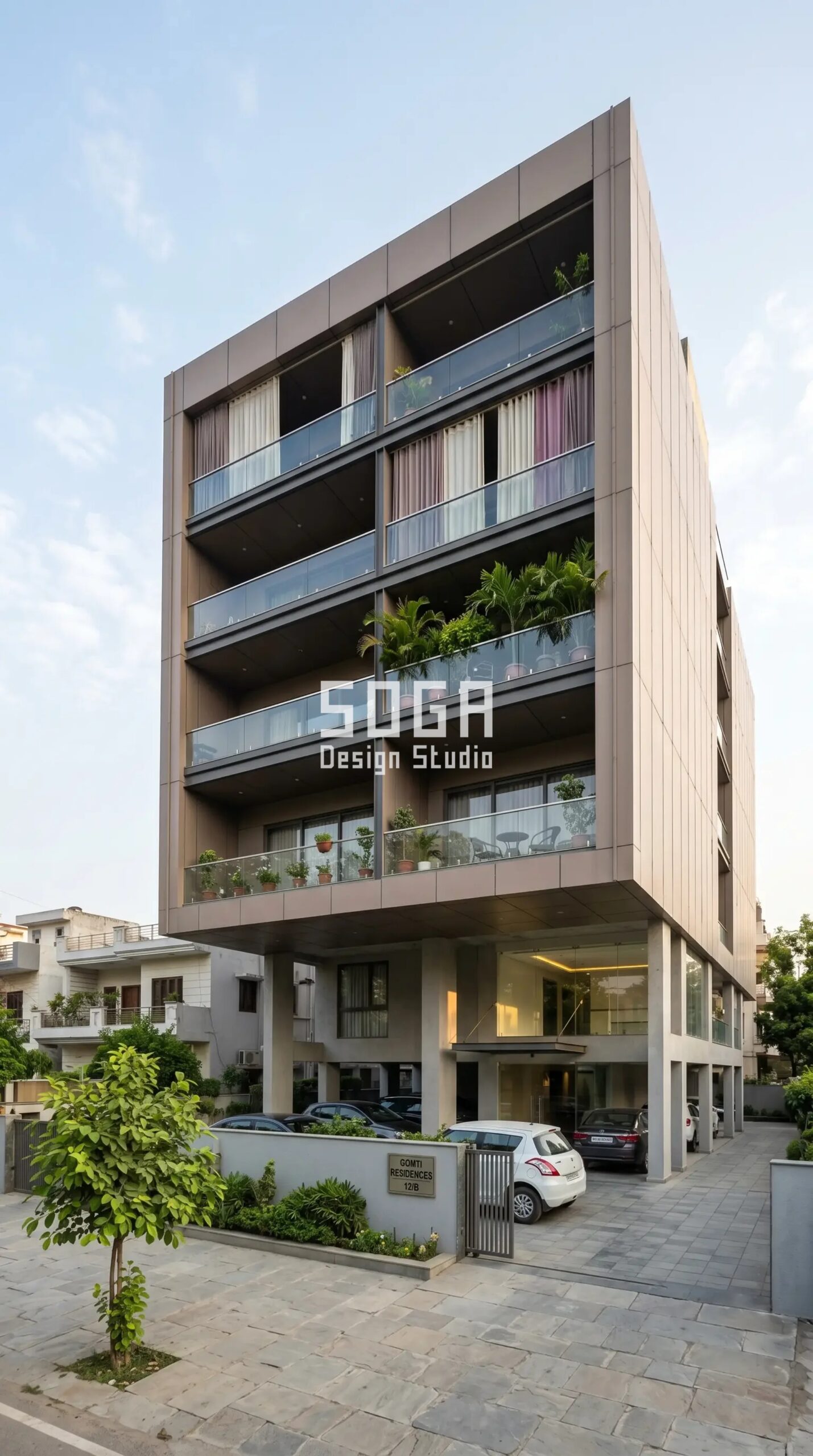
Gomti Nagar plots in Lucknow often come with tight ground-floor setbacks, so this G+5 lifts a massive cantilevered box of metal cladding above open parking, buying back floor area on the upper levels where it matters. The clad volume is finished in matte powder-coated RAL 8025 pale brown steel, a warm neutral that hides the fine dust of a North Indian summer instead of advertising it. Read from the street looking up, the cantilever reads as one clean monolithic mass floating over a glass lobby, which gives the address an unmistakably contemporary signature. The clean module joints and honest fixings keep it looking engineered rather than decorated. For a builder, the payoff is simple: more usable space and a stronger street identity from the same footprint.
4. Mumbai Helix Shell: S-Curve Ribbon Facade
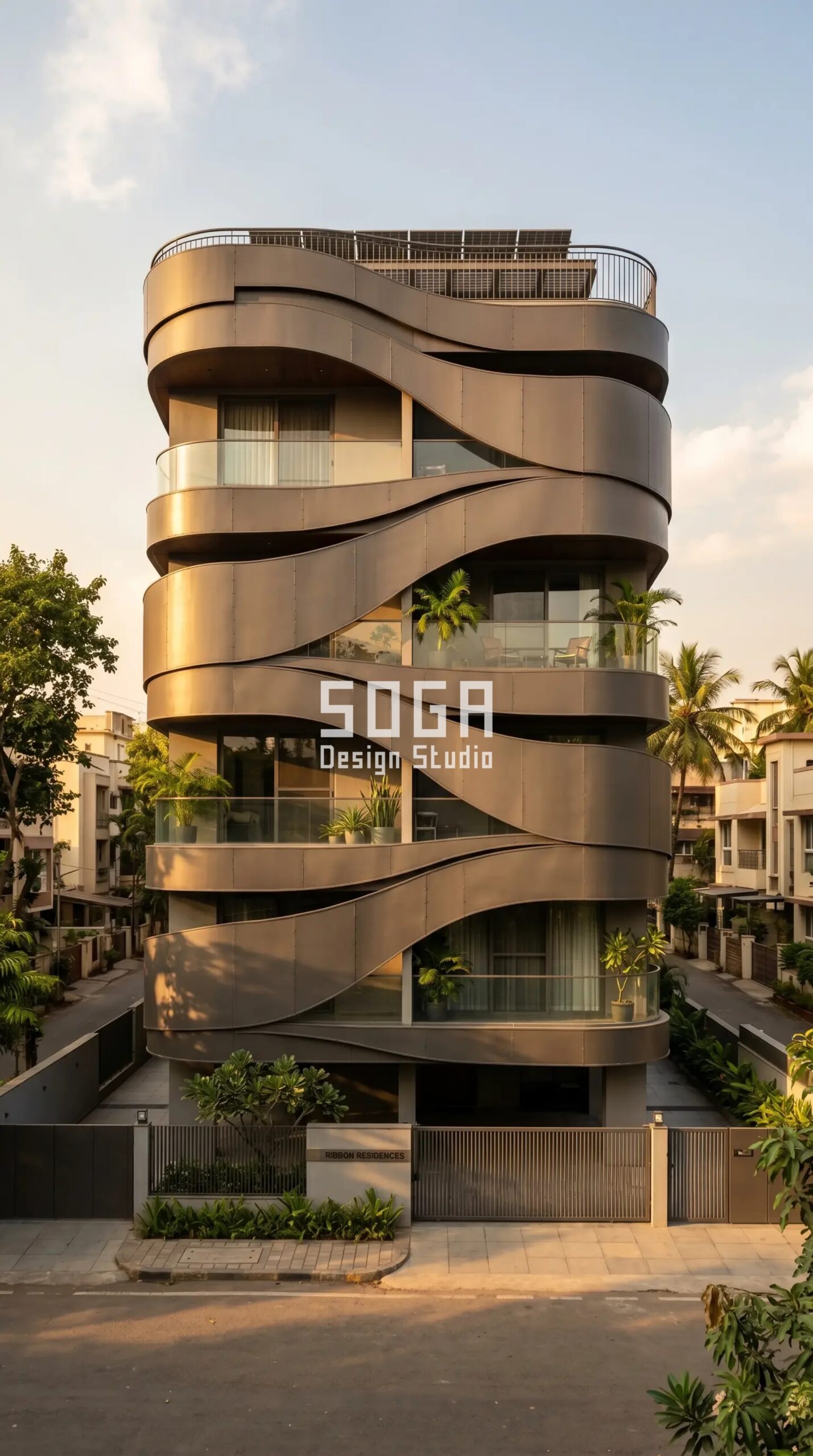
Powai plots in Mumbai are small and overlooked on every side, so this G+3 turns constraint into spectacle with a continuous S-curve ribbon that spirals up across all floors. As the brown-grey RAL 7013 steel bands wind upward they alternately project and recede, carving a private shaded terrace out of each floor without stealing carpet area. In late-afternoon golden light the rolling relief throws long, soft shadows that make a modest three-storey home feel sculptural and bespoke. The powder-coated steel is chosen to shrug off Mumbai’s monsoon, with honest panel seams that age gracefully instead of streaking. It proves the point that the tightest, most ordinary plot can carry the most memorable facade when the geometry does the work.
Cost Benchmarks for Indian Parametric Metal Facades
One of the most-asked questions on a Hyderabad project brief is budget. The current all-in installed rates for parametric metal facades in India sit in the following ranges:
- Steel facade (full design + install): ₹1,200–₹2,800 per sq ft
- Aluminium, anodised or powder-coated: ₹800–₹2,500 per sq ft
- Zinc cladding: ₹1,500–₹3,000 per sq ft
- ACM panels (3 mm basic): ₹200–₹250 per sq ft (basic)
- ACM panels (4 mm): ₹250–₹350 per sq ft
- Solid aluminium panels: ₹800–₹1,800 per sq ft
- Installation labour: ₹50–₹150 per sq ft (varies by height + access)
- Conventional cladding (for comparison): ₹400–₹1,200 per sq ft installed (stone veneer / ceramic / standard ACM)
These figures are baseline; actual project cost depends on facade area, panel complexity, fabricator location, and finish specification. SOGA Design Studio prepares an itemised cost estimate as part of every consultation so the budget conversation starts with hard numbers rather than guesses.
Parametric Facade Design Across India, Dubai & Singapore
Climate is the unspoken brief on every Indian project. Hyderabad, with its specific solar geometry and humidity profile, demands facades that perform — not just facades that look striking. At SOGA Design Studio, every parametric concept is run through climate analysis early: solar radiation per orientation, wind exposure, and monsoon water-shedding paths all feed back into panel angle and perforation density. The concepts you see above already incorporate this layer of analysis for Hyderabad’s sun path; adapting them for Mumbai’s rain, Delhi’s dust, or Bangalore’s milder conditions is part of the standard scope.
Why Trust SOGA Design Studio for Facade Design in Hyderabad
- Experience: SOGA Design Studio designs and visualises parametric metal facades for real Indian G+3 to G+7 residential plots, and has run a daily facade study series since 2023 – the four concepts here come from that ongoing, plot-by-plot practice across Indian cities.
- Expertise: Each concept is built on the SOGA parametric systems, with per-orientation climate analysis (west-sun control in Hyderabad, coastal corrosion in Vizag, dust and heat in Lucknow, monsoon in Mumbai) and fabrication-ready detailing developed with vetted Indian metal fabricators.
- Authority: SOGA positions as India’s facade design specialists, working only from its own engineering studies and built detailing rather than borrowed references – every system shown is one the studio can detail, cost and deliver.
- Trust: We publish real 2026 cost-per-sq-ft ranges, itemised estimates before any commitment, a free no-obligation consultation, and a remote workflow built for NRI clients managing a build from abroad.
Frequently Asked Questions
How much does a parametric metal facade cost in Hyderabad in 2026?
As a 2026 benchmark, aluminium parametric facades run about Rs 800-2,500 per sq ft fully designed and installed, steel screens about Rs 1,200-2,800 per sq ft, and zinc about Rs 1,500-3,000 per sq ft. Basic 4mm ACM cladding is far cheaper at roughly Rs 250-350 per sq ft, but it cannot deliver the depth, sun control or longevity of an engineered metal screen. The final number depends on facade area, system depth, building height and access, so SOGA always issues an itemised estimate rather than a flat rate.
Which metal is best for a facade in the Indian climate?
It depends on the city. Powder-coated aluminium is the all-round workhorse for most Indian plots – light, corrosion-resistant and cost-efficient. Steel suits bold structural screens like Hyderabad’s woven concept, while terracotta-toned composites and zinc earn their premium in coastal, high-corrosion settings like Vizag. The right choice is matched to orientation, distance from the coast and budget, which is exactly what the design stage resolves.
Can a parametric metal facade be retrofitted onto an existing building?
Yes, and it is one of the fastest-growing segments. A lightweight aluminium parametric screen can be mounted on stand-off brackets over existing brick, RCC or tired plaster, transforming a dated elevation without touching the structure behind it. A quick structural check confirms the existing frame can carry the modest added load, after which the screen is fabricated to fit and installed floor by floor.
Is a parametric facade actually buildable or just a render?
It is fully buildable. Every SOGA concept is taken from the parametric model into fabrication-ready shop drawings, with each panel dimensioned, the support system engineered and tolerances coordinated with the fabricator before anything is cut. The studio works with vetted Indian fabricators so the screen you approve on screen is the screen that gets installed.
Why is parametric architecture suited to the Indian climate?
India’s combination of intense sun, monsoon humidity, and dense urban context demands a ‘smart skin’ rather than a static wall. Parametric facades let designers tune perforation density, panel depth, and orientation per building per orientation — cutting solar heat gain by 25–40% while boosting cross-ventilation. The approach also reinterprets centuries-old metal shadow screening for modern G+3 and G+4 buildings.
How long does a powder-coated metal facade last in Indian conditions?
Quality powder-coated aluminium or galvanised steel facades, when correctly detailed and ventilated, last 25–30 years before recoating is needed — even in coastal Mumbai, Chennai, and Kochi. Anodised aluminium and pre-patinated zinc/copper can exceed 40 years. Maintenance is annual rinse-down only; no repainting like traditional plaster facades.
How much heat does a parametric metal facade actually reduce?
Independent studies on Indian residential applications show double-skin parametric metal screen facades reduce direct solar heat gain by 25-40% on west and south orientations, dropping interior surface temperatures by 4-7 deg C compared to bare RCC. The shaded gap also enables passive cross-ventilation. SOGA Design Studio tunes the screen opening density based on each orientation solar load.
Parametric metal facade vs traditional stone or paint — which is better long-term?
Stone is heavy, expensive (₹600–₹1,500 per sq ft just for material), and difficult to repair when chipped. Paint requires repainting every 4–6 years in Indian conditions. A powder-coated parametric metal facade has higher upfront cost but a 25–30 year service life, zero repainting, and far stronger street identity — making total cost of ownership lower over a 20-year horizon. It is also significantly lighter, reducing structural cost on G+3 and above.
What is the typical timeline from design to installed parametric facade?
For a G+3 to G+4 residence: 3 weeks for concept and approval, 4 weeks for fabrication-ready drawings, 6–8 weeks for fabrication, and 3–5 weeks for site installation — total 16–20 weeks from go-ahead to occupancy. Retrofit projects on existing buildings compress this to 10–14 weeks because no structural coordination is needed.
Which RAL colours work best for Indian residential facades?
Three palettes dominate 2026 Indian residential work: warm earthy bronze and corten tones (RAL 8004, 8019) for traditional contexts; deep desaturated blues and greens (RAL 5004, 5011, 6009) for contemporary luxury; and matte charcoal/black (RAL 9005, 7016) paired with brass or copper accents for a graphic urban look. Light cladding with dark frames is the most-searched aesthetic of 2026.
How much does a parametric metal facade cost per square foot in Indore?
Currently, all-in parametric metal facade rates in India range from ₹800–₹2,500 per sq ft for aluminium and ₹1,200–₹2,800 per sq ft for steel, installed. SOGA Design Studio prepares itemised estimates as part of the consultation.
What is a sculptural petal-shaped metal fin facade?
SOGA Design Studio addresses this question in detail during the design consultation. For Hyderabad projects, we provide a fully customised answer based on plot, orientation, and budget — typically within 48 hours of receiving the brief.
Related Reading
- complete guide to parametric facade design in India
- how metal facade cost per sq ft is calculated in India
Start Your Facade Project With SOGA Design Studio
The difference between cladding and a facade is intent: the four concepts here are not patterns chosen by the square foot, they are screens engineered for a specific plot, sun and climate – which is exactly why they outperform a repeated sheet.
Whether you are building new or retrofitting an existing block, SOGA Design Studio can adapt the concepts above to your exact plot and budget. Start the conversation here — consultations are free and no-commitment.