Walk down a quiet Palasia lane in Indore in 2026 and one G+7 stops you mid-step. It is not painted, not clad in the usual stone veneer — its face is a deep grid of warm desert-sand metal, the panels catching the morning light like worked leather. Three hundred kilometres apart, four Indian cities are doing the same thing in four different ways, because facade design in India has quietly stopped being decoration and become climate engineering. This guide walks through four parametric metal facade concepts — one for Indore and three from other Indian cities — what each one solves, and what it costs per square foot today.
Facade Design in India: Why Indore Is Choosing Parametric Metal
Facade design in India has moved from an afterthought to the single most important decision on a residential project. Today, demand for parametric facade design in India is rising fastest in cities such as Indore, Mumbai, Bangalore, Delhi, and Pune, where homeowners and developers want elevations that are both performance-driven and instantly recognisable. SOGA Design Studio specialises in facade design in India — from G+3 individual homes to G+7 residential blocks — pairing algorithmic geometry with matte powder-coated warm desert sand s and fabrication-ready detailing. Whether you are comparing metal facade design in India for a new build or a retrofit, the concepts below show how a considered facade redefines a building’s identity and its long-term value.
1. Indore Parametric Hammered Grid: Warm Steel for the Malwa Sun
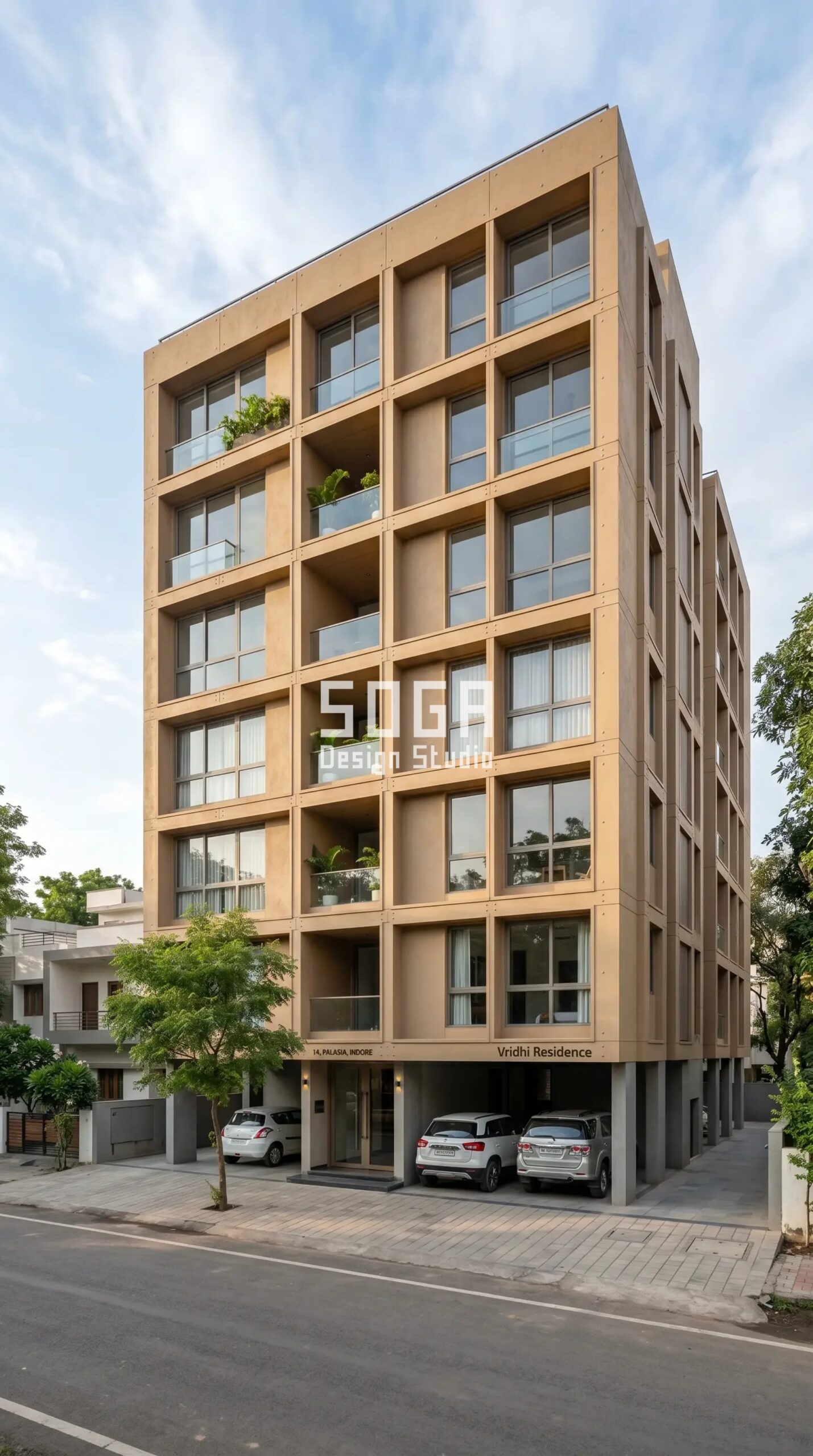
Indore’s Malwa plateau gives long, bright, dust-carrying days, so this G+7 in Palasia answers with a deep grid of large rectangular window punches set into hand-textured, powder-coated desert-sand steel. The recessed openings self-shade the glass behind them, cutting the worst of the mid-morning glare without darkening the rooms. The warm sand tone hides the region’s fine dust far better than a flat white render, so the building still reads clean a year in. Because the panels are a true grid, every flat in the stack gets the same generous window without the elevation turning into a repetitive box. The textured face is what stops it looking like a render — honest seams, real depth, light that grazes rather than bounces. For a builder it is a practical west-and-south facade dressed as a quiet luxury object.
2. Vizag Parametric Basket Weave: A Coastal Skin in Verdigris Copper
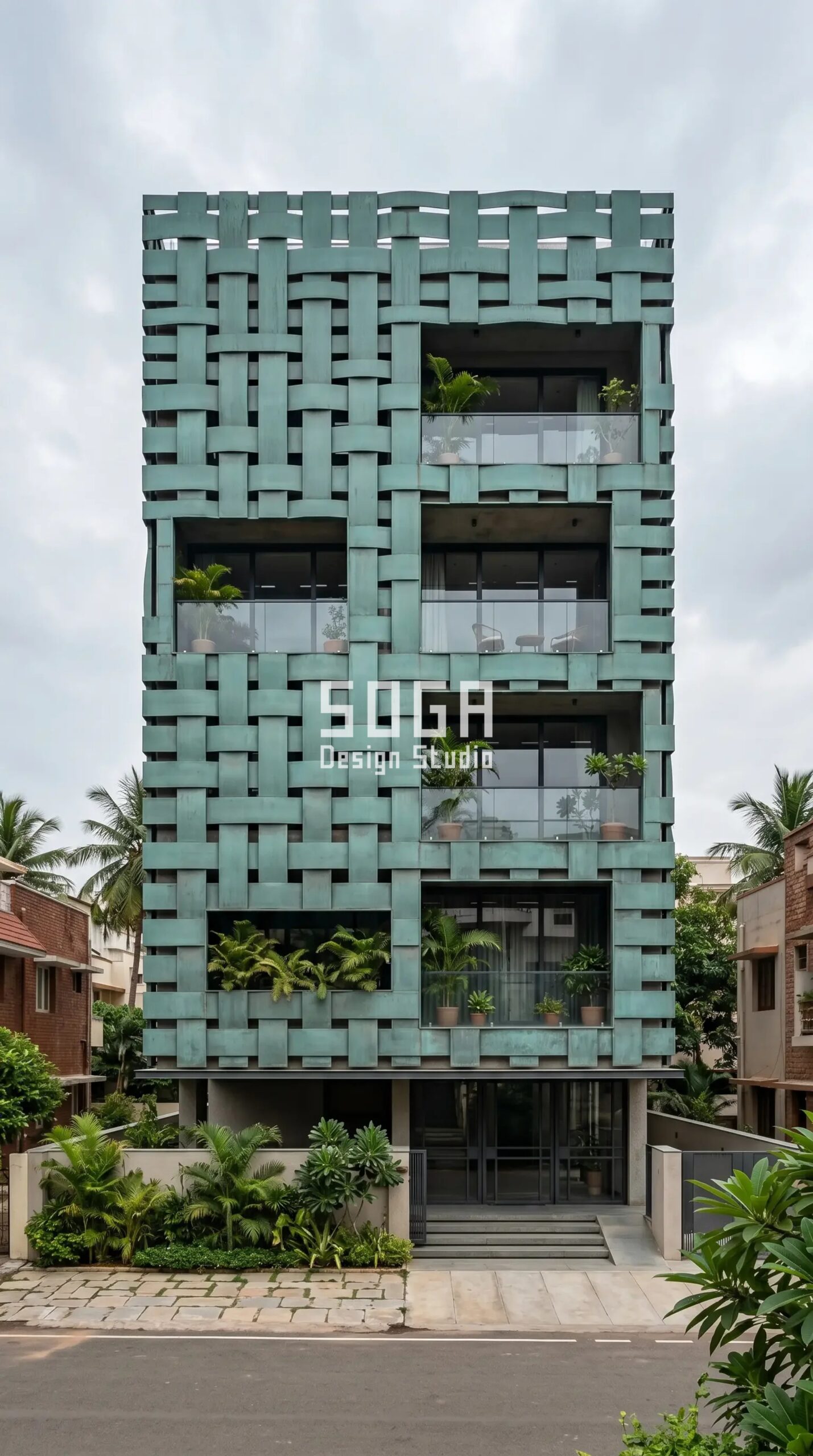
Visakhapatnam sits on the Bay of Bengal, where salt air and overcast monsoon light punish thin claddings and wash out pale colours. This G+5 in MVP Colony answers with a macro-scale basket-weave screen of interlaced verdigris copper-toned metal, woven over a recessed glass wall. The interlocking bands let sea breeze move across the balconies while breaking direct sun and prying sightlines from the street below. The green-blue copper tone is deliberate: it belongs to the coast and only deepens as the air works on it, so the building ages with the place instead of fighting it. Seen from a low street angle the weave reads as genuine craft, not a printed pattern. It is the rare coastal facade that treats humidity and salt as a design brief rather than a maintenance problem.
3. Nagpur Parametric Contour Shell: Curved Bands Against the Vidarbha Heat
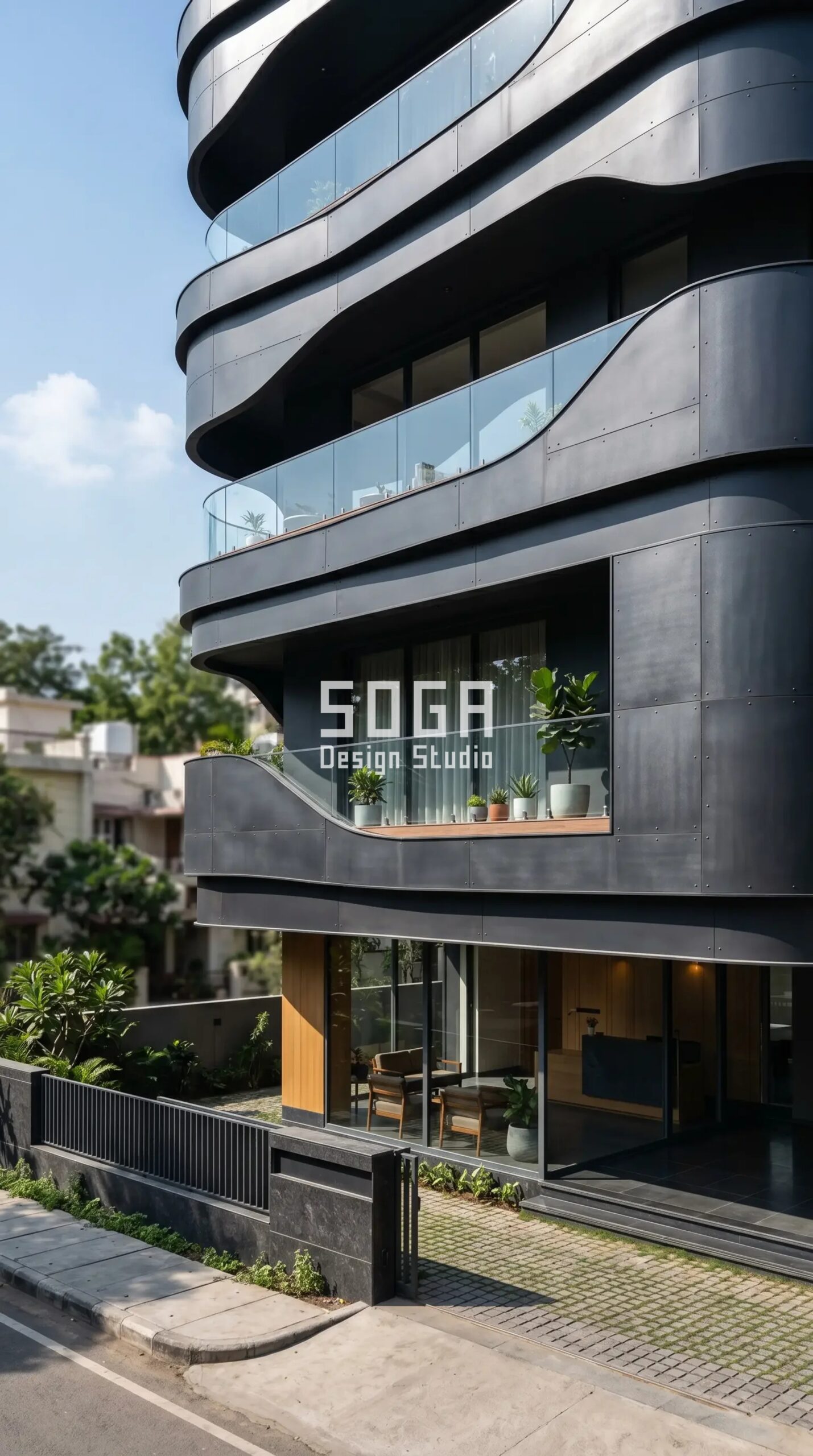
Nagpur’s Vidarbha summers are among the hottest in central India, with a hard, high midday sun. This G+7 in Civil Lines wraps each floor plate in flowing organic curved bands of matte RAL 7021 dark black-grey steel, so the elevation becomes a series of deep horizontal shelves. Those curves are not sculpture for its own sake — each band oversails the floor below, throwing a moving shadow line that keeps the strong noon light off the glass. The dark graphite tone holds its colour under relentless UV where lighter coatings chalk and fade. The rolling relief gives the building a different face every hour as the shadows travel, which is why a tight view of the lower floors already tells the whole story. For a hot, dry city it is shading and identity in one move.
4. Kolkata Parametric Branch Screen: A Corten Tree Against the Eastern Light
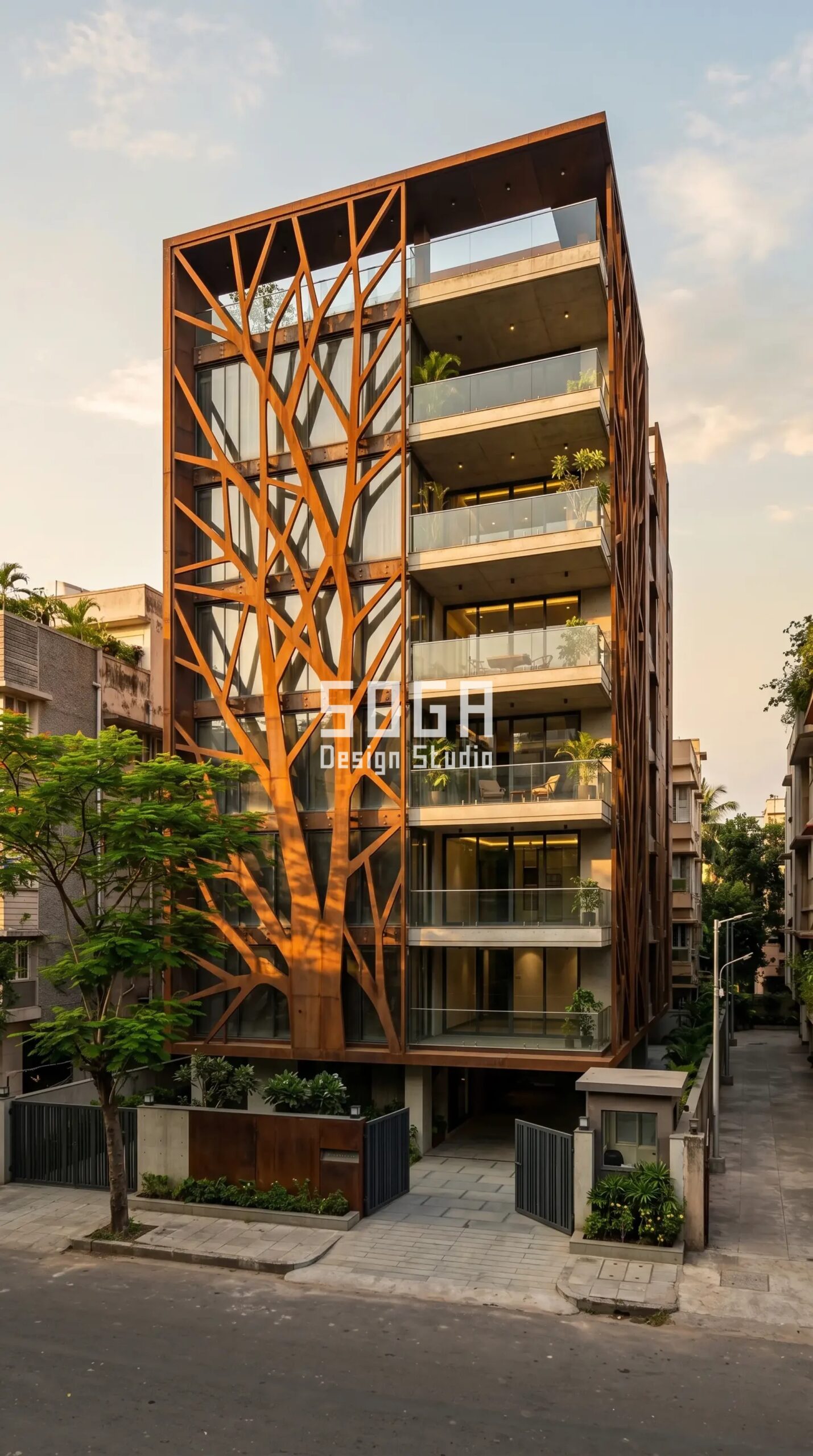
Kolkata’s long, warm, low-angle afternoon light and its love of greenery shape this G+6 in Alipore, where a tree-branch inspired screen in raw Corten steel fronts a recessed glass wall. The branching members are spaced to filter the raking western sun into soft, moving dapple across the rooms — the same effect a real tree gives, engineered to a fixed plot. Corten’s deep rust tone settles into a stable protective skin suited to the humid east, needing no repainting. The organic pattern breaks the flat street elevation and gives privacy to the lower balconies without a solid wall. Caught in golden-hour light the rust glows and the shadows stretch, turning a compact plot into a landmark on its lane. It is proof that a metal facade can feel warm and rooted, not industrial.
Cost Benchmarks for Indian Parametric Metal Facades
One of the most-asked questions on a Indore project brief is budget. The current all-in installed rates for parametric metal facades in India sit in the following ranges:
- Steel facade (full design + install): ₹1,200–₹2,800 per sq ft
- Aluminium, anodised or powder-coated: ₹800–₹2,500 per sq ft
- Zinc cladding: ₹1,500–₹3,000 per sq ft
- ACM panels (3 mm basic): ₹200–₹250 per sq ft (basic)
- ACM panels (4 mm): ₹250–₹350 per sq ft
- Solid aluminium panels: ₹800–₹1,800 per sq ft
- Installation labour: ₹50–₹150 per sq ft (varies by height + access)
- Conventional cladding (for comparison): ₹400–₹1,200 per sq ft installed (stone veneer / ceramic / standard ACM)
These figures are baseline; actual project cost depends on facade area, panel complexity, fabricator location, and finish specification. SOGA Design Studio prepares an itemised cost estimate as part of every consultation so the budget conversation starts with hard numbers rather than guesses.
Parametric Facade Design Across India, Dubai & Singapore
For NRI clients building or renovating in India, SOGA Design Studio runs a complete remote workflow. Clients in Dubai, Singapore, the UK, the US, and Australia routinely commission parametric facades for properties in their hometowns — Coimbatore, Indore, Hyderabad, Pune, and Chandigarh are particularly active corridors. The pipeline is fully virtual: site survey by our local team, design development over weekly video reviews, fabrication-ready drawings shared on cloud storage, and on-site supervision relayed through dated photo updates. NRI projects now make up a growing share of our parametric facade portfolio.
Why Trust SOGA Design Studio for Facade Design in Indore
- Experience: SOGA Design Studio designs and visualises parametric metal facades for real Indian G+3 to G+7 plots, and has run a daily facade study series since 2023 — every concept here is drawn for a specific city, orientation and plot constraint, not a stock template.
- Expertise: Each facade is built on a defined parametric system, per-orientation solar and climate analysis, and fabrication-ready detailing in powder-coated steel, anodised aluminium, copper and Corten with vetted Indian fabricators.
- Authority: SOGA positions as India’s facade design specialists for parametric metal elevations, working across Mumbai, Delhi, Bangalore, Hyderabad, Pune and tier-2 cities like Indore, Vizag and Nagpur, plus NRI clients abroad.
- Trust: We publish real 2026 cost ranges per square foot, give itemised estimates, and offer a free no-commitment consultation with a fully remote workflow for NRI owners — no inflated ‘starting from’ numbers.
Frequently Asked Questions
Is parametric facade design suitable for G+3 to G+7 residential plots?
Yes — parametric metal facades are ideal for G+3 to G+7 homes and boutique residential buildings, which is exactly the scale of all four concepts in this guide. The geometry is tuned to each plot’s setbacks and orientation, so smaller plots gain privacy and shading without losing daylight, while taller stacks get a coherent identity across every floor.
How much heat can a parametric metal screen actually reduce?
A well-designed metal shading screen set in front of the glass intercepts direct sun before it hits the wall, which can noticeably lower surface and indoor temperatures and cut cooling load on west and south faces. The exact figure depends on orientation, screen depth and openness, which is why SOGA models each facade per elevation rather than quoting a single number.
Can NRIs design and build a parametric facade in India remotely?
Yes. SOGA runs a fully remote workflow — site inputs and drawings are shared online, concepts and 3D visuals are reviewed over video, and fabrication is coordinated with vetted Indian fabricators — so NRI owners in the Gulf, Singapore, the UK and elsewhere can design and build a facade in India without travelling for every stage.
How long does a powder-coated metal facade last in Indian conditions?
A properly specified powder-coated steel or aluminium facade is built to last decades in Indian conditions, holding colour and finish through monsoon, heat and dust with minimal upkeep. Coastal cities like Vizag use marine-grade coatings, while Corten and copper develop a stable protective surface that needs no repainting at all.
How is AI changing facade design in India in 2026?
AI is now a routine input at the concept stage: generative tools propose dozens of parametric variations from a single brief, and computational performance simulators predict heat gain, daylight, and material cost before any drawing is finalised. SOGA Design Studio uses AI-assisted visualisation to accelerate the concept phase from 4 weeks to 4 days, while the engineering and fabrication detailing remain human-led.
What is parametric facade design?
Parametric facade design uses algorithmic rules — light, climate, orientation, and structural parameters — to generate a building skin where every panel is mathematically calibrated. The result is a facade that performs (heat control, ventilation, daylighting) while expressing a unique sculptural identity. It is the direct computational descendant of traditional Indian metal screens.
How much does a parametric metal facade cost in India 2026?
Aluminium parametric facades range ₹800–₹2,500 per sq ft (full design + install), steel ₹1,200–₹2,800 per sq ft, and zinc ₹1,500–₹3,000 per sq ft. Basic ACM cladding (3–4 mm) starts at ₹200–₹350 per sq ft; solid aluminium panels run ₹400–₹600 per sq ft. Installation labor adds ₹50–₹150 per sq ft depending on building height. SOGA Design Studio provides itemised cost estimates as part of every consultation.
What is the typical timeline from design to installed parametric facade?
For a G+3 to G+4 residence: 3 weeks for concept and approval, 4 weeks for fabrication-ready drawings, 6–8 weeks for fabrication, and 3–5 weeks for site installation — total 16–20 weeks from go-ahead to occupancy. Retrofit projects on existing buildings compress this to 10–14 weeks because no structural coordination is needed.
What is a kinetic facade and is it practical for Indian residences?
A kinetic facade has moving panels — louvres, rotating fins, or actuated screens — that respond to sun angle, occupancy, or wind. For mid-rise Indian residences, the practical version is ‘pseudo-kinetic’: a static parametric pattern that creates the visual illusion of motion as the sun tracks across it. True actuated kinetic systems are typically reserved for premium G+10 and above commercial buildings.
Parametric metal facade vs traditional stone or paint — which is better long-term?
Stone is heavy, expensive (₹600–₹1,500 per sq ft just for material), and difficult to repair when chipped. Paint requires repainting every 4–6 years in Indian conditions. A powder-coated parametric metal facade has higher upfront cost but a 25–30 year service life, zero repainting, and far stronger street identity — making total cost of ownership lower over a 20-year horizon. It is also significantly lighter, reducing structural cost on G+3 and above.
What is a sculptural petal-shaped metal fin facade?
SOGA Design Studio addresses this question in detail during the design consultation. For Indore projects, we provide a fully customised answer based on plot, orientation, and budget — typically within 48 hours of receiving the brief.
Related Reading
- our Mumbai facade design guide
- the Kochi metal facade guide
- Sculptural Petal-Shaped Metal Fin Facades: Indore Architecture Guide 2026
Start Your Facade Project With SOGA Design Studio
One studio, four cities, four climates — and four completely different metal facades, because the right elevation is the one your weather and your plot ask for.
If any of the large rectangular window punches su concepts above resonate with your project, send us your brief. SOGA Design Studio delivers customised parametric facade concepts for India, Dubai, Singapore, and the UK.