HITEC City, Gachibowli, and the Financial District in Hyderabad house over 1,400 technology and BFSI companies and approximately 580,000 IT professionals — making this corridor India’s most concentrated technology employment belt after Bengaluru’s Outer Ring Road. Corporate campus and IT park facade design in this context is a strategic business decision: the buildings that attract and retain top talent in 2026 are those that signal innovation through architecture, deliver superior indoor environmental quality, and demonstrate ESG credibility through measurable sustainability features.
What IT Companies Want from Their Building Facades in 2026
Surveys of 200+ technology companies across HITEC City conducted by Hyderabad’s CREDAI chapter in 2024 identified four facade attributes that influence leasing decisions: biophilic elements visible from the exterior (green walls, planting integrated into facade systems) — cited by 68% of respondents; daylight quality inside the building, driven by glazing ratio and solar control on the facade — cited by 72%; visible sustainability markers (solar panels, rain screen ventilation) — cited by 61%; and building identity / street presence, meaning the facade must be identifiable and photographable for employer branding — cited by 58%. These are now the brief for every serious IT park facade project in Hyderabad.
Facade Design Strategies for Hyderabad IT Parks 2026
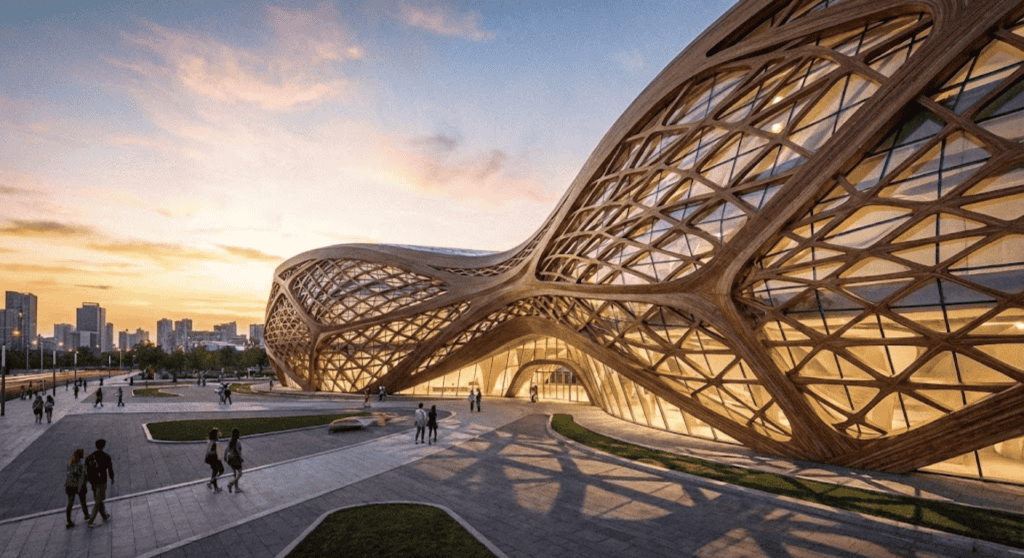
Three facade typologies dominate Hyderabad’s IT corridor in 2026: high-performance curtain wall with integral sun shading — aluminium-framed double-skin or single-skin with external blade screen, optimised for Hyderabad’s semi-arid climate where solar radiation exceeds 5.5 kWh/m²/day for 9 months of the year; parametric aluminium screen facades — custom-designed CNC-cut or extruded aluminium panels in geometric or organic patterns, providing solar control while creating a distinctive building identity; and biophilic facade systems — planter boxes, vertical garden modules, or green wall frames integrated into the facade cladding system, addressing the tenant preference for visible greenery without sacrificing weather protection.
Hyderabad’s Climate and What It Means for Facade Specification
Hyderabad’s climate is hot semi-arid (BSh), with summer peaks of 42°C (April–May), a 700mm annual rainfall concentrated in July–September, and a dry, dust-laden period from February through May. Unlike Mumbai, there is no salt-air corrosion risk — standard 6063-T5 aluminium with PVDF or polyester powder coat performs adequately. Unlike Delhi, the temperature range is narrower (5°C winter minimum vs 2°C in Delhi) — so thermal expansion detailing is less critical. Hyderabad’s primary facade challenge is solar gain: the city sits at latitude 17°N with clear-sky days 250+ days per year, meaning south and west facades receive intense solar radiation for most of the year. External solar shading on south and west elevations is not optional — it is essential for a 5-star BEE-rated building.
HITEC City vs Gachibowli vs Financial District: Design Context
HITEC City (Phase 1 and 2) contains older building stock from 1998–2012, much of which is now undergoing facade renovation to compete with newer Financial District developments. Typical floor plates are 25,000–40,000 sqft, building heights G+8 to G+14. The corridor’s mature tree canopy and Cyberabad lakes create a landscape context that rewards facades with natural-tone palettes — muted aluminium in warm silver, champagne, or sand tones read better than chrome or highly reflective finishes that create glare onto adjacent roads. The Financial District (Nanakramguda) and Gachibowli are newer stock, G+15 to G+30, and carry a more international corporate aesthetic — glass-dominant curtain wall with aluminium sun-shading blade screens.
Campus vs Single-Building Facades: Different Design Approaches
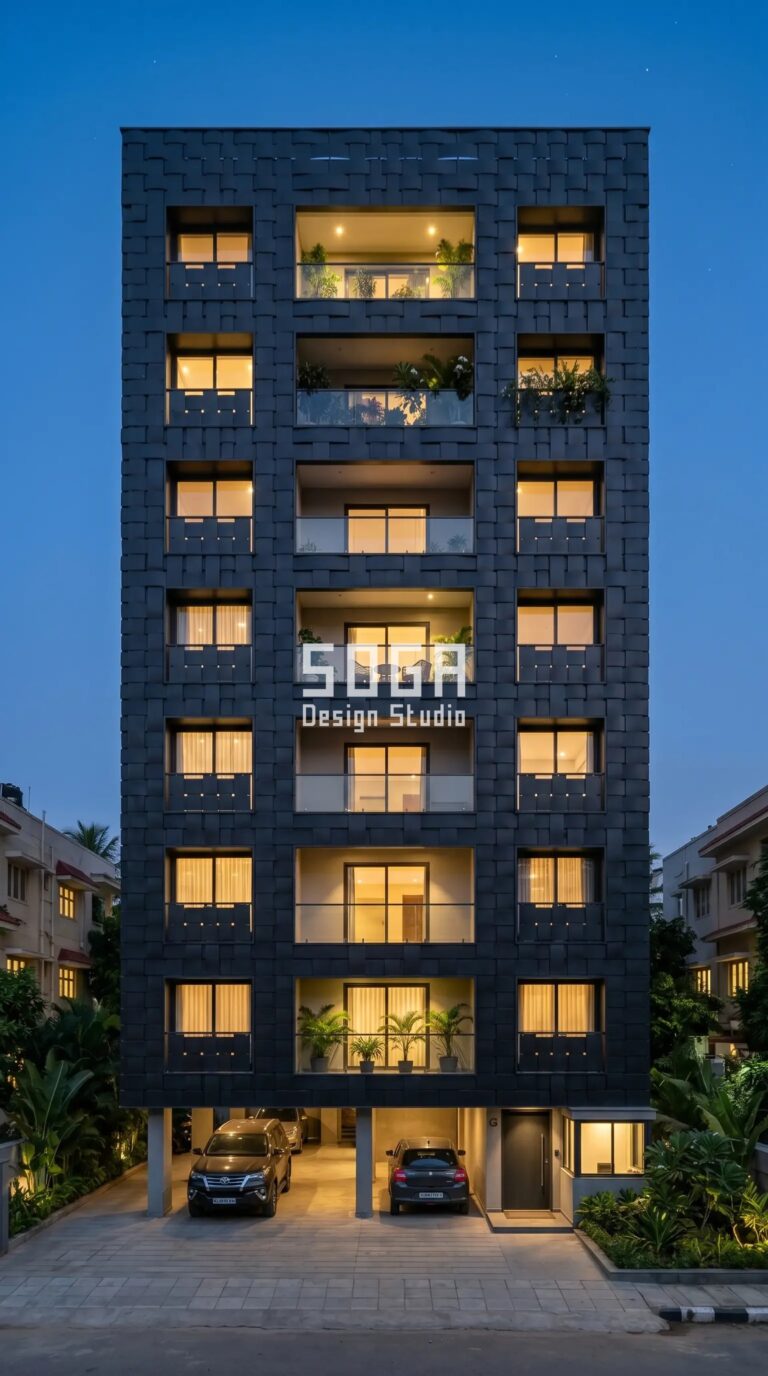
IT campuses (multiple blocks, shared landscape) benefit from a cohesive facade design language — one material palette, one geometric system, varied compositionally across individual blocks. Infosys Hyderabad campus, Amazon’s Hyderabad development, and Google’s planned campus all use this approach. Single-building IT park towers in HITEC City and Gachibowli, competing for individual visibility on a busy arterial road, need strong individual identity — a distinctive facade colour, an unusual geometry, or a biophilic feature that creates an instantly recognisable building. SOGA Design Studio designs both campus systems and standalone building identities for Hyderabad’s IT corridor.
Cost Guide: IT Park Facade Design Hyderabad 2026
Grade A IT park facades in Hyderabad’s HITEC City–Gachibowli–Financial District corridor range from ₹1,100 to ₹3,200/sqft installed depending on specification tier. Standard aluminium curtain wall with external blade screen shading: ₹1,100–1,500/sqft. Premium parametric aluminium screen facade with bespoke CNC pattern: ₹1,400–2,000/sqft. High-performance double-skin facade with integrated biophilic system: ₹2,200–3,200/sqft. Total facade package for a typical 1.5 lakh sqft IT park tower: ₹16.5–48 crore. Green building certification via IGBC Gold/Platinum or LEED Gold, typically achievable with the right facade specification, adds 10–18% rental premium in Hyderabad’s Grade A market.
Frequently Asked Questions: IT Park Facade Design Hyderabad
What facade type gets the best IGBC or LEED rating in Hyderabad?
A thermally broken aluminium curtain wall with external horizontal blade screen on south and west elevations, combined with low-e IGU glazing (SHGC 0.25–0.30) and opaque spandrel panels with 80mm PIR insulation, typically achieves Fenestration Performance Index sufficient for IGBC Gold. Adding a biophilic element (green wall or planter boxes) and photovoltaic panels on east-facing spandrels can push to Platinum.
How do IT companies in Hyderabad use building facades for employer branding?
Several HITEC City companies have made their building facade the centrepiece of recruitment marketing — especially for campus hires from Hyderabad universities. A distinctive parametric screen, a green wall with the company logo spelled in planting, or a sculptural canopy entry sequence creates instantly shareable content for social media that doubles as employer brand signalling. SOGA Design Studio has designed facade elements specifically for this purpose for Hyderabad IT clients.
Design Your Hyderabad IT Park Facade with SOGA Design Studio
SOGA Design Studio has designed corporate campus facades and standalone IT park towers across Hyderabad’s HITEC City, Gachibowli, and Financial District. Our parametric design process creates building identities that meet IGBC targets, deliver measurable energy savings, and give technology companies an exterior that reflects their brand. Contact us at sogadesignstudio.com to begin.