SOGA Design Studio Creates Brass Facade Masterpiece with CNC-Cut Lotus Motifs in Mysuru
In the culturally rich city of Mysuru (Mysore), Karnataka, where royal heritage meets contemporary aspirations, Padmaja Regal Jewellery emerges as an architectural landmark that seamlessly blends traditional symbolism with cutting-edge parametric design. Created by SOGA Design Studio, India’s leading parametric facade company specializing in computational design across India and Dubai, this project showcases how CNC-cut brass lotus motifs can transform jewelry retail architecture into cultural storytelling.
Lotus Motifs: Sacred Geometry Meets Parametric Precision
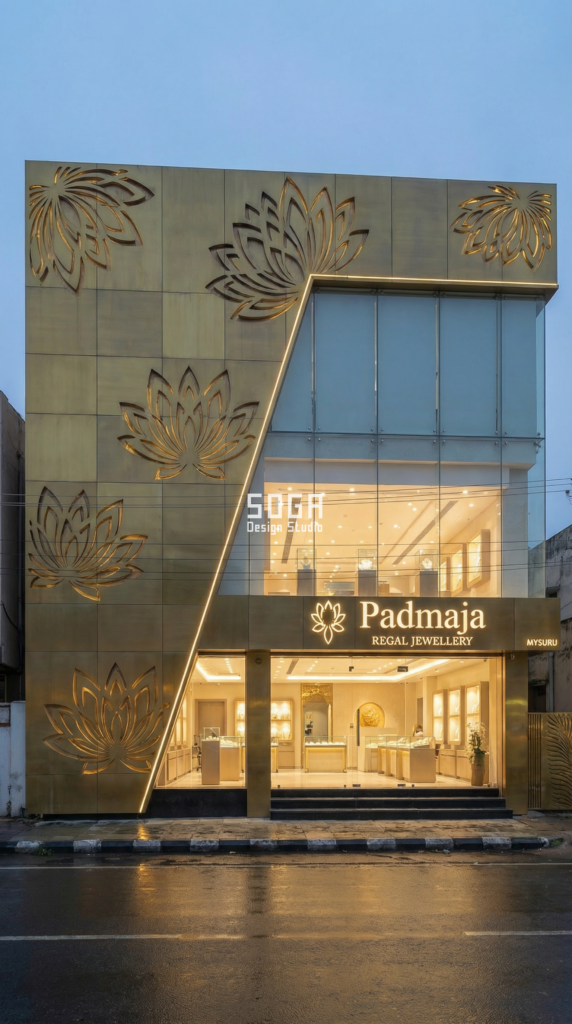
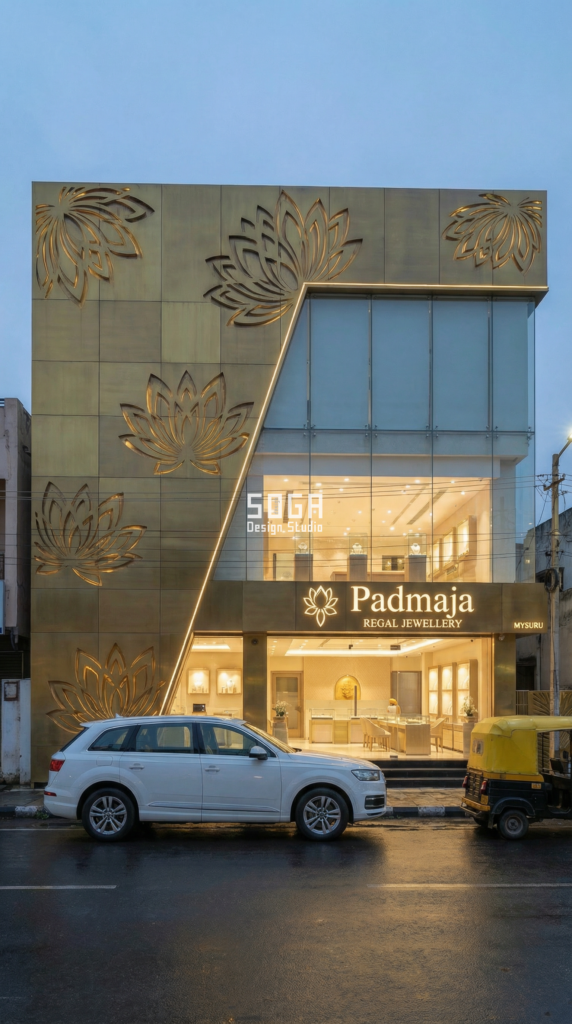
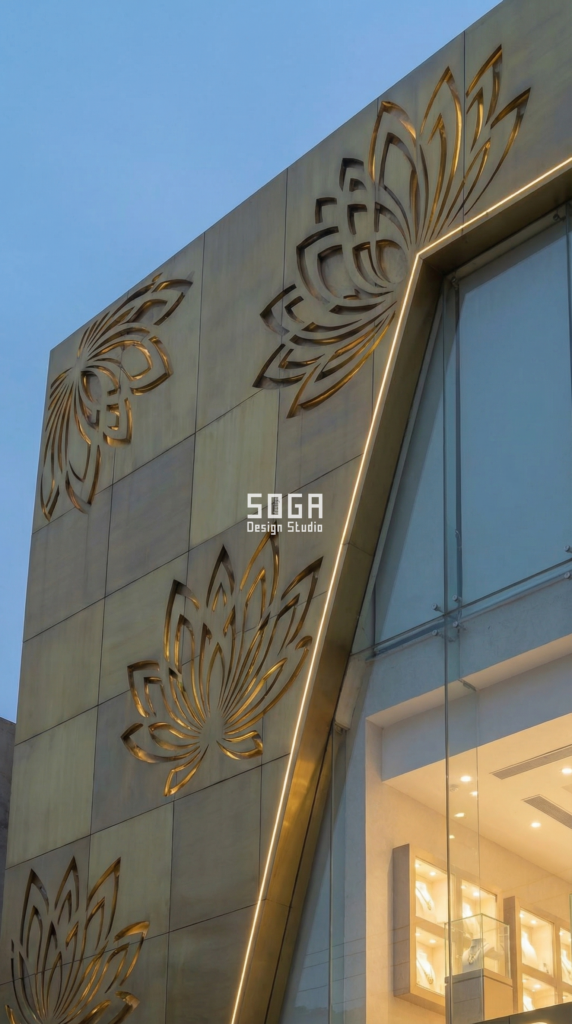
The defining feature of Padmaja Regal Jewellery is its stunning parametric lotus facade—a brass-finished surface adorned with multiple large-scale CNC-cut lotus flower patterns that create a dialogue between India’s sacred symbolism and contemporary design technology.
The Lotus: Cultural Symbolism in Parametric Form
The lotus (Padma in Sanskrit) holds profound significance in Indian culture, representing purity, prosperity, spiritual awakening, and divine beauty. SOGA Design Studio’s parametric interpretation brings this ancient symbol into contemporary architectural expression:
Multiple Scales: The facade features lotus motifs in varying sizes—from large dominant flowers to smaller accent blooms. This scale variation creates visual hierarchy and depth, ensuring the pattern remains engaging from both distant street views and close pedestrian encounters.
Geometric Precision: Each lotus is parametrically designed with mathematically perfect petal curves, radial symmetry, and proportional relationships. This precision elevates the traditional motif beyond decorative application into sophisticated geometric art.
Three-Dimensional Relief: The lotus patterns aren’t merely surface graphics—they’re deeply cut into the brass panels, creating substantial shadows that emphasize the three-dimensional sculptural quality. The depth of these cuts changes throughout the day as sun angles shift, making the facade a dynamic architectural sundial.
Strategic Composition: The lotus motifs are parametrically positioned across the facade in a carefully orchestrated composition. Some flowers are complete, others are partially cropped by panel edges, creating visual tension and suggesting infinite extension beyond the building’s boundaries.
Integrated Lighting: LED edge lighting is integrated within the lotus cutouts, transforming the facade at night into a glowing constellation of illuminated blooms. This day-to-night transformation ensures the building maintains architectural presence around the clock.
Brass Finish: Warmth, Luxury, and Heritage
The choice of brass finish for the lotus facade carries multiple layers of significance:
Cultural Resonance: Brass has been used in Indian temple architecture, traditional jewelry, and decorative arts for millennia. Using brass connects Padmaja Regal Jewellery to this deep cultural heritage while expressing it through contemporary parametric design.
Warm Golden Glow: The brass finish creates a warm, golden appearance that directly references the precious metals and jewelry sold within. This visual connection between building material and merchandise reinforces brand identity.
Aging Patina: Quality brass develops a beautiful patina over time, gradually darkening and gaining character. This aging process adds depth and richness, ensuring the facade becomes more distinguished as years pass.
Light Interaction: Brass’s reflective properties capture and modulate sunlight throughout the day. Morning and evening light create particularly dramatic effects, making the lotus flowers appear to glow from within.
Premium Positioning: Brass communicates luxury, craftsmanship, and quality—essential associations for a high-end jewelry retailer where perceived value directly influences purchase decisions.
The Diagonal Line: Dynamic Geometry
A striking diagonal line—illuminated with LED edge lighting—cuts across the facade, creating dynamic energy and visual movement:
Compositional Tension: The diagonal disrupts the facade’s orthogonal geometry, creating visual tension that makes the design more dynamic and less static.
Wayfinding Element: The illuminated diagonal guides the eye toward the entrance, subtly directing foot traffic and creating clear visual hierarchy.
Modern Counterpoint: While the lotus motifs reference traditional Indian symbolism, the diagonal line introduces contemporary geometric abstraction, balancing heritage with modernity.
Night Transformation: After sunset, the illuminated diagonal becomes the facade’s dominant feature, transforming the building’s nighttime identity and ensuring visibility in Mysuru’s commercial streetscape.
SOGA Design Studio: Parametric Design Excellence in Heritage Context
Padmaja Regal Jewellery demonstrates SOGA Design Studio’s unique capability to apply parametric design methodologies while respecting cultural context and heritage sensibilities:
Computational Design for Cultural Motifs
Creating the lotus facade required sophisticated computational design processes:
Lotus Parametrization: Each lotus flower was parametrically modeled with adjustable parameters controlling petal count, petal width, petal curvature, center size, and overall scale. This parametric flexibility enabled rapid exploration of different lotus interpretations before selecting the optimal design.
Pattern Distribution Algorithm: Rather than manually positioning each lotus, our team developed parametric algorithms that distributed the flowers across the facade based on rules considering visual balance, structural constraints, and compositional rhythm. The algorithm generated dozens of layout options, from which we selected the most compelling.
Scale Variation: Parametric tools controlled the scaling of lotus motifs across the facade. Larger flowers anchor key compositional areas while smaller blooms fill supporting zones, creating visual hierarchy through algorithmic size distribution.
Edge Condition Handling: The algorithm intelligently managed lotus flowers that intersect panel edges, determining whether to crop them cleanly, wrap them to adjacent panels, or slightly adjust their position. This edge handling prevents awkward compositional moments.
Structural Integration: Each CNC-cut lotus removes material from the brass panels, affecting structural performance. Parametric structural analysis ensured that despite the extensive perforations, panels maintain adequate strength to resist wind loads and support their own weight.
CNC Fabrication Precision
The lotus patterns were realized through advanced CNC (Computer Numerically Controlled) cutting:
Digital to Physical: Digital files derived directly from the parametric model controlled CNC plasma or waterjet cutting equipment, ensuring that every petal curve matches the design intent precisely.
Complex Geometry: The lotus patterns include intricate interior details—veining within petals, small accent cuts, subtle curves—that would be nearly impossible to fabricate accurately using traditional methods. CNC technology makes this complexity practical and economical.
Consistency Across Panels: CNC cutting ensures perfect consistency. Every repeated lotus motif is identical within manufacturing tolerances measured in fractions of millimeters, maintaining pattern integrity across the entire facade.
Material Efficiency: The parametric model optimized the nesting of lotus patterns on raw brass sheets, minimizing waste material. This optimization reduced brass consumption by approximately 15-20% compared to non-optimized layouts.
Edge Quality: CNC cutting produces clean, precise edges that require minimal finishing. The quality of these cut edges is critical given that they’re highlighted by integrated lighting at night.
Mysuru Context: Innovation in India’s Heritage City
Mysuru, Karnataka’s cultural capital known for its royal palaces, silk sarees, sandalwood, and educational institutions, presents unique contextual challenges and opportunities:
Respecting Heritage While Innovating
Cultural Sensitivity: In a city deeply connected to its heritage, contemporary architecture must respect traditional values while offering fresh expression. The lotus motif choice demonstrates this sensitivity—using a universally recognized Indian symbol expressed through parametric precision.
Royal Associations: Mysuru’s identity is inseparably linked to its Maharaja’s Palace and royal heritage. The brass finish and lotus symbolism create subtle associations with royal patronage and luxury appropriate to this context.
Tourist Destination: Mysuru attracts millions of domestic and international tourists annually. The distinctive lotus facade creates a photogenic landmark that enhances the city’s architectural landscape while supporting tourism marketing.
Commercial Vitality: Despite its heritage character, Mysuru is a thriving commercial center. Padmaja Regal Jewellery demonstrates that contemporary retail architecture can achieve business objectives while respecting cultural context.
Setting New Standards for Karnataka Architecture
Parametric Pioneer: The project brings world-class parametric facade design to Karnataka’s heritage context, demonstrating that computational design methodologies can enhance rather than conflict with traditional sensibilities.
Local Fabrication: The brass panels were fabricated using Karnataka’s metal fabrication capabilities, demonstrating that local industry can execute sophisticated parametric designs when provided with digital tools and technical support.
Architectural Evolution: The project shows how Mysuru’s architecture can evolve—maintaining cultural continuity through symbolic elements while adopting contemporary design methodologies and technologies.
Performance-Driven Parametric Design
Beyond its cultural and aesthetic dimensions, the lotus facade delivers measurable performance benefits:
Solar Shading and Thermal Comfort
Perforation Benefits: The extensive lotus cutouts create effective solar shading while allowing daylight penetration. The brass panels block direct sun while the perforations admit diffused light, balancing daylight availability with heat gain control.
Heat Gain Reduction: The brass facade reduces solar heat gain by approximately 35-40% compared to conventional glazing, significantly decreasing air conditioning loads in Karnataka’s tropical climate.
Thermal Mass: The brass panels have minimal thermal mass compared to stone or concrete, preventing heat storage that would radiate into occupied spaces during evening hours.
Natural Ventilation: During Mysuru’s cooler months, the perforated facade enables natural ventilation through operable windows behind the brass screen, reducing mechanical cooling requirements.
Visual Comfort and Daylighting
Glare Control: The brass screen interrupts direct sun penetration that would otherwise create glare on jewelry displays and visual discomfort for customers—critical in retail environments where visual comfort affects sales.
Light Diffusion: The lotus perforations create filtered, diffused light that flatters jewelry displays, making precious metals and gemstones sparkle attractively without harsh glare.
Shadow Patterns: Throughout the day, the three-dimensional lotus cutouts cast beautiful shadow patterns on interior surfaces, creating dynamic interior environments that change with time and season.
Brand Identity Through Lotus Symbolism
The parametric lotus facade serves powerful branding functions for Padmaja Regal Jewellery:
Name-Architecture Alignment
Padmaja = Lotus: “Padmaja” literally means “born from lotus” in Sanskrit. The facade makes this connection explicit and unforgettable, ensuring that the building itself becomes a three-dimensional expression of the brand name.
Visual Mnemonic: The lotus facade creates instant brand recognition. Customers remember “the jewelry store with the lotus building,” making word-of-mouth marketing more effective.
Cultural Authenticity: Using an authentically Indian motif communicates that Padmaja Regal Jewellery understands and honors traditional Indian jewelry aesthetics and cultural values—important for customer trust in jewelry retail.
Luxury Positioning
Craftsmanship Signal: The precision of the CNC-cut lotus patterns communicates attention to detail and craftsmanship—exactly the qualities customers seek in high-end jewelry.
Material Quality: The brass finish suggests premium materials and quality standards, positioning Padmaja Regal Jewellery in the luxury segment.
Architectural Investment: The sophisticated facade signals financial strength and commitment to quality, reassuring customers that the business is established and trustworthy.
Social Media Marketing
Instagram-Worthy Design: The lotus facade is highly photogenic, particularly at night when illuminated. Customers naturally photograph and share the building, generating organic social media marketing.
Landmark Status: The distinctive facade makes Padmaja Regal Jewellery a Mysuru landmark, appearing in travel blogs, architectural features, and tourism promotion—exposure that extends far beyond traditional advertising.
SOGA Design Studio: Integrated Design-Build Expertise
The Padmaja Regal Jewellery project showcases SOGA Design Studio’s comprehensive facade design and build capabilities:
Seamless Design to Installation
Concept Development: Our parametric design team worked with the client to develop the lotus concept, exploring multiple motif interpretations, scale variations, and compositional approaches through rapid parametric iteration.
Engineering Documentation: The parametric model automatically generated fabrication drawings, structural calculations, lighting integration details, and installation instructions—ensuring design intent translated accurately into construction documents.
Fabrication Coordination: We provided CNC-ready digital files to brass fabricators, derived directly from the parametric model. This digital workflow eliminated interpretation errors and ensured geometric accuracy.
Quality Control: Every fabricated panel was verified against the parametric model specifications before shipment. This verification prevented costly field corrections and ensured consistent quality.
Installation Management: Our installation team used laser surveying equipment referencing the 3D parametric model to position panels precisely, maintaining pattern alignment despite normal construction tolerances.
Lighting Integration: We coordinated LED lighting installation within the lotus cutouts and along the diagonal line, ensuring that nighttime illumination enhanced rather than distorted the design intent.
This integrated approach—from parametric concept through built reality—distinguishes SOGA Design Studio as India’s premier parametric facade company capable of delivering complete design-build services.
Parametric Design in Indian Cultural Context
Padmaja Regal Jewellery demonstrates how parametric design in India can engage with cultural heritage rather than ignoring or contradicting it:
Tradition Through Innovation
Symbolic Continuity: Using the lotus motif maintains continuity with Indian architectural and artistic traditions spanning thousands of years.
Technical Innovation: Applying CNC cutting and parametric design represents technical innovation that enhances traditional motifs rather than replacing them.
Cultural Evolution: The project shows how Indian architecture can evolve—honoring heritage while adopting contemporary methodologies that increase precision, efficiency, and performance.
Global-Local Balance
International Standards: The parametric design process, digital fabrication, and performance optimization meet international quality standards.
Local Identity: The lotus symbolism, brass materiality, and cultural sensitivity ensure the building expresses Indian identity rather than generic internationalism.
Best of Both: The project demonstrates that Indian architecture can achieve global technical excellence while maintaining distinctive cultural character—avoiding both derivative traditionalism and culturally disconnected modernism.
Technical Innovation: CNC Brass Fabrication
Creating the lotus facade required advanced fabrication capabilities:
CNC Cutting Technology
Plasma or Waterjet: The intricate lotus patterns were cut using either CNC plasma cutting (for speed and economy) or waterjet cutting (for maximum edge quality), depending on panel specifications.
Nesting Optimization: Parametric nesting algorithms positioned lotus patterns on raw brass sheets to minimize waste, improving material efficiency and reducing costs.
Edge Finishing: CNC-cut edges received minimal finishing—deburring and light polishing—ensuring clean appearance while controlling fabrication time and cost.
Brass Material Characteristics
Alloy Selection: The specific brass alloy was selected for optimal balance between formability, corrosion resistance, color consistency, and cost. Our materials expertise ensured appropriate specifications.
Surface Treatment: The brass received protective coating that preserves initial color while allowing controlled patina development over time. This treatment prevents unsightly corrosion while permitting elegant aging.
Thickness Optimization: Parametric structural analysis determined optimal brass thickness—adequate for structural performance and wind resistance, minimal for material economy and CNC cutting efficiency.
Installation Methodology
Substructure System: An engineered aluminum substructure behind the brass panels provides structural support and creates the cavity for integrated lighting. This substructure was also parametrically designed.
Panel Attachments: Each brass panel connects to the substructure at precisely calculated points that transfer wind loads while accommodating thermal expansion.
Lighting Integration: LED strip lighting within the lotus cutouts and along the diagonal line required careful coordination with panel installation, including waterproofing and electrical connections.
Alignment Verification: Laser surveying throughout installation ensured that panel alignment and pattern registration matched parametric model specifications.
Sustainability Through Parametric Optimization
The lotus facade contributes to Padmaja Regal Jewellery’s environmental sustainability:
Energy Efficiency: The 35-40% solar heat gain reduction directly decreases air conditioning energy consumption, lowering operating costs and carbon emissions throughout the building’s lifespan.
Material Optimization: Parametric nesting and structural analysis minimized brass usage—reducing embodied carbon while maintaining performance.
Durability: Quality brass with protective coatings ensures 50+ year service life with minimal maintenance, avoiding premature replacement waste.
Recyclability: Brass is fully recyclable. At end of life, the facade panels can be recycled with minimal energy penalty, supporting circular economy principles.
Local Sourcing: Fabricating panels using Karnataka’s manufacturing capabilities reduced transportation carbon compared to importing facade systems.
Passive Cooling: Natural ventilation through the perforated facade reduces mechanical cooling requirements during temperate months.
These sustainability benefits emerge naturally from parametric design approaches that optimize performance holistically rather than treating environmental concerns as add-ons.
SEO Keywords: Parametric Design Leadership
SOGA Design Studio’s expertise at Padmaja Regal Jewellery establishes us as leaders in:
Parametric Design in India: Pioneering computational design methodologies across diverse Indian contexts from metros to heritage cities.
Parametric Facade: Specializing in algorithmically generated facade systems optimized for cultural resonance, performance, and aesthetics.
Parametric Facade Company: Offering integrated design-build services ensuring seamless execution of complex parametric systems.
SOGA Design Studio: India’s premier computational design firm with proven capabilities across retail, commercial, residential, and institutional sectors.
Computational Design India: Applying algorithmic thinking and digital tools to Indian architectural challenges with cultural sensitivity.
CNC Facade Design: Expertise in digitally fabricated facade systems leveraging CNC cutting, forming, and finishing technologies.
Brass Facade: Specialization in brass and copper facade systems combining traditional materials with contemporary parametric design.
Cultural Parametric Design: Integrating Indian cultural motifs and symbols with parametric precision and computational optimization.
Mysuru Architecture: Bringing parametric innovation to Karnataka’s heritage city while respecting cultural context.
Jewelry Retail Facade: Creating facades specifically optimized for jewelry retail environments where brand perception is paramount.
This comprehensive expertise positions SOGA Design Studio as the preferred choice when Indian projects demand parametric sophistication, cultural sensitivity, and proven design-build capabilities.
Lessons for Indian Architecture
Padmaja Regal Jewellery offers valuable lessons for contemporary Indian architectural practice:
Cultural Symbols Work: Traditional Indian motifs like the lotus remain powerful and relevant when expressed through contemporary methodologies. Don’t abandon cultural heritage—reinterpret it.
Technology Serves Culture: Parametric design and CNC fabrication are tools that can enhance traditional architectural languages rather than replacing them with generic internationalism.
Material Matters: Material choices—like brass—carry cultural resonance that strengthens architectural communication in Indian contexts.
Performance and Symbolism Unite: The false choice between cultural expression and technical performance dissolves when parametric design optimizes both simultaneously.
Heritage Cities Welcome Innovation: Even culturally conservative contexts like Mysuru embrace architectural innovation when it demonstrates respect for local values and identity.
Business Value: Distinctive architecture creates measurable business value through brand differentiation, foot traffic generation, and social media exposure.
Conclusion: Lotus Blooms in Parametric Precision
The Padmaja Regal Jewellery facade in Mysuru represents a defining achievement in culturally-rooted parametric design in India. Through SOGA Design Studio’s computational design expertise, integrated facade design and build capabilities, and cultural sensitivity, a jewelry retail project becomes an architectural statement that honors tradition while embracing innovation.
The brass lotus facade—with its CNC-cut geometric precision, integrated illumination, and symbolic resonance—demonstrates that parametric design serves cultural expression while delivering measurable performance benefits. This isn’t architecture that could have emerged from conventional design processes; the complexity, precision, and optimization result directly from computational methodologies.
As India’s leading parametric facade company and premier computational design firm operating across India and Dubai, SOGA Design Studio continues proving that Indian architectural expertise can achieve parametric excellence that respects cultural heritage while competing globally in technical sophistication.
The Padmaja Regal Jewellery project invites the Indian architecture profession to embrace parametric methodologies not as imported foreign techniques but as tools that can strengthen cultural expression, improve building performance, and create architecture that resonates both locally and globally.
From Mysuru’s heritage streets to Mumbai’s modern skyline, from traditional motifs to contemporary geometries, SOGA Design Studio demonstrates that parametric design’s future in India is bright—and distinctively Indian.
About SOGA Design Studio
SOGA Design Studio is India’s premier parametric design company and computational design firm, specializing in innovative parametric facade solutions across India and Dubai. As a leading parametric facade company offering integrated design-build services, we create distinctive architectural experiences through advanced algorithmic design, cultural sensitivity, and precision fabrication. Our portfolio includes the brass lotus facade at Padmaja Regal Jewellery Mysuru, wave fins at Kanak Jewellery Sangli, Para Curve Fins at One 9 Group GIFT City, Para Triblock panels at Aabhusan Palace Mumbai, and numerous other parametric projects throughout India.
For inquiries about parametric facade design, computational design services, CNC-cut brass facades, culturally-rooted parametric design, or to discuss how our expertise can elevate your project anywhere in India or Dubai, contact SOGA Design Studio.
Project Details:
- Project Name: Padmaja Regal Jewellery
- Location: Mysuru (Mysore), Karnataka, India
- Design and Build: SOGA Design Studio
- Facade System: CNC-cut brass panels with parametric lotus motifs
- Key Features: Multiple scale lotus patterns, integrated LED lighting, diagonal illuminated line
- Building Type: Luxury jewelry retail showroom
- Performance: 35-40% solar heat gain reduction, glare control, daylighting optimization
- Materials: Brass-finished metal panels with CNC-cut lotus patterns, integrated LED lighting
- Design Approach: Culturally-rooted parametric computational design with performance optimization
- Significance: Demonstrating how parametric design can honor Indian cultural heritage while achieving technical excellence