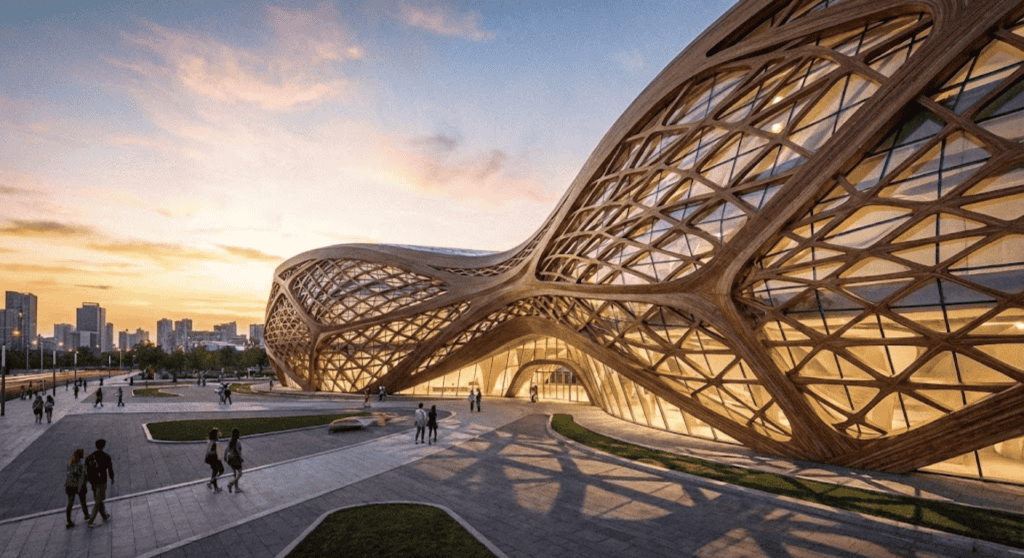
Parametric architecture in Pune is transforming the city’s residential skyline in 2026, with bold facades that use computational geometry, layered metal cladding, and dynamic rhythm to stand apart from conventional apartment blocks. As one of India’s fastest-growing design hubs, Pune is now home to a new generation of buildings where the envelope itself becomes an architectural statement — a fusion of material innovation, climate responsiveness, and visual identity. SOGA Design Studio explores three defining facade typologies that are setting the tone for luxury residential and mixed-use design across the city.
The Rise of Parametric Architecture in Pune
Pune’s urban fabric has long been marked by dense mid-rise housing, but a new wave of design thinking is reshaping what a residential facade can achieve. Driven by advances in BIM software, CNC fabrication, and a growing appetite among Pune’s affluent home buyers for bespoke architectural experiences, parametric design is moving from the pages of international journals into built reality on Indian streets.
The principles behind parametric architecture — rule-based geometry, material variation across a surface, and rhythmic repetition — translate exceptionally well to the 9:16 proportions of the typical Indian urban plot. Tall, narrow facades become canvases for vertical material storytelling, each floor contributing to an overall composition that reads as a single coherent object rather than a stacked series of floors. From Koregaon Park to Baner and Kharadi, projects incorporating these ideas are now appearing across Pune’s premium residential corridors.
Design Philosophy — Materials and Form
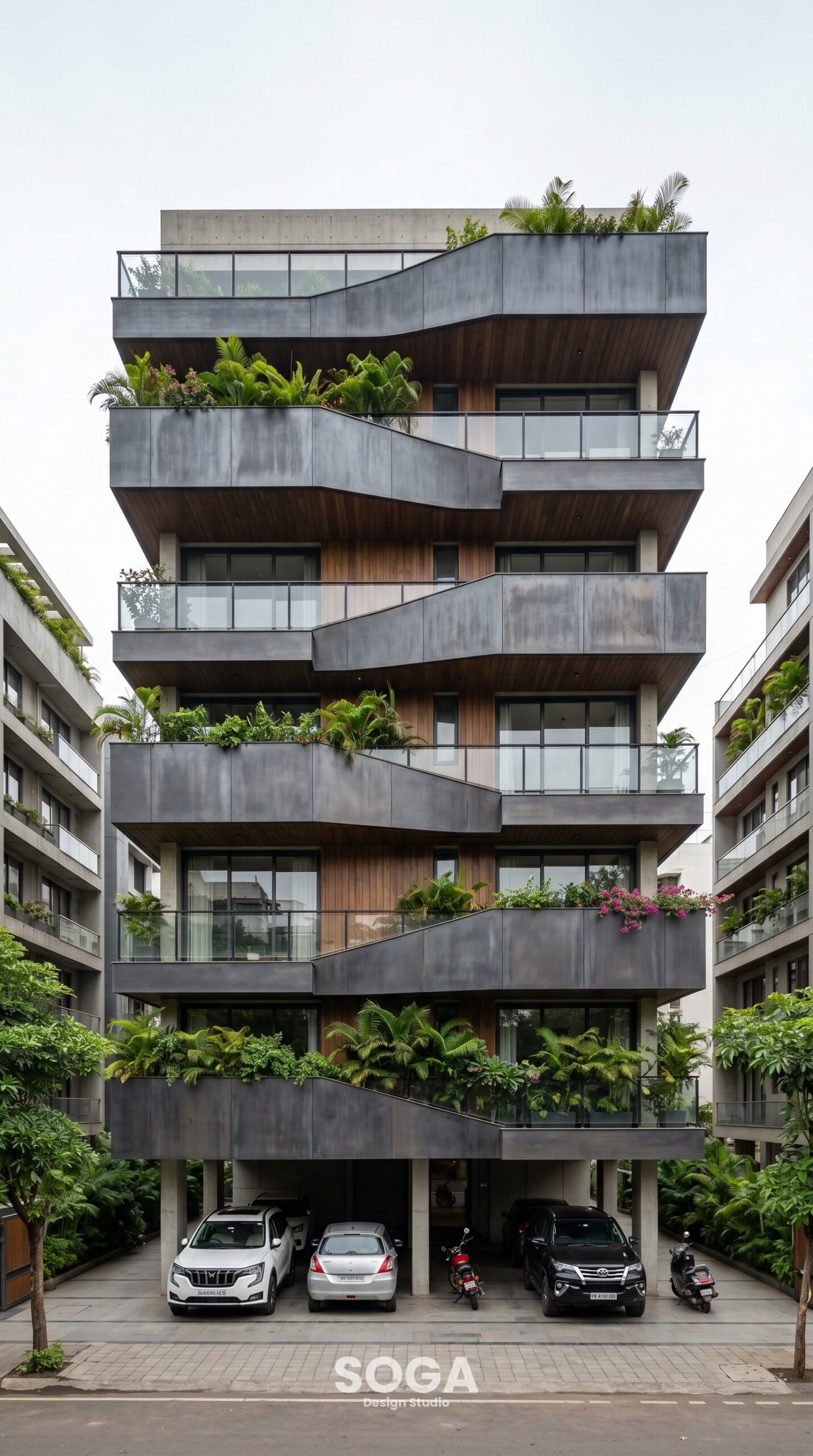
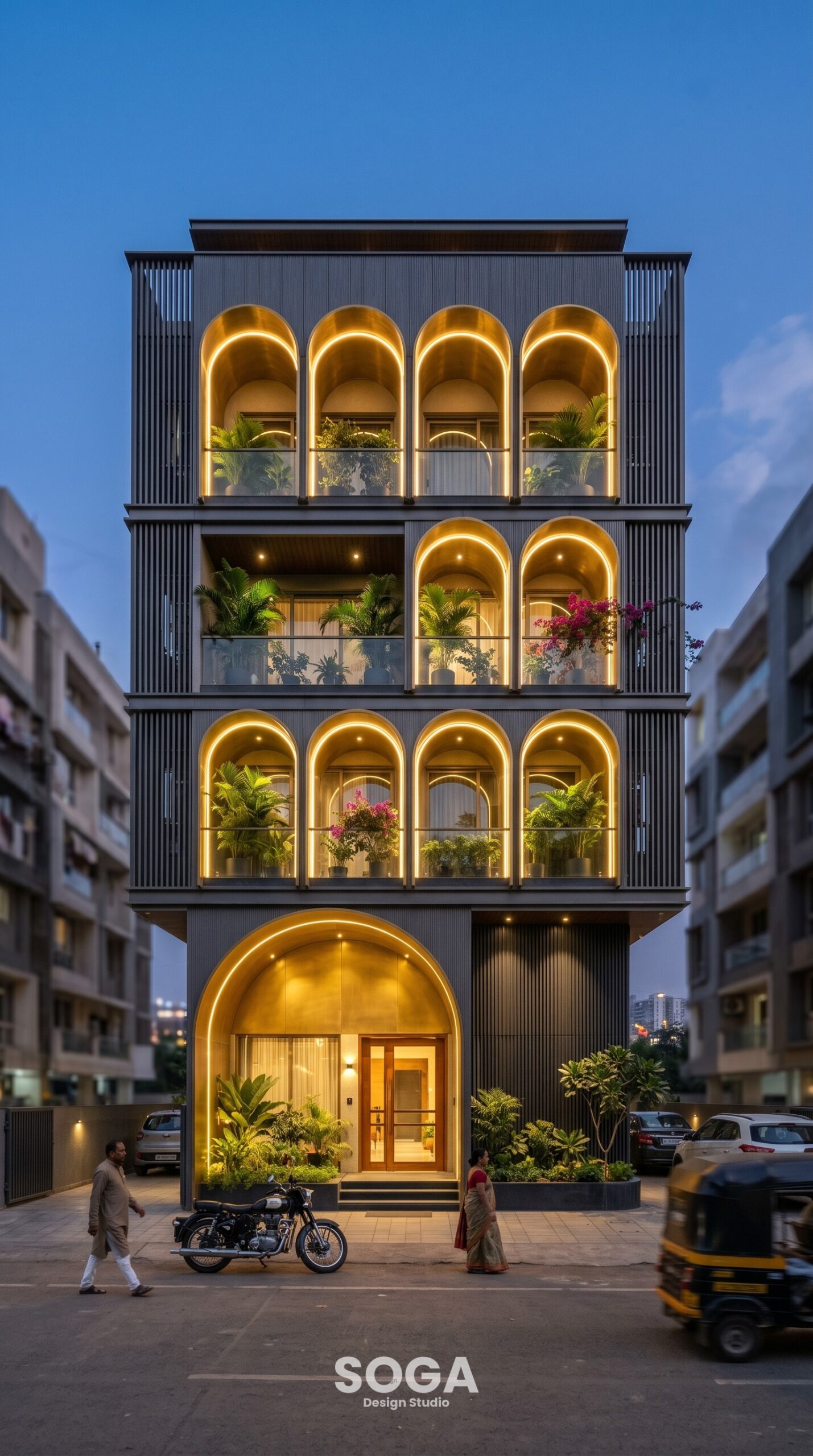
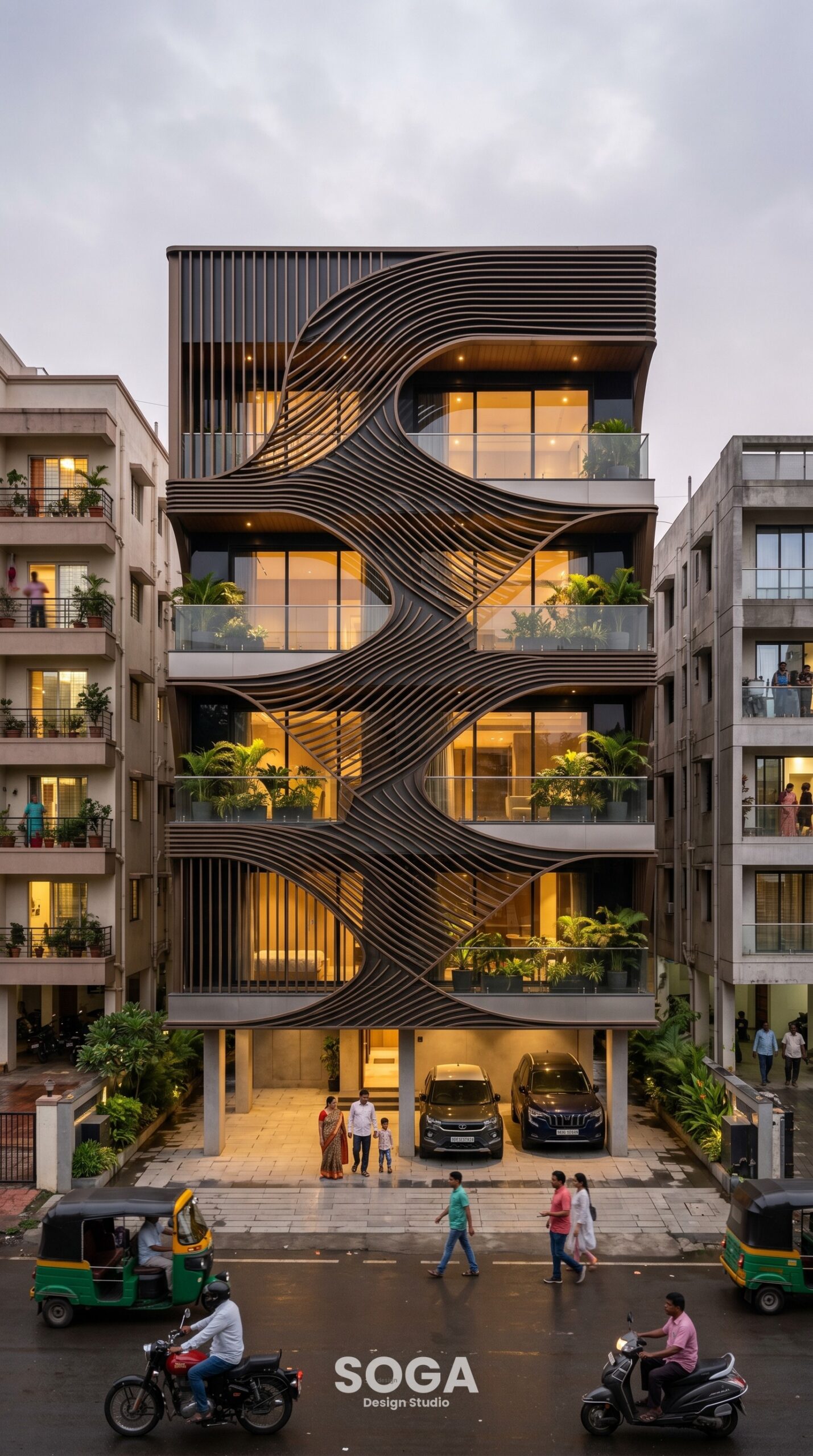
The three facade typologies visualised by SOGA Design Studio for Pune share a common thread: the deliberate use of metal as the primary expressive material, layered over a concrete structural frame. Whether it is continuous horizontal balcony slabs clad in matt metal that shift floor by floor to create a wave rhythm, extruded brass-finished arch frames that glow warmly at dusk, or dark bronze fins that sweep vertically across the facade in a fluid parametric pattern, metal enables precision, longevity, and the kind of surface depth that reflects India’s strong light conditions beautifully.
Tropical planting is a consistent feature across all three typologies — not as decoration but as integral to the facade’s thermal and visual performance. Pune’s climate, with its intense summer sun and monsoon humidity, makes shaded balconies and green edges not just aesthetically desirable but functionally essential. The buildings visualised here treat planting as a third material alongside metal and glass, creating facades that breathe and shift seasonally.
Key Features of Contemporary Parametric Facades in Pune
What distinguishes these designs from standard high-end residential construction in Pune is not simply the use of expensive materials, but the integration of computational logic into every design decision. The wave offset of each floor’s balcony slab is not arbitrary — it follows a sinusoidal rule that ensures consistent shadow depth across the facade at noon, while maximising morning and evening light penetration into interior spaces. The brass arch frames are sized and spaced to frame standard room widths, so the architectural module and the structural module align precisely.
For the dark bronze fin typology, the fins are not purely decorative. Their depth and angle are calculated to shade glass surfaces during Pune’s peak summer months (March–May) while allowing lower winter sun to warm interiors. This kind of climate-integrated parametric logic is precisely what the global parametric architecture discourse has been advocating for years, and SOGA Design Studio is bringing it to Pune’s residential market with full contextual rigour.
Why This Works in Pune’s Urban Landscape
Pune occupies a unique position in India’s architectural culture. It has a sophisticated, design-literate client base — shaped by its proximity to Mumbai, its strong IT and manufacturing economy, and its large population of well-travelled professionals — yet it retains the mid-scale urban grain that makes contextual facade design meaningful. Unlike Mumbai, where towers often stand in isolation, Pune’s residential fabric is typically flanked by similar-height neighbours, which means a distinctive facade reads within a streetscape rather than against a skyline.
The visualisations SOGA Design Studio has produced deliberately situate these parametric buildings within their Pune context — neighbouring conventional apartment blocks, Indian vehicles and street life visible at ground level, real Indian sky conditions. This grounding is intentional: parametric design in India must prove itself in the street, not just in rendering portfolios. The brass arch building glowing amber against a deep blue dusk sky, set between standard neighbours, is a statement about what is possible within the ordinary urban conditions of a Pune residential plot.
For more on how SOGA Design Studio approaches parametric residential design in Pune and across India, see our project portfolio.
Looking Ahead — Architectural Trends for Pune in 2026 and Beyond
The trajectory for parametric architecture in Pune points toward increasing integration of sustainable materials — recycled aluminium fins, low-carbon concrete, bio-composite cladding panels — within the same parametric logic that drives today’s metal-dominated facades. As fabrication costs for CNC-cut and algorithmically designed components continue to fall, the premium associated with bespoke parametric facades will compress, making this level of architectural ambition accessible to a wider range of Pune residential projects beyond the top-tier luxury segment.
If you are planning a luxury residential or commercial project in Pune and want to explore how parametric facade design can elevate your building’s identity, contact SOGA Design Studio for a consultation. Our team combines computational design expertise with deep knowledge of Indian construction practice, climate, and urban context to deliver facades that are as buildable as they are beautiful.