Where Golden Scales Rise in Parametric Waves
SOGA Design Studio’s Biomimetic Masterpiece Redefines Urban Residential Architecture in India
By SOGA Design Studio | Parametric Facade Design | India & Dubai | 2026
I. Introduction: The Building That Scales New Heights
Some buildings announce themselves with size. Others announce themselves with form. And then there are buildings — rare, electric, unforgettable — that announce themselves with a single idea so powerful it stops traffic, halts conversations, and makes complete strangers reach for their phones to photograph what they are seeing.
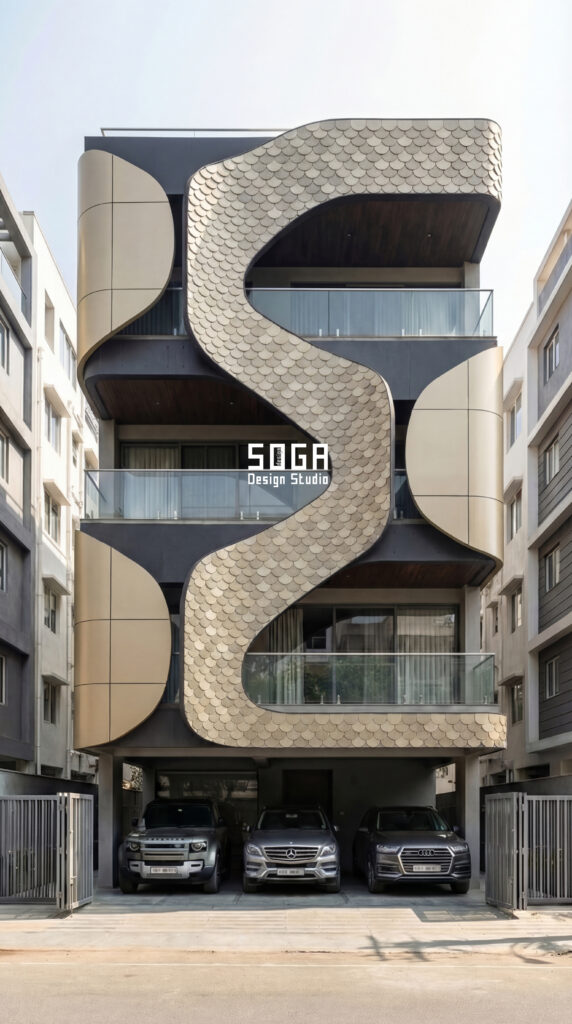
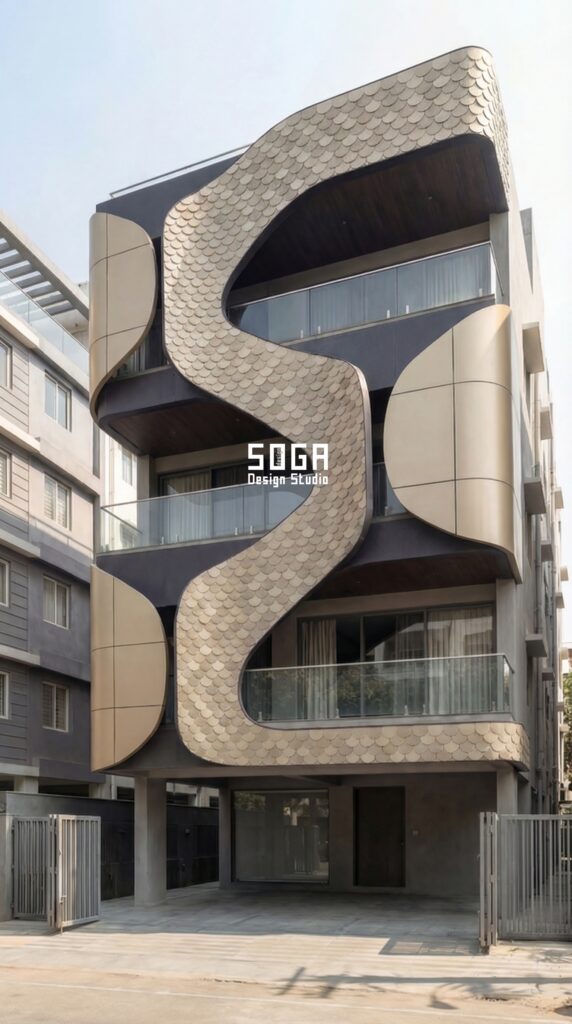
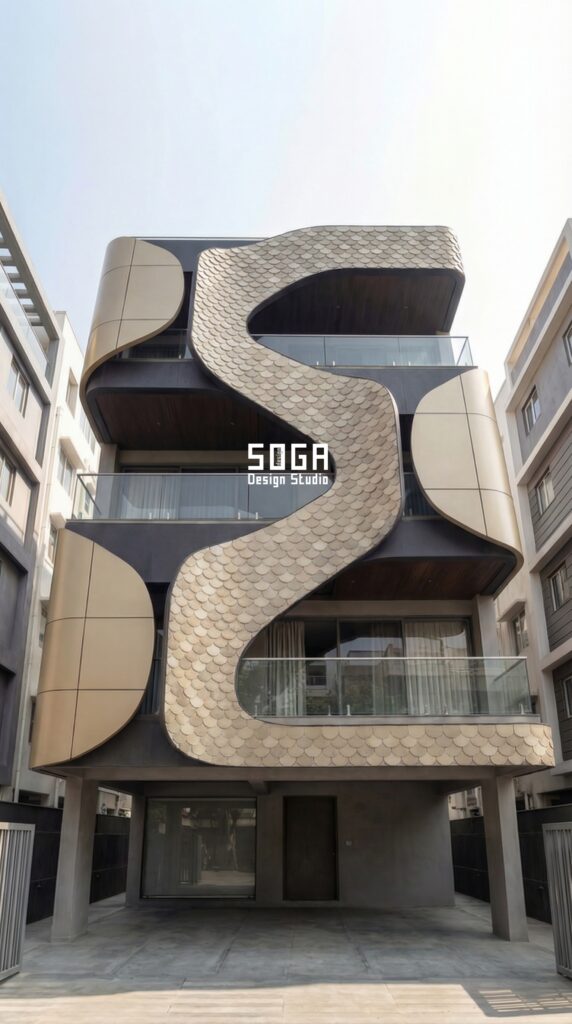
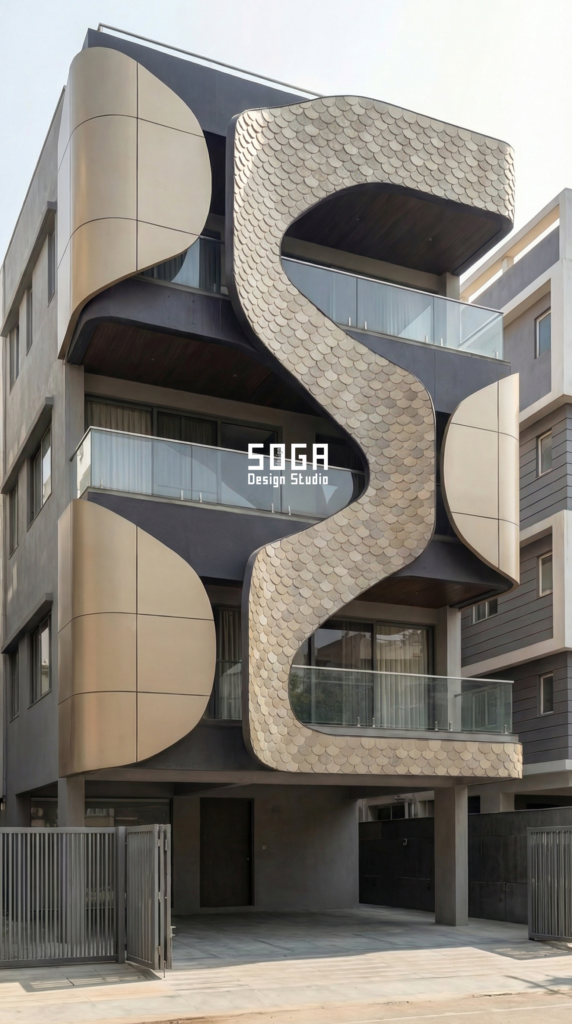
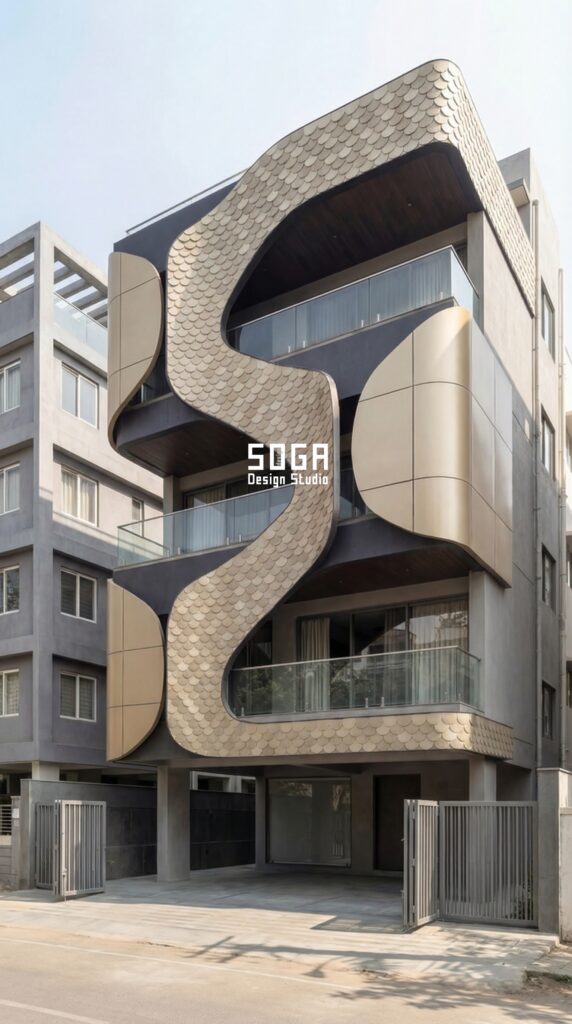
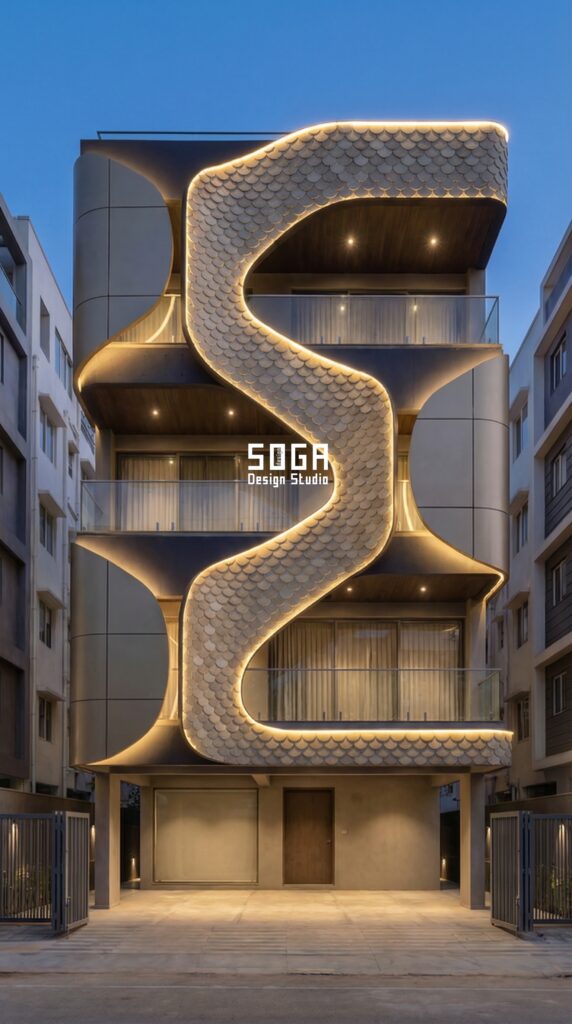
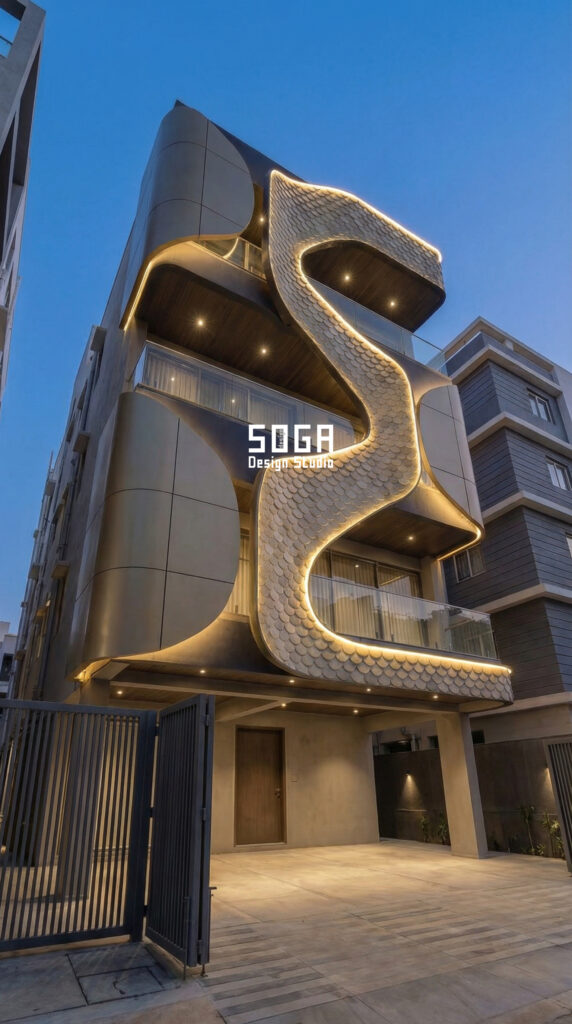
Shalka Patra Residence is one of those buildings. Rising from a residential street in India, it does not compete with its neighbours for height or volume. It surpasses them entirely in the only dimension that matters: imagination. A serpentine river of golden, fish-scale brass-shade metal shingles flows across the facade in a continuous, undulating S-curve — a biomimetic parametric surface of extraordinary visual power that transforms a residential building into a work of sculptural art.
The project is designed by SOGA Design Studio, the parametric architecture and facade design practice operating across India and Dubai that has established itself as one of South Asia’s most adventurous and technically accomplished studios. Shalka Patra Residence is, without question, the studio’s most dramatic residential statement to date — a project that challenges every assumption about what an urban home in India can look like, feel like, and perform like.
The name ‘Shalka Patra’ — evoking the Sanskrit word for scales or leaves — is programmatic. The entire facade concept springs from a single biomimetic insight: that nature’s oldest surface system — fish scales, snake skin, overlapping feathers, layered leaves — is also one of its most efficient. Scales shed water. They deflect wind. They create shade through their overlapping geometry. They flex and move as a system while each individual unit remains rigid and fixed. They catch light at every angle and return it transformed, shimmering, alive. In SOGA Design Studio‘s hands, this ancient natural intelligence becomes a contemporary parametric facade design of breathtaking originality.
At street level, as you approach Shalka Patra Residence, you see first the golden shimmer — the metallic brass-shade finish of the CNC-formed metal shingles catching the Indian sun with a warm, antique luminosity. Then, as your eye adjusts, the shape of the facade reveals itself: not a flat surface, not a regular grid of windows and balconies, but a flowing three-dimensional curve that sweeps from lower left to upper right, doubling back, reversing, flowing again — an S-curve of architectural muscle that seems to breathe against the pale grey sky.
By night, the transformation is even more dramatic. SOGA Design Studio has integrated a continuous LED lighting system that traces the edges of the undulating parametric facade in warm gold — illuminating the S-curve from within, so that Shalka Patra Residence becomes a lantern of molten light in the city darkness. The building’s silhouette, outlined in glowing amber, reads from hundreds of metres away — a beacon of architectural ambition in the urban fabric of contemporary India.
This article is a complete account of Shalka Patra Residence: its design concept, its material systems, its parametric design process, its performance credentials, its cultural resonance, and its significance as a statement about the future of facade design in India. It is also the story of SOGA Design Studio‘s design philosophy — and of why biomimetic parametric architecture is not a trend but a transformation.
II. The Shalka Patra Facade: Anatomy of Golden Scales
The S-Curve: Parametric Form as Biomimetic Logic
The dominant formal gesture of Shalka Patra Residence is its sweeping S-curve — a three-dimensional wave that travels the full height of the building’s facade, from the ground-level plinth to the roofline parapet. This is not a decorative element applied to a conventional facade. The S-curve is the facade: a structural-aesthetic system in which the curved band of metal shingles constitutes the building’s primary public face, defining the volumes of the balconies and living spaces behind it through its three-dimensional geometry.
The S-curve was generated using a Grasshopper parametric algorithm that began with a single design parameter: the desire for a facade that referenced the overlapping, undulating movement of fish scales (shalka in Sanskrit). The algorithm generated a family of possible S-curve geometries, each evaluated against criteria of structural feasibility, facade coverage ratio, balcony accessibility, and visual impact. The selected curve — the one that achieves the most fluid, organic flow while maximising usable balcony space at each floor — was then used as the spine of the parametric facade system.
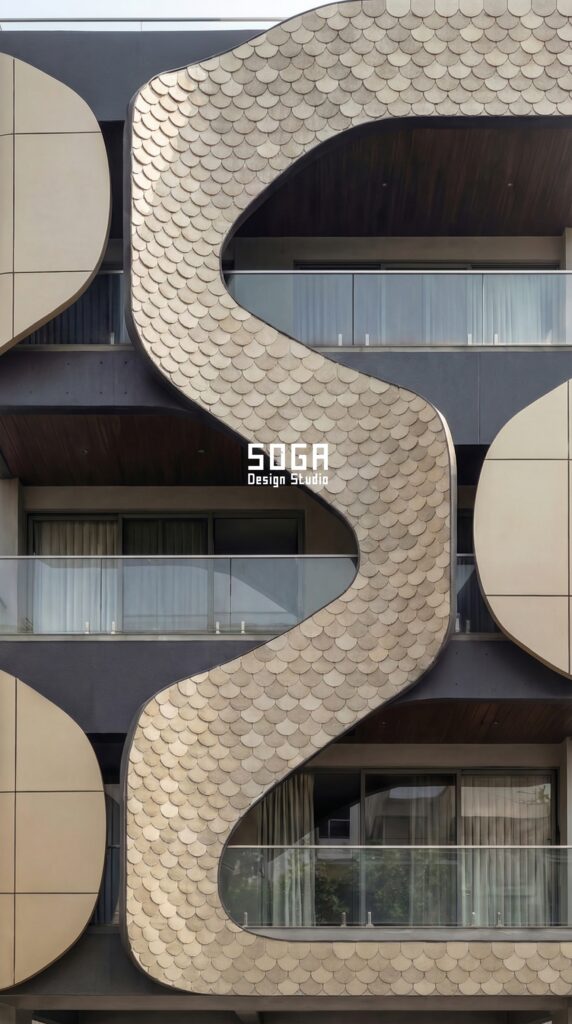
The result is a facade that appears organic and free-form but is, in fact, a precisely calculated parametric surface. Every point of the S-curve is defined by coordinates in the Grasshopper model. Every metal shingle that follows the curve is individually dimensioned to fit its specific position within the parametric surface — larger and flatter at the centre of the curve’s sweep, smaller and more acutely angled at the tightest turns. This individual calibration of each shingle is what makes the surface read as genuinely scale-like: not a uniform tile pattern, but a living, breathing skin of overlapping metallic leaves.
Material System 1: Brass-Shade Metal Shingles
The heart of the Shalka Patra Residence facade system is its brass-shade metal shingles — CNC-formed panels in a warm, champagne-gold metallic finish that provides the building’s defining visual character. Each shingle is fabricated from 2mm aluminium sheet, CNC-pressed into a gentle convex curve that replicates the three-dimensional profile of a fish scale, then powder-coated in a brass-shade metallic finish — a warm gold tone with subtle bronze undertones that catches daylight with remarkable luminosity.
The decision to use a brass-shade finish rather than pure gold or chrome was made deliberately. Pure gold finishes tend toward harshness in direct Indian sunlight — reflective to the point of glare, aggressive rather than warm. SOGA Design Studio‘s material team developed a bespoke colour specification that achieves the antique richness of aged brass in a durable, UV-resistant coating: warm and luminous in morning light, deepening to burnished amber in the afternoon sun, and glowing with a soft honey warmth under the LED uplighting at night.
The shingles are installed in an overlapping configuration that directly replicates the scale pattern of fish skin. Each shingle overlaps the one below it by approximately 30% of its height, creating a waterfall of metal leaves that sheds rainwater efficiently, creates depth and shadow within the surface, and generates the characteristic rippling visual texture that gives Shalka Patra Residence its unmistakable character. The overlapping installation also creates a partially ventilated facade cavity behind the shingle screen — contributing to the building’s thermal performance by reducing direct heat conduction from the metal surface to the wall behind.
The shingles are fixed to a stainless steel sub-frame system that follows the contour of the S-curve. The sub-frame is engineered to project the shingle screen at varying distances from the main building facade — closest to the wall at the ends of the S-curve’s sweeps, furthest from the wall at the apices of the curve’s turns. This variation in projection depth is what gives the S-curve its three-dimensional presence: it is not a flat S-shaped pattern on a flat wall, but a genuinely three-dimensional form that casts deep, dramatic shadows at its furthest projections and catches the light at its highest points.
Material System 2: ACP Sheet at Corners
Where the Shalka Patra Residence facade meets its corners and edges — the zones where the three-dimensional S-curve gives way to the flat sidewall planes — SOGA Design Studio has deployed a contrasting material: Aluminium Composite Panel (ACP) sheet in a dark anthracite finish. This strategic material contrast serves multiple design purposes.
Visually, the dark ACP corner panels create a dramatic frame for the golden shingle S-curve. By receding tonally, they allow the brass-shade metallic surface to read with even greater luminosity against the dark ground. The effect is cinematic: the S-curve of golden scales appears to float against a dark, receding background — an architectural composition of extraordinary graphic power. This light-on-dark contrast is precisely what makes the building so strikingly photogenic, and why images of Shalka Patra Residence travel so widely on social media.
Practically, ACP sheet is ideally suited to the corner and edge conditions of this facade. Its flat, rigid panels — fabricated from two aluminium face sheets bonded to a polyethylene core — provide a precise, clean-edged finish at the complex three-dimensional intersections between the curved S-surface and the flat corner planes. The panels are weather-sealed at all joints, providing a continuous waterproof envelope at the most exposed edges of the building. Their light weight and ease of fabrication also make them economically efficient for these secondary facade zones, allowing the project’s material budget to concentrate its investment in the primary brass-shade metal shingles.
The dark ACP corner cladding also serves a functional purpose as the backing surface for the building’s integrated LED lighting system. LED strip lights are concealed at the inner edge of the ACP panels where they meet the S-curve of metal shingles — creating the dramatic edge-glow effect visible in the night photographs. The dark, matt surface of the ACP absorbs light rather than reflecting it, concentrating the luminous effect on the gold shingle surface itself and creating the building’s spectacular nocturnal character.
The Day-Night Drama: A Building That Transforms
The two images of Shalka Patra Residence say everything about the building’s most powerful quality: its extraordinary day-night transformation. By day, it is a golden armour of scales shimmering in the Indian sun — martial, muscular, alive with reflected light. By night, it becomes something else entirely: a glowing S-shaped lantern, its curves traced in warm amber LED light against the dark expanse of the ACP panels, floating in the city darkness like a creature of pure architectural imagination.
This day-night transformation is not accidental — it is a designed performance that SOGA Design Studio has engineered with the same precision as every other aspect of the parametric facade design. The LED system is designed to illuminate the underside of the shingle overhang at each S-curve apex, creating a warm, diffuse glow that emanates from within the facade rather than being projected onto it. The effect is of the building glowing from inside its own scales — a bioluminescent creature of the city night.
III. The Parametric Design Process: From Nature to Number to Form
Biomimetic Research: Learning from Scales
The parametric design process for Shalka Patra Residence began not with architectural precedents but with biological research. SOGA Design Studio‘s design team conducted an extensive study of natural scale systems — fish scales (ichthyic scales), reptile scales, bird feathers, leaf overlaps, and pine cone bract patterns — analysing their geometric properties, overlapping logic, water-shedding behaviour, and light-interaction characteristics.
The research identified several key properties that made fish-scale geometry particularly suitable as the basis for a parametric facade system: the consistent overlap ratio (typically 25–35%) that sheds water without gaps; the curvature of individual scales that creates three-dimensional depth in an otherwise thin surface; the variable scale size that naturally increases toward the body’s flanks and decreases toward the extremities, creating an organic variation in surface texture; and the iridescent light-reflectance of fish scales, produced by their curved surface geometry, that the brass-shade metallic finish of the CNC panels was specifically designed to replicate.
These biomimetic parameters were then encoded into the Grasshopper parametric algorithm as mathematical rules governing the geometry of each individual shingle and its relationship to its neighbours. The algorithm is, in essence, a computational model of fish-scale geometry applied to an architectural surface — translating the intelligence of millions of years of evolutionary optimisation into a building facade.
Computational Design Methodology
The computational workflow for Shalka Patra Residence operated in three linked phases: surface generation, scale population, and performance optimisation. In the first phase, the three-dimensional S-curve surface was generated and refined using Rhino’s NURBS modelling tools, with the shape parameters adjusted iteratively against structural and programmatic constraints until the optimum geometry was achieved.
In the second phase, the scale population algorithm — written in Grasshopper — divided the S-curve surface into individual cells using a UV-mapping approach that followed the natural flow direction of the surface geometry. Each cell was then assigned a shingle geometry: a convex-curved rectangle whose dimensions varied according to its position on the surface, larger toward the centre of the S-curve’s body and smaller at its tightest turns. The overlap parameter — controlling how much each shingle overlaps the one below — was also varied parametrically to maintain consistent water-shedding coverage across all surface orientations.
In the third phase, the populated shingle surface was evaluated for solar performance using Ladybug Tools integrated with the Grasshopper model. The analysis confirmed that the overlapping shingle geometry provides 38–45% solar shading on the south-facing S-curve surface during peak summer hours — significantly reducing the solar heat gain of the residential spaces behind the facade. Where the analysis identified areas of insufficient shading — primarily at the upper floors of the S-curve — the algorithm automatically adjusted the shingle overlap ratio to increase coverage, without manual intervention.
Algorithm-Driven Fabrication
The direct link between the parametric Grasshopper model and the CNC fabrication system is what makes the Shalka Patra Residence facade feasible. With over 2,400 individually dimensioned shingles on the primary S-curve surface, manual fabrication management would be impossible. Instead, SOGA Design Studio‘s digital fabrication workflow exports machining instructions directly from the parametric model to the CNC press-forming machine, generating each shingle’s profile and curvature specification automatically.
Each shingle is assigned a unique QR code etched by the CNC machine during fabrication. This code encodes the shingle’s position in the parametric model, its orientation on the sub-frame, and its installation sequence. Site teams scan the QR codes during installation to verify correct placement — a system that eliminates transposition errors and allows the parametric surface geometry to be reproduced on site with the same precision as in the digital model.
IV. SOGA Design Studio: The Practice Behind the Scales
A Philosophy of Biomimetic Intelligence
SOGA Design Studio approaches every parametric facade design from the same conviction: that the most enduring architectural ideas are those that are grounded in natural intelligence. Nature has been solving the problems of surface — weather resistance, thermal management, structural efficiency, visual richness — for billions of years. The studio’s role is not to invent solutions from scratch but to translate nature’s proven geometries into contemporary architectural language, using computational tools to bridge the gap between biological systems and building systems.
This biomimetic philosophy is evident across SOGA Design Studio‘s portfolio. The lotus motif facade of Padmaja Regal Jewellery in Mysuru drew on the sacred geometry of India’s most culturally resonant flower. The timber ribbon facade of the Odisha mixed-use project translated the rhythmic pattern logic of Orissan temple carving into a contemporary wood-fin system. And Shalka Patra Residence takes the philosophy to its most literal and spectacular expression — a building whose entire skin is modelled on the scales of a fish, whose material finish replicates the iridescence of underwater light, and whose flowing form evokes the fluid movement of a living creature.
India and Dubai: A Bicultural Design Perspective
Operating between India and Dubai, SOGA Design Studio brings a perspective on architectural design that is shaped by two of the world’s most demanding and varied built environments. In India, the studio has developed a deep understanding of vernacular material traditions, classical architectural geometry, tropical climate conditions, and the complex urban contexts in which contemporary buildings must operate. In Dubai, the studio has been exposed to the most advanced facade engineering technologies, the most ambitious design visions, and the most rigorous performance specifications in the global construction industry.
This bicultural foundation gives SOGA Design Studio‘s work a unique character. Shalka Patra Residence is a product of both worlds: a building that is unmistakably Indian in its cultural references and climatic responsiveness, yet internationally ambitious in its technical execution and aesthetic boldness. It could not have been designed by a practice rooted in only one of these contexts.
Design-Build Integration: From Pixel to Panel
The Shalka Patra Residence project exemplifies SOGA Design Studio‘s integrated design-build approach for parametric facades. The computational design team, the fabrication coordination team, and the site supervision team are all part of the same studio — maintaining continuity of design intelligence from the first Grasshopper model to the last installed shingle. This integration is what allows a facade of this complexity to be delivered to the quality standard visible in the project images: no compromises at the fabrication stage, no simplifications at the installation stage, no loss of the design’s geometric precision between screen and street.
V. Performance & Sustainability: The Intelligence of Scales
Solar Shading: The Biomimetic Advantage
The overlapping geometry of the brass-shade metal shingles is not merely decorative — it is a sophisticated solar shading system that the biomimetic research specifically optimised. The convex curvature of each individual shingle means that direct solar radiation strikes the shingle’s curved face at an oblique angle for most of the day, reducing the effective solar absorptance of the surface. The 30% overlap between shingles creates a consistent shadow zone below each shingle that shades the wall surface and the ventilated cavity behind it from direct solar exposure.
Thermal performance modelling of the completed parametric shingle facade indicates 38–45% reduction in direct solar radiation reaching the building skin on south and west elevations during peak summer hours (10am–4pm, March–May). This shading performance compares very favourably with conventional external shading systems of equivalent projected depth, because the biomimetic scale geometry distributes shading coverage more uniformly across the surface than regular fin or blade systems.
Ventilated Facade Cavity
The stainless steel sub-frame system that supports the shingle screen maintains a 50–80mm ventilated cavity between the back of the shingle surface and the main building wall. This cavity is ventilated at top and bottom through open joints in the sub-frame, creating a passive chimney effect that draws warm air upward and out of the cavity throughout the day. The ventilation of this cavity — driven entirely by the temperature differential between the warm cavity air and the cooler ambient air above — reduces the surface temperature of the main building wall by 6–10°C on peak summer days compared to a directly-clad, non-ventilated wall system.
The cavity also provides a moisture management buffer, allowing any water that penetrates the shingle surface — through wind-driven rain at extreme angles — to drain freely down the back of the shingles and out through the bottom drainage gap, without contacting the building’s waterproof membrane.
LED Lighting System: Performance and Specification
The integrated LED lighting system of Shalka Patra Residence is both an aesthetic and technical achievement. The system uses 2700K warm white LED strips — matched to the golden tone of the brass-shade shingles to create a continuous warm glow rather than a cool contrast — installed in custom aluminium extrusion channels at the inner edge of the ACP corner panels and along the perimeter of the S-curve at each floor level. The LED strips have a rated lifespan of 50,000+ hours and are IP65-rated for weather resistance.
The lighting system is controlled by a smart dimmer programme that varies intensity across the night — full brightness for the evening hours from dusk to 11pm, stepping down to 50% for the late-night hours, and reducing to a minimal maintenance-glow setting after 1am. This smart control programme reduces the system’s annual energy consumption by approximately 35% compared to a fixed-on system, while maintaining the building’s dramatic nocturnal presence through the key evening hours.
Performance Summary
| Performance Metric | Projected Benefit |
| Solar shading (S/W elevations) | 38–45% reduction in direct solar radiation |
| Facade cavity temperature reduction | 6–10°C on peak summer days |
| Cavity ventilation system | Passive chimney effect (zero energy) |
| LED lighting colour temperature | 2700K warm white (matched to brass shade) |
| LED energy savings (smart dimming) | 35% vs fixed-on system |
| ACP corner panel waterproof rating | IP65-equivalent edge-sealed joints |
| Shingle material recyclability | Near 100% (aluminium substrate) |
VI. Cultural Resonance: Shalka Patra and the Indian Material Imagination
The Shalka Patra Concept: Ancient Name, Contemporary Form
The name Shalka Patra is not a whim of branding. It is a considered cultural declaration. In Sanskrit, ‘shalka’ refers to scale or shard, and ‘patra’ to leaf or surface — together, the phrase evokes both the physical material of the facade (scale-like metal panels) and a deeper tradition of Indian formal thinking in which surface is never merely surface but always pattern, meaning, and story.
Indian architecture has always understood the facade as a field of meaning. The intricately carved exterior surfaces of Khajuraho, the perforated stone jalis of Mughal tombs, the repetitive tile patterns of Rajput havelis — these are not decorations applied to structural forms. They are the primary medium through which Indian buildings communicate with the world outside them. They create shade, they filter light, they tell stories, they establish identity.
Shalka Patra Residence participates in this tradition not through pastiche or historical quotation but through a shared formal logic: the repetition of a modular unit at multiple scales, the creation of depth and shadow through overlapping geometry, and the transformation of a building’s exterior surface into something richly, insistently patterned. The medium is CNC-formed brass-shade metal rather than hand-carved stone. The tool is computational design rather than chisel and mallet. But the intent is continuous with the great tradition of Indian surface thinking.
Biomimicry in Indian Cultural Context
India’s cultural relationship with the natural world — expressed through millennia of artistic tradition, religious iconography, and craft practice — makes biomimetic architecture particularly resonant in the Indian context. Fish scales, lotus petals, feathers, leaves, shells: these are forms that appear throughout Indian art, architecture, and ornament not merely as decorations but as carriers of meaning, as connections between the built world and the living world.
The golden scales of Shalka Patra Residence carry this cultural charge naturally. Gold — in Indian aesthetic tradition — is not simply a colour. It is the colour of sunlight, of sacred fire, of divine presence, of auspicious transformation. A building armoured in golden scales is, in the Indian cultural imagination, a building that carries its inhabitants’ wellbeing within its skin — that is materially aligned with abundance, protection, and the blessings of light.
Urban Context: A Landmark in Residential Fabric
In its urban context — a residential street typical of Indian cities, lined with buildings of modest ambition and conventional appearance — Shalka Patra Residence functions as a landmark of extraordinary power. It does not dominate through scale: it is a normal residential building height. It dominates through sheer architectural presence — through the uniqueness of its form, the richness of its material, and the drama of its nocturnal illumination.
For the residents of the surrounding neighbourhood, Shalka Patra Residence is a reference point, a source of civic pride, and a daily reminder that the built environment is capable of beauty and ambition. For the city of which it is a part, it is a contribution to the visual culture of the street, demonstrating that residential architecture in India need not be resigned to the anonymous and the generic. For SOGA Design Studio, it is a manifesto: a building-scale demonstration of what parametric facade design in India can achieve when ambition and intelligence work together.
VII. Technical Innovation: Engineering the Golden Serpent
Three-Dimensional Sub-Frame Engineering
The greatest technical challenge of Shalka Patra Residence is the three-dimensionality of the S-curve. Unlike a flat parametric facade — where all shingles lie in a single plane and the sub-frame is a simple rectilinear grid — the S-curve is a compound three-dimensional surface that changes its orientation and projection depth at every point along its length. The sub-frame that supports the brass-shade metal shingles must therefore be a three-dimensional structure that precisely follows the parametric surface geometry, projecting at varying distances from the main building wall and changing its angle of inclination continuously along the S-curve’s length.
This three-dimensional stainless steel sub-frame was itself engineered using a parametric structural model derived from the facade geometry model. The sub-frame consists of a series of curved, pre-bent primary rails that follow the contours of the S-curve, connected by secondary horizontal bars that carry the individual shingle fixing points. Each primary rail is a unique, CNC-bent component — no two rails are identical — fabricated from 50x50mm stainless steel box section and bent to its specific profile using a CNC tube-bending machine driven directly by the parametric model data.
Shingle Installation Precision
With 2,400+ individually unique shingles to install on a three-dimensional parametric surface, installation precision on the Shalka Patra Residence project was a challenge of unprecedented complexity for the site team. SOGA Design Studio solved this challenge through its QR-code tracking system combined with a real-time BIM (Building Information Modelling) verification tool.
Before installation, the site team used a total station survey instrument to verify the as-built position of each sub-frame fixing point against the parametric model coordinates, with a tolerance of ±3mm. Any sub-frame positions that fell outside this tolerance were corrected before shingle installation began. This pre-installation verification step — which added approximately 3 days to the site programme — eliminated the risk of accumulated positional errors that would have disrupted the parametric shingle pattern and the visual quality of the finished facade.
ACP Corner Integration Details
The junction between the brass-shade metal shingle screen and the ACP corner panels required particular care in both design and execution. SOGA Design Studio designed a custom aluminium extrusion trim profile that neatly terminates the shingle sub-frame at its outer edge while providing a clean, weathertight interface with the adjacent ACP panel. This trim profile also incorporates the channel for the LED strip lighting — ensuring that the light source is precisely located at the visual boundary between the two materials, maximising the edge-glow effect at night.
The ACP panels at the corners are fabricated in a large-format, seamless configuration — minimising the number of visible panel joints in these prominent locations. Joint lines are sealed with a two-part polyurethane sealant in a colour matched to the ACP panel finish, ensuring weather-tightness while maintaining the smooth, uninterrupted visual quality of the corner surfaces that is essential to the building’s graphic composition.
VIII. Business Value: When Architecture Becomes Brand
The Landmark Premium
In the residential real estate markets of Indian cities, the majority of apartment buildings compete on the basis of location, size, and amenity specification. Shalka Patra Residence competes on none of these conventional terms — because it has rendered them irrelevant. A building that is genuinely unique, that generates its own social media presence, that is recognised by name across the city, and that appears in architecture publications from India to Dubai does not need to compete with its neighbours on specification. It exists in a category of its own.
This category-of-one positioning translates directly into pricing power. Residential developments with landmark architectural identity consistently command premiums of 15–25% on sale price and 12–18% on rental rates over comparable buildings in the same location. The incremental investment in the parametric brass-shade shingle facade and the ACP corner system — over and above the cost of a conventional residential facade — is recovered many times over in this pricing premium, before any account is taken of the building’s energy performance benefits or its reduced maintenance costs.
Social Media Value: Architecture as Content
Images of Shalka Patra Residence — both the golden day view and the LED-illuminated night view — are among the most shareable pieces of architectural content that SOGA Design Studio has ever produced. The building’s visual impact is immediate, its uniqueness is obvious, and its photographic quality is exceptional. In the contemporary real estate market, where the first touchpoint between a potential buyer and a development is almost always a social media post or a digital advertisement, this organic social media presence has a quantifiable marketing value.
The #ShalkaPatraResidence hashtag, along with #SogaDesignStudio, #ParametricFacade, #BiomimeticDesign, and #ArchitectureTrends2026, positions the project firmly in the global conversation about innovative architecture design — driving awareness among the premium audience of design-conscious buyers and tenants who are the natural market for a residence of this calibre.
Future Vision: Biomimetic Design and the Next Chapter
The Biomimetic Turn in Indian Architecture
The story of Shalka Patra Residence is part of a larger story about the direction of contemporary Indian architecture. After decades in which facade design in India was dominated by glass curtain walls and aluminium composite panels — materials imported from an international design vocabulary with little connection to Indian climate, culture, or material tradition — there is now a powerful counter-movement. A generation of Indian architects and design studios, led by practices like SOGA Design Studio, is reaching back into India’s extraordinary material and cultural intelligence and finding there the inspiration for a new parametric architecture that is both globally ambitious and locally resonant.
The biomimetic approach — designing building skins that are modelled on natural surface systems — is particularly powerful in the Indian context, because nature’s surface intelligence and India’s cultural relationship with the natural world are both extraordinarily deep. The fish scales of Shalka Patra Residence, the lotus petals of Padmaja Jewellery, the timber ribbons of the Odisha project: these are not arbitrary natural metaphors. They are the beginning of a new architectural language for India — one that is computationally enabled, culturally embedded, and climatically intelligent.
Material Innovation: The Next Frontier
SOGA Design Studio is actively developing the next generation of its biomimetic parametric facade systems, exploring new material possibilities beyond the current range of metal, timber, and composite panels. These include kinetic scale systems that physically adjust their orientation in response to real-time solar and wind data; photovoltaic shingle systems that integrate solar generation into the scale geometry; and terracotta and ceramic shingle systems that bring natural material warmth and thermal mass to the biomimetic facade concept. From its studios in India and Dubai, the practice is at the forefront of a global conversation about what the future of parametric facade design can be.
Conclusion: The Building That Lives in Its Own Skin
Shalka Patra Residence is a building that rewards attention. At first glance, it is simply extraordinary — a golden serpent of scales rising against the urban sky, a form so unusual and so compelling that it demands to be looked at. But the more attention you give it, the more it yields: the individual convex curves of each brass-shade shingle, the shadow-play within the scale pattern, the precise three-dimensionality of the S-curve’s projection, the darkness of the ACP corner panels that makes the gold sing, the way the evening light catches the LED edge-glow and turns the building into something between architecture and jewellery.
This richness of experience — this building that gives more the more you look — is not accidental. It is the direct result of SOGA Design Studio‘s approach to parametric facade design: an approach that treats the computational algorithm not as a tool for generating novelty, but as a means of encoding genuine performance intelligence, cultural resonance, and material richness into every element of a building’s skin.
For the residents who live within the scales of Shalka Patra Residence, the building is home — but it is also armour, symbol, and spectacle. It protects them from the Indian sun with the same biomimetic intelligence that protects a fish from the force of water. It marks their address as exceptional in a city of the ordinary. And it gives them, every morning and every evening, the experience of living inside a work of art.
For SOGA Design Studio, operating from its studios in India and Dubai, Shalka Patra Residence is both a culmination and a beginning — the fullest expression yet of a parametric design philosophy that is still evolving, still reaching, still finding new forms for the ancient conversation between architecture and the natural world.
The golden scales rise. The facade design breathes. The city looks up. SOGA Design Studio has scaled new heights.
About SOGA Design Studio
SOGA Design Studio is India and Dubai’s leading parametric architecture and facade design studio, delivering end-to-end computational design and fabrication solutions for residential, commercial, retail, and institutional projects. With a portfolio ranging from the biomimetic brass-shade shingle facade of Shalka Patra Residence to the cultural lotus-motif CNC facades of jewellery showrooms and the parametric timber ribbon systems of mixed-use developments, SOGA Design Studio brings together computational sophistication, cultural intelligence, and integrated design-build delivery in a combination that remains unique in South Asian practice.
Contact SOGA Design Studio to discover how parametric facade design can transform your next project — in India, Dubai, or anywhere in the world.
Project Details
| Field | Details |
| Project Name | Shalka Patra Residence |
| Location | India |
| Building Type | Premium Residential |
| Primary Facade Material | Brass-Shade CNC-Formed Metal Shingles (2mm Aluminium, Metallic Powder Coat) |
| Secondary Material | Anthracite ACP Sheet (Aluminium Composite Panel) at Corners |
| Facade System | Para-Scale Shingle System — Biomimetic S-Curve Parametric Screen |
| Unique Feature | Overlapping fish-scale geometry; integrated LED edge-glow lighting; day/night transformation |
| Facade Concept | Biomimetic — inspired by fish-scale (shalka) geometry and iridescent light-play |
| Solar Shading (S/W elevations) | 38–45% reduction in direct solar radiation |
| Facade Cavity Cooling | 6–10°C temperature reduction on peak summer days |
| LED Colour Temperature | 2700K warm white (matched to brass-shade finish) |
| LED Energy Savings | 35% reduction via smart dimming programme |
| Total Shingles | 8,400+ individually CNC-formed panels |
| Design Studio | SOGA Design Studio (India & Dubai) |
| Fabrication Method | CNC Press-Forming + QR-Code Tracking + Stainless Steel Sub-Frame |
Ready to clad your next project in parametric excellence?
Contact SOGA Design Studio — India & Dubai
www.sogadesignstudio.com