SOGA Design Studio Redefines Urban Luxury with Fluid Architectural Forms
In the heart of South Bombay’s dense urban fabric, where historic architecture meets contemporary aspirations, the Vikram Ahuja residence emerges as a bold statement of parametric design excellence. Created by SOGA Design Studio, India’s premier parametric design company and leading facade specialist operating across India and Dubai, this residential masterpiece demonstrates how computational design can create sculptural, organic forms that respect their context while asserting a distinctive contemporary identity.
A Sculptural Response to Urban Density
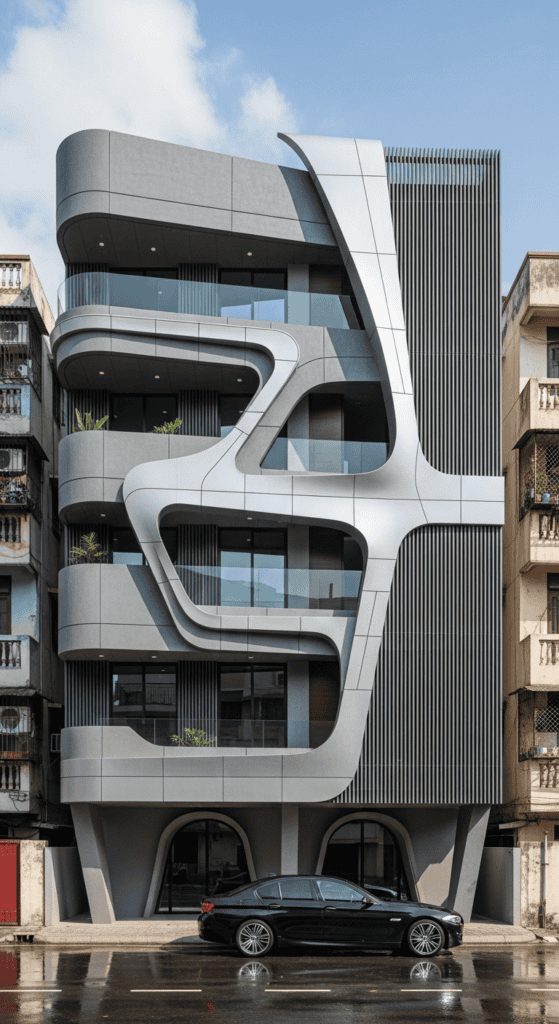
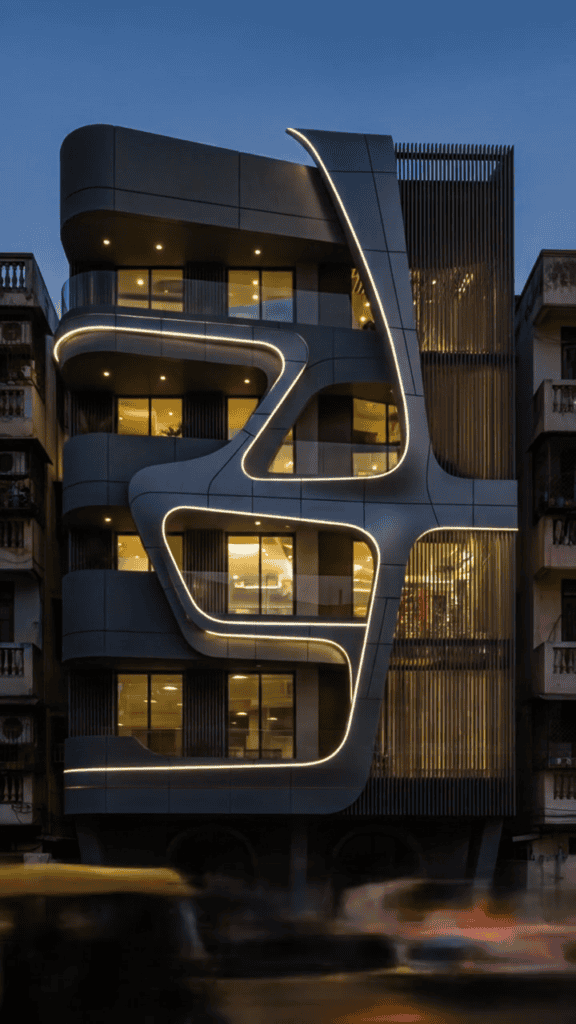
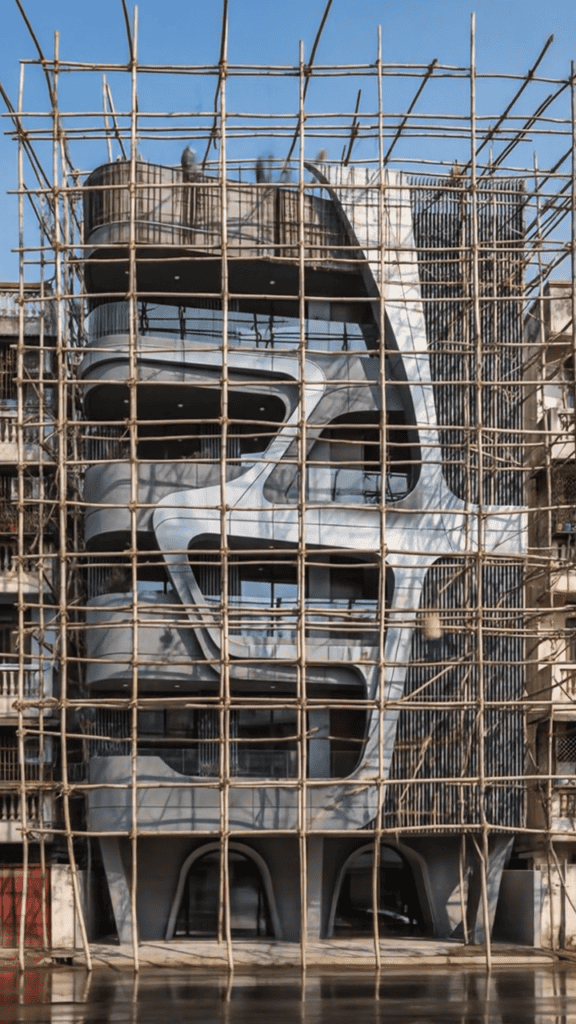
The Vikram Ahuja residence stands as a striking contrast to its traditional neighbors—a fluid, curvaceous composition of sweeping forms that appears almost to flow upward through the narrow urban plot. This isn’t arbitrary sculptural expression; it’s a carefully calibrated parametric response to the unique challenges of designing luxury residential architecture in one of Mumbai’s most prestigious and constrained neighborhoods.
Fluid Organic Forms Through Parametric Design
The facade’s most striking feature is its continuous flowing geometry—horizontal ribbon-like bands that wrap around the building, creating organic balconies and terraces at each level. These aren’t simply decorative curves; they’re parametrically optimized forms that serve multiple functions:
Privacy and Openness: The curved elements create semi-enclosed balcony spaces that provide privacy from neighboring buildings while maintaining generous openness toward desirable views. This balance is critical in South Bombay’s tight urban grain where buildings stand shoulder-to-shoulder.
Solar Shading: The deep horizontal projections provide substantial shading to the glazed areas behind them, reducing solar heat gain in Mumbai’s tropical climate. The curves are parametrically shaped to optimize shading angles based on sun path analysis.
Structural Expression: The flowing forms aren’t merely aesthetic—they represent the structural logic of cantilevered slabs and beams, expressed through sculptural geometry that makes the structure’s forces visible and beautiful.
Visual Identity: In a neighborhood of rectangular buildings with traditional facades, the organic curves create immediate visual distinction, signaling the contemporary luxury within.
Material Palette: Grey, White, and Vertical Texture
The facade employs a sophisticated three-part material strategy:
Light Grey Panels: The flowing curved elements are clad in light grey panels that emphasize their sculptural quality. The matte finish prevents glare while highlighting the three-dimensional depth of the parametric forms.
White Accents: Strategic white panels punctuate the composition, creating visual contrast and breaking down the building’s scale. These lighter elements emphasize key architectural moments and add refinement to the overall palette.
Vertical Louvers: The right portion of the facade features vertical metal louvers that provide texture, screen services, and contrast with the horizontal flow of the curved elements. This juxtaposition of vertical and horizontal elements creates dynamic visual tension.
The restrained color palette allows the complex geometry to take center stage, while the material differentiation helps organize the facade’s visual hierarchy.
SOGA Design Studio: Computational Design Excellence
As India’s leading parametric design company and computational design firm, SOGA Design Studio brought sophisticated digital design methodologies to this challenging residential project:
Advanced Parametric Modeling
The continuous flowing curves of the Vikram Ahuja residence required advanced parametric modeling techniques:
NURBS Surface Modeling: The organic forms were created using Non-Uniform Rational B-Spline (NURBS) surfaces, which allow precise control over complex curved geometries. Each flowing ribbon was parametrically defined, ensuring smooth transitions and structural feasibility.
Form-Finding Algorithms: Rather than imposing arbitrary curves, SOGA Design Studio used parametric algorithms that considered structural efficiency, solar orientation, view corridors, and spatial requirements. The resulting forms emerge from these multiple constraints rather than pure aesthetic preference.
Rationalization for Fabrication: The smooth parametric curves needed to be translated into buildable panels. Our team developed rationalization algorithms that approximated the curves using manufacturable flat or single-curved panels, maintaining the visual impression of flowing forms while controlling fabrication complexity and cost.
Integration Analysis: The parametric model integrated all building systems—structure, mechanical, electrical, plumbing—ensuring that the sculptural facade didn’t compromise functional requirements. This holistic approach prevented conflicts and coordination issues during construction.
Multi-Criteria Optimization
The facade design balanced numerous competing requirements:
- Visual Impact: Creating a memorable, distinctive architectural presence
- Privacy: Screening from adjacent buildings while preserving views
- Climate Response: Optimizing solar shading and natural ventilation
- Structural Efficiency: Minimizing material while maintaining safety
- Budget: Controlling costs through strategic complexity management
- Buildability: Ensuring the design could be constructed with available technologies
Parametric optimization tools allowed SOGA Design Studio to explore thousands of design variations, identifying the solution that best balanced these diverse criteria.
The South Bombay Context: Innovation Within Constraints
South Bombay presents unique challenges for contemporary architecture. The neighborhood is characterized by:
Historic Fabric: Many surrounding buildings are historic structures with traditional architectural languages. New construction must negotiate this context without resorting to pastiche.
Extreme Density: Properties are narrow and tightly packed, with minimal setbacks between buildings. Privacy, daylighting, and views require careful design consideration.
Premium Real Estate: South Bombay represents Mumbai’s most prestigious residential addresses. Architecture must communicate luxury and distinction.
Regulatory Constraints: Heritage area regulations, floor area ratios, height restrictions, and setback requirements tightly constrain development possibilities.
Infrastructure Limitations: Narrow streets and dense construction complicate material delivery and construction logistics.
The Vikram Ahuja residence responds to these constraints through parametric design that maximizes the potential of the limited footprint while creating distinctive architectural character that enhances rather than disrupts the neighborhood fabric.
Parametric Design for Residential Architecture
While parametric design is often associated with large-scale public buildings, the Vikram Ahuja residence demonstrates its value for residential projects:
Customization at Every Scale
Parametric tools enabled customization throughout the project:
Unit Layouts: Each residential level features slightly different layouts optimized for specific views, orientations, and functional requirements. The parametric model maintained design consistency while accommodating these variations.
Balcony Curves: While the flowing aesthetic is consistent, each balcony’s specific geometry responds to its level, orientation, and relationship to neighboring buildings. This micro-customization would be impractical without parametric tools.
Privacy Screening: The degree of enclosure varies parametrically across the facade, providing more screening where adjacent buildings are close and more openness where views are unobstructed.
Interior-Exterior Integration: The parametric model ensured that interior spaces responded to the curved facade geometry, creating unique spatial experiences rather than treating the facade as an arbitrary wrapper.
Performance-Driven Luxury
Parametric analysis ensured that the residence performs as well as it appears:
Daylighting Analysis: Computational studies evaluated natural light penetration throughout the year, informing window placement and sizing to maximize daylight while controlling glare.
Thermal Comfort: CFD (Computational Fluid Dynamics) analysis evaluated natural ventilation patterns, ensuring that the curved balconies channel breezes effectively in Mumbai’s climate.
Acoustic Privacy: The curved facade elements help deflect sound from the street and neighboring properties, improving acoustic comfort within the residences.
View Optimization: Parametric view analysis from interior spaces ensured that the flowing forms frame desirable views while screening less attractive aspects of the urban surroundings.
This integration of performance analysis with aesthetic development exemplifies how parametric design creates residences that are both beautiful and deeply functional.
Technical Innovation: Building the Unbuildable
Translating the Vikram Ahuja residence’s flowing parametric forms into built reality required innovative construction approaches:
Curved Panel Fabrication
The flowing grey and white panels required sophisticated fabrication:
Digital Fabrication: Each panel was CNC-cut from digital files generated directly from the parametric model, ensuring accuracy and eliminating translation errors.
Panel Rationalization: The smooth curves were approximated using developable surfaces—geometries that can be formed from flat sheets without stretching or compressing the material. This rationalization made fabrication practical while maintaining the visual impression of continuous curves.
Mock-ups and Prototyping: Full-scale mockups of critical facade sections were produced to verify appearance, weather performance, and construction methodology before full production.
Structural Complexity
The cantilevered flowing forms required advanced structural engineering:
Load Path Analysis: Parametric structural models analyzed load paths through the complex geometry, identifying optimal reinforcement strategies.
Connection Details: Each panel connects to the structure at specific points calculated to transfer loads efficiently. These connection points were parametrically positioned to align with structural logic.
Construction Sequencing: The parametric model informed construction sequencing, identifying the order in which elements needed to be built to maintain structural stability during construction.
Quality Control
Achieving the design’s precision required rigorous quality control:
Digital Surveying: As-built conditions were laser scanned and compared to the parametric model, identifying any deviations requiring correction.
Tolerance Management: The parametric model incorporated realistic construction tolerances, ensuring that small variations wouldn’t compromise the overall geometry or performance.
Installation Coordination: Each panel was digitally tagged, with installation drawings generated from the parametric model showing exact positioning, simplifying on-site coordination.
Sustainable Design Through Parametric Optimization
While the Vikram Ahuja residence’s sculptural forms might suggest aesthetic priorities over environmental concerns, parametric design enabled significant sustainability features:
Passive Solar Control: The deep overhangs provide substantial solar shading, reducing cooling loads by an estimated 25-30% compared to a conventional glazed facade.
Natural Ventilation: The curved balconies are shaped to channel prevailing breezes into living spaces, reducing reliance on mechanical cooling during Mumbai’s more temperate months.
Material Efficiency: Parametric structural optimization minimized concrete and steel quantities while maintaining safety margins, reducing embodied carbon.
Durable Materials: The metal and composite panel systems are designed for 50+ year service lives with minimal maintenance, improving lifecycle sustainability.
Water Management: The curved forms incorporate concealed drainage systems that channel monsoon rain away from the building envelope, protecting against water damage and extending material lifespan.
These performance features demonstrate how parametric design serves sustainability through optimization rather than compromise.
Redefining Urban Luxury
The Vikram Ahuja residence establishes new standards for luxury residential architecture in Mumbai:
Architectural Distinction: The flowing parametric forms create unmistakable visual identity in a crowded market where luxury is often communicated through generic “international style” architecture.
Spatial Quality: The curved balconies create unique outdoor spaces that feel expansive despite limited dimensions—true luxury in Mumbai’s constrained urban environment.
Privacy: The parametric screening provides visual privacy without sacrificing light or views—a critical luxury in dense urban contexts.
Craftsmanship: The precision of digitally fabricated elements demonstrates a contemporary interpretation of craftsmanship appropriate to computational design.
Contextual Innovation: Rather than ignoring the historic neighborhood, the design creates contemporary architecture that enriches rather than disrupts the urban fabric.
This project demonstrates that luxury in contemporary architecture comes not from ostentatious materials or excessive scale, but from thoughtful design that responds to specific conditions through innovative methodologies.
SOGA Design Studio’s Residential Portfolio
The Vikram Ahuja residence represents SOGA Design Studio’s growing expertise in parametric residential architecture, complementing our commercial facade projects:
Commercial Facades: Projects like Aabhusan Palace, Ramo Jewel, Raja Ram, and Mohini Jewels demonstrate our mastery of geometric patterns and metal facade systems for retail architecture.
Residential Innovation: The Vikram Ahuja residence shows how parametric design principles apply equally to residential projects, where performance, privacy, and spatial quality are paramount.
Scale Flexibility: As a top facade company in India and Dubai, we work across scales from boutique residential projects to large commercial developments, maintaining design excellence throughout.
Contextual Sensitivity: Each project responds to its specific urban context—whether historic South Bombay neighborhoods or contemporary commercial districts—through parametric design that adapts to local conditions.
This versatility establishes SOGA Design Studio as India’s premier computational design company, capable of applying parametric methodologies across diverse building types and contexts.
The Future of Residential Architecture in Mumbai
The Vikram Ahuja residence points toward exciting possibilities for urban housing:
Form Diversity: Parametric design enables move beyond the rectangular towers that dominate Mumbai’s skyline, creating varied building forms that enrich urban visual diversity.
Performance Integration: As climate concerns intensify, parametric optimization of solar shading, natural ventilation, and daylighting will become increasingly important for residential comfort and sustainability.
Customization: Parametric tools enable mass customization—creating unique residences at the cost of repetitive development, democratizing architectural distinctiveness.
Urban Density: As Mumbai grows denser, parametric design offers tools for creating quality residential environments in increasingly constrained sites.
Material Innovation: Parametric design drives demand for advanced fabrication capabilities, encouraging local development of digital manufacturing infrastructure.
Lessons for Contemporary Practice
The Vikram Ahuja residence offers insights for architects and developers:
Embrace Complexity: Complex forms are no longer prohibitively expensive or risky when designed parametrically. The computational approach makes sophisticated geometries practical.
Integrate Analysis: Performance analysis integrated into the design process leads to better outcomes than post-design evaluation. Parametric tools enable this integration naturally.
Digital Fabrication: Direct digital workflows from design model to fabrication equipment ensure accuracy while reducing costs and schedules.
Contextual Response: Parametric design excels at responding to specific site conditions, enabling architecture that emerges from rather than ignores its context.
Sustainable Innovation: Performance and aesthetics need not compete—parametric optimization can enhance both simultaneously.
These lessons apply across project types and scales, making parametric methodologies increasingly essential for contemporary architectural practice.
Conclusion
The Vikram Ahuja residence in South Bombay stands as a compelling demonstration of how parametric design transforms residential architecture. Through SOGA Design Studio’s computational design expertise, a constrained urban site becomes home to a sculptural masterpiece that balances privacy with openness, tradition with innovation, and aesthetic ambition with functional performance.
The flowing organic forms, created through sophisticated parametric algorithms and realized through digital fabrication, establish new possibilities for luxury residential architecture in Mumbai’s dense urban fabric. This isn’t architecture that could have been designed through conventional methods—the complexity, optimization, and precision result directly from computational design approaches.
As India’s leading parametric design company, premier computational design firm, and top facade company operating across India and Dubai, SOGA Design Studio continues to demonstrate that parametric design serves not just spectacular public buildings but intimate residential projects where quality of life and spatial experience matter most.
The Vikram Ahuja residence invites us to reimagine urban housing—where parametric tools enable forms that respond to specific sites, optimize environmental performance, and create distinctive architectural character that enriches both residents’ lives and the broader urban fabric. In a city as dense and dynamic as Mumbai, this approach to residential design offers a compelling vision for how we might house ourselves in the contemporary metropolis.
About SOGA Design Studio
SOGA Design Studio is India’s premier parametric design company and computational design firm, specializing in innovative facade solutions across India and Dubai. As a top facade company, we combine advanced parametric tools with deep material expertise and fabrication knowledge to create distinctive architectural experiences across residential, commercial, and institutional building types. Our portfolio spans from flowing residential forms like the Vikram Ahuja residence to geometric commercial facades including Aabhusan Palace Mumbai, Ramo Jewel Chennai, Raja Ram Pune, and Mohini Jewels, demonstrating versatility across scales and programs.
For inquiries about parametric design for residential projects, computational design services, or to discuss how our expertise can elevate your development, contact SOGA Design Studio.
Project Details:
- Project Name: Vikram Ahuja Residence
- Location: South Bombay, Mumbai, India
- Design Firm: SOGA Design Studio
- Design Approach: Parametric organic forms with performance optimization
- Materials: Metal panels in grey and white, vertical louvers, high-performance glazing
- Building Type: Luxury residential
- Key Features: Flowing curved balconies, solar shading, privacy screening, contextual innovation