By SOGA Design Studio | Part 4 of Our Facade Series
The material reveal.
For three installments of this series — eighteen facades — we talked about process, philosophy, and range. We showed organic twists, angular volumes, heritage arches, quiet bands, flowing curves, and sculptural forms. We talked about computational design, about refusing to repeat, about the difference between a studio with a style and a studio with a process.
What we didn’t say, until now, is what all of those facades are made from.
Aluminium.
Every one of them. The flowing organic ribbons. The sharp angular volumes. The heritage pointed vaults. The quiet horizontal bands. The diamond geometry. The fish-scale shingles. The deep monolithic grids. The eight-floor organic waves.
All aluminium.
This surprises people. Because aluminium, in most people’s mental model, means window frames. Maybe louvers. Maybe a sheet of ACP cladding in a forgettable silver finish on a commercial building nobody looks at twice.
That’s not what aluminium is. That’s what aluminium defaults to when nobody asks it to be more.
This fourth installment — projects nineteen through twenty-four — is about what happens when you ask aluminium to be everything.
Project 19: The Diamond Glow
Design language: Faceted diamond-geometry panels with integrated LED edge-lighting — a facade with two complete identities.
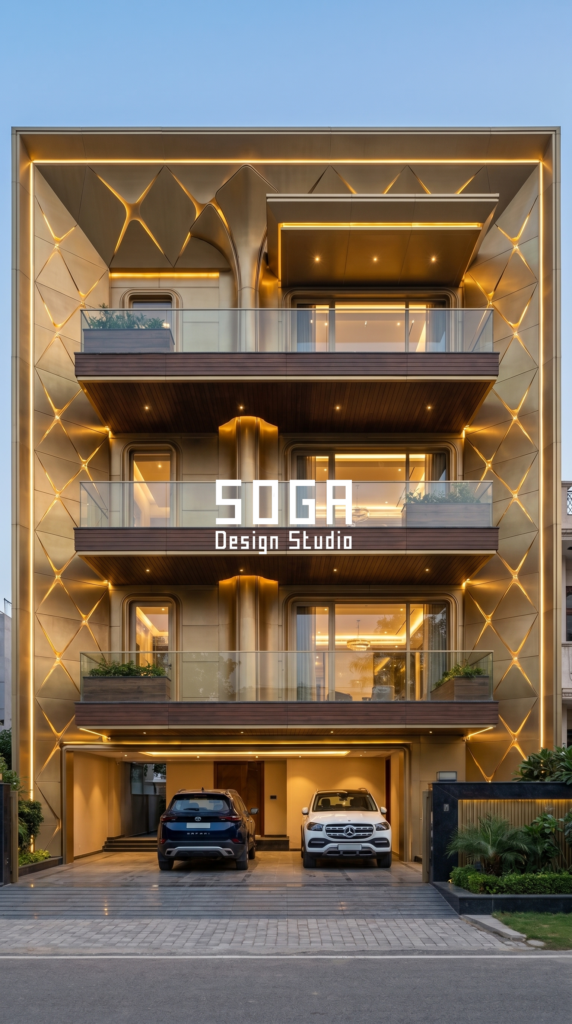
This building lives two lives.
By day, the facade is a field of large diamond-shaped aluminium panels, each angled slightly differently on a concealed sub-frame. Sunlight hits each facet at a different angle, creating a subtle three-dimensional relief across the elevation — some panels bright, some in shadow, the surface shifting as the sun moves. Pointed arch profiles emerge at the top floor, referencing heritage Indian and Islamic geometry. Dark wood-finish bands ground each balcony level with warmth.
Then the sun sets. And the building becomes something else entirely.
Warm LED strips embedded along the edge of every diamond panel illuminate the joints between them. The panels themselves become secondary — the light lines become the architecture. The entire facade transforms into a glowing geometric lattice that reads from across the neighborhood.
How the material makes this possible:
Each diamond panel is CNC-cut aluminium, powder-coated in a warm champagne finish. The faceted angles are achieved through a concealed sub-frame — the aluminium panels are lightweight enough that the sub-frame carries them without requiring heavy structural support. The LED channels are integrated into the panel joints during fabrication, not applied afterward. The lighting is weatherproof, permanent, and precisely aligned with the geometry because it’s part of the system, not an addition to it.
The pointed arch profiles at the roofline are not decorative add-ons. They’re the natural geometric conclusion of the diamond grid — the same parametric rule that generates the flat panels also generates the arch when the grid meets the building’s crown. One algorithm, carried to its conclusion.
What this project proves about aluminium:
A facade doesn’t end at sunset. Most Indian residential facades are designed for daytime photography and ignored at night. This building has equal presence in both conditions — from the same physical elements. The LED integration costs a fraction of the aluminium system but doubles the building’s impact by giving it a twenty-four-hour identity. Aluminium’s precision fabrication makes this dual-purpose approach possible — the channels for LED strips are milled into the panel edges during CNC cutting, not retrofitted.
Project 20: The Fish-Scale Curve
Design language: Overlapping aluminium shingles in a fish-scale pattern, following a sweeping doubly-curved form.
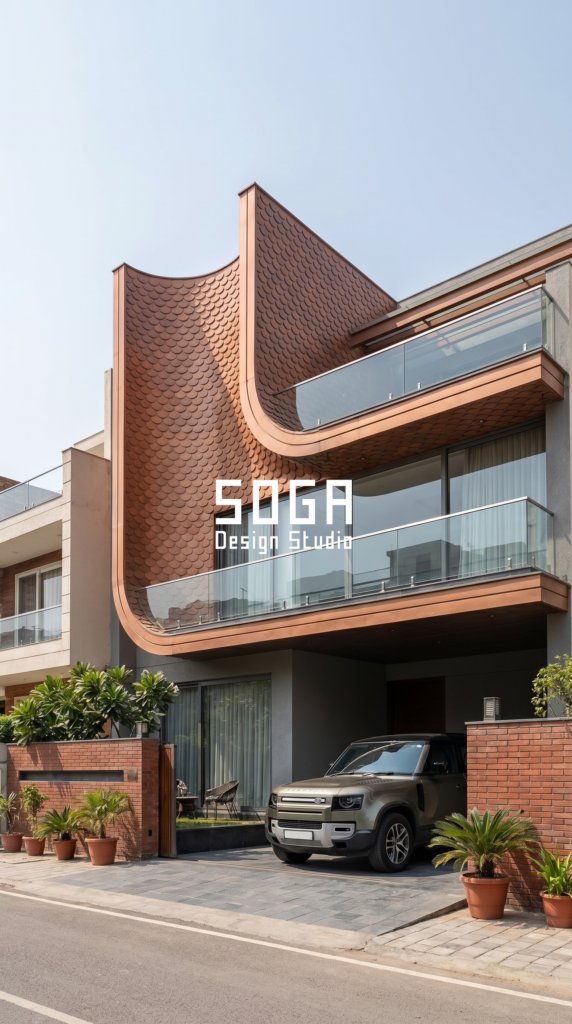
This is the project that makes people say: “That can’t be aluminium.”
It is.
Hundreds of overlapping circular shingles — each one individually cut and positioned — clad a sweeping curved volume that rises over the upper floor like a sculptural canopy. The copper-tone powder-coat finish gives the surface a warmth and depth that reads as handcrafted metalwork from the street. Below, a brick base grounds the building in its residential neighborhood context.
The fish-scale pattern creates a texture that no flat panel or smooth cladding can replicate. Every shingle edge catches light differently. Shadow pools in the overlaps. The surface shimmers slightly as viewing angle changes. It’s a material effect that usually belongs to couture or jewelry — scaled up to architecture.
How the material makes this possible:
Individual shingles on a doubly-curved surface present a precision challenge. On a flat wall, every shingle is identical. On a curve, each one sits at a slightly different angle, and the overlap must be maintained despite the changing surface geometry. The parametric model calculates the position, rotation, and overlap for every individual piece — generating a numbered fabrication drawing where each shingle has a designated location.
The copper-tone finish is powder-coated aluminium, not real copper. Real copper would patina green over time, weigh significantly more, cost substantially more, and require structural support that a residential building’s frame isn’t designed for. Aluminium achieves the same visual warmth at a fraction of the weight and cost, holds the finish permanently, and requires zero maintenance.
What this project proves about aluminium:
Texture is the most underused tool in Indian facade design. Most residential facades rely on flat surfaces with material changes to create interest. The fish-scale field creates interest from a single material by varying the surface relief at a fine grain. Aluminium’s formability — each shingle CNC-cut from flat stock — makes this level of textural detail fabrication-feasible at residential scale and budget.
Project 21: The Rotating Grid
Design language: Protruding bay window modules in a grid, each rotated to a different angle — a facade of rooms reaching outward.
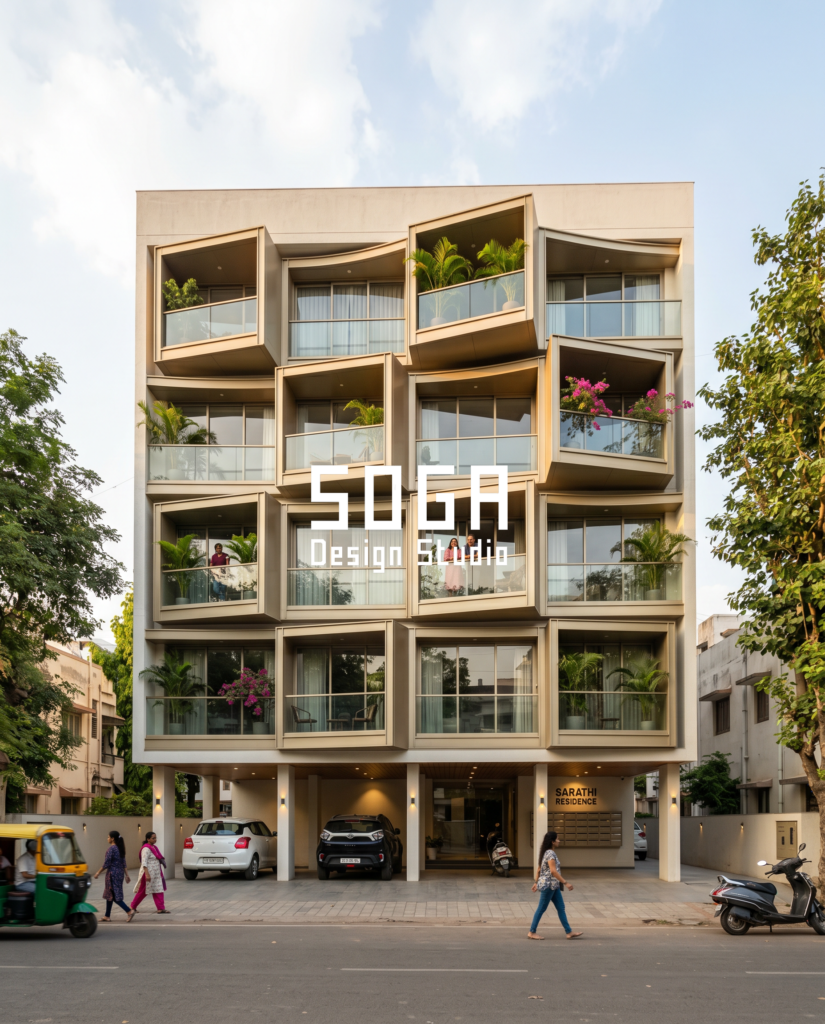
This facade is a building turned inside-out. Instead of hiding the living spaces behind a flat wall, it pushes them forward — each room projected outward in a bay window module, framed in aluminium, and rotated to a slightly different angle.
The rotation isn’t random. Each module is angled toward its optimal orientation — morning sun for bedrooms, street views for living rooms, garden-facing for quieter spaces. From the street, the varying angles create a dynamic surface that appears to twist gently. From inside each unit, the rotation creates a wider field of view and a deeper interior volume than a standard flat window.
People are visible in several modules — gardening, standing at the window, going about their day. Plants cascade from others. The facade is alive with the evidence of occupation. The name on the building — Sarathi Residence — and the busy Indian street context (auto-rickshaws, pedestrians) ground this firmly in everyday life.
How the material makes this possible:
Each bay window module has an aluminium-framed enclosure projecting from the structural slab. The rotation angle is parametrically optimized for three criteria: maximum useful daylight per unit, minimum overheating from direct sun, and maximum view angle toward the preferred direction. Aluminium’s strength-to-weight ratio allows these modules to cantilever outward without heavy structural reinforcement — the frames are self-supporting within the building’s standard structural grid.
The consistent warm tone across all modules — despite their varying angles — comes from a single powder-coat batch applied to all aluminium components before assembly. Material consistency across geometric variation: that’s what aluminium fabrication enables.
What this project proves about aluminium:
A facade can be a diagram of how people live. Most Indian residential facades present a uniform face to the street regardless of what’s happening behind it. This project makes every room’s orientation visible from outside — the angles tell you which way each space faces, which ones get morning light, which ones prioritize view. Aluminium framing makes this legible because the frames are precise, thin, and consistent — they disappear as structure and read as pure geometry.
Project 22: The Perforated Flow
Design language: Flowing perforated aluminium screens in S-curves alongside deep wood soffits — two aluminium systems in one composition.
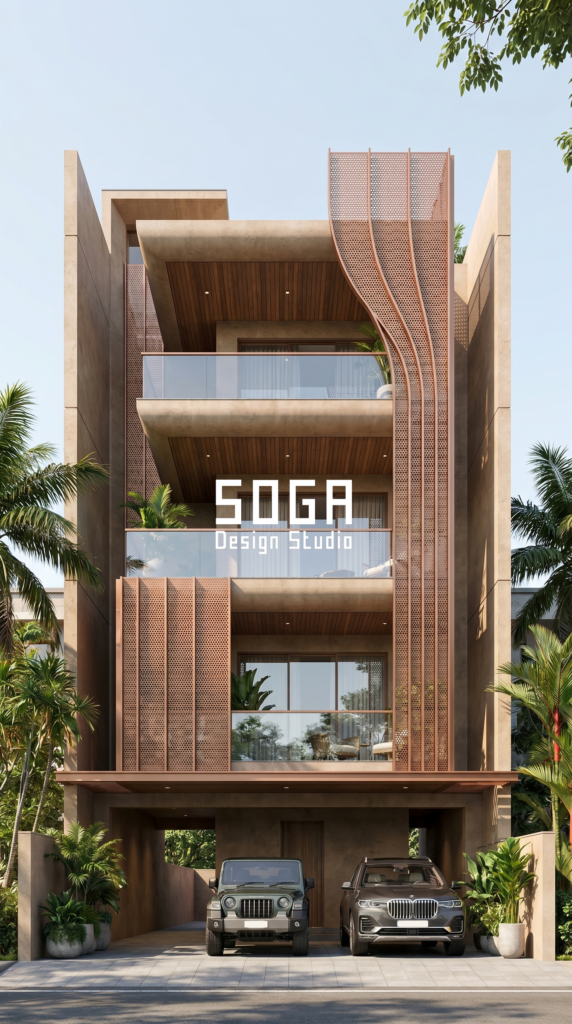
This facade combines two different aluminium expressions in a single elevation — and makes them feel like one idea.
On the right side, tall perforated metal screens flow in S-curves from ground to rooftop. Thousands of small circular holes punched through the aluminium surface filter light into soft, diffused patterns. The screens shimmer with a moiré effect when seen at an angle — the surface appears to shift and breathe as you move past it.
On the left and underneath each balcony, deep wood-finish aluminium soffits run horizontally, adding warmth and shadow. The perforated screens handle light and privacy. The solid soffits handle shade and material contrast. Together, they create a facade with three layers of depth: screen, soffit, glazing.
Tropical planting — palms, banana leaves, broad-leaf species — fills the gaps. The building doesn’t sit in nature. It participates in it.
How the material makes this possible:
The perforated screens are punched on flat aluminium stock, then roll-formed to the required S-curve radius. The parametric model adjusts the perforation pattern to account for the stretching that occurs during forming — ensuring the holes remain visually even after the sheet is curved. Without this computational compensation, the holes would distort and the pattern would look irregular on the curved sections.
The wood-finish soffits are the same aluminium substrate with a different powder-coat treatment — wood-grain transfer printing that replicates timber’s visual warmth without any of timber’s maintenance requirements. Two completely different visual effects — perforated metal lace and warm wood — from one base material and one maintenance regime (zero).
What this project proves about aluminium:
Two aluminium systems are better than one when they serve different purposes. The perforated screen controls light. The solid soffit controls shade. Together they create visual and environmental performance that neither achieves alone — without introducing a second material or a second maintenance schedule. It’s still all aluminium. It’s still all zero maintenance. But the range has doubled.
Project 23: The Monolithic Grid
Design language: Deep dark aluminium grid with cathedral-like recessed bays — architecture through shadow and proportion alone.
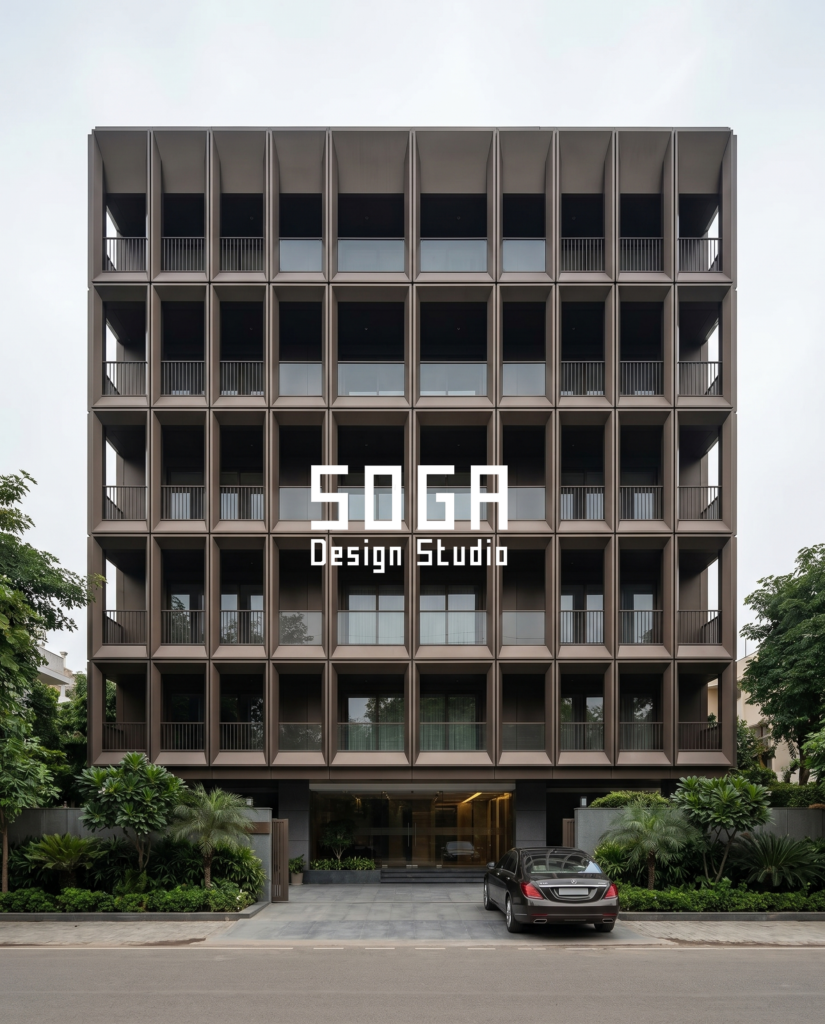
This is the heaviest facade in the entire series. And it’s the one that most completely disproves the assumption that aluminium must look light, thin, or metallic.
A deep grid of aluminium-clad bays creates a surface of profound shadow. Each bay recedes far enough that the glazing and balconies behind disappear into darkness. The facade reads as a solid mass with rectangular voids carved into it. The dark powder-coat finish absorbs light rather than reflecting it. On an overcast day, the building appears almost solid. On a bright day, sharp light catches the grid edges while the recesses hold black.
There is no ornament. No color variation. No secondary material breaking up the grid. Just proportion, depth, and shadow. The building says exactly what it is and nothing more.
How the material makes this possible:
The depth of each bay — the distance from the outer grid face to the glazing behind — is the design’s critical dimension. The parametric model tested depths from 300mm to 1200mm, evaluating interior daylight levels against exterior shadow intensity. The final depth maximizes shadow presence without compromising interior livability.
The grid members are aluminium-clad steel — aluminium provides the permanent dark finish and weather resistance, steel provides the structural depth to span each bay without intermediate supports. The hybrid construction is invisible from the street. It reads as one monolithic material. This is aluminium’s hidden capability: it can clad and protect structural steel, giving heavy engineering the appearance and maintenance profile of a lightweight, permanent-finish material.
Dense greenery at ground level provides the only softness — a deliberate contrast that makes the grid above feel even more imposing.
What this project proves about aluminium:
Aluminium can feel heavy. It can impersonate stone, concrete, or carved mass. Its actual properties — lightweight, maintenance-free, formable — allow it to create impressions of weight that would be prohibitively expensive in the materials people associate with heaviness. The question isn’t what aluminium looks like. It’s what you want the building to feel like. Aluminium will get you there — and then require nothing from you for decades.
Project 24: The Organic Wave Tower
Design language: Horizontal wave forms cascading down an eight-storey tower with integrated hanging gardens — the largest and most ambitious facade in the series.
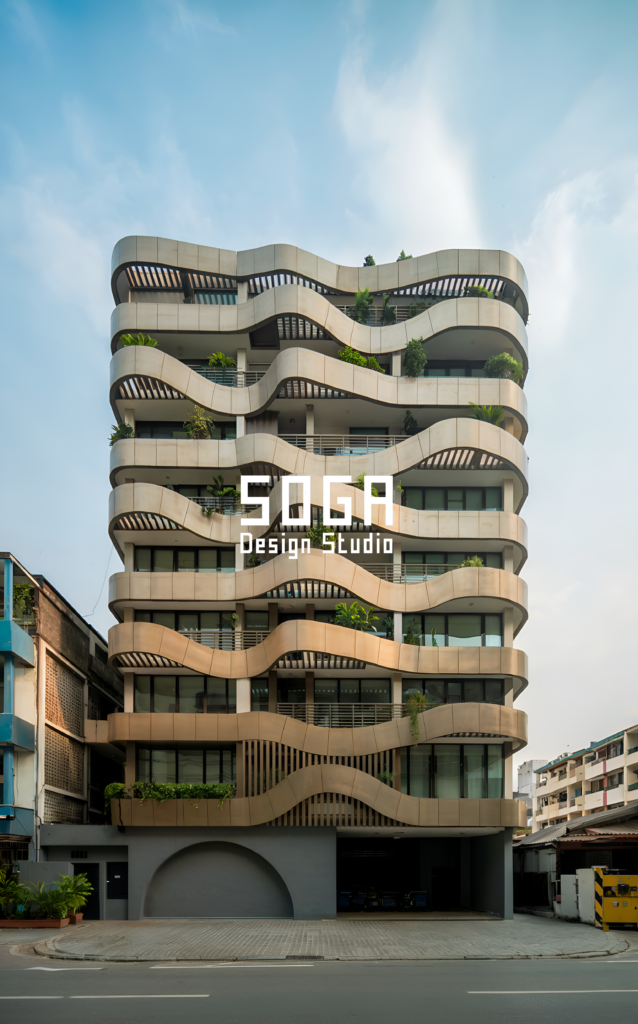
Eight floors. Horizontal waves rolling from rooftop to second level. Greenery growing from the wave crests. Dense urban context — flat rectangular buildings on every side, a typical Indian commercial street below.
This is the biggest gesture in twenty-four projects. And it’s the one that stretches aluminium the furthest from anyone’s default expectation of what the material can do.
The wave bands wrap the building at every level, creating a continuous organic rhythm that cascades downward with natural variation — wider and more pronounced on some floors, tighter on others, like actual ocean waves or geological strata. The building reads as something eroded or grown rather than constructed. Everything around it is rigid. This building flows.
Plants grow from the wave crests on multiple levels, adding a living dimension that changes with the seasons. The combination of flowing aluminium forms and cascading greenery creates a building that is simultaneously engineered and biological.
How the material makes this possible:
Each wave band is formed from curved aluminium panels mounted on a steel sub-frame that follows the computed wave profile. The wave geometry comes from a modified sine function with variable amplitude — amplitude increases slightly from bottom to top, creating a sense of expansion as the building rises.
The planting troughs are structurally integrated into the wave crests — formed aluminium with drainage, waterproofing, and soil retention designed into the panel system. The plants are not pots placed on ledges. They’re designed into the wave geometry from the first parametric model, with drainage paths following the wave profile downward. Aluminium’s corrosion resistance makes it suitable for permanent contact with soil and moisture — unlike steel, which would rust, or wood, which would rot.
At eight floors, the total wave-panel surface area is substantial. The parametric model generates a panel schedule with unique numbering for every piece. Site assembly follows the sequence from bottom to top. The complexity is resolved in the digital model. The site work is methodical.
What this project proves about aluminium:
Scale changes the ambition but not the material. The same aluminium that makes a three-floor residential louver facade makes an eight-floor organic wave tower. The weight-to-strength ratio is what enables a gesture this bold — the same form in stone or concrete would require a fundamentally different (and more expensive) structural system. Aluminium lets you dream at city scale and build at residential cost.
What twenty-four projects prove about one material
The evidence across four installments is now comprehensive.
Aluminium has become: flowing louvers, diagonal sweeps, heritage arches, diamond facets, fish-scale shingles, rotating bay frames, perforated lace screens, monolithic shadow grids, and organic wave towers carrying living gardens.
No other single building material in Indian construction can claim this range.
The reasons are not marketing. They’re physical:
Formability. Aluminium can be extruded, rolled, bent, punched, perforated, folded, and CNC-cut into virtually any profile. Whatever geometry a parametric model generates, aluminium can follow.
Weight. The strength-to-weight ratio means ambitious forms don’t overload the building structure. Deep grids, cantilevered waves, protruding bay modules — all feasible without extraordinary engineering.
Durability. Anodized or powder-coated aluminium holds its finish permanently in Indian conditions. Monsoon, 45-degree summers, pollution, dust. No fading, no chalking, no recoating. Year twenty looks like year one.
Finish range. One substrate finished to look like copper, bronze, dark steel, warm wood, raw concrete, matte black, champagne gold, or any custom color. The material disappears behind whatever identity the project demands.
Sustainability. 100% recyclable with no loss of properties. The embodied energy is recoverable at end-of-life.
Maintenance. Zero. The single most important word in Indian construction, where monsoons, dust, and pollution attack every exterior surface relentlessly. Aluminium doesn’t care. It endures.
About SOGA Design Studio
SOGA Design Studio is a parametric and computational architecture firm based in Gurugram, India, co-founded by Gajender Jaiswal and Sonali Jaiswal. With 900+ facade projects across India, Dubai, and Singapore, the studio pushes aluminium further than any other facade practice in the region.
Core belief: Aluminium has no upper limit. Only design thinking has limits — and ours keeps expanding.
Products: SOGA Louver — proprietary aluminium louver system engineered for parametric variation.
Website: sogadesignstudio.com Instagram: @sogadesignstudio Enquiries: [Contact details]
The Complete Facade Series
→ One Louver, Six Facades: Part 1 → 12 Facades, 1 Studio: Part 2 → 18 Facades, 1 Studio: Part 3 → How Much Does a Building Facade Cost? → Modern vs Traditional Facade Designs → How to Make Your Facade More Interesting → Facade Trends 2026 → Why Hire a Facade Specialist vs General Contractor?
FAQ (Schema markup ready)
Q: Can aluminium facades look like copper or wood? A: Yes. Powder-coated aluminium finishes accurately replicate the visual appearance of copper (Project 20), wood grain, dark steel (Project 23), and virtually any custom color. The match is indistinguishable at normal viewing distances, while the aluminium substrate provides zero-maintenance durability that natural materials cannot match.
Q: Can aluminium panels be curved on complex surfaces? A: Yes. SOGA Design Studio uses parametric modeling to generate aluminium panel layouts for doubly-curved geometries like the fish-scale facade (Project 20) and organic wave tower (Project 24). Each panel is individually calculated for its position on the curved surface.
Q: How does integrated LED facade lighting work? A: LED strips are embedded into aluminium panel joints during fabrication, as shown in Project 19. The channels are CNC-milled into panel edges, making the lighting weatherproof, maintenance-free, and permanently aligned with the facade geometry.
Q: Is aluminium strong enough for deep facade grids? A: Yes. Project 23 demonstrates aluminium-clad bays with depths exceeding 600mm. For deep elements, aluminium is paired with a steel sub-frame for structural spanning — the aluminium provides the permanent finish and weather resistance.
Q: Can aluminium facades support living plants? A: Yes. Project 24 shows aluminium wave bands with integrated planting troughs — drainage and waterproofing designed into the panel system. Aluminium’s corrosion resistance makes it suitable for continuous contact with soil and moisture.
Q: How does SOGA Design Studio achieve different looks from one material? A: Through computational design. The parametric process generates facade solutions from project constraints — the same aluminium substrate is formed into diamonds, shingles, waves, grids, and perforated screens based on each project’s requirements. Aluminium’s formability means it follows virtually any geometry the model generates.