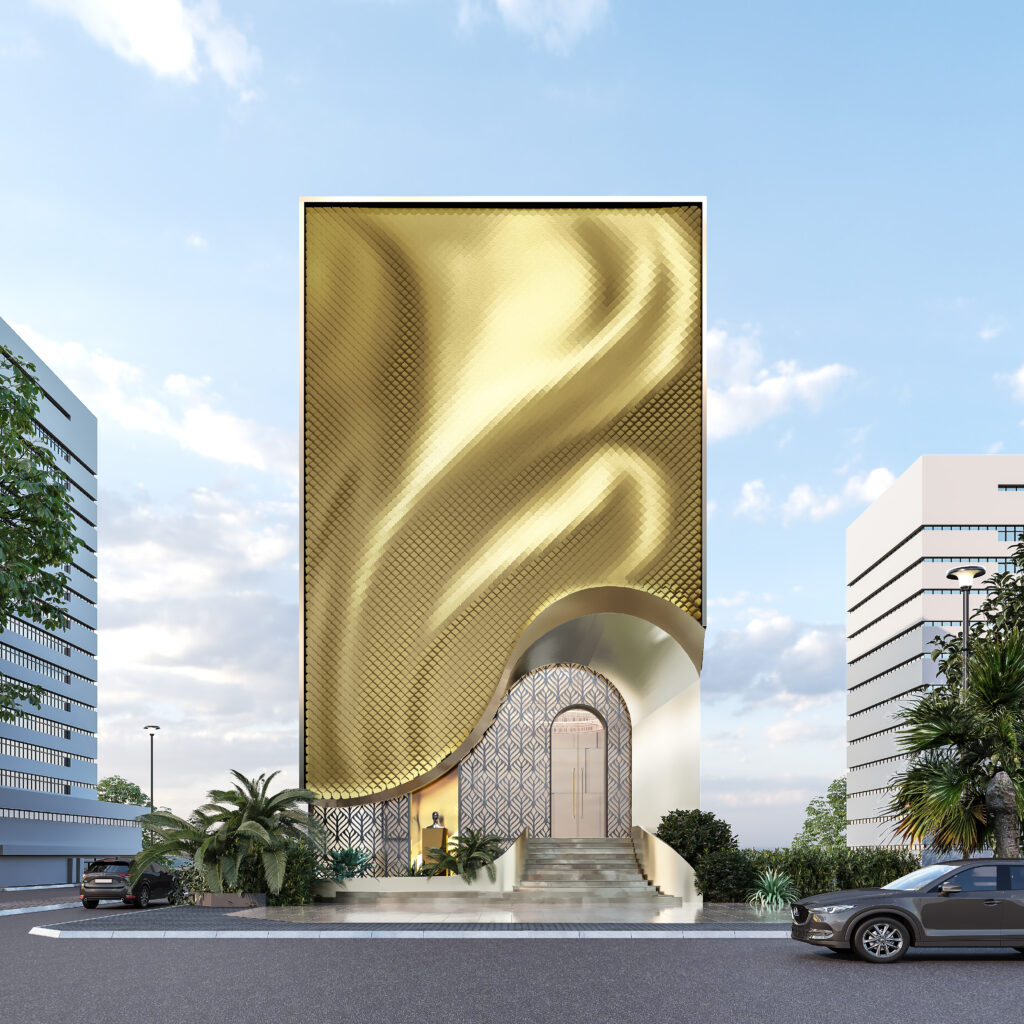
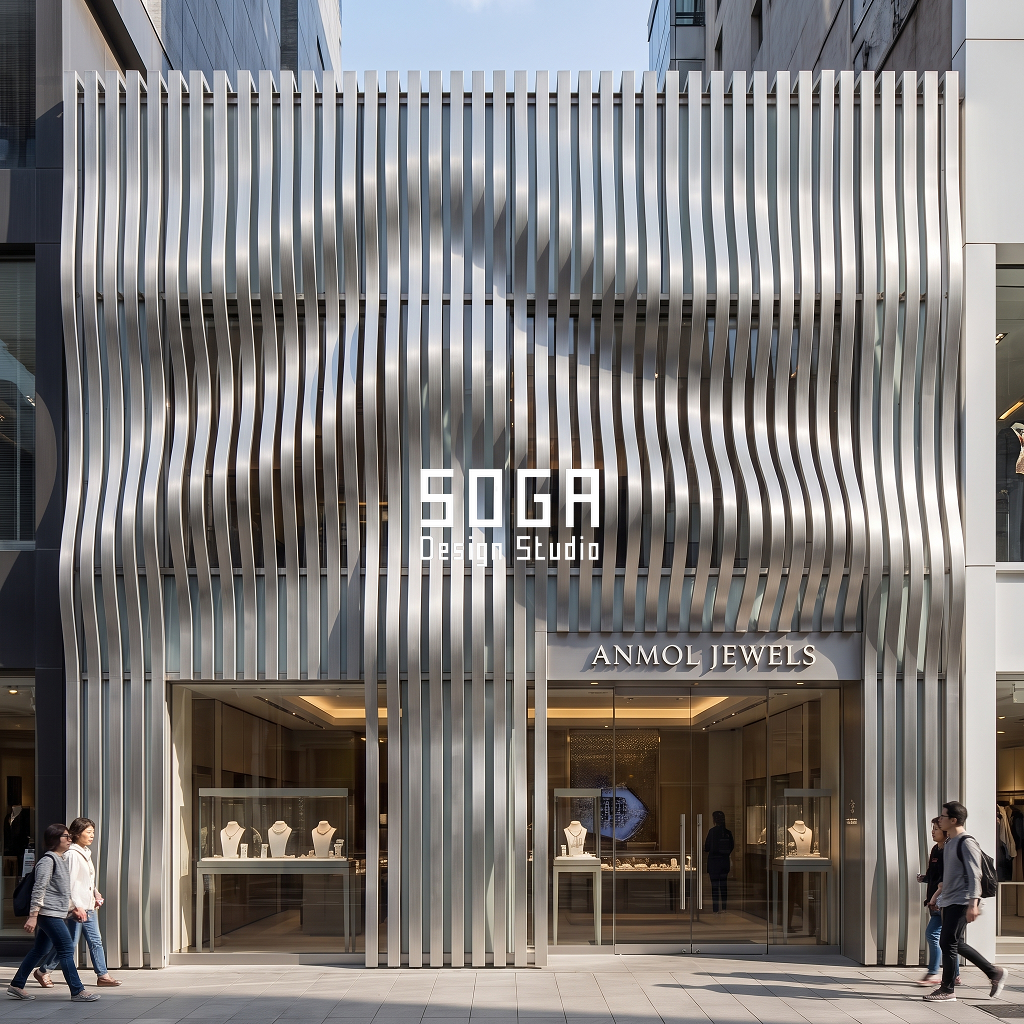
By SOGA Design Studio | Part 2 of Our Facade Series
Most studios have a signature style. We have a signature process.
Walk through any architecture studio’s portfolio and you’ll notice a pattern within the first five projects. Curved forms. Or sharp angles. Or minimal grids. Or heavy material palettes. Every studio gravitates toward a visual language — a comfort zone that becomes a brand.
We never developed one.
Twelve projects into this series — organic twists, sharp angular volumes, cathedral vaults, quiet horizontal bands, golden canopies, controlled compositional chaos — and the only visual thread connecting them is the absence of repetition.
That’s not an accident. It’s a design decision.
SOGA Design Studio runs on computational thinking — a process-driven approach where the facade emerges from each project’s unique constraints, not from a preset aesthetic the studio carries from job to job. The software is the same. The methodology is the same. The rigor is the same. The output is different every single time, because every client, site, budget, and aspiration is different.
This article walks through six facades that demonstrate that range — and explains why the thinking behind each one matters more than the look of any one of them.
Project 7: Organic Forms That Twist and Defy Gravity
Design language: Flowing, biomorphic ribbons that spiral upward — architecture that feels grown, not built.
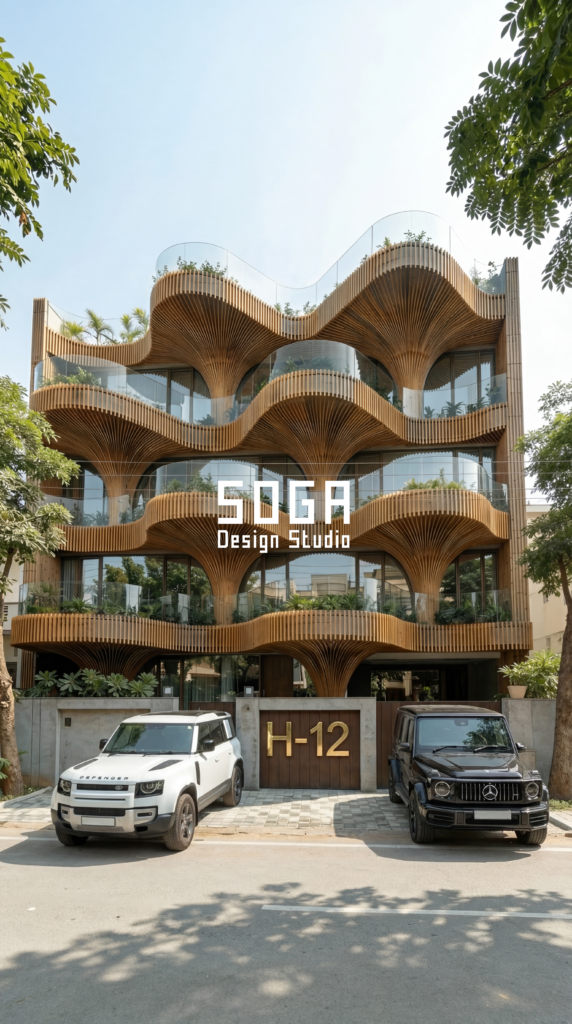
There are facades that sit on a building, and then there are facades that become the building. This project crosses that line. Warm-toned organic ribbons twist and spiral through the elevation, creating deep overhangs, integrated planter shelves, and a form that looks less like something an architect drew and more like something that grew out of the ground.
The organic twists serve a real purpose beyond visual drama. Each spiral creates a deep canopy over the floor below — providing shade without blocking views. The twist geometry is parametrically generated from solar analysis: the ribbon widens where sun exposure is highest and narrows where natural light is welcome. The form follows the data.
Plants cascade from every level, growing within the ribbons themselves. The facade blurs the line between architecture and landscape — a building that breathes, grows, and changes with the seasons.
Why this approach works for this project: The client wanted a home that felt alive. Not in a metaphorical sense — literally alive, with plants integrated at every level and a form that suggested growth rather than construction. The organic twist geometry gave us a way to create deep planting surfaces at every floor while maintaining structural logic. The warmth of the material palette reinforced the living, natural quality the client was after.
The design principle at work: Architecture doesn’t have to look constructed. When the parametric model draws from natural growth patterns — branching, spiraling, expanding — the result can feel biological even though it’s built from steel and aluminium. The computational tool doesn’t care whether the input is geometric or organic. It processes both with equal precision.
Project 8: Sharp Blue Angular Volumes — Bold and Unapologetic
Design language: Dark angular planes in deep blue — geometric, hard-edged, zero softness.
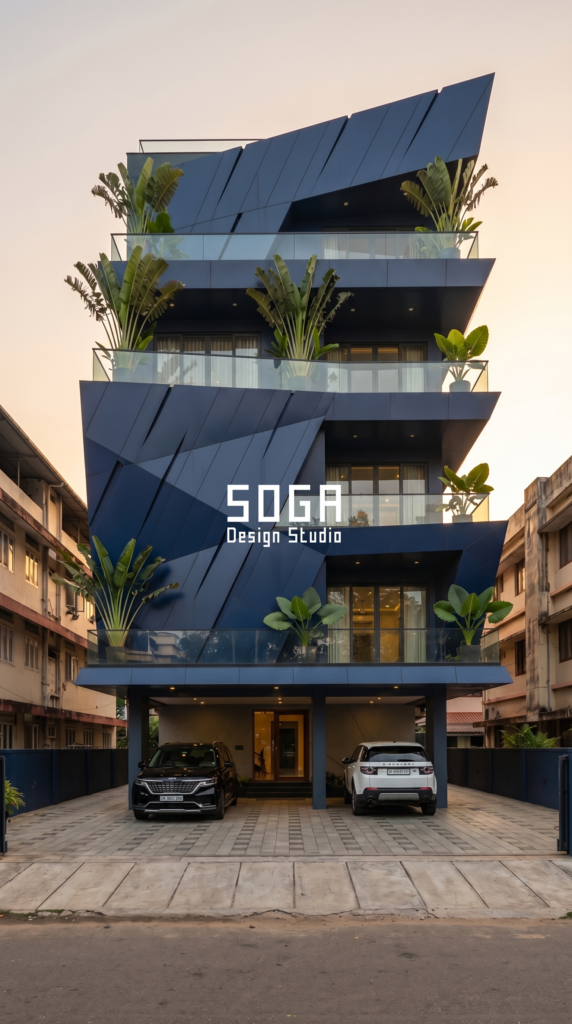
From the organic spiral to this: sharp blue angular volumes cutting through space with no apology. No curves. No warmth. No greenery. Just hard planes meeting at precise angles, creating a facade that reads as simultaneously modern and aggressive.
The deep blue ACP panels wrap the building in geometric origami — some planes pushing forward, others receding, creating a three-dimensional composition that shifts dramatically depending on where you stand. Morning light catches one set of surfaces. Afternoon light catches another. The building is never visually static.
At street level, the angular volumes frame the entrance and parking with the same precision, carrying the design language from sky to ground without breaking character.
Why this approach works for this project: The client brief was one word: bold. Not warm. Not inviting. Not blending in. Bold. On a street of beige and brown buildings, this project needed to be the one you couldn’t ignore. The angular blue volumes deliver that presence with total conviction. The facade doesn’t ask you to like it. It asks you to notice it.
The design principle at work: Not every facade needs to be friendly. Some projects demand confrontation — a visual statement that says “I am here and I am not apologizing for it.” The computational process serves this energy as effectively as it serves organic softness. The process is emotionally neutral. The designer’s intent shapes the outcome.
Project 9: Pointed Vaults Rising Like Cathedral Arches Between Floors
Design language: Pointed arch forms spanning between floor slabs — heritage cathedral geometry rendered in contemporary material.
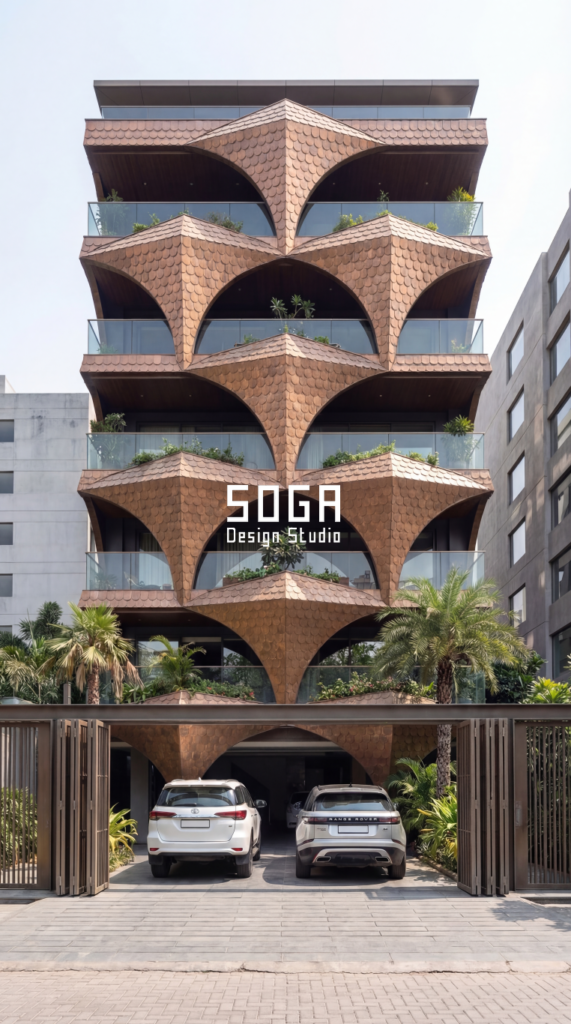
This is the project that makes architects do a double-take. Because it doesn’t look like what anyone expects from a computational design studio. It looks like heritage architecture — pointed arches rising between floors, creating a rhythmic colonnade that references Mughal gateways, Gothic cathedrals, and Rajasthani palace screens simultaneously.
But look at the material. These aren’t carved stone arches. They’re computationally generated curved forms in metal, each arch precisely calculated to span the structural bay while creating maximum visual impact at the street level. The warmth of the finish connects to Indian craft traditions. The precision of the geometry belongs entirely to the digital age.
The pointed vaults create deep recesses on each floor — natural shade pockets that keep the interiors cool while giving the facade a dramatic depth that flat screens can never achieve.
Why this approach works for this project: The client wanted their home to feel rooted in Indian architectural history without looking like a period reproduction. That’s a delicate balance — too traditional and it becomes pastiche, too modern and it loses the connection to heritage. The pointed vault geometry solved this by abstracting a recognizable heritage form (the arch) into a contemporary material and parametric logic. It feels Indian. It feels modern. It feels like neither is trying to overpower the other.
The design principle at work: Parametric design is not a style. It is a method. Feed it arch geometry and it produces heritage-inflected facades. Feed it sine waves and it produces flowing organic forms. Feed it angular planes and it produces sharp geometric volumes. The computational tool is culturally and stylistically neutral. It serves whatever language the project demands.
Project 10: Warm Horizontal Bands — Proof That Quiet Carries Power
Design language: Clean horizontal lines in warm wood-shade — minimal, measured, deliberately understated.
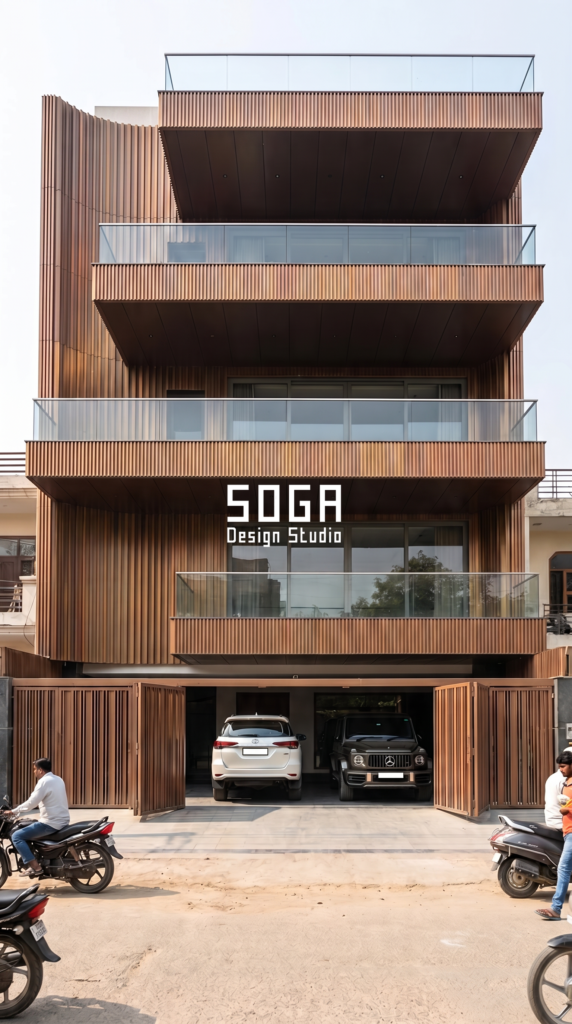
After the cathedral arches, this project lands like a long exhale. Horizontal bands of warm material wrap the facade in quiet, parallel lines. No curves. No dramatic angles. No heritage references. No greenery. Just clean horizontals, warm tones, and a building that trusts its simplicity to carry the elevation.
The horizontal orientation is rare in Indian residential facades — most default to vertical louvers or mixed materials. Going horizontal changes everything about how the building reads. It feels wider, calmer, more grounded. The eye moves across rather than up, creating a sense of stability and rest.
The warm wood-shade finish connects this project materially to the organic and heritage projects in this series, but the design language is entirely different. Proof that the same material palette can speak in whispers just as effectively as it speaks in exclamations.
Why this approach works for this project: The client didn’t want a landmark. They wanted a home that felt considered, well-made, and calm. Not every person building a house wants their facade to start conversations. Some want it to end them — to settle the question of quality quietly and permanently. This facade serves that client with total honesty.
The design principle at work: Quiet design is harder than loud design. Adding another curve, another material, another detail is always easy. Removing until only the essential remains — and making that essential feel complete rather than unfinished — requires a confidence that most studios develop only after they’ve proven they can do loud. We’ve done loud. This project proves we can do quiet with the same conviction.
Project 11: Golden Fins With a Dramatic Angular Canopy
Design language: Vertical golden fins meeting a bold angular canopy element — two systems in tension.
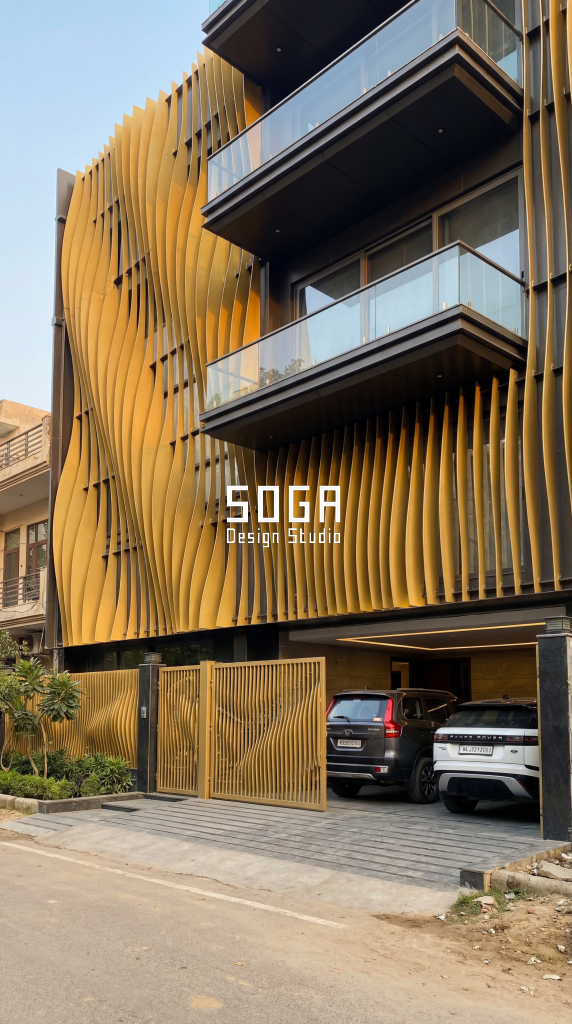
This facade operates on contrast. Warm golden vertical fins create a consistent, rhythmic screen across the elevation — ordered, disciplined, predictable. And then a dark angular canopy element cuts across them diagonally, disrupting the order and creating a focal point that anchors the entire composition.
The tension between the two systems — the regular fin rhythm and the irregular angular cut — gives the building an energy that neither system would have on its own. The fins alone would be pleasant but forgettable. The angular element alone would be dramatic but unresolved. Together, they create a facade that feels both controlled and dynamic.
The golden finish catches afternoon light with particular intensity, turning the upper floors into a warm glow while the dark angular element reads as shadow and weight. The contrast amplifies throughout the day as the sun moves.
Why this approach works for this project: The client wanted both order and surprise — a home that felt composed overall but had a moment of visual drama that made it memorable. The two-system approach delivers exactly that: the fins provide the order, the angular canopy provides the surprise. The building is calm from a distance and exciting up close.
The design principle at work: A facade doesn’t need to be one system or one language. Two systems in deliberate tension can create more interest than either one alone — as long as the tension is designed, not accidental. The parametric model here generates both systems simultaneously, ensuring they intersect at precisely the right point for maximum visual impact.
Project 12: Protruding Volumes and Vertical Rhythm in Controlled Tension
Design language: Sharp protruding volumes meeting a strong vertical fin system — compositional complexity held in precise balance.
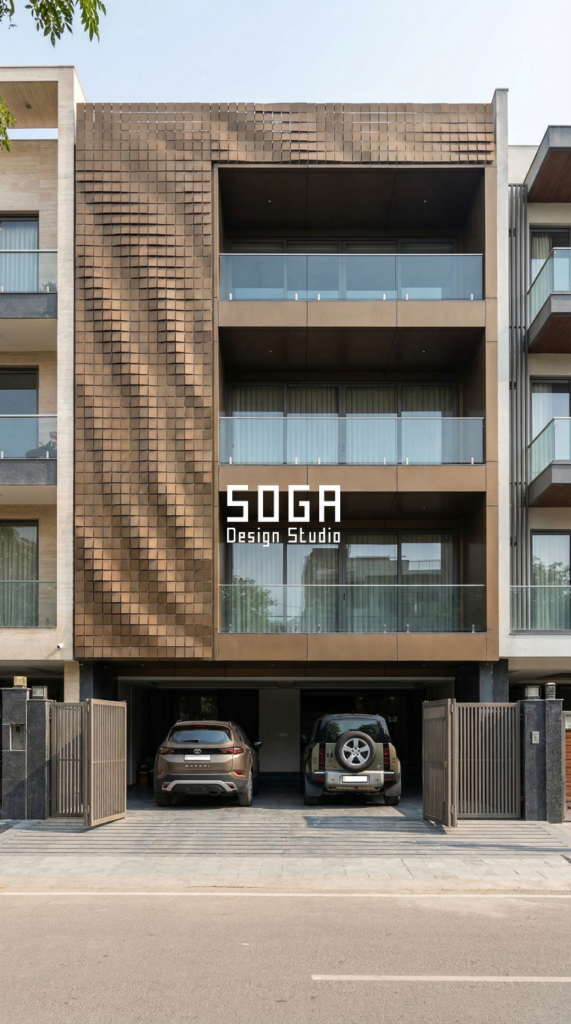
The final project in this series brings together several ideas that appeared separately in earlier projects — angular volumes, vertical rhythm, material contrast, compositional tension — and layers them into the most complex elevation in the set.
Dark protruding volumes push outward from the building face at different depths on different floors, creating a staggered, asymmetric composition. Between them, vertical fins in a warmer tone maintain a consistent background rhythm. The result reads as controlled chaos — every element precisely placed, but the overall effect is dynamic, layered, and visually dense.
This is the kind of facade that rewards repeat viewing. Walk past it once and you register “interesting building.” Walk past it ten times and you notice a new relationship — between two volumes, between a shadow and a fin, between the stagger on the second floor and the alignment on the fourth — every time.
Why this approach works for this project: The narrow urban plot meant the facade had to carry enormous visual weight on a single frontage. A simple louver screen would have been too flat. A single bold gesture would have been too one-note for the scale. The layered composition — volumes plus fins plus stagger — creates enough complexity to hold the eye at tower scale, while the consistent material palette and precise parametric placement keep it from tipping into chaos.
The design principle at work: Complexity and chaos are not the same thing. A facade can be visually complex — many elements, many depths, many relationships — while remaining compositionally controlled. The parametric model ensures that every element relates to every other element through consistent rules, even when the visual outcome looks free and spontaneous. That’s the difference between designed complexity and decorated confusion.
What twelve projects reveal about how a studio should work
Twelve facades. Organic to angular. Heritage to futuristic. Loud to quiet. Warm to cool. Not a single visual thread connecting any two of them — except the quality of thinking behind each one.
This is deliberate. And it’s worth explaining why.
A signature style is a crutch. Studios develop signature styles because it’s efficient — once you’ve solved a problem one way, solving every subsequent problem the same way is faster, cheaper, and lower-risk. But it means every client gets a version of the same answer, regardless of whether that answer fits their question. Computational design eliminates this trade-off. The process generates solutions from constraints, not from precedent. Speed and customization aren’t opposed. They’re built into the same tool.
Clients deserve their own building, not a variation of someone else’s. When a homeowner invests their life savings in a residence, or a developer commits capital to a commercial project, they deserve a facade that was designed for their specific site, their specific climate, their specific vision. Not a template that was designed for a different client three projects ago and reskinned with a different color.
Range is the real proof of capability. Any studio can show you one great project. The question is whether they can show you twelve projects that look nothing like each other — and explain the thinking behind every single one. That’s the difference between a studio with talent and a studio with process. Talent produces peaks. Process produces consistency across range.
The SOGA Design Studio Process
Every project in this series — regardless of its visual language — was generated through the same computational workflow:
Step 1: Constraint mapping. We begin with the site (orientation, setbacks, surroundings), the climate (sun path, monsoon direction, temperature range), the building code (FAR, height, coverage), and the client’s vision. These constraints define the design space — the boundaries within which solutions must live.
Step 2: Parametric modeling. Using Rhino and Grasshopper, we build a parametric model that generates facade solutions from the constraints. The model can vary fin spacing, curve profiles, material depths, opening positions, and hundreds of other parameters — testing thousands of combinations in minutes rather than weeks.
Step 3: Performance optimization. Every generated solution is evaluated against performance criteria — solar control, ventilation, privacy, structural efficiency, fabrication feasibility. The model isn’t looking for the most dramatic solution. It’s looking for the solution that performs best across all criteria simultaneously.
Step 4: Fabrication output. The final design is translated directly into fabrication-ready drawings — DXF files, panel schedules, connection details — that go to the fabricator without requiring manual redrawing. The digital model IS the construction document.
Step 5: Site assembly. Components arrive pre-finished, pre-drilled, and labeled. Assembly follows a numbered sequence. The complexity lives in the digital model, not on the construction site.
This process takes the same amount of time whether the output is an organic spiral or a sharp angular volume. The tool doesn’t care about style. It cares about precision.
About SOGA Design Studio
SOGA Design Studio is a parametric and computational architecture firm based in Gurugram, India, co-founded by Gajender Jaiswal and Sonali Jaiswal. With 900+ facade projects delivered across India, Dubai, and Singapore, the studio works across residential, commercial, and institutional scales.
Core belief: Most studios have a signature style. We have a signature process.
Products: SOGA Louver — proprietary aluminium louver system engineered for parametric variation in Indian climate conditions.
Website: sogadesignstudio.com Instagram: @sogadesignstudio
Related reading
→ One Louver, Six Facades: Part 1 → 12 Facades, 1 Studio: Part 2 → 18 Facades, 1 Studio: Part 3 → How Much Does a Building Facade Cost? → Modern vs Traditional Facade Designs → How to Make Your Facade More Interesting → Facade Trends 2026 → Why Hire a Facade Specialist vs General Contractor?
FAQ (Schema markup ready)
Q: Does SOGA Design Studio have a signature facade style? A: No. SOGA Design Studio deliberately avoids a signature style. The studio uses a computational design process that generates unique facade solutions from each project’s specific constraints — site, climate, budget, and client vision. This process-driven approach means no two SOGA facades look alike across 900+ completed projects.
Q: Can computational design create traditional or heritage-style facades? A: Yes. As demonstrated in Project 9 (Pointed Vaults), SOGA’s parametric process can generate heritage-inflected facades — including Mughal arch profiles, Rajasthani screen patterns, and Gothic vault geometries — using modern materials and computational precision. The tool is style-agnostic and serves whatever architectural language the project requires.
Q: What software does SOGA Design Studio use for facade design? A: SOGA Design Studio uses Rhino and Grasshopper for parametric modeling, combined with environmental analysis tools for solar and ventilation optimization. The computational workflow generates facade solutions from project constraints and produces fabrication-ready drawings (DXF files, panel schedules) directly from the digital model.
Q: Can SOGA Design Studio do both loud and minimal facade designs? A: Yes. The studio’s portfolio ranges from highly expressive facades (organic twists, angular volumes, cathedral vaults) to deliberately quiet designs (horizontal bands, simple vertical rhythms). The computational process adapts to any design intent — restraint requires the same precision as expression.
Q: How does SOGA’s design process work from start to finish? A: The process follows five steps: constraint mapping (site, climate, code, client vision), parametric modeling , performance optimization (solar, ventilation, privacy, structure), fabrication output (DXF files direct to fabricator), and site assembly (pre-finished components in numbered sequence). This process works identically regardless of the facade’s visual style.
Q: How many different facade styles can SOGA Design Studio deliver? A: There is no fixed number. Because the computational process generates facades from constraints rather than templates, the studio can deliver any style — organic, geometric, heritage, minimal, sculptural, or hybrid. Across 900+ projects, no two facades have been visually repeated.