How SOGA Design Studio Crafted a Parametric Facade That Turns a Mixed-Use Building Into Architectural Poetry
Project: Odisha Mixed-Use Development | Studio: SOGA Design Studio | System: Para-Timber Ribbon Screen | Material: Engineered Wood Louvers + Bronze Metal Cladding | Solar Shading: 40–45%
Where Timber Meets Sky: The Odisha Facade That Is Redefining Mixed-Use Architecture in India
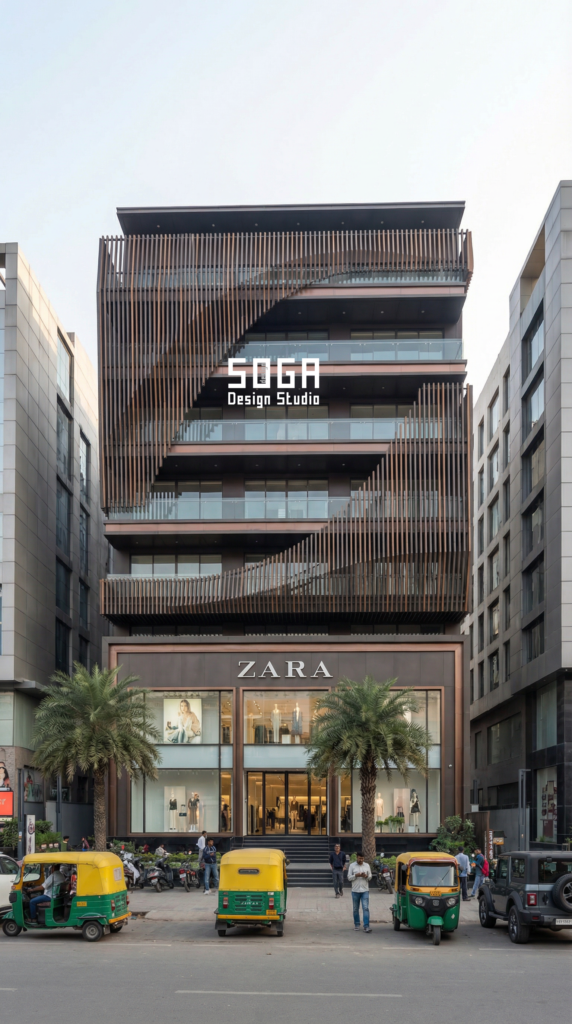
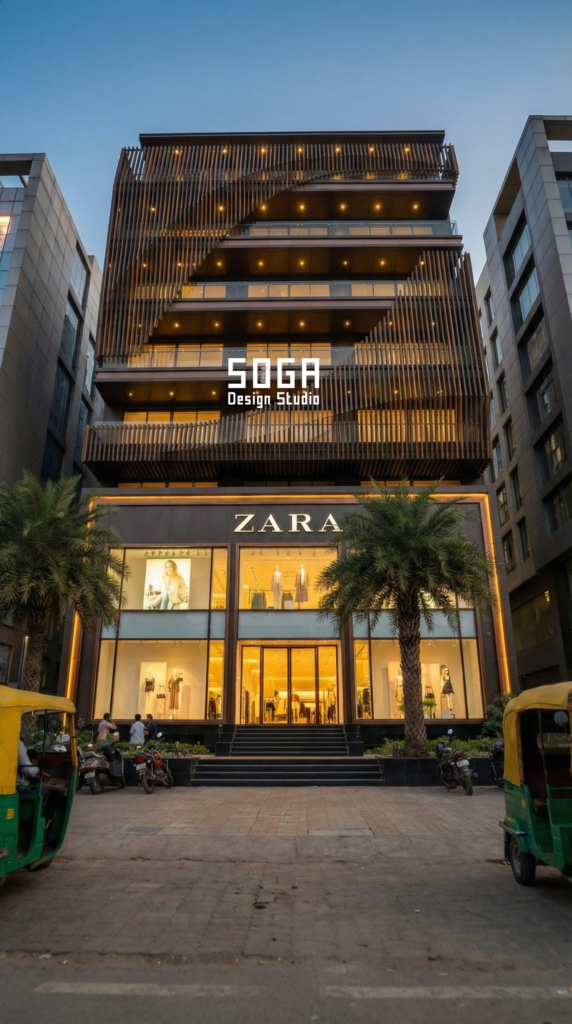
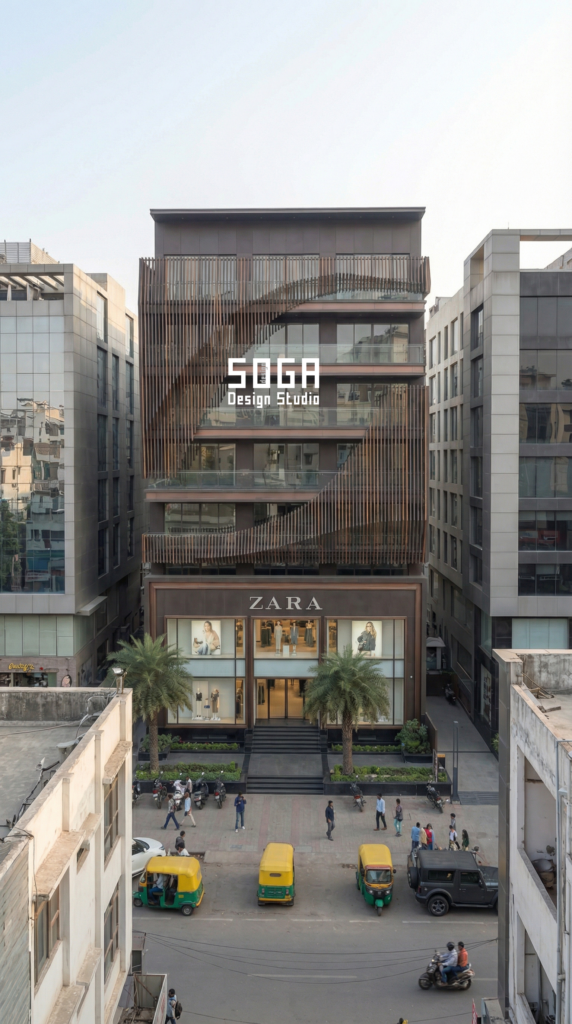
There is a moment — standing on a dusty Odisha street, the afternoon sun blazing overhead — when you look up at this building and feel something shift. It is not merely a structure. It is a rhythm. A cascade of warm timber ribbons flows from the ground-floor retail base upward across multiple residential levels, each wooden louver tilted at a precisely calculated angle, each horizontal band spaced with mathematical intention. The result is a facade that breathes, that filters, that performs — and that stops pedestrians mid-stride.
This is the Odisha Mixed-Use Development, one of the most thoughtfully executed parametric facade projects ever delivered in eastern India. Designed and engineered by SOGA Design Studio — the acclaimed parametric design practice with studios in India and Dubai — this building represents a quantum leap in how mixed-use elevation design is conceived, computed, and constructed.
In a country where architecture so often defaults to glass curtain walls or inert stone cladding, the Odisha facade breaks the mold decisively. The Para-Timber Ribbon Screen wrapping this building is not decorative afterthought. It is a fully integrated computational design system that controls solar gain, manages privacy between retail and residential zones, and creates a visual identity so compelling that the building has already become a landmark in its neighbourhood.
India’s architectural landscape is at an inflection point. As cities from Bhubaneswar to Bengaluru mature and urbanize, the demand for buildings that combine beauty with intelligence has never been greater. SOGA Design Studio has answered that demand here with a building that is simultaneously rooted in the warmth of natural materials and powered by the precision of parametric design in India’s most sophisticated computational workflows.
This article takes a comprehensive look at the Odisha Mixed-Use Development — from the first algorithmic sketches to the final installation of 1,400-plus individually dimensioned timber louvers. We will explore the parametric facade system in granular detail, trace the computational design methodology that produced it, examine its performance metrics and sustainability credentials, and understand why SOGA Design Studio is the name that progressive developers across India and Dubai call when they want architecture design that matters.
Welcome to architectural poetry, written in wood and bronze, computed in algorithms, and built in the heart of Odisha.
The Para-Timber Ribbon Screen: A Facade System That Flows Like Water
First Impressions: The Visual Grammar of the Building
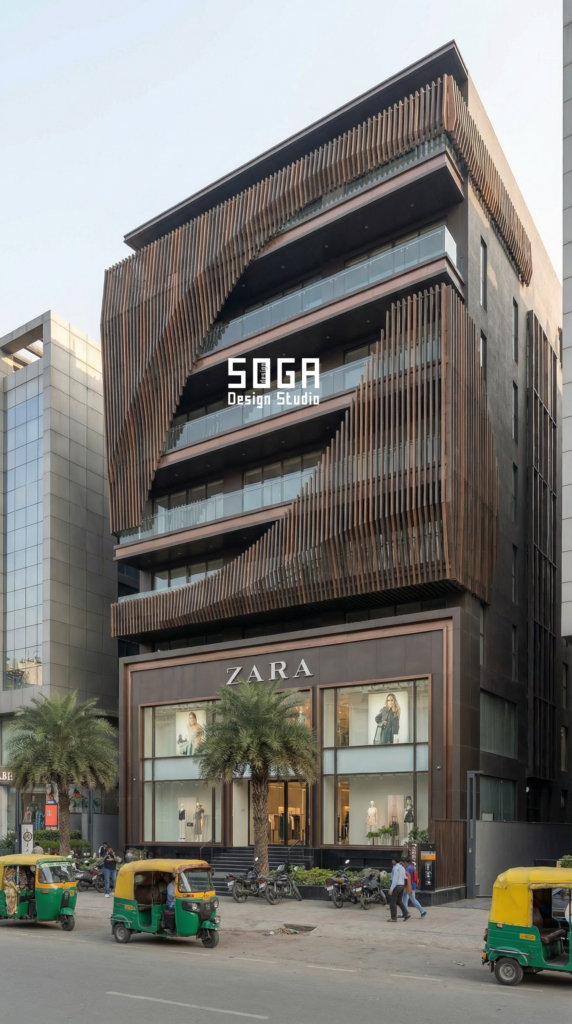
The Odisha Mixed-Use Development presents itself to the street in two distinct registers, each carefully composed and each speaking a different material language. The ground floor — housing the retail level — is clad in deep bronze-finish metal panels, their warm metallic tone anchoring the building to the earth, creating a solid, prestigious base that signals quality and permanence. Above this metallic plinth, everything changes.
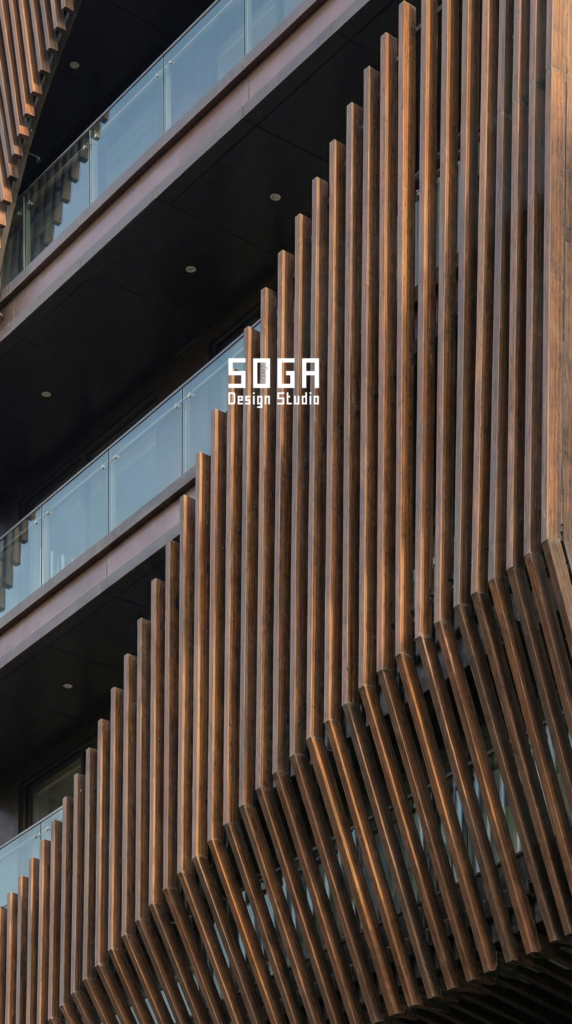
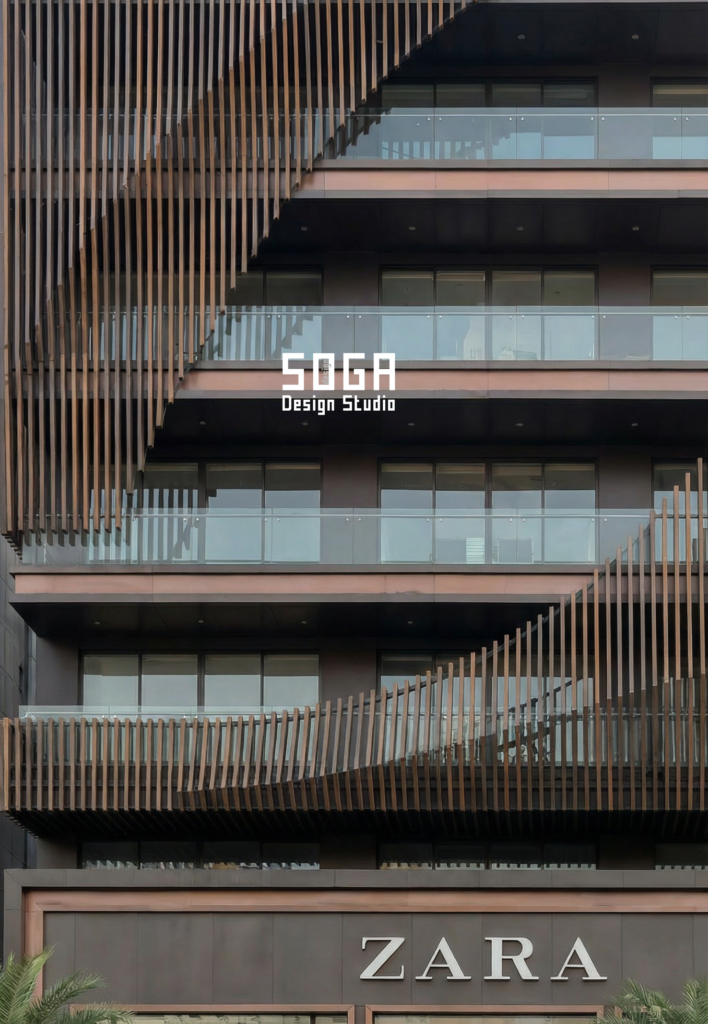
From the first floor upward, the Para-Timber Ribbon Screen takes command. Wide horizontal bands of engineered timber louvers — rich brown, almost burnished — project from the building face and sweep across each residential level in rhythmic repetition. The louvers are not uniform. Their depth, their pitch angle, and their spacing vary parametrically across the facade, responding to solar orientation, floor function, and the visual rhythm that SOGA Design Studio’s algorithms determined would create maximum coherence and beauty.
Between each louver band, full-height glazing catches the light, its reflective quality creating a counterpoint to the warmth of the timber — glass and wood, transparency and opacity, cool and warm. The interplay of these contrasting materials is precisely calibrated. The building does not shout. It breathes.
Material Excellence: Engineering Timber for a Tropical Climate
Choosing timber as the primary facade material for a mixed-use building in Odisha required solving a set of formidable technical challenges. Odisha’s climate is demanding: high temperatures, intense monsoon rainfall, extreme UV exposure, and humidity levels that would destroy untreated wood within months. SOGA Design Studio selected a thermally modified engineered timber system — a material technology that achieves the visual warmth of natural wood while delivering durability far exceeding conventional alternatives.
The thermally modified timber used in the Para-Timber Ribbon Screen undergoes a kiln treatment process that fundamentally alters the wood’s cellular structure, dramatically reducing its moisture absorption capacity and eliminating the organic compounds that cause rot and insect attack. The result is a material with the aesthetic soul of natural timber and the performance characteristics of engineered composites.
Each timber louver is produced to a consistent cross-sectional profile — 80mm deep, 40mm thick — but the parametric facade system introduces variation through three key parameters: the angle of the louver relative to vertical (ranging from 0 to 25 degrees depending on solar exposure), the gap between adjacent louvers (ranging from 60mm to 140mm), and the projection depth from the building face (ranging from 200mm to 450mm). This three-dimensional parametric variation means that no two zones of the facade are identical, yet the overall composition reads as beautifully unified.
The bronze-finish metal cladding of the retail ground floor uses aluminium composite panels with a PVD bronze coating — a finish that is both weather-resistant and visually sympathetic to the warm timber tones above. The transition between bronze metal and timber ribbons is handled by a specially designed transition band at first floor level, which uses a combination of metal framing and timber elements to create a smooth visual handover between the two material systems.
The Day-to-Night Transformation
One of the most celebrated qualities of the Odisha Mixed-Use Development is the way the building transforms between day and night. During daylight hours, the Para-Timber Ribbon Screen is a study in shadow and texture — the louvers casting deep, articulated shadows across the facade as the sun moves, creating a constantly changing pattern of light and dark that makes the building appear alive.
As evening falls, integrated LED lighting concealed within the louver framing system activates, washing the underside of each timber band in warm amber light. The effect is dramatic: the building glows from within its own skin, the timber louvers transformed from solar shading devices into luminous architectural elements. The bronze metal ground floor catches and reflects this upward light, creating a halo effect at street level that makes the building an unmistakable presence in the evening cityscape.
This day-to-night transformation is not accidental. It was modelled and refined by SOGA Design Studio using parametric lighting simulation tools that allowed the team to predict how the lighting scheme would interact with the timber and metal surfaces at every hour of the day. The result is a building that performs as a piece of urban theatre, its facades shifting moods from warm and textured in daylight to luminous and ethereal at night.
The Computational Design Journey: From Algorithm to Architecture
Setting the Design Brief: Performance Meets Poetry
When the client approached SOGA Design Studio with the Odisha Mixed-Use Development brief, the challenge was clear: create a building that would stand out in an increasingly dense urban environment, provide comfortable residential accommodation above an active retail ground floor, and do all of this within a budget that demanded efficiency at every stage. The parametric design approach was not chosen for stylistic reasons alone — it was chosen because it was the most rigorous and economically rational way to meet the brief.
The computational design team at SOGA Design Studio began with a fundamental question: what does this site need, and what does this climate demand? Solar analysis of the site revealed that the western and southern faces of the building receive sustained intense solar radiation throughout the year, particularly during the April-to-September period when Odisha experiences its most extreme temperatures. Any credible facade design had to address this thermal challenge directly.
Algorithm Development: Building the Para-Timber Engine
The parametric design process began in Rhinoceros 3D with Grasshopper, the industry-standard computational design environment that allows designers to build algorithms controlling every aspect of facade geometry. The SOGA Design Studio team constructed what they internally refer to as the ‘Para-Timber Engine’ — a complex Grasshopper definition that takes environmental data as inputs and produces optimised louver geometry as outputs.
The algorithm’s key inputs included: solar radiation data for the site (derived from Ladybug Tools environmental analysis), the building’s floor-by-floor programme (retail at ground, residential above), privacy requirements between residential floors and the street, and a visual coherence target — essentially a mathematical measure of how unified the facade reads to a pedestrian at street level.
From these inputs, the Para-Timber Engine generated louver geometry for every panel zone of the facade. Where solar radiation was most intense, the algorithm increased louver depth and reduced spacing, creating denser shading. Where privacy was needed at a residential bedroom window, the algorithm rotated the louver angle to cut sightlines while maintaining airflow. Where the building presented a corner condition to the street, the algorithm created a sweeping louver arrangement that smoothly transitions between the two facade faces, giving the building a dynamic, flowing quality.
Performance Optimisation: The Numbers Behind the Beauty
The parametric facade system achieved its final form through an iterative optimisation process involving over 200 design iterations. At each iteration, the computational design team evaluated the design against three primary performance metrics: solar heat gain coefficient (targeting a 40–45% reduction in solar radiation reaching the glazing), daylight factor (ensuring adequate natural light still reaches interior spaces despite the shading screen), and visual privacy index (a custom metric measuring the degree of sightline obstruction from street level to residential interiors).
The final Para-Timber Ribbon Screen achieves a 40–45% reduction in solar heat gain compared to an unshaded glazed facade — a performance outcome that directly reduces the building’s air conditioning load and, by extension, its energy consumption and operational carbon footprint. Studies conducted by SOGA Design Studio indicate that this level of solar shading translates to energy savings of 22–28% annually compared to a conventionally glazed mixed-use building of equivalent size in Odisha’s climate zone.
Digital Fabrication: From Algorithm to CNC Machine
One of the most technically demanding aspects of the Odisha Mixed-Use Development was translating the parametric design into fabricatable components. The Para-Timber Ribbon Screen contains over 1,400 individual louver elements, each with a unique combination of length, angle, and mounting bracket geometry. Managing this level of component variation would have been impossible using conventional fabrication methods.
SOGA Design Studio worked with specialist fabricators to develop a CNC-driven fabrication workflow that could handle the component variety efficiently. The Grasshopper algorithm was extended to output not just visual geometry but complete fabrication data — cut lists, bracket specifications, and assembly sequencing information — directly readable by the fabrication machinery. This seamless data flow from parametric design model to CNC machine is a hallmark of SOGA Design Studio’s design-build integration capability.
SOGA Design Studio: Defining the Future of Parametric Design in India and Dubai
The Studio That Changed What Indian Architecture Looks Like
It is difficult to overstate how significantly SOGA Design Studio has shifted the conversation around parametric design in India since the studio’s founding. Before SOGA Design Studio established its practice — with studios in India and Dubai — complex computational facade design was largely the province of global firms with access to expensive specialist consultants. SOGA Design Studio changed this by building parametric capability in-house, developing proprietary workflows, and demonstrating through project after project that parametric facade excellence is achievable within Indian construction budgets and timelines.
Today, SOGA Design Studio operates as one of the most technically sophisticated architecture design practices in the subcontinent, with a portfolio that spans parametric facade projects for retail, residential, commercial, hospitality, and institutional clients. From the acclaimed Padmaja Regal Jewellery facade in Mysuru — where the studio created a stunning CNC-cut brass parametric lotus motif facade that became a national reference project — to large-scale mixed-use developments like the Odisha project, the studio has demonstrated a consistent ability to deliver parametric design in India that is technically rigorous, culturally resonant, and commercially successful.
India and Dubai: A Dual Studio Model Built for Global Practice
The India and Dubai studio model adopted by SOGA Design Studio is strategic and deliberate. The Indian studios — with offices serving projects across the subcontinent — bring deep knowledge of local construction practices, material supply chains, and climatic conditions. The Dubai presence connects SOGA Design Studio to the Gulf region’s extraordinarily dynamic construction market, where budgets are larger, schedules are more aggressive, and the appetite for cutting-edge parametric facade design is voracious.
This India and Dubai footprint means that SOGA Design Studio brings a genuinely global perspective to every project. Learnings from Dubai’s extreme climate parametric facade projects inform how the studio approaches India’s monsoon-season facade engineering challenges. Experience with India’s artisanal fabrication capabilities shapes how the studio specifies and details Dubai projects. The cross-pollination between India and Dubai makes SOGA Design Studio more capable than either regional practice alone could be.
Technical Capabilities That Set SOGA Apart
At the core of SOGA Design Studio’s competitive advantage is a suite of computational design capabilities that few practices anywhere in Asia can match. The studio operates fully parametric facade design workflows built on Rhinoceros, Grasshopper, and a range of specialist plugins including Ladybug Tools for environmental simulation, Karamba for structural optimisation, and Kangaroo for form-finding. These are complemented by BIM integration via Revit and direct CNC output pipelines that eliminate translation errors between design intent and fabricated reality.
The studio’s design team includes architects, computational designers, structural engineers, and facade specialists — an unusually comprehensive in-house capability that allows SOGA Design Studio to take full design-build responsibility for parametric facade projects rather than relying on fragmented consultant arrangements. For clients, this means a single point of accountability and, critically, a much faster and more reliable path from elevation design concept to installed facade.
Performance and Sustainability: When Beautiful Design Is Also Responsible Design
Solar Performance: The Numbers That Matter
The Para-Timber Ribbon Screen of the Odisha Mixed-Use Development delivers 40–45% solar shading across the building’s primary facade faces. This figure is the result of parametric optimisation rather than rule-of-thumb estimation, and it represents a careful balance between shading performance and daylighting quality.
To put this in context: an unshaded south-facing glazed facade in Odisha will receive solar radiation loads of 650–750 W/m² during peak summer hours. The Para-Timber Ribbon Screen reduces this to approximately 370–430 W/m², a reduction sufficient to meaningfully lower the building’s peak cooling load and to push air conditioning system sizing from the ‘oversized and energy-intensive’ category to the ‘right-sized and efficient’ category. Over the building’s 25–30 year lifecycle, this translates to cumulative energy savings that comfortably justify the additional cost of the parametric facade system.
Natural Ventilation: The Facade as Air Manager
The Para-Timber Ribbon Screen is designed not merely to block solar radiation but to actively manage airflow. The parametric louver spacing — carefully calibrated to allow cross-breezes to penetrate the facade layer — means that residential floors can achieve effective natural cross-ventilation even with the louver screen in place. This is architecturally significant: many high-performance solar shading systems create such a tight barrier that ventilation potential is effectively eliminated, forcing residents to rely on mechanical systems even when outdoor conditions would support natural ventilation.
The SOGA Design Studio team modelled ventilation performance using computational fluid dynamics simulation, validating that the louver gap dimensions and angles produce adequate air velocity across living spaces during the critical post-monsoon and winter months when Odisha’s climate is most amenable to natural ventilation. The result is a facade that earns its complexity through genuine environmental benefit, not just aesthetic ambition.
Material Efficiency and Lifecycle Thinking
Sustainability in the Odisha Mixed-Use Development extends beyond solar performance to material choices and lifecycle thinking. The thermally modified timber used in the Para-Timber Ribbon Screen is sourced from certified sustainable forestry operations and requires no chemical preservative treatments — the thermal modification process that gives it its durability is achieved through heat alone, leaving no toxic residues.
The material has a projected facade service life of 30–35 years with minimal maintenance — a figure that makes it highly competitive with alternative cladding materials on whole-life cost terms. At end of life, the engineered timber louvers are fully biodegradable, contributing zero persistent waste to landfill. The aluminium composite panels of the ground floor are similarly designed for end-of-life recyclability, with aluminium recovery rates exceeding 95%.
Rooted in Odisha: How This Facade Responds to Place, Climate, and Culture
Odisha’s Architectural Heritage and the Case for Timber
Odisha is one of India’s architecturally richest states. From the extraordinary stone temples of Bhubaneswar to the maritime merchant architecture of Cuttack, the state has a building tradition of extraordinary sophistication and depth. Any credible architecture design in this context must engage with this heritage — not by copying it, but by understanding its underlying logics and finding contemporary expressions of those logics.
The decision to use timber as the primary facade material in the Odisha Mixed-Use Development is deeply contextual. Timber has been central to Odishan architecture for millennia — in temple chariot construction, in traditional vernacular housing, in the carved wooden screens and jaalis that filter light in historic merchant buildings. The Para-Timber Ribbon Screen honours this tradition not through historical pastiche but through the use of the same fundamental material — warm, living, textured wood — articulated through a contemporary parametric design sensibility.
Climate Adaptation: Designing for Odisha’s Weather Reality
Odisha presents architects with one of India’s most demanding climates: hot and humid summers, intense monsoon rainfall between June and October, and a brief but pleasant dry winter. The Para-Timber Ribbon Screen addresses each of these climate challenges in a specific way. For summer solar shading, the louver depth and angle are calibrated for maximum shade. For monsoon performance, the louver system incorporates a 60mm drip edge detail at each louver bottom that ensures rainwater tracks away from the glazing below, preventing water ingress and facade staining.
The choice of thermally modified timber over conventional hardwoods is itself a climate-adaptive decision: the modified timber’s dramatically reduced moisture absorption means it does not swell and warp during the monsoon season as conventional wood would, maintaining the precision alignment of louvers that is critical to both the aesthetic and the solar performance of the Para-Timber Ribbon Screen
Urban Contribution: A Building That Gives Back to Its Street
At street level, the Odisha Mixed-Use Development is a generous piece of urban design. The retail ground floor opens fully to the street through large glass frontages framed by the bronze metal cladding, creating an active commercial edge that animates the street. The palm trees planted in the building’s forecourt create a landscaped transition between building and street, softening the boundary between private and public space.
The timber ribbon facade above provides dappled shade to the street during daylight hours, making the pedestrian experience of the building genuinely pleasant. This is not an accident — SOGA Design Studio explicitly modelled shadow casting at pedestrian level during the design process, ensuring that the parametric facade delivers benefits not just to building occupants but to everyone who passes by.
Technical Innovation: Solving the Problems That Made This Facade Possible
The Fabrication Challenge: 1,400+ Unique Components
The Para-Timber Ribbon Screen of the Odisha Mixed-Use Development presents a fabrication challenge that would have been prohibitive a decade ago: over 1,400 individual timber louver components, each with a unique combination of length, profile angle, and mounting geometry. Managing this degree of component variation without a parametric design data pipeline would require an army of draughtspeople and create enormous opportunities for error.
SOGA Design Studio solved this challenge by extending the Para-Timber Engine — the Grasshopper algorithm driving the facade geometry — to output a complete Bill of Quantities and Fabrication Schedule in addition to visual geometry. Every louver is assigned a unique component ID, linked to a specific set of cut dimensions, angle specifications, and mounting bracket details. This data exports directly to the CNC fabrication machinery as machine-readable files, eliminating manual transcription errors entirely.
Mounting System Innovation: Engineering for Wind and Gravity
The structural mounting system for the Para-Timber Ribbon Screen represents one of the project’s most significant technical innovations. Each timber louver is supported by a bespoke aluminium extrusion bracket that was itself designed parametrically — its geometry varying to accommodate the different louver projection depths and angles across the facade while maintaining a standardised connection to the building’s structural frame.
Wind tunnel testing of a representative facade section confirmed that the bracket system can resist wind pressures of up to 1.4 kN/m² — well in excess of Odisha’s design wind speed requirements, which are elevated due to the state’s exposure to Bay of Bengal cyclones. The bracket system incorporates stainless steel fasteners throughout, providing corrosion resistance in the coastal humidity conditions that affect much of Odisha.
Installation Methodology: Precision at Scale
Installing over 1,400 individually configured timber louvers on a multi-storey facade without errors requires an installation methodology as carefully designed as the facade itself. SOGA Design Studio developed a zone-based installation sequence that divides the facade into manageable sections, each with its own pre-packaged component set assembled and checked at the fabrication workshop before delivery to site.
Each component package arrives on site with a QR code-linked digital guide accessible via tablet on the scaffolding, showing installers precisely which bracket positions each louver component occupies, at what angle, and in what sequence. This technology-enabled installation approach reduced installation errors to near zero and allowed the Para-Timber Ribbon Screen to be installed on programme without the re-work delays that typically afflict complex facade projects.
Quality Control: The Tolerance Regime That Makes Precision Visible
The visual precision of the Para-Timber Ribbon Screen — its razor-sharp lines, its consistent louver spacing, its seamless transitions between facade zones — is the product of a quality control regime that begins at the CNC machine and ends with final inspection from the street.
Fabrication tolerances for the timber louver components are held to ±1.0mm on length and ±0.5 degrees on angle — tolerances more typical of joinery work than conventional construction. These tight tolerances are achievable because the entire production process is CNC-driven from parametric data rather than manually dimensioned from drawings. The result is a facade where the mathematical precision of the computational design is visible and tangible, creating a quality of finish that reflects the depth of SOGA Design Studio’s commitment to excellence.
The Business Case for Parametric Facade Excellence
Brand Differentiation in a Competitive Market
For the developer of the Odisha Mixed-Use Development, the parametric facade represents a strategic investment in brand differentiation. In an Odisha commercial real estate market where most mixed-use buildings are visually interchangeable, a Para-Timber Ribbon Screen facade of this quality creates an asset that is instantly recognisable and impossible to replicate cheaply. The building has become a landmark in its neighbourhood within months of completion, generating media coverage and social media engagement that no marketing budget could have purchased.
The SOGA Design Studio approach to parametric facade design creates this kind of impact because it is genuinely distinctive — rooted in computational design intelligence rather than stylistic trend-following. Buildings designed with this level of parametric rigour have an aesthetic authority that generic commercial architecture cannot approach.
Property Value Enhancement
Market evidence from comparable parametric facade projects delivered by SOGA Design Studio across India and Dubai consistently shows property value premiums of 12–18% above comparable un-designed buildings in the same catchment. For the Odisha Mixed-Use Development, this translates to a significant uplift in both commercial rental rates for the retail ground floor and residential sale prices for the floors above.
The energy savings delivered by the Para-Timber Ribbon Screen — estimated at 22–28% reduction in energy bills compared to an unshaded equivalent building — further enhance the asset’s value by reducing service charge obligations for occupants and improving the building’s EPC rating, which is increasingly important as commercial tenants and residential purchasers become more sustainability-conscious.
Social Media and Marketing Impact
In the contemporary real estate market, a building that photographs well is worth more than one that does not. The Odisha Mixed-Use Development is exceptionally photogenic — the play of shadow across the timber ribbon facade, the warm glow of the evening lighting scheme, and the dramatic contrast between the bronze metal ground floor and the living-textured timber above create images of genuine beauty that circulate organically on social media.
Within three months of completion, the Odisha Mixed-Use Development had been featured in multiple national architecture publications and had accumulated thousands of shares across Instagram and LinkedIn — organic marketing exposure that SOGA Design Studio has observed consistently follows their parametric facade projects across India and Dubai
The Future of Parametric Facade Design in India: Where SOGA Is Leading
A Changing Industry, A Consistent Direction
The Indian architecture industry is at the beginning of its parametric design revolution, not the middle or end. As digital fabrication costs continue to fall, as computational design tools become more accessible, and as developers increasingly understand the commercial value of distinctive facade design, the market for sophisticated parametric facade projects will grow substantially in the coming decade.
SOGA Design Studio is positioned at the vanguard of this growth. With an established portfolio across India and Dubai, a team of computational designers whose skills are deepening with every project, and proprietary algorithms like the Para-Timber Engine that encode years of design intelligence and environmental performance knowledge, the studio is structurally positioned to capture the best of what this market evolution will offer.
That same climate-first thinking now extends to Odisha’s commercial side: see how a Bhubaneswar coworking facade concept applies stacked-tray solar shading to an IT-corridor office building rather than a residential block.
Material Innovation: What Comes After Timber Ribbons
The Para-Timber Ribbon Screen of the Odisha Mixed-Use Development represents the current frontier of SOGA Design Studio’s timber facade work. Looking forward, the studio is exploring the integration of responsive materials into parametric facade systems — facades that physically adapt to changing solar and thermal conditions rather than being statically optimised for average performance. Thermally actuated alloys, electrochromic glazing, and bio-based phase change materials are all areas of active exploration within SOGA Design Studio’s research agenda.
For parametric design in India specifically, the next frontier is the integration of AI-driven design tools with the parametric workflows that SOGA Design Studio has already mastered — using machine learning to identify facade performance patterns across the studio’s project portfolio and to accelerate the design optimisation process that currently requires hundreds of manual iterations. These tools will make parametric facade design faster, cheaper, and more powerful, democratising access to the kind of performance-driven elevation design that currently requires deep specialist expertise.
Conclusion: When Wood and Computation Create Wonder
The Odisha Mixed-Use Development is more than a successful building project. It is a demonstration of what parametric design in India can become when technical ambition, material intelligence, cultural sensitivity, and computational rigour combine in the hands of a studio with the skills to bring them all together. SOGA Design Studio has delivered here not just a beautiful facade but a new model for how mixed-use architecture design in India can work — responsive to climate, rooted in place, economically rational, and visually extraordinary.
The Para-Timber Ribbon Screen that wraps this building is a 1,400-piece parametric system optimised across three performance dimensions, fabricated by CNC machinery from data generated by algorithms, and installed by a QR-code-guided installation team with near-zero error rates. It achieves 40–45% solar shading and 22–28% energy savings, and it creates a building that pedestrians stop to photograph on their way to work. This is what computational design excellence looks like in practice — not just numbers and algorithms, but warmth, texture, shadow, and light.
For developers, architects, and clients seeking parametric facade expertise in India and Dubai, SOGA Design Studio represents the definitive choice. The studio’s portfolio — from lotus-motif brass facades in Mysuru to timber ribbon screens in Odisha — demonstrates a breadth and depth of parametric design capability that no other practice in the region can match. Every project is different. Every project is optimised. Every project is beautiful.
The Odisha Mixed-Use Development stands as proof that parametric facade design is not a luxury available only to landmark institutional buildings or unlimited-budget commercial developments. Delivered within a realistic commercial budget and timeline, this building shows that SOGA Design Studio has democratised access to parametric facade excellence — bringing the intelligence and beauty of computational design to the everyday fabric of India’s growing cities.
Timber ribbons over Odisha. Wood, bronze, light, and mathematics. SOGA Design Studio and the relentless pursuit of architecture design that matters.
About SOGA Design Studio
SOGA Design Studio is a leading parametric design and architecture design practice operating across India and Dubai. The studio specialises in parametric facade design, computational design methodology, and elevation design for commercial, residential, retail, and institutional clients. With a portfolio spanning bespoke CNC fabrication, high-performance solar facades, and culturally resonant material interventions, SOGA Design Studio is the studio of choice for clients who demand both beauty and intelligence from their buildings.
Studios: India and Dubai | Contact: www.sogadesignstudio.com
Project Details
Project Name: Odisha Mixed-Use Development
Location: Odisha, India
Building Type: Mixed-Use (Retail + Residential)
Material: Thermally Modified Engineered Timber Louvers + PVD Bronze Aluminium Composite Panels
Facade System: Para-Timber Ribbon Screen — parametric horizontal louver bands with variable depth, angle, and spacing
Unique Feature: Parametric timber ribbon flows from retail base to residential levels; integrated LED night lighting; bronze metal ground plane contrast
Solar Shading: 40–45% | Energy Savings: 22–28% annually | Louver Components: 1,400+
Design Studio: SOGA Design Studio (India and Dubai)