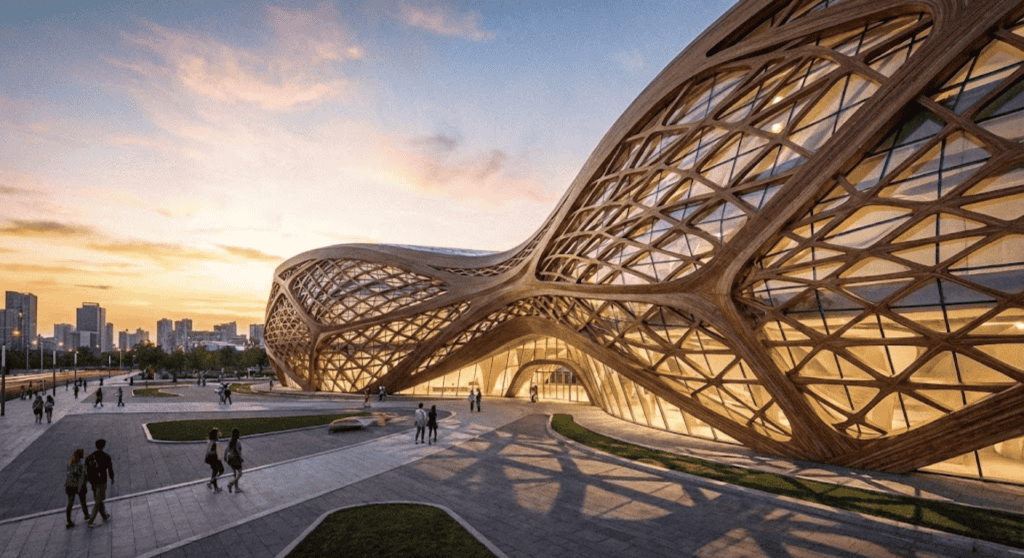
Parametric architecture in India is reshaping the skylines of our fastest-growing cities — and at SOGA Design Studio, we are at the forefront of this transformation. This post presents three distinct parametric facade concepts from our 2026 project portfolio, each one a response to the unique aspirations of India’s contemporary residential and mixed-use real estate market. From flowing biomorphic balcony forms to sweeping metallic curves and layered arch-frame elevations, these designs demonstrate how computational thinking can elevate a building from mere shelter into a landmark that resonates with its context, climate, and community. All three concepts are available for adaptation across Indian cities including Mumbai, Bengaluru, Hyderabad, Pune, Delhi NCR, Ahmedabad, and Chennai.
The Rise of Parametric Architecture in India
Over the past decade, Indian cities have undergone a profound architectural shift. Fuelled by a growing upper-middle class, rising aspirations for design-forward living, and the maturation of India’s real estate sector, developers and landowners are increasingly seeking facades that communicate quality, modernity, and identity. Parametric architecture — where form is generated by algorithmic rules that respond to site, climate, and programme — is finding deep resonance across India’s urban landscape. Unlike static conventional facades, parametric designs create surfaces that change character with the angle of light, the time of day, and the viewer’s distance from the building. For Indian cities, where buildings are dense, plots are narrow, and street-level engagement is paramount, this kind of facade performance is not a luxury — it is a strategic advantage. SOGA Design Studio has developed these three concepts to demonstrate the full range of what parametric facade design can achieve across different building typologies and market segments in India.
Parametric facade design in India changed direction in 2026. The novelty phase is over. Clients no longer ask whether a facade can be algorithmically generated — they ask what it costs to maintain, whether it will clear fire approval, and how it will look in year seven. Below are the seven shifts we are seeing across live projects in Delhi NCR, Mumbai, Bangalore, Jaipur and the Gulf, followed by three facade styles that define the current Indian language.
7 Parametric Facade Trends Defining India in 2026
1. Fire compliance is now driving material choice, not aesthetics
The single biggest specification shift this year. Commercial and high-rise projects are moving off composite panels onto solid aluminium, GFRC and terracotta because of fire-core scrutiny. Designs that assumed ACP two years ago are being re-engineered mid-project. Anyone specifying a commercial facade in 2026 should read the fire safety and approvals comparison for India, Dubai and Singapore before locking material.
2. One mould, many faces — cost engineering as a design discipline
The mature Indian practice in 2026 is generating maximum visual variation from a minimum number of moulds and dies. A facade of 900 apparently unique panels drawn from one tool is now considered better design than 40 bespoke panels, because it delivers the same visual richness at a fraction of the tooling cost. This is where parametric work earns its fee.
3. Terracotta returns — and not for nostalgia
Clay rainscreens are re-entering Indian specifications because they are non-combustible, thermally superior to metal, and age without looking degraded. The constraint is lead time and a thin domestic supplier base. See our terracotta facade design guide for buildable concepts and rates.
4. “Kinetic-lite” replaces true kinetic
Genuinely moving facades keep failing on maintenance budgets in Indian conditions — dust, monsoon, and no facilities team. The 2026 answer is static geometry shaped to read as motion as the viewer or the sun moves. All the drama, none of the actuators. Our kinetic facade guide separates what is buildable from what is render-only.
5. Night identity is designed alongside the daytime facade
Lighting is no longer bolted on after handover. On retail and showroom projects especially, the lighting layer is now modelled into the parametric skin from concept stage, so the building has a deliberate second identity after dark. Details in our facade lighting design guide.
6. Retrofit overtakes new-build on commercial parametric work
Re-skinning an existing 1990s or 2000s commercial building is becoming the more common parametric brief in Indian metros, because the land is already occupied and a new skin buys a decade of relevance for a fraction of redevelopment cost. Parametric suits this well — the algorithm absorbs the old building’s irregularities rather than fighting them. See commercial facade retrofit.
7. Tier-2 cities are now a real market
Parametric facade work is no longer a metro-only phenomenon. Jaipur, Surat, Indore, Nagpur, Coimbatore, Lucknow and Dehradun are commissioning parametric elevations, largely driven by jewellery retail, showrooms and premium residential. Fabrication logistics, not design capability, is the limiting factor.
Style A — Organic Wave-Form Balcony Facade
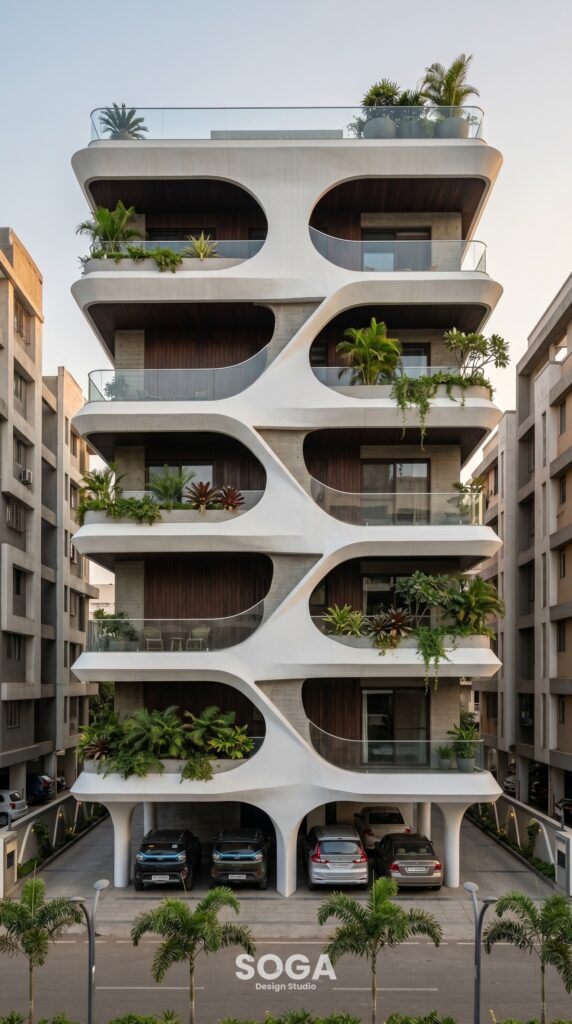
The first concept in this series is a luxury residential facade built around a biomorphic wave rhythm. Each floor’s balcony slab is sculpted into a flowing, organic curve — no two levels share the same profile. The slabs cantilever forward and sweep laterally, creating a three-dimensional surface that reads as a continuous undulating form rather than a stacked series of flat floors. Warm LED strip lighting is integrated into the underside of each curved slab, so the building glows with a soft amber warmth at dusk — a quality that is particularly striking against the deep blue evening skies of Indian cities in the post-monsoon season. Lush tropical plants spill from every balcony, softening the geometry and connecting the building to India’s rich horticultural culture. This facade typology is especially well-suited to premium 3BHK and 4BHK residential developments in cities like Mumbai, Hyderabad, and Bengaluru, where buyers in the ₹1.5 crore to ₹4 crore segment increasingly expect architectural identity as part of the product offering.
Style B — Sweeping Curved Metallic Facade
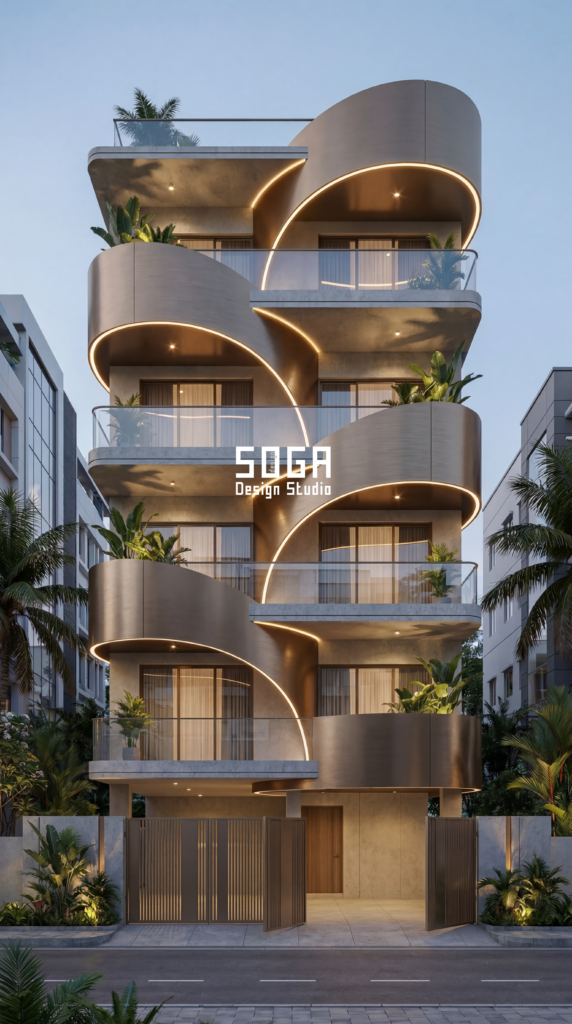
The second concept takes a sculptural approach rooted in large-radius curves and premium metallic cladding. The facade is defined by a series of sweeping horizontal ledges — each one a broad, circular arc that wraps around the building’s face and terminates in a generous overhang. The cladding material is a brushed metallic panel in a warm champagne-bronze tone, which shifts from a near-silver in direct sunlight to a deep warm gold in the long shadows of the late afternoon. The ground level is conceived as a luxury arrival experience: a wide, sheltered forecourt with polished stone paving, landscape planters, and subtle uplighting that announces the building’s presence on the street without ostentation. This facade language — monumental yet refined, bold yet not aggressive — translates particularly well to high-end residential developments in premium corridors such as South Mumbai, Jubilee Hills in Hyderabad, Koramangala in Bengaluru, and Golf Course Road in Gurugram. The curved geometry also provides natural solar shading for the glazed balcony faces behind, making this design as environmentally considered as it is visually powerful.
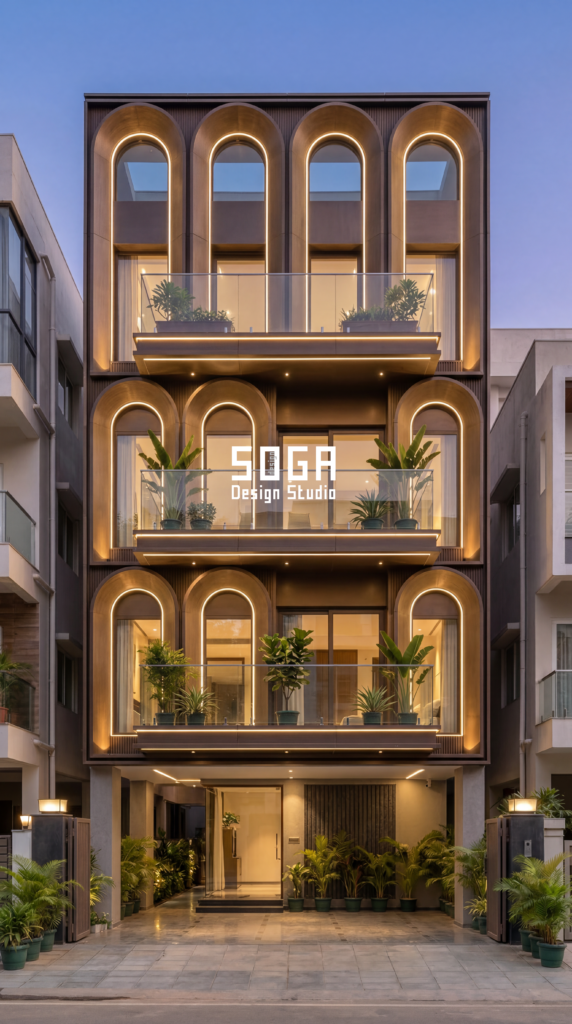
Style C — Stacked Arch-Frame Facade
The third concept brings a more classical sensibility into dialogue with parametric thinking. The primary facade element is a tall, narrow arch — drawn from the proportions of Mughal and Indo-Saracenic architecture but stripped of ornament and rendered in a warm brushed-gold anodised aluminium. These arches are stacked three-per-floor across four storeys, creating a grid of 12 repetitions that gives the building immediate rhythm and hierarchy. Within each arch, the balcony depth and planted edges create a layered quality: the facade reads as a series of framed tableaux, each one filled with greenery, warm interior light, and the life of its occupants. At night, the arches glow from within, transforming the building into a lantern-like presence on the street. This typology works exceptionally well for boutique mixed-use developments — retail on the ground floor, serviced apartments or offices above — in historic city centres such as Old Delhi, Bandra in Mumbai, Indiranagar in Bengaluru, and Banjara Hills in Hyderabad, where a building must simultaneously respect its surroundings and assert its own contemporary identity.
Why Parametric Facade Design Makes Commercial Sense in India
India’s urban density is simultaneously parametric architecture’s greatest challenge and its greatest opportunity. Buildings across Indian cities are typically squeezed onto narrow plots, flanked by neighbours on both sides, and visible only from the width of a street. This means the facade is not a scenic object to be appreciated in the round — it is a singular vertical surface, 10 to 20 metres wide, that must perform in compressed conditions. Parametric design excels here precisely because it generates maximum visual impact, depth, and character from a single plane. A facade of organic wave-form slabs, sweeping metallic curves, or stacked arched frames creates hierarchy and identity without requiring the generous setbacks and landscaping that Western precedents often assume.
India’s fabrication industry has also matured dramatically. Metalwork contractors in cities like Hyderabad, Pune, Surat, and the Mumbai metropolitan region can now produce complex curved, profiled, and perforated facade panels at costs that make parametric design viable for mid-range luxury residential projects — not just institutional or landmark commissions. For developers targeting the upper-mid segment — typically 2BHK and 3BHK apartments priced between ₹80 lakh and ₹2.5 crore across India’s major metros — a distinctive parametric facade increasingly justifies a 10 to 15 percent price premium over comparable conventional buildings. You can explore more international facade precedents at ArchDaily’s facade design archive.
Parametric Architecture Trends Across India in 2026 and Beyond
As we move through 2026, the integration of parametric design with sustainability is becoming the defining conversation in Indian architecture. The three facade typologies shown here each have clear passive performance dimensions: the wave-form balcony slabs shade south and west-facing glazing; the sweeping metallic curves create deep overhangs that reduce direct solar gain; the arch-frame grid provides rhythm and shadow that animate the facade throughout the day without mechanical systems. Going forward, SOGA Design Studio is integrating these geometric strategies with photovoltaic-ready cladding panels, green wall substrates, and natural ventilation channels specifically calibrated for India’s varied climate zones — from the humid coast of Kerala and Karnataka to the semi-arid conditions of Rajasthan and the moderate climate of the Deccan plateau. If you are a developer, builder, or landowner interested in how parametric design can elevate your next project anywhere in India, we invite you to contact SOGA Design Studio for a design consultation. Our team combines computational design capability with deep knowledge of Indian building regulations, material supply chains, and the aspirations of the contemporary Indian homebuyer.
Parametric Facade Trends in India: FAQs
What is the biggest parametric facade trend in India in 2026?
Fire compliance driving material selection. Commercial and high-rise projects across India are shifting from aluminium composite panels to solid aluminium, GFRC and terracotta because of tightened scrutiny on composite core grades. This is reshaping specifications more than any aesthetic trend this year.
Are kinetic facades practical in India?
Rarely. True moving facades struggle with dust, monsoon exposure and the absence of a dedicated facilities team on most Indian buildings. The practical 2026 alternative is static geometry designed to read as motion as the sun or viewer moves — it delivers the visual effect without actuators, sensors or an ongoing maintenance contract.
Which Indian cities are commissioning the most parametric facades?
Delhi NCR, Mumbai and Bangalore remain the largest markets, but the notable 2026 change is tier-2 growth. Jaipur, Surat, Indore, Nagpur, Coimbatore, Lucknow and Dehradun are all commissioning parametric elevations, driven mainly by jewellery retail, showrooms and premium residential projects.
Is retrofit or new-build more common for parametric facades in India?
On commercial work, retrofit is overtaking new-build in Indian metros. Re-skinning an existing 1990s or 2000s building buys roughly a decade of market relevance at a fraction of redevelopment cost, and parametric design suits it particularly well because the algorithm can absorb the existing structure’s irregularities instead of correcting them.
Is terracotta better than metal for Indian facades?
Thermally, yes — terracotta rainscreens outperform metal and age gracefully rather than degrading visually. They are also non-combustible. The trade-offs are longer lead times, a thinner Indian supplier base, and a higher installed rate of roughly ₹1,100–₹2,200 per sq ft against ₹800–₹1,600 for solid aluminium.