A SOGA Design Studio Case Study | Built with SOGA Louver
Thirty identical buildings. Then this one.
Walk down any residential sector in Gurugram, Noida, Jaipur, or Chandigarh and you’ll see the same scene: rows of 20×60 plots, each built to the same FAR, the same setbacks, the same height limits. The structures are near-identical. The facades are where they diverge — or, more often, where they don’t.
Most homes in these neighborhoods settle for safe choices. Stone cladding. ACP panels. A balcony railing that matches the neighbor’s. The result is a street where every building could swap elevations and nobody would notice.
This project started with a simple question from the client: Can our home look completely different from everything around it — without breaking the budget or the building code?
The answer turned out to be one curved line.
The design move: a single S-curve across three floors
Rather than layering multiple materials, textures, and colors onto the facade — the approach most builders default to when asked for “something different” — we went the opposite direction. One element. One material. One gesture.
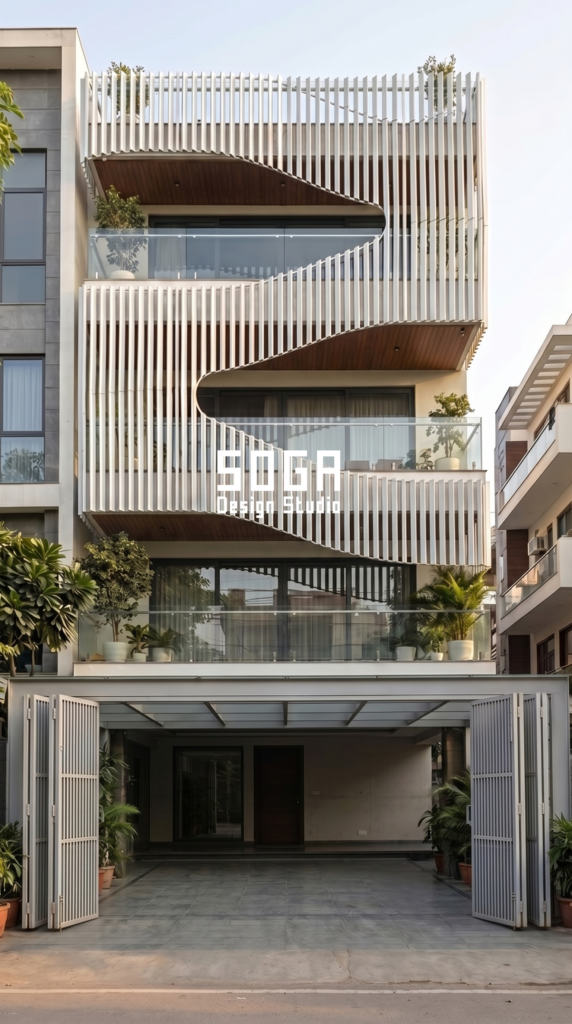
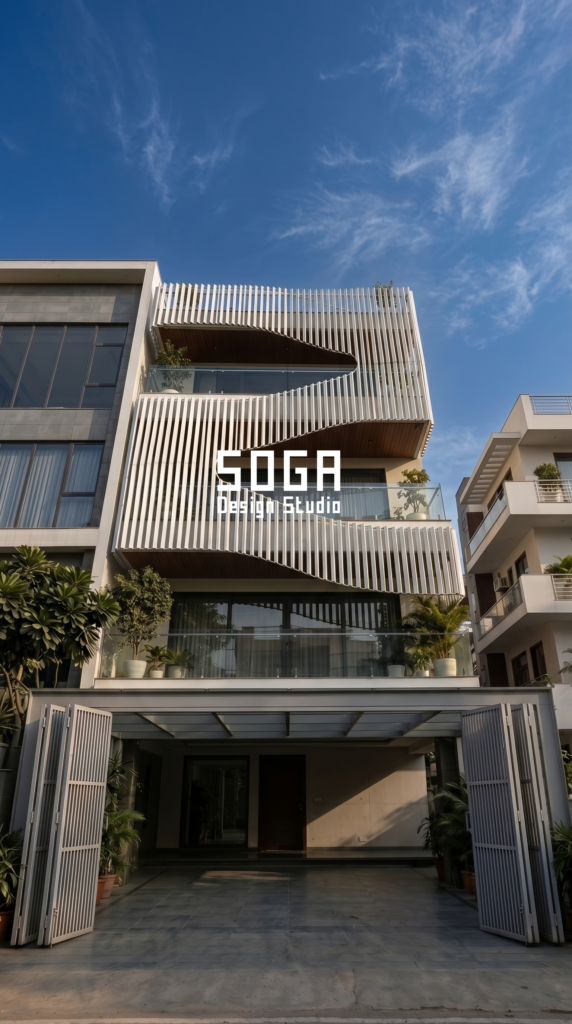
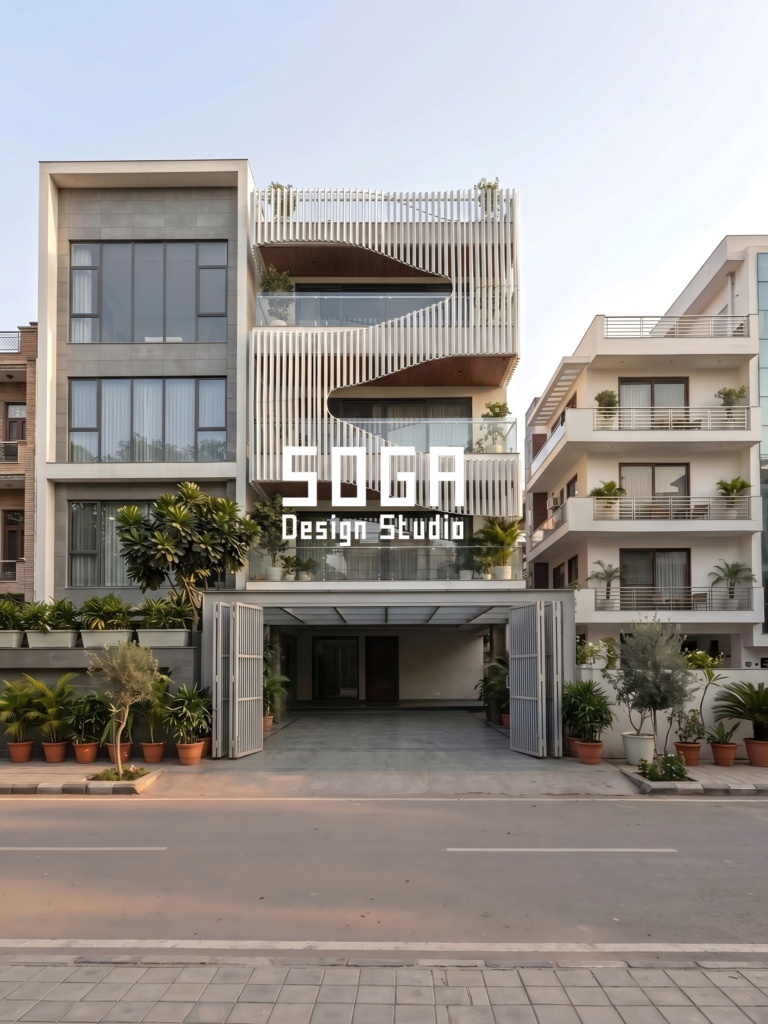
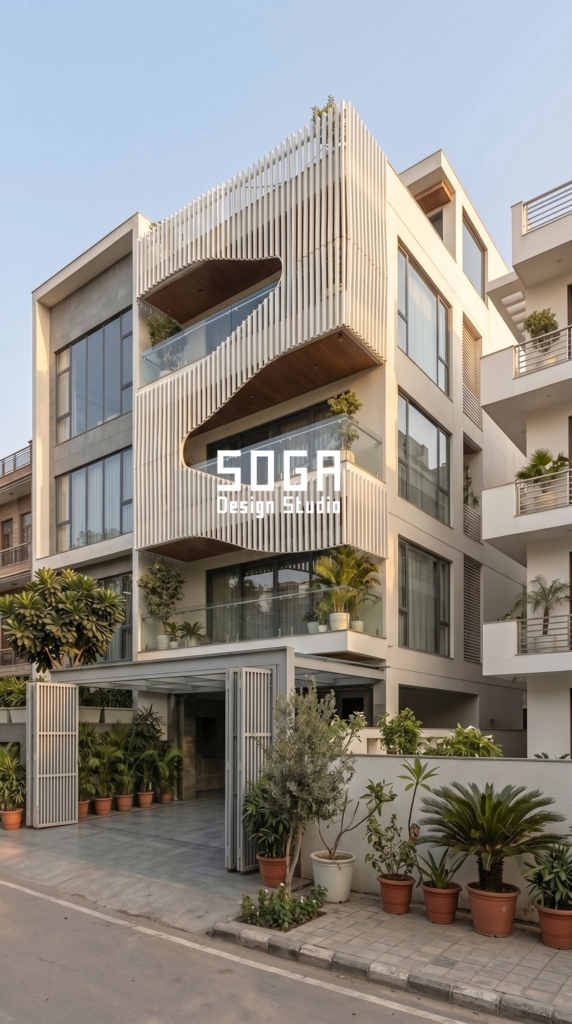
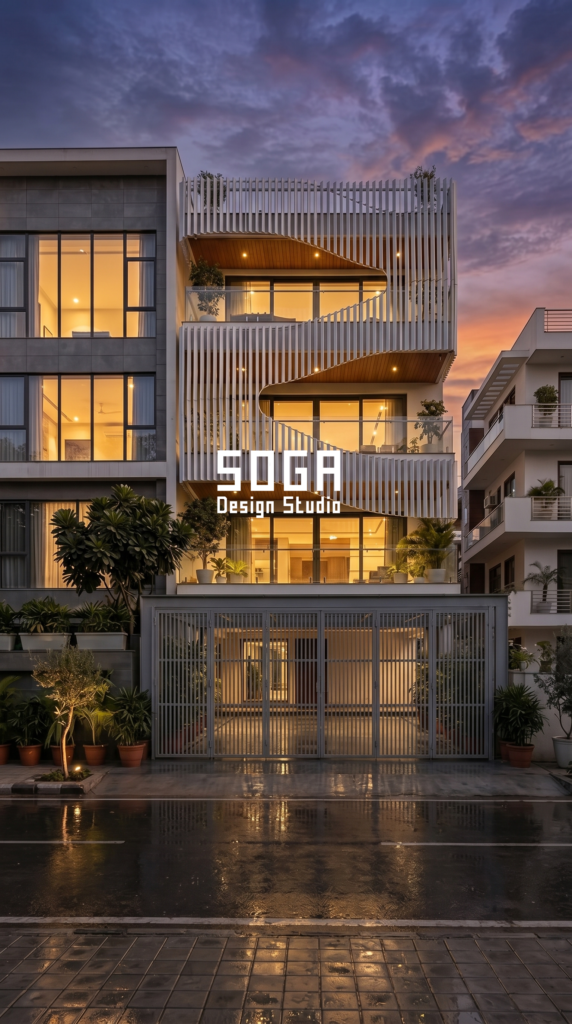
A continuous S-curve, built from SOGA Louver aluminium fins, sweeps across the upper three floors of the home. The curve starts at one edge of the building, pushes outward to create a deep overhang on the second floor, pulls back to open up views on the third, then pushes out again at the top to crown the building with a distinctive silhouette.
Below the louvers, warm wood-finish soffits line the underside of each curved balcony. At the base, the same louver language continues in the entrance gates — quieter, straighter, but unmistakably part of the same family.
Glass railings on every balcony stay deliberately invisible. The louvers own the elevation. Nothing competes.
The result, seen from the street, is a home that reads as one fluid gesture from ground to sky — in a row of buildings that read as stacked boxes.
Why a curve, and why this curve
Curved facades aren’t new. But most curved facades in Indian residential construction exist purely as decoration — a swooping balcony edge, a rounded corner, an arched window. The curve looks interesting but doesn’t do anything the building couldn’t do without it.
This S-curve is different. Every part of it is earning its place.
Where the curve pushes outward, the louvers create a deeper overhang. That deeper overhang means more shade on the floor below — directly reducing solar heat gain on the west-facing elevation. In a Gurugram summer, that’s not a visual choice. It’s a performance one.
Where the curve pulls back, the louvers recede closer to the building face. The floor behind gets a wider field of view, more sky exposure, and better cross-ventilation. Privacy is maintained because the louver spacing remains consistent — but the feeling of that floor shifts from sheltered to open.
The alternating rhythm — push, pull, push — gives each floor a different character. The second floor feels protected and intimate. The third feels bright and expansive. The top floor feels crowned and prominent. Three different living experiences, generated from one continuous line.
This is the core principle of parametric facade design: a single rule, applied with controlled variation, produces richer results than multiple unrelated design decisions stacked together.
How to choose the right facade for a standard residential plot
This project illustrates a broader set of principles that apply to any residential facade decision — whether you’re building on a 20×60, 30×60, or 40×80 plot.
Lead with one strong idea, not five competing ones. The most common mistake on residential facades is trying to make every floor “interesting” with different materials, colors, or patterns. The result is visual noise. This project uses one material (SOGA Louver aluminium), one color (white matte), and one gesture (the S-curve). That discipline is what gives it presence.
Let the facade solve a real problem. A facade that only looks good is a facade that will feel dated in five years. A facade that controls sun, manages privacy, enables ventilation, and also looks good is a facade that ages well. The S-curve here isn’t decoration wearing a performance costume — the performance drove the form.
Choose materials for the long run. The Indian climate is uniquely harsh on exterior materials. Monsoon humidity, 45°C+ summers, pollution, dust storms — whatever you put on the outside of your building will face all of it, every year, forever. We developed SOGA Louver specifically for this reality: anodized aluminium that holds its finish permanently, never rusts, never needs repainting, and handles thermal cycling without warping or cracking.
Respect the context, then distinguish yourself. This home sits on the same plot size, under the same building code, in the same neighborhood as its neighbors. It doesn’t break any rules. It doesn’t cantilever over the setback or tower above the height limit. It simply uses the same constraints more thoughtfully. The best residential facades don’t fight their context — they reframe it.
Material deep-dive: why aluminium louvers, not wood or WPC
The most common question clients ask when they see this project: “Is that real wood?”
It isn’t. It’s SOGA Louver — a premium aluminium louver system available in white matte, wood-shade, dark bronze, and custom RAL finishes. The wood soffits underneath the balconies add warmth, but the primary facade screen is aluminium through and through.
Here’s why that matters:
Maintenance reality. Real wood on an exterior Indian facade requires re-oiling or re-staining every 1-2 years, anti-termite treatment, and eventual replacement of sections that warp, crack, or rot. Over a 20-year building life, the maintenance cost of an exterior wood facade frequently exceeds the original installation cost. Aluminium requires zero maintenance. Zero. The finish is permanent.
Monsoon performance. Wood absorbs moisture. In a Delhi NCR monsoon — weeks of sustained humidity, driving rain, standing water — wood facades swell, warp, and develop mold. Aluminium is inert to moisture. It performs identically in monsoon and summer.
Curve fabrication. Bending real wood into a continuous S-curve across three floors would require lamination, steam-bending, or CNC-milled timber — all expensive, all fragile at connection points. Aluminium louver sections can be fabricated to follow curved rail profiles with standard tooling, assembled on-site in modular sections, and connected with concealed fixings that allow for thermal movement.
Thermal behavior. Aluminium has a low thermal mass, which means it doesn’t store and re-radiate heat the way stone or concrete cladding does. Combined with the airflow through the louver gaps, the facade acts as a ventilated screen — keeping the wall behind it cooler than a sealed cladding system would.
Sustainability. Aluminium is 100% recyclable with no loss of properties. At end-of-life (which, for anodized aluminium, is measured in decades, not years), the entire facade can be recycled into new material. The embodied energy is recovered. Wood, once degraded, is waste.
The construction reality: parametric design on a standard Indian site
One of the most important things about this project is what it didn’t require.
No special cranes. No imported components. No extended construction timeline. No exotic subcontractors flown in from another city.
The S-curve was parametrically modeled in Rhino and Grasshopper, which generated the exact geometry for every louver section, every curved rail profile, and every connection point. That digital model was translated directly into fabrication drawings — DXF files that went to a local aluminium fabricator.
The louver sections arrived on-site pre-finished, pre-drilled, and labeled. Assembly followed a numbered sequence. The curved rails were installed floor-by-floor, and the louver fins were fixed into them. The entire facade screen went up in 6 weeks .
This is the real promise of computational design in Indian residential construction: you can design forms that look bespoke and complex, but fabricate and install them using standard processes, standard labor, and standard timelines. The complexity lives in the digital model, not on the construction site.
The takeaway for anyone planning a facade
You don’t need a bigger plot to build a remarkable home. You don’t need a bigger budget. You don’t need imported materials or an international architect.
You need one strong idea — applied consistently, fabricated precisely, and chosen for performance as much as appearance.
This project proves that a single curved louver, designed with computational precision and built with a material that lasts, can turn a standard residential building into something people photograph, remember, and aspire to.
That’s what facade design is supposed to do.
About SOGA Louver
SOGA Louver is a premium aluminium louver system designed and manufactured by SOGA Design Studio. Available in straight and curved profiles, multiple finishes (white matte, wood-shade, dark bronze, custom RAL), and engineered for Indian climate conditions.
Applications: residential facades, commercial buildings, boundary walls, gates, pergolas, balcony screens
Key properties: → Zero maintenance — no rust, no repainting, no re-finishing → Parametric curve capability — not limited to straight-line installations → Lightweight — minimal structural load on the building → Modular fabrication — site assembly with concealed fixings → 100% recyclable aluminium
About SOGA Design Studio
SOGA Design Studio is a parametric and computational architecture firm based in Gurugram, India, founded by Gajender Kumar Sharma and Sonali Jaiswal. The studio specializes in facade design, parametric installations, and computational design across architectural, engineering, and product design scales — with projects across India, Dubai, and Singapore.
Services: Parametric facade design, computational modeling, fabrication drawings, facade consulting, SOGA Louver supply and installation
Contact: [Details] Website: sogadesignstudio.com
Related reading
→ How Much Does a Building Facade Cost? → What Materials Are Best for Your Building Facade? → How to Choose the Right Facade Design for Your Building → Facade Trends 2026: What’s New in Building Design → Energy-Efficient Facade Solutions That Save Money
FAQ (Schema markup ready)
Q: Can aluminium louvers be curved for residential facades? A: Yes. SOGA Louver aluminium sections can be fabricated to follow curved rail profiles, enabling S-curves, waves, and organic forms on standard residential buildings without exotic fabrication methods.
Q: How much does a curved louver facade cost compared to a standard facade? A: A SOGA Louver curved facade typically costs 1000-1500 more than standard stone or ACP cladding at installation, but saves significantly over the building’s lifetime due to zero maintenance requirements.
Q: Do aluminium louvers work in Indian monsoon conditions? A: Aluminium is inert to moisture and does not rust, swell, warp, or develop mold. SOGA Louver is specifically engineered for Indian climate conditions including monsoons, extreme heat, and dust exposure.
Q: How long does a SOGA Louver facade last? A: Anodized aluminium facades have a documented lifespan of 20+ years with zero maintenance. The finish is permanent and does not require repainting or re-coating.
Q: Can parametric facades be built on standard Indian residential plots? A: Yes. This project was built on a standard 20×60 plot under normal building code restrictions, using local fabrication and standard construction labor. Computational design handles the complexity digitally, keeping site work straightforward.
Q: What finishes are available for SOGA Louver? A: White matte, wood-shade (multiple grain options), dark bronze, and custom RAL colors. All finishes are permanent anodized or powder-coated treatments.