New Delhi’s summer temperatures crossed 48°C in May 2024 — a record that has fundamentally changed how architects and building owners think about facade design. An uninsulated metal or glass facade in Delhi’s extreme heat can raise interior surface temperatures to 55–62°C, adding 25–35% to a building’s air-conditioning load. In 2026, the right insulated facade system is not a luxury upgrade in Delhi — it is the single most impactful intervention to reduce energy bills, improve comfort, and meet India’s increasingly strict BEE (Bureau of Energy Efficiency) building ratings.
Delhi’s Climate Challenge: Why Standard Facades Fail
Delhi experiences a 45°C temperature swing between its extremes: 48°C peak summer (May–June) and 1–3°C winter nights (December–January). This thermal cycling stresses facade materials beyond what most building codes explicitly account for. Beyond temperature extremes, Delhi’s air quality crisis — average AQI exceeding 200 for 4–6 months annually — coats building surfaces with particulate matter that embeds into porous materials and is nearly impossible to clean from textured stone or render. Smooth metal facade surfaces (powder-coated aluminium, stainless steel, HPL) shed particulate matter in rain and can be pressure-washed easily, making them the only practical exterior finish for Delhi’s pollution environment.
Insulated Metal Facade Systems for Delhi’s 48°C Summers
Three facade systems deliver the thermal performance needed for Delhi’s climate: Insulated Metal Panels (IMP) — factory-assembled panels with rigid PIR foam core between two aluminium skins, achieving U-values of 0.25–0.35 W/m²K versus 5.8 W/m²K for an uninsulated wall. Rain-screen cladding with mineral wool insulation in the cavity — aluminium outer skin, 80–100mm Rockwool layer, structural wall behind, delivering U-values of 0.30–0.45 W/m²K. Ventilated facade with large overhangs — uses the chimney effect to draw hot air up and away from the building skin, reducing peak surface temperature by 12–18°C versus a sealed system. All three are compatible with Rank Math and BEE 5-star ratings under the ECBC-R 2021 residential building code.
Reflective vs Absorptive Coatings: Choosing the Right Finish for Delhi
Facade surface colour and finish dramatically affects solar heat gain in Delhi’s intense sunlight. A dark-coloured aluminium panel (Solar Reflectance Index, SRI: 15–25) absorbs 75–85% of incident solar radiation; a light-coloured or metallic panel (SRI: 70–90) reflects 70–90%. For south and west-facing elevations in Delhi — which receive peak afternoon sun of 900–1,000 W/m² — specifying a high-SRI finish reduces facade surface temperature by up to 28°C compared to a dark panel. SOGA Design Studio’s standard specification for Delhi projects: light silver, warm white, or matte champagne powder coat on south/west elevations; darker accent tones reserved for shaded north and east-facing panels only.
Sun Shading Strategies That Actually Work in Delhi
Fixed aluminium louvre blades at 45–60° angle on south elevations block 80–90% of summer direct solar radiation (sun angle 70–80° at noon in May–June) while admitting 60–70% of winter sun (sun angle 30–35° at noon in December). The calculation is geometry, not architecture: a 200mm deep blade at 600mm vertical pitch on a south wall in Delhi will completely shade the window beneath it from April through September — the peak cooling months — while admitting full winter light. Horizontal blade systems are more effective on south facades; vertical fins perform better on east and west elevations where morning and evening sun comes in at low angles.
Energy Saving Calculations: Before and After Facade Insulation in Delhi
A typical 5,000 sqft commercial office in Delhi’s NCR, currently clad in single-skin ACP with no insulation, carries an annual air-conditioning electricity bill of approximately ₹8.2–9.5 lakhs. Installing an insulated metal panel system with high-SRI coating and integrated sun shading reduces cooling load by 32–38% per ECBC modelling benchmarks. Annual saving: ₹2.6–3.6 lakhs. At an insulated facade cost of ₹1,100–1,450/sqft (5,000 sqft = ₹55–72 lakhs), payback period is 15–20 years on energy alone. Factor in reduced maintenance (no painting, no plaster repairs), enhanced IGBC rating (increasing commercial property value 8–12%), and NBF soft loan eligibility for green buildings, and the real payback drops to 9–12 years.
Delhi NCR Neighbourhood Facade Guide: Gurgaon, Noida, Connaught Place
Gurgaon’s Cyber City and Golf Course Road commercial belt has set the benchmark for high-performance facade design in NCR — the corridor has the highest concentration of IGBC Platinum and Gold rated buildings in north India. Noida’s Sector 62 and 63 IT parks are now following, with several 2024–2025 projects specifying insulated metal panel facades. In central Delhi — Connaught Place, Barakhamba Road, Nehru Place — heritage zone regulations restrict certain facade types but permit aluminium rain-screen systems that maintain setback and massing compatibility.
Frequently Asked Questions: Delhi Extreme Heat Facade
What is the best facade for a Delhi building to reduce AC costs?
Insulated Metal Panels (IMP) with high-SRI powder coat (SRI 70+) combined with fixed aluminium louvre sun shading on south and west elevations deliver the best thermal performance. This system can reduce cooling loads by 32–38% versus uninsulated facades in Delhi’s climate. U-value target: below 0.35 W/m²K for walls.
Does facade insulation help with Delhi’s winter cold as well?
Yes — insulated facade systems work bidirectionally. The same PIR foam or mineral wool layer that keeps summer heat out also retains interior heat in Delhi’s 1–3°C winter nights, reducing heating load. Buildings in NCR with insulated facades typically see 20–28% reduction in combined annual HVAC energy consumption (heating + cooling).
Design a Heat-Resistant Delhi Facade with SOGA Design Studio
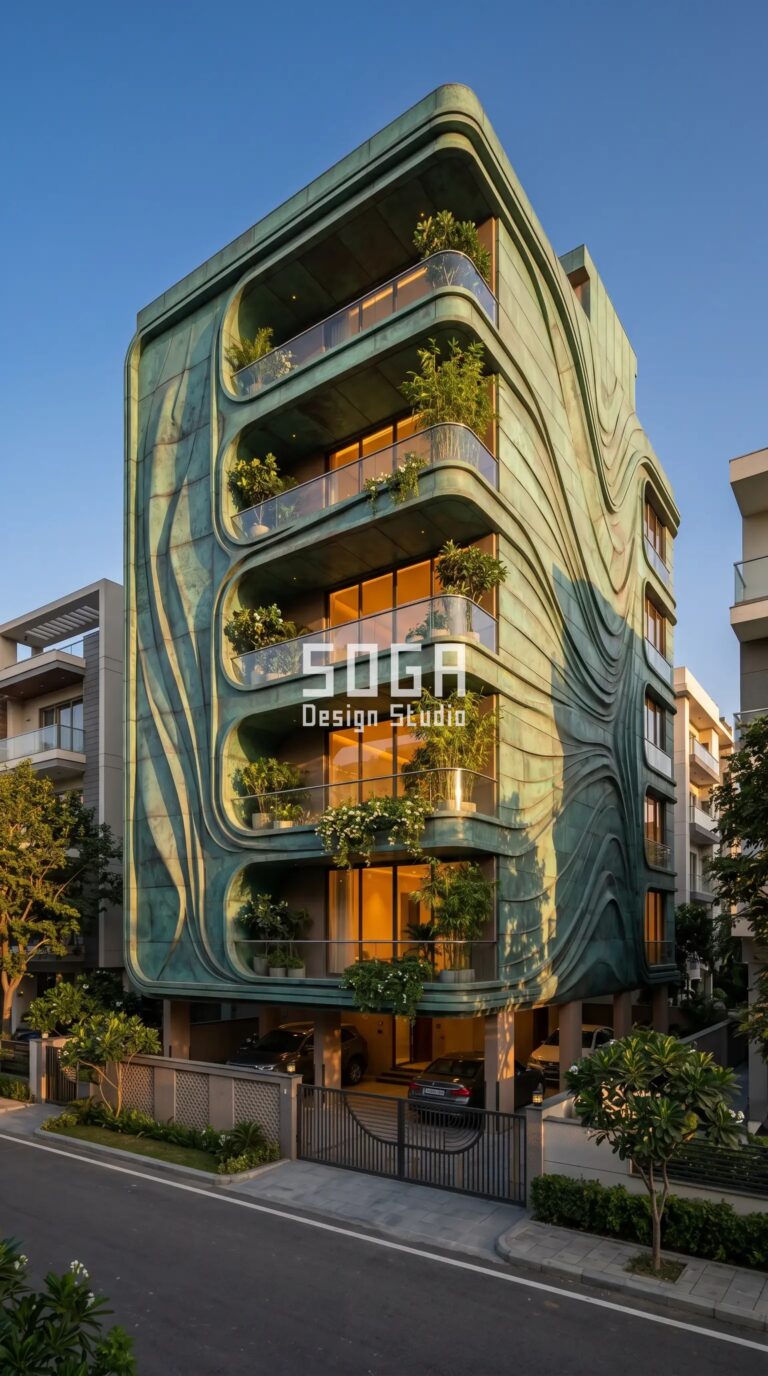
SOGA Design Studio’s Delhi and NCR projects combine thermal performance engineering with parametric design — the result is facades that are as striking architecturally as they are efficient energetically. Every Delhi project includes a solar radiation analysis, U-value calculation, and estimated AC cost saving before design is finalised. Contact us at sogadesignstudio.com.
For a fuller worked calculation of shading savings, including payback and ECBC, see the real numbers on facades and AC bills.