The jaali design is one of India’s oldest pieces of building intelligence — a perforated screen that cools, shades, and gives privacy while turning sunlight into moving pattern. In 2026 it is having a sharp revival, but with a twist: the hand-carved stone lattice has become a CNC-cut metal, terracotta, or GFRC screen generated by algorithm. This guide explains why jaali design for exterior walls works so well in the Indian climate, the modern materials and patterns available, real costs per square foot, and how SOGA Design Studio uses parametric design to take the jaali from heritage motif to engineered, contemporary facade.
Why the Jaali Still Beats Modern Walls in the Indian Climate
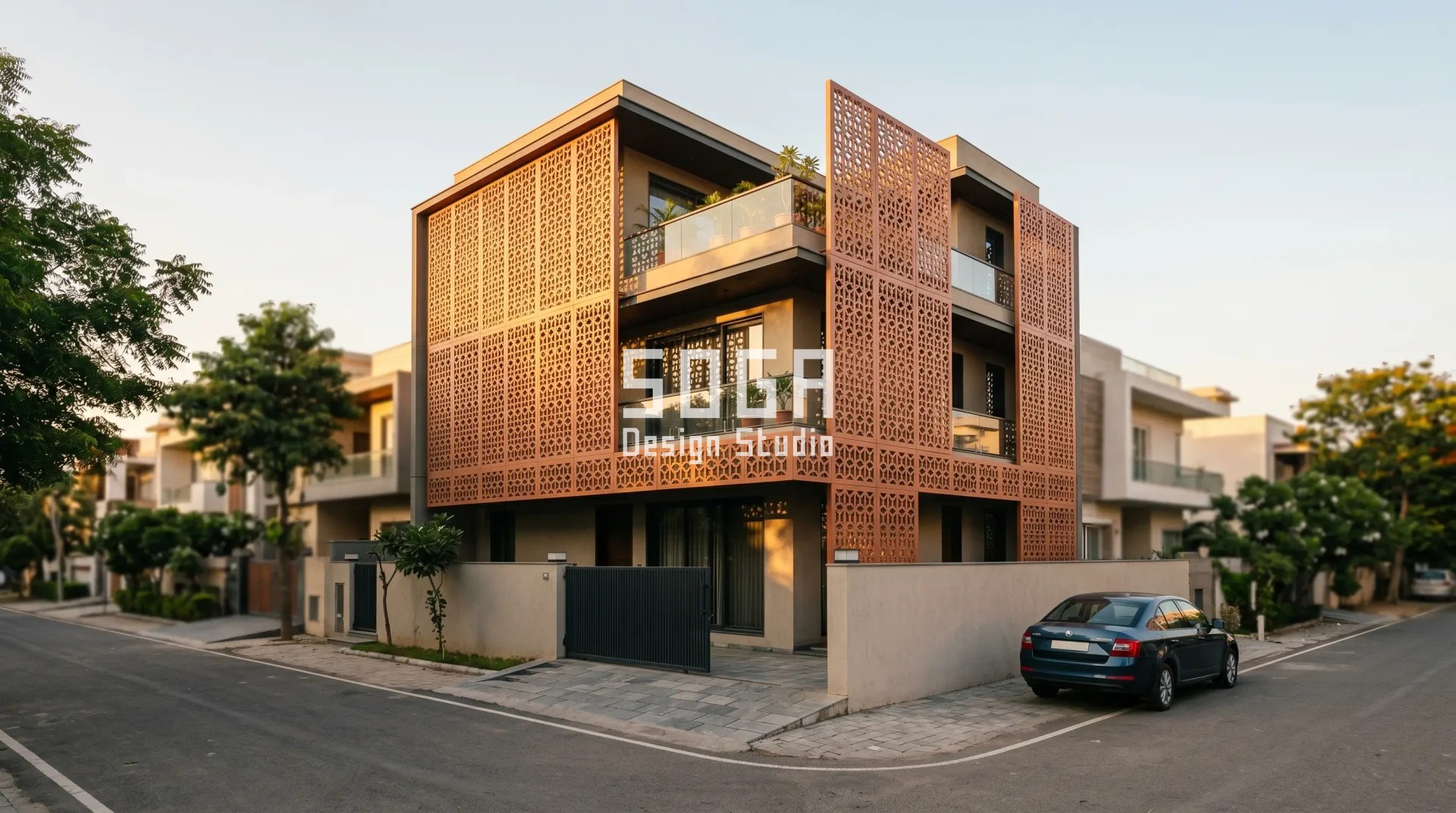
The jaali was never decoration alone. A perforated screen does four things a solid wall cannot: it blocks direct sun while letting diffused light through, it pulls cooler air across the gap behind it (the Venturi effect), it gives privacy without shutters, and it turns harsh glare into soft, shifting pattern on the floor. In Indian summers that combination is worth real money — a well-designed jaali design for exterior walls cuts direct solar heat gain by 25–40% on west and south faces and drops interior surface temperatures by 4–7°C versus bare RCC. That is centuries-old passive cooling, and it still outperforms a painted wall plus a bigger air conditioner.
Modern Jaali Materials: Beyond Carved Stone
The principle is ancient; the materials are new.
Terracotta Jaali
Warm, earthy, naturally insulating, and perfect for traditional or Indo-contemporary homes. Modern extruded terracotta blocks come in repeatable geometric units. A terracotta jaali design ages gracefully and needs almost no maintenance.
CNC Metal Jaali
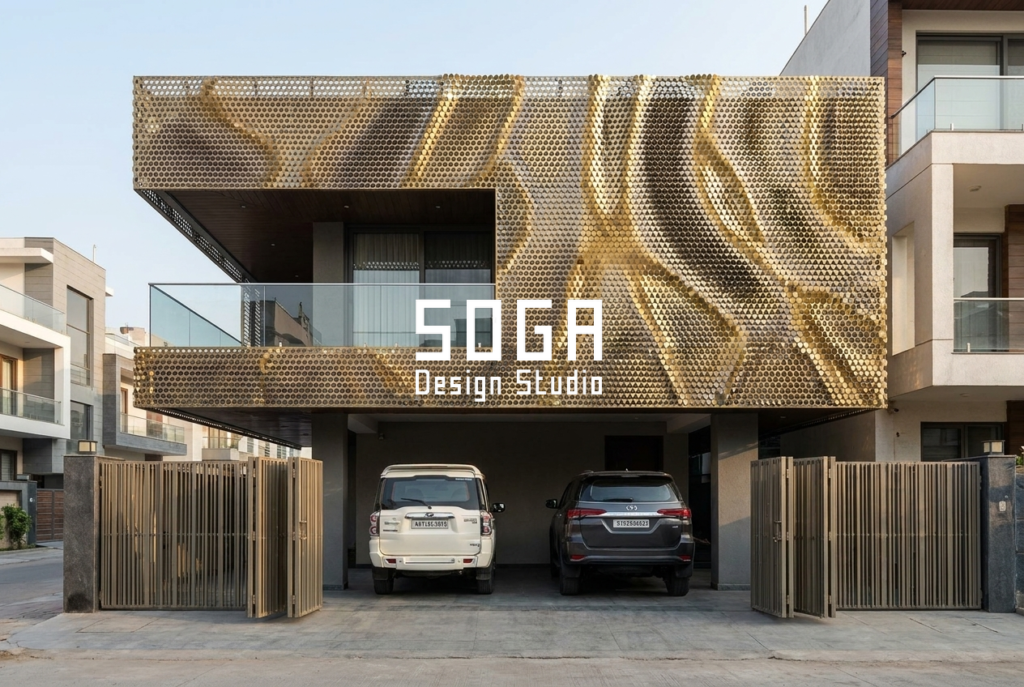
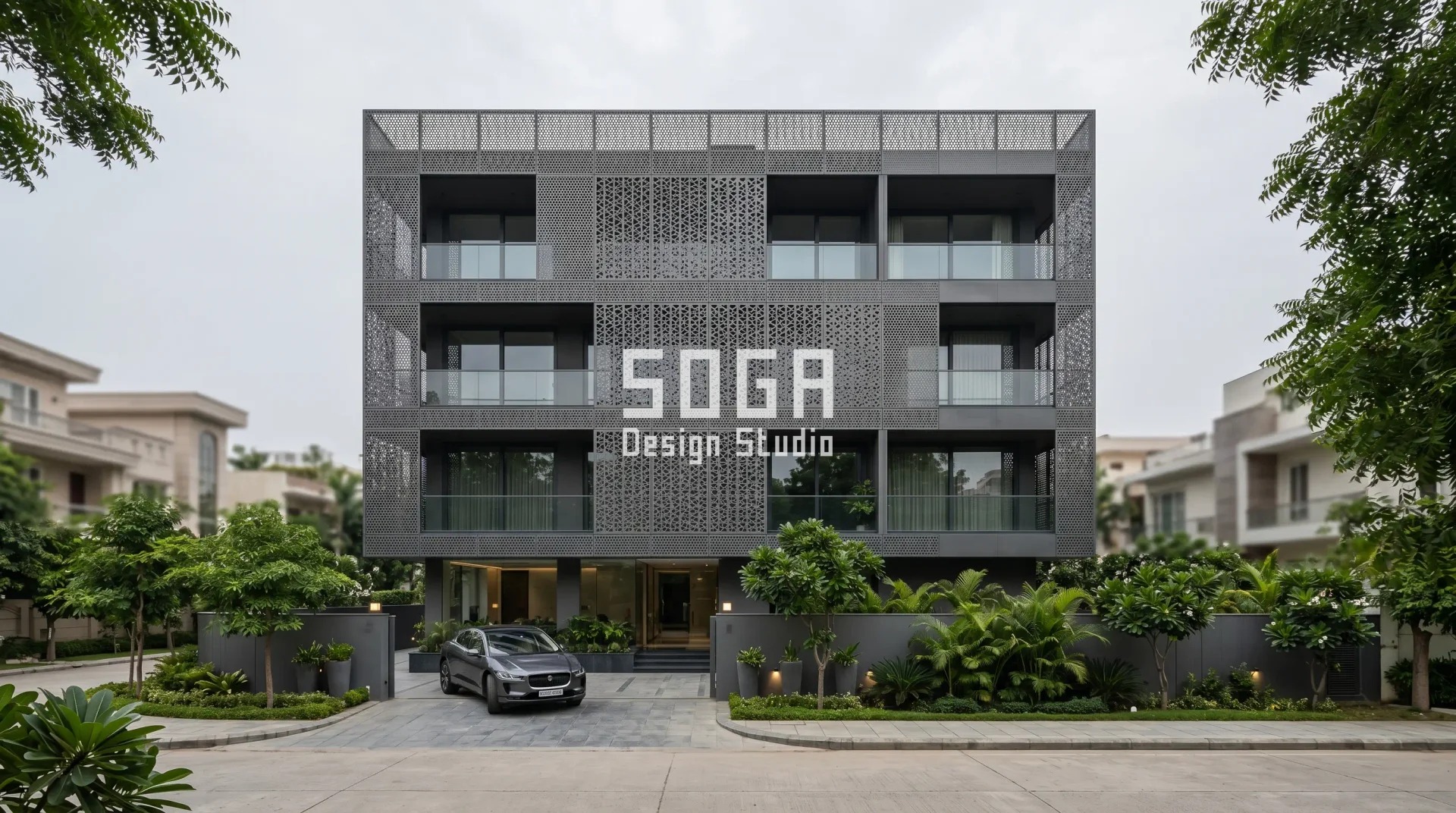
A cnc jaali design in powder-coated aluminium or steel allows any pattern — geometric, organic, or fully parametric — cut to the millimetre. It is lightweight, spans large openings, and is the go-to for sharp, modern facades.
GFRC Jaali
Glass-fibre reinforced concrete gives the mass and shadow depth of stone at a fraction of the weight, with crisp moulded patterns. Ideal when you want a solid, sculptural read rather than a thin screen.
Brick & Perforated Block
Laid-brick screens and patterned concrete blocks are the most economical route to the jaali effect for boundary walls and stair cores.
15+ Jaali Pattern Ideas for Exterior Walls
- Classic six-point geometric repeat (timeless, Indo-Islamic lineage)
- Hexagonal honeycomb for a contemporary read
- Parametric gradient — dense at the bottom, open at the top
- Organic leaf or wave pattern in CNC metal
- Diagonal diagrid for a structural look
- Square-grid minimalist screen for modern homes
- Vertical-slot pattern to slim a wide facade
- Floral-abstract terracotta for traditional contexts
- Solar-tuned density that varies across the wall by orientation
- Layered double-screen for depth and privacy
- Stair-core full-height jaali as the hero element
- Balcony privacy jaali in champagne or bronze
- Compound-wall jaali for street-level interest
- Backlit jaali that glows as a lantern at night
- Mixed-material jaali — metal screen over terracotta base
Jaali Cost Per Square Foot in India (2026)
| Jaali type | Installed cost (₹ per sq ft) | Character |
|---|---|---|
| Perforated concrete / brick block | ₹150–₹400 | Economical, boundary walls |
| Terracotta jaali (extruded blocks) | ₹350–₹900 | Warm, earthy, low maintenance |
| GFRC moulded jaali | ₹900–₹2,200 | Sculptural depth, stone-like |
| CNC powder-coated aluminium screen | ₹800–₹2,500 | Any pattern, sharp, modern |
| CNC steel / brass specialty screen | ₹1,500–₹3,500 | Premium, long span, statement |
A typical stair-core or balcony jaali of 80–200 sq ft lands between ₹70,000 and ₹5 lakh depending on material and pattern complexity. The cost driver in a cnc jaali design is pattern intricacy and panel size, not just area. SOGA Design Studio optimises the pattern for both look and fabrication efficiency, so you are not paying for cutting time you do not need.
Pattern intricacy is really a question of gradient: see how wide a jaali’s opening has to grade before it reads as deliberate for the 6–9x spread a hole-size gradient needs before a viewer reads it as a rule rather than a randomly pierced wall.

From Heritage Motif to Parametric Facade
The leap that defines 2026 jaali design is parametric design. Instead of repeating one carved unit, the pattern itself becomes a variable: opening size and density shift continuously across the wall, responding to the sun path, the view, and privacy needs at each point. Tight where the western sun is harsh, open where you want a breeze and a glimpse of the street — all in one continuous screen. This is the jaali doing exactly what it always did, but tuned with the precision of computation and cut by machine.
A jaali pattern has to grow to a pitch of about 300 mm before it reads from a 20 m street; see Indo contemporary elevation design at street scale.
SOGA Design Studio designs these screens in Rhino and Grasshopper, runs orientation-specific solar analysis, and produces a fabrication-ready Para-Hex 3D Module or custom pattern for CNC or GFRC production. The result is a parametric facade that honours the cultural lineage of the jaali while performing like a modern engineered system. It is the same thinking behind landmark Indian work like the IGNCC’s screen and Sanjay Puri’s inhabitable jaali towers — translated for individual homes.
Why SOGA Design Studio
SOGA Design Studio is a parametric and computational architecture firm based in Gurugram, India, working across India, Dubai, and Singapore — where the jaali tradition runs from Rajasthan to the mashrabiya of the Gulf. We treat the jaali as a performance element, not a sticker: modelled parametrically, analysed for heat and daylight, and built fabrication-first through GFRC and CNC production. From a single stair-core screen to a full G+7 facade, our parametric facade design services and the Para-Chevron Diagrid system give your exterior wall genuine cultural depth and measured climate performance. Get a custom facade concept for your plot — contact SOGA Design Studio at sogadesignstudio.com/contact.
Frequently Asked Questions
What is jaali design and why is it used on exterior walls? Jaali design is a perforated screen used on exterior walls to provide shade, privacy, and ventilation while filtering sunlight into pattern. On Indian homes it cuts solar heat gain by 25–40% on hot orientations and turns glare into soft light, making it both decorative and climate-functional.
Which is the best material for an exterior jaali in India? Terracotta, CNC powder-coated metal, and GFRC are the best modern jaali materials. Terracotta suits traditional homes and is naturally insulating, CNC metal allows any precise pattern, and GFRC gives stone-like sculptural depth at lower weight — all lasting 25–30 years with minimal upkeep.
How much does a jaali wall cost per square foot in India in 2026? Jaali cost ranges from ₹150–₹400 per sq ft for perforated concrete blocks to ₹800–₹2,500 per sq ft for CNC powder-coated aluminium screens. Terracotta jaali runs ₹350–₹900 and GFRC ₹900–₹2,200 per sq ft, depending on pattern complexity.
What is a CNC jaali design? A CNC jaali design is a screen cut by computer-controlled machines from metal, wood, or composite, allowing precise, repeatable, and fully custom patterns — including parametric designs where opening density varies across the wall. It is the modern, engineered evolution of the hand-carved stone jaali.
Can SOGA Design Studio design a custom parametric jaali remotely? Yes. SOGA Design Studio designs custom parametric jaali screens for clients across India and NRI clients in Dubai, Singapore, and the UK. The pattern is modelled in Rhino and Grasshopper, analysed for heat and light, and delivered as fabrication-ready CNC or GFRC drawings — fully remotely.