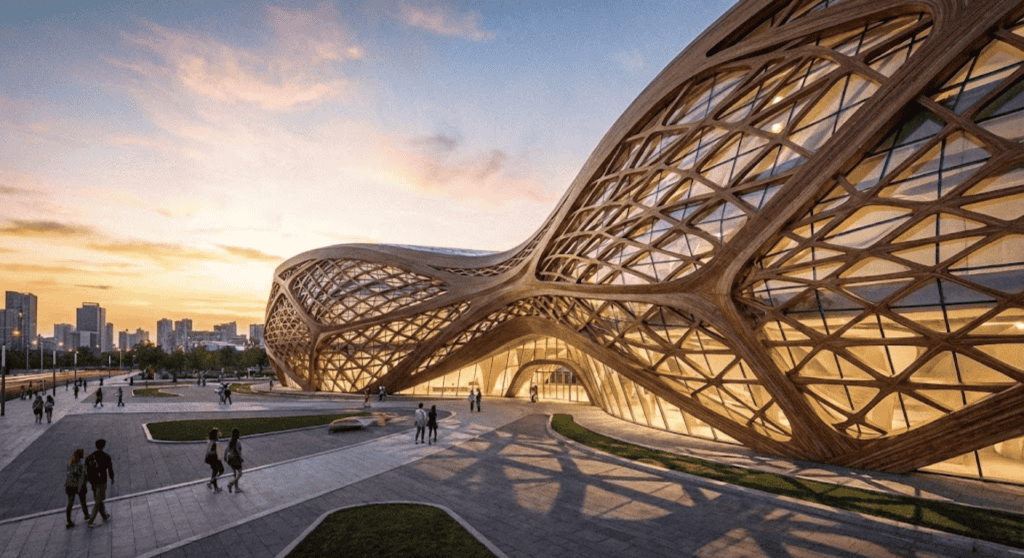
Villa facade design in India, Dubai, Singapore and the UAE is converging on one idea in 2026: the exterior skin is no longer a flat wall but a tuned, parametric instrument that controls sun, glare and monsoon while giving a home its signature. At SOGA Design Studio we design metal facades for luxury residences across four of the world’s most demanding residential markets, and the same computational discipline travels from a Mumbai sea-front plot to a Dubai desert villa, a Singapore tropical bungalow and an Abu Dhabi coastal estate. This guide walks through four buildable concepts – one for each city – and the exact numbers behind them.
Why Villa Facade Design Went Multi-Geo Parametric in 2026
By 2026, the villa facade brief looks strikingly similar whether the plot is in India, the UAE or Singapore: owners want a sculptural, low-maintenance metal skin that measurably cuts cooling load. Independent studies on Indian residential applications show a well-tuned parametric metal screen reduces direct solar heat gain by 25-40% and drops interior surface temperatures by 4-7 degrees C versus a bare RCC wall – figures that matter just as much against Dubai’s desert sun or Singapore’s tropical humidity. The shared engine is computational: density gradients, rotation fields and depth modulation are all scripted, then fabricated to tolerance. Our parametric facade design in India practice is the backbone we adapt for every geography.
1. Mumbai Parametric Cascade Fin: A G+3 Luxury Private Villa
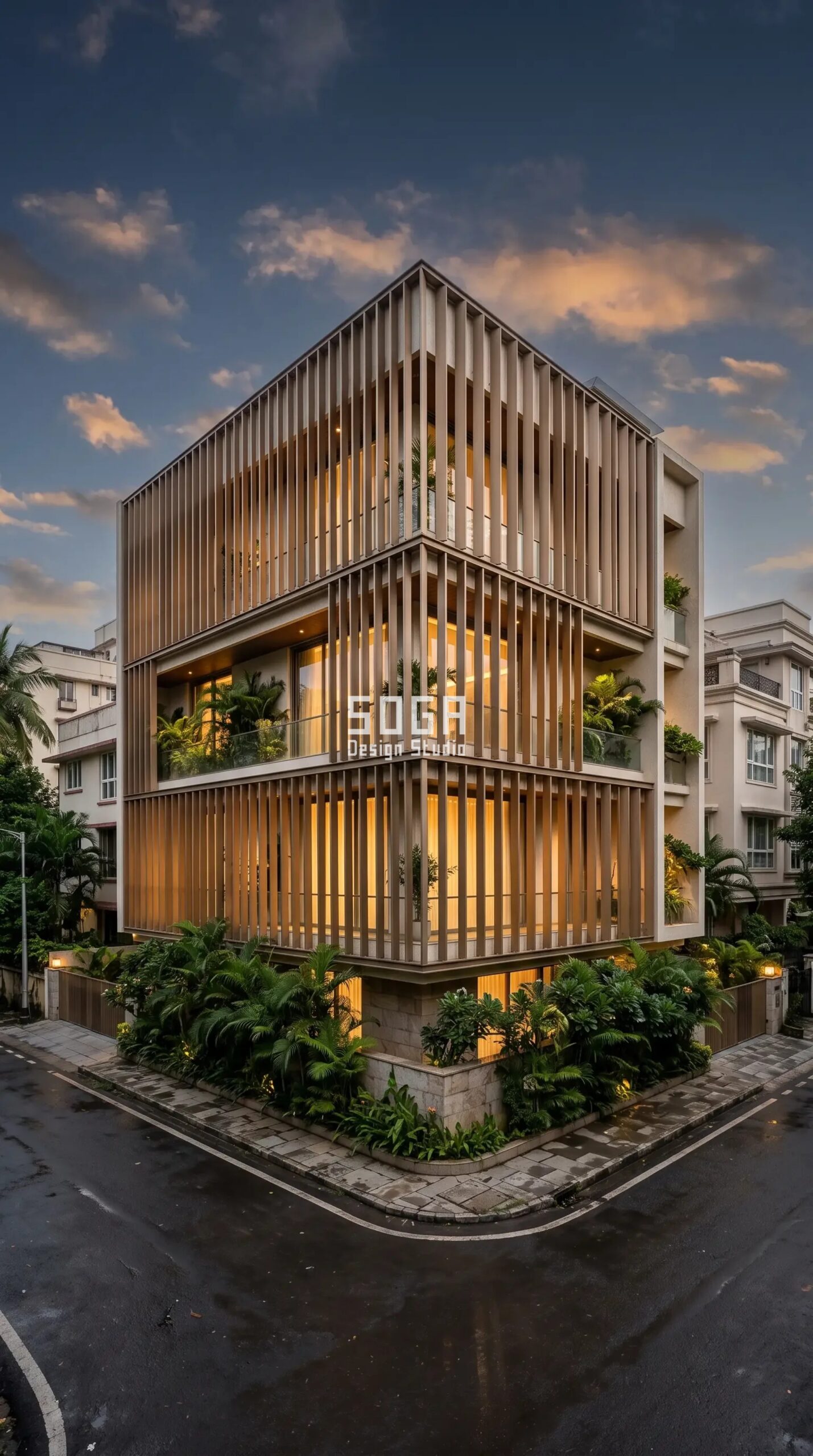
Design seed: Stacked cantilevered massing (compact-urban DNA) x vertical blade-fin skin x sun-path rotation field x champagne-bronze anodised aluminium x sea-facing deep-west shade. This G+3 luxury private villa in Bandra West, Mumbai wears a Parametric Cascade Fin skin in champagne-bronze anodised aluminium blade fins on an off-white RCC frame. Mumbai’s humid coastal glare and driving monsoon are met by the deep western fin recess and a 150mm drained cavity that keeps the wall dry while cutting west solar gain. The parametric variation is written into the fabrication drawings, not sprayed on afterwards.
How the Parametric Cascade Fin is built
| Design parameter | Specification |
|---|---|
| Module | 50 x 180mm aluminium blade fin, running floor-to-roof (~3.2m per storey) |
| Spacing driver | vertical centre-to-centre spacing widening 140mm at the sea-facing west corner to 460mm at the sheltered core |
| Variation | each fin rotates 0 to 32 degrees along a sun-path attractor, turning to block the low western sun |
| Density | visual porosity easing 35% open at the private bedrooms to 65% at the double-height living volume |
| Panels + substructure | 18 unique fin lengths on a 50 x 50mm aluminium SHS grid, chemically anchored to the RCC slab edge |
| Cavity | 150mm ventilated shadow gap off the off-white RCC frame |
Material & colour: hero skin in champagne-bronze RAL 8024 fins with warm off-white NCS S1002-Y frame, kept to a restrained palette so the geometry does the talking. Indicative facade cost: Rs 1,600-2,600 per sq ft, fully designed and installed, with an itemised estimate produced per project.
2. Dubai Parametric Dune Facet: A G+2 Luxury Desert Villa
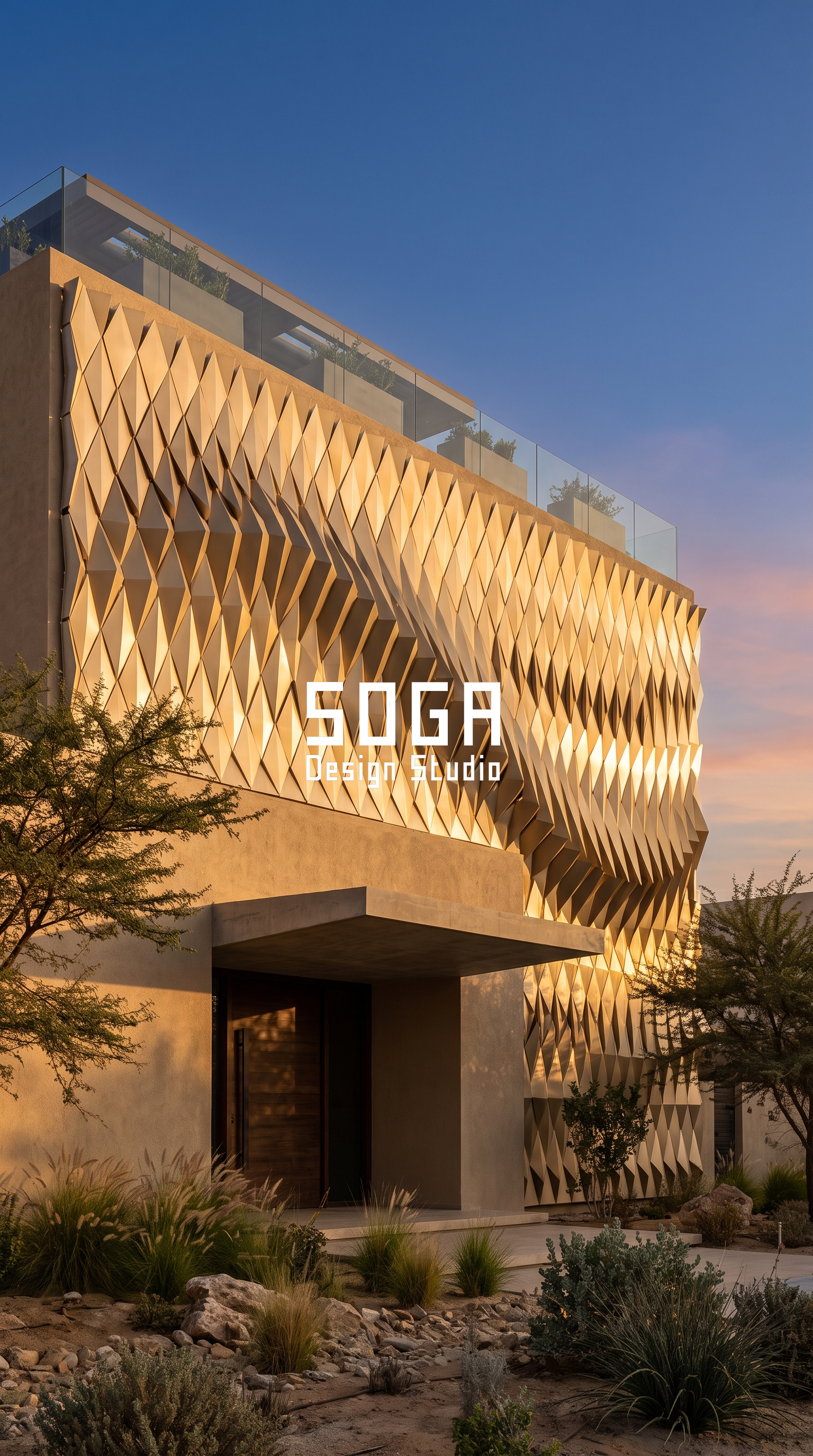
Design seed: Sculpted monolithic massing (large-plot DNA) x faceted 3D diamond-panel skin x depth-extrusion field x sand-gold champagne stainless steel x desert self-shading. This G+2 luxury desert villa in Al Barari, Dubai wears a Parametric Dune Facet skin in sand-gold champagne stainless steel faceted panels over a sand-toned base. Dubai’s fierce desert sun and heat are handled by the self-shading facet depth and a rear-ventilated cavity, while the light champagne finish reflects glare rather than absorbing it. The parametric variation is written into the fabrication drawings, not sprayed on afterwards.
How the Parametric Dune Facet is built
| Design parameter | Specification |
|---|---|
| Module | 600 x 900mm faceted 3D diamond panel, folded stainless steel |
| Depth driver | panel projection extruding 40mm to 200mm along a dune-crest attractor sweeping across the elevation |
| Variation | fold angle steepening 12 to 38 degrees so the skin reads as a slow rolling metal dune |
| Density | reflective-to-shaded balance shifting 70% bright faces to 45% toward the shaded courtyard side |
| Panels + substructure | 16 unique panel geometries on a 60 x 40mm aluminium unitised frame with concealed clip fixings |
| Cavity | 120mm rear-ventilated cavity over insulated blockwork |
Material & colour: hero skin in sand-gold champagne stainless with a warm sand-limestone base, kept to a restrained palette so the geometry does the talking. Indicative facade cost: Rs 2,000-3,200 per sq ft equivalent, fully designed and installed, with an itemised estimate produced per project.
3. Singapore Parametric Frond Weave: A G+2 Luxury Tropical Landed House
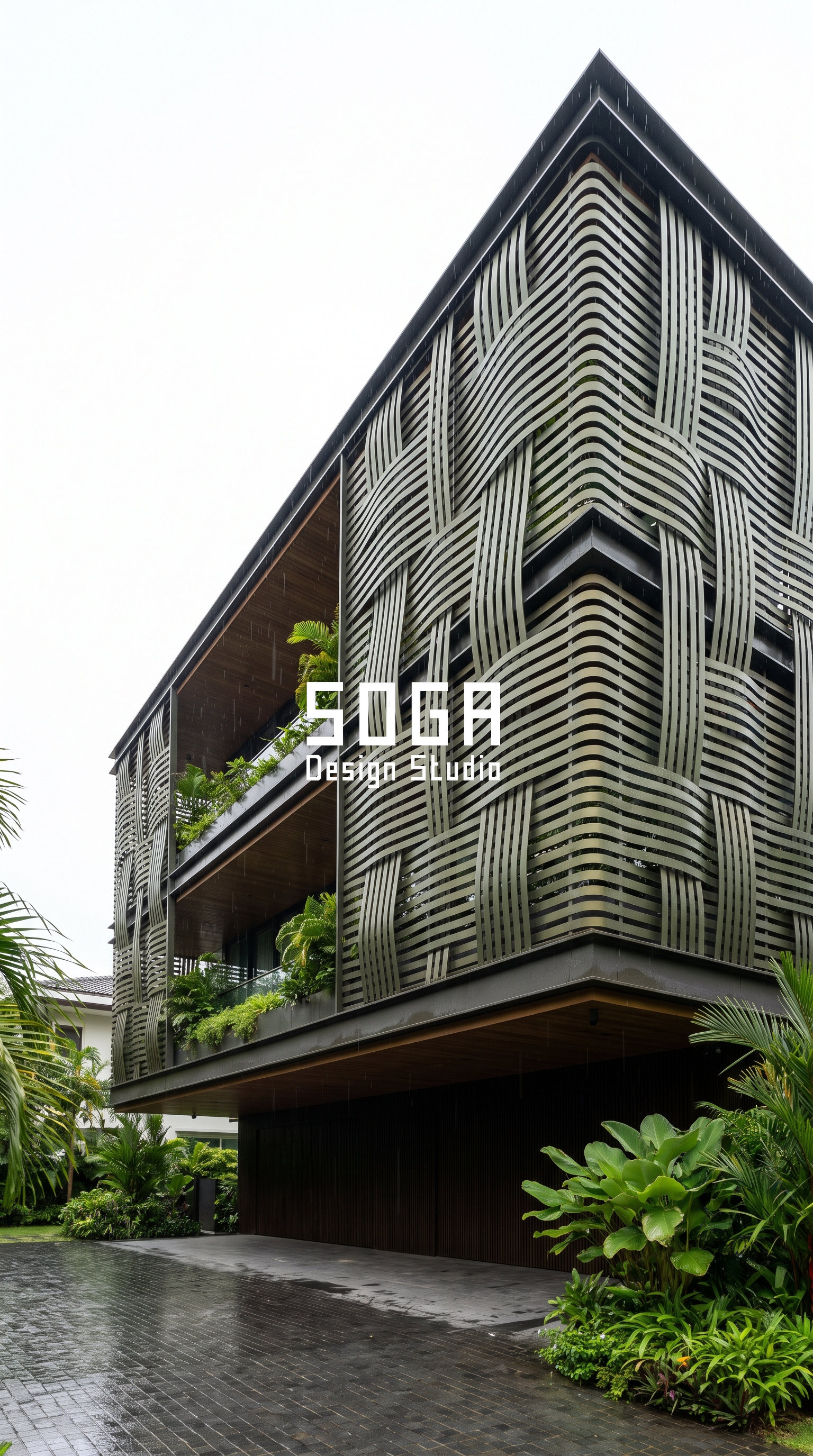
Design seed: Horizontal terraced massing (tropical-plot DNA) x woven ribbon screen x contour-wave field x bronze-green anodised aluminium x deep-overhang biophilic cooling. This G+2 luxury tropical landed house in Sentosa Cove, Singapore wears a Parametric Frond Weave skin in bronze-green anodised aluminium woven ribbons with timber-finish soffits and planting. Singapore’s hot, wet tropics are answered with 1.2m overhangs, a shaded woven screen for cross-ventilation, and a 200mm biophilic cavity that cools the skin through evaporation and planting. The parametric variation is written into the fabrication drawings, not sprayed on afterwards.
How the Parametric Frond Weave is built
| Design parameter | Specification |
|---|---|
| Module | 40 x 12mm anodised aluminium ribbon, interwoven horizontally and vertically |
| Amplitude driver | ribbon undulation amplitude rising 150mm to 600mm along a rainfall-flow attractor |
| Variation | weave spacing easing 90mm to 300mm, opening the screen toward the planted balconies |
| Density | visual porosity graded 45% at the private bedrooms to 75% at the veranda living zone |
| Panels + substructure | 14 unique woven cassettes on a 50 x 50mm aluminium sub-grid behind 1.2m deep overhangs |
| Cavity | 200mm planted cavity carrying trailing greenery and drip irrigation |
Material & colour: hero skin in bronze-green anodised aluminium with warm timber-finish soffits, kept to a restrained palette so the geometry does the talking. Indicative facade cost: Rs 1,700-2,700 per sq ft equivalent, fully designed and installed, with an itemised estimate produced per project.
4. Abu Dhabi Parametric Pleat Screen: A G+2 Luxury Coastal Villa
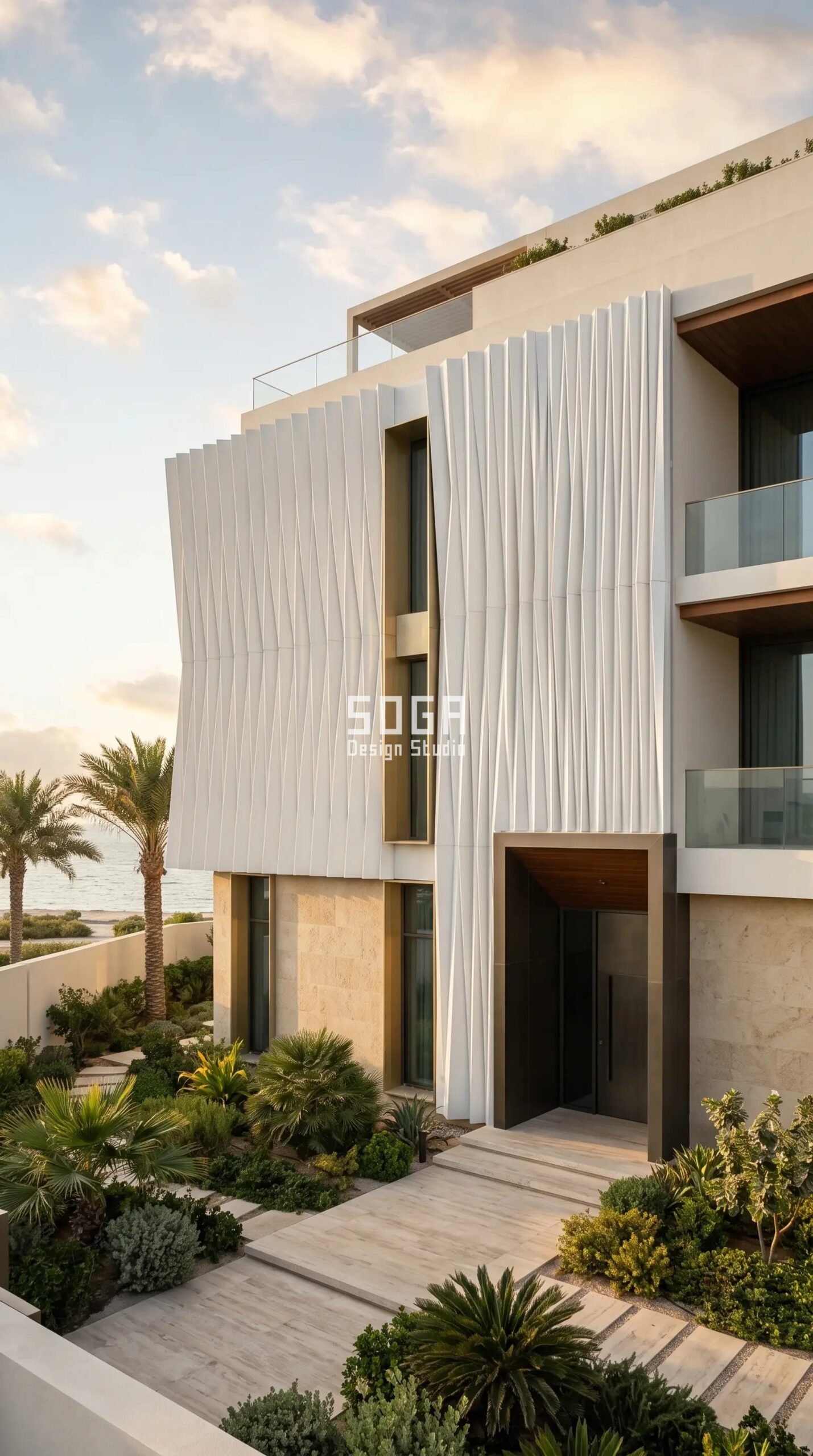
Design seed: Pure cubic massing (compact DNA) x vertical folded-pleat screen x sine-wave density x pearl-white powder-coated aluminium with brass reveals x Gulf coastal glare control. This G+2 luxury coastal villa in Saadiyat Island, Abu Dhabi wears a Parametric Pleat Screen skin in pearl-white powder-coated aluminium pleats with champagne-brass reveals over a sand-toned base. Abu Dhabi’s coastal desert glare is tamed by the deepening pleat self-shadow and a ventilated cavity; the pearl-white powder coat holds up against salt-laden Gulf air with only an annual rinse. The parametric variation is written into the fabrication drawings, not sprayed on afterwards.
How the Parametric Pleat Screen is built
| Design parameter | Specification |
|---|---|
| Module | 1.0m wide folded aluminium pleat panel, floor-height |
| Fold driver | pleat fold depth deepening 50mm to 220mm along a sine rhythm that compresses at the entrance |
| Variation | pleat centre-to-centre spacing tightening 380mm to 110mm toward the shaded entrance portal |
| Density | self-shadowing coverage grading 40% at the north glazing to 75% at the west glare face |
| Panels + substructure | 12 unique pleat profiles roll-formed on a 60 x 60mm aluminium grid with brass-lined reveals |
| Cavity | 130mm ventilated cavity over a sand-toned insulated wall |
Material & colour: hero skin in pearl-white RAL 9010 pleats with champagne-brass reveals, kept to a restrained palette so the geometry does the talking. Indicative facade cost: Rs 1,800-2,900 per sq ft equivalent, fully designed and installed, with an itemised estimate produced per project.
Villa Facade Cost in India, UAE & Singapore (2026)
Facade cost scales with geometric complexity – a flat panel sits at the bottom of each band, while a rotating fin array or a three-dimensional folded skin approaches the top. The India rates below are our published benchmarks; UAE and Singapore projects typically run 30-60% higher on installed labour and imported finishes, but the material logic is identical.
| System / material | Indicative rate (per sq ft) |
|---|---|
| Aluminium (anodised / powder-coated) | Rs 800-2,500 per sq ft |
| Steel facade (full design + install) | Rs 1,200-2,800 per sq ft |
| Zinc facade | Rs 1,500-3,000 per sq ft |
| Solid aluminium panels | Rs 800-1,800 per sq ft |
| ACM panels (4mm) | Rs 250-350 per sq ft |
| Conventional cladding (stone / ceramic / standard ACM) | Rs 400-1,200 per sq ft |
Buildable, Not Just Rendered: How SOGA Engineers Each Skin
Every concept in this guide is drawn to fabrication tolerance before it is ever rendered. Our team scripts each facade in a parametric model, caps unique panel types at roughly 20% of the total to control mould and cutting cost, and details the substructure – aluminium or MS grid, chemical anchors, ventilated cavity – as part of the same drawing set. Panel weights are kept within a two-person lift or flagged for crane, finishes are specified for their local climate (salt-laden Gulf air, coastal Mumbai humidity, Singapore rainfall), and each project ships with an itemised cost estimate. That engineering-first method is why SOGA facades move cleanly from concept to an installed skin across India, the UAE and Singapore.
Related Reading
Frequently Asked Questions
How much does a villa facade cost in India, Dubai and Singapore in 2026?
In India, a designed-and-installed parametric metal villa facade runs Rs 800-2,500 per sq ft for aluminium, Rs 1,200-2,800 for steel and Rs 1,500-3,000 for zinc. Basic ACM cladding starts around Rs 250-350 per sq ft. Comparable Dubai, Abu Dhabi and Singapore projects typically cost 30-60% more once imported finishes and local installation labour are included, though the underlying material and design logic is the same. SOGA Design Studio issues an itemised estimate for every villa.
Which facade material is best for Dubai and Abu Dhabi villas?
For UAE villas, powder-coated and anodised aluminium and champagne stainless steel perform best because they reflect desert glare, resist salt-laden coastal air, and need only an annual rinse. A rear-ventilated cavity behind the metal skin lets heat escape before it reaches the wall. SOGA specifies light, reflective finishes and self-shading panel depth to cut cooling load in the Gulf climate.
Does a parametric metal facade work in Singapore’s tropical climate?
Yes. In Singapore’s hot, humid, high-rainfall climate, the winning combination is deep 1.0-1.5m overhangs, a shaded metal screen that still allows cross-ventilation, and a planted cavity that cools the skin. Anodised aluminium and marine-grade finishes resist corrosion, while the screen geometry is tuned to block low east-west sun without darkening the interior.
How much heat does a parametric villa facade actually cut?
Independent studies on Indian residential applications show a double-skin parametric metal screen reduces direct solar heat gain by 25-40% on west and south orientations and drops interior surface temperatures by 4-7 degrees C compared with bare RCC. The shaded gap also enables passive cross-ventilation. The same physics applies in Dubai, Abu Dhabi and Singapore, where the density and depth are re-tuned to the local sun path.
Can NRIs and overseas owners design an India villa facade remotely?
Yes. SOGA Design Studio runs end-to-end remote consultations for owners in Dubai, the UAE, Singapore and the UK – covering site analysis, design development, fabrication-ready drawings and on-site supervision virtually. NRI villa projects across Indian metros and tier-2 cities are a fast-growing share of our portfolio.
Design Your Villa Facade with SOGA
Whether your plot is in Mumbai, Dubai, Singapore or Abu Dhabi, SOGA Design Studio can take your villa from a parametric concept to an installed metal facade – with the engineering, cost estimate and climate tuning done up front. Explore our parametric facade design work, then write to us at [email protected] to start your project across India, the UAE and Singapore.