A SOGA Design Studio Case Study — Commercial Facade Design India
The corner everyone now stops at
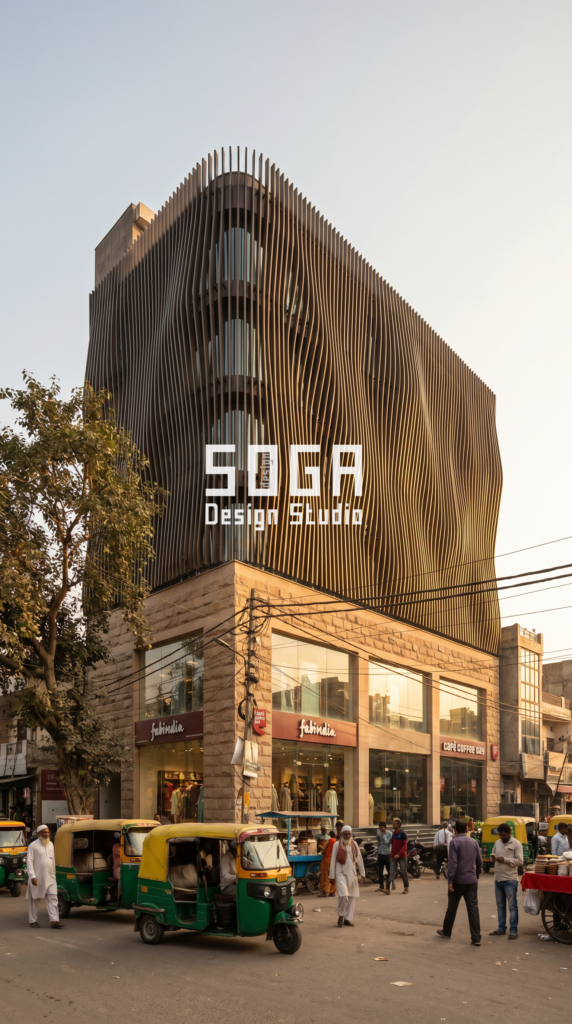
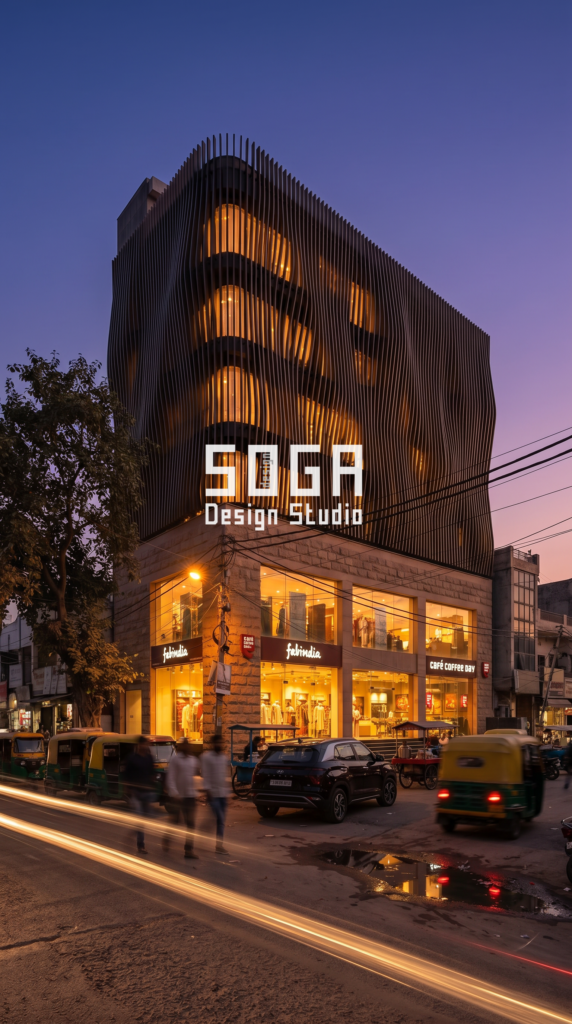
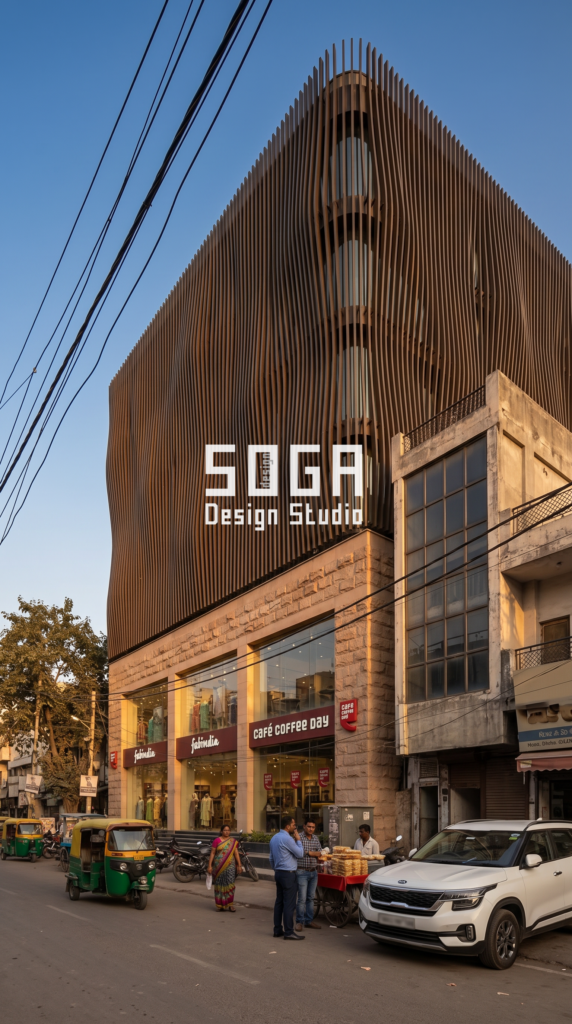
On a dense retail street — autos honking, shoppers crowding the Fabindia windows, a Café Coffee Day glowing at the corner — most buildings disappear into the noise. They become backgrounds.
This one doesn’t.
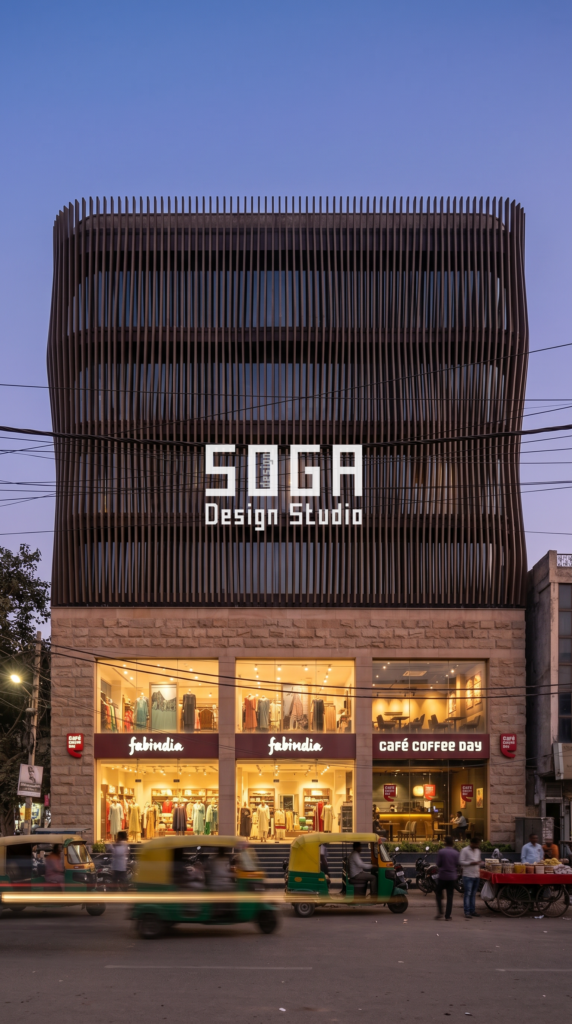
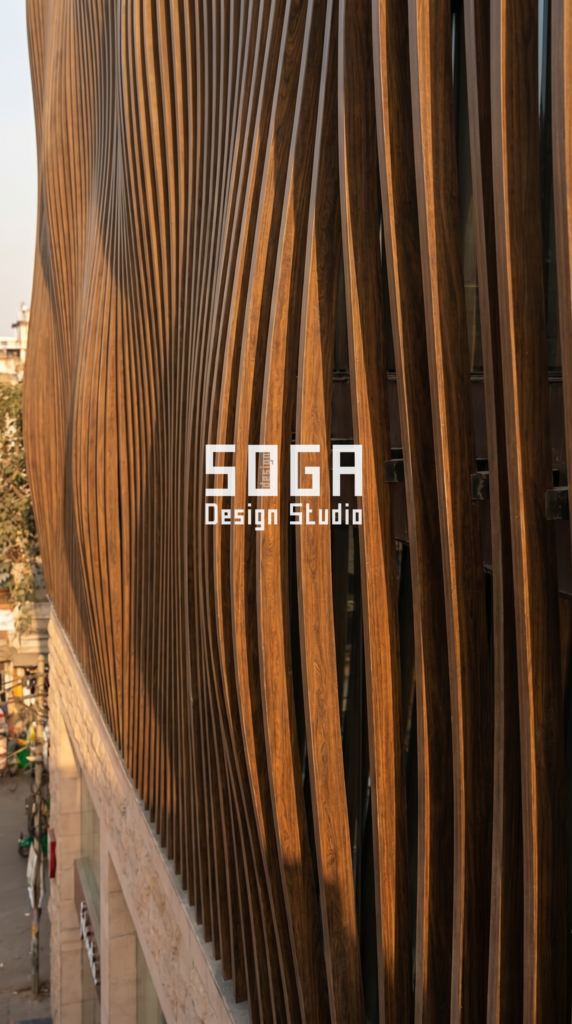
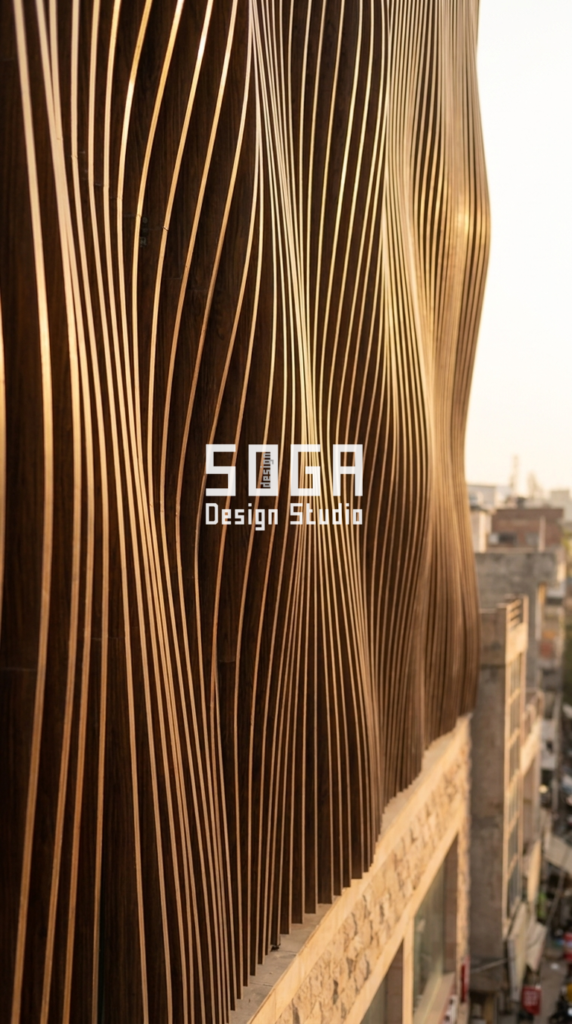
Above a solid stone base rises a flowing wooden veil: hundreds of vertical fins that curve, gather, and cascade like fabric caught mid-motion. By day it catches golden light and throws soft shadows across itself. At dusk, the warm interior glow filters through the gaps, and the whole upper volume seems to breathe.
We call the project The Veil. And it answers a question every commercial property owner eventually asks: what actually makes a facade worth investing in?
Why a facade is a business decision, not just a design one
For a retail and commercial building, the facade is not decoration. It is the single most public-facing asset the building has. It works around the clock, whether the shops are open or not.
A well-designed commercial facade does three jobs at once:
It earns attention. On a crowded street, recognition is currency. A building people remember becomes an address people give directions by — “the one with the wooden waves.” That recall is free marketing for every tenant inside.
It protects what’s behind it. The fins here aren’t only sculptural. They filter harsh direct sun off the upper floors, cut glare, and reduce heat load on the interiors — which matters for both comfort and running costs in an Indian climate.
It signals quality. A considered exterior tells customers, tenants, and investors that the building is cared for. That perception flows directly into footfall, rental value, and how long a property stays relevant.
So when we talk about what makes a good facade, the honest answer is: one that performs on all three fronts at once — attention, protection, and value — rather than chasing looks alone.
The idea behind The Veil
The brief was a commercial building on a prominent market corner, anchored by recognizable retail brands at street level. The challenge: how do you give it a strong identity without fighting the chaotic, vibrant context around it?
Our answer was contrast, not competition.
The base stays grounded and solid — stone, generous glazing for the storefronts, a clear and welcoming retail frontage. It belongs to the street.
The upper volume does something completely different. It lifts off into a flowing screen of vertical fins that ripple across the surface. Where the base is heavy and rooted, the top is light and in motion. That tension — solid versus flowing, grounded versus weightless — is what makes people look up.
The flow isn’t random. The fins follow a controlled rhythm, denser in some areas, opening up in others, so the facade reveals and conceals the building behind it depending on where you’re standing. Walk past it and it appears to move with you.
Why we chose flowing vertical fins
A simple vertical fin is one of the most useful elements in a facade designer’s toolkit. On its own, a single fin is ordinary. Repeated and arranged with intent, fins become something else entirely.
Here’s what they do for this building:
Sun control. Vertical fins are excellent at blocking low-angle and side sunlight while still allowing views and daylight through the gaps. The upper floors get protection without being sealed off.
Privacy with openness. From the street, the screen reads as a continuous surface. From inside, you can see out clearly. The building gets privacy without feeling closed in.
Depth and movement. Because the fins curve and shift across the facade, light hits them differently through the day. The building is never visually static — morning, noon, and dusk each give it a different character.
A single language, endless variation. One repeated element, arranged with computational control, produces a surface far richer than the sum of its parts. This is the core of parametric thinking: simple rules, complex and beautiful results.
Project: The Veil — Commercial Facade
A note on material and durability
The fin system is built from timber / timber-finish weather resistance wood in the building’s climate and pollution exposure.
For any exterior facade material, the questions worth asking before you commit are:
How does it hold up to sun, rain? What maintenance does it need, and how often? Does the finish fade, warp, or need re-coating? How is it fixed back to the structure, and is that system serviceable?
A facade is a long-term asset. The right material is the one that still looks intentional a decade after installation — not just on opening day. (Insert SOGA’s specific material rationale and maintenance cycle here.)
What this means for your project
If you own or are planning a commercial or retail building, The Veil illustrates a few principles worth carrying into your own facade decisions:
Lead with identity. On a competitive street, a recognizable facade is a business advantage, not a vanity expense. It compounds in value over time.
Let the facade work, not just decorate. The best exteriors solve real problems — heat, glare, privacy — while looking remarkable. Performance and beauty aren’t a trade-off when the design is considered from the start.
Respect the context, then rise above it. A grounded, welcoming base keeps the building connected to the street. A distinctive upper volume gives it presence. You don’t have to choose between fitting in and standing out.
Plan the material for the long run. The visual idea is only as good as the system that keeps it looking that way for years.
Designed and delivered by SOGA Design Studio
At SOGA Design Studio, we specialize in parametric and computational facade design — turning simple, buildable elements into facades that perform and stay memorable. From residential homes to commercial landmarks like The Veil, our work brings together design intent, material intelligence, and engineering precision.
Planning a facade for your building? We’d love to discuss it. Reach out to SOGA Design Studio for a consultation.
📍 SOGA Design Studio — Parametric & Computational Architecture