Walk down a Sector-70 lane in Mohali in 2026 and one G+3 quietly stops you: its moss-green skin seems to breathe, the metal ribs bowing in and out as the evening light slides across them. It is not paint and it is not stone – it is a parametric metal facade, chosen because it does something a flat wall cannot. That single question – which material is genuinely best for a building facade – is the one every Indian homeowner and builder now asks first. The honest answer is that there is no universal winner; the right metal depends on your sun, your salt, your street and your budget. The four concepts below, spanning Mohali, Surat and Kochi, show how facade design in India matches material to place.
Facade Design in India: Why Mohali Is Choosing Parametric Metal
Facade design in India has moved from an afterthought to the single most important decision on a residential project. Today, demand for parametric facade design in India is rising fastest in cities such as Mohali, Mumbai, Bangalore, Delhi, and Pune, where homeowners and developers want elevations that are both performance-driven and instantly recognisable. SOGA Design Studio specialises in facade design in India — from G+3 individual homes to G+7 residential blocks — pairing algorithmic geometry with matte powder-coated ral 6005 moss gree and fabrication-ready detailing. Whether you are comparing metal facade design in India for a new build or a retrofit, the concepts below show how a considered facade redefines a building’s identity and its long-term value.
1. Mohali Parametric Billow Shell: Moss-Green Ribbed Steel Facade
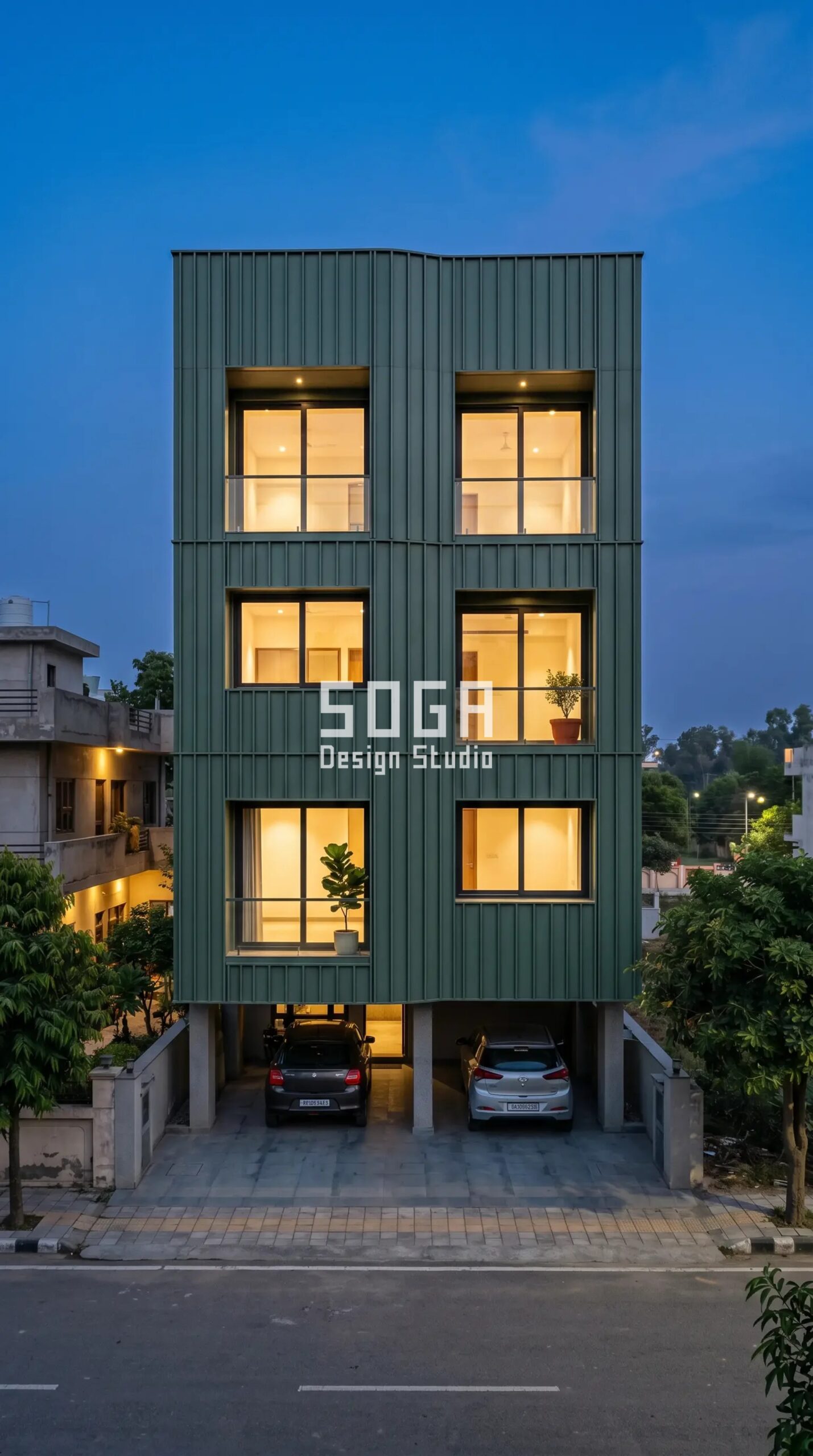
Mohali’s Sector-70 plots open onto wide, sunlit streets, so the whole G+3 elevation is on show and the west light is unforgiving through a long Punjab summer. The Billow Shell answers with an ordered rhythm of undulating vertical ribs in powder-coated RAL 6005 moss-green steel, bowing gently in and out so the facade self-shades and never reads as a flat billboard. Powder-coated steel is the pragmatic choice here – tough, colour-stable, and priced for a family home rather than a showpiece budget. Each rib is a discrete, repeating module with honest seams, which keeps the look sculptural but the fabrication simple. At blue hour the ribs catch the warm glow from the windows and the building turns quietly jewel-like above its open stilt parking. It is proof that a modest G+3 can carry serious identity without exotic materials.
2. Surat Parametric Loop Weave: Interlocking Metal-Tube Screen
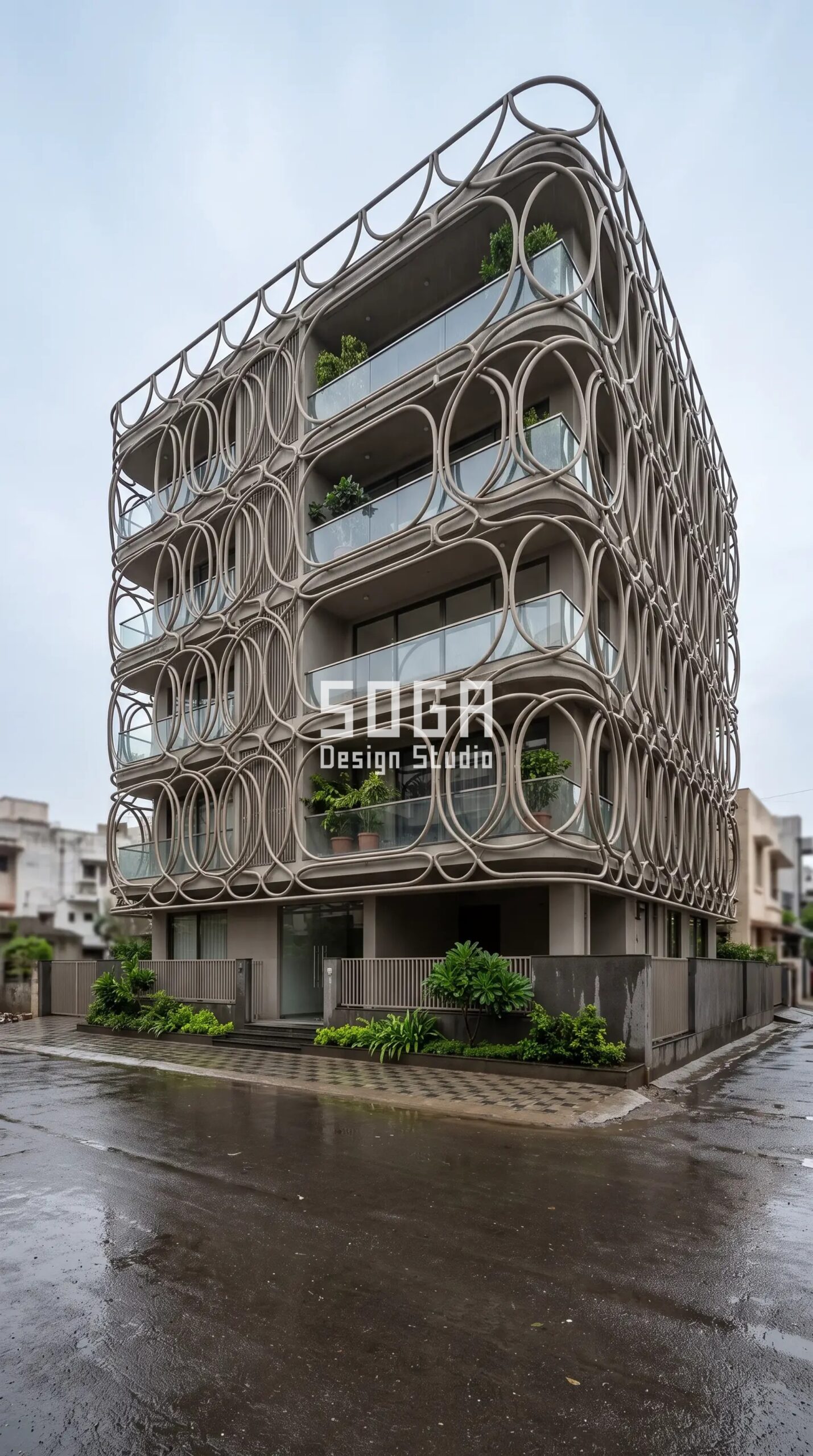
Surat sits in a humid, monsoon-heavy belt, so a Vesu G+4 needs a skin that shades hard but still breathes as the wet-season air moves. The Loop Weave wraps the building in a clean, evenly spaced rhythm of interlocking circular loops in bent steel tube, finished a warm beige-grey that stays calm against grey monsoon skies. The looped screen throws deep shade over the balconies while the open geometry lets damp air pass, cutting the trapped heat that plagues solid walls in Gujarat. Because the loops are crisp, discrete tube forms rather than a chaotic tangle, the pattern stays buildable and easy to maintain. Mounted on stand-off brackets, the same screen can even retrofit over an existing plastered facade. After the rain, the wet street mirrors the whole woven elevation back at you.
3. Surat Parametric Chevron Grid: Dark-Bronze ACP Herringbone Facade
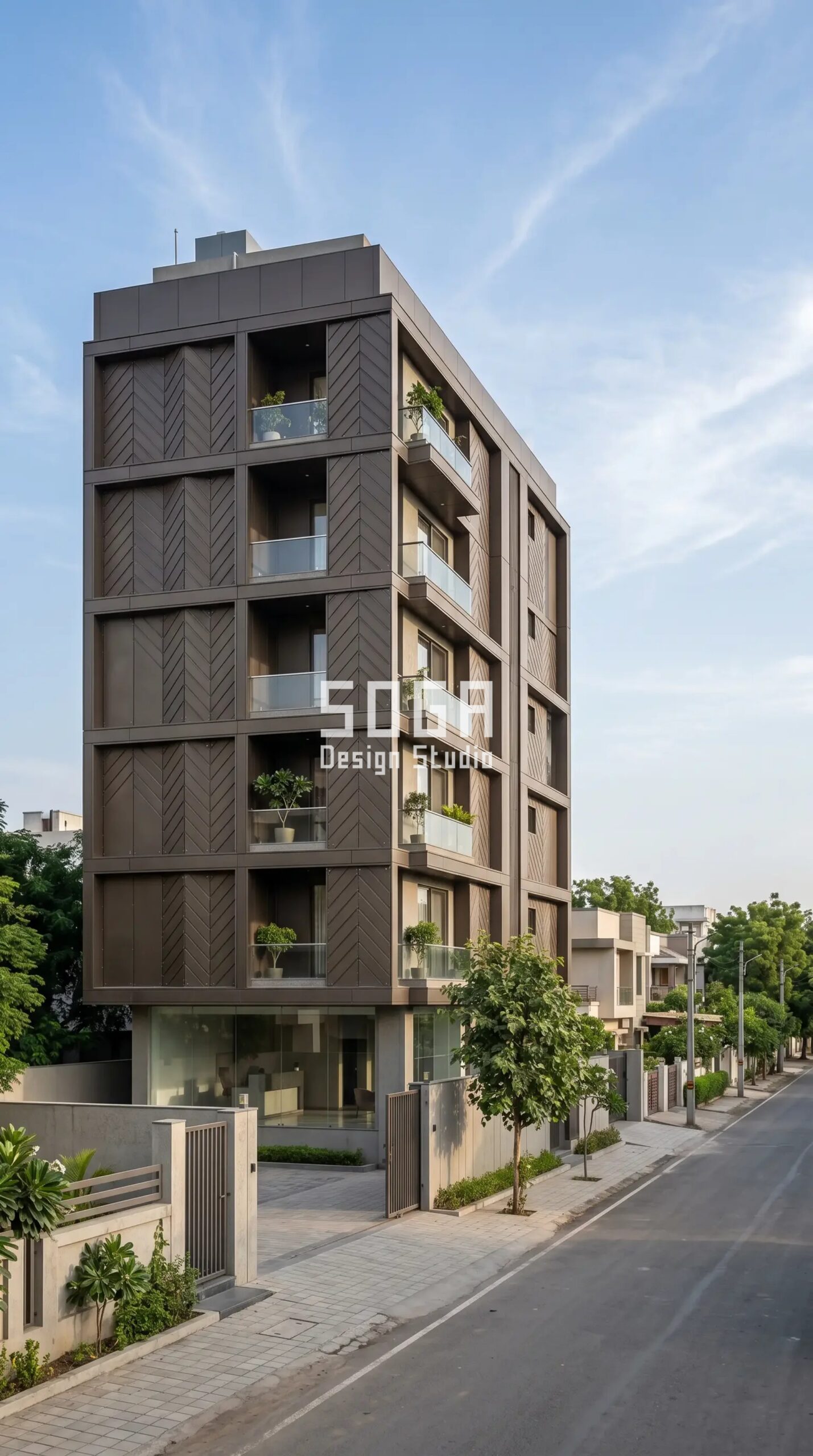
A tighter Vesu plot next door takes the opposite route: instead of a screen, a G+5 leans into flat graphic power. The Chevron Grid stacks embossed dark-bronze ACP panels floor to floor in a bold herringbone, each a discrete flat facet on a clean rectangular module grid. ACP is the value engineer’s material here – light, fast to install, and among the most affordable cladding routes in India – yet the chevron embossing lifts it far above a plain box. In clear morning sun the folds throw a crisp diagonal shadow that shifts through the day, so the elevation is never static. A glass ground-floor lobby grounds the composition and signals a considered, contemporary address. This is how a cost-conscious G+5 still buys real street presence.
4. Kochi Parametric Quill Screen: Verdigris Copper Fin Facade
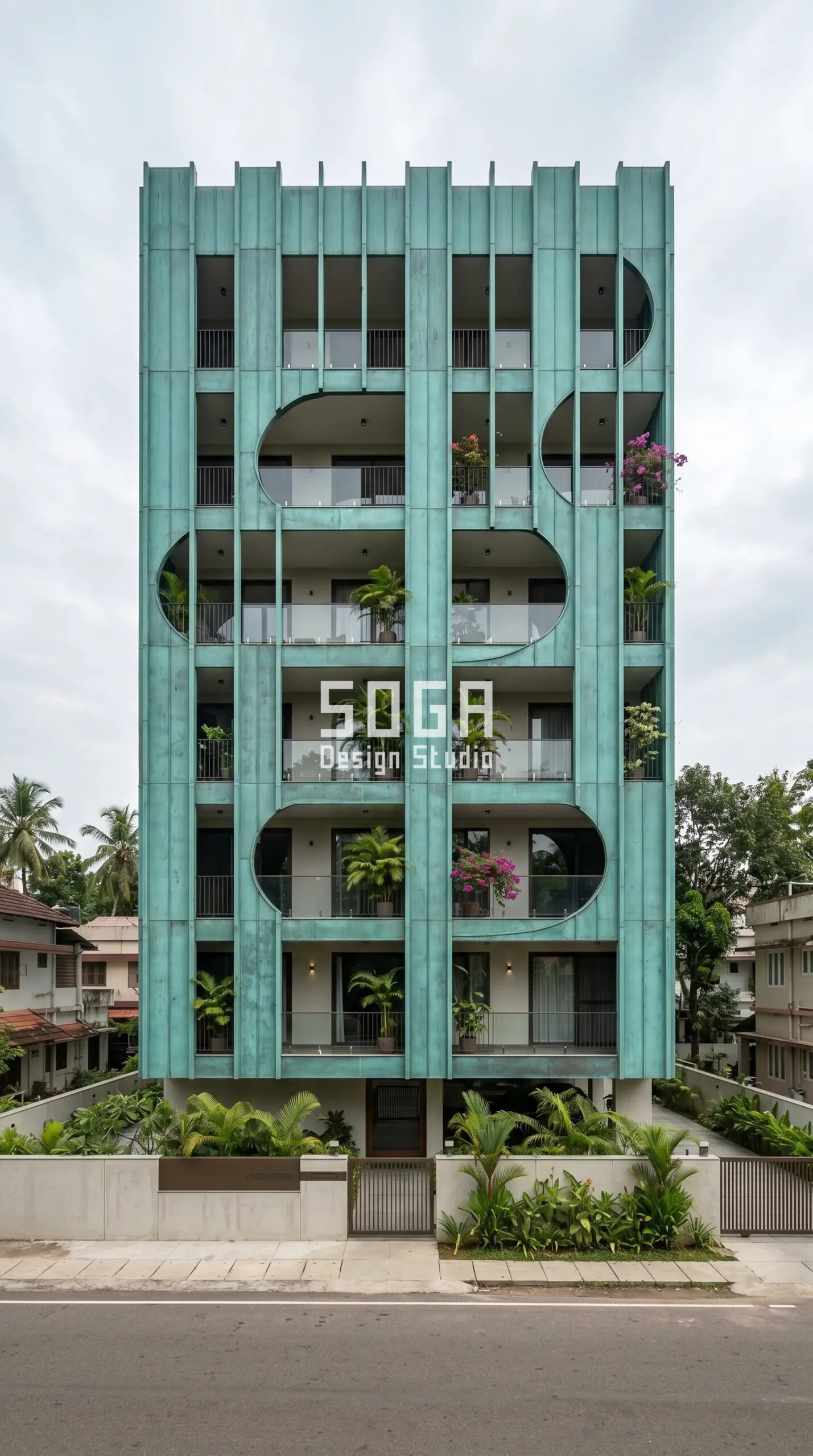
Coastal Kochi is the toughest test: salt air, relentless monsoon damp, and a demand for something that ages gracefully rather than streaking. The Quill Screen answers with tall, slender vertical fins in verdigris patinated copper, spaced by sinuous wavy openings that filter the soft overcast light onto tropical balconies. Copper is the premium, long-horizon choice – a correctly detailed copper or patinated skin can outlast 40 years in coastal conditions with almost no upkeep. The sea-green patina is not a defect but the material’s own protective finish, and it settles beautifully into Kochi’s palm-lined streets. As an ordered rhythm of discrete fins, the screen stays airy and buildable rather than heavy. For a G+6 by the water, it is the facade that quietly improves with age.
Cost Benchmarks for Indian Parametric Metal Facades
One of the most-asked questions on a Mohali project brief is budget. The current all-in installed rates for parametric metal facades in India sit in the following ranges:
- Steel facade (full design + install): ₹1,200–₹2,800 per sq ft
- Aluminium, anodised or powder-coated: ₹800–₹2,500 per sq ft
- Zinc cladding: ₹1,500–₹3,000 per sq ft
- ACM panels (3 mm basic): ₹200–₹250 per sq ft (basic)
- ACM panels (4 mm): ₹250–₹350 per sq ft
- Solid aluminium panels: ₹800–₹1,800 per sq ft
- Installation labour: ₹50–₹150 per sq ft (varies by height + access)
- Conventional cladding (for comparison): ₹400–₹1,200 per sq ft installed (stone veneer / ceramic / standard ACM)
These figures are baseline; actual project cost depends on facade area, panel complexity, fabricator location, and finish specification. SOGA Design Studio prepares an itemised cost estimate as part of every consultation so the budget conversation starts with hard numbers rather than guesses.
Parametric Facade Design Across India, Dubai & Singapore
SOGA Design Studio operates across the full Indian residential market — Mumbai, Delhi, Bangalore, Hyderabad, Chennai, Pune, Jaipur, Ahmedabad, and tier-2 cities including Coimbatore, Indore, Nagpur, and Chandigarh. Demand for sculptural metal cladding, phototropic facade material is no longer concentrated in metros; we are seeing equal pull from owner-builders in tier-2 markets who want their G+3 home to read as clearly designed, not generic. Every project starts with your plot dimensions, local building bylaws, and a 30-minute discovery call to align on aesthetic direction.
Why Trust SOGA Design Studio for Facade Design in Mohali
- Experience: SOGA Design Studio has designed and visualised parametric metal facades for real Indian G+3 to G+7 plots since 2023, publishing a daily facade study series that stress-tests systems, materials and climate response across Indian cities.
- Expertise: Five in-house parametric systems, orientation-by-orientation climate tuning (west-sun shading, monsoon ventilation, coastal salt resistance), and fabrication-ready detailing developed with vetted Indian fabricators across the Mumbai-Pune, Chennai-Coimbatore, Delhi-NCR and Ahmedabad clusters.
- Authority: Positioned as India’s facade design experts, working across Punjab, Gujarat, Kerala and the wider Indian metros and tier-2 cities, plus NRI markets in Dubai, Singapore and the UK.
- Trust: Real 2026 cost ranges and itemised, no-obligation estimates on every consultation, a fully remote NRI design-to-installation workflow, and honest material lifespans rather than sales promises.
Frequently Asked Questions
What is the best facade material for a building in Mohali?
There is no single best material – it depends on orientation, budget and how much maintenance you want. In Mohali’s dry, sun-heavy climate, powder-coated aluminium or steel (Rs 800-2,800 per sq ft installed) offers the best balance of durability, colour stability and cost, while ACP (Rs 200-350 per sq ft) is the value option and copper the premium, long-life choice. A parametric system lets SOGA Design Studio tune the material and screen density to each facade’s actual solar load.
Which metal lasts longest on an Indian facade?
Anodised aluminium and pre-patinated zinc or copper last the longest – often 40 years or more, even in coastal Mumbai, Chennai and Kochi – because their protective finish is part of the metal itself. Quality powder-coated aluminium and galvanised steel last 25-30 years before any recoating, needing only an annual rinse-down rather than the repainting a plaster facade demands.
How much does a parametric metal facade cost in India 2026?
Aluminium parametric facades range ₹800–₹2,500 per sq ft (full design + install), steel ₹1,200–₹2,800 per sq ft, and zinc ₹1,500–₹3,000 per sq ft. Basic ACM cladding (3–4 mm) starts at ₹200–₹350 per sq ft; solid aluminium panels run ₹400–₹600 per sq ft. Installation labor adds ₹50–₹150 per sq ft depending on building height. SOGA Design Studio provides itemised cost estimates as part of every consultation.
Can NRIs design and build a parametric facade in India remotely?
Yes. SOGA Design Studio runs end-to-end remote consultations for NRI clients in Dubai, Singapore, the UK, and the US. The workflow — site analysis, design development, client review, fabrication-ready drawings, and on-site supervision — is delivered virtually. NRI projects in tier-2 cities like Coimbatore, Indore, and Chandigarh make up a fast-growing share of our portfolio.
Can a parametric metal facade be retrofitted onto an existing Indian building?
Yes, and it is one of the fastest-growing segments. A lightweight aluminium parametric screen can be mounted on stand-off brackets over existing brick, RCC, or even tired plaster facades — completely transforming the elevation in 4–8 weeks without disturbing tenants or interiors. Retrofit is particularly cost-effective for 1990s-2010s Indian apartments where the original facade has aged.
Is parametric design suitable for G+3 and G+4 residential plots?
Absolutely — it is in fact the highest-growth segment in India. G+3 and G+4 plots benefit most because the entire facade is visible from the street, so a sculptural parametric treatment yields maximum identity per rupee invested. SOGA Design Studio specialises in this typology, with concepts adapted to standard 30×40, 40×60, and 50×80 ft plots across Indian metros and tier-2 cities.
Which RAL colours work best for Indian residential facades?
Three palettes dominate 2026 Indian residential work: warm earthy bronze and corten tones (RAL 8004, 8019) for traditional contexts; deep desaturated blues and greens (RAL 5004, 5011, 6009) for contemporary luxury; and matte charcoal/black (RAL 9005, 7016) paired with brass or copper accents for a graphic urban look. Light cladding with dark frames is the most-searched aesthetic of 2026.
How is AI changing facade design in India in 2026?
AI is now a routine input at the concept stage: generative tools propose dozens of parametric variations from a single brief, and computational performance simulators predict heat gain, daylight, and material cost before any drawing is finalised. SOGA Design Studio uses AI-assisted visualisation to accelerate the concept phase from 4 weeks to 4 days, while the engineering and fabrication detailing remain human-led.
What is a sculptural petal-shaped metal fin facade?
SOGA Design Studio addresses this question in detail during the design consultation. For Mohali projects, we provide a fully customised answer based on plot, orientation, and budget — typically within 48 hours of receiving the brief.
Related Reading
Start Your Facade Project With SOGA Design Studio
The best facade material is never a single answer – it is the metal tuned to your orientation, climate and budget, which is exactly what a parametric system lets you decide plot by plot.
If any of the undulating vertical metal ribs that concepts above resonate with your project, send us your brief. SOGA Design Studio delivers customised parametric facade concepts for India, Dubai, Singapore, and the UK.