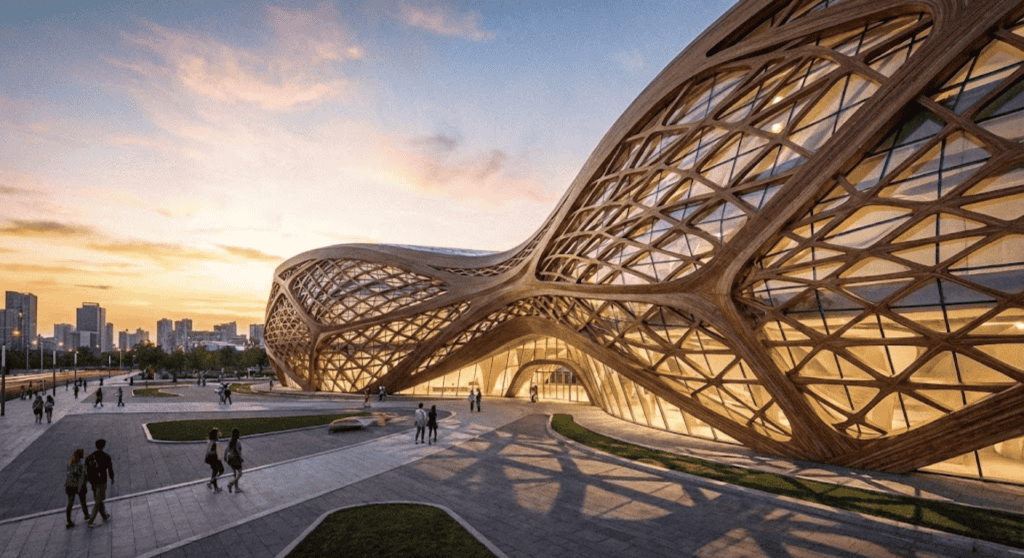
A great front elevation design double floor house starts with one honest question: when someone stops outside your gate, what does the building say about you? For most Indian homeowners building a G+1, the elevation is the single most visible — and most permanent — decision on the whole project, yet it is usually rushed at the end when the budget is already tight. The result is a flat, painted box that looks dated within five years. This guide walks through 25+ modern double floor front elevation design directions, real material costs per square foot, the colours and screens that survive the Indian sun, and how SOGA Design Studio turns a standard two-storey plot into a street landmark.
Why the Double Floor Elevation Matters More Than You Think
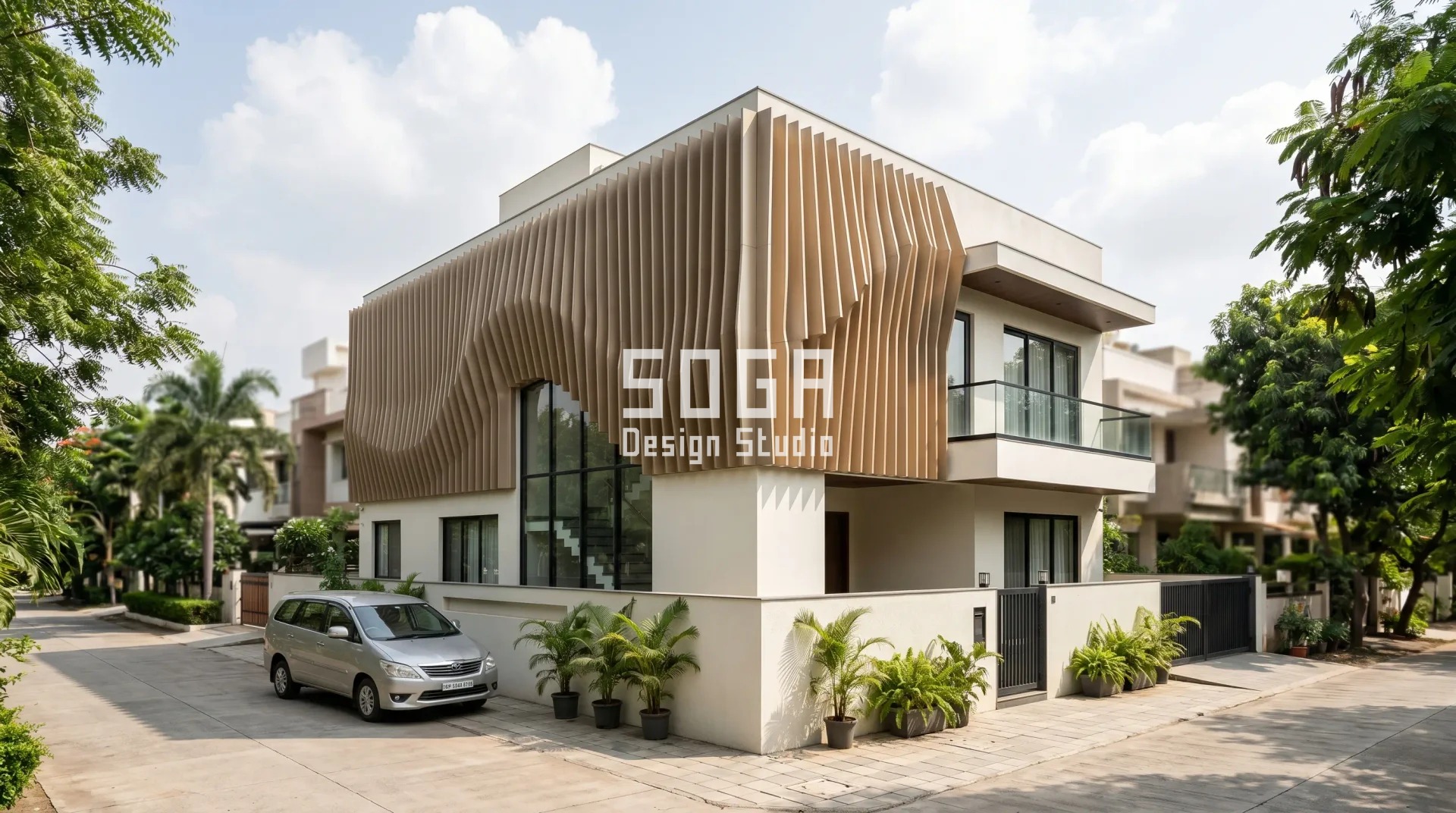
On a single-storey home the eye reads the gate, the door, and a strip of wall. On a double floor house the entire two-storey face is exposed to the street, which means a front elevation design double floor home has roughly twice the surface area working either for you or against you. That extra height is an opportunity: it lets you stack contrasting materials, introduce a double-height entrance, and create a vertical rhythm that a bungalow simply cannot. It is also why a weak two-storey elevation looks so obviously cheap — there is nowhere for a bad decision to hide.
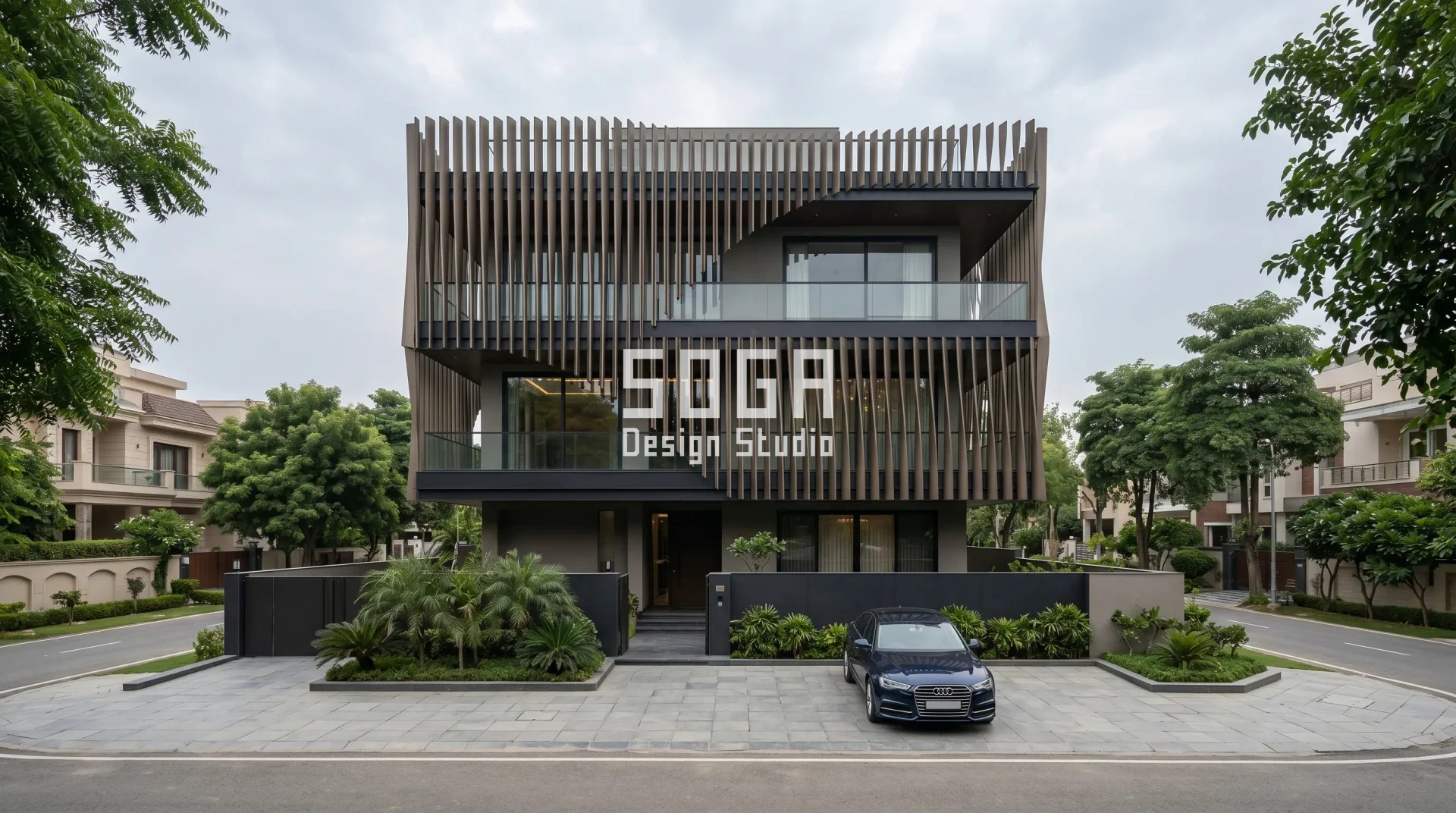
The modern Indian double floor front elevation design has moved decisively away from heavy Roman columns and glossy granite toward layered, climate-aware facades: a quiet base, an expressive upper floor, and a screen or fin element that controls light. Done well, this is the look that reads as “architect-designed” from the road.
25+ Modern Front Elevation Ideas for a Double Floor House
You do not need every idea — you need the three or four that suit your plot, orientation, and budget. Group them by the lever they pull:
Material-Led Looks (the biggest visual impact)
- Wood-tone aluminium ribbon screen over the first floor (low maintenance, warm)
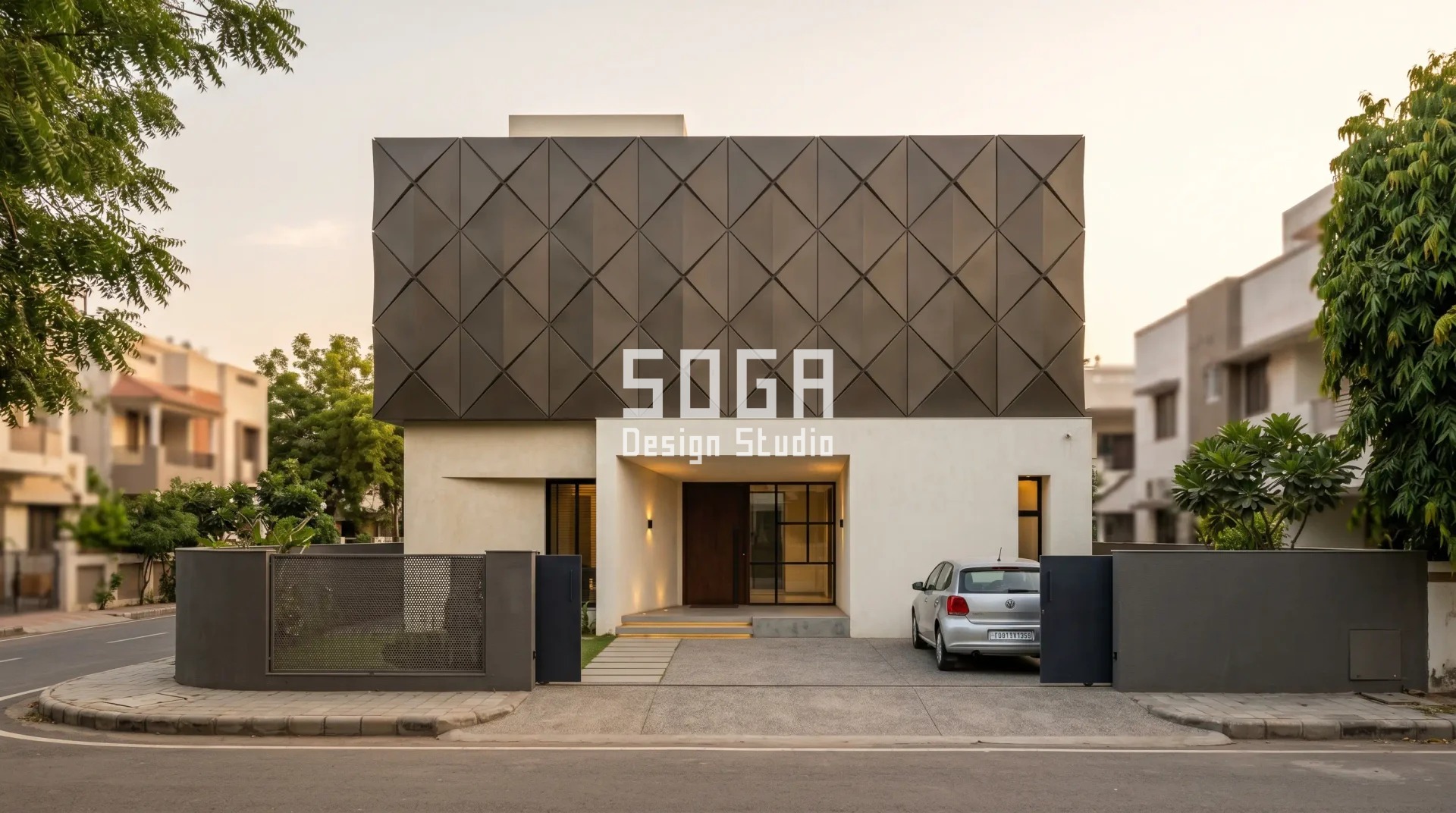
- Aluminium composite panel (ACP) bands in dual tones — dark frame, light cladding
- Precision-cut metal screen as a balcony privacy layer (the modern jaali)
- Fluted GFRC panels for a soft, shadow-rich texture
- Exposed-finish concrete base with a metal upper volume
- Stone-look porcelain at the entrance core, metal everywhere else
Form-Led Looks (architecture doing the work)
- Double-height entrance recess that pulls the front door into shadow
- Cantilevered first-floor box for a floating, premium feel
- Vertical fin array running full height to slim a wide plot
- Asymmetric massing — solid on one side, glazed on the other
- Stepped parapet to break the flat roofline
Detail-Led Looks (cheap upgrades, big effect)
- Continuous linear LED wash grazing a textured panel at night
- A single feature material framing the staircase glazing
- Planter ledges integrated into the elevation, not bolted on
- Dark anodised railings instead of stainless steel
- Concealed gutters and downpipes for clean lines
Mix one material-led idea, one form-led idea, and one detail-led idea, and almost any house front elevation design will look composed rather than busy.
Front Elevation Cost Per Square Foot: Double Floor House (2026)
The number that actually decides your elevation is cost per square foot of the front face. Here are realistic 2026 all-in installed ranges in India so you can budget before you fall in love with a render:
| Elevation material / system | Installed cost (₹ per sq ft) | Best for |
|---|---|---|
| Texture paint + basic plaster bands | ₹120–₹300 | Tight budgets, rental builds |
| ACP cladding (3–4 mm) | ₹200–₹350 | Fast, flat, modern dual-tone looks |
| Solid aluminium panels | ₹800–₹1,800 | Premium flat facades, long life |
| Powder-coated aluminium screen / fins | ₹800–₹2,500 | Privacy + shading on the upper floor |
| GFRC fluted / moulded panels | ₹900–₹2,200 | Soft texture, sculptural depth |
| Stone-look porcelain (entrance feature) | ₹400–₹900 | Entrance core accent only |
For a typical double floor front elevation design with around 600–900 sq ft of visible front face, most homeowners land between ₹3.5 lakh and ₹12 lakh depending on how much of the face is metal versus paint. A smart split — paint or ACP on the secondary planes, a real metal or GFRC feature on the entrance and upper floor — gives 80% of the impact at half the all-metal cost. SOGA Design Studio prepares an itemised, plane-by-plane estimate so the budget conversation starts with hard numbers rather than a lump-sum guess.
Beating the Indian Heat: The Elevation as a Sun Shield
A front elevation in India is not just a face — it is the first line of defence against heat. A west- or south-facing two-storey wall takes a brutal solar load from 2 PM onward, and a bare painted surface pushes that heat straight into your bedrooms. A layered facade fixes this. A precision-cut metal screen or a fin array held 150–250 mm off the wall creates a ventilated shadow gap that cuts direct solar heat gain by 25–40% on those orientations and drops interior surface temperatures by 4–7°C compared to bare RCC.
This is where a parametric facade earns its keep. Instead of a uniform screen, the opening density is tuned per orientation — tighter where the sun is harsh, more open where you want the view and breeze. SOGA Design Studio runs every concept through orientation-specific solar analysis, so your Para-Scale Shingle facade or fin layer shades the glass where it matters and opens up where it does not. The elevation becomes a working climate device, not just decoration.
Colours and Finishes That Survive the Sun
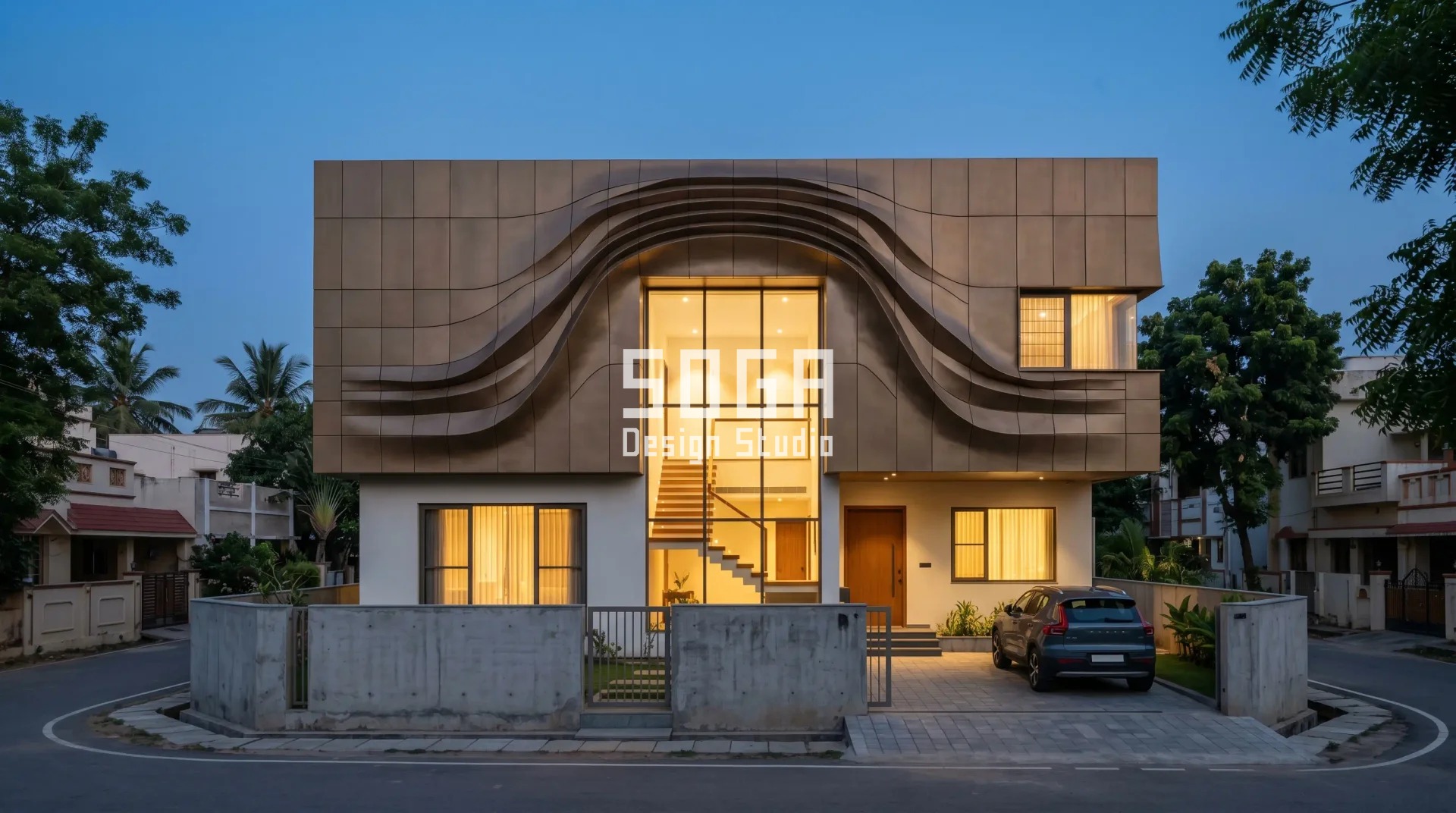
The most-searched 2026 palette is “dark frame, light cladding”: a charcoal or bronze frame around warm off-white, sand, or wood-tone infill. It photographs beautifully and hides dust between washes. Avoid pure gloss white (shows every streak) and high-gloss black (shows heat shimmer and scratches). For metal, matte and satin powder coats in RAL 7016 anthracite, RAL 8019 grey-brown, and champagne bronze are the safest long-life choices for Indian conditions, lasting 25–30 years before any recoat.
How to Choose the Right Elevation for Your Plot
Start with three constraints, in this order: orientation (where does the afternoon sun hit?), plot width (narrow plots want vertical emphasis, wide plots want horizontal banding), and budget tier. Only then pick the look. A common mistake is choosing a Pinterest elevation first and forcing it onto a plot it does not suit — a wide horizontal facade on a narrow 20-foot plot looks squashed, while tall fins on a wide plot look like a fence. Matching the gesture to the geometry is exactly the judgement an architect adds.
Why SOGA Design Studio
SOGA Design Studio is a parametric and computational architecture firm based in Gurugram, India, working across India, Dubai, and Singapore. We design front elevations the way the best facades are made everywhere — fabrication-first. Every concept is modelled in Rhino and Grasshopper, resolved as a real parametric facade with panel sizes, fixings, and a sub-frame, then taken to GFRC or CNC fabrication and installation. That means what you approve in the visualisation is what gets built, on tolerance and on budget. From a single G+1 home to a G+7 block, our parametric facade design services and signature systems like the Para-Chevron Diagrid give your house a defined identity and real climate performance. Get a custom facade concept for your plot — contact SOGA Design Studio at sogadesignstudio.com/contact.
Frequently Asked Questions
What is the best front elevation design for a double floor house? The best front elevation design double floor look layers a quiet base, an expressive upper floor, and a screen or fin element for shade — for example exposed concrete with a wood-tone aluminium screen above. This combination reads as modern, controls heat, and suits most Indian plots and budgets.
How much does a double floor house front elevation cost in India? A modern double floor front elevation costs roughly ₹3.5–₹12 lakh for a 600–900 sq ft front face in 2026, depending on material. ACP runs ₹200–₹350 per sq ft while powder-coated metal screens run ₹800–₹2,500 per sq ft installed.
Which material is best for a front elevation in the Indian climate? Powder-coated aluminium and GFRC are the best front elevation materials for Indian conditions. They last 25–30 years, need only an annual rinse, and — when used as a screen — cut solar heat gain by 25–40% on west and south walls, unlike paint which fades and reheats.
Is ACP or metal screen better for a double floor elevation? ACP is cheaper and gives a flat, modern dual-tone finish, while a metal screen adds depth, privacy, and real shading. Most homeowners use ACP on secondary planes and a metal screen on the upper floor and entrance for the best value-to-impact ratio.
Can SOGA Design Studio design my elevation remotely? Yes. SOGA Design Studio runs a full remote workflow for clients across India and NRI clients in Dubai, Singapore, and the UK. Site analysis, design development, and fabrication-ready drawings are delivered virtually, with on-site supervision relayed through dated photo updates.