A jewellery showroom is the one retail typology where the building itself has to look like the product. Gold, light and precision are the promise, and the facade makes that promise before a customer reaches the door. That job has become harder in 2026, because the same brand now has to make it in four very different places at once. Indian jewellery houses are opening in the UAE and Singapore, Gulf retailers are moving into Indian metros, and a single showroom identity now has to survive Kerala monsoon, Gulf sand, and equatorial sun without losing its shine. This guide sets out four jewellery showroom facade design concepts by SOGA Design Studio, one each for India, Dubai, Singapore and Abu Dhabi, with the real parameters, costs and buildability behind them.
These are concept designs by SOGA Design Studio, produced as design visualisations rather than photographs of completed buildings.
Why Jewellery Showroom Facade Design Is Different in 2026
Three things changed at once. First, jewellery retail went multi-market: brands that were city-level ten years ago now run showrooms across India and the Gulf, and Singapore has become the third node on that route, so a facade has to be a repeatable system rather than a one-off elevation. Second, the climate envelope hardened. Gulf codes now push harder on solar gain through display glazing, and a showroom is mostly glass at the ground floor, so shading has to be designed rather than tinted in. Third, and most practically, fabrication caught up: press-braked cassettes, folded blades and unitised carriers are now made to tolerance by facade contractors in Kochi, Sharjah and Johor, which means a varying, three-dimensional skin costs closer to a flat one than it did in 2020. That is why our concepts are built on parametric facade design logic: one module, one fabrication method, and a parameter that changes across the elevation, so the same detail can be re-tuned for a different city instead of redrawn.
1. Kochi: Parametric Bezel Grid Jewellery Showroom Facade
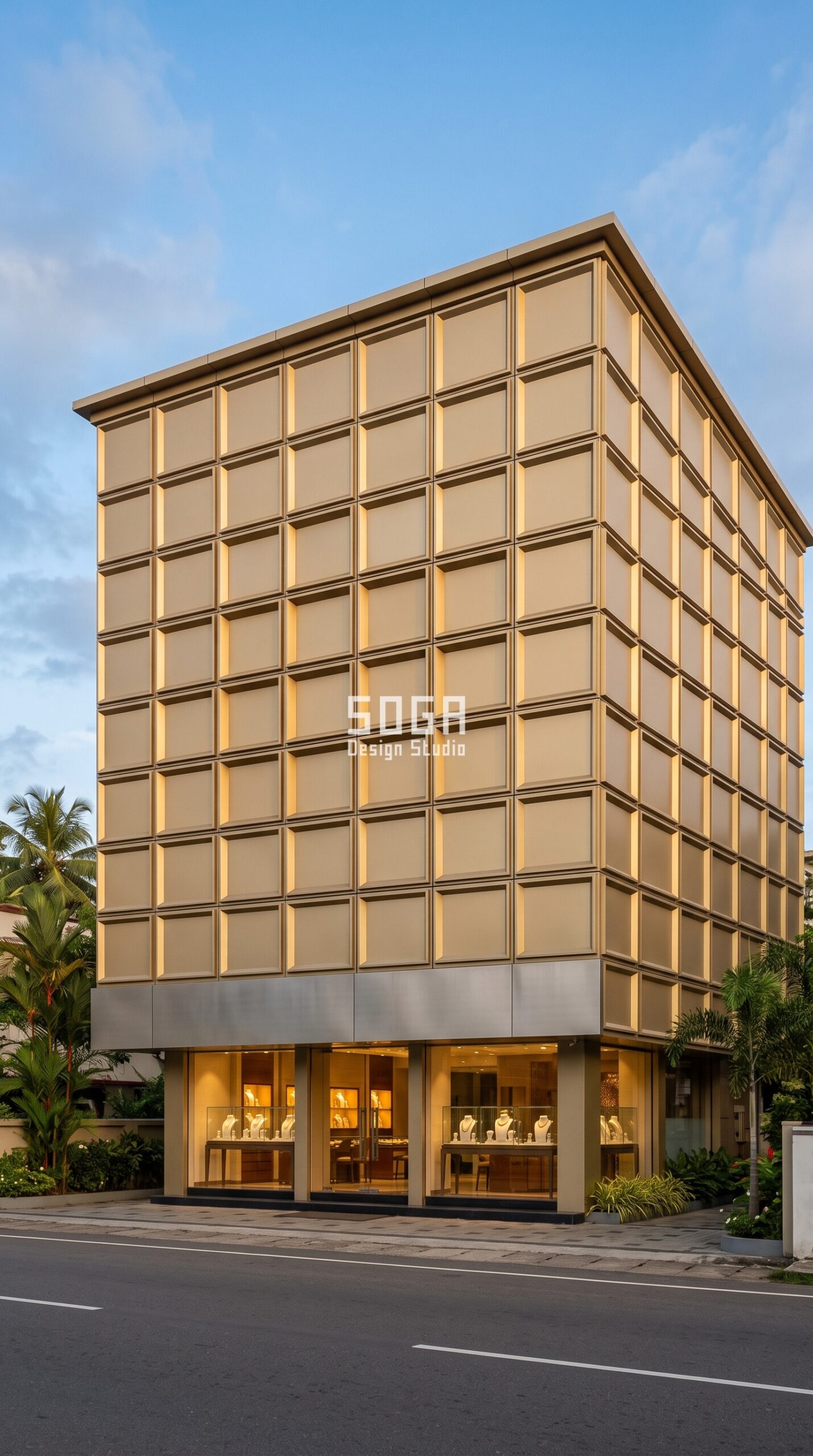
Design seed: Curved-plate retail massing x raised-rim cassette skin x depth modulation x champagne-gold anodised aluminium x a signage band written into the module grid rather than bolted onto it. This G+3 jewellery showroom in Panampilly Nagar, Kochi wears a Parametric Bezel Grid skin in champagne-gold anodised aluminium cassette panels with bronze-tinted glazing. Kochi is warm-humid with heavy monsoon driving rain, so the cassettes work as a drained-and-back-ventilated rainscreen with open joints and a full drainage plane behind, and every fixing is marine-grade stainless against the coastal salt air. The parametric variation is written into the fabrication drawings, not sprayed on afterwards.
How the Parametric Bezel Grid is built
| Design parameter | Specification |
|---|---|
| Module | 750 x 750 mm anodised aluminium cassette tray, 2.5 mm sheet, press-braked raised rim |
| Depth driver | Tray projection depth, driven by a centre-weighted gradient across the elevation |
| Variation range | 40 mm at the outer bays to 180 mm at the central entrance bay |
| Density | Full-coverage grid, 6 bays wide x 14 courses; 100% closed on the upper body, 0% over the display glazing |
| Panels & substructure | Approx. 1,050 trays, 7 unique depth types (0.7% unique parts); unitised on 150 mm galvanised steel brackets |
| Cavity & base | 150 mm ventilated rainscreen cavity with cavity fire barriers at each floor; ground 2.4 m in bronze-anodised solid plate for cleaning and wear |
Material & colour: hero skin in champagne gold (anodised, matte) with a warm bronze glass line at the ground floor, kept to a restrained palette so the geometry does the talking. Indicative facade cost: Rs 1,900-2,700 per sq ft, fully designed and installed, with an itemised estimate produced per project.
2. Dubai: Parametric Ingot Screen Jewellery Showroom Facade
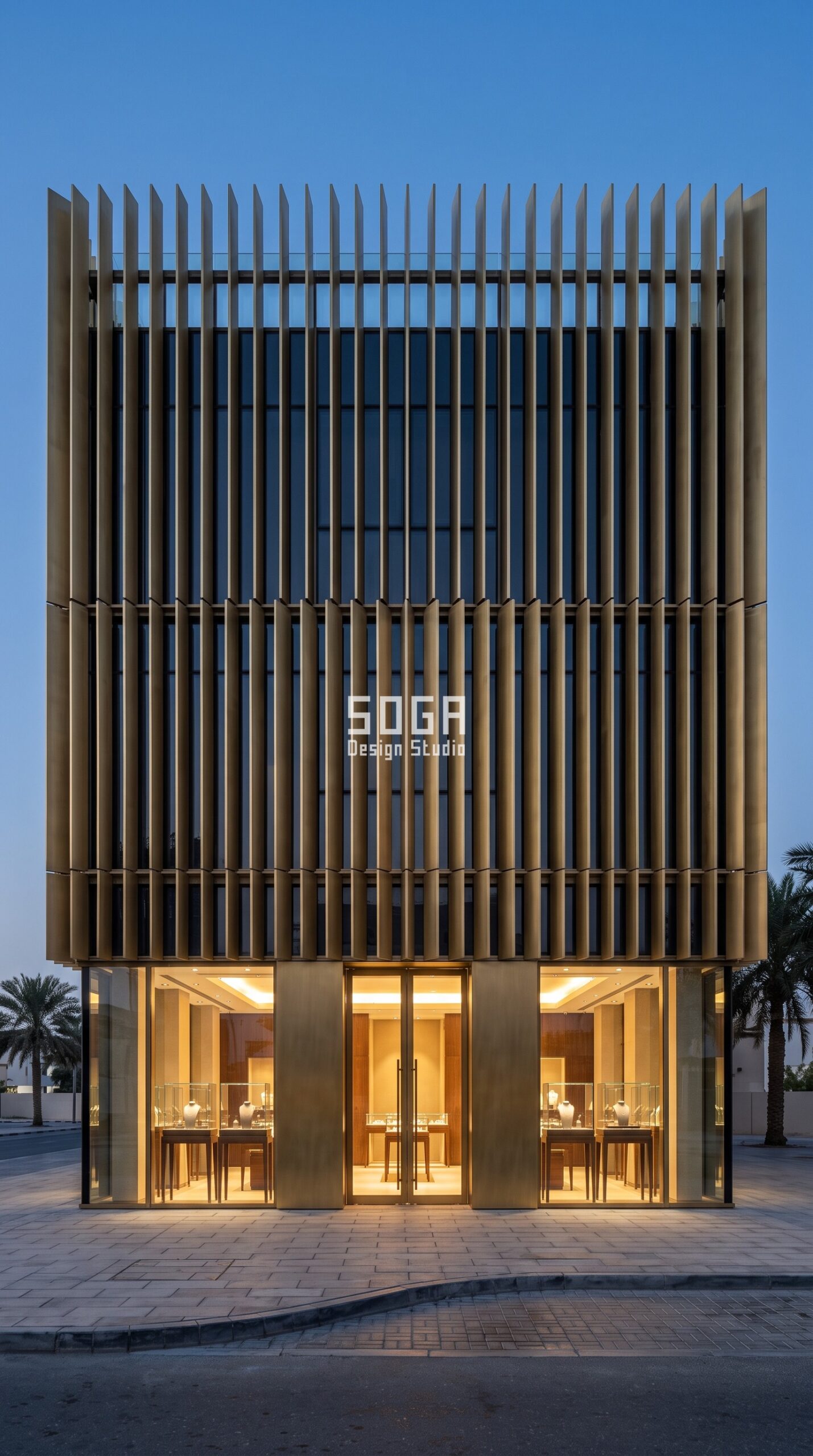
Design seed: Podium-and-frame retail massing x folded blade screen x depth-and-spacing modulation x brushed brass-toned stainless steel x the entrance announced by the screen opening rather than by signage. This G+2 jewellery showroom in Deira gold retail district, Dubai wears a Parametric Ingot Screen skin in brushed brass-toned stainless steel blades on a galvanised steel carrier frame. Dubai is hot-arid with severe west sun and blown sand, so the blade depths are set from the summer solar angles to cut direct gain on the display glazing, all gaps are kept above 5 mm so sand self-clears, and the coating is a marine-grade specification for the coastal humidity. The parametric variation is written into the fabrication drawings, not sprayed on afterwards.
How the Parametric Ingot Screen is built
| Design parameter | Specification |
|---|---|
| Module | 80 x 420 mm folded stainless blade, 3 mm sheet, full floor-to-roof runs |
| Spacing driver | Blade centres tighten toward the entrance bay on a linear gradient |
| Variation range | Blade depth 120 mm to 420 mm; spacing 480 mm to 220 mm centres |
| Density | Screen porosity eases from 28% open at the outer bays to 62% open across the entrance |
| Panels & substructure | Approx. 310 blades, 6 unique depth profiles (1.9% unique parts); stick-built onto a galvanised steel carrier frame at 1,500 mm centres |
| Cavity & base | 600 mm deep shading cavity in front of the glazing line; ground 2.4 m in solid bronze-anodised plate against sand abrasion |
Material & colour: hero skin in brushed brass with a dark bronze reveal behind the blades, kept to a restrained palette so the geometry does the talking. Indicative facade cost: Rs 2,400-3,400 per sq ft, fully designed and installed, with an itemised estimate produced per project.
3. Singapore: Parametric Prism Pulse Jewellery Showroom Facade
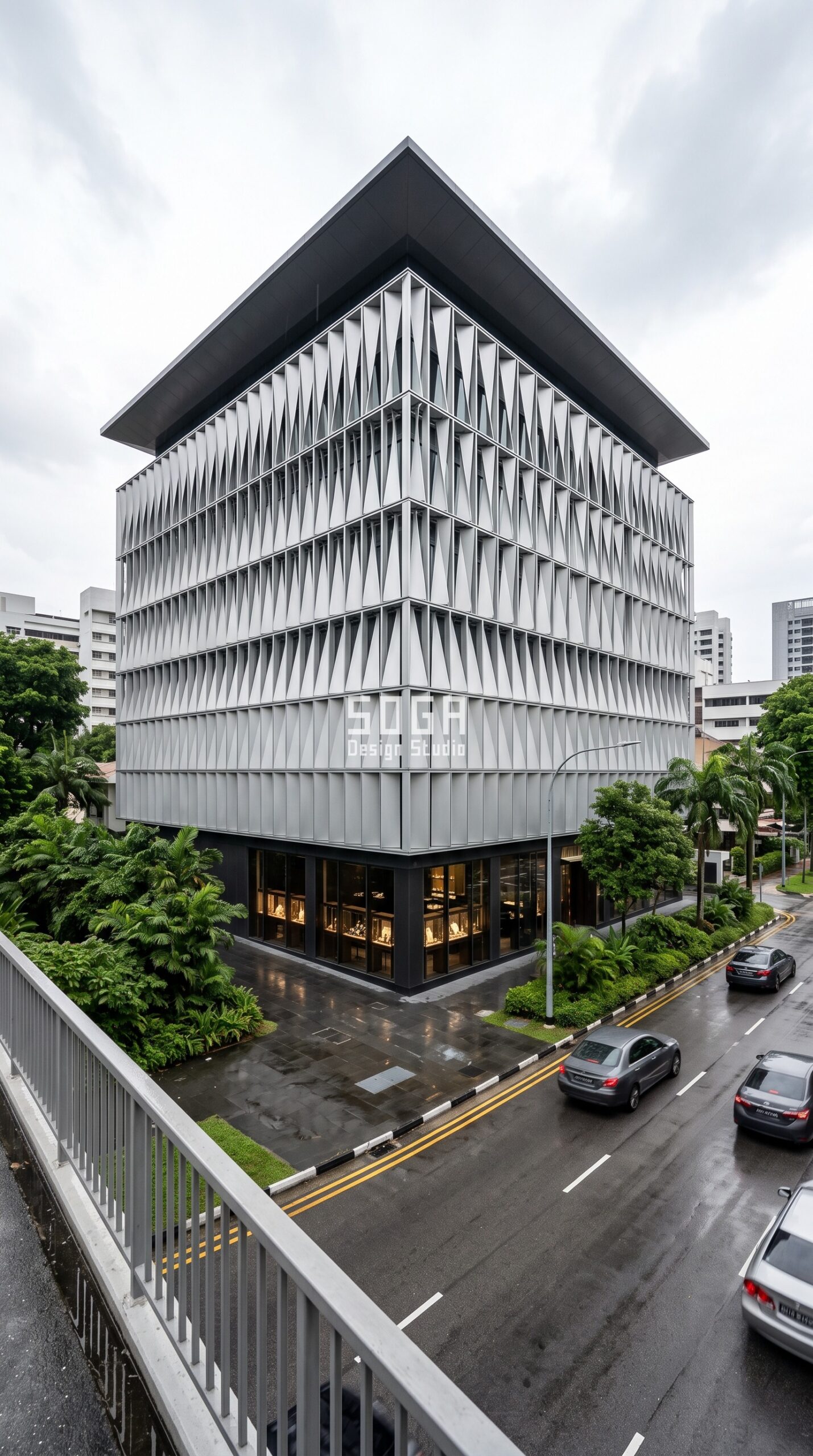
Design seed: Stacked shophouse-scale massing x triangular prism blade field x rotation-and-count modulation x pearl-silver anodised aluminium x a deep tropical overhang that doubles as the identity line. This G+4 jewellery showroom in Serangoon Road, Singapore wears a Parametric Prism Pulse skin in pearl-silver anodised aluminium prism blades with fritted glass behind. Singapore is hot-humid year round with intense overhead sun and sudden heavy rain, so the blades rotate to cut the high noon angle while keeping the street-level view open, and the whole assembly is a drained rainscreen with anti-fungal coatings and generous overhangs. The parametric variation is written into the fabrication drawings, not sprayed on afterwards.
How the Parametric Prism Pulse is built
| Design parameter | Specification |
|---|---|
| Module | 180 mm triangular press-formed aluminium prism blade, mounted at a constant 600 mm pitch |
| Rotation driver | Blade rotation angle turns with height, set from the tropical noon sun altitude |
| Variation range | Rotation 0 degrees at the base to 32 degrees at the top floor |
| Density | Blade count per bay thins from 9 at the street to 5 at the crown; effective shading factor 0.42 to 0.68 |
| Panels & substructure | Approx. 620 blades, 5 unique rotation brackets (0.8% unique parts); unitised bays 1.5 x 4.5 m craned into place |
| Cavity & base | 450 mm cavity with a 900 mm roof overhang for driving rain; drained and back-ventilated with anti-fungal coatings |
Material & colour: hero skin in pearl silver with a soft white frit, kept near-monochrome so the lit vitrines carry the colour, kept to a restrained palette so the geometry does the talking. Indicative facade cost: Rs 2,200-3,100 per sq ft, fully designed and installed, with an itemised estimate produced per project.
4. Abu Dhabi: Parametric Scallop Shell Jewellery Showroom Facade
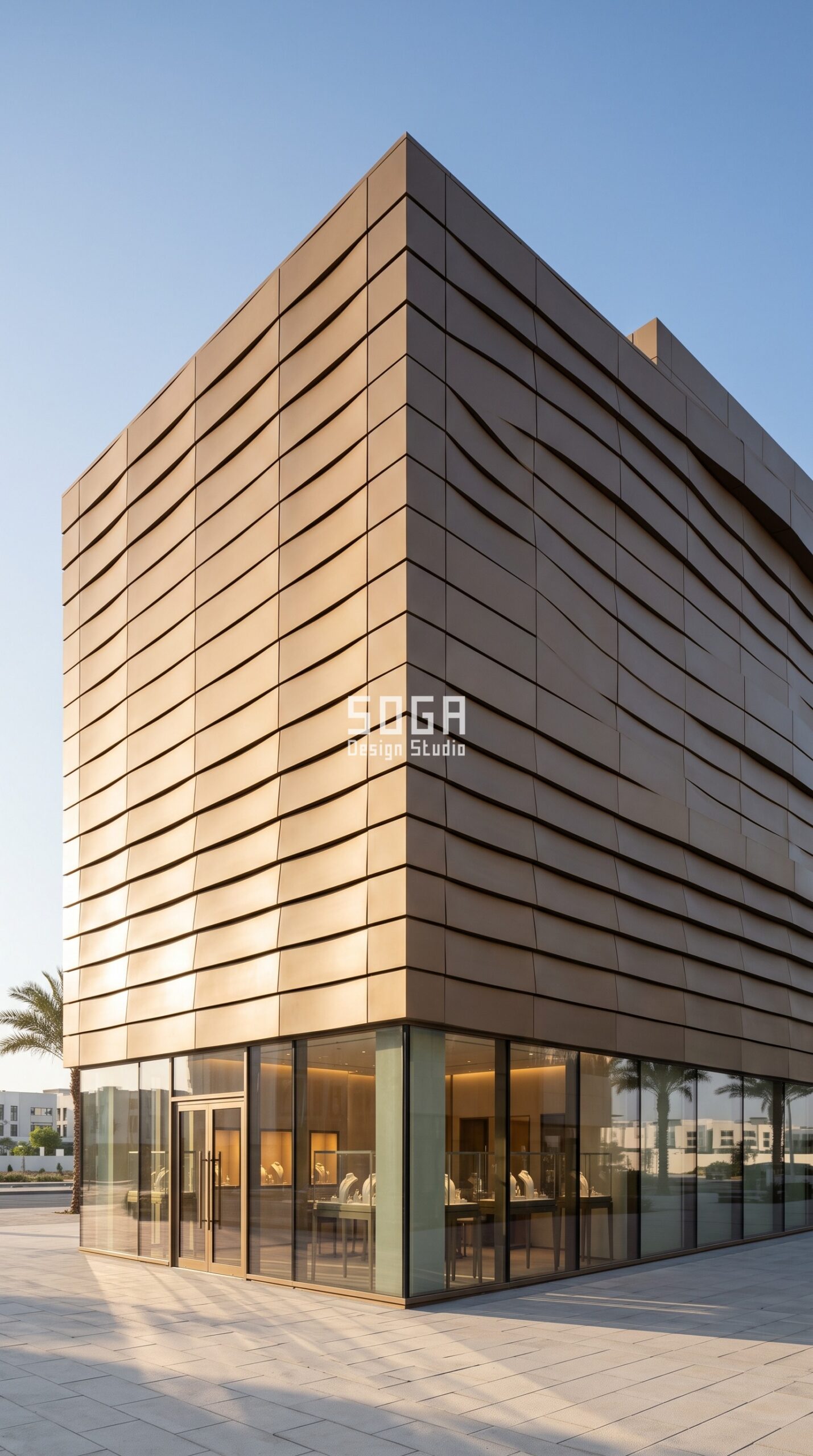
Design seed: Long horizontal retail frontage x shallow press-formed curved cassette x arc-depth modulation x sand-bronze powder-coated aluminium x a corner that turns the pattern instead of stopping it. This G+2 jewellery showroom in Madinat Zayed, Abu Dhabi wears a Parametric Scallop Shell skin in sand-bronze powder-coated aluminium cassettes on a thermally broken carrier. Abu Dhabi runs hot-arid with a very high summer radiant load, so the scallop depth is largest where the low morning and evening sun strikes hardest, the cavity is ventilated to shed heat off the backing wall, and the powder coat is a super-durable marine-grade specification. The parametric variation is written into the fabrication drawings, not sprayed on afterwards.
How the Parametric Scallop Shell is built
| Design parameter | Specification |
|---|---|
| Module | 1,500 x 750 mm press-formed aluminium cassette, 3 mm sheet, one shallow scalloped curve per panel |
| Depth driver | Scallop arc depth, driven vertically so the shadow line thickens toward the street |
| Variation range | 30 mm arc depth at the top course to 150 mm at the ground course |
| Density | 9 horizontal courses at a constant 750 mm pitch, full coverage above the display glazing |
| Panels & substructure | Approx. 430 cassettes, 9 unique arc dies (2.1% unique parts); unitised on a thermally broken aluminium carrier |
| Cavity & base | 120 mm rainscreen cavity with cavity barriers per floor; ground 2.4 m in solid stone for heat and cleaning |
Material & colour: hero skin in warm sand bronze with a darker bronze shadow reveal between courses, kept to a restrained palette so the geometry does the talking. Indicative facade cost: Rs 2,000-2,900 per sq ft, fully designed and installed, with an itemised estimate produced per project.
Jewellery Showroom Facade Cost in India, Dubai and Singapore (2026)
Facade cost for a jewellery showroom is driven by four things: the material family, the depth of three-dimensional relief, how much lighting is integrated, and the engineering behind the skin. As a working benchmark, a typical showroom frontage of 2,000 to 4,000 sq ft lands around Rs 12-15 lakh for an entry screen and can reach Rs 60 lakh and beyond for a fully lit, three-dimensional signature facade. Gulf projects sit higher than Indian ones because of marine-grade coatings, sand-tolerant detailing and imported carrier systems; Singapore sits between the two, with the premium going into drainage and anti-fungal specification rather than into the metal itself. The rates below are indicative, fully designed and installed.
| System / material | Indicative rate |
|---|---|
| Entry screen — ACP or powder-coated panel (India) | Rs 450-900 per sq ft |
| Anodised aluminium cassette grid (India) | Rs 1,200-2,200 per sq ft |
| Fully lit three-dimensional signature facade (India) | Rs 1,800-3,000+ per sq ft |
| Stainless steel blade screen (Dubai / UAE) | Rs 2,400-3,400 per sq ft |
| Prism blade rainscreen (Singapore) | Rs 2,200-3,100 per sq ft |
| Installation and access, all markets | Rs 50-150 per sq ft |
How We Keep a Jewellery Facade Buildable Across Four Markets
Every concept here is checked against the same buildability rules our studio applies on live projects, because a jewellery showroom facade is quoted by a fabricator, not by a render. We hold unique parts under about 2% of the total: the Kochi grid varies its depth across 1,050 trays using only 7 tray types, and the Dubai screen gets its whole gradient from 6 blade profiles, so the tooling cost stays flat while the elevation still visibly changes. Panel sizes stay inside standard crane and unitised limits, typically 1.5 x 4.5 m, and thermal movement joints are set at 20 mm per 6 m run in aluminium. Cavity fire barriers go in at every floor and cladding is specified to fire-rated grade, in line with NBC in India and the equivalent Gulf and Singapore requirements. Coatings are chosen for the actual air: marine-grade for Kochi’s salt and the Gulf coast, anti-fungal for Singapore’s humidity. Where a detail fails one of these checks, we value-engineer it and put both options in front of the client with the cost difference stated, rather than carrying a drawing that cannot be built.
Related Reading
- Parametric facade design in India — the complete guide
- How parametric facade systems are engineered and costed
- Jewellery showroom facade design in India: 4 concepts
- Luxury jewellery showroom facade design India 2026
- Office and retail facade design: India, Dubai, Singapore
- FRP Showroom Facade: Clothing & Jewellery India 2026
- Kanak Jewellery Sangli: Parametric Wave Fins Transform Maharashtra’s Jewelry Retail Architecture
- India’s Most Iconic Jewellery Showroom Facade: JKJ Jaipur Gold Sequin Parametric Design by SOGA Design Studio
Related Reading
Frequently Asked Questions
How much does a jewellery showroom facade cost in India in 2026?
For a designed metal facade, budget roughly Rs 450-900 per sq ft for an entry screen, Rs 1,200-2,200 per sq ft for an anodised aluminium cassette grid, and Rs 1,800-3,000+ per sq ft for a fully lit three-dimensional signature facade. On a typical 2,000-4,000 sq ft showroom frontage that works out to about Rs 12-15 lakh at the entry end and Rs 60 lakh or more for a signature facade, designed and installed.
What is the best facade material for a jewellery showroom?
Anodised aluminium is the default for most jewellery showrooms: it holds a champagne, gold or bronze tone without repainting, it press-brakes cleanly into three-dimensional cassettes, and it is light enough to unitise. Stainless steel in a brass tone is used where the frontage is small and the metal is seen close up, as in Gulf gold districts. Avoid anything that needs frequent recoating, because scaffolding a live showroom frontage is the expensive part.
How is a jewellery showroom facade different in Dubai compared to India?
Three practical differences. Solar gain on display glazing is much higher in Dubai, so shading depth is designed from the summer sun angles rather than added later. Blown sand means every gap in a screen is kept above about 5 mm so it self-clears, and coatings are marine-grade for the coastal humidity. And the cost band runs higher, typically Rs 2,400-3,400 per sq ft, largely because of imported carrier systems and the coating specification.
Can a jewellery brand use the same facade design across India, the UAE and Singapore?
Yes, if it is designed as a parametric system rather than a fixed elevation. Keep the module, the fabrication method and the material family constant so the brand is recognisable, then re-tune the changing parameter for each city: shading depth for Gulf sun, blade rotation and overhangs for Singapore rain, and drainage and salt-grade fixings for coastal India. That gives one identity with three correct engineering answers.
How long does a jewellery showroom facade take to design and install?
For a frontage of this size, allow about 3-5 weeks for concept and parametric development, 4-6 weeks for fabrication drawings, approvals and shop drawings, and 6-10 weeks for fabrication and installation, depending on whether the system is unitised or stick-built and whether the showroom stays trading during the work. Gulf and Singapore projects usually add 2-3 weeks for material import and local approvals.
Design Your Jewellery Showroom Facade with SOGA Design Studio
SOGA Design Studio designs parametric metal facades for jewellery showrooms and retail across India, Dubai, the UAE and Singapore. If you are opening a new showroom or refreshing an existing frontage, send us the plot dimensions, the frontage length, the floors and the market, and we will come back with a concept, a full parameter set and an itemised cost estimate your fabricator can quote against. Write to [email protected], or start with our guide to parametric facade design in India to see how the engineering behind these concepts works.