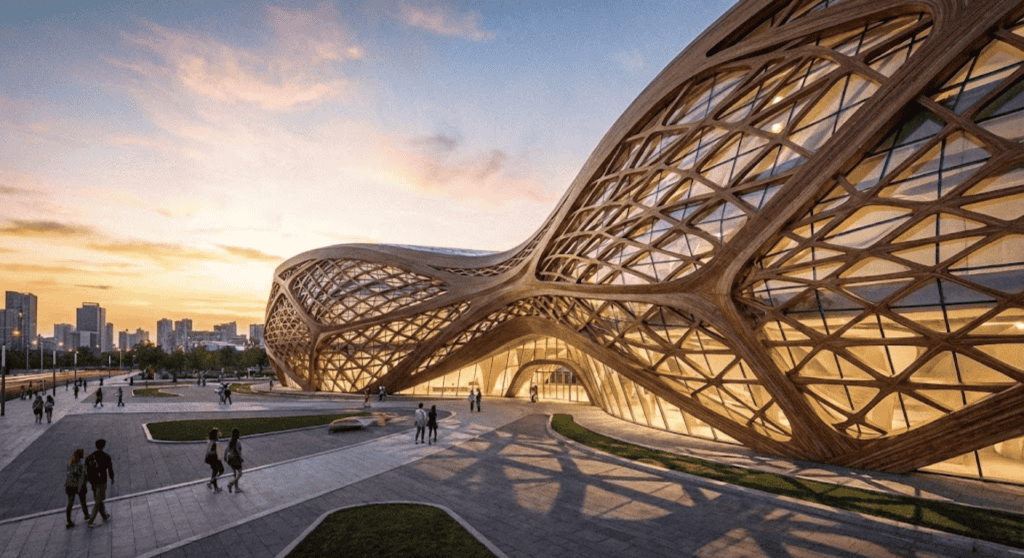
From Concept to Construction: How Parametric Facades Are Designed and Built in India
Parametric facades represent the intersection of algorithmic design, advanced manufacturing, and architectural innovation. In India’s rapidly evolving urban landscape, these dynamic architectural elements are transforming how we design and construct building envelopes. But what does the journey really look like—from initial concept to the finished facade gleaming on a building in Mumbai, Delhi, Bangalore, Hyderabad, or Jaipur?
Unlike conventional facade design, parametric facades follow a distinctly different pathway. Rather than creating static designs, parametric architecture employs algorithms and computational logic to generate solutions that respond to site-specific conditions, performance metrics, and design constraints. This article demystifies the complete parametric facade design-to-installation process, offering architects and developers a clear roadmap of what to expect.
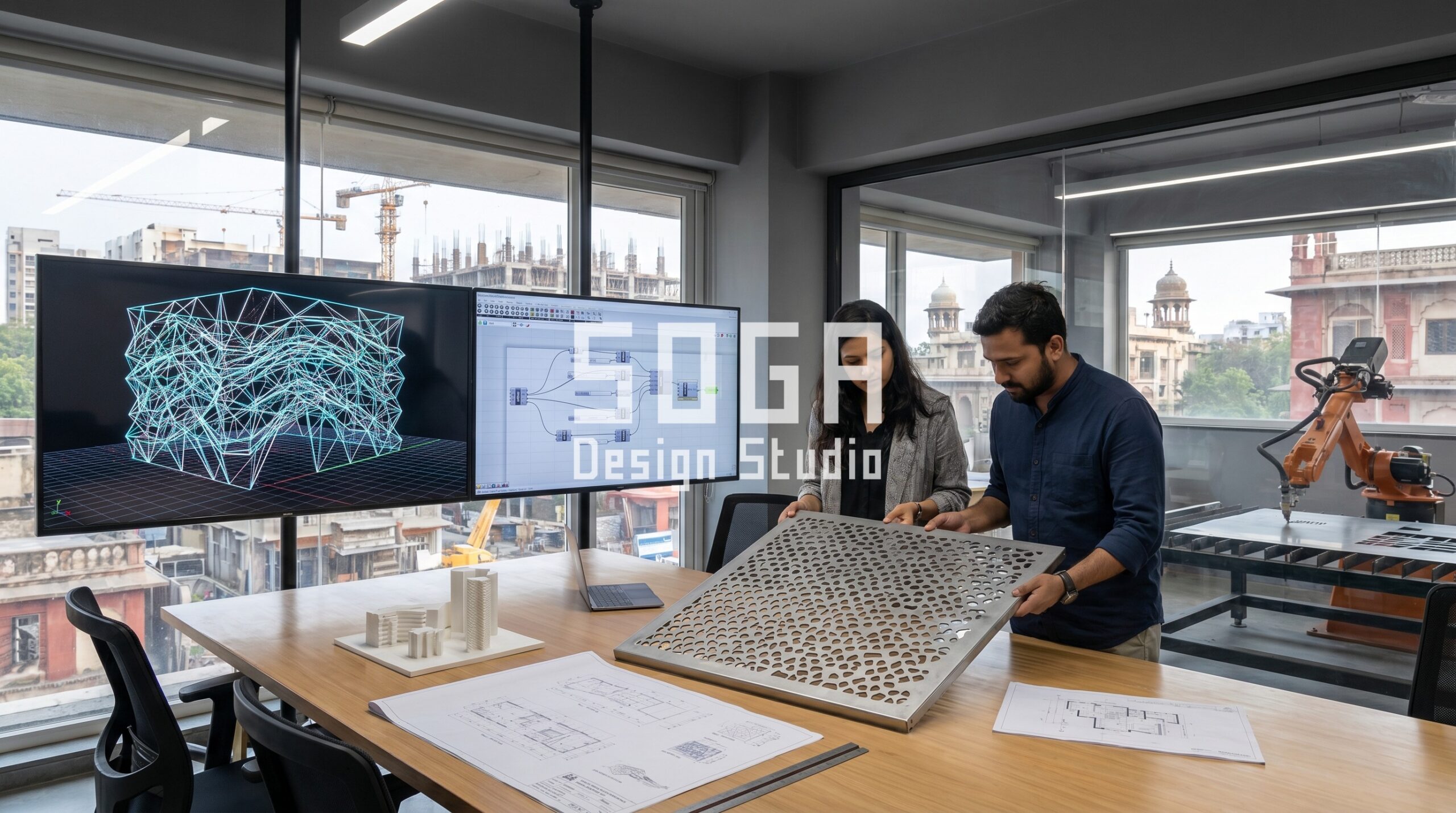
At SOGA Design Studio, we’ve guided countless projects through this journey, learning that the difference between a mediocre facade and an exceptional one lies not just in the final product, but in the rigor of the process. Let’s walk through each phase.
Step 1: Design Brief and Concept Development
Every parametric facade project begins where all great architecture begins—with listening. The design brief phase is where we understand the client’s vision, the building’s purpose, and the unique conditions of the site.
Understanding Client Goals
Before we touch Grasshopper or Rhino, we ask fundamental questions: What does this building represent? What experience should it create? Is the client prioritizing aesthetic impact, thermal performance, cost efficiency, or maintenance accessibility? For a commercial tower in Delhi, the brief might emphasize solar control to reduce cooling loads. For a cultural center in Bangalore, the focus might be on creating a dynamic visual presence that shifts throughout the day.
Site Analysis: The Foundation of Parametric Design
Site analysis is where parametric design truly shines. We conduct detailed assessments of:
- Solar geometry: Sun path analysis determines which facades receive the most intense radiation and when, informing where shading is most critical
- Wind patterns: Wind rose analysis reveals prevailing directions and intensities, affecting facade depth and orientation
- View corridors: Visual relationships to surrounding buildings, landscape, and cityscape inform transparency and opacity
- Local climate data: Temperature ranges, humidity, monsoon patterns, and dust accumulation all influence material and geometry selection
- Structural capacity: Building frame dimensions and load-bearing capability constrain facade depth and weight
This data becomes the foundation for our parametric models. Rather than guessing at appropriate facade depths or panel orientations, we let the site itself inform the design through quantified analysis.
Establishing Design Parameters
With the site analysis complete, we identify the key parameters that will drive the facade design. For a typical project, these might include: panel depth, rotation angle, perforation percentage, module size, material type, and color/finish. These parameters become the variables in our computational model, allowing us to explore hundreds of design iterations in hours rather than weeks.
Step 2: Computational Modeling with Grasshopper + Rhino
This is where the parametric magic happens. Grasshopper—a visual programming plugin for Rhino—transforms our design parameters into a living, responsive algorithm.
How the Algorithm Works
Imagine describing the facade not as a static design, but as a set of rules. For instance: “Every panel rotates based on the sun angle at its location; panels on the south side rotate more aggressively for deeper shade; panel sizes increase toward the building base for structural stability; perforation density varies to balance visual privacy with daylight penetration.”
Grasshopper codifies these rules. A designer inputs the building’s base geometry, attaches solar analysis data, structural constraints, and material limitations. The algorithm then applies these rules across thousands of points on the facade surface, generating a design that’s both mathematically coherent and responsively optimized.
Parametric Control and Iteration
The power of this approach becomes apparent during iteration. Change one parameter—say, increase the target shading percentage from 40% to 50%—and the entire facade regenerates. Within minutes, you can see how more aggressive shading affects visual impact, material quantity, fabrication complexity, and cost. This enables rapid exploration of design alternatives without starting from scratch each time.
During this phase, we typically generate 8-15 major design iterations, each testing different performance targets, aesthetic directions, and cost scenarios. Client presentations can happen in real-time, with parametric adjustments made live in response to feedback.
Performance Simulation and Validation
Before moving forward, we validate that the parametric design actually achieves its stated performance goals. This involves thermal modeling (How much solar heat is blocked?), daylight analysis (How much natural light penetrates?), and structural review (Do panel orientations create wind loads we can accommodate?). Adjustments are made iteratively until performance metrics align with project targets.
Step 3: Geometric Surface Development (GSD) — Flattening the Curves
Here’s where theory meets manufacturing reality. The beautiful, curved, three-dimensional parametric surface generated in Grasshopper must now be translated into flat panels that can actually be manufactured.
The Challenge of Double Curvature
Many parametric facades feature double-curved surfaces—panels that curve in two directions simultaneously (think of an orange peel). While mathematically beautiful, double-curved panels are expensive to fabricate. The solution: Geometric Surface Development.
GSD analyzes the parametric surface and breaks it into sections that can be manufactured as single-curved or flat panels, with minimal distortion from the original design intent. Think of it as carefully cutting a pattern so that when panels are assembled in three dimensions, they approximate the parametric surface.
Panelization Strategy
We determine optimal panel sizes—balancing manufacturing efficiency, transportation constraints, and installation practicality. In India, where fabrication facilities and site logistics vary by region, panelization strategies differ for Mumbai projects versus Jaipur. A Mumbai high-rise might use 500mm × 500mm modules for precision and alignment, while a Hyderabad project might employ larger 1000mm × 1500mm panels to reduce installation time and complexity.
Tolerance Management
Parametric facades demand tight tolerances (typically ±2-5mm) to maintain visual coherence. During GSD, we establish a tolerance strategy: how much variation is acceptable in panel size, depth, and orientation before the facade’s appearance degrades? This informs fabrication specifications and quality control protocols.
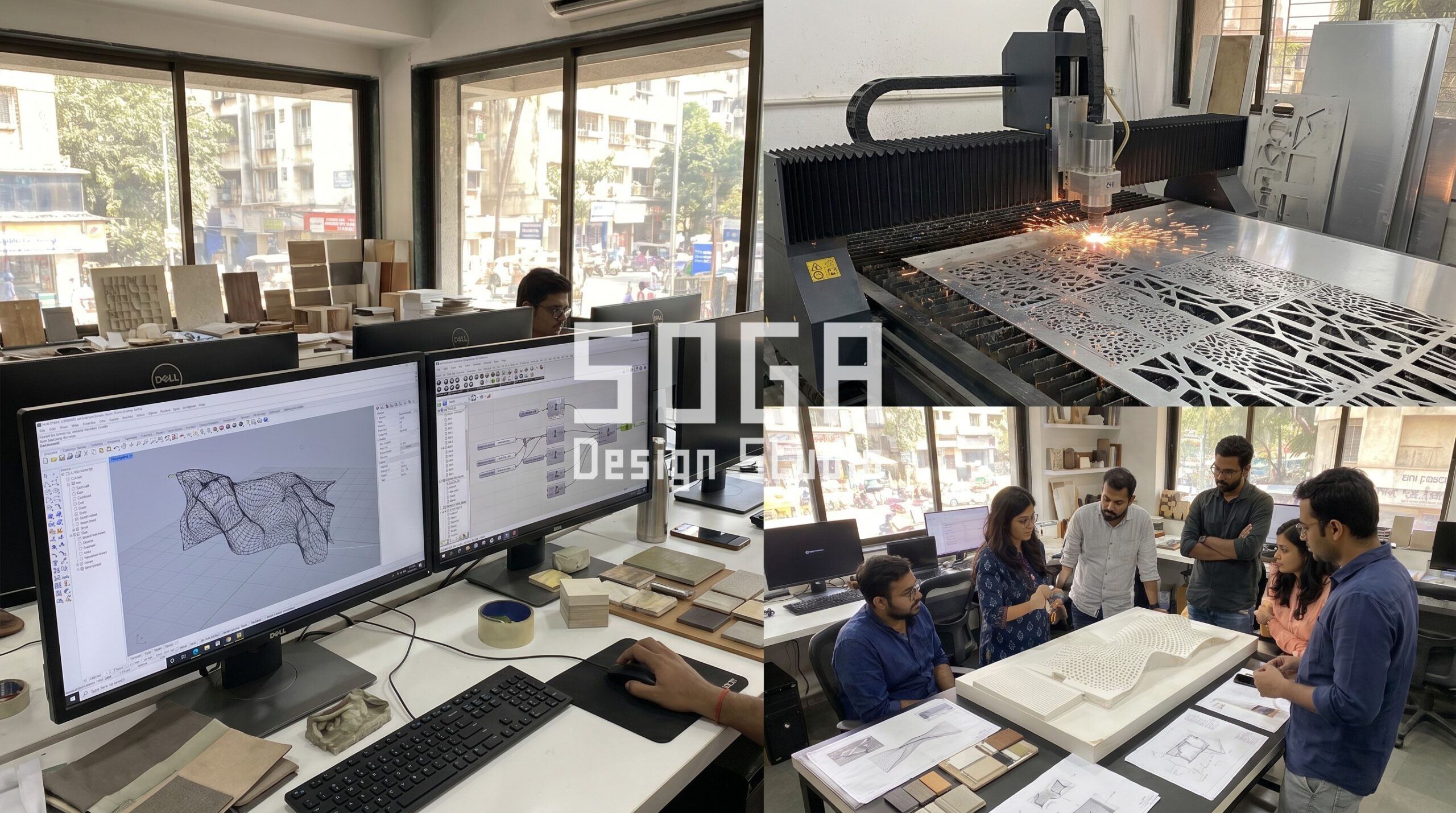
By the end of GSD, we have a complete set of manufacturing drawings—dimensioned, panelized, and ready for the shop floor. Each panel has a unique identifier, precise coordinates for assembly, and material specifications.
Step 4: Material Selection and Prototyping
The parametric design itself is material-agnostic—the algorithm doesn’t care if you’re using aluminum or steel. But the success of the final project absolutely depends on intelligent material selection.
Selecting the Right Material System
In India, parametric facades are typically constructed from:
- Aluminum (extruded profiles and sheets): Lightweight, corrosion-resistant, ideal for solar-intensive climates. Most common choice for commercial facades in Mumbai, Delhi, Bangalore
- Perforated metal sheets: Aluminum or steel with strategic perforations. Allows airflow, reduces glare, lowers solar gain. Excellent for reducing cooling loads in hot-dry regions like Jaipur and Hyderabad
- Solid panels with textured finishes: Anodized aluminum or powder-coated steel. Provides privacy, visual impact, and durability against monsoons in coastal Mumbai
- Composite materials: Fiber-reinforced polymers for lighter weight and reduced structural loading, increasingly used in retrofits
- Timber and metal hybrids: Parametric programs can accommodate sustainable materials, though fabrication requires specialized coordination
Prototyping and Testing
Before committing to full-scale fabrication, we build a full-scale prototype section—typically 2m × 2m to 3m × 3m. This prototype is tested for:
- Manufacturing accuracy and tolerance feasibility
- Installation methodology and labor efficiency
- Weatherproofing and water management
- Thermal and acoustic performance
- Maintenance accessibility
- Visual appearance under natural and artificial light
Feedback from the prototype often leads to refinements in panel design, connection details, and installation sequences. This iterative validation prevents costly mistakes once full-scale fabrication begins.
Finish Specifications
Material finish—anodize color, powder coat, patina development—significantly impacts the facade’s visual character and performance. We specify finishes that complement the parametric geometry while providing durability in local climates. In monsoon-prone Mumbai, we prioritize matte finishes that resist weathering; in arid Delhi, brighter finishes that reflect heat are preferred.
Step 5: Fabrication — From Digital File to Physical Panel
With material selected and prototypes approved, we transition to full-scale fabrication. This is where the precision of parametric design truly pays dividends.
CNC-Driven Manufacturing
Our manufacturing drawings are sent directly to fabrication partners who use CNC (computer numerical control) machinery to cut, bend, perforate, and shape panels with high precision. For a parametric facade with 3,000+ unique panels, this digital-to-physical translation eliminates the errors that plague traditional hand-drawn fabrication.
A perforated aluminum panel in a Bangalore project, for instance, is programmed into a CNC punch press. The machine automatically positions, cuts, and shapes each perforation pattern based on the parametric algorithm—ensuring consistency across all panels.
Quality Control During Fabrication
Parametric facades demand rigorous QC. We implement:
- First-article inspection: The first 5-10 panels of each type are inspected for dimensional accuracy, surface finish, and connection points
- Batch testing: Random samples from each production batch are measured against tolerance specifications
- Surface finish inspection: Anodize thickness, powder coat coverage, and color consistency are verified
- Assembly test: Panels are mock-assembled in the shop to verify connection systems and alignment before shipping
In India’s diverse manufacturing landscape, this standardized approach ensures that whether fabrication happens in Mumbai, Bangalore, or Hyderabad, quality remains consistent.
Sequencing and Packaging for Installation
Parametric facades often involve thousands of unique panels. We develop a detailed installation sequence—mapped to a 3D model—that guides workers through assembly in logical order. Panels are packaged in installation-sequence bundles, labeled with QR codes that workers scan to confirm correct placement. This reduces on-site confusion and accelerates installation.
Step 6: Site Installation and Quality Control
Installation is where design and fabrication meet real-world conditions—wind, rain, heat, and the practical realities of working at height.
Pre-Installation Coordination
Before the first panel arrives on site, we coordinate:
- Structural frame verification: Confirming that building structure matches design assumptions
- Support system installation: Mounting frames, fastening systems, and connection points are established and leveled
- Worker training: Installation teams receive detailed training on the parametric facade system, proper sequencing, and quality standards
- Weather planning: In monsoon-prone regions, installation scheduling is coordinated to avoid heavy rain during vulnerable phases
Installation Methodology
Parametric facades typically employ one of two installation approaches:
- Module-based: Pre-assembled panel clusters (6-12 panels per module) are installed as units, reducing on-site assembly time
- Piece-by-piece: Individual panels are installed sequentially, allowing for precise alignment and connection verification at each step
The choice depends on accessibility, weather patterns, and project timeline. High-rise projects in Delhi often favor module-based installation to minimize exposure to wind and dust.
Real-Time Quality Assurance
As panels are installed, we verify alignment, connection integrity, and weatherproofing seals. Digital tools—3D scanning, drone footage, laser alignment—allow us to catch deviations immediately rather than discovering issues after the facade is complete.
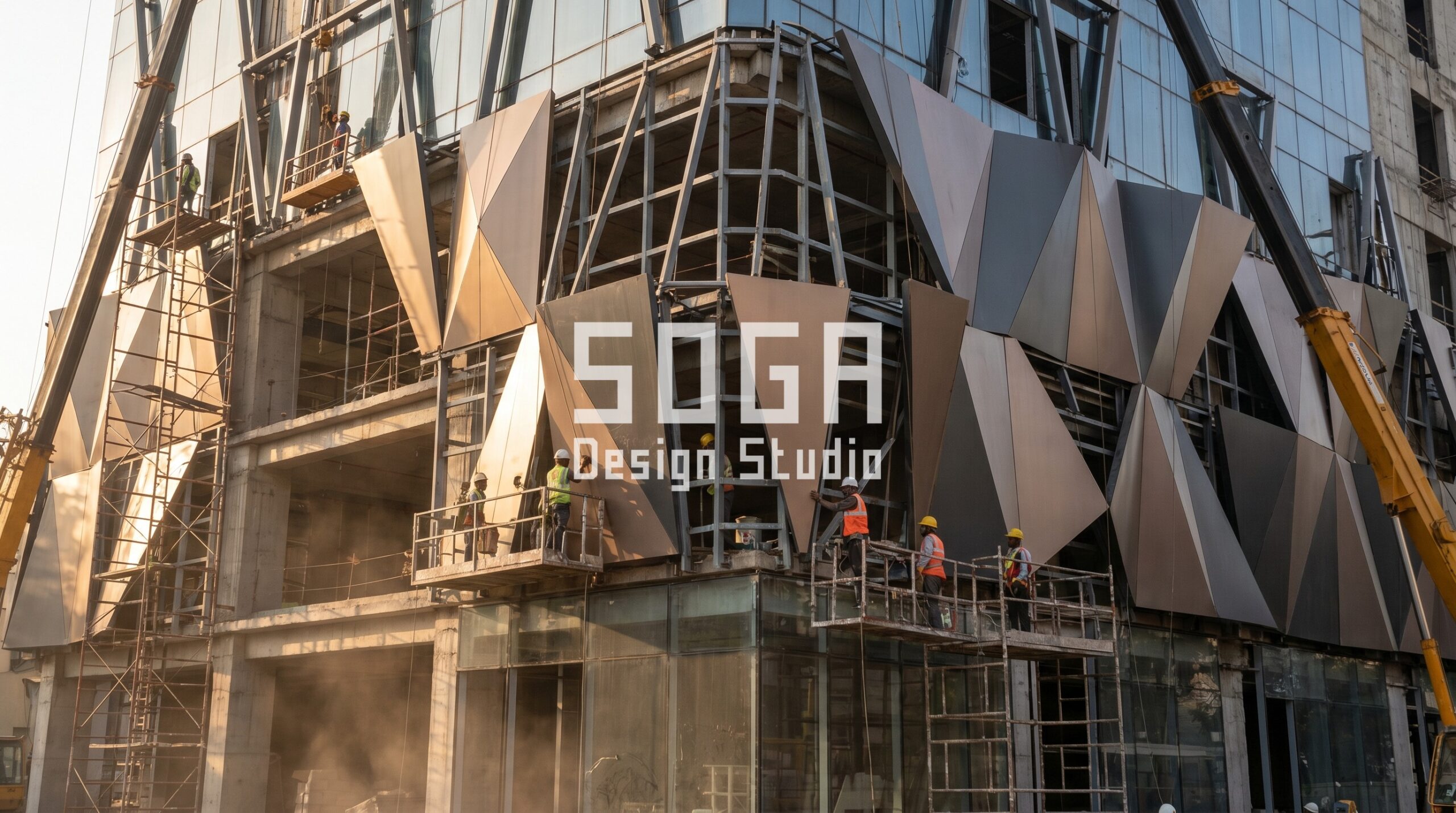
Weatherproofing and Water Management
Parametric facades must shed water reliably in India’s monsoon climate. We implement multi-layered waterproofing: gaskets at panel joints, sloped surfaces to direct water downward, and weep holes to manage any water penetration. Installation quality at these junctures is critical—a single failed seal can compromise an entire facade section.
Timeline: Fabrication to Installation
The fabrication and installation phase typically spans 2-3 months for a mid-sized project. Fabrication alone might take 6-8 weeks for a 5,000-panel facade; installation requires another 4-8 weeks depending on building height, complexity, and weather conditions. For a complete 3-6 month project timeline, design and GSD consume the first 4-8 weeks, prototyping adds 2-4 weeks, followed by fabrication and installation.
Step 7: Post-Installation: Maintenance and Long-Term Performance
Parametric facades don’t end when installation is complete. Their long-term performance depends on a thoughtful maintenance strategy.
Commissioning and Performance Verification
Upon completion, we conduct comprehensive commissioning:
- Thermal imaging: Identifies thermal bridges or poor connections that could affect performance
- Water testing: Simulates heavy rain to verify that the facade sheds water without leakage
- Optical analysis: Confirms that the parametric geometry creates intended visual and daylighting effects
- Structural verification: Confirms that facade systems properly transfer loads and move with the building
Maintenance Programs
Parametric facades—especially perforated designs—can accumulate dust in India’s environment. We develop maintenance protocols that specify:
- Cleaning frequency and methods (pressure washing can damage some finishes)
- Inspection intervals for corrosion, seal degradation, or fastener loosening
- Resealing schedules for weather-resistant gaskets and caulking
- Panel replacement procedures for damaged sections
Performance Monitoring
Some advanced parametric facade projects incorporate sensors that monitor thermal performance, humidity, and structural movement. This data validates that the facade is performing as designed and provides early warning of potential issues.
Long-Term Cost Efficiency
While parametric facades require higher initial investment (design fees + computational modeling), they often deliver superior long-term value through optimized performance, reduced energy consumption, and lower maintenance costs compared to poorly designed conventional facades.
Why Working with a Design-Led Studio Makes the Difference
The journey from concept to construction for a parametric facade is complex, requiring expertise across architecture, computational design, structural engineering, material science, and installation logistics. The difference between a successful project and a mediocre one often comes down to having a design-led studio guiding the entire process.
Integrated Design Philosophy
At SOGA Design Studio, we’re not just designers who hand off drawings to fabricators. We’re embedded throughout the entire process—from computational modeling, through prototyping and fabrication coordination, to installation verification and commissioning. This continuity ensures that design intent is preserved and performance goals are achieved.
Deep Material and Manufacturing Knowledge
We work directly with fabrication partners across India—in Mumbai, Delhi, Bangalore, Hyderabad, and Jaipur. We understand each facility’s capabilities, constraints, and strengths. This knowledge allows us to design facades that are optimized for the specific fabricators we’ll work with, improving quality and reducing cost.
Climate-Responsive Design
Parametric design shines in responding to local climate conditions. We’ve designed facades that manage Jaipur’s intense dry heat, Mumbai’s monsoon dynamics, Delhi’s dust-laden winds, and Bangalore’s variable temperature swings. Each design is parametrically rooted in site-specific analysis rather than generic best practices.
Value Beyond Aesthetics
While parametric facades are visually distinctive, their true value lies in performance. Optimized facades reduce cooling loads, lower energy consumption, improve daylighting, and often cost less to maintain than poorly designed conventional systems. Working with a design-led studio ensures these benefits are realized.
Ready to explore parametric facade design for your project? Contact SOGA Design Studio to discuss how computational design can elevate your building envelope. Or dive deeper into the foundational concepts with our guide to understanding parametric design in architecture.
For more about our approach to design excellence, visit our team and philosophy.
Frequently Asked Questions About Parametric Facade Design
How long does a parametric facade project take in India?
A typical parametric facade project takes 3-6 months from concept to completion. This includes 4-8 weeks for design and geometric surface development, 2-4 weeks for prototyping and refinement, 6-8 weeks for fabrication, and 4-8 weeks for on-site installation. Timeline varies based on project complexity, material selection, and weather conditions.
What are the main costs in a parametric facade project?
Parametric facade projects typically allocate costs as follows: design fees (15-25% of total), fabrication costs (50-65%), installation and labor (15-25%), plus contingency. Total costs depend on facade area, material selection (aluminum vs. steel vs. perforated), and local labor rates. In Mumbai, costs may be 15-20% higher than in Bangalore or Hyderabad due to labor and logistics.
Can parametric facades be used in all Indian climates?
Absolutely. Parametric design’s strength is its adaptability to local conditions. Facades can be parametrically optimized for monsoon climates (Mumbai, coastal regions), extreme heat (Jaipur, Delhi), humidity (Bangalore, Hyderabad), or any combination. Material selection, perforation strategies, and panel orientation are all parametrically informed by site-specific climate analysis.
What software is used for parametric facade design?
Grasshopper is the industry standard for parametric facade design. Grasshopper is a visual programming plugin for Rhino that allows designers to create algorithmic models. Parameters can be adjusted to explore design variations, and performance can be tested without manual redesign. Other tools like Python scripting, Ladybug (for energy analysis), and Honeybee (for environmental analysis) integrate with Grasshopper to enhance performance simulation.
How do parametric facades perform compared to traditional facades?
Parametric facades typically outperform traditional designs because they’re optimized for specific site conditions. A parametrically designed facade might reduce solar heat gain by 30-40% compared to a conventional curtain wall, lower cooling loads, improve natural daylighting, and adapt to wind patterns. The digital-first approach enables rigorous testing and refinement before fabrication, reducing performance surprises post-installation.
Maintenance frequency is not a property of the material so much as of the surface it runs over; we set out wash intervals indexed to fall angle rather than a single blanket schedule.