A jewellery showroom sells light, craft and trust before a single piece is shown — and the facade is where that promise begins. On a busy Indian high street, the exterior of a jewellery store has to do three jobs at once: signal luxury from a hundred metres away, feel rooted in Indian craft, and protect a glowing, climate-controlled interior. At SOGA Design Studio we design jewellery showroom facades as parametric metal systems that do all three — turning the building skin itself into the brand’s first piece of jewellery. This guide walks through four concept facades, the design logic behind each, and what a project like this costs in India in 2026.
Jewellery Showroom Facade Design in India: Why Luxury Retail Is Choosing Parametric Metal in 2026
Across Mumbai, Jaipur, Hyderabad and Surat, premium jewellers are moving away from flat glass-and-granite shopfronts toward sculptural metal facades. The reason is simple: a parametric metal facade reads as crafted, not bought. Jewellery showroom facade design now borrows the same vocabulary as the products inside — faceting, light play, repetition with subtle variation — so the building becomes a billboard for the maker’s eye for detail. A precision-cut metal screen can carry a brand motif at architectural scale, glow warmly at night to pull in evening footfall, and shade the interior from harsh Indian sun so the display lighting always wins. It is climate response and brand-building in a single move, which is exactly why parametric facades have become the default for luxury retail. (For the full background on the approach, see our pillar guide to parametric facade design in India.) The four concepts below each use a different SOGA Parametric System™ to show the range available to a jewellery brand.
1. RIVAAZ JEWELS, Jaipur — SogaScreen Champagne-Gold Shadow Screen
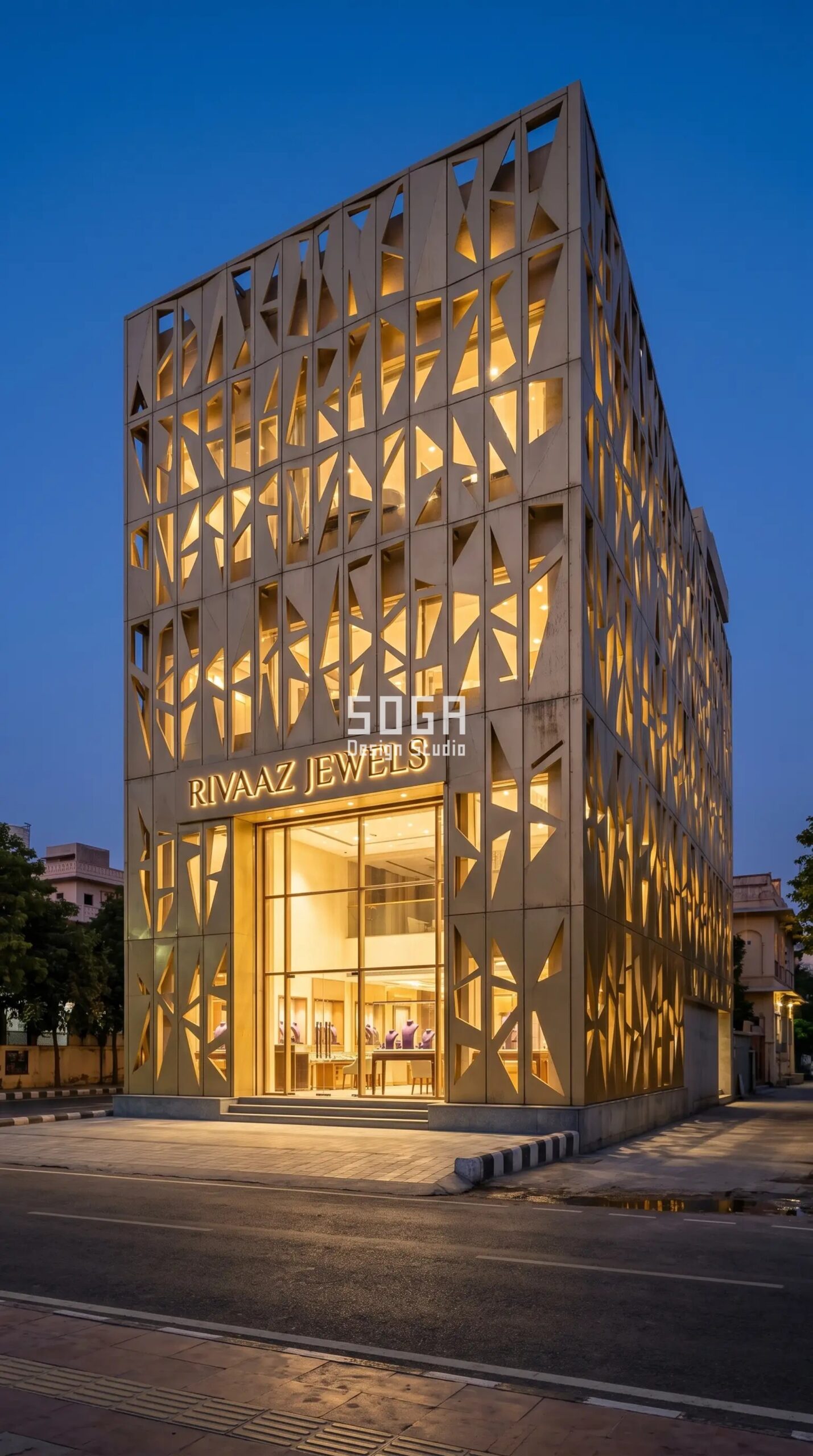
For this Jaipur concept we wrapped a G+3 jewellery showroom in a SogaScreen parametric shadow screen — a precision-cut champagne-gold anodised-aluminium skin with clean angular geometric openings. The pattern is driven by a single rule that opens the apertures wider toward the entrance and tightens them at the upper floors, so the screen reads as one continuous, hand-crafted veil rather than a repeated tile. At dusk the magic happens: warm interior light spills through every opening, the building turns into a lantern, and the RIVAAZ JEWELS signage sits cleanly within the gold field. The screen also does serious daytime work, cutting Jaipur’s strong western sun off the display glass while keeping the showroom interiors visible from the street. It is a facade that belongs to a jewellery house and to its city in equal measure.
2. MEHRAAB GOLD, Mumbai — SogaWeave Twisted Gold-Bronze Fins
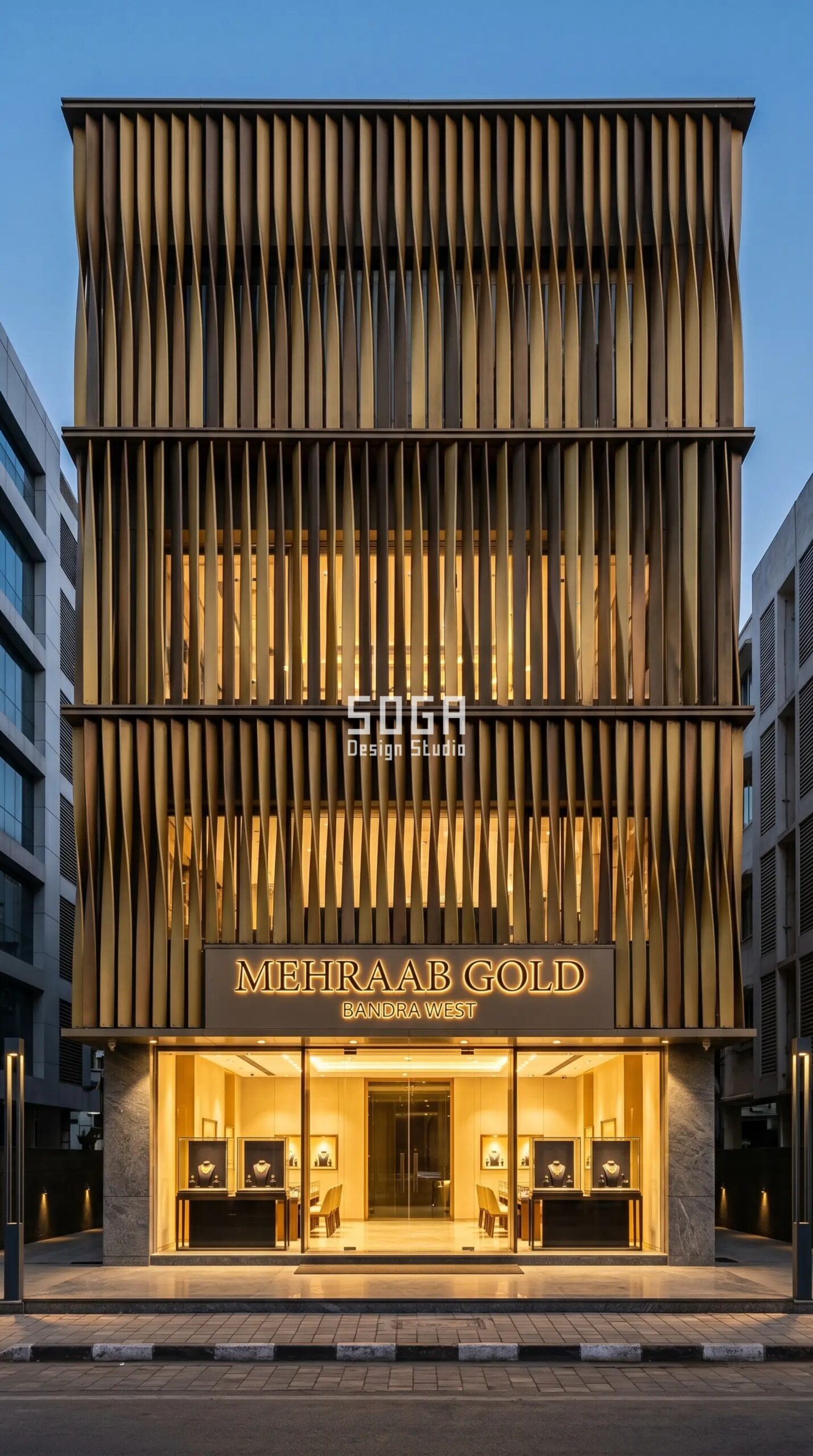
The Bandra West concept uses SogaWeave — an array of twisted vertical aluminium fins in warm gold and dark bronze, each rotated at a slightly different angle so the whole surface shimmers like woven metal as you move past it. For a jewellery brand this is a deliberate gesture: the facade behaves like a textile of precious metal, catching highlights the way a gold chain does in the hand. The fins are spaced to frame, not hide, the double-height MEHRAAB GOLD storefront, so the lit display vitrines read clearly at eye level while the upper floors dissolve into rhythm and shadow. Because the fins stand proud of the glass line, they create a ventilated cavity that keeps the facade cool — important on Mumbai’s humid coast — and give the building a quiet sense of depth that flat cladding can never match.
3. NAZRANA DIAMONDS, Hyderabad — SogaGrid 3D Diamond-Faceted Panels
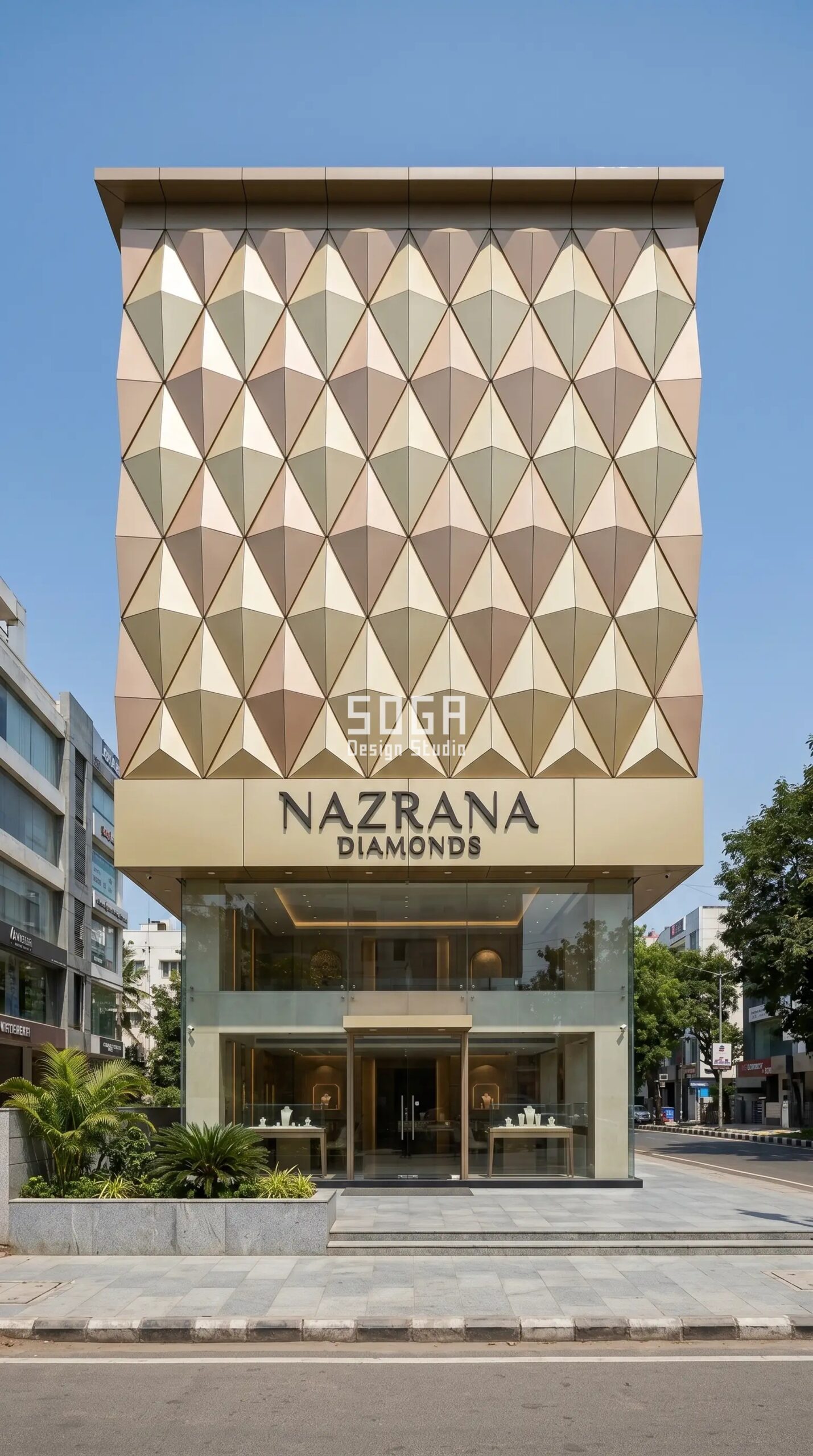
No facade speaks a diamond brand’s language more directly than SogaGrid. Here a G+3 showroom in Banjara Hills is clad in a faceted grid of three-dimensional diamond-shaped metal panels in champagne gold and pale bronze, each facet angled so it catches real relief and self-shadow under Hyderabad’s bright sky — exactly the way a cut stone throws light. The result is a facade that is never the same twice: as the sun moves, the panels shift from soft matte to bright highlight across the day, so the NAZRANA DIAMONDS building advertises itself for free from morning to evening. The faceting is also functional, breaking up solar gain and giving the double-height display windows a deep, jewel-box frame. It is the clearest example of how a SOGA facade can translate a brand’s core product straight into architecture.
4. ZEVAAR LUXE, Surat — Soga 3d panel Density-Varying Metal Panel
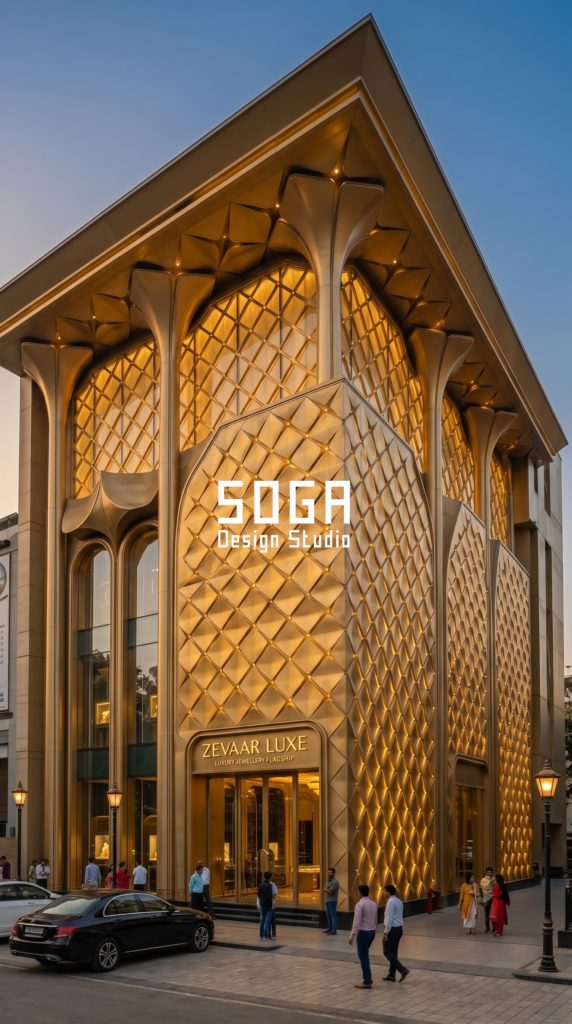
For the diamond city of Surat we used Soga 3d panel — a parametric metal screen whose panel density and aperture angle change gradually across the elevation, tightening and loosening like a sparkle gradient. In dark gunmetal with champagne-gold accents, the ZEVAAR LUXE facade feels contemporary and confident rather than ornate, which suits a younger luxury buyer. The density rule is tied to where the building needs privacy versus display: the screen is dense and protective over the upper floors, then opens up dramatically over the ground-floor lobby so the glowing interior reads straight through to the street. Seen from a low angle in golden-hour light, the gradient gives the whole building a sense of upward movement — a quiet, modern take on luxury that still rewards a second look.
What a Jewellery Showroom Facade Costs in India (2026)
Clients almost always ask the cost question first, so here are realistic 2026 bands for a designed metal facade in India. Pricing depends on material, the depth of three-dimensional relief, lighting integration and the engineering behind the screen.
| Facade System | Typical Material | Cost Band (₹ / sq ft, 2026) |
|---|---|---|
| Entry parametric metal screen | ACP / powder-coated steel | ₹450 – ₹750 |
| Mid-range precision-cut screen | Anodised / PVDF aluminium | ₹750 – ₹1,200 |
| Premium 3D faceted / woven system | Champagne anodised, brass, GFRC | ₹1,200 – ₹2,200 |
| Signature lit jewellery facade | Anodised metal + integrated lighting | ₹1,800 – ₹3,000+ |
A typical jewellery showroom facade of 2,000–4,000 sq ft therefore lands anywhere from ₹12–15 lakh for an entry screen to ₹60 lakh-plus for a fully lit, faceted signature facade. The number that matters, though, is footfall: a distinctive, well-lit jewellery store facade routinely lifts walk-ins and brand recall enough to pay for itself within a season of festive trading.
Designing Jewellery Showroom Facades for India, Dubai, Singapore & the NRI Market
Jewellery is one of India’s most globally connected luxury categories, and SOGA Design Studio designs showroom facades for brands expanding well beyond a single city. The same parametric systems shown here scale cleanly to high streets and malls in Mumbai, Delhi, Bangalore, Hyderabad, Jaipur and Surat, and to NRI-heavy luxury markets in Dubai, Singapore and the UK. Each system is re-tuned to its climate — deeper screens and reflective finishes for Gulf heat, ventilated cavities for tropical Singapore, warmer lit screens for cooler UK evenings — while keeping the brand motif consistent across every location. For a jewellery house building a recognisable storefront identity across borders, a parametric metal facade is the single most portable, ownable design asset available.
Related Reading
Frequently Asked Questions
What is the best facade material for a jewellery showroom in India? Anodised or PVDF-coated aluminium is the most popular choice — it holds a champagne-gold or bronze tone for years, resists Indian dust and coastal humidity, and can be precision-cut into fine parametric patterns. For a premium signature look, brass, faceted metal panels or GFRC are used. SOGA Design Studio matches the material to the brand, climate and budget.
How much does a jewellery store facade cost per square foot in 2026? A designed metal facade in India ranges from about ₹450 per sq ft for an entry ACP or powder-coated screen to ₹1,800–₹3,000+ per sq ft for a fully lit, three-dimensional faceted jewellery facade. Most premium showroom facades fall in the ₹1,200–₹2,200 per sq ft band.
How long does it take to design and install a showroom facade? A typical jewellery showroom facade takes around 10–16 weeks end to end — roughly 3–4 weeks for parametric design and engineering, and 6–10 weeks for fabrication and installation, depending on facade area and lighting integration.
Can a facade design include the jewellery brand’s name or motif? Yes. A key advantage of parametric design is that a brand motif, monogram or signage can be woven directly into the screen pattern at architectural scale, so the facade itself becomes a recognisable brand asset rather than just a backdrop for a sign board.
Does SOGA Design Studio handle the full facade from design to installation? Yes. SOGA Design Studio takes a jewellery showroom facade from concept and parametric modelling through engineering, fabrication drawings and on-site installation, working across India and for NRI clients in Dubai, Singapore and the UK.
Start Your Jewellery Showroom Facade with SOGA Design Studio
A jewellery showroom facade is the highest-leverage piece of branding a jeweller will ever build — seen by every passer-by, every day, for decades. SOGA Design Studio designs parametric metal facades that turn that exterior into the brand’s signature, engineered for Indian climate and built to glow on a festive evening. Whether you are opening a flagship in Mumbai, a heritage-street store in Jaipur or an international showroom in Dubai or Singapore, we will design a facade that is unmistakably yours. Get in touch with SOGA Design Studio for a facade concept and consultation.