Drive through Malviya Nagar in 2026 and the new houses blur into one another — until one G+6 stops you. Its champagne-gold skin is punched with oversized ovals and a scatter of small circles, and by mid-morning the desert sun is already being broken into soft pools of shade across the balconies behind it. That is the quiet shift happening to facade design in Jaipur: homeowners are no longer asking for another plaster-and-paint elevation, they are asking for a metal screen that controls the harsh Rajasthan light and gives the house an identity you can describe over the phone. Below are four parametric concepts — one for Jaipur and three from other Indian cities — that show exactly how that works.
Facade Design in India: Why Jaipur Is Choosing Parametric Metal in 2026
Facade design in India has moved from an afterthought to the single most important decision on a residential project. In 2026, demand for parametric facade design in India is rising fastest in cities such as Jaipur, Mumbai, Bangalore, Delhi, and Pune, where homeowners and developers want elevations that are both performance-driven and instantly recognisable. SOGA Design Studio specialises in facade design in India — from G+3 individual homes to G+7 residential blocks — pairing algorithmic geometry with matte champagne gold acp panels and fabrication-ready detailing. Whether you are comparing metal facade design in India for a new build or a retrofit, the concepts below show how a considered facade redefines a building’s identity and its long-term value.
1. Jaipur SogaScreen: A Champagne-Gold Metal Sun-Screen Facade
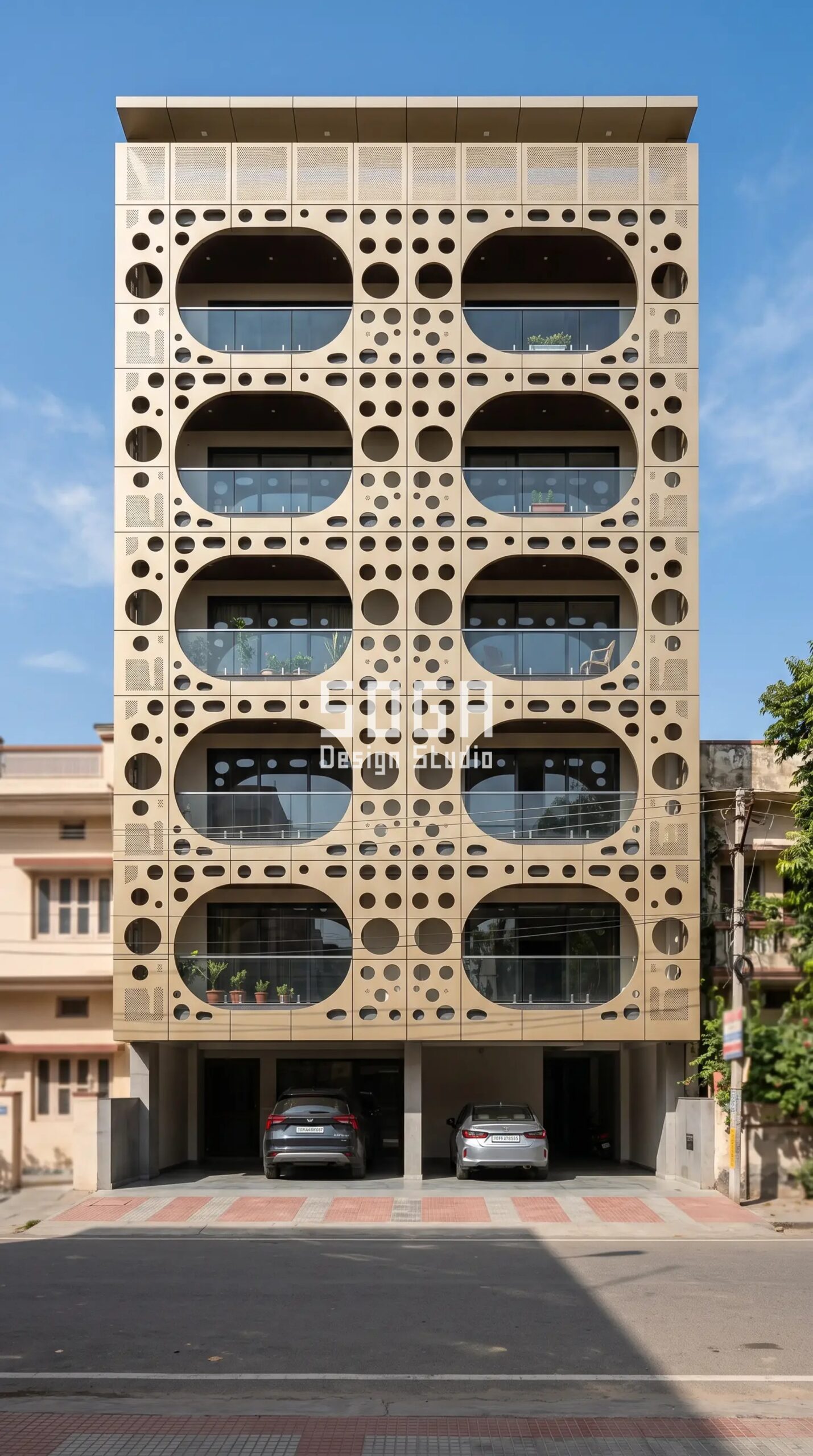
This Jaipur concept treats the facade as a working sun-screen. The SogaScreen layer — oversized circular and oval openings precision-cut into champagne-gold ACP, with a scatter of smaller discs between them — sits a few inches off the glass line, so the harsh western and southern desert light is broken before it ever touches the rooms behind. The opening sizes are not decorative whimsy; they were set parametrically against Jaipur’s sun path, larger where the view matters and tighter where the afternoon glare is worst. By day the screen reads as a solid, warm-toned sculpture; after dark the interior glow leaks through the openings and the whole elevation turns into a lantern. It is the kind of facade that becomes the address — ‘the gold one with the circles’ — which in a Pink City context is exactly the point.
2. Ludhiana SogaShell: Hand-Hammered Metal Facade With Window Punches
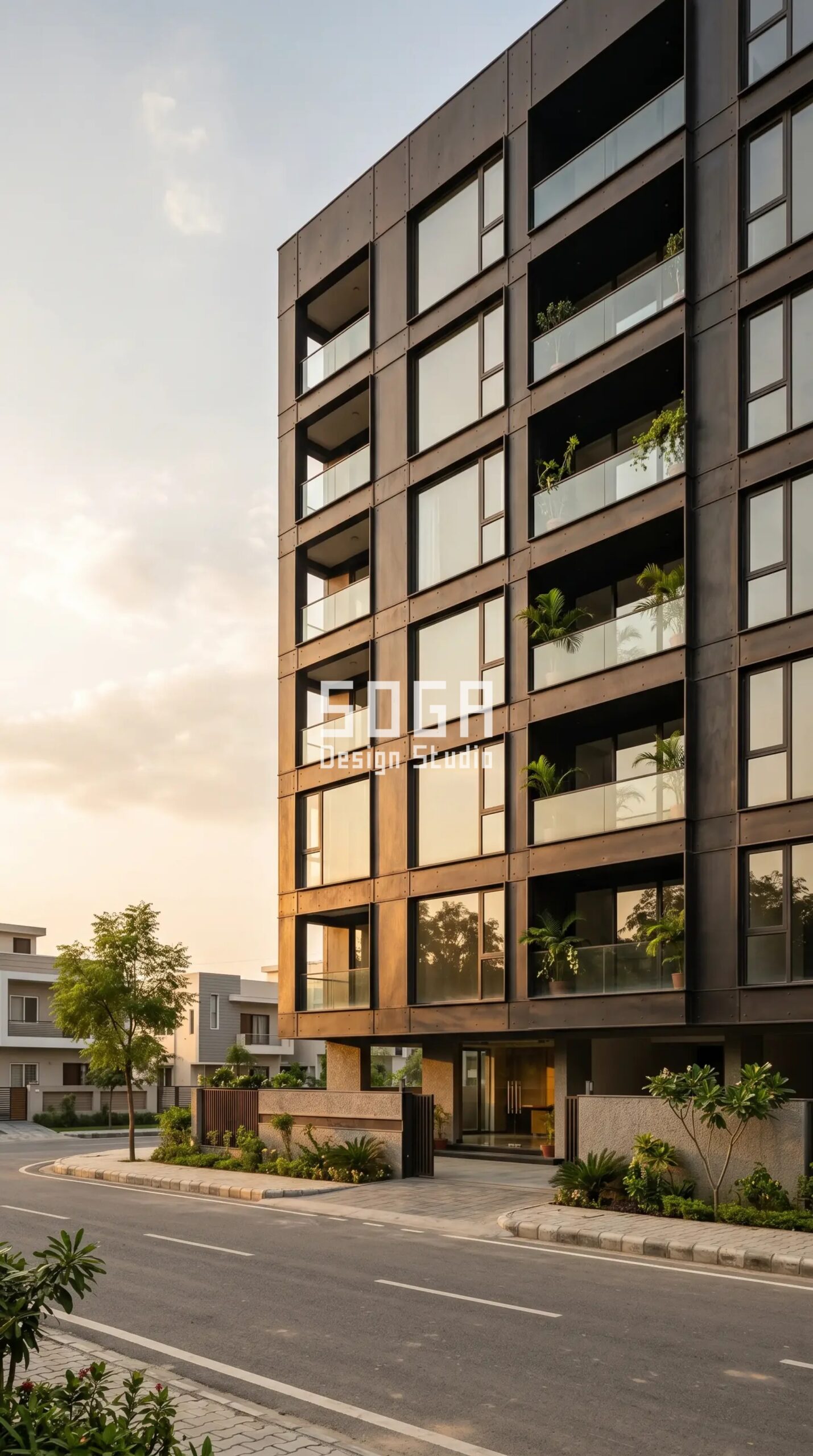
Ludhiana asks a different question: how do you get a strong, private street face on a Punjab plot that bakes in summer and greys under winter dust? This SogaShell concept answers with a hand-hammered, lightly textured metal surface in dark black-brown RAL 8022, punctuated by large rectangular window punches. The solid surface keeps the heat and the street at arm’s length, while the deep reveals around each opening throw real shadow lines that change through the day. The hammered texture is doing quiet work too — it scatters light so the dark facade never reads as a flat, dead panel, and it hides the everyday dust that would streak a glossy surface. It is a deliberately grounded, almost industrial elegance, tuned for a city that values substance over sparkle.
3. Coimbatore SogaGrid: A Faceted Triangular Panel Facade
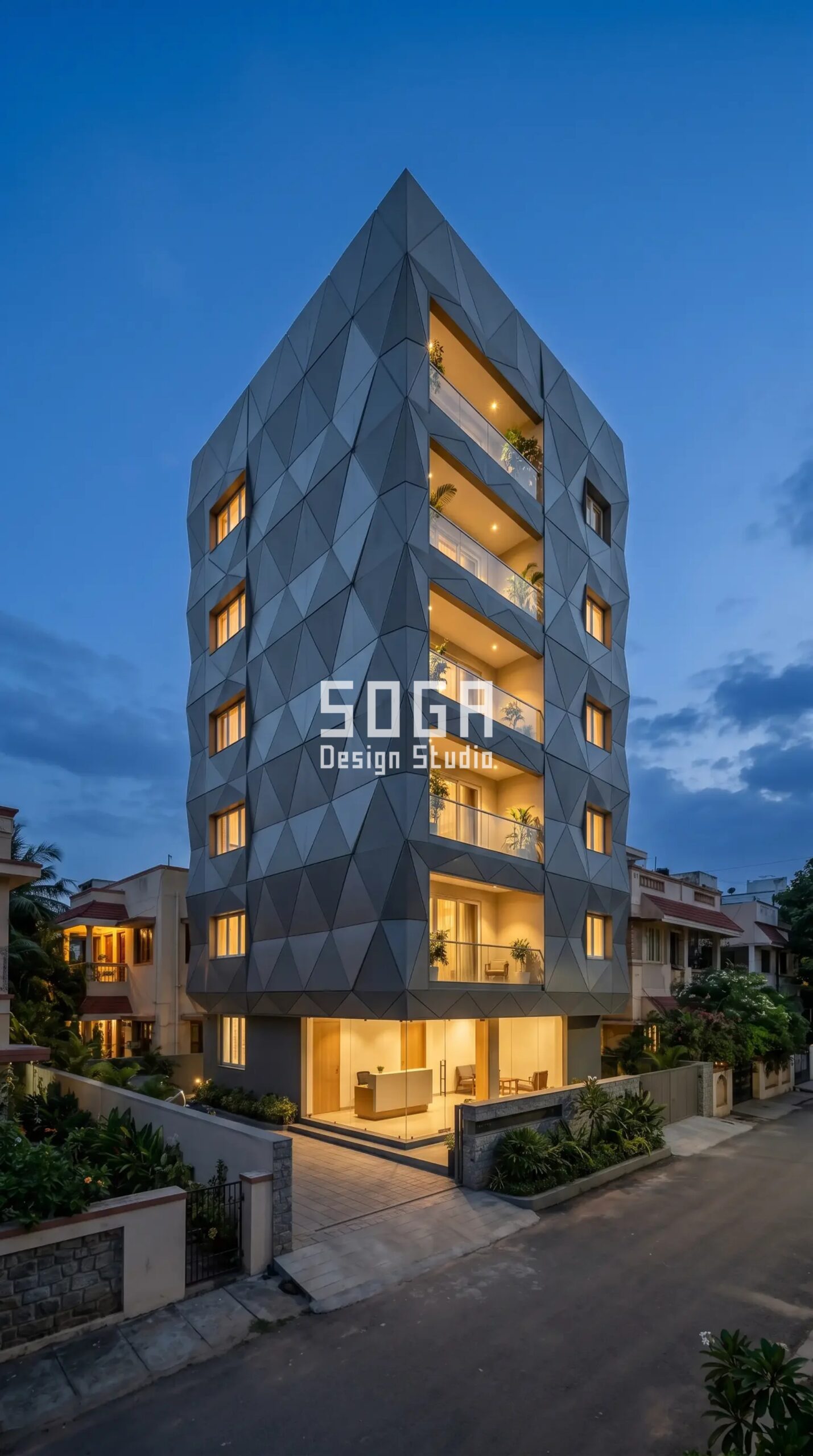
In Coimbatore the brief is depth and privacy without losing daylight, and this SogaGrid concept delivers it with interlocking three-dimensional triangular panels in umbra-grey steel. The faceted relief means the facade is never the same surface twice: each triangle catches the blue-hour sky at a slightly different angle, so the whole elevation shimmers as you move past it. Alternating matte and soft-sheen finishes deepen that play of light without tipping into glossy CGI. Crucially, the angled panels screen the balconies from neighbours’ sightlines while still letting the south Indian light filter in — privacy and openness resolved in the same geometry. Lit from within at dusk, the warm lobby glow against the cool grey facets is the shot that sells the building.
4. Vadodara SogaPulse: Undulating Metal Sunshade Bands
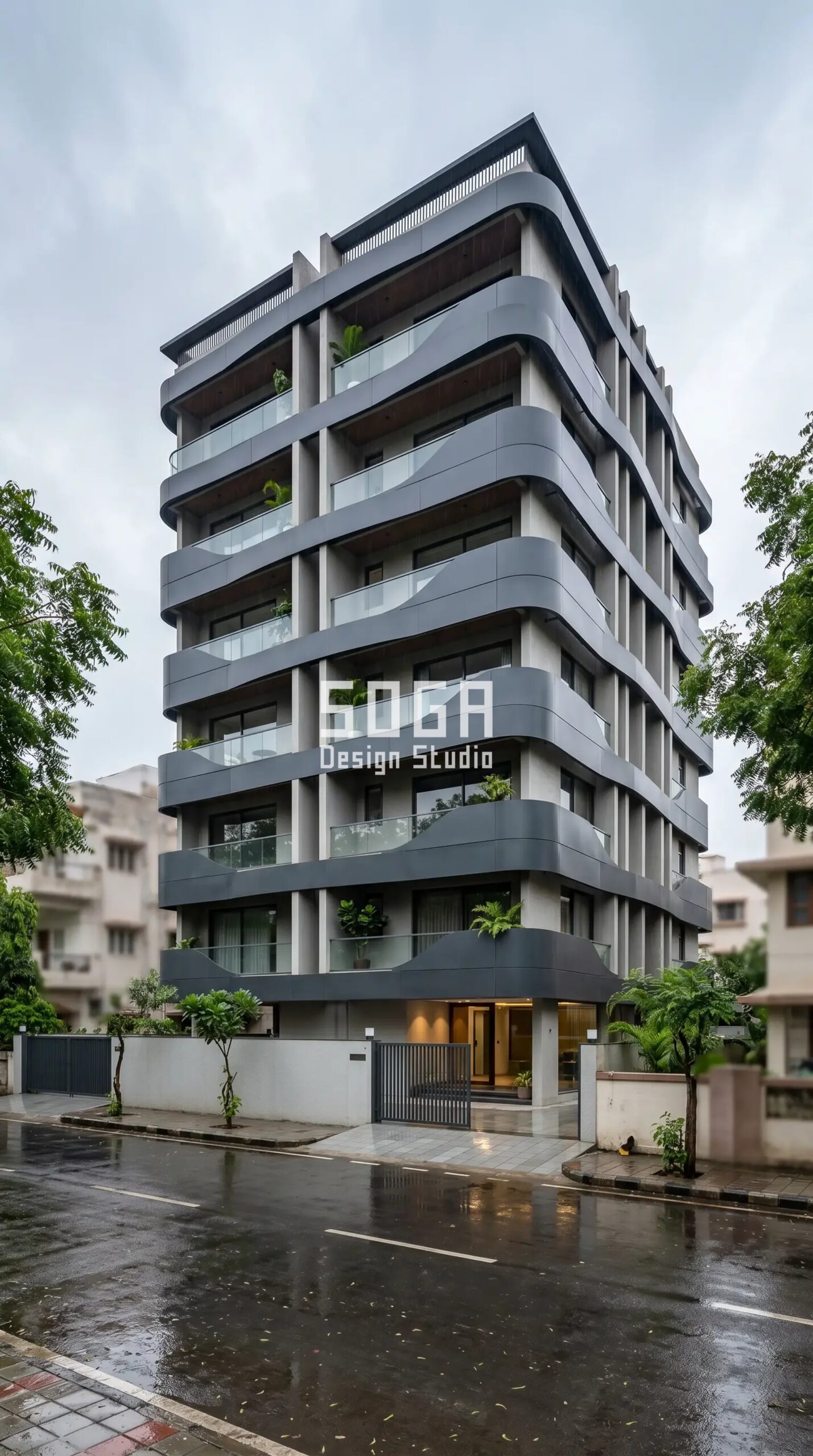
Vadodara’s monsoon and strong west sun drove this SogaPulse concept, where wide undulating metal bands wrap the building as per-floor sunshades. The depth and spacing of the bands vary across the elevation, tightening where the solar load is heaviest and easing where shade is already plentiful — the ‘pulse’ is literally the building responding to its own sun exposure. In anthracite-grey RAL 7016 the bands read as calm and architectural rather than busy, and their projecting profile sheds monsoon water clear of the windows. On a wet, overcast Gujarat afternoon the facade still has presence because the shadow gaps and the reflective wet street do the work that bright sun would do elsewhere. It is climate-response made visible.
2026 Cost Benchmarks for Indian Parametric Metal Facades
One of the most-asked questions on a Jaipur project brief is budget. The 2026 all-in installed rates for parametric metal facades in India sit in the following ranges:
- Steel facade (full design + install): ₹1,200–₹2,800 per sq ft
- Aluminium, anodised or powder-coated: ₹800–₹2,500 per sq ft
- Zinc cladding: ₹1,500–₹3,000 per sq ft
- ACM panels (3 mm basic): ₹200–₹250 per sq ft (basic)
- ACM panels (4 mm): ₹250–₹350 per sq ft
- Solid aluminium panels: ₹800–₹1,800 per sq ft
- Installation labour: ₹50–₹150 per sq ft (varies by height + access)
- Conventional cladding (for comparison): ₹400–₹1,200 per sq ft installed (stone veneer / ceramic / standard ACM)
These figures are baseline; actual project cost depends on facade area, panel complexity, fabricator location, and finish specification. SOGA Design Studio prepares an itemised cost estimate as part of every consultation so the budget conversation starts with hard numbers rather than guesses.
Parametric Facade Design Across India, Dubai & Singapore
Climate is the unspoken brief on every Indian project. Jaipur, with its specific solar geometry and humidity profile, demands facades that perform — not just facades that look striking. At SOGA Design Studio, every parametric concept is run through climate analysis early: solar radiation per orientation, wind exposure, and monsoon water-shedding paths all feed back into panel angle and perforation density. The concepts you see above already incorporate this layer of analysis for Jaipur’s sun path; adapting them for Mumbai’s rain, Delhi’s dust, or Bangalore’s milder conditions is part of the standard scope.
Why Trust SOGA Design Studio for Facade Design in Jaipur
- Experience: SOGA Design Studio runs a daily facade study series and has developed these G+4 to G+8 parametric typologies for real Indian plots across Jaipur, Punjab, Tamil Nadu and Gujarat since 2023.
- Expertise: Every concept is built on the five SOGA Parametric Systems with per-orientation solar analysis and fabrication-ready detailing, working with vetted Indian metal fabricators.
- Authority: SOGA positions as India’s facade design experts, with a continuously published body of parametric residential facade studies across Indian cities.
- Trust: We quote real 2026 cost ranges and itemised estimates up front, offer a free no-commitment consultation, and run a full remote workflow for NRI clients.
Frequently Asked Questions
How much does a parametric metal facade cost in Jaipur?
In 2026, all-in installed rates in India are roughly ₹800–₹2,500 per sq ft for powder-coated or anodised aluminium and ₹1,200–₹2,800 per sq ft for steel; ACM screen panels start lower at about ₹200–₹350 per sq ft plus ₹50–₹150 per sq ft installation. The final Jaipur number depends on facade area, opening complexity and finish. SOGA prepares an itemised estimate as part of the consultation.
Which facade design is best for Jaipur’s hot, dry climate?
A parametric metal screen that sits off the glass line — like the SogaScreen concept above — is ideal for Jaipur. It breaks the harsh western and southern sun before it reaches the rooms, cutting solar heat gain by roughly 25–40% on exposed orientations and lowering interior surface temperatures by several degrees versus bare RCC, while the open pattern still allows daylight and views.
What is a parametric facade?
A parametric facade is one whose pattern and geometry are generated by a script tied to real inputs — sun path, plot orientation, views and privacy — rather than drawn by hand. The result is a facade where every panel angle, opening size and shadow gap has a performance reason, which is why it can be both climate-responsive and visually distinctive.
Is a metal facade durable and low-maintenance in Indian conditions?
Yes. Powder-coated and anodised aluminium and pre-finished steel are specified for Indian dust, heat and monsoon; they resist fading and corrosion for years and typically need only periodic washing. Textured and matte finishes (as in the Ludhiana concept) also hide everyday dust better than glossy surfaces.
How long does a parametric facade take to design and build?
For a typical G+4 to G+8 residence, SOGA moves from concept to fabrication-ready drawings in a few weeks of weekly reviews, after which fabrication and installation depend on facade area and site access. Retrofit screens on stand-off brackets can often be installed in 4–8 weeks without disturbing interiors.
Why is parametric architecture suited to the Indian climate?
India’s combination of intense sun, monsoon humidity, and dense urban context demands a ‘smart skin’ rather than a static wall. Parametric facades let designers tune perforation density, panel depth, and orientation per building per orientation — cutting solar heat gain by 25–40% while boosting cross-ventilation. The approach also reinterprets centuries-old jali screening for modern G+3 and G+4 buildings.
Which RAL colours work best for Indian residential facades?
Three palettes dominate 2026 Indian residential work: warm earthy bronze and corten tones (RAL 8004, 8019) for traditional contexts; deep desaturated blues and greens (RAL 5004, 5011, 6009) for contemporary luxury; and matte charcoal/black (RAL 9005, 7016) paired with brass or copper accents for a graphic urban look. Light cladding with dark frames is the most-searched aesthetic of 2026.
Can a parametric metal facade be retrofitted onto an existing Indian building?
Yes, and it is one of the fastest-growing segments. A lightweight aluminium parametric screen can be mounted on stand-off brackets over existing brick, RCC, or even tired plaster facades — completely transforming the elevation in 4–8 weeks without disturbing tenants or interiors. Retrofit is particularly cost-effective for 1990s-2010s Indian apartments where the original facade has weathered.
How is AI changing facade design in India in 2026?
AI is now a routine input at the concept stage: generative tools propose dozens of parametric variations from a single brief, and computational performance simulators predict heat gain, daylight, and material cost before any drawing is finalised. SOGA Design Studio uses AI-assisted visualisation to accelerate the concept phase from 4 weeks to 4 days, while the engineering and fabrication detailing remain human-led.
Is parametric design suitable for G+3 and G+4 residential plots?
Absolutely — it is in fact the highest-growth segment in India. G+3 and G+4 plots benefit most because the entire facade is visible from the street, so a sculptural parametric treatment yields maximum identity per rupee invested. SOGA Design Studio specialises in this typology, with concepts adapted to standard 30×40, 40×60, and 50×80 ft plots across Indian metros and tier-2 cities.
How much does a parametric metal facade cost per square foot in Indore?
In 2026, all-in parametric metal facade rates in India range from ₹800–₹2,500 per sq ft for aluminium and ₹1,200–₹2,800 per sq ft for steel, installed. SOGA Design Studio prepares itemised estimates as part of the consultation.
What is a sculptural petal-shaped metal fin facade?
SOGA Design Studio addresses this question in detail during the design consultation. For Jaipur projects, we provide a fully customised answer based on plot, orientation, and budget — typically within 48 hours of receiving the brief.
Related Reading
Start Your Facade Project With SOGA Design Studio
In Jaipur — and any hot Indian city — the facade that ages well is the one designed as a sun-screen first; parametric geometry just lets it be beautiful at the same time.
If any of the oversized circular and oval cutout concepts above resonate with your project, send us your brief. SOGA Design Studio delivers customised parametric facade concepts for India, Dubai, Singapore, and the UK.