A tired concrete elevation can become the most-photographed building on the street in a single season — if you know what a facade overhaul actually involves. This 2026 guide walks through four real parametric metal facade concepts we developed for buyers in Kochi and three other Indian cities, each one a worked example of how a SOGA Design Studio facade moves from first sketch to installed reality, and what it costs along the way.
Facade Design in India: Why Kochi Is Choosing Parametric Metal
Facade design in India has moved from an afterthought to the single most important decision on a residential project. Today, demand for parametric facade design in India is rising fastest in cities such as Kochi, Mumbai, Bangalore, Delhi, and Pune, where homeowners and developers want elevations that are both performance-driven and instantly recognisable. SOGA Design Studio specialises in facade design in India — from G+3 individual homes to G+7 residential blocks — pairing algorithmic geometry with matte pale platinum silver brushed met and fabrication-ready detailing. Whether you are comparing metal facade design in India for a new build or a retrofit, the concepts below show how a considered facade redefines a building’s identity and its long-term value.
1. Kochi: A Parametric Ripple-Shell Facade in Brushed Platinum
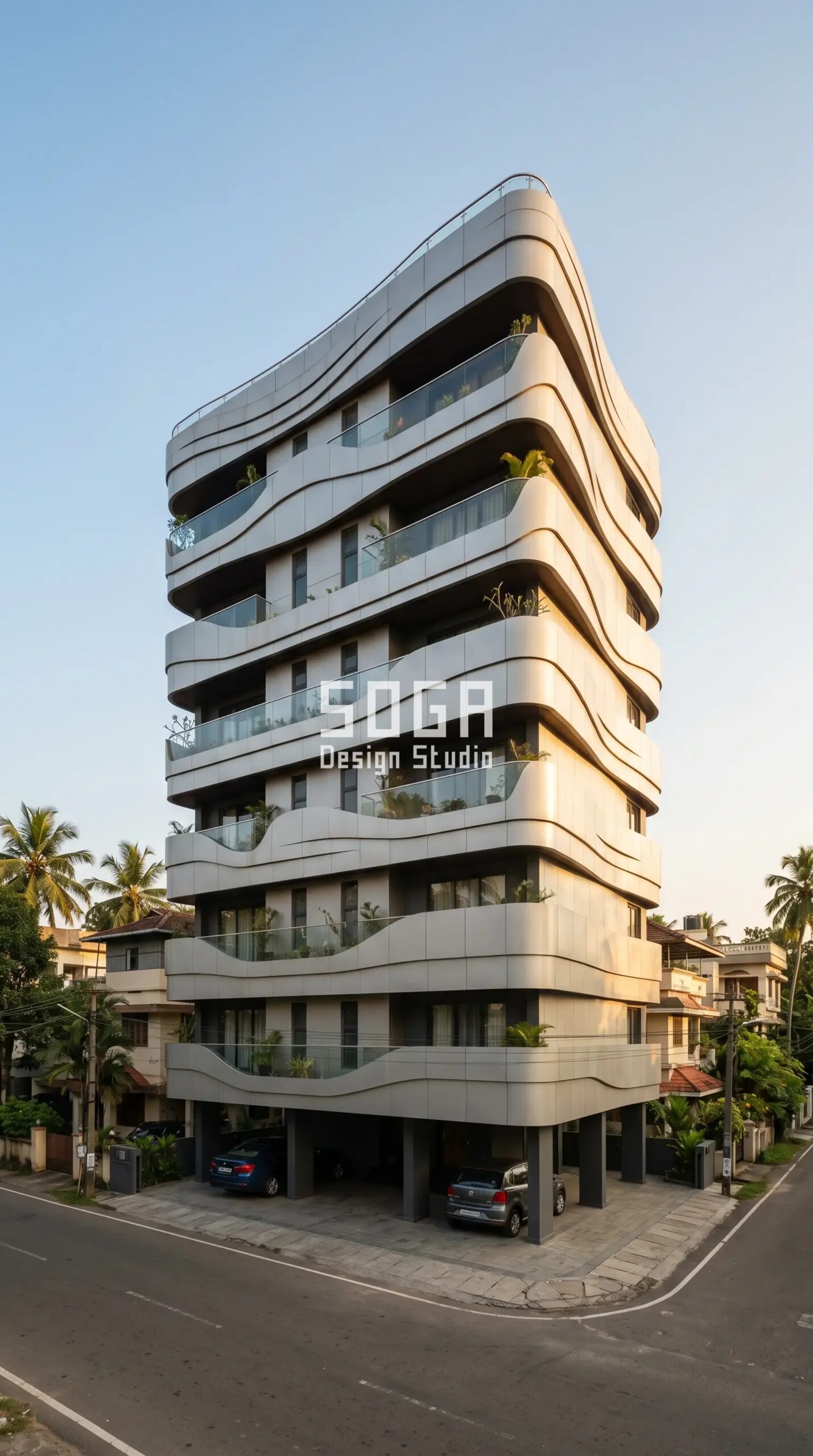
Our lead concept reimagines a humid coastal G+6 in Kakkanad, Kochi, with a parametric ripple-shell facade: large powder-coated panels of brushed pale-platinum metal layered into a soft, rolling horizontal wave. In Kochi’s bright coastal light the matte platinum reads clean and calm rather than flashy, and the rolling relief throws gentle self-shadows that keep the elevation interesting from dawn to golden hour. Functionally the shell stands clear of the structural wall, so monsoon-driven rain drains behind it while interiors stay shaded and cool. On the process side, a wave like this is modelled in Grasshopper first, then unrolled into individually fabricated panels — the step where a clean digital design becomes a real, buildable kit of parts. It is the calmest of the four facades, and a good illustration of how restraint, not ornament, signals quality.
2. New Delhi: A Parametric Blade-Screen Facade in Dark Steel
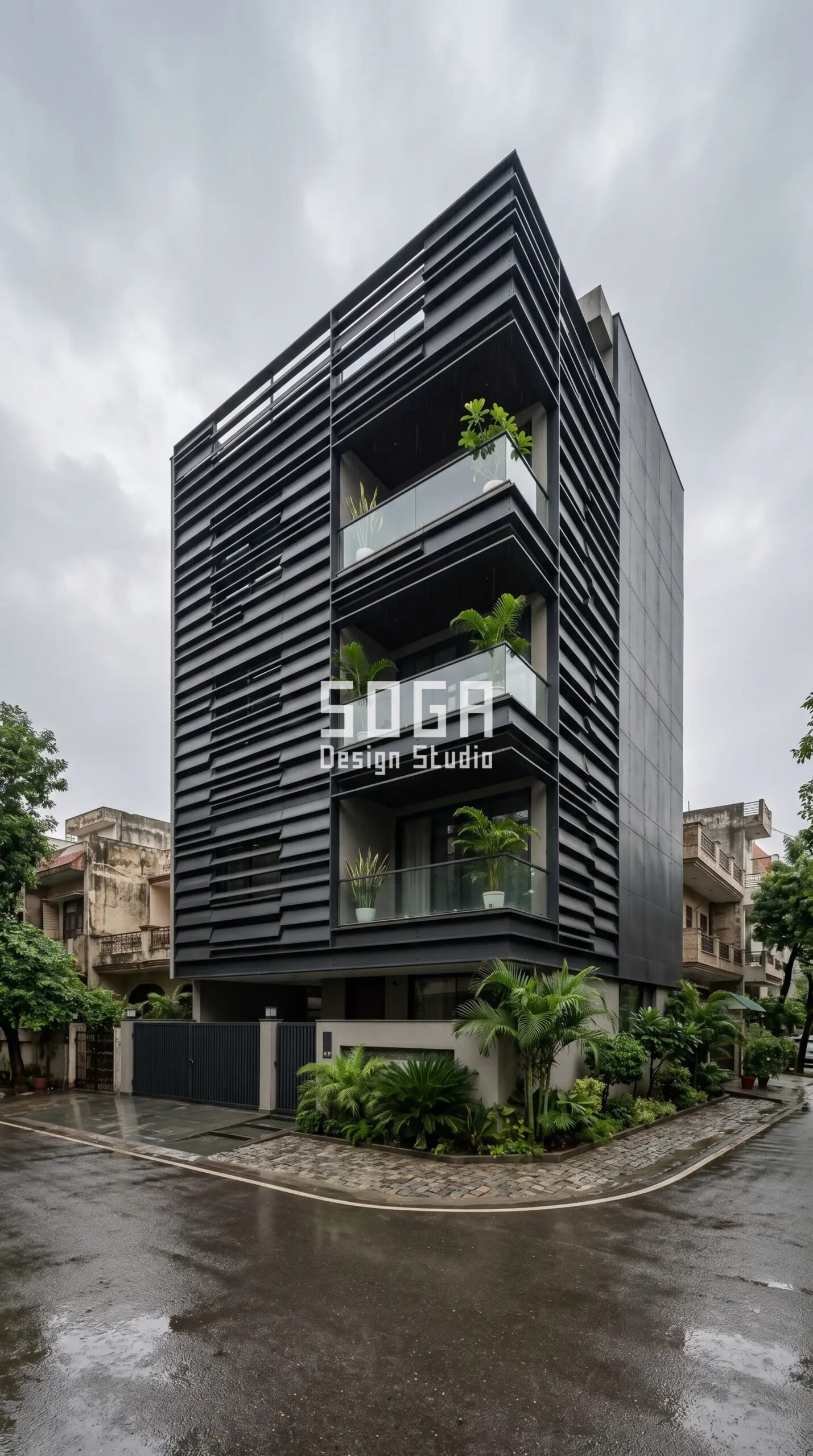
In Greater Kailash, New Delhi, the same overhaul logic produces a very different mood: a parametric blade-screen of layered, offset horizontal steel blades in matte powder-coated RAL 7021 dark grey. The blades sit proud of the glass behind them, casting deep shadow relief that does double duty — it cuts Delhi’s harsh western sun and gives the home privacy without sealing it off. Dark grey steel is a deliberate choice for a dust-prone city: it reads sharp and contemporary and hides the grime that pale finishes show. After a wet monsoon afternoon the matte blades pick up subtle reflections from the street rather than glare. During an overhaul this is the stage where we build a one-bay material mock-up on site, so the client approves the exact blade depth, gap and colour before fabrication begins.
3. Ahmedabad: Parametric Twist-Weave Fins in Dark Bronze
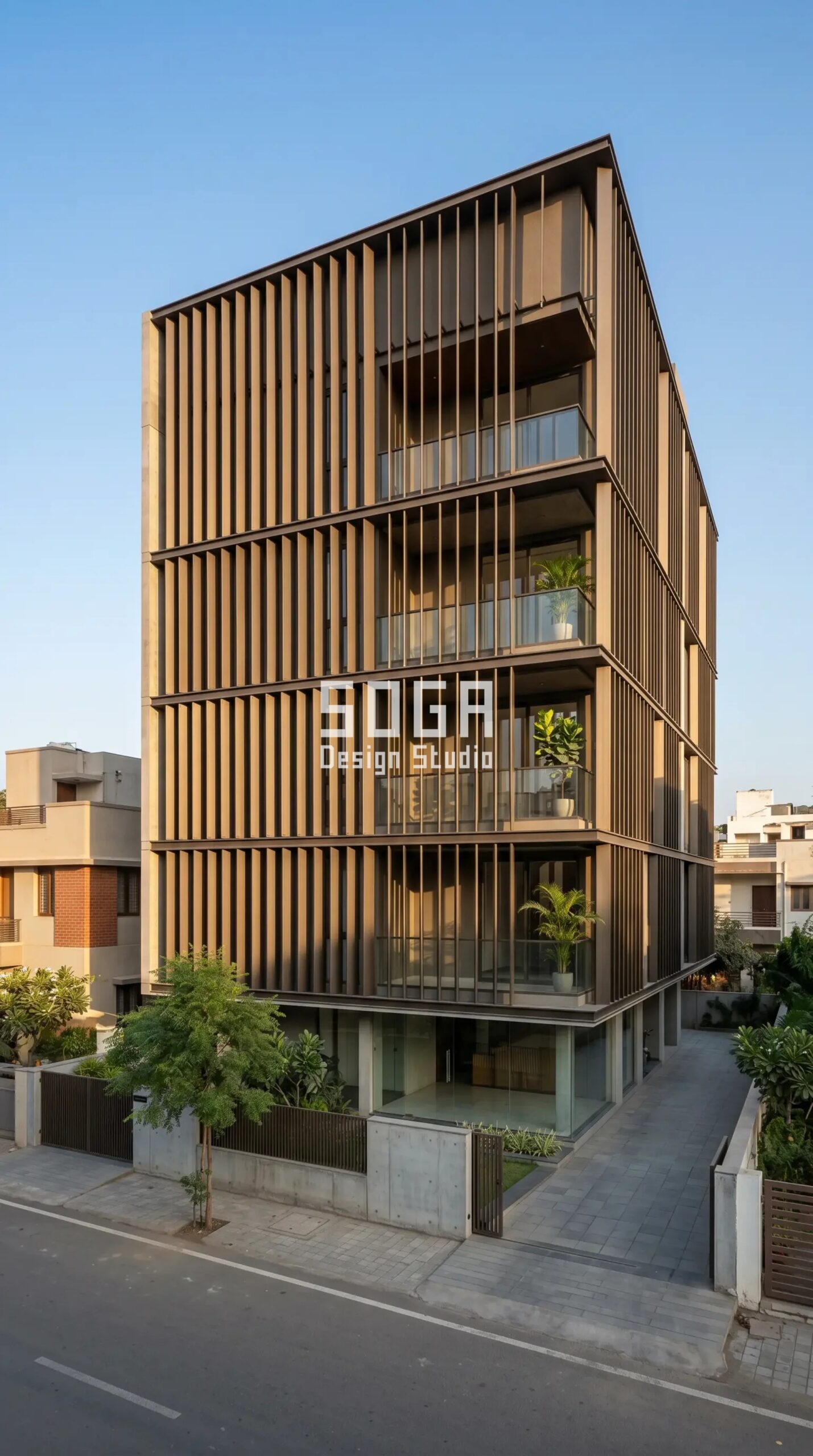
Ahmedabad’s hot, dry climate calls for shading you can feel, so the Thaltej concept uses a parametric twist-weave of slim vertical aluminium fins in clean matte dark bronze, each fin rotated to a slightly different angle across the elevation. The rotation is not styling — it is tuned to the sun path, presenting a denser face to the punishing west light and opening up toward softer northern light. Dark bronze powder-coat keeps the look warm and premium while staying brand-new and maintenance-light, the opposite of a raw, rough metal. In golden-hour light the fins throw long vertical shadow lines that change through the day. This facade shows how a single repeating component, varied parametrically, replaces dozens of bespoke parts — which is exactly what keeps a high-design facade affordable to fabricate.
4. Kolkata: A Parametric Crystal-Grid Facade in Wine-Red ACP
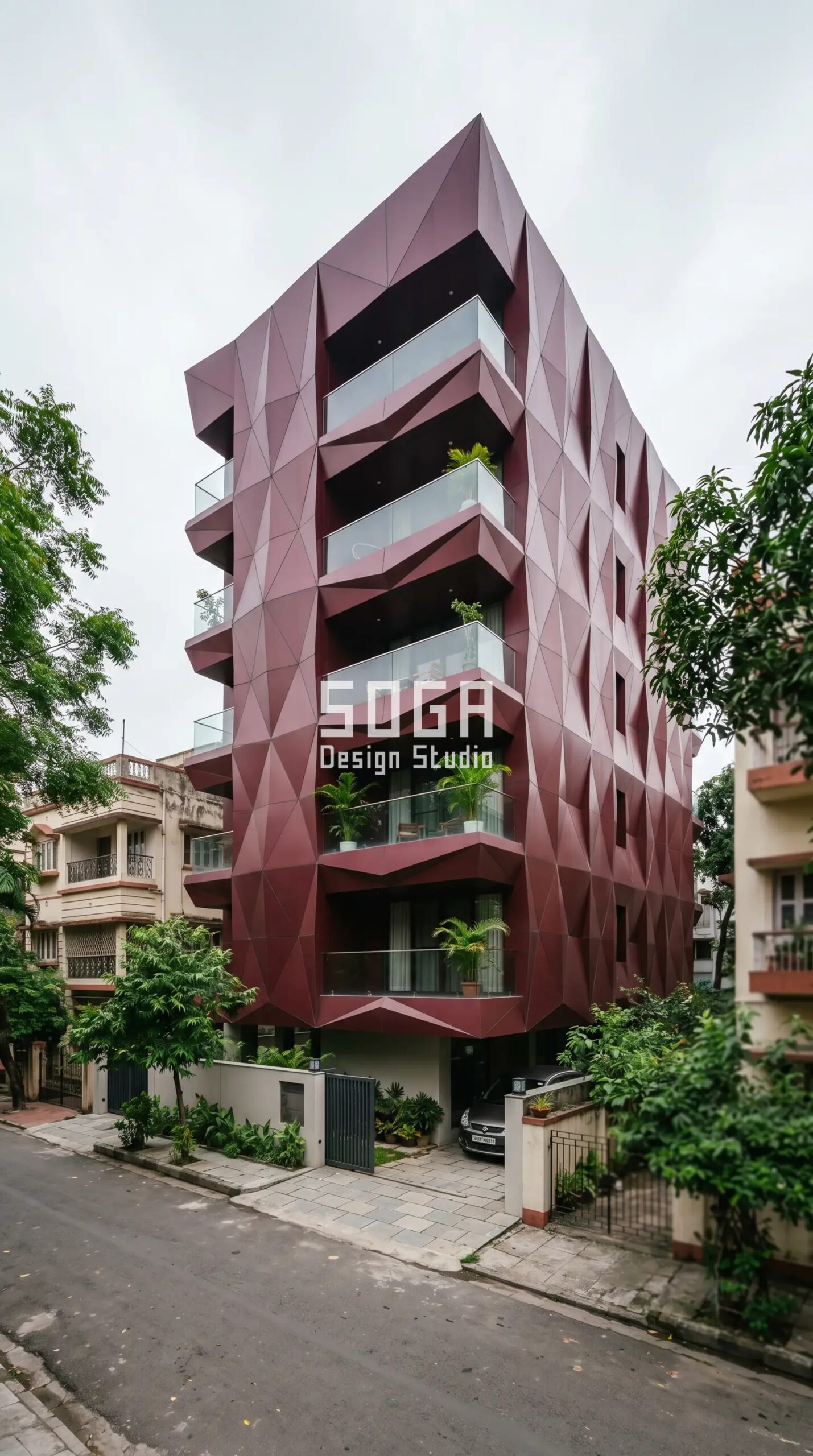
The boldest of the four sits in New Alipore, Kolkata: a parametric crystal-grid of three-dimensional faceted panels that fold the elevation into a prismatic, gem-like rhythm, finished in rich matte burgundy wine-red ACP. Colour is the identity here — in Kolkata’s soft, often overcast light the deep wine-red stays saturated and elegant where a glossy panel would look plastic. The faceting catches what little directional light there is, so the building never reads flat. ACP (aluminium composite) makes the faceted geometry both lightweight and cost-effective for a G+5, and its factory finish is consistent panel to panel. For an overhaul, the crystal-grid is the clearest before-and-after: a plain box becomes a sculptural address, while the underlying structure is untouched.
Cost Benchmarks for Indian Parametric Metal Facades
One of the most-asked questions on a Kochi project brief is budget. The current all-in installed rates for parametric metal facades in India sit in the following ranges:
- Steel facade (full design + install): ₹1,200–₹2,800 per sq ft
- Aluminium, anodised or powder-coated: ₹800–₹2,500 per sq ft
- Zinc cladding: ₹1,500–₹3,000 per sq ft
- ACM panels (3 mm basic): ₹200–₹250 per sq ft (basic)
- ACM panels (4 mm): ₹250–₹350 per sq ft
- Solid aluminium panels: ₹800–₹1,800 per sq ft
- Installation labour: ₹50–₹150 per sq ft (varies by height + access)
- Conventional cladding (for comparison): ₹400–₹1,200 per sq ft installed (stone veneer / ceramic / standard ACM)
These figures are baseline; actual project cost depends on facade area, panel complexity, fabricator location, and finish specification. SOGA Design Studio prepares an itemised cost estimate as part of every consultation so the budget conversation starts with hard numbers rather than guesses.
Parametric Facade Design Across India, Dubai & Singapore
Retrofit is the fastest-growing segment of today’s Indian facade market and SOGA Design Studio is investing heavily in it. A lightweight aluminium parametric screen mounted on stand-off brackets can transform a tired 1990s or 2000s Kochi apartment block in 4 to 8 weeks without disturbing tenants or interiors. The economics often surprise owners: a retrofit facade can reset rental yield, reposition a building in the listings, and add visible value at a fraction of the cost of a full reclad. Several of the concepts shown above have direct retrofit variants available on request.
Why Trust SOGA Design Studio for Facade Design in Kochi
- Experience: Across G+3 to G+8 residential and boutique-commercial elevations in Kochi, Mumbai, Delhi, Bangalore, Hyderabad and the Gulf, SOGA Design Studio has refined a repeatable process for turning ageing concrete facades into clean parametric metal envelopes.
- Expertise: Every SOGA facade is engineered in Rhino and Grasshopper, then detailed for powder-coated and anodised aluminium, PVDF steel, zinc and ACP, with panel density and fin angle tuned to each plot’s solar exposure and local climate.
- Authority: SOGA Design Studio works as a dedicated facade-design specialist for Indian homeowners and NRI clients, and publishes transparent 2026 cost benchmarks and climate-response guidance so buyers can plan with real numbers.
- Trust: Fixed-scope design stages, real material mock-ups approved on site before fabrication, and supervised installation mean clients see exactly what they are paying for at every milestone.
Frequently Asked Questions
How much does a parametric metal facade cost per sq ft in India in 2026?
In 2026, anodised or powder-coated aluminium runs about ₹800–₹2,500 per sq ft and steel facades about ₹1,200–₹2,800 per sq ft; 4 mm ACM/ACP panels are around ₹250–₹350 per sq ft, plus roughly ₹50–₹150 per sq ft for installation depending on height and access. The final figure depends on the system, finish and your plot.
How long does a facade overhaul take from design to installation?
A typical parametric metal overhaul runs about 10–16 weeks: 2–4 weeks for parametric design and an approved on-site mock-up, 4–8 weeks for factory fabrication, and 2–4 weeks for installation over the existing structure.
Can a parametric metal facade be retrofitted onto an existing building?
Yes. A lightweight sub-frame is fixed over the existing structure and the new metal panels or fins mount onto it, so most of the work happens outside and day-to-day life inside the home is barely disrupted.
Can NRIs design and build a facade in India remotely?
Yes. SOGA Design Studio handles the full design remotely with 3D previews and approvals, then manages local fabrication and supervised installation, so NRI clients can complete a facade overhaul without being on site.
What is the typical timeline from design to installed parametric facade?
For a G+3 to G+4 residence: 3 weeks for concept and approval, 4 weeks for fabrication-ready drawings, 6–8 weeks for fabrication, and 3–5 weeks for site installation — total 16–20 weeks from go-ahead to occupancy. Retrofit projects on existing buildings compress this to 10–14 weeks because no structural coordination is needed.
What is a kinetic facade and is it practical for Indian residences?
A kinetic facade has moving panels — louvres, rotating fins, or actuated screens — that respond to sun angle, occupancy, or wind. For mid-rise Indian residences, the practical version is ‘pseudo-kinetic’: a static parametric pattern that creates the visual illusion of motion as the sun tracks across it. True actuated kinetic systems are typically reserved for premium G+10 and above commercial buildings.
How long does a powder-coated metal facade last in Indian conditions?
Quality powder-coated aluminium or galvanised steel facades, when correctly detailed and ventilated, last 25–30 years before recoating is needed — even in coastal Mumbai, Chennai, and Kochi. Anodised aluminium and pre-patinated zinc/copper can exceed 40 years. Maintenance is annual rinse-down only; no repainting like traditional plaster facades.
What is parametric facade design?
Parametric facade design uses algorithmic rules — light, climate, orientation, and structural parameters — to generate a building skin where every panel is mathematically calibrated. The result is a facade that performs (heat control, ventilation, daylighting) while expressing a unique sculptural identity. It is the direct computational descendant of traditional Indian metal screens.
Why is parametric architecture suited to the Indian climate?
India’s combination of intense sun, monsoon humidity, and dense urban context demands a ‘smart skin’ rather than a static wall. Parametric facades let designers tune perforation density, panel depth, and orientation per building per orientation — cutting solar heat gain by 25–40% while boosting cross-ventilation. The approach also reinterprets centuries-old metal shadow screening for modern G+3 and G+4 buildings.
Where are parametric metal facades fabricated in India?
The main fabrication clusters are Mumbai-Pune (precision aluminium and steel), Chennai-Coimbatore (laser cutting and powder coating), Delhi-NCR (large-format ACM and screens), and Ahmedabad (brass and copper specialty). SOGA Design Studio works with vetted fabricators in each cluster to keep transport cost and lead-time low for any project location.
How much does a parametric metal facade cost per square foot in Indore?
Currently, all-in parametric metal facade rates in India range from ₹800–₹2,500 per sq ft for aluminium and ₹1,200–₹2,800 per sq ft for steel, installed. SOGA Design Studio prepares itemised estimates as part of the consultation.
What is a sculptural petal-shaped metal fin facade?
SOGA Design Studio addresses this question in detail during the design consultation. For Kochi projects, we provide a fully customised answer based on plot, orientation, and budget — typically within 48 hours of receiving the brief.
Related Reading
- parametric facade design in India
- SOGA Design Studio facade portfolio
- Custom Facade Design in Kochi 2026: What Is Actually Possible
- Silver Dot: Parametric Facade Innovation by Soga Design Studio
- Parametric Facades: A New Vision in Architecture
Start Your Facade Project With SOGA Design Studio
Four cities, four climates, four very different looks — one repeatable process. Whether you want the calm platinum wave of Kochi, the sharp dark-steel blades of Delhi, the warm bronze fins of Ahmedabad or the wine-red crystal grid of Kolkata, a parametric metal overhaul follows the same path: parametric design, an approved on-site mock-up, factory fabrication, then a clean installation over your existing structure. Get the process right and the result is a facade that looks built-to-last, not bolted-on.
Whether you are building new or retrofitting an existing block, SOGA Design Studio can adapt the concepts above to your exact plot and budget. Start the conversation here — consultations are free and no-commitment.