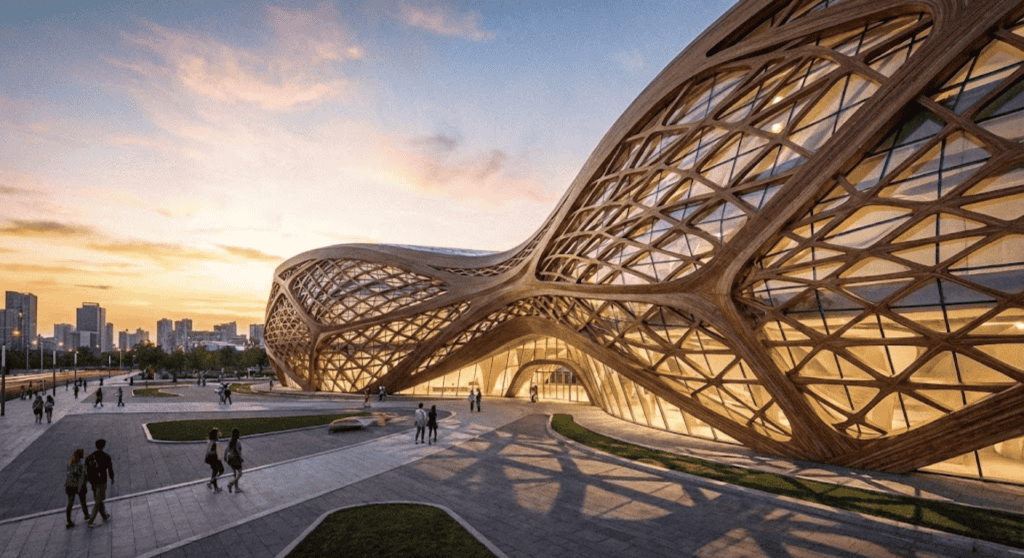
Most residential elevations in India still start from a catalogue. You pick a cladding, a colour, a railing — and end up with a building that looks like the three next to it. The residential facade design approach in this guide does the opposite: every one of the four homes below begins from a design seed — a unique combination of massing logic, a parametric skin operation, a material family and a climate move — so no two facades can ever read the same. Below are four buildable parametric metal facade concepts, one each for a real plot in Chennai, Indore, Hyderabad and Visakhapatnam, developed the way SOGA Design Studio develops a live project: with exact parameters, honest costs, and nothing that a good Indian fabricator cannot build.
Residential Facade Design in India: Why 2026 Belongs to the Parametric Metal Skin
Across Indian metros in 2026, the fastest-growing facade segment is not the glass tower — it is the G+3 to G+5 home whose entire elevation is visible from the street. On these plots a sculptural parametric facade design in India yields the maximum identity per rupee: the skin is the building. Done well, a parametric metal facade also performs — a double-skin metal screen cuts direct solar heat gain by roughly 25–40% on west and south faces and drops interior surface temperatures by 4–7°C versus bare RCC, while the shaded cavity drives passive ventilation. The four concepts here each answer a specific plot problem, not a mood board.
1. Chennai Parametric Cascade Weave: A G+4 Smoky Facade
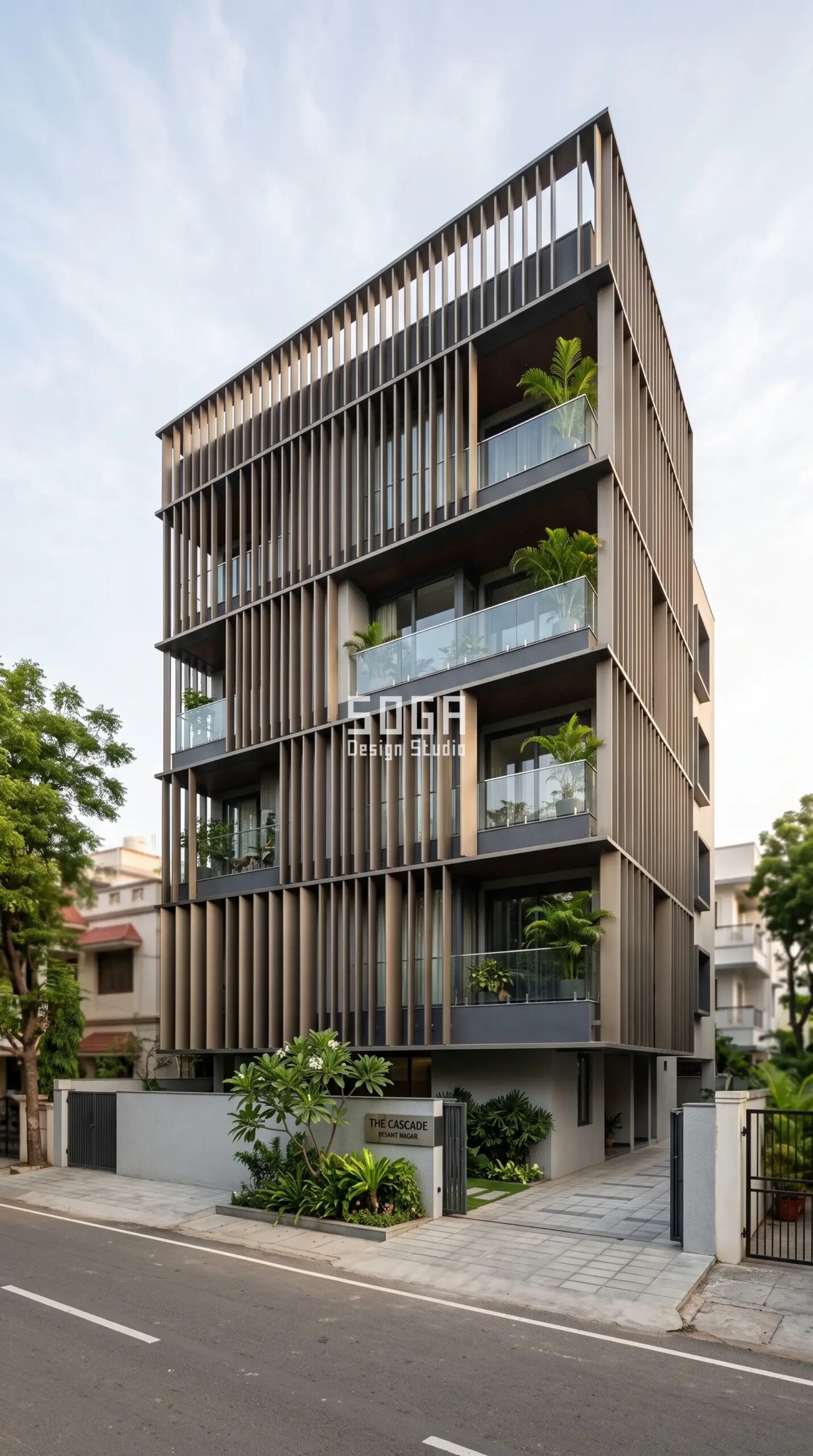
Design seed: Stepped-cascade massing x vertical ribbon skin x attractor-gradient fin spacing. This G+4 home in Besant Nagar, Chennai wears a Parametric Cascade Weave skin in smoky bronze anodised aluminium. East sea-breeze plot: the fins self-shade the low morning sun while the 150 mm ventilated cavity lets coastal air wash the glass line and pull heat off the skin. The parametric variation is not decoration — it is the whole point of the system, and it is written into the fabrication drawings, not sprayed on afterwards.
How the Parametric Cascade Weave is built
| Design parameter | Specification |
|---|---|
| Module | 50 x 50 mm anodised aluminium fin, length 900–2400 mm |
| Spacing / driver | c/c widening 120 mm (top) to 480 mm (base), roofline attractor |
| Variation | fin length + spacing gradient — the ‘frozen waterfall’ read |
| Density | approx 80% closed at bedroom bays to 45% at living |
| Panels | ~16 unique 1.2 x 3.0 m panels on 40 x 40 SHS grid |
| Cavity | 150 mm ventilated cavity over inner glazing |
Material & colour: hero skin in Smoky Bronze anodised (RAL 8025 tone), kept to a restrained residential palette (texture contrast over colour contrast) so the geometry does the talking. Indicative facade cost: approx Rs 1,400–1,900 per sq ft (anodised aluminium band Rs 800–2,500), fully designed and installed, with an itemised estimate produced per plot.
2. Indore Parametric Spire Screen: A G+3 Matte Facade
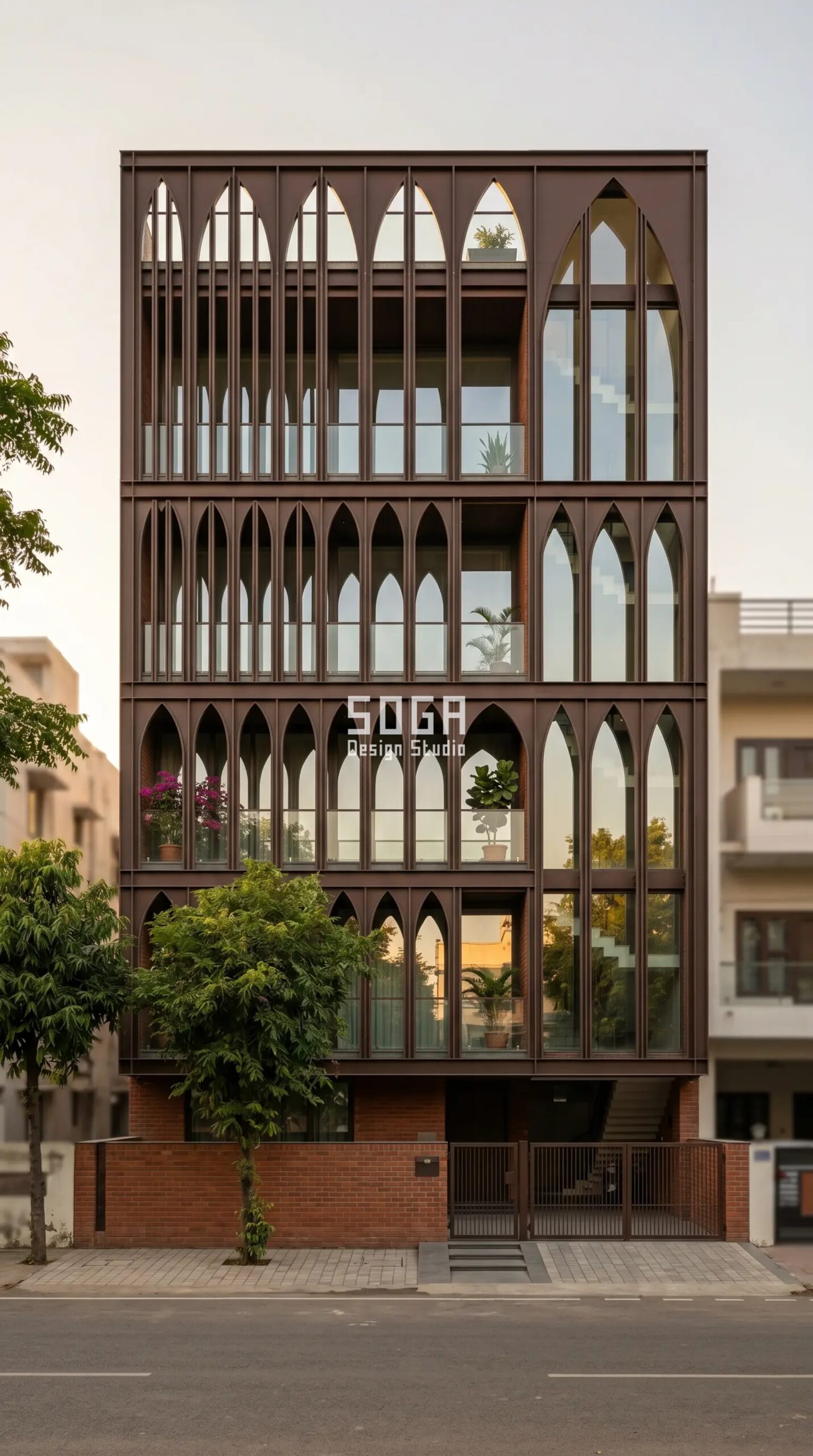
Design seed: Compact urban massing x pointed-arch rhythm x aperture density-map. This G+3 home in Vijay Nagar, Indore wears a Parametric Spire Screen skin in matte chocolate brown steel. West deep-shade plot: the tall arches cut the harsh low west sun of the Malwa plateau, and the brick plinth adds thermal mass that keeps the ground floor cool. The parametric variation is not decoration — it is the whole point of the system, and it is written into the fabrication drawings, not sprayed on afterwards.
How the Parametric Spire Screen is built
| Design parameter | Specification |
|---|---|
| Module | pointed-arch bay ~600 mm wide x 1800 mm tall, 3 mm folded steel |
| Aperture / driver | open ratio shifting 40% closed at stair to 80% closed at bedrooms |
| Variation | arch height + open ratio gradient — the screen visibly ‘breathes’ |
| Depth | 200 mm proud of the inner glazed wall |
| Panels | ~12 unique arch panels on MS 40 x 40 SHS substructure |
| Base | wire-cut warm brick plinth for thermal mass |
Material & colour: hero skin in Matte Chocolate Brown steel (RAL 8017 tone), kept to a restrained residential palette (texture contrast over colour contrast) so the geometry does the talking. Indicative facade cost: approx Rs 1,800–2,400 per sq ft (steel band Rs 1,200–2,800), fully designed and installed, with an itemised estimate produced per plot.
3. Hyderabad Parametric Hex Grid: A G+5 Deep Facade
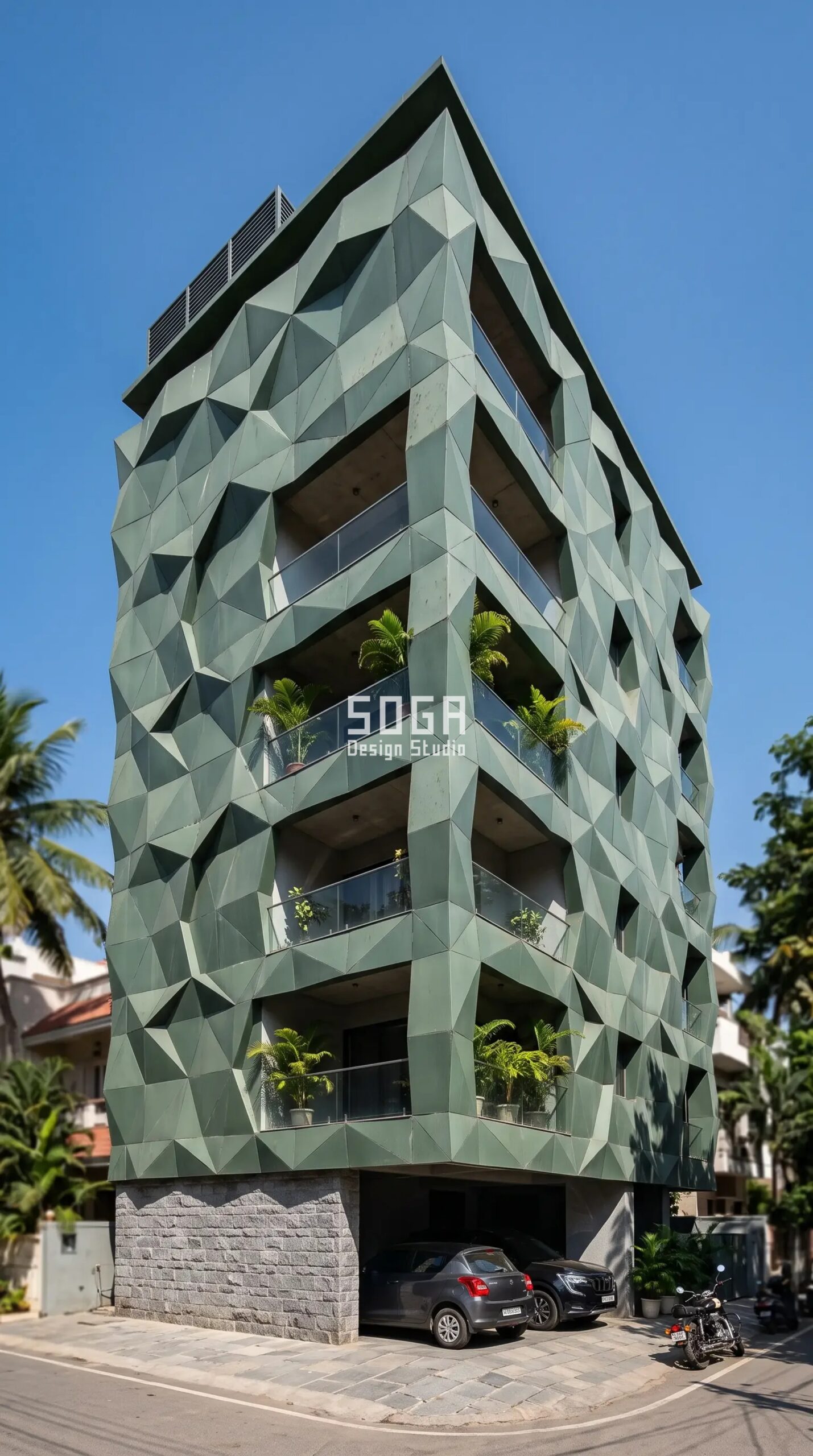
Design seed: Faceted massing x 3D triangular panel skin x depth-extrusion field. This G+5 home in Jubilee Hills, Hyderabad wears a Parametric Hex Grid skin in deep sage green powder-coated steel. South heat screen: the deep faceted panels throw self-shadow across the hottest orientation through the Deccan afternoon, while the ventilated cavity carries heat away. The parametric variation is not decoration — it is the whole point of the system, and it is written into the fabrication drawings, not sprayed on afterwards.
How the Parametric Hex Grid is built
| Design parameter | Specification |
|---|---|
| Module | triangular faceted panel ~600 mm edge, folded steel |
| Extrusion / driver | panel depth varying 40 mm to 180 mm on a south-solar attractor |
| Variation | depth field — the surface ripples with real self-shadow |
| Density | deepest facets banked to the south / west solar face |
| Panels | ~18 unique facet folds; repeat panels nested to hold cost |
| Base | grey granite plinth, 100 mm ventilated cavity |
Material & colour: hero skin in Deep Sage Green powder-coat (RAL 6021 tone), kept to a restrained residential palette (texture contrast over colour contrast) so the geometry does the talking. Indicative facade cost: approx Rs 1,500–2,400 per sq ft (powder-coated steel band), fully designed and installed, with an itemised estimate produced per plot.
4. Visakhapatnam Parametric Tide Shell: A G+4 Matte Facade
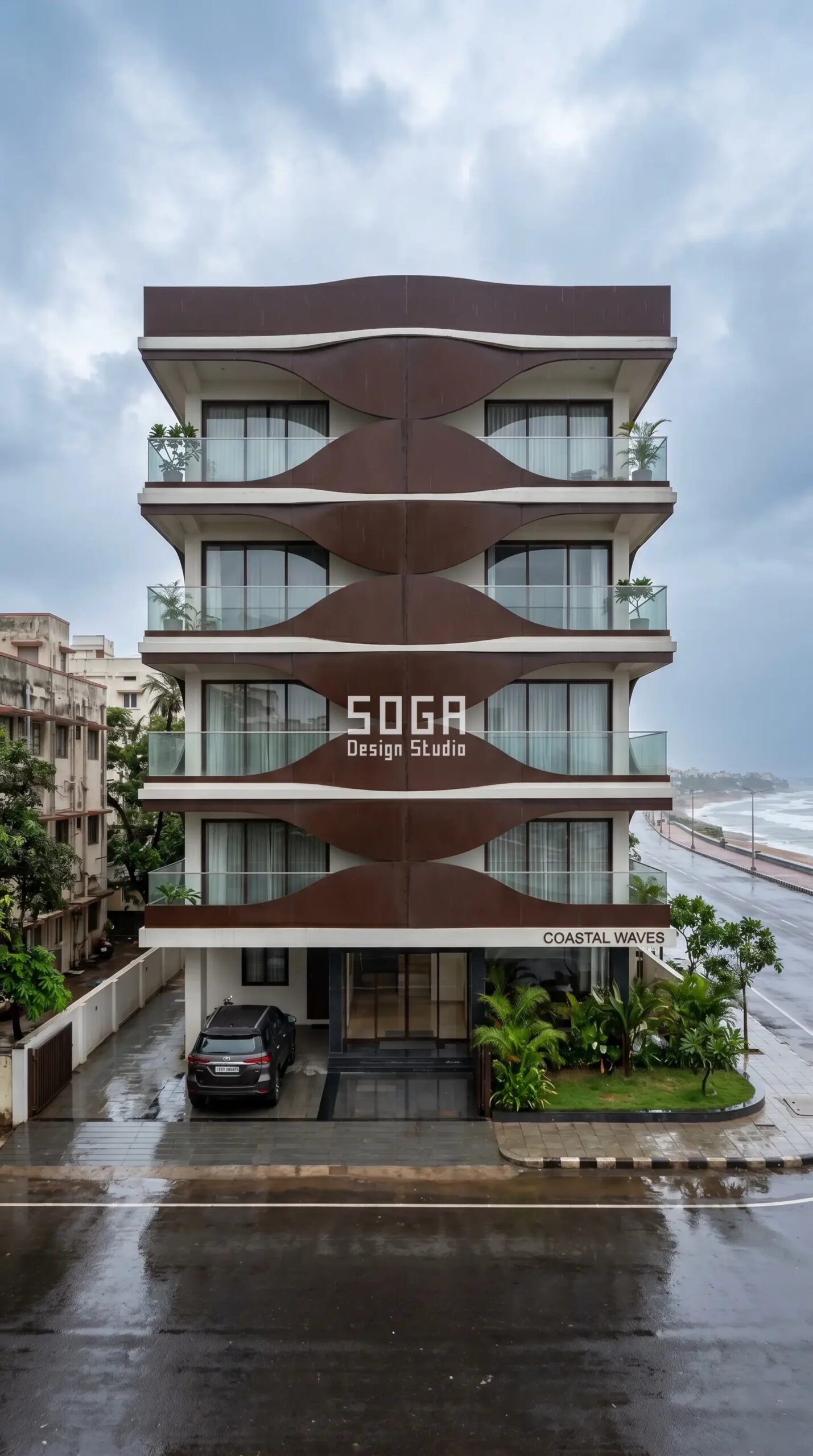
Design seed: Undulating slab massing x horizontal wave banding x contour-wave amplitude. This G+4 home in Beach Road, Visakhapatnam wears a Parametric Tide Shell skin in matte chocolate brown marine-grade steel. Coastal post-monsoon plot on the Bay of Bengal: marine-grade coating resists salt air, and the swelling wave overhangs shade the glass and throw driving rain clear of the openings. The parametric variation is not decoration — it is the whole point of the system, and it is written into the fabrication drawings, not sprayed on afterwards.
How the Parametric Tide Shell is built
| Design parameter | Specification |
|---|---|
| Module | horizontal fascia band ~600 mm deep, one per floor |
| Amplitude / driver | wave swelling 150 mm at the ends to 600 mm at centre |
| Variation | sine-wave amplitude field — each band rolls like a coastal swell |
| Edge | crisp white RCC slab edges between the steel waves |
| Panels | ~10 rolled wave segments, marine-grade coating |
| Detail | deep overhang doubles as monsoon shade + sun shade |
Material & colour: hero skin in Matte Chocolate Brown marine-grade steel (RAL 8017 tone), kept to a restrained residential palette (texture contrast over colour contrast) so the geometry does the talking. Indicative facade cost: approx Rs 1,400–2,000 per sq ft (marine steel band), fully designed and installed, with an itemised estimate produced per plot.
Parametric Residential Facade Cost in India (2026)
Facade cost depends on the metal, the panel complexity and your city. As a planning guide for a fully designed-and-installed parametric metal residential facade in India:
| System / material | Indicative rate (per sq ft) |
|---|---|
| Anodised / powder-coated aluminium | Rs 800 – Rs 2,500 |
| Steel (folded / plate) facade | Rs 1,200 – Rs 2,800 |
| Zinc facade | Rs 1,500 – Rs 3,000 |
| ACM / solid aluminium panels | Rs 200 – Rs 1,800 |
| Installation labour (height dependent) | Rs 50 – Rs 150 |
Against a bare painted or plastered elevation (repainting every 4–6 years), a powder-coated parametric metal facade carries a higher upfront cost but a 25–30 year service life with only an annual rinse — so the total cost of ownership over 20 years is typically lower, with far stronger street identity.
Why These Concepts Are Buildable, Not Just Renders
Every concept above passes the same buildability checklist SOGA Design Studio applies to live work: a named fabrication method for each element, an MS or aluminium substructure with a clear load path, module weights kept to a two-person lift or a noted crane pick, unique-part counts held low so mould and cutting cost stay controlled, and materials sourceable within India. Experience: SOGA develops these G+3 to G+7 residential typologies for real Indian plots and runs a daily facade study series. Expertise: each skin is driven by per-orientation climate analysis and fabrication-ready detailing rather than copied from a catalogue. Trust: honest 2026 cost ranges, itemised per-plot estimates, and a fully remote workflow for NRI clients — the first consultation carries no commitment.
Related Reading
- Parametric facade design in India — the complete guide
- Metal facade cost per square foot in India
- 4 Powder-Coated Aluminium Parametric Facade Designs for Indian Residential Buildings 2025
- Parametric Architecture India 2025-26: 4 Facade Styles Transforming Residential Buildings
- How Twisted Aluminium Fin Facade Design Transforms a Residential Building | Soga Design Studio
Frequently Asked Questions
How much does a parametric residential facade cost per sq ft in India in 2026?
For a fully designed-and-installed parametric metal residential facade, aluminium runs about Rs 800–2,500 per sq ft, steel Rs 1,200–2,800 per sq ft and zinc Rs 1,500–3,000 per sq ft; basic ACM cladding starts near Rs 200 per sq ft, with installation labour adding Rs 50–150 per sq ft by height. SOGA Design Studio gives an itemised estimate for your specific plot.
Is parametric facade design suitable for G+3 and G+4 residential plots?
Yes — it is the highest-growth residential segment in India. On G+3 and G+4 plots the whole elevation is visible from the street, so a sculptural parametric skin yields maximum identity per rupee. SOGA adapts concepts to standard 30×40, 40×60 and 50×80 ft plots across Indian metros and tier-2 cities.
Which metal is best for a residential facade in coastal cities like Chennai and Visakhapatnam?
Anodised aluminium and marine-grade powder-coated steel perform best on the coast; correctly detailed and ventilated, they last 25–30 years against salt air with only an annual rinse. A ventilated cavity behind the skin is essential to let coastal humidity escape.
How does a parametric metal facade reduce heat inside an Indian home?
A double-skin parametric metal screen cuts direct solar heat gain by roughly 25–40% on west and south orientations and can drop interior surface temperatures by 4–7 deg C versus bare RCC, while the shaded cavity enables passive cross-ventilation. SOGA tunes screen depth and opening density to each orientation’s solar load.
Can NRIs get a residential facade designed and built in India remotely?
Yes. SOGA Design Studio runs end-to-end remote consultations for NRI clients in Dubai, Singapore, the UK and the US — site analysis, design development, review, fabrication-ready drawings and on-site supervision, all delivered virtually.
Start Your Residential Facade Project
Have a plot in Chennai, Indore, Hyderabad, Visakhapatnam or anywhere in India or the Gulf? SOGA Design Studio will develop a unique parametric facade concept for your home — with real parameters, a buildable detail package and an honest cost estimate. Explore our parametric facade design work or write to [email protected] for a free, no-commitment consultation.