Drive down any Indian street and you can read a facade’s future in its first monsoon: the flat, featureless elevation streaked with water stains, the cheap coating already chalking, the west wall too hot to touch by 4 PM. Facades rarely fail because of one dramatic fault. They fail quietly, from small design decisions made years earlier. The good news is that the same decisions, made well, produce a facade that stays sharp for decades. Below are four residential concepts from SOGA Design Studio, one for Ahmedabad and three from other Indian cities, each engineered as a parametric metal skin that answers a specific way ordinary facades break down.
Facade Design in India: Why Ahmedabad Is Choosing Parametric Metal
Facade design in India has moved from an afterthought to the single most important decision on a residential project. Today, demand for parametric facade design in India is rising fastest in cities such as Ahmedabad, Mumbai, Bangalore, Delhi, and Pune, where homeowners and developers want elevations that are both performance-driven and instantly recognisable. SOGA Design Studio specialises in facade design in India — from G+3 individual homes to G+7 residential blocks — pairing algorithmic geometry with matte powder-coated ral 4009 pastel vi and fabrication-ready detailing. Whether you are comparing metal facade design in India for a new build or a retrofit, the concepts below show how a considered facade redefines a building’s identity and its long-term value.
1. Ahmedabad Parametric Pod Bay: Depth That Sheds Water and Sun
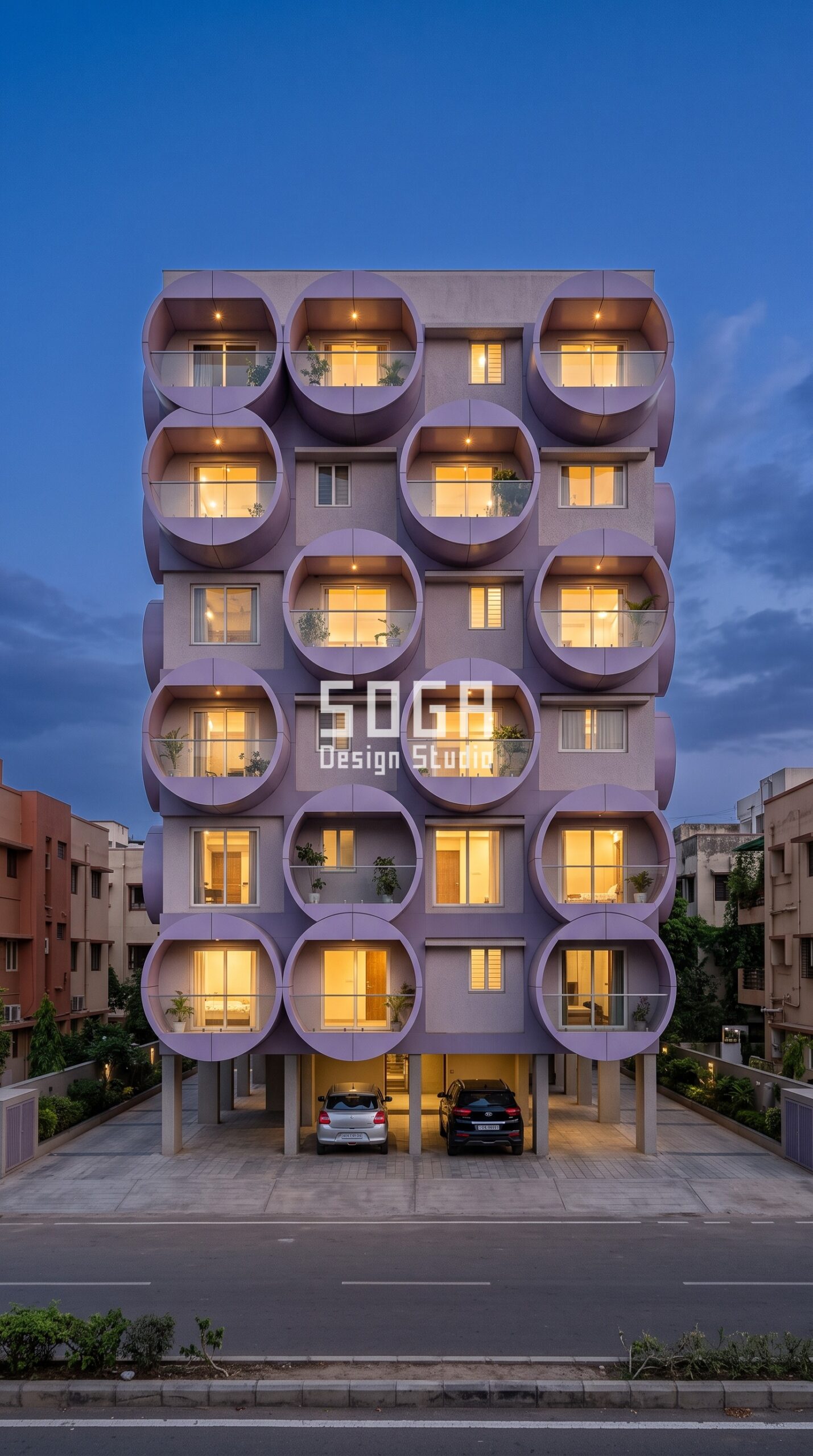
Ahmedabad’s flat, sun-blasted elevations are the classic failure story: a plain rendered wall streaks with monsoon runoff within two seasons and bakes through the afternoon. This G+5 concept in Navrangpura answers both with pure geometry. A rhythmic array of circular pod-like metal balcony bays projects from the wall in a shifting pattern, finished in matte powder-coated RAL 4009 pastel-violet steel. Each deep circular reveal throws its own shade and channels rainwater clear of the face instead of letting it wash down the render. The powder-coated steel carries honest panel seams and true daylight rather than a plastic sheen, and because the bays step in and out across the elevation, no single floor reads as a repeat. It is a facade whose distinctiveness is also its weatherproofing.
2. New Delhi Parametric Spire Screen: A Climate Buffer Against Heat and Glare
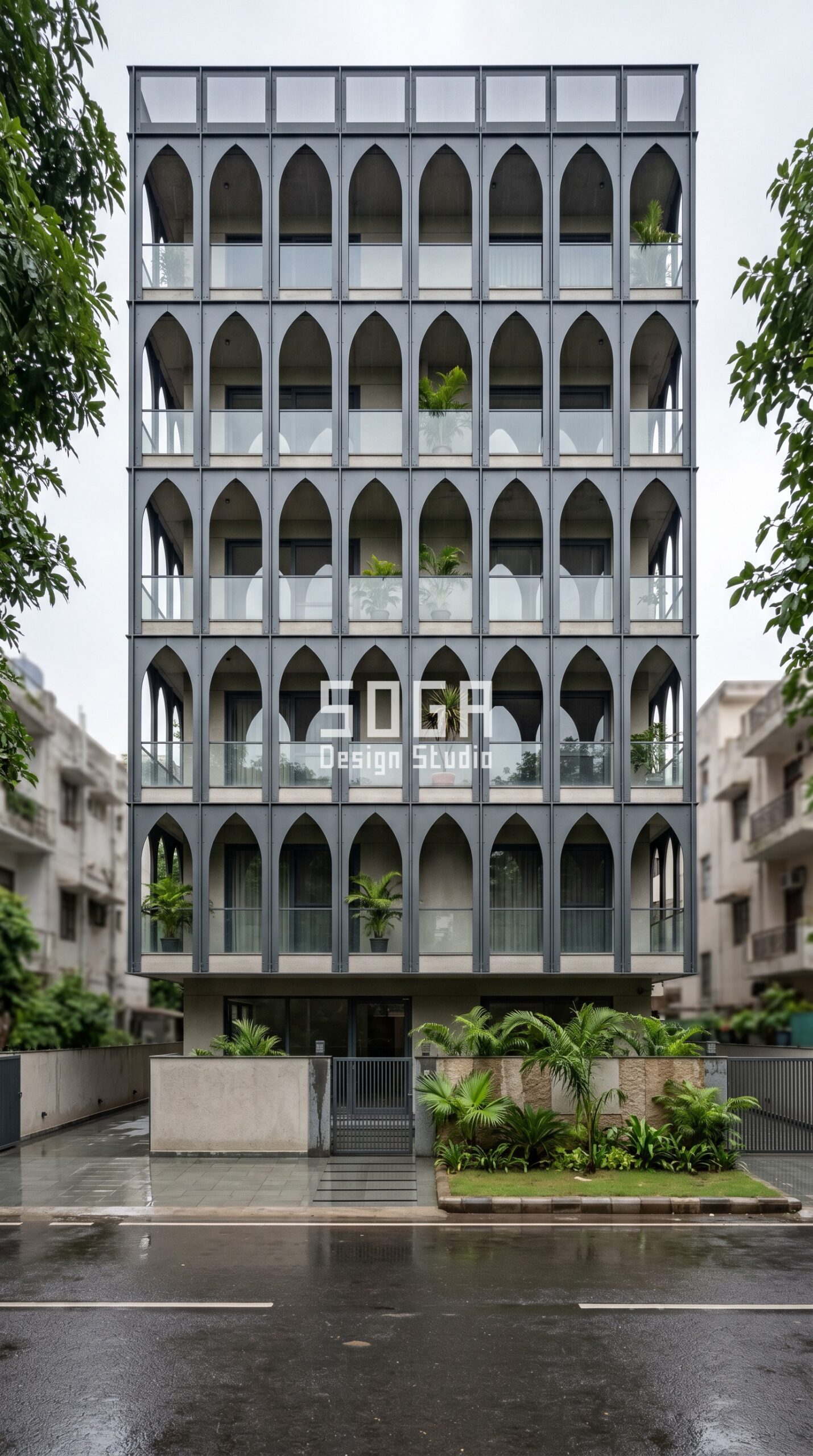
In New Delhi, the facades that fail fastest are the all-glass boxes: interiors overheat, blinds stay permanently shut, and the elevation looks tired within a decade. This G+7 concept in Anand Niketan runs a vertical tapered-arch motif across the full width as an ordered metal screen in matte powder-coated RAL 7016 anthracite-grey steel. The arched screen sits a few hundred millimetres proud of the glass line, so it intercepts direct sun before it reaches the rooms, cutting solar gain while keeping views and daylight. True-to-life matte metal with visible module joints ages far more gracefully than a coated flat panel, and shot here under a post-monsoon overcast sky against a wet street, the grey screen reads calm and permanent rather than showy.
3. Hyderabad Parametric Braid Screen: The Metal That Never Needs Repainting
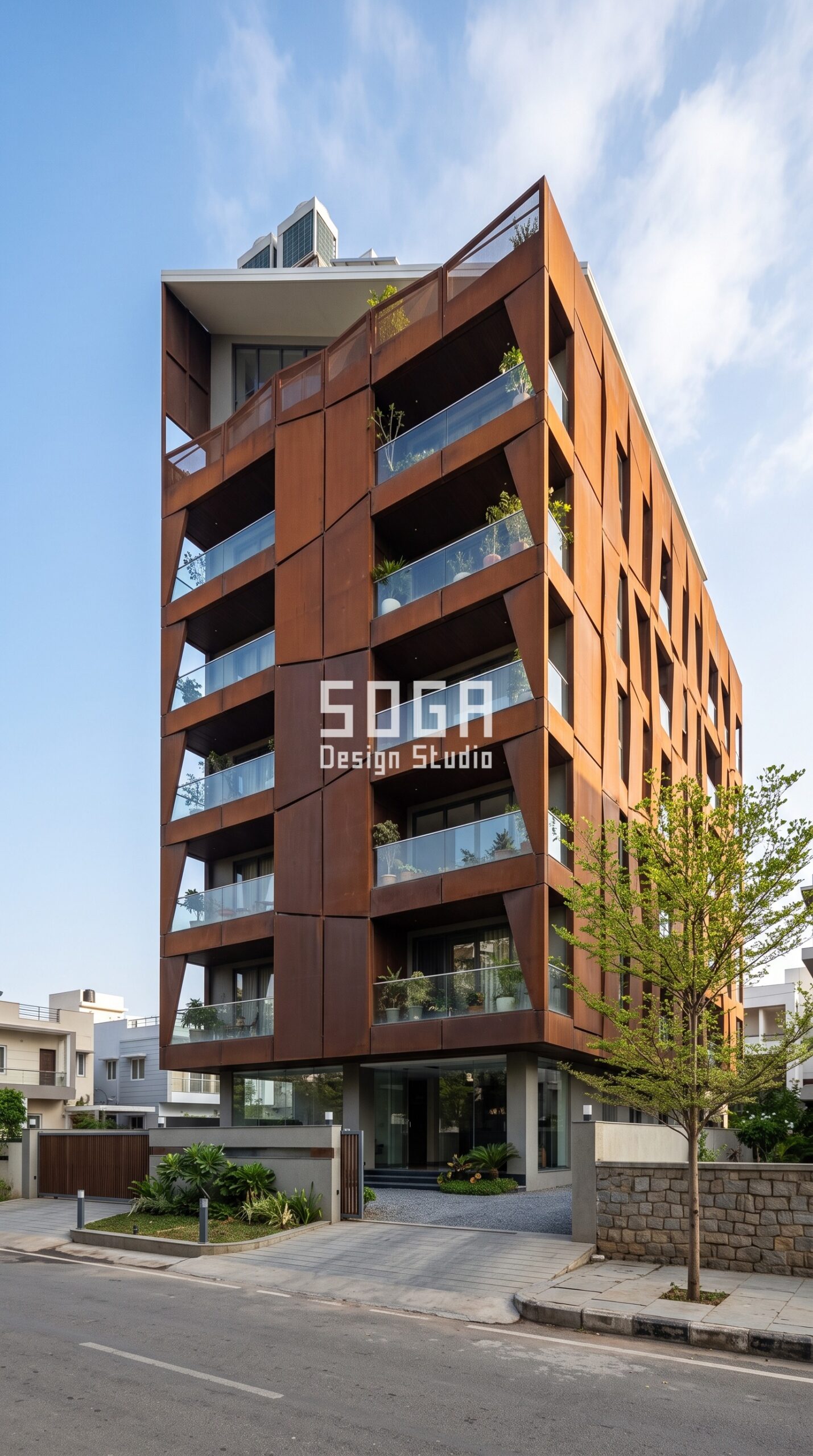
The single most common facade failure in India is the maintenance one: a painted or lightly coated skin that chalks, streaks and demands repainting every few years. This G+6 concept in Jubilee Hills, Hyderabad removes the problem at the source. Its woven, interlocking angular screen with alternating solid and open sections is built in matte raw Corten steel in deep rust tones, a material that forms its own stable protective surface and asks for no coating at all. The interlocking modules stay crisp and discrete on a clear grid, shot in bright morning light so the rust tone glows warm rather than muddy. A glass ground-floor lobby and compound wall keep the base honest and buildable. It is a facade designed to be left alone and still look intentional at year twenty.
4. Surat Parametric Ribbon Band: Layered Bands That Absorb Thermal Movement
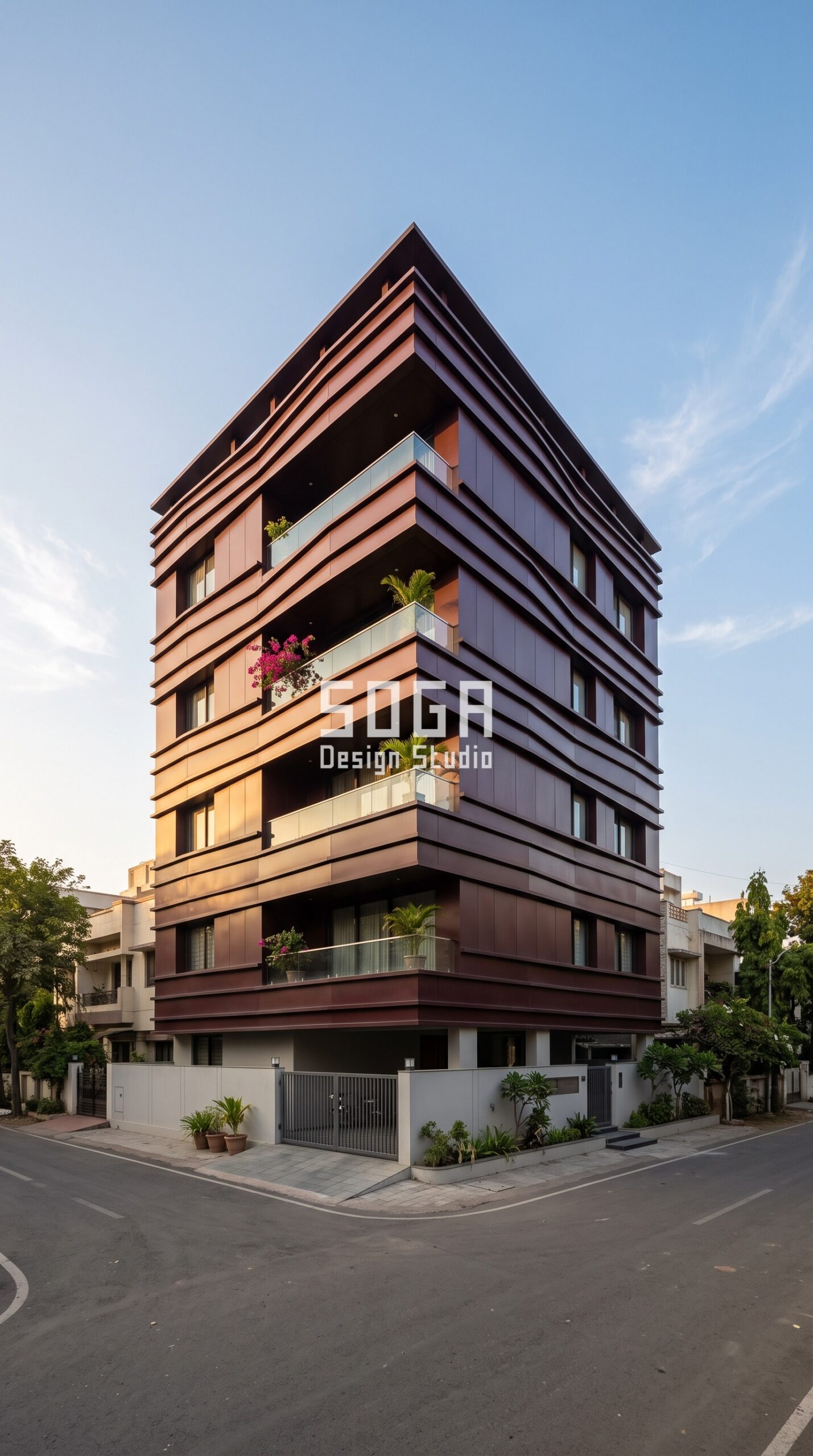
Surat’s heat swing is brutal on rigid facades: monolithic panels expand, crack at the joints and open hairline gaps that let water in. This G+5 concept in Piplod turns that stress into the design idea. Rippling horizontal bands of bent metal step across the elevation in matte powder-coated RAL 3007 deep black-red steel, each band a discrete module on a clear rhythm. The layered, overlapping bands give the skin room to expand and contract without cracking, while the deep colour and long late-afternoon shadows make the depth read as sculpture rather than repetition. A compound wall, simple metal gate and clean paved entry ground it as a real Surat street building, not a render. Movement-tolerant detailing is exactly what keeps a facade watertight through decades of Gujarat summers.
Cost Benchmarks for Indian Parametric Metal Facades
One of the most-asked questions on a Ahmedabad project brief is budget. The current all-in installed rates for parametric metal facades in India sit in the following ranges:
- Steel facade (full design + install): ₹1,200–₹2,800 per sq ft
- Aluminium, anodised or powder-coated: ₹800–₹2,500 per sq ft
- Zinc cladding: ₹1,500–₹3,000 per sq ft
- ACM panels (3 mm basic): ₹200–₹250 per sq ft (basic)
- ACM panels (4 mm): ₹250–₹350 per sq ft
- Solid aluminium panels: ₹800–₹1,800 per sq ft
- Installation labour: ₹50–₹150 per sq ft (varies by height + access)
- Conventional cladding (for comparison): ₹400–₹1,200 per sq ft installed (stone veneer / ceramic / standard ACM)
These figures are baseline; actual project cost depends on facade area, panel complexity, fabricator location, and finish specification. SOGA Design Studio prepares an itemised cost estimate as part of every consultation so the budget conversation starts with hard numbers rather than guesses.
Parametric Facade Design Across India, Dubai & Singapore
SOGA Design Studio operates across the full Indian residential market — Mumbai, Delhi, Bangalore, Hyderabad, Chennai, Pune, Jaipur, Ahmedabad, and tier-2 cities including Coimbatore, Indore, Nagpur, and Chandigarh. Demand for sculptural metal cladding, parametric facade India is no longer concentrated in metros; we are seeing equal pull from owner-builders in tier-2 markets who want their G+3 home to read as clearly designed, not generic. Every project starts with your plot dimensions, local building bylaws, and a 30-minute discovery call to align on aesthetic direction.
Why Trust SOGA Design Studio for Facade Design in Ahmedabad
- Experience: SOGA Design Studio has detailed and delivered parametric metal facades across Indian cities, resolving the panelisation, fixing and drainage details that decide whether a facade lasts.
- Expertise: Each concept is engineered with a defined module, projection depth, material grade and climate response rather than applied as decoration.
- Trust: Honest 2026 cost-per-sq-ft ranges and material trade-offs are given openly so buyers can plan a real budget.
Frequently Asked Questions
Why do building facades fail in India?
Most facades fail from a handful of avoidable causes: monsoon water staining on flat rendered walls, solar heat gain on unshaded glass, coating breakdown on cheaply painted panels, and thermal cracking where rigid panels cannot move. All four are design and detailing problems, not bad luck, and a well-detailed metal facade with real depth, self-finishing material and movement-tolerant modules prevents them.
How much does a parametric metal facade cost per sq ft in India in 2026?
In 2026, a full steel facade installation runs about Rs 1,200 to Rs 2,800 per sq ft, anodised or powder-coated aluminium about Rs 800 to Rs 2,500 per sq ft, and a zinc facade Rs 1,500 to Rs 3,000 per sq ft. Solid aluminium panels are Rs 800 to Rs 1,800 per sq ft and installation labour adds Rs 50 to Rs 150 per sq ft depending on building height and access. The parametric geometry itself adds little cost; the material grade and finish drive the budget.
Which metal facade needs the least maintenance?
Corten (weathering) steel needs the least because it forms its own stable protective surface and never needs repainting, as in the Hyderabad Braid Screen concept. Anodised aluminium and quality powder-coated steel are also very low maintenance, typically needing only periodic washing, far less than painted render or cheap coated panels that chalk and streak within a few years.
Can a metal facade reduce heat gain in a hot Indian city?
Yes. A metal screen held proud of the glass line, like the New Delhi Spire Screen, intercepts direct sun before it reaches the rooms, cutting solar gain and glare while keeping daylight and views. Deep projecting modules, such as the Ahmedabad Pod Bay reveals, add self-shading, which lowers cooling loads through the afternoon.
Does SOGA Design Studio work on residential facades outside Ahmedabad?
Yes. SOGA Design Studio designs parametric metal facades for residential and commercial buildings across India, including Ahmedabad, New Delhi, Hyderabad, Surat, Mumbai and Bangalore, and for NRI clients in Dubai, Singapore and the UK. Each facade is engineered to its city’s climate from concept to buildable detail.
Can a parametric metal facade be retrofitted onto an existing Indian building?
Yes, and it is one of the fastest-growing segments. A lightweight aluminium parametric screen can be mounted on stand-off brackets over existing brick, RCC, or even tired plaster facades — completely transforming the elevation in 4–8 weeks without disturbing tenants or interiors. Retrofit is particularly cost-effective for 1990s-2010s Indian apartments where the original facade has aged.
Which RAL colours work best for Indian residential facades?
Three palettes dominate 2026 Indian residential work: warm earthy bronze and corten tones (RAL 8004, 8019) for traditional contexts; deep desaturated blues and greens (RAL 5004, 5011, 6009) for contemporary luxury; and matte charcoal/black (RAL 9005, 7016) paired with brass or copper accents for a graphic urban look. Light cladding with dark frames is the most-searched aesthetic of 2026.
Why is parametric architecture suited to the Indian climate?
India’s combination of intense sun, monsoon humidity, and dense urban context demands a ‘smart skin’ rather than a static wall. Parametric facades let designers tune perforation density, panel depth, and orientation per building per orientation — cutting solar heat gain by 25–40% while boosting cross-ventilation. The approach also reinterprets centuries-old metal shadow screening for modern G+3 and G+4 buildings.
What is the typical timeline from design to installed parametric facade?
For a G+3 to G+4 residence: 3 weeks for concept and approval, 4 weeks for fabrication-ready drawings, 6–8 weeks for fabrication, and 3–5 weeks for site installation — total 16–20 weeks from go-ahead to occupancy. Retrofit projects on existing buildings compress this to 10–14 weeks because no structural coordination is needed.
Is parametric design suitable for G+3 and G+4 residential plots?
Absolutely — it is in fact the highest-growth segment in India. G+3 and G+4 plots benefit most because the entire facade is visible from the street, so a sculptural parametric treatment yields maximum identity per rupee invested. SOGA Design Studio specialises in this typology, with concepts adapted to standard 30×40, 40×60, and 50×80 ft plots across Indian metros and tier-2 cities.
What is a kinetic facade and is it practical for Indian residences?
A kinetic facade has moving panels — louvres, rotating fins, or actuated screens — that respond to sun angle, occupancy, or wind. For mid-rise Indian residences, the practical version is ‘pseudo-kinetic’: a static parametric pattern that creates the visual illusion of motion as the sun tracks across it. True actuated kinetic systems are typically reserved for premium G+10 and above commercial buildings.
How much does a parametric metal facade cost per square foot in Indore?
Currently, all-in parametric metal facade rates in India range from ₹800–₹2,500 per sq ft for aluminium and ₹1,200–₹2,800 per sq ft for steel, installed. SOGA Design Studio prepares itemised estimates as part of the consultation.
What is a sculptural petal-shaped metal fin facade?
SOGA Design Studio addresses this question in detail during the design consultation. For Ahmedabad projects, we provide a fully customised answer based on plot, orientation, and budget — typically within 48 hours of receiving the brief.
Start Your Facade Project With SOGA Design Studio
Facades do not have to fail. Water staining, heat gain, coating breakdown and thermal cracking are all design problems with design answers, and a parametric metal skin, detailed with real depth, honest material and movement-tolerant modules, solves them while giving each building a face worth remembering. That is the standard SOGA Design Studio brings to every elevation across Ahmedabad and India.
Ready to give your Ahmedabad residence the same parametric treatment? Talk to SOGA Design Studio — share your plot dimensions, a few reference images, and your build timeline, and we will return a tailored facade concept within 48 hours.