A commercial building’s facade is its single largest billboard, and in 2026 that skin is expected to earn its cost three times over — as brand identity, as solar armour and as the reason a tenant, guest or shopper picks this address over the one next door. Whether it is a corporate office tower in Mumbai, a retail flagship in Dubai, a business-park office in Singapore or a boutique hotel in Abu Dhabi, the smartest developers have moved past flat glass boxes toward parametric metal systems tuned to each city’s sun and each brand’s personality. This is where commercial facade design in India and across the Gulf and Singapore now sits. Below are four 2026 commercial concepts by SOGA Design Studio, one for each market, each a different buildable metal facade.
Commercial Facade Design in India, Dubai and Singapore: Why It Matters in 2026
On a commercial building the facade is the most public part of the balance sheet: it sets rental value, brand recall and running cost before anyone walks through the door. A climate-tuned parametric metal facade cuts direct solar heat gain by 25 to 40 percent on the sun-facing elevations and drops interior surface temperatures by several degrees, which lowers cooling load and carbon in a Mumbai monsoon summer as much as a Dubai or Abu Dhabi one, while giving the building a silhouette competitors cannot copy. That combination of performance and identity is why office, retail and hospitality developers across India, the UAE and Singapore are specifying parametric metal skins over static curtain walls. The engineering discipline behind these systems is set out in our guide to parametric facade design in India, and it applies just as directly to Gulf and tropical commercial buildings.
1. Mumbai Parametric Stride Fin: A G+14 Corporate Office Tower
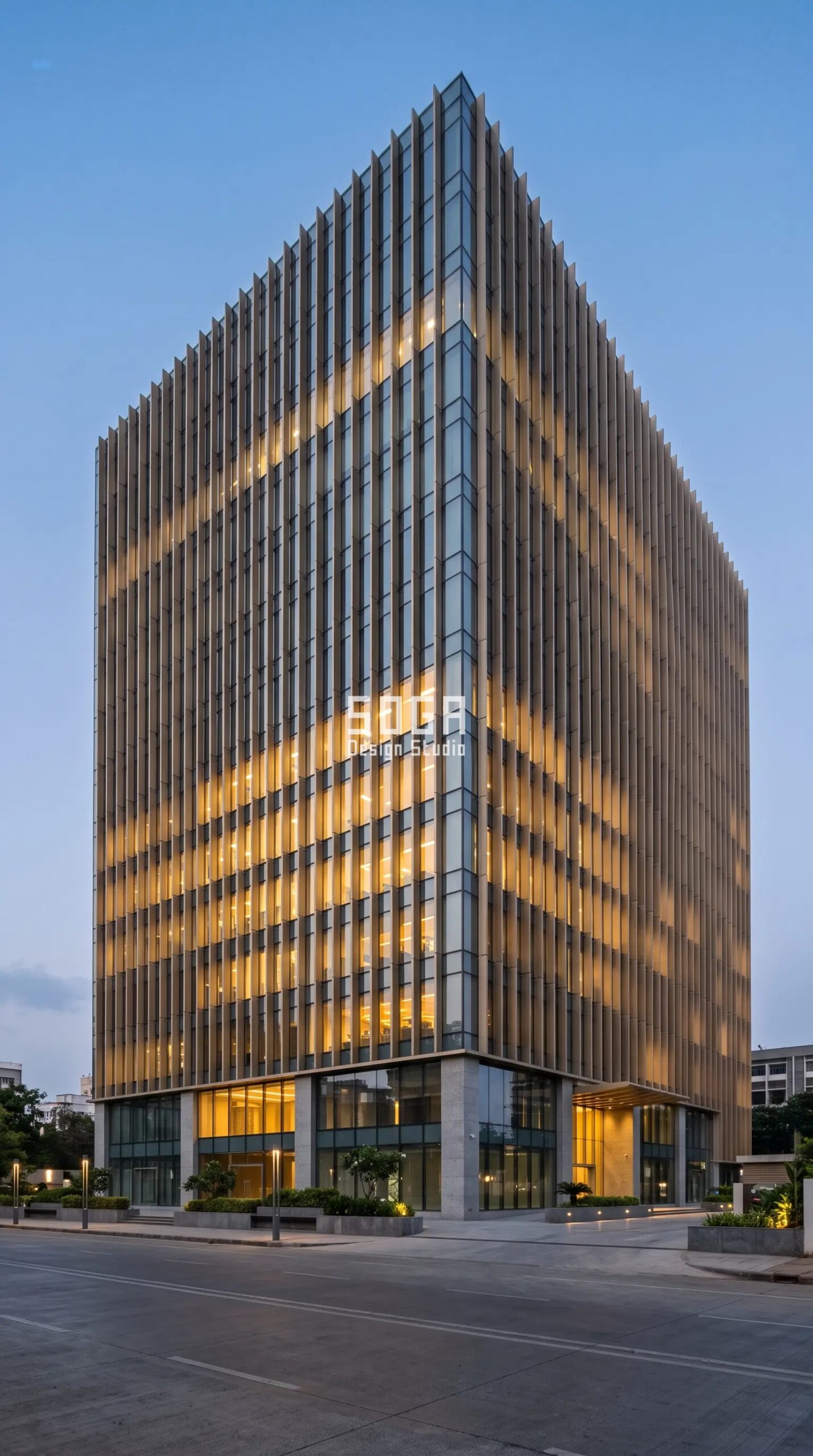
Design seed: Stepped office-tower massing x tall slender vertical fin skin x sun-radiation spacing-and-rotation field x champagne-bronze anodised aluminium fins over fritted glazing x corporate-rhythm brand-gradient identity. This G+14 corporate office tower in Bandra Kurla Complex, Mumbai wears a Parametric Stride Fin skin in champagne-bronze anodised aluminium vertical fins over grey-tint fritted double-glazed curtain wall, stone-and-glass podium. Mumbai’s humid coastal air, monsoon driving rain and hard low west sun are the design load, so the champagne fins tighten and rotate over the south-west glass to cut glare and heat while the ventilated cavity drains and dries the wall behind. The parametric variation is written into the fabrication drawings, not sprayed on afterwards.
How the Parametric Stride Fin is built
| Design parameter | Specification |
|---|---|
| Module | 100 x 300mm extruded champagne-bronze anodised aluminium vertical fin, 3.9m floor-to-floor, unitised curtain wall behind |
| Spacing / rotation driver | South-west solar-radiation attractor sets each fin’s spacing, projection and turn |
| Variation | Fin centre-to-centre spacing widening 450mm to 1350mm; projection 150mm to 420mm; rotation 0 to 25 degrees toward the view corner |
| Density | Densest fins over the south-west glazing, easing open toward the shaded north atrium and entrance |
| Panels + substructure | ~8 unique fin extrusions across ~2,400 fins (<1% unique, extrusion economy) on 150mm unitised brackets |
| Cavity / base | 150mm ventilated rain-screen cavity over the DGU curtain wall; G+14 RCC-and-steel frame, double-height stone-and-glass retail podium |
Material & colour: hero skin in champagne-bronze (RAL 8008 family) fins, grey-tint glass, honed grey granite podium, kept to a restrained palette so the geometry does the talking. Indicative facade cost: Rs 1,800-3,200 per sq ft, fully designed and installed, with an itemised estimate produced per project.
2. Dubai Parametric Facet Veil: A G+5 Retail And Showroom Flagship
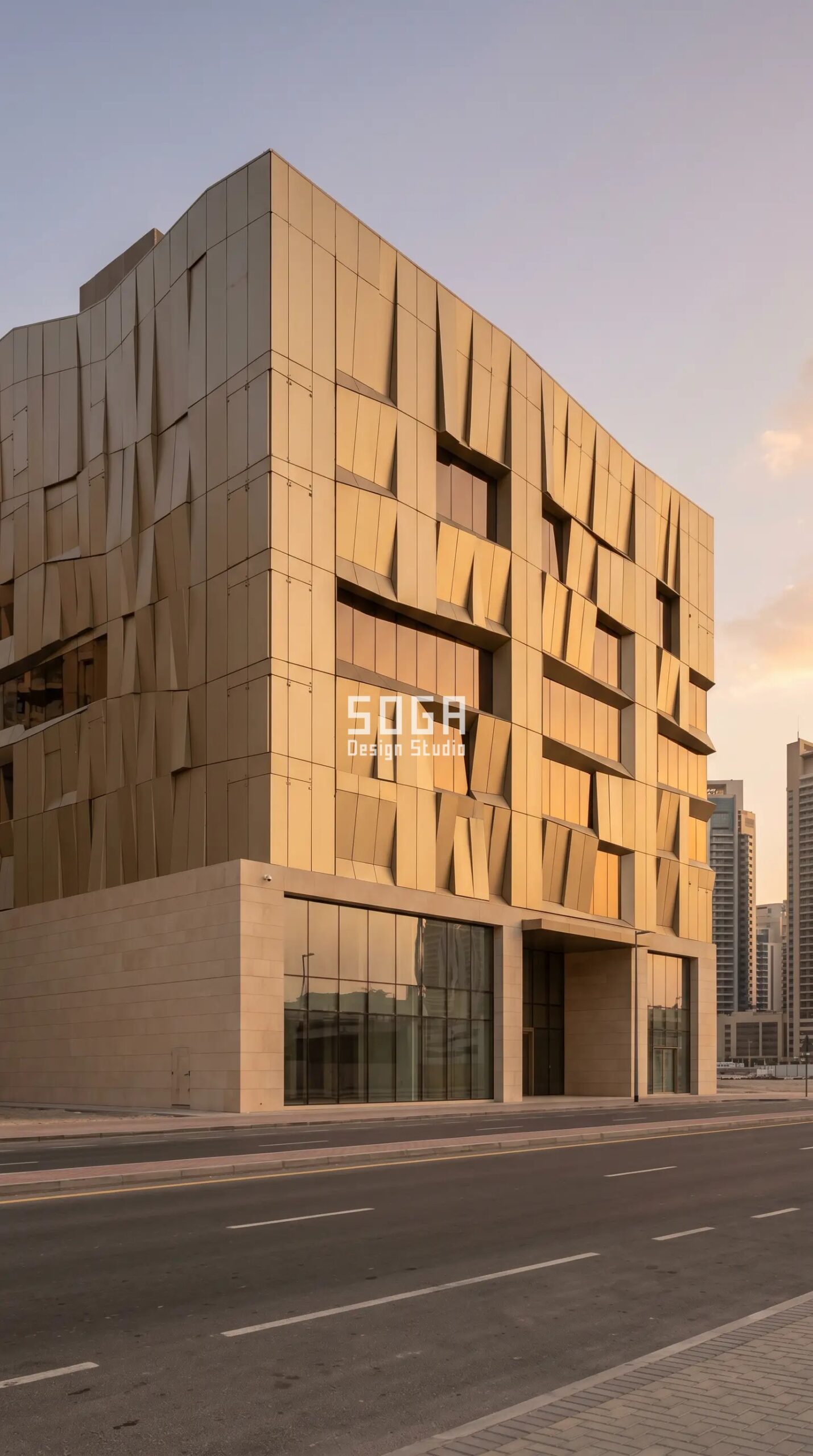
Design seed: Retail-podium massing x folded faceted shade-panel skin x sun-load depth-extrusion and aperture-density operation x champagne-gold anodised aluminium folded panels over bronze-tint glass x illuminated crown identity. This G+5 retail and showroom flagship in Business Bay, Dubai wears a Parametric Facet Veil skin in champagne-gold anodised aluminium folded faceted panels over bronze-tint glazing, honed limestone podium. Dubai’s harsh desert sun, glare and fine dust drive the design, so the champagne-gold folds deepen and close toward the south-west to self-shade the recessed showroom glass and scatter the low glare, needing only an annual rinse in the dusty coastal air. The parametric variation is written into the fabrication drawings, not sprayed on afterwards.
How the Parametric Facet Veil is built
| Design parameter | Specification |
|---|---|
| Module | 1.2 x 2.4m folded faceted champagne-gold anodised aluminium panel, unitised on a 1.2m grid |
| Depth driver | South-west sun-load attractor sets each panel’s fold depth and facet pitch |
| Variation | Fold depth 60mm to 260mm; facet pitch 0 to 26 degrees tilting toward the sun-facing south-west |
| Density | Open aperture easing from 75 percent at the shaded north to 40 percent over the south-west showroom glass |
| Panels + substructure | ~14 unique fold cassettes on a 60×60 SHS unitised frame (<=20% unique) |
| Cavity / base | 180mm ventilated cavity over recessed bronze-tint glazing; G+5 frame, honed limestone retail podium and shaded entrance |
Material & colour: hero skin in champagne-gold anodised aluminium, bronze-tint glass, honed limestone base, kept to a restrained palette so the geometry does the talking. Indicative facade cost: Rs 2,200-4,200 per sq ft, fully designed and installed, with an itemised estimate produced per project.
3. Singapore Parametric Brise Louvre: A G+9 Business-Park Office
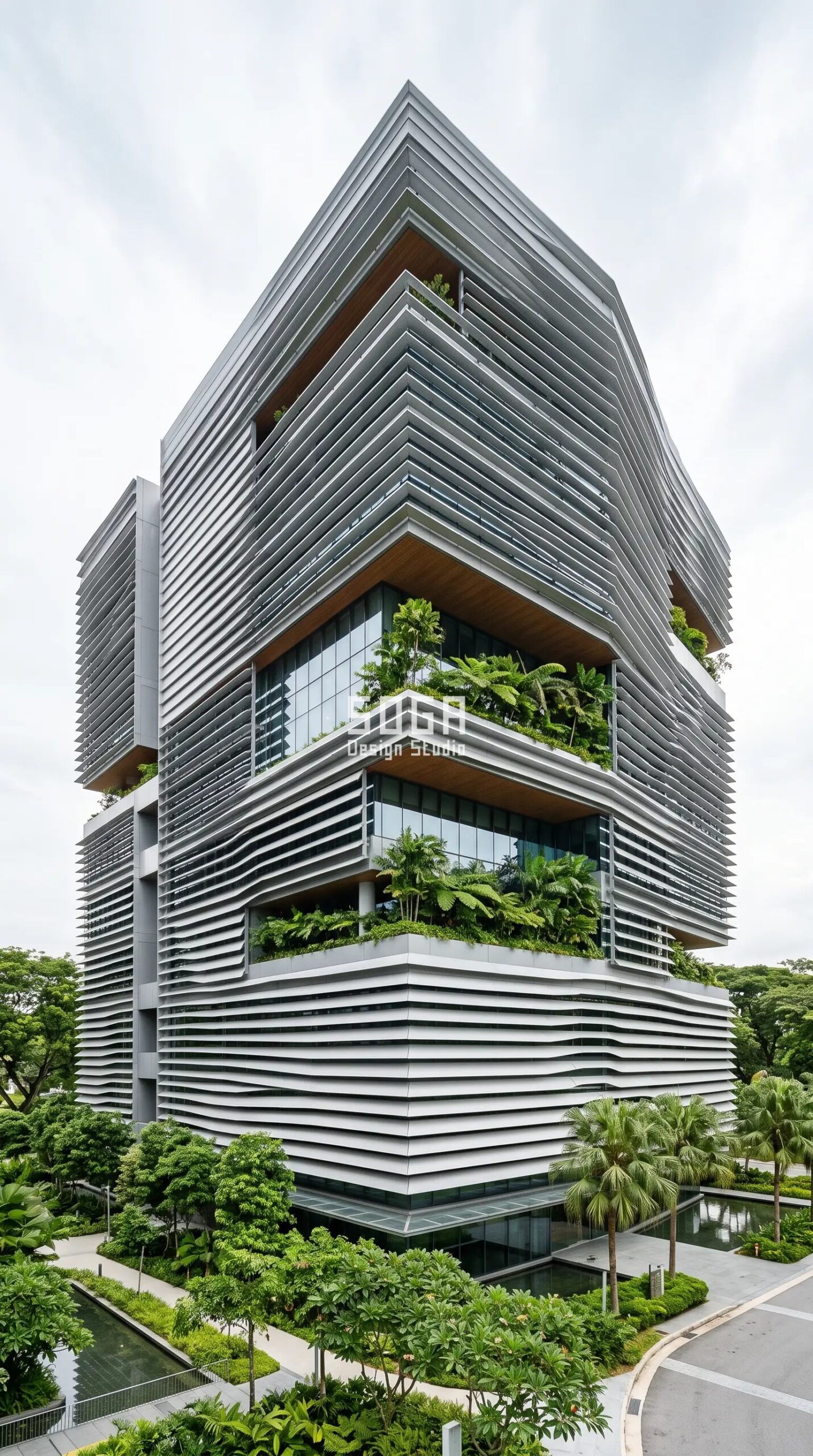
Design seed: Terraced business-park massing x horizontal brise-soleil blade skin x sun-and-rain contour projection operation x silver-grey powder-coated aluminium blades plus timber soffits and sky-terrace biophilia x tropical deep-shade identity. This G+9 business-park office in one-north, Singapore wears a Parametric Brise Louvre skin in silver-grey powder-coated aluminium horizontal brise-soleil blades with timber-finish soffits and planted sky-terraces over high-performance glazing. Tropical Singapore throws high equatorial sun, driving monsoon rain and constant humidity, so the deep silver blades shade the full-height glass and shed rain while the planted sky-terraces cool the air and blur the office into its garden campus. The parametric variation is written into the fabrication drawings, not sprayed on afterwards.
How the Parametric Brise Louvre is built
| Design parameter | Specification |
|---|---|
| Module | Horizontal silver-grey powder-coated aluminium brise-soleil blade, 350mm deep, at a 1.5m vertical rhythm |
| Projection driver | Sun-and-rain contour band sets each blade’s projection and tilt down the elevation |
| Variation | Blade projection easing 300mm to 800mm and tilt 0 to 15 degrees; blade spacing tightening 1.5m to 0.9m over the west sun |
| Density | Deepest blades over the west and upper glazing, shallower at the shaded garden faces; planted sky-terrace bands every three floors |
| Panels + substructure | ~10 unique blade lengths on cantilever brackets off the RCC slab edges (<=20% unique) |
| Cavity / base | Recessed high-performance low-iron glazing behind the blades, timber-finish soffits; G+9 RCC frame, landscaped ground plaza |
Material & colour: hero skin in silver-grey aluminium blades, warm timber-finish soffits, planted terraces, low-iron glass, kept to a restrained palette so the geometry does the talking. Indicative facade cost: Rs 2,000-3,800 per sq ft, fully designed and installed, with an itemised estimate produced per project.
4. Abu Dhabi Parametric Scallop Shell: A G+9 Boutique Hotel And Hospitality
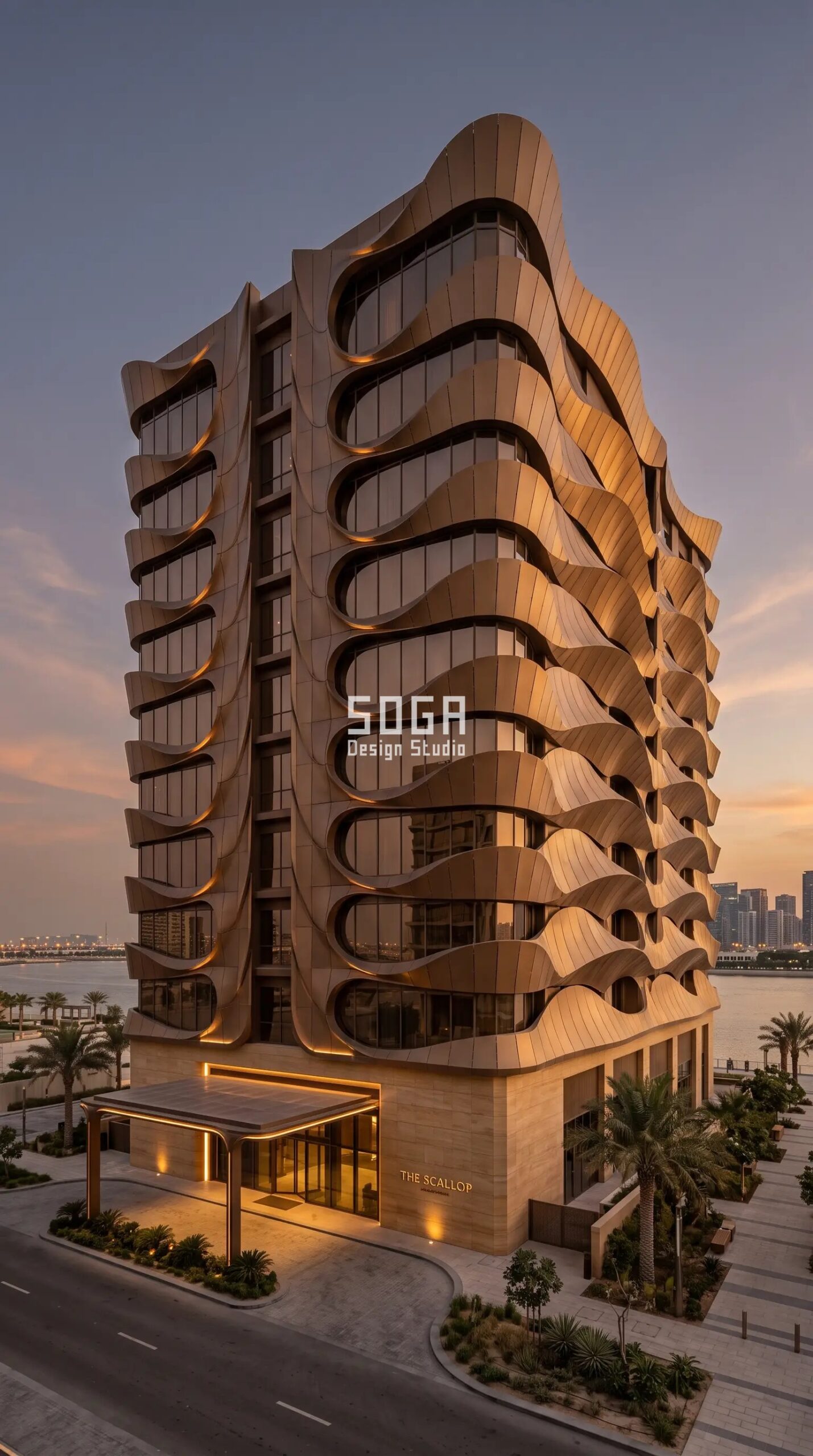
Design seed: Sculpted hospitality massing x undulating scalloped metal shell skin x sun-and-view amplitude-and-depth operation x warm-bronze anodised aluminium scallops over honey travertine x soft-glow crown identity. This G+9 boutique hotel and hospitality in Al Maryah Island, Abu Dhabi wears a Parametric Scallop Shell skin in warm-bronze anodised aluminium undulating scalloped shell panels over honey travertine base, bronze-tint glazing. Abu Dhabi pairs harsh Gulf sun and glare with coastal salt air, so the bronze scallops deepen toward the south-west to self-shade the guest-room glass and soften the desert light, while marine-grade anodising keeps maintenance to an annual rinse. The parametric variation is written into the fabrication drawings, not sprayed on afterwards.
How the Parametric Scallop Shell is built
| Design parameter | Specification |
|---|---|
| Module | 1.5m-wide undulating scalloped warm-bronze anodised aluminium shell panel, one per structural bay, 4.0m floor-to-floor |
| Amplitude driver | Sun-and-sea-view attractor sets each scallop’s wave amplitude and depth |
| Variation | Scallop wave amplitude 150mm to 600mm; panel depth 80mm to 300mm deepening toward the south-west sun |
| Density | Deepest scallops shade the south-west guest rooms, flattening toward the shaded northern sea-view rooms |
| Panels + substructure | ~12 unique scallop cassettes on a 60×60 SHS grid off the RCC frame (<=20% unique) |
| Cavity / base | Bronze-tint glazing recessed behind the shell; G+9 RCC frame, honey travertine plinth and shaded entrance canopy |
Material & colour: hero skin in warm bronze (RAL 8004 family) scalloped shell, honey travertine base, bronze-tint glass, kept to a restrained palette so the geometry does the talking. Indicative facade cost: Rs 2,100-4,000 per sq ft, fully designed and installed, with an itemised estimate produced per project.
Commercial Facade Cost in India and the Gulf (2026)
Commercial facade budgets vary widely by system, material, height and market. The ranges below are indicative 2026 rates for the full designed-and-installed facade; the Gulf and Singapore markets carry a premium over Indian metros for logistics, marine-grade finishes, high-rise access and fire compliance. Every SOGA project is priced with an itemised estimate rather than a rule of thumb.
| System / material | Indicative rate (per sq ft) |
|---|---|
| Parametric aluminium fin / louvre facade (design + install) | Rs 1,800-3,500 per sq ft |
| Folded faceted anodised aluminium panel system | Rs 2,000-4,200 per sq ft |
| Undulating scalloped metal shell system | Rs 2,100-4,000 per sq ft |
| Unitised high-performance glass curtain wall | Rs 1,400-2,800 per sq ft |
| Solid / anodised aluminium panels | Rs 800-1,800 per sq ft |
| ACM / ACP cladding (4mm, FR-grade) | Rs 250-350 per sq ft |
| Installation (height and access) | Rs 80-200 per sq ft |
Why These Are Buildable Commercial Facades, Not Just Renders
Every concept on this page is drawn as a real construction system, not a styling exercise. SOGA Design Studio develops each commercial facade from a rationalised panel set: a limited family of unique cassettes or fin extrusions — typically under 20 percent of all parts are one-off, and for extruded fins under one percent — repeated across a clear structural grid, so the parametric variation is achieved through fabrication data rather than hand-shaping. The studio details the unitised aluminium sub-frame, slab-edge brackets, ventilated rain-screen cavity, per-floor cavity fire barriers to post-Grenfell norms, thermal breaks and the right marine-grade or composite finish for each climate, and works with vetted aluminium and steel fabricators to keep lead time and transport cost controlled. Every module is sized for a crane lift and unitised install, every unique cut is nested on standard sheet sizes, and BMU or cradle maintenance access is planned into the crown. That is what separates a facade that photographs well from one that can actually be built, warrantied, fire-certified and maintained on a commercial building.
Related Reading
- Shopping Mall Facade Design: colonnade spans and cost bands across 5 cities
- Parametric facade design in India — the engineering guide
- How parametric metal facades are detailed and costed
- How to write a commercial facade tender BOQ that can be levelled
- Boutique Resort Wind Tower Facade Design: 5 UAE Concepts
Frequently Asked Questions
How much does a commercial facade cost in India in 2026?
A designed-and-installed parametric aluminium fin or louvre commercial facade in India runs about Rs 1,800 to Rs 3,500 per sq ft, a folded faceted anodised aluminium panel system Rs 2,000 to Rs 4,200, and an undulating scalloped metal shell Rs 2,100 to Rs 4,000. A unitised high-performance glass curtain wall runs Rs 1,400 to Rs 2,800, and FR-grade ACM cladding Rs 250 to Rs 350 per sq ft, with installation adding Rs 80 to Rs 200 depending on height and access. SOGA Design Studio provides an itemised estimate for every project.
What is the best facade material for a commercial building in Dubai and the UAE?
For Gulf commercial buildings the priority is self-shading, glare control and salt resistance. Marine-grade anodised aluminium in champagne, bronze and gold tones performs best: it shades the glass, scatters the harsh desert glare, resists coastal salt and dust, and needs only an annual rinse. SOGA tunes the panel depth, fold and density to each elevation’s sun load rather than wrapping the building in one uniform skin, so the south-west face is heavily shaded while the north stays open and bright.
How much heat can a parametric metal facade reduce on a commercial building?
A well-detailed parametric metal facade reduces direct solar heat gain by roughly 25 to 40 percent on the west and south elevations and drops interior surface temperatures by four to seven degrees compared with a bare glass curtain wall, which directly lowers the air-conditioning load and running cost. The shaded ventilated cavity also improves the envelope U-value and supports green-rating targets such as ECBC, LEED and Green Mark, an increasingly common requirement for commercial leasing across India, the UAE and Singapore.
Can SOGA design a commercial facade remotely for developers in Singapore or the Gulf?
Yes. SOGA Design Studio runs end-to-end remote commissions for developers and corporate clients in Dubai, Abu Dhabi, Singapore and the UK — site and solar analysis, concept design, fabrication-ready drawings, fire and code coordination and site supervision are delivered virtually, coordinated with a vetted local facade contractor and installer in the project city.
How long does a commercial parametric facade take from design to installation?
For a mid-rise commercial building, expect roughly 4 weeks for concept and approval, 5 to 6 weeks for fabrication-ready drawings and unitised shop drawings, 8 to 12 weeks for fabrication, and 6 to 10 weeks for installation — around 24 to 32 weeks in total, depending on height, unitised versus stick-built system, access and market. A retrofit metal screen over an existing commercial facade compresses this timeline because no new primary structure is needed.
Design Your Commercial Facade with SOGA Design Studio
SOGA Design Studio designs parametric metal facades for offices, retail, showrooms, hospitality and mixed-use buildings across India, Dubai, the UAE, Singapore and the UK. If you are planning a commercial building and want a facade that controls heat, meets fire and green-rating codes and builds lasting brand identity, email [email protected] for a concept consultation, or start with our guide to parametric facade design in India.