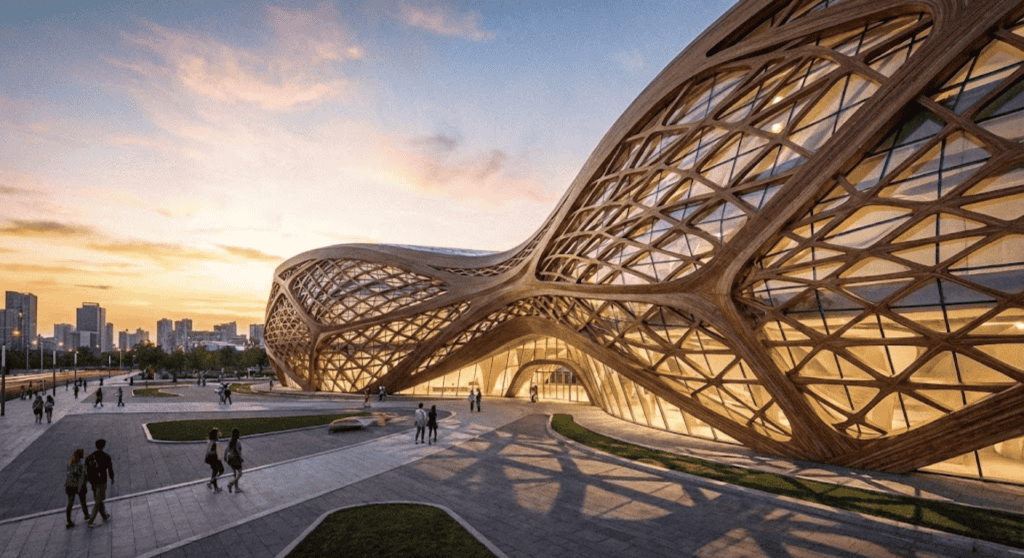
[‘Fluidic architecture apartment design means a residential apartment building whose balcony edges and skin are drawn as continuous flowing curves rather than straight lines. In India the cost of that look is not set by how curved it is. It is set by how many unique panels the curve needs – because an apartment block repeats the same floor plate eight, twelve or twenty times, and a curve that repeats with it is cheap while a curve that changes every floor is not.’, ‘That is the whole argument of this article, and it is the one thing most flowing-facade proposals get wrong. A drawing that looks effortless can carry ninety different panel geometries. A drawing that looks almost identical can carry three. From the street they read the same. On the bill of quantities they are different buildings.’, ‘So the rule SOGA Design Studio works to is blunt: repeat the mould, not the curve. Below are five apartment concepts across five Indian cities, each buying the flowing line a different way and at a different price – from one GFRC mould cast sixty-four times, down to a building where nothing curves except the balustrade.’]
All five buildings below are SOGA Design Studio concept designs, visualised for this article. They are not photographs of completed projects and are not presented as built work.
Why a Flowing Apartment Facade Is Priced by Panel Count, Not by Curve
[‘A facade panel is expensive the first time and cheap every time after. Most of the money in a curved GFRC or UHPC panel sits in the mould – pattern-making, the GRP tool itself, the trial cast and the sign-off. Once that tool exists, each additional cast costs a fraction of the first. So the real question on an apartment building is never how curved is it. It is how many times can we cast the same tool.’, ‘Run the arithmetic on a G+7 block. A single curved GFRC mould costs roughly Rs 55,000 to 90,000. Cast it 64 times – eight segments across eight identical floors – and the tooling adds under Rs 1,400 to each panel. Give every floor its own curve instead and you need eight moulds for the same 64 panels, and the tooling alone lands somewhere between Rs 4.4 and 7.2 lakh. Same elevation area. Same apparent flow. Roughly eight times the tooling bill.’, ‘This is also why single curvature does most of the work in the concepts below. A surface that bends one way – in plan, like a ribbon lying flat – can be pulled off a simple mould or rolled from flat stock. A surface that bends two ways at once, like a saddle or a dome, cannot: it needs its own dedicated tool per panel, or hand-forming. Double curvature is not forbidden. It is just expensive enough that it belongs in one place, as a feature, and not spread across an entire elevation. Exactly one of the five concepts below uses it, and only at a corner.’, ‘There is one more constraint that is specific to apartments and absent from villas: saleable area. Curving a slab edge changes the carpet area of the flat above and below it, which changes the sanctioned plan, the sale agreement and the approval. Curving only the skin or only the balustrade changes nothing that gets sold. On a builder-funded project that difference decides the scheme more often than aesthetics does.’]
1. Thane: SOGA Fluidic Band Fluidic Apartment Concept
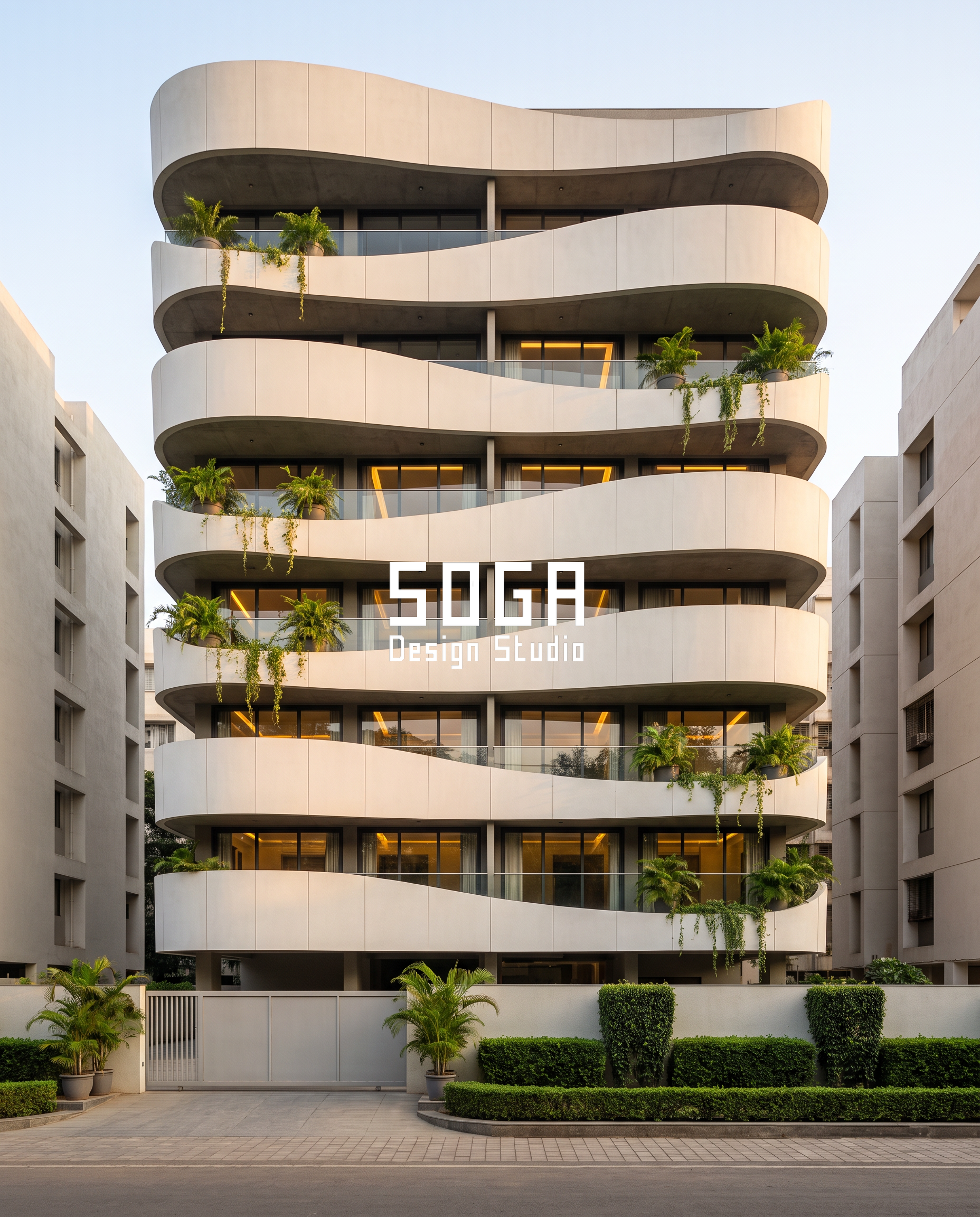
Design seed: a 22 m frontage that has to repeat identically eight times without repeating visually. This G+7 residential apartment building in Ghodbunder Road, Thane wears a SOGA Fluidic Band skin in glass-fibre reinforced concrete (GFRC), 15 mm shell on a hot-dip galvanised steel frame. Thane’s wind-driven monsoon decides the detail before the curve does: every band is cast with a drip groove on its underside and a 12 mm open joint at every segment, so water leaves the panel face instead of tracking back along the curve into the joint behind it. The parametric variation is written into the fabrication drawings, not sprayed on afterwards.
How the SOGA Fluidic Band is built
| Design parameter | Specification |
|---|---|
| Plot frontage / width | 22 m, a standard Ghodbunder Road apartment plot |
| Building height | G+7, about 24 m to the terrace |
| Curvature class | SINGLE curvature only – the band bends in plan, never in section |
| Unique panel types | 3 (a swell, a draw-back and a handed pair) for the whole building |
| Moulds required | 3 GRP moulds, each cast 64 times across 8 floors |
| Segments per floor | 8 curved segments, each about 2.7 m long |
| Mould amortisation | Rs 55,000-90,000 per mould, spread over 64 casts = under Rs 1,400 a cast |
| Why this is the cheap one | Panel count, not curve depth, drives price. One curve reused 64 times is the least expensive flowing facade in this article. |
Material & colour: hero skin in off-white sandblasted GFRC against dark grey glazing, kept to a restrained palette so the geometry does the talking. Indicative facade cost: Rs 1,450-2,400 per sq ft, fully designed and installed, with an itemised estimate produced per project.
2. Visakhapatnam: SOGA Fluidic Ribbon Fluidic Apartment Concept
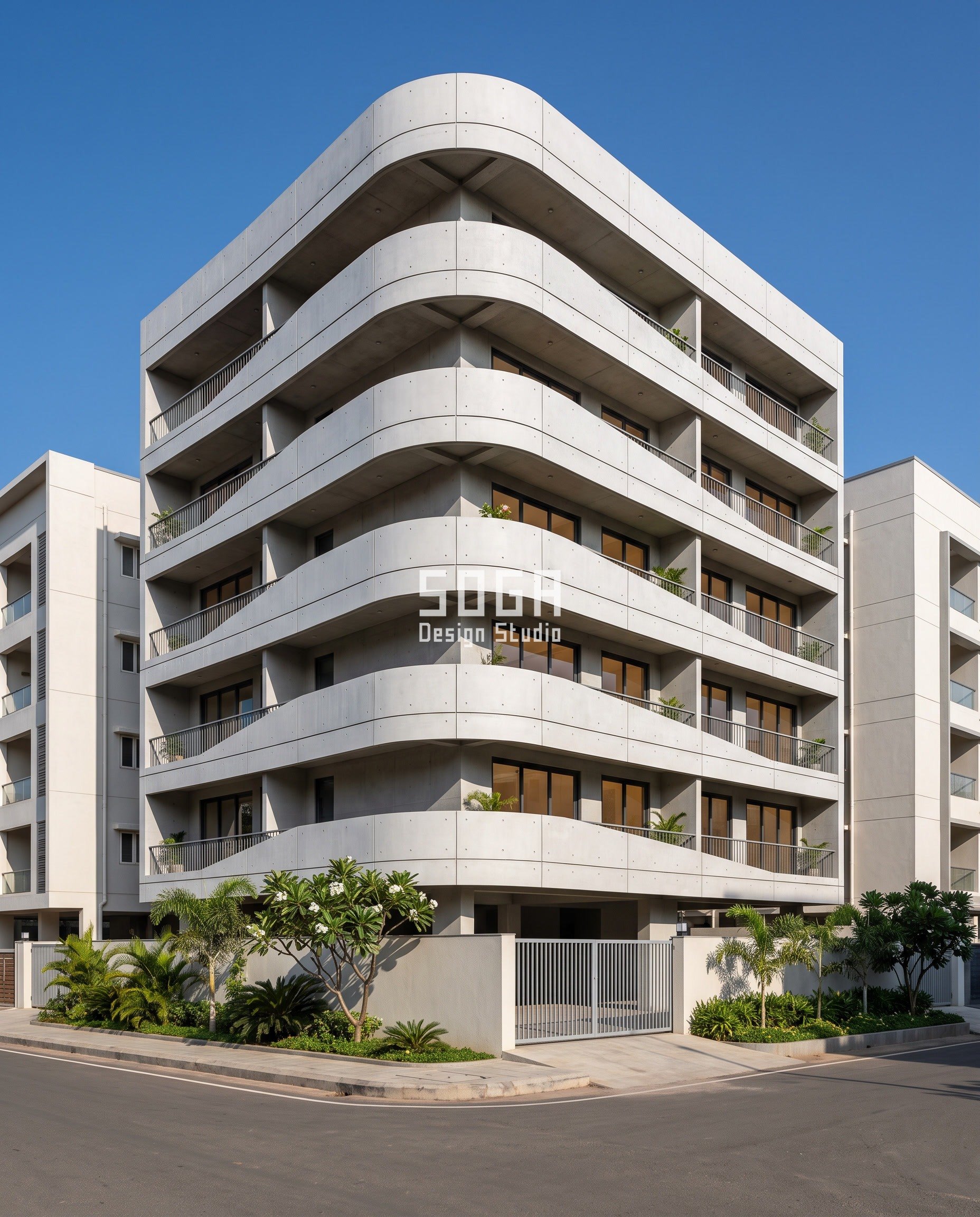
Design seed: a sea-facing block where the flowing line has to survive chloride air. This G+5 residential apartment building in Beach Road, Visakhapatnam wears a SOGA Fluidic Ribbon skin in ultra-high performance concrete (UHPC), 25 mm ribbon section, stainless fixings. Coastal chloride is the reason this one is UHPC and not ordinary GFRC. The mix is dense enough to run a 25 mm edge with a 40 mm cover-free stainless fixing, and every ribbon is drained forward so salt-laden water never sits in a return. The parametric variation is written into the fabrication drawings, not sprayed on afterwards.
How the SOGA Fluidic Ribbon is built
| Design parameter | Specification |
|---|---|
| Plot frontage / width | 18 m, a Beach Road sea-facing plot |
| Building height | G+5, about 18 m to the terrace |
| Curvature class | SINGLE curvature, one profile, shifted in plan floor by floor |
| Unique panel types | 1 profile – the SAME section on all six levels, only its position moves |
| Moulds required | 1 extrusion-style mould, 6 pours |
| Shift per floor | 600 mm sideways, always the same direction, so the drift reads as deliberate |
| Why it looks more complex than it costs | Offsetting one identical profile is free. Changing the profile is what costs money, so the profile never changes. |
| Trade-off | UHPC is the priciest material here; the geometry is the cheapest. They cancel out. |
Material & colour: hero skin in pale grey UHPC with dark bronze glazing, kept to a restrained palette so the geometry does the talking. Indicative facade cost: Rs 2,000-3,200 per sq ft, fully designed and installed, with an itemised estimate produced per project.
3. Vadodara: SOGA Fluidic Shell Fluidic Apartment Concept
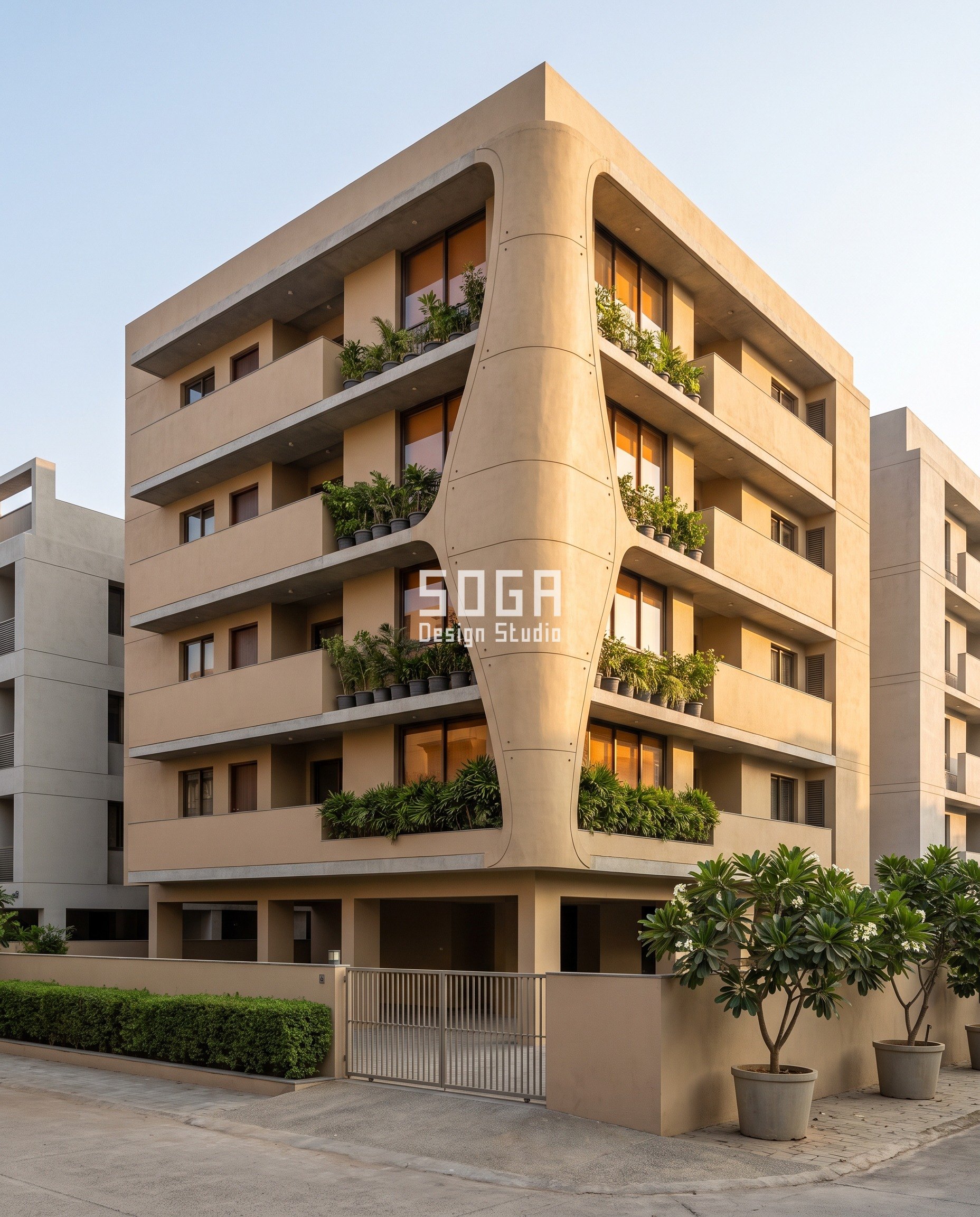
Design seed: spend the whole curvature budget in one place instead of spreading it thin. This G+4 residential apartment building in Alkapuri, Vadodara wears a SOGA Fluidic Shell skin in ferrocement, hand-trowelled over a welded mesh armature, 35 mm average thickness. Vadodara’s hot-dry summers make a deep shaded corner worth more than a shallow one everywhere. The shell is deepest at mid-height where the west sun hits the corner flats hardest. The parametric variation is written into the fabrication drawings, not sprayed on afterwards.
How the SOGA Fluidic Shell is built
| Design parameter | Specification |
|---|---|
| Plot frontage / width | 16 m corner plot |
| Building height | G+4, about 15 m to the terrace |
| Curvature class | DOUBLE curvature – the only one in this article, and deliberately so |
| Unique panel types | Not panelised at all – one continuous hand-formed shell |
| Moulds required | 0. Ferrocement is formed on site over an armature, which is why double curvature is affordable here and nowhere else |
| Extent | Corner only, roughly 14 percent of the elevation area |
| Why it is restricted to the corner | Hand-forming is priced by surface area and skilled labour days. As a feature it is affordable; as a whole-building skin it is not. |
| The honest limit | Ferrocement is NOT a cheap material. At Rs 1,500-2,500 per sq ft it sits above most metal rainscreens – it buys geometry, not savings. |
Material & colour: hero skin in warm sand-coloured ferrocement against a plain off-white rendered body, kept to a restrained palette so the geometry does the talking. Indicative facade cost: Rs 1,500-2,500 per sq ft (shell area only), fully designed and installed, with an itemised estimate produced per project.
4. Mysuru: SOGA Fluidic Fold Fluidic Apartment Concept
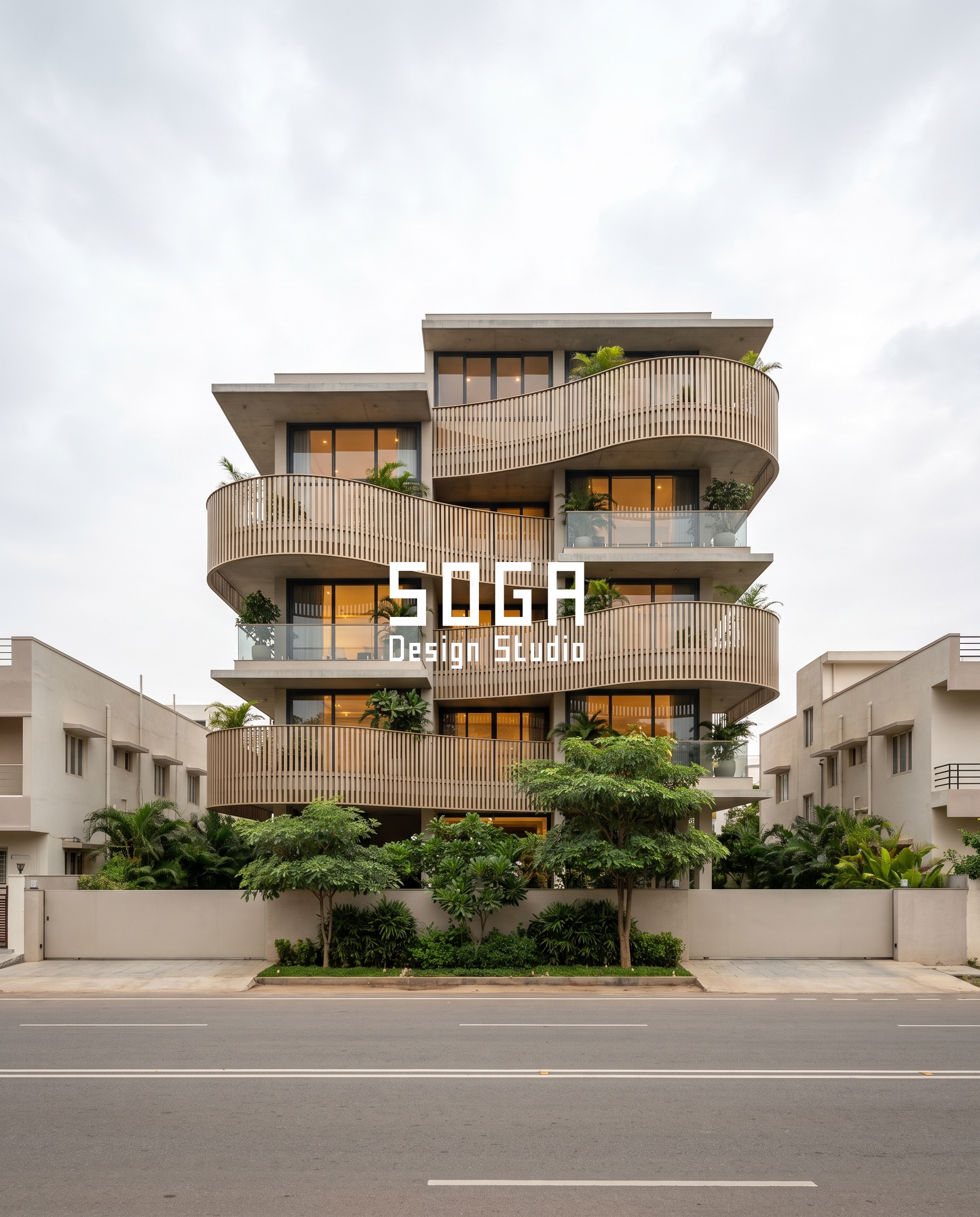
Design seed: get a curve without paying for a single curved component. This G+3 residential apartment building in Vijayanagar, Mysuru wears a SOGA Fluidic Fold skin in roll-formed aluminium members, 50 x 100 mm, on curved hot-dip galvanised rails. Mysuru’s temperate climate lets the members sit open with wide gaps for air, so the rail carries the line and the members carry nothing but their own weight and wind. The parametric variation is written into the fabrication drawings, not sprayed on afterwards.
How the SOGA Fluidic Fold is built
| Design parameter | Specification |
|---|---|
| Plot frontage / width | 20 m |
| Building height | G+3, about 12 m to the terrace |
| Curvature class | NONE in the members – curvature exists only in the rail |
| Unique panel types | 1 member, cut to 34 different lengths |
| Bent members | Zero. Every member is straight stock, which is why this is the lowest-risk build |
| Members per floor | 30 vertical members, each about as wide as two fingers and a storey tall |
| Where the curve actually lives | In two curved rails per floor, top and bottom. Bending a rail is a shop operation; bending 120 members is a fabrication programme. |
| Why builders like this one | It tolerates site error. A straight member on a curved rail absorbs setting-out slop that a moulded panel would reveal. |
Material & colour: hero skin in warm champagne anodised aluminium against pale grey render, kept to a restrained palette so the geometry does the talking. Indicative facade cost: Rs 1,100-2,300 per sq ft, fully designed and installed, with an itemised estimate produced per project.
5. Bhubaneswar: SOGA Fluidic Rail Fluidic Apartment Concept
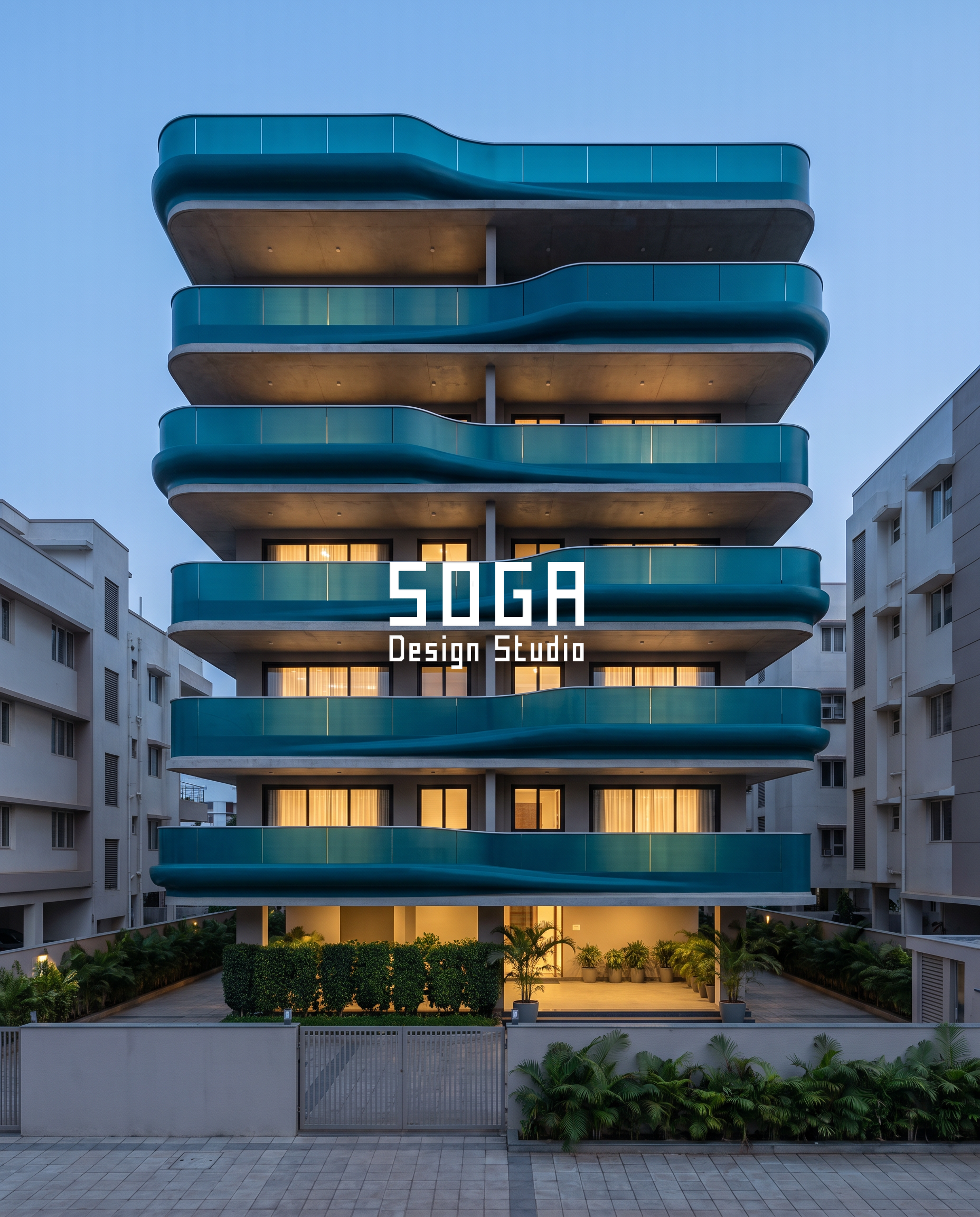
Design seed: the cheapest honest way to buy the flowing look on a builder budget. This G+6 residential apartment building in Patia, Bhubaneswar wears a SOGA Fluidic Rail skin in glass-fibre reinforced polymer (GRP) balustrade sections, 8 mm satin gelcoat shell. Bhubaneswar’s cyclone-season gusts are the reason the balustrade is GRP on a steel core rather than a pure composite: the core takes the design wind load and the GRP only makes the shape. The parametric variation is written into the fabrication drawings, not sprayed on afterwards.
How the SOGA Fluidic Rail is built
| Design parameter | Specification |
|---|---|
| Plot frontage / width | 19 m |
| Building height | G+6, about 21 m to the terrace |
| Curvature class | SINGLE curvature, balustrade only |
| Unique panel types | 2 (a swell and a return), repeated on all seven floors |
| What stays orthogonal | Every slab, every beam, every column – the structure is a normal RCC frame |
| Why this matters on an apartment | Curving the slab changes the carpet area of every flat above and below it. Curving only the balustrade changes nothing that gets sold. |
| Approval friction | Lowest of the five. Nothing structural moves, so the sanctioned plan does not |
| The trade | It reads as flowing from the street and flat from inside the flat. That is the deal. |
Material & colour: hero skin in deep teal GRP against off-white render, kept to a restrained palette so the geometry does the talking. Indicative facade cost: Rs 850-1,600 per sq ft (balustrade run, not full elevation), fully designed and installed, with an itemised estimate produced per project.
What Fluidic Apartment Facades Cost in India (2026)
Rates are indicative, supply and fix, for the facade system only – they exclude the RCC frame, glazing and internal finishes. The column that actually matters is the last one: how many unique panel types the geometry demands. Everything else follows from it.
| System / material | Indicative rate |
|---|---|
| SOGA Fluidic Band, Thane – GFRC, 15 mm shell | Rs 1,450 – 2,400 per sq ft – 3 unique panel types |
| SOGA Fluidic Ribbon, Visakhapatnam – UHPC, 25 mm section | Rs 2,000 – 3,200 per sq ft – 1 unique profile |
| SOGA Fluidic Shell, Vadodara – ferrocement, hand-formed | Rs 1,500 – 2,500 per sq ft – no mould at all |
| SOGA Fluidic Fold, Mysuru – roll-formed aluminium | Rs 1,100 – 2,300 per sq ft – 1 member in 34 lengths |
| SOGA Fluidic Rail, Bhubaneswar – GRP on a steel core | Rs 850 – 1,600 per sq ft – 2 unique panel types |
| Curved GRP mould, tooling, one-off | Rs 55,000 – 90,000 each, amortised across every cast taken from it |
| The same geometry with one curve per floor | Rs 4.4 – 7.2 lakh of tooling on a G+7 – eight moulds instead of three |
How These Curves Are Set Out, Drained and Kept Buildable
[‘Setting out is where flowing facades fail on site. A curve has no obvious dimension to measure from, so SOGA sets every one of these systems out from a chord and offset table against the straight structural grid line, at 300 mm intervals – not from the curve itself. The frame stays orthogonal and the curve is dimensioned off it. That way a surveyor with a tape and a level can check the work, and a 10 mm slab tolerance does not propagate along the whole sweep.’, ‘Drainage is the second failure. Water runs along a curve to its low point and stops there, so every curved band carries a drip groove on its underside and an open joint at each segment end, and the low point of every sweep is deliberately placed over an open joint rather than over a panel face. Without that, the low point becomes the streak the owner photographs in year two.’, ‘Movement is the third. GFRC and UHPC move with temperature, so every segment gets one fixed pin and slotted holes everywhere else, with a nylon sleeve in each slot. A curved panel pinned rigidly at both ends does not crack politely – it cracks at the crown, in the most visible place on the building.’]
Related Reading
- https://sogadesignstudio.com/parametric-facade-design-india/
- https://sogadesignstudio.com/parametric-facade-design-in-india-trends-systems-whats-buildable-in-2026/
- https://sogadesignstudio.com/double-curvature-facade-design-india/
- https://sogadesignstudio.com/fluid-concrete-facade-design-india-2026/
- https://sogadesignstudio.com/apartment-facade-design-india-dubai-singapore-uae-2026/
- https://sogadesignstudio.com/ferrocement-facade-design-india-2026/
Frequently Asked Questions
What is fluidic architecture in an apartment building?
It is an apartment building whose balcony edges and skin are drawn as continuous flowing curves instead of straight lines. In practice the defining number is not the curve radius but the count of unique panel types: the five concepts here range from 3 unique panels down to 1, and that single figure moves the facade rate between roughly Rs 850 and Rs 3,200 per sq ft.
Does a curved facade cost more than a straight one in India?
Yes, but far less than most people expect if the curve repeats. A single-curvature GFRC band reused across eight identical floors runs about Rs 1,450 to 2,400 per sq ft against roughly Rs 900 to 1,500 for a flat panel of the same material. Give every floor its own curve and the tooling alone adds Rs 4.4 to 7.2 lakh on a G+7 before a single panel is cast.
Will a flowing balcony reduce the carpet area of my flat?
It does if you curve the slab, and that is the version to avoid on an apartment. Curving the slab edge changes carpet area above and below, which reopens the sanctioned plan and the sale agreement. Four of the five concepts here curve only the skin or the balustrade, leaving every slab orthogonal and every sold area untouched.
Can double curvature be built affordably in India?
In one place, not everywhere. Hand-formed ferrocement over a mesh armature needs no mould at all, which is why the Vadodara corner shell is viable at Rs 1,500 to 2,500 per sq ft over about 14 percent of the elevation. Spread that same technique across a whole building and it becomes a labour-day problem rather than a design one.
What is the cheapest way to get a flowing look on an apartment building?
Curve only the balustrade and leave the structure alone, as in the Bhubaneswar concept at roughly Rs 850 to 1,600 per sq ft of balustrade run. It reads as flowing from the street, needs 2 unique panel types across 7 floors, and because nothing structural moves it carries the least approval friction of the five.
Design a Fluidic Apartment Facade That Costs What You Expect
Send us the sanctioned plan and the floor count and SOGA Design Studio will tell you, before anything is drawn, how many unique panels a given flowing line would need and what that does to the rate. If the answer is too many, we will show you which of these five strategies gets the same read for less. All five systems above are concept designs, not built work.