We check every elevation panel in India against a 47 m/s design gust and not one of them against the 12 m/s breeze the owner will actually phone about. Read the direction of this page before you go further: here the facade is the SOURCE of the noise, not the barrier against it. Keeping road noise out of a bedroom is a mass-and-glazing problem with its own answer — that one lives in reducing road noise coming into a house facade, and none of it is on this page.
Wind-induced facade noise is sound produced by the cladding itself rather than transmitted through it. It is generated when air separating over a panel edge or member sheds vortices at an audible frequency and the panel resonates in response.
Elevation panels make noise in wind for one reason: somewhere the panel is thin, flat and free at an edge. Wind sheds vortices off that edge at a frequency set by its depth, and the loose sheet resonates with them. The fix is section depth, not a tighter screw.
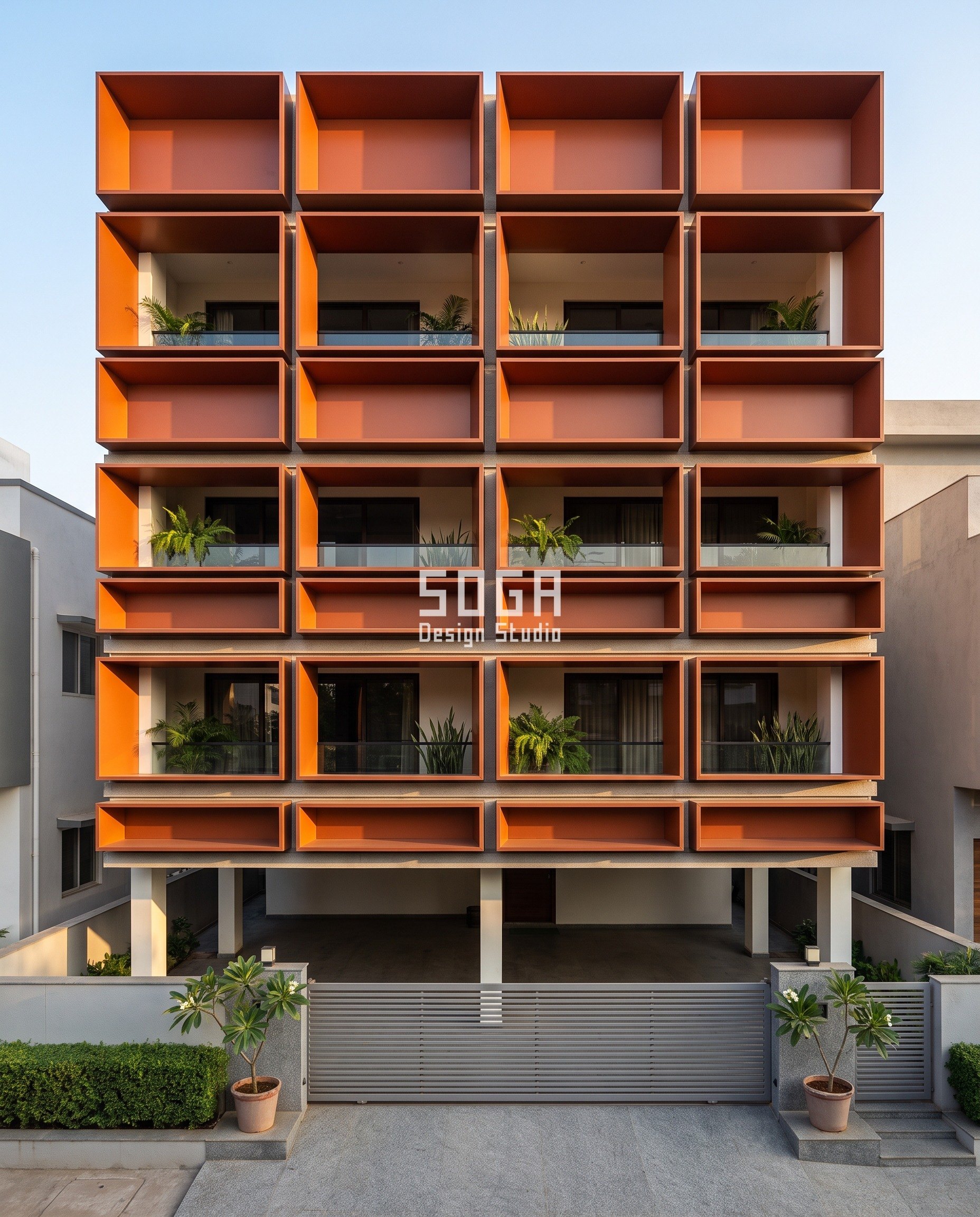
Is The Wind-Load Check Wrong? No, It Answers A Different Question
The wind-load check is right and we run it on every job. IS 875 (Part 3):2015 sets six basic wind speeds — 33, 39, 44, 47, 50 and 55 m/s, each a three-second gust at 10 m in Terrain Category 2 on a 50-year return — and that one number sizes the bracket, the anchor and the sheet. It is also brutally conservative for this purpose. At 47 m/s against a 12 m/s nuisance wind the dynamic pressure ratio is (47/12)², about 15 to 1: the industry designs for fifteen times the load that generates the complaint. Concede the cheap tier too: a loose fastener or a perished EPDM gasket will rattle, and on a five-year-old facade that is the first thing to check and often the only thing wrong. The trade half-knows the rest, too — it calls the waviness in a flat sheet oil canning and files it as cosmetic, not a defect. Same unstiffened sheet. The noise is the other half of that bill.
What A Kerala Charupady Knew About Wind Noise
Stand on the poomukham of an old Kerala nalukettu and look at the charupady — the built-in teak bench that runs along the open front porch. A seat plank on short posts, and behind it a raked backrest built up from horizontal teak reapers set with deliberate air gaps. It stands fully exposed on the windward face, and it is silent. Not one member in it is thin, flat or free at an edge. Every reaper is a thick short piece held at both ends, and the whole backrest is raked out of the wind’s plane instead of standing flat in it, so a monsoon squall crossing that porch finds nothing to excite. The thachan was solving air and light. Section depth handed him the silence for free, four hundred years before anyone wrote a Strouhal number down.
The Rule: Detune The Panel, Don’t Tighten It
Pressure is not what makes noise. Frequency is, and there is no frequency anywhere in the wind-load check. It never asks what the panel’s first mode is, and it never asks at what rate the panel’s own edges shed vortices. A flat 3 mm 5052-H32 aluminium sheet spanning 900 mm between rails has a first mode at 8.6 Hz, inside the band where gust energy is strongest, so it passes every load case you can write and booms in every pre-monsoon squall. Detune the panel, don’t tighten it. You change the note by changing the section, and depth is the only lever that moves both frequencies at once — which is why every number here is argued in Hz or in second moment of area, never in how the elevation looks.
What Are The Four Noises An Elevation Panel Makes In Wind?
Facade wind noise comes in four distinct forms. Drumming is a low boom from an unstiffened flat sheet. Edge flutter is a papery buzz from a free lapped edge. Aeolian whistle is a steady tone from vortices shedding off a bluff member. Thermal tick is a single irregular crack from an over-constrained fixing, and is not wind at all.
Diagnose by when it happens before you diagnose by what it sounds like. Anything arriving at sunrise and sunset on a still evening is the fourth row, and no amount of re-cladding will touch it.
| The noise | When it happens, the member at fault, and the quantity that ends it |
|---|---|
| Drumming — a low booming thud | In gusts. At fault: an unstiffened flat sheet spanning 900 mm or more. Fixed by return depth — a 45 mm return lifts the first mode from 8.6 Hz to about 75 Hz. |
| Edge flutter — a rapid papery buzz | In steady wind, not gusts. At fault: a free lapped edge lying flat in the flow. Fixed by cant angle — 13 degrees on a 100 mm lap lifts the leading arris 22.5 mm clear. |
| Aeolian whistle — a steady tone that rises in pitch with wind speed | In a narrow band, usually 10 to 18 m/s. At fault: a bluff member shedding vortices off its own edge. Fixed by depth or by blade angle — a 25 mm blade sheds at 120 Hz at 15 m/s, the same blade turned to present 300 mm sheds at 10 Hz. |
| Thermal tick — irregular single cracks, no wind at all | At sunrise and sunset, on still evenings. At fault: an over-constrained fixing node. Fixed by a slot, not a section — a 12 x 9 mm slot on an M8 shank gives ±2.0 mm against the ±1.38 mm a 3.0 m aluminium rail needs. |
How Deep Does A Member Have To Be To Stop Whistling?
Deep enough that its shedding frequency falls below about 20 Hz, which is the floor of audible tone. Vortex shedding follows f = St x U / D, where St is roughly 0.2, U is wind speed in metres per second and D is the member’s depth facing the flow. At 15 m/s a 25 mm member sheds near 120 Hz, clearly audible. A 230 mm member sheds near 13 Hz, and stops being a tone at all.
Resonance is what turns audible into unbearable. When the shedding frequency coincides with the element’s first-mode natural frequency the panel amplifies its own excitation, and a flat 3 mm sheet at 8.6 Hz sits in exactly that trap. Read the table as an order-of-magnitude screening check, not a prediction: St = 0.2 is the round-member value at the high end, and a square-edged fold runs 0.12 to 0.15, so the real depth needed is smaller than shown.
| Member depth D facing the flow | Shedding frequency at 8 / 15 / 25 m/s |
|---|---|
| 10 mm | 160 / 300 / 500 Hz — a sharp whistle |
| 25 mm | 64 / 120 / 200 Hz — a clear tone |
| 45 mm | 36 / 67 / 111 Hz — a low hum |
| 60 mm | 27 / 50 / 83 Hz — marginal, felt more than heard |
| 115 mm | 14 / 26 / 44 Hz — mostly below the audible floor |
| 230 mm | 7 / 13 / 22 Hz — infrasonic, inaudible as a tone |
What Actually Sets The Depth, The Cant And The Slot
Four quantities decide whether an elevation is quiet, and only one of them is a load. The other three are a frequency, a geometry and a temperature.
| Driver | What it sets, and to what |
|---|---|
| Vortex shedding frequency against the 20 Hz tonal floor, evaluated at the 5–20 m/s everyday wind where complaints happen — not at the design gust | Sets the depth D of any member square into the flow: 20 to 160 mm on the Bhilai return, 30 to 230 mm on the Silchar standoff. At 15 m/s the Bhilai ladder sheds at 150 / 67 / 40 / 26 / 19 Hz. The last rung is the first one inaudible, which is why these ladders end past 150 mm and not at the 45 mm a structural engineer would sign off. |
| First-mode natural frequency of the panel against the gust energy band, which is concentrated below about 15 Hz | Sets the folded return on the 3 mm 5052-H32 cassette. Flat, the second moment of area is 2,025 mm⁴ and the first mode is 8.6 Hz — inside the gust band, which is why an unstiffened cassette drums. A 45 mm return raises I to 171,800 mm⁴, 85 times the flat sheet, for 10% more mass, and the first mode to about 75 Hz. |
| Course height against the neighbours’ parapet line, about 9 m on both Hisar party walls — courses below sit in the wake, courses above see free stream | Sets the cant angle of the 400 x 400 mm, 1.5 mm CuAl5Zn5 shingle: 6 / 13 / 20 / 27 / 34 degrees. Standoff = lap x sin(theta), so on a 100 mm lap that is 10.5 / 22.5 / 34.2 / 45.4 / 55.9 mm. The arris must clear about ten sheet thicknesses, 15 mm, putting the flutter threshold at 8.6 degrees. The 6-degree rung survives only because it sits in the wake. |
| Thermal movement of a 3.0 m aluminium carrier rail through a 40 °C day-night swing — this driver is not wind at all | Sets the slot length at every non-fixed fastener. Aluminium moves 0.023 mm per metre per degree, so a 3.0 m rail across 40 °C moves 2.76 mm. Pinned at mid-length, each end needs ±1.38 mm. A 12 x 9 mm slot on an M8 shank gives ±2.0 mm; a 9 mm slot gives ±0.5 mm, the rail binds, and releases it in one crack at sunset. |
Two of those drivers ask the same fold for opposite numbers, and the top-floor corner cassette at Bhilai is where they meet. Stiffness is satisfied at 45 mm: first mode 75 Hz, five times clear of the gust band, drumming gone. Shedding is satisfied nowhere near it — at 15 m/s that same 45 mm return sheds at 67 Hz off its own exposed edge, squarely audible. Solving the drum has built the whistle. Depth wins and stiffness follows. Stiffness cannot move a shedding frequency — no second moment of area appears anywhere in f = St x U / D — while depth moves both: the 160 mm return that drops shedding to 19 Hz also carries 3,251 times the flat sheet’s second moment of area, and puts the first mode near 419 Hz on the way past. Never stop at the structural answer.
Five Elevation Panel Systems, One Bracket, Five Depths
Five concept systems, five Indian towns, one bay. Every one uses a 1200 x 900 mm opening on a 1240 x 940 mm grid with a 40 mm shadow gap, and the bracket, the centres and the rail never change from Bhilai to Silchar. The only variable is the third-dimension quantity — which is what makes these five a comparison rather than five separate stories. All five are SOGA concept systems, drawn and costed, not built work.
SOGA Parametric Return Rim
Parametric Return Rim varies one quantity on a G+3 in Bhilai: the depth of the return folded onto a 3 mm 5052-H32 PVDF cassette, 20 / 45 / 75 / 115 / 160 mm from stilt to parapet. As first mode that ladder reads 25 / 75 / 153 / 272 / 419 Hz; as shedding at 15 m/s it reads 150 / 67 / 40 / 26 / 19 Hz. The top rung is the first depth at which the panel neither drums nor sings. It answers drumming.
| Specification | SOGA Parametric Return Rim |
|---|---|
| Product | 3 mm 5052-H32 aluminium, 70% PVDF, press-brake return on all four edges |
| What varies | Folded return depth, 20 / 45 / 75 / 115 / 160 mm |
| Indicative rate | Rs 900–1,400 per sq ft, supply and fix |
SOGA Parametric Cant Scale
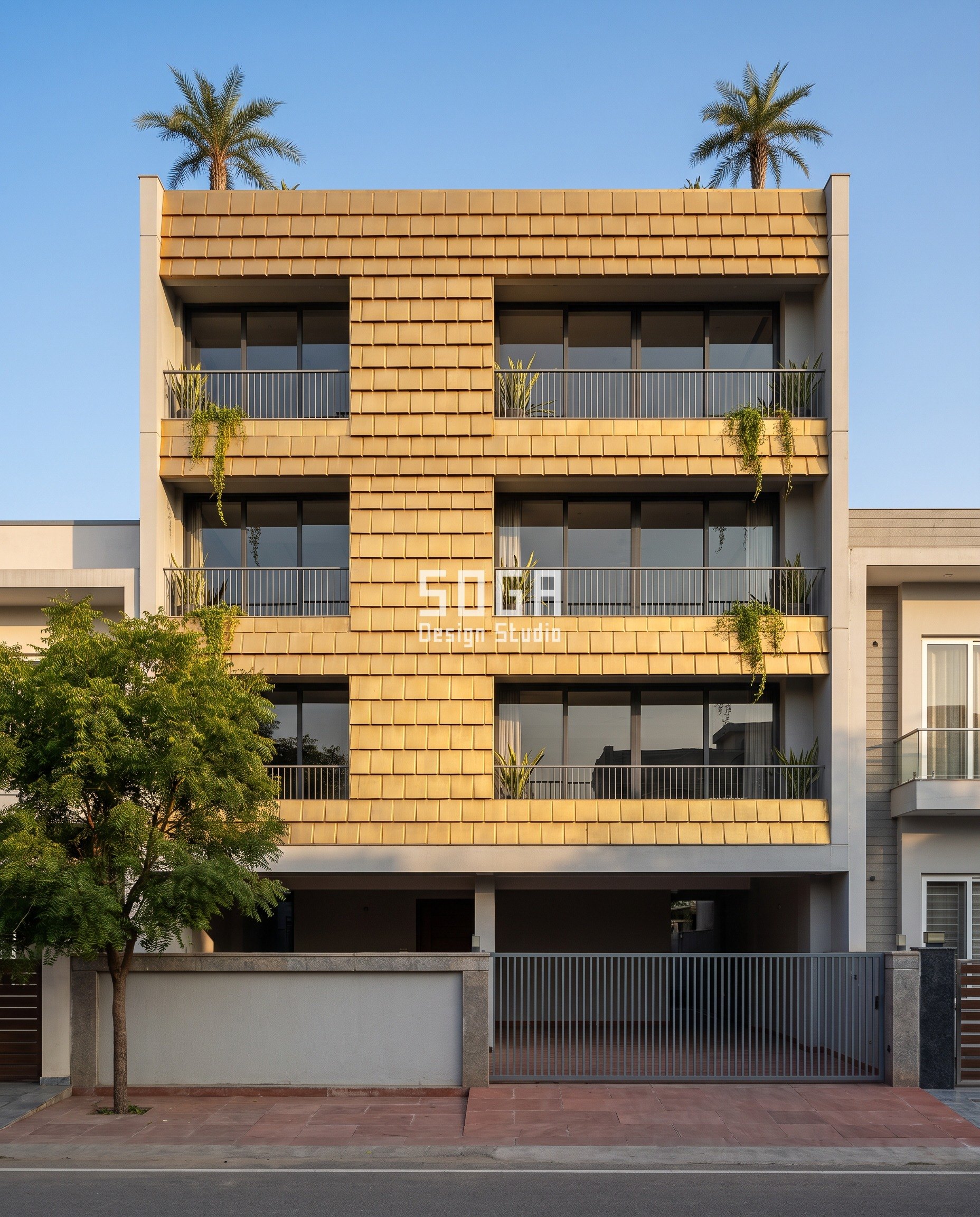
Parametric Cant Scale varies the cant angle of a 400 x 400 mm, 1.5 mm CuAl5Zn5 pressed shingle on a G+4 in Hisar: 6 / 13 / 20 / 27 / 34 degrees, first course to parapet. A free lapped edge lying flat in the flow is what flutters; cant lifts it and pins the separation point on the shingle’s own arris. On a 100 mm lap the leading arris stands 10.5 / 22.5 / 34.2 / 45.4 / 55.9 mm clear, against a 15 mm threshold. It answers edge flutter.
| Specification | SOGA Parametric Cant Scale |
|---|---|
| Product | 1.5 mm CuAl5Zn5 copper alloy, mill-bright non-patinating, 400 x 400 mm pressed shingle |
| What varies | Cant angle, 6 / 13 / 20 / 27 / 34 degrees |
| Indicative rate | Rs 2,100–3,100 per sq ft, supply and fix |
SOGA Parametric Jut Box
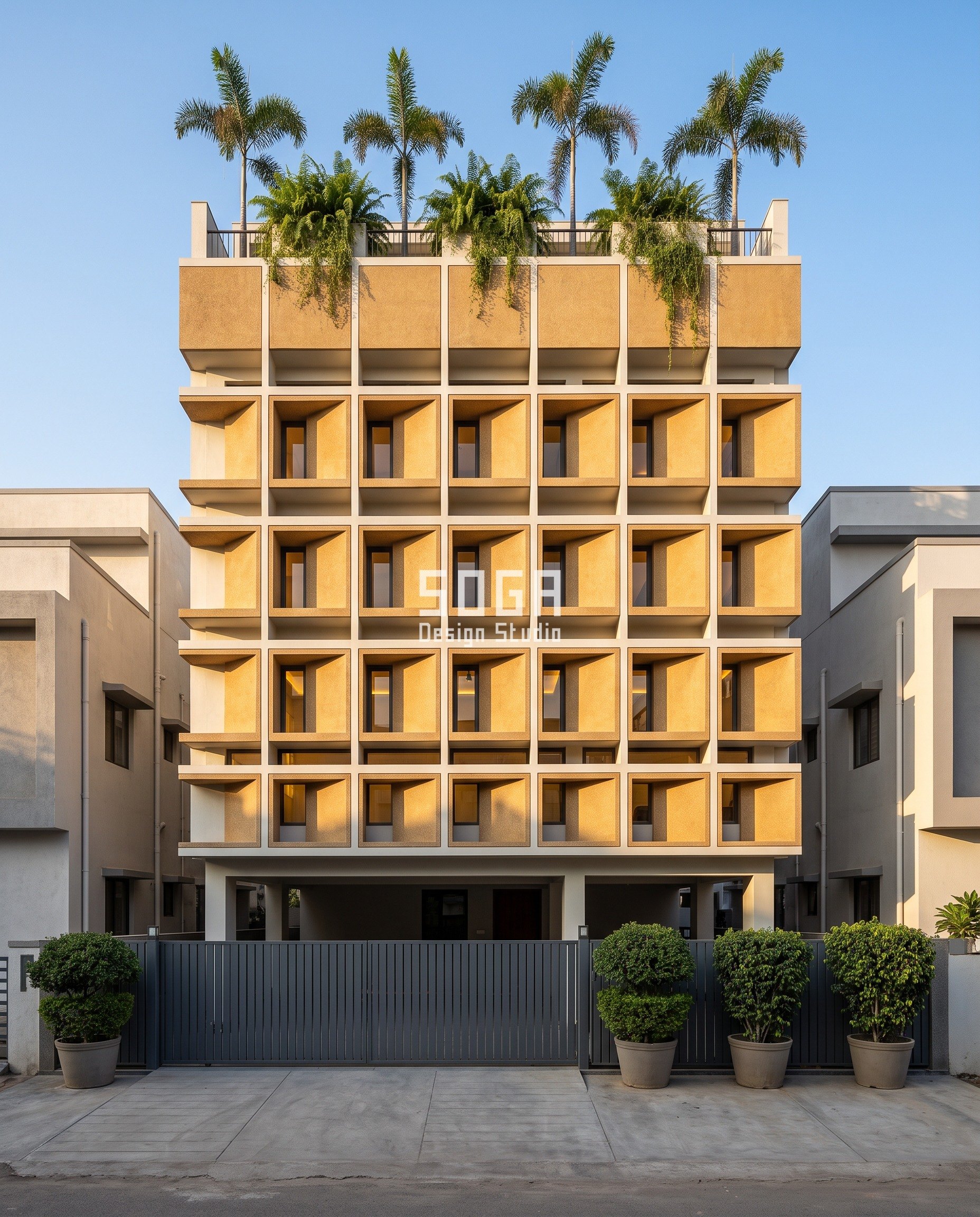
Parametric Jut Box varies how far an exposed-aggregate precast shell projects from the plane of a G+3 in Bharuch: 60 / 140 / 250 / 370 / 500 mm. Precast is heavy and stiff, so it does not drum. What it changes is wind load bay by bay, and it crosses the tonal floor on the way: at 15 m/s the five shed at 50 / 21 / 12 / 8 / 6 Hz, so the whistle disappears between the second and third rung. It answers per-bay buffeting load.
| Specification | SOGA Parametric Jut Box |
|---|---|
| Product | 60 mm exposed-aggregate architectural precast shell on an HDG MS subframe |
| What varies | Box projection, 60 / 140 / 250 / 370 / 500 mm |
| Indicative rate | Rs 750–1,200 per sq ft, supply and fix |
SOGA Parametric Pivot Blade

Parametric Pivot Blade varies the set angle of a 10 mm compact grade laminate blade, 300 mm deep, on a G+3 boutique showroom in Hosur: 0 / 22 / 45 / 68 / 90 degrees. This one is silenced by turning, not by thickening. Edge-on the wind sees 25 mm and the blade sheds at 120 Hz at 15 m/s, a clear tone; turned until the flow sees the 300 mm dimension it sheds at 10 Hz. It answers the aeolian whistle.
| Specification | SOGA Parametric Pivot Blade |
|---|---|
| Product | 10 mm compact grade laminate blade, 300 mm deep, extruded aluminium carrier |
| What varies | Blade angle, 0 / 22 / 45 / 68 / 90 degrees |
| Indicative rate | Rs 800–1,300 per sq ft, supply and fix |
SOGA Parametric Cross Boss
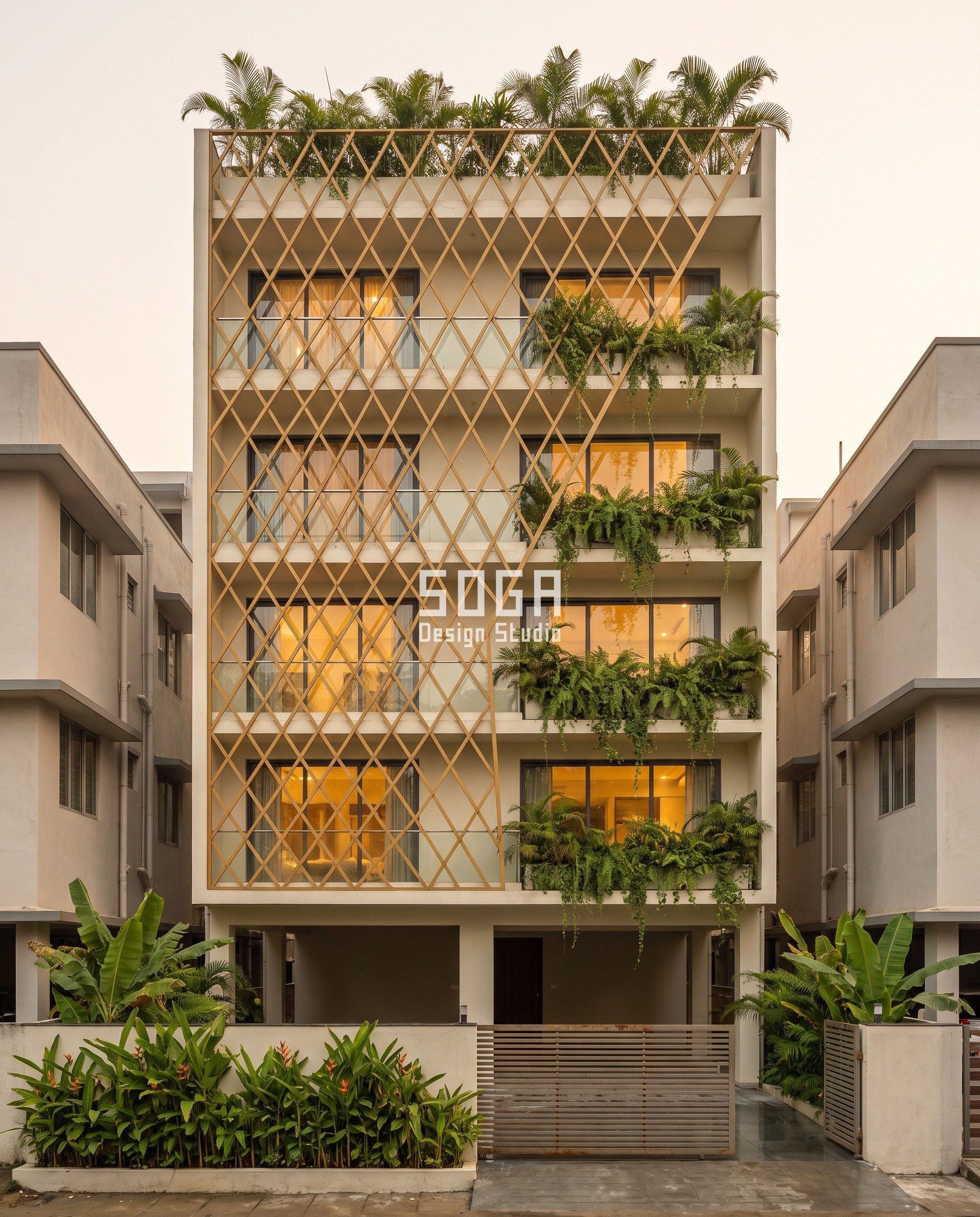
Parametric Cross Boss varies the standoff at which two 60 x 25 mm HDG flat bars cross in a diamond lattice on a G+4 in Silchar: 30 / 65 / 110 / 165 / 230 mm. The standoff is what lets the diagonal move. At 30 mm the node is over-constrained, and a 900 mm diagonal growing 0.8 mm across a Silchar day releases it as a crack at sunset. At 230 mm it has room. It answers thermal tick — the noise that is not wind.
| Specification | SOGA Parametric Cross Boss |
|---|---|
| Product | 60 x 25 mm HDG MS flat bar, super-durable polyester powder coat, on aluminium T-rail |
| What varies | Crossing standoff, 30 / 65 / 110 / 165 / 230 mm |
| Indicative rate | Rs 620–980 per sq ft, supply and fix |
How Is A Silent Elevation Panel Actually Fixed?
On one bracket, held identical across all five. A 6 mm hot-dip galvanised mild-steel L-bracket, 100 x 100 x 150 mm long, at 1200 x 900 mm centres, through-fixed to the RCC slab edge with two M10 A4 stainless anchors, carrying a 3.0 m extruded aluminium T-rail. Every system clips to that same rail on M8 A4 stainless fasteners. Five different sections, one substructure — the only way five quantities can be compared honestly.
| Design parameter | Specification |
|---|---|
| Opening and grid | 1200 x 900 mm opening on a 1240 x 940 mm grid, 40 mm shadow gap |
| Bracket and anchors | 6 mm HDG MS L-bracket 100 x 100 x 150 mm at 1200 x 900 centres, two M10 A4 anchors |
| Carrier | 3.0 m extruded aluminium T-rail, one fixed pin per rail at mid-length |
| Sliding fixings | M8 A4 shank through a 12 x 9 mm slot — ±2.0 mm travel, ±1.38 mm needed |
| Isolation | EPDM washer under every head, 3 mm nylon sleeve in every slot |
| Free edges in the flow | 90-degree press-brake break, 25 mm minimum, never a rolled hem |
| Hollow member ends | Capped — an open 60 x 25 section is an organ pipe with a wind supply |
The three details that decide whether it stays quiet
- One fixed pin per 3.0 m rail at mid-length; every other fastener an M8 A4 shank through a 12 x 9 mm slot, ±2.0 mm of travel against the ±1.38 mm the rail needs. An EPDM washer under every head and a 3 mm nylon sleeve in every slot, so no node is dry metal on metal. That sleeve is the thermal break at the bracket, and it is why a slot that slips does it silently.
- Every free edge facing the flow gets a 90-degree press-brake break, 25 mm minimum, never a rolled hem. A sharp arris fixes the separation point on the line you drew it; a hem lets it wander along the radius and turns a steady tone into a warble worse than the tone. Cap every hollow member end for the same reason.
- Never run forty identical members at identical spacing down one line. A uniform array locks every member’s shedding to one frequency and they add. All five ladders vary their quantity course by course, and that variation alone spreads the shedding across a band.
The Honest Limit
Depth kills the tone. It does not kill the rush. Above roughly 20 m/s every one of these five produces a soft continuous broadband hiss as air moves through the 40 mm shadow gaps and the open rainscreen joints, and no section depth removes it. The only cure is closing the joints, which would end the rainscreen and put water in the wall. We do not close them, and we say so before the contract rather than after. The second limit matters more, and it is the formula itself. St = 0.2 is a round-member value; a square-edged fold typically runs 0.12 to 0.15, which puts the real frequency lower than our table and the real required depth smaller. Our numbers therefore sit on the safe side of an estimate, not on a prediction, and we publish them as an order-of-magnitude screen. If a facade is already singing and the owner needs a figure someone can be held to, that is a measurement, not a calculation, and no page on the internet — this one included — can do it for them.
What A Quiet Elevation Panel Costs In India (2026)
Indicative August 2026 Indian rates, supply and fix. The row that matters is the acoustic delta: what the section itself costs over the same panel built flat — extra sheet, extra press-brake hits, deeper bracket. That is the price of the silence, separated out. All five are concept systems, not built work.
| System / material | Indicative rate (per sq ft) |
|---|---|
| Parametric Return Rim — 3 mm 5052-H32 folded aluminium cassette, 70% PVDF (Bhilai) | Rs 900–1,400 per sq ft |
| Parametric Cant Scale — 1.5 mm CuAl5Zn5 pressed shingle, mill-bright (Hisar) | Rs 2,100–3,100 per sq ft |
| Parametric Jut Box — 60 mm exposed-aggregate architectural precast shell (Bharuch) | Rs 750–1,200 per sq ft |
| Parametric Pivot Blade — 10 mm compact grade laminate blade, 300 mm deep (Hosur) | Rs 800–1,300 per sq ft |
| Parametric Cross Boss — 60 x 25 mm HDG MS flat bar lattice, powder coated (Silchar) | Rs 620–980 per sq ft |
| The acoustic delta — the section over the same panel built flat | Rs 90–260 per sq ft |
| Shared substructure — HDG L-bracket, aluminium T-rail, A4 fixings, EPDM and nylon | Rs 180–300 per sq ft |
What Should You Do If The Elevation Is Already Making Noise?
Measure before you re-clad. Work down this list in order, because the cheapest causes are also the most common.
The order to check it in
- When does it happen? Sunrise and sunset on a still evening is thermal tick. The fix is a 12 x 9 mm slot and a 3 mm nylon sleeve at one node, not a new facade.
- Fixings and gaskets first. A loose fastener or a perished EPDM washer is a half-day job and accounts for most complaints on a facade over five years old.
- Note the wind speed it starts at. A tone only in a narrow band around 12 to 15 m/s is vortex shedding, and the depth at fault back-calculates from the pitch: D = 0.2 x U / f.
- Look for a repeated array. Forty identical louvres at identical spacing is the highest-risk condition there is; breaking the spacing detunes them against each other.
- If the panel is perforated, check free area ratio and hole pitch. A uniform perforation at a single pitch is a tuned array, and randomising the pitch costs nothing at the CNC.
Related Reading
- Parametric facade design in India
- Parametric facade systems and what is buildable in India
- Reducing road noise coming into a house facade
- Facade panel wind load for a house in India
- Why a folded section beats an ACP sheet
- How deep a facade projection should be
- Parametric vertical fin systems, in full
Frequently Asked Questions
Why do elevation panels make noise in wind if they passed the wind-load check?
Because they measure different things. IS 875 (Part 3):2015 sizes the panel against a three-second gust of 33 to 55 m/s and contains no frequency at all, while tonal complaints arrive at everyday speeds of 5 to 20 m/s. A flat 3 mm sheet on 900 mm spans has a first mode of 8.6 Hz: it passes every load case and drums in every squall.
What does it cost to make an elevation panel quiet in India?
The acoustic delta — the section over the same panel built flat — runs Rs 90 to 260 per sq ft. Complete systems run Rs 620 to 3,100 per sq ft supply and fix depending on material, with shared substructure at Rs 180 to 300 per sq ft.
My elevation cracks at sunset with no wind at all. Is that wind noise?
No. That is thermal tick, a fixing problem rather than a facade problem. Aluminium moves 0.023 mm per metre per degree, so a 3.0 m rail through a 40 °C swing grows 2.76 mm; if the slot cannot absorb ±1.38 mm at each end the joint releases it in one crack. A 12 x 9 mm slot and a 3 mm nylon sleeve end it.
Will an open rainscreen elevation be noisier in the monsoon?
It will hiss, not sing. Above roughly 20 m/s air moving through the 40 mm shadow gaps produces a soft broadband rush that no section depth removes. Closing the joints would stop it and would also put water into the wall, so we leave them open and say so in advance.
Can a noisy facade be fixed without re-cladding it?
Usually. Check fixings and gaskets first — a loose fastener or perished EPDM washer is a half-day job. If it is a genuine tone, adding a 25 mm stiffener rib or a 45 mm return to the existing sheet lifts the first mode from 8.6 Hz to about 75 Hz: a workshop operation on the panels, not a new elevation.
Get The Section Right Before It Is Fabricated
SOGA Design Studio designs parametric and metal facades across India, and this acoustic screen runs on every elevation we draw — before the press brake is booked, not after the owner phones. Send us the elevation, the bay size and the town, and we will tell you which of the four noises it will make and what depth ends it.