Every facade enquiry that reaches SOGA Design Studio arrives with a picture attached, and almost every picture is chosen for the same reason: the elevation has depth. Deep shadow reads as expensive, and it is — but not for the reason most clients assume. The cost is rarely in the metal. It is in what depth drags along behind it: a bigger bracket, a heavier load path back to the slab, a projection your municipal sanction may or may not allow, and a cleaning method that decides what the building looks like in year seven. Here are four residential concepts from Gurugram, Ahmedabad, Nagpur and Chennai, each built on a different depth band — from a 60mm fold made entirely in the press brake to a 1400mm ring standing a full metre off the structure — and what each depth actually buys.
Facade Design in India: Why Gurugram Is Choosing Parametric Metal
Facade design in India has moved from an afterthought to the single most important decision on a residential project. Today, demand for parametric facade design in India is rising fastest in cities such as Gurugram, Mumbai, Bangalore, Delhi, and Pune, where homeowners and developers want elevations that are both performance-driven and instantly recognisable. SOGA Design Studio specialises in facade design in India — from G+3 individual homes to G+7 residential blocks — pairing algorithmic geometry with matte warm amber gold anodised alumini and fabrication-ready detailing. Whether you are comparing metal facade design in India for a new build or a retrofit, the concepts below show how a considered facade redefines a building’s identity and its long-term value.
Depth follows from spacing, but spacing follows from the sun angle, and that angle is set by where the building stands. For the latitude condition behind every depth on this page, see how latitude sets the depth across five Indian cities.
1. Gurugram: When Depth Is Habitable — Curved Soffits at 150–420mm
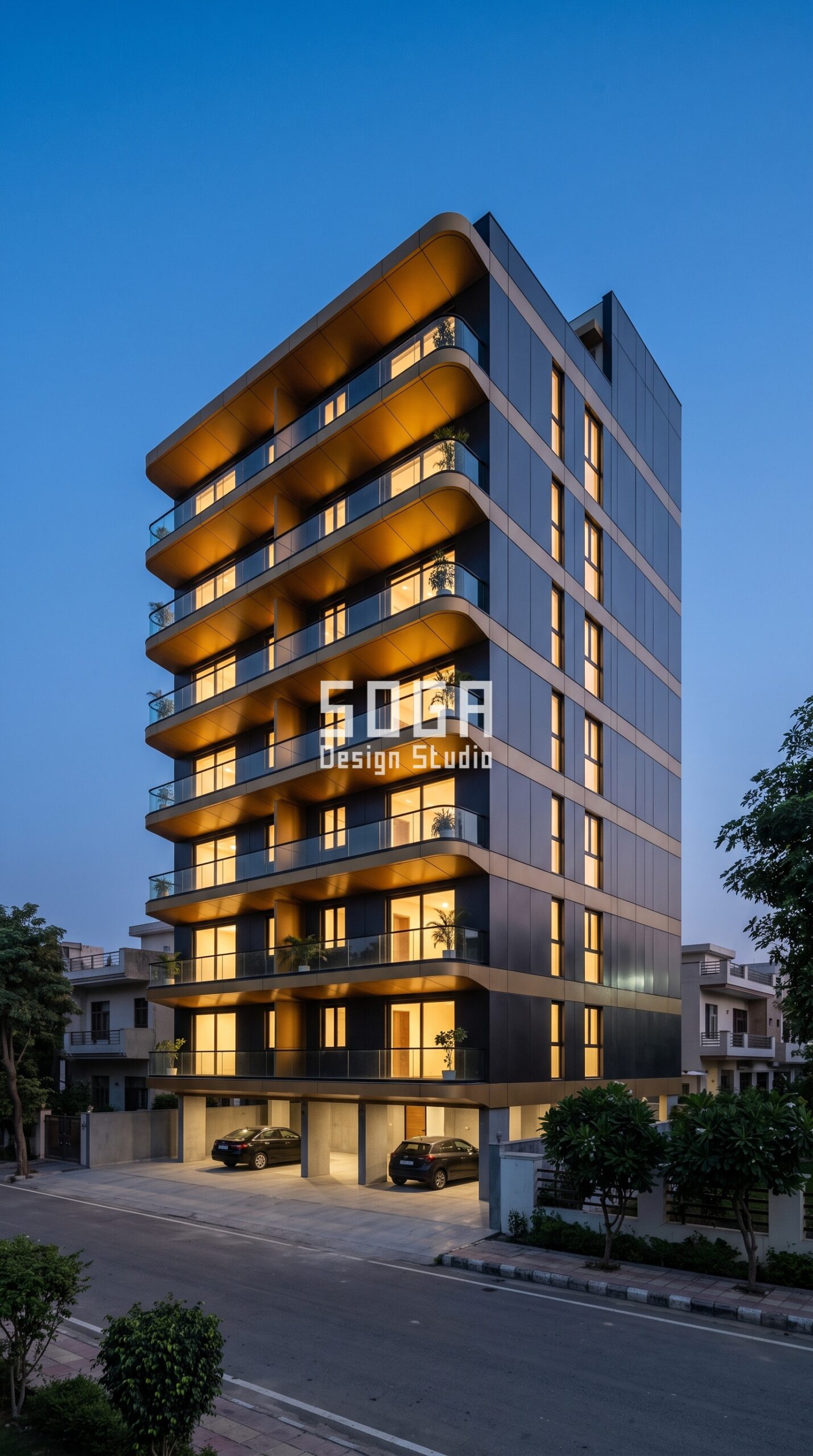
The Gurugram concept, a Parametric Crest Shell on a G+8 block in Sector 21, puts its depth where the client can stand in it. Warm amber gold anodised aluminium wraps the underside of each cantilevered balcony, and the soffit curve grows from 150mm at the lower floors to 420mm near the roofline, so the building reads heavier at the top where the sky is brightest behind it. This is the most valuable kind of facade depth because it is not decoration — it is floor area you can occupy, and in most Indian municipal frameworks a balcony is assessed differently from a purely ornamental projection. It is also the most demanding structurally: the soffit is carried on the balcony slab itself, which means the depth has to be agreed with the structural consultant before the elevation is frozen, not after. The lesson from this concept is that if you are going to spend money pushing a facade outward, push it outward where somebody can put a chair.
2. Ahmedabad: Depth as a Standoff Screen — Rings at 900–1400mm
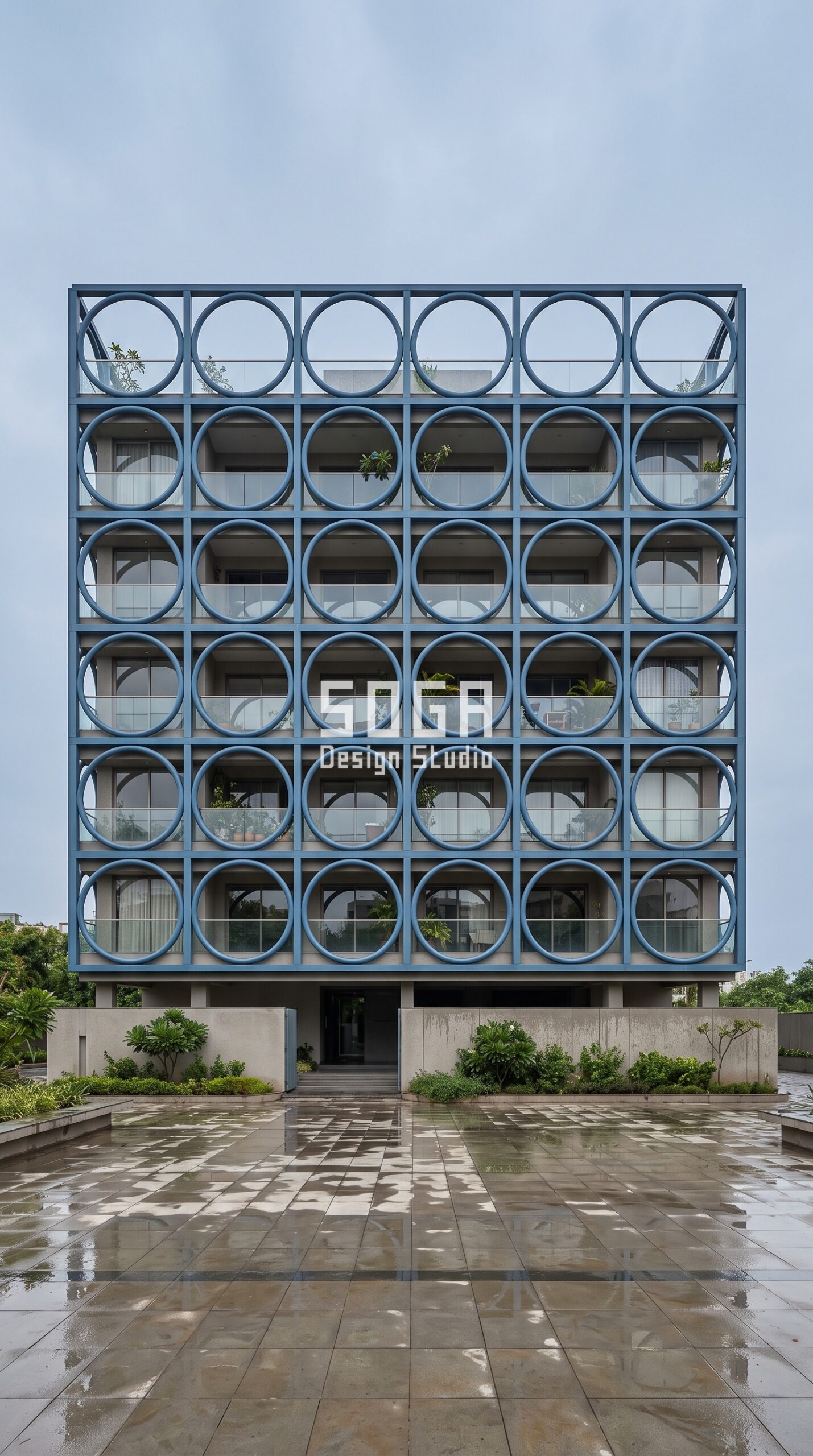
Ahmedabad’s Parametric Ring Weave is the opposite bet. On this G+6 building in Bodakdev, slate ocean blue bent-steel-tube rings sit one per structural bay, standing well clear of the glass line, with ring diameters growing from 900mm to 1400mm up the elevation while the bay grid stays perfectly regular. Nothing here is habitable — the depth exists purely to put a metre of shade and privacy in front of the balconies, which is exactly what Ahmedabad’s summer asks for. That distance is bought with secondary steel: brackets off the slab edge, a load path for wind uplift on a large-diameter tube, and a corrosion specification that has to survive monsoon humidity at every fixing point. A standoff screen is the most visually powerful depth available and the least forgiving of a vague drawing, because the entire system hangs on the accuracy of the bracket layout.
3. Nagpur: The Cheapest Depth in India — Folds at 60–240mm
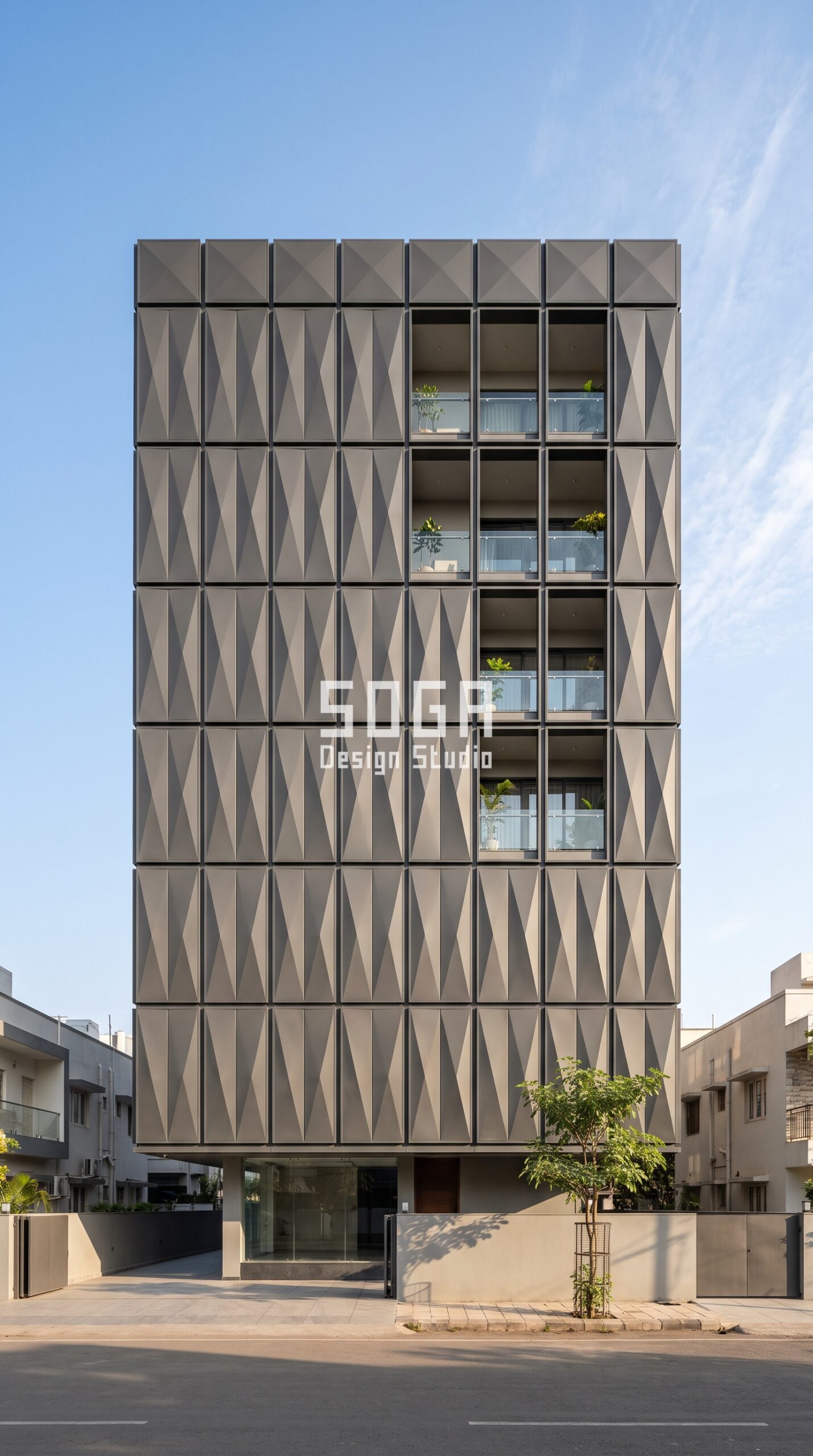
The Nagpur concept is the one worth studying if the budget is tight. This G+7 in Dharampeth wears a Parametric Prism Grid: flat RAL 7022 umbra grey steel panels, each folded on a press brake so that the fold depth grows from 60mm to 240mm across the sun-facing elevation while the module grid stays perfectly regular. Every millimetre of that relief is created in the fabrication shop by bending a sheet, not by standing anything off the wall. There is no secondary steel, no extra bracket, no projection beyond the building line worth arguing about at sanction stage, and the panel still fixes back on the same rail a flat panel would use. The shadow it throws in Nagpur’s hard morning light is deep enough to give the building a real identity. Pound for pound this is the highest-yielding facade depth available in India in 2026, and it is the option most clients never hear about because it costs the least to install.
4. Chennai: Depth That Has to Be Cleaned — Blades at 200–480mm
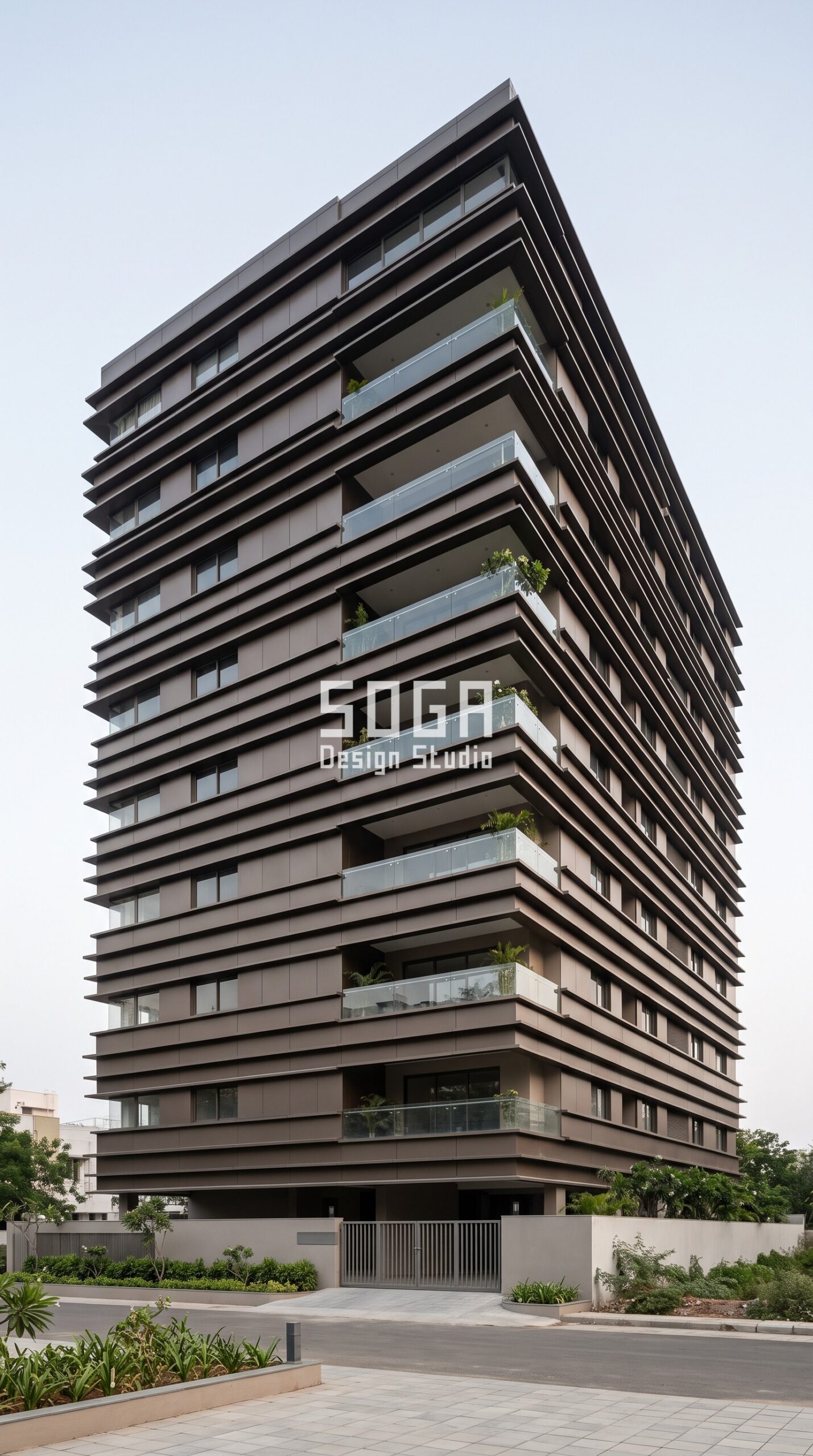
Chennai’s Parametric Ledge Screen carries its depth horizontally. On this G+8 in Thiruvanmiyur, matte dark bronze ACP blades run in straight lines at a constant 600mm pitch, with the blade projection growing from 200mm to 480mm across the elevation. Horizontal depth is the correct answer for Chennai’s high sun angle — a 480mm blade blocks midday sun far more efficiently than any vertical fin of the same size — but it is also the depth that collects. Every horizontal surface on a coastal Indian elevation gathers dust, salt and monsoon debris, so this system has to be specified alongside its cleaning strategy: a top face that sheds water, a coating grade chosen for salt exposure rather than colour, and honest access for a cradle or a pole system. Choose horizontal depth for performance, then budget for the fact that you have just created eighty ledges.
Cost Benchmarks for Indian Parametric Metal Facades
One of the most-asked questions on a Gurugram project brief is budget. The current all-in installed rates for parametric metal facades in India sit in the following ranges:
- Steel facade (full design + install): ₹1,200–₹2,800 per sq ft
- Aluminium, anodised or powder-coated: ₹800–₹2,500 per sq ft
- Zinc cladding: ₹1,500–₹3,000 per sq ft
- ACM panels (3 mm basic): ₹200–₹250 per sq ft (basic)
- ACM panels (4 mm): ₹250–₹350 per sq ft
- Solid aluminium panels: ₹800–₹1,800 per sq ft
- Installation labour: ₹50–₹150 per sq ft (varies by height + access)
- Conventional cladding (for comparison): ₹400–₹1,200 per sq ft installed (stone veneer / ceramic / standard ACM)
These figures are baseline; actual project cost depends on facade area, panel complexity, fabricator location, and finish specification. SOGA Design Studio prepares an itemised cost estimate as part of every consultation so the budget conversation starts with hard numbers rather than guesses. These city-by-city depths also fall on a broader pattern: the fixing-class threshold behind these depth numbers.
Parametric Facade Design Across India, Dubai & Singapore
Climate is the unspoken brief on every Indian project. Gurugram, with its specific solar geometry and humidity profile, demands facades that perform — not just facades that look striking. At SOGA Design Studio, every parametric concept is run through climate analysis early: solar radiation per orientation, wind exposure, and monsoon water-shedding paths all feed back into panel angle and perforation density. The concepts you see above already incorporate this layer of analysis for Gurugram’s sun path; adapting them for Mumbai’s rain, Delhi’s dust, or Bangalore’s milder conditions is part of the standard scope.
Why Trust SOGA Design Studio for Facade Design in Gurugram
- Experience: SOGA Design Studio details residential metal facades for Indian sites from G+3 individual homes to G+8 residential blocks, and takes each elevation through to fabrication-ready shop drawings rather than stopping at a rendering.
- Expertise: Every concept in this post is modelled parametrically, with the varying parameter — soffit curve, ring diameter, fold depth, blade projection — held inside a stated numeric range on a regular structural grid, so the panel schedule stays manufacturable.
- Authority: The studio works across Indian metros and for NRI clients in Dubai, Singapore and the UK, specifying anodised aluminium, powder-coated steel and ACP systems against Indian climate and access conditions.
- Trust: The concepts shown here are design visualisations created for this article, not photographs of completed projects, and the cost bands quoted are 2026 Indian market ranges that vary with height, access and finish grade.
Frequently Asked Questions
How much can a facade project beyond the building line in India?
Permissible projection is set by your local development control rules, not by a national figure, and it varies by city, road width and setback. Ornamental facade elements are usually treated more leniently than habitable balconies, which are counted against your setback and sometimes against FAR. The practical rule: keep purely decorative relief modest — the 60–240mm fold band used in the Nagpur concept sits comfortably inside almost every Indian bylaw — and get any projection over roughly 600mm, or anything you can stand on, confirmed with your local authority before the elevation is frozen. The same limits govern changing the elevation after the slab is cast, where the frame can no longer be altered to suit the depth you want.
Does a deeper facade need extra structural support?
It depends entirely on how the depth is made. Depth folded into the panel itself, as in the Nagpur press-braked system, adds almost no load and fixes back on the same rail a flat panel uses. Depth created by standing an element off the building, as with Ahmedabad’s 900–1400mm rings, needs secondary steel, brackets designed for wind uplift, and a load path back to the slab edge — which is where the real cost of a deep facade lives.
How much does a parametric metal facade cost in India in 2026?
As an installed range in 2026: ACP panels run roughly ₹200–₹250 per sq ft for 3mm and ₹250–₹350 per sq ft for 4mm, solid aluminium panels ₹800–₹1,800 per sq ft, anodised or powder-coated aluminium systems ₹800–₹2,500 per sq ft, and steel facade systems ₹1,200–₹2,800 per sq ft, with installation labour adding ₹50–₹150 per sq ft depending on height and access. Depth is what moves you up these bands — a folded panel stays near the bottom of its range, a standoff screen sits near the top.
Which facade depth gives the most shade for the money?
Horizontal blades, provided your sun is high. The Chennai concept’s 200–480mm blades at 600mm pitch cut midday sun far more efficiently per rupee than a vertical fin of the same projection, because at low latitudes the sun spends most of the working day overhead. Vertical depth earns its keep on east and west elevations where the sun is low and side-on. Match the direction of the depth to the direction the sun actually comes from before comparing prices.
Does a deep facade make cleaning and maintenance harder?
Yes, and it is the cost most often forgotten. Every horizontal surface you create is a ledge that collects dust, and on coastal sites such as Chennai it also collects salt. Budget for an access method at design stage — cradle, pole system or walkway — and specify the coating grade for the exposure rather than for the colour. A facade that cannot be reached is a facade that ages badly by year seven, whatever it cost to build.
Can a deep parametric facade be retrofitted onto an existing building?
Often yes, but the depth has to be chosen around what the existing structure can carry. Folded-panel systems in the 60–240mm band are the usual retrofit answer because they add minimal dead load and can fix to a light rail system over the existing wall. Standoff screens of the Ahmedabad type need a structural survey first — the slab edge has to be checked for the bracket loads before anything is promised to the client.
Can NRIs design and build a parametric facade in India remotely?
Yes. SOGA Design Studio runs end-to-end remote consultations for NRI clients in Dubai, Singapore, the UK, and the US. The workflow — site analysis, design development, client review, fabrication-ready drawings, and on-site supervision — is delivered virtually. NRI projects in tier-2 cities like Coimbatore, Indore, and Chandigarh make up a fast-growing share of our portfolio.
How long does a powder-coated metal facade last in Indian conditions?
Quality powder-coated aluminium or galvanised steel facades, when correctly detailed and ventilated, last 25–30 years before recoating is needed — even in coastal Mumbai, Chennai, and Kochi. Anodised aluminium and pre-patinated zinc/copper can exceed 40 years. Maintenance is annual rinse-down only; no repainting like traditional plaster facades.
Why is parametric architecture suited to the Indian climate?
India’s combination of intense sun, monsoon humidity, and dense urban context demands a ‘smart skin’ rather than a static wall. Parametric facades let designers tune perforation density, panel depth, and orientation per building per orientation — cutting solar heat gain by 25–40% while boosting cross-ventilation. The approach also reinterprets centuries-old metal shadow screening for modern G+3 and G+4 buildings.
How much heat does a parametric metal facade actually reduce?
Independent studies on Indian residential applications show double-skin parametric metal screen facades reduce direct solar heat gain by 25-40% on west and south orientations, dropping interior surface temperatures by 4-7 deg C compared to bare RCC. The shaded gap also enables passive cross-ventilation. SOGA Design Studio tunes the screen opening density based on each orientation solar load.
How is AI changing facade design in India in 2026?
AI is now a routine input at the concept stage: generative tools propose dozens of parametric variations from a single brief, and computational performance simulators predict heat gain, daylight, and material cost before any drawing is finalised. SOGA Design Studio uses AI-assisted visualisation to accelerate the concept phase from 4 weeks to 4 days, while the engineering and fabrication detailing remain human-led.
What is the typical timeline from design to installed parametric facade?
For a G+3 to G+4 residence: 3 weeks for concept and approval, 4 weeks for fabrication-ready drawings, 6–8 weeks for fabrication, and 3–5 weeks for site installation — total 16–20 weeks from go-ahead to occupancy. Retrofit projects on existing buildings compress this to 10–14 weeks because no structural coordination is needed.
How much does a parametric metal facade cost per square foot in Indore?
Currently, all-in parametric metal facade rates in India range from ₹800–₹2,500 per sq ft for aluminium and ₹1,200–₹2,800 per sq ft for steel, installed. SOGA Design Studio prepares itemised estimates as part of the consultation.
What is a sculptural petal-shaped metal fin facade?
SOGA Design Studio addresses this question in detail during the design consultation. For Gurugram projects, we provide a fully customised answer based on plot, orientation, and budget — typically within 48 hours of receiving the brief.
Related Reading
- Parametric facade design in India: systems, costs and what’s buildable
- 3D parametric facade panels: design and cost in India
- ACP vs glass vs stone vs metal: choosing a facade material
- Facade design in Gurugram: timeline and cost guide
- Facade colour design: choosing a metal finish that lasts
- How to Choose a Parametric Architecture Studio in India: 7 Questions Every Client Should Ask
- Top 10 Digital Tools Every Parametric Design Student Should Master in 2025
Start Your Facade Project With SOGA Design Studio
Depth is the most expensive word in a facade brief. Decide early whether you are buying habitable depth, shading depth or shadow depth — because only one of the three is made in the press brake, and that is the one that costs the least.
If any of the generously cantilevered balconies w concepts above resonate with your project, send us your brief. SOGA Design Studio delivers customised parametric facade concepts for India, Dubai, Singapore, and the UK.
How much of that projection ends up pointing at the sky is a separate decision, set out in our note on dust proof facade design in India.
On a balcony the same projection question has a second answer, because there is a floor to keep dry — see how deep a balcony band has to be to keep the floor dry.